


 |
市場調查報告書
商品編碼
2113833
亞太地區豬飼料預混合料:市佔率分析、產業趨勢與統計及成長預測(2026-2031)Asia-Pacific Swine Feed Premix - Market Share Analysis, Industry Trends & Statistics, Growth Forecasts (2026 - 2031) |
||||||

※ 本網頁內容可能與最新版本有所差異。詳細情況請與我們聯繫。
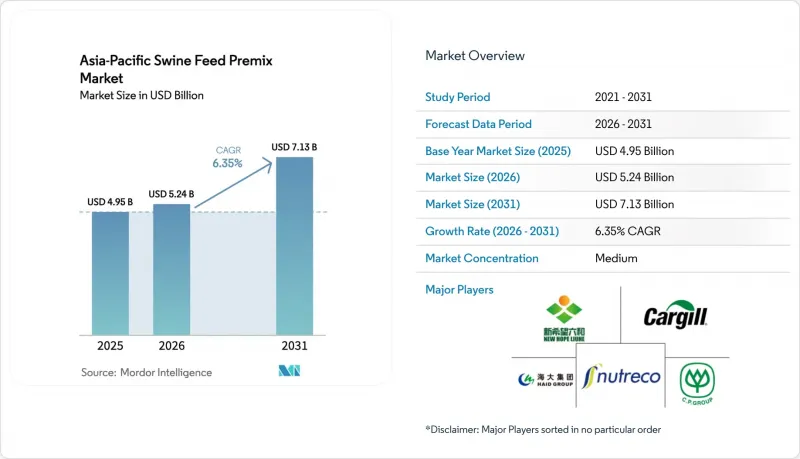
根據 Mordor Intelligence 預測,亞太地區豬飼料預混合料市場規模將從 2025 年的 49.5 億美元和 2026 年的 52.4 億美元成長到 2031 年的 71.3 億美元,2026 年至 2031 年的複合年成長率為 6.35%。
本報告按產品類型(維生素、胺基酸及其他)、劑型(乾粉、液體)、功能(促進生長、增強免疫力及其他)、原料來源(天然、合成)、購買者類型(商業一體化企業、合作飼料廠及其他)、分銷管道(直銷及其他)和地區(中國、印度及其他)進行分類。市場預測以美元計價。
亞太地區豬飼料預混合料市場趨勢與洞察
由於生物安全措施,非洲豬瘟 (ASF) 導致增強型預混合料的需求增加。
非洲豬瘟(AFS)對中國養豬業造成了毀滅性打擊,導致母豬存欄量下降,並迫使養殖業轉向工業化的生物安全標準。目前,綜合養豬戶正在提高飼料配方中維生素A、D、E、鋅和硒的比例,以增強高密度養殖場的豬群免疫力。到2025年,越南同奈省和隆安省的豬群重組將推動高蛋白預混合料和特殊飼料的需求,預計複合飼料產量將達到2,212萬噸。在菲律賓,受非洲豬瘟影響地區的養殖場在2024年就必須立即進行營養強化,導致需求激增。東南亞畜牧系統的現代化預計將推動亞太地區豬飼料市場的成長,其中,在對生物安全和飼料轉換率的重視下,特種預混合料和添加劑預計將在2028年之前引領市場。
政府對無抗生素豬肉的監管正在加速功能性食品添加劑的普及。
中國自2020年7月起禁止在飼料中使用抗生素生長促進劑,促使酵素製劑、益生菌和有機酸的使用量增加。因此,大型綜合畜牧企業的飼料轉換率提高了5%。越南計畫在2024年於重點畜牧部門實施試驗計畫後,於2026年全面禁止使用抗生素生長促進劑,這將推動市場對酵素製劑和益生菌的需求,以取代粘菌素和桿菌肽鋅。泰國的出口型養豬場必須獲得良好生產規範(GMP+)認證,該認證禁止使用抗生素生長促進劑,從而增加了對天然來源生長促進預混合料的需求。雖然監管合規導致2024年至2025年間飼料配製成本增加了8-10%,但綜合養豬戶透過提高營養物質的消化率恢復了盈利。隨著中國和東南亞的生產商更加關注腸道健康的營養補充劑,向無抗生素飼料的轉變預計將重振亞太地區的豬飼料預混合料市場。
維生素A和維生素E的價格波動給製劑公司的利潤率帶來了壓力。
2024年7月,BASF公司位於路德維希港的工廠發生火災,導致全球大部分維生素A前驅產能停產,到年底維生素A價格加倍以上。直到2025年4月工廠復工後,供應水準才恢復正常。同時,浙江醫藥集團紹興廠因環保維修暫時關閉,導致維生素E價格上漲38%。到2025年底,中國豬肉價格跌至多年來的最低水準(低於每公斤11元人民幣),嚴重影響了利潤率。豬飼料預混合料生產商與供應商進行談判,將維生素價格下調了高達50%,並將添加劑採購推遲到2026年。同樣,印度買家也推遲了訂單,以緩解原物料價格波動的影響。隨著生豬生產週期恢復正常,預計2027年初,全球添加劑價格將完全穩定下來。
細分市場分析
至2025年,維生素將佔亞太地區豬飼料預混合料市場34%的佔有率。這主要歸因於監管部門強制要求使用脂溶性維生素以確保豬隻的最佳生長和繁殖能力。同時,預計到2031年,酵素製劑的複合年成長率將達到8.9%,成為所有產品類型中成長最快的,因為植酸酶和木聚醣酶的混合物可以恢復抗生素禁用後損失的飼料轉換率。胺基酸和礦物質合計佔據了大部分需求,並且仍然是瘦肉組織積累和免疫支持所必需的。抗生素的市佔率有限,在中國和越南僅限於複方製劑。
鑑於礦物質的天然特性,預計隨著酵素製劑的成長,礦物質市場也將進一步擴張。供應商正以單劑量小袋包裝銷售酵素製劑和益生菌,以方便操作並適應精準計量系統。中國的衛生標準「GB 13078」延長了新活性成分的核准週期,這使得擁有先進實驗室的跨國公司更具優勢。這些趨勢使得亞太地區豬飼料預混合料市場保持高度的競爭性和創新性。
截至2025年,乾粉預混合料佔亞太地區豬飼料預混合料市場的71.5%。這主要是由於大量合作社和家庭式農場依賴傳統的間歇式攪拌機。相較之下,預計到2031年,液體產品的複合年成長率將達到7.6%。這主要得益於自動化配料系統的優勢,該系統可減少15-20%的人工成本,並將配料精度提高到1%以內。液體配方在亞太地區豬飼料預混合料市場正經歷快速成長。這主要得益於日本和韓國一體化企業(整合商)的廣泛應用,這些企業由於需要降低人事費用,主導了液體配方的普及。
在印度和印尼,液態飼料添加劑的普及也在加速。在這些國家,液態飼料添加劑的售價在5萬至8萬美元之間,並且需要溫控儲存設施。租賃模式的出現旨在降低資金籌措門檻。供應商也正在使用濃縮液體添加劑,這可以減少高達40%的運輸重量,並降低收貨成本。隨著薪資成長的普遍性,預計液態產品在亞太地區整個豬飼料預混合料產業的佔有率將會上升。
其他好處
- Excel格式的市場預測(ME)表
- 3個月的分析師支持
目錄
第1章:引言
- 研究假設和市場定義
- 調查範圍
第2章:調查方法
第3章執行摘要
第4章 市場狀況
- 市場概覽
- 市場促進因素
- 由於生物安全措施,非洲豬瘟 (ASF) 導致增強型預混合料的需求增加。
- 政府對無抗生素豬肉的監管正在加速功能性食品添加劑的普及。
- 新興中產階級豬肉消費量的增加導致商業飼料的更廣泛應用。
- 整合商擁有的巨型農場擴張計劃旨在整合預混合料採購
- 引進精準營養微量餵食系統以提高飼料轉換率。
- 數位化農場分發器可減少人工,減少分發錯誤。
- 市場限制因素
- 維生素A和維生素E的價格波動給製劑公司的利潤率帶來了壓力。
- 由於中國嚴格禁止使用抗生素生長促進劑,導致製劑成本增加。
- 厄爾尼諾現象導致糧食短缺,進而造成供應鏈中斷
- 消費者對合成添加劑的懷疑態度導致對天然衍生產品的需求轉變。
- 監理情勢
- 技術展望
- 波特五力模型
第5章 市場規模與成長預測
- 依產品類型
- 維他命
- 礦物
- 胺基酸
- 抗生素
- 酵素
- 其他種類(益生菌、精油)
- 按形式
- 乾燥
- 液體
- 按功能
- 促進生長
- 提高免疫力
- 繁殖性能
- 飼料轉換率
- 按原料來源
- 自然的
- 合成
- 按買家類型
- 商業整合商
- 合作飼料廠
- 獨立經營的家庭農場
- 透過分銷管道
- 直銷(工廠直銷)
- 第三方經銷商
- 按地區
- 中國
- 印度
- 日本
- 韓國
- 越南
- 泰國
- 菲律賓
- 印尼
- 澳洲
- 紐西蘭
- 其他亞太國家
第6章 競爭情勢
- 市場集中度
- 策略趨勢
- 市佔率分析
- 公司簡介
- Charoen Pokphand Group Co., Ltd.
- Cargill, Incorporated
- Guangdong Haid Group Co., Ltd.
- New Hope Liuhe Co., Ltd.(New Hope Group)
- SHV Holdings NV(Nutreco)
- Dsm-Firmenich AG
- BASF SE
- Archer Daniels Midland Company
- Bluestar Adisseo Company(Sinochem Holdings)
- Evonik Industries AG
- Beijing Dabeinong Technology Group Co., Ltd.
- CJ CheilJedang Corp.(CJ Corp.)
- Associated British Foods plc
- Alltech, Inc.
- Tongwei Co., Ltd.
第7章 市場機會與未來展望
According to Mordor Intelligence, the Asia-Pacific swine feed premix market size is projected to expand from USD 4.95 billion in 2025 and USD 5.24 billion in 2026, to USD 7.13 billion by 2031, registering a CAGR of 6.35% between 2026 to 2031.
This report is Segmented by Product Type (Vitamins, Amino Acids, and More), Form (Dry and Liquid), Functionality (Growth Promotion, Immunity Enhancement, and More), Ingredient Source (Natural and Synthetic), Purchaser Type (Commercial Integrators, Cooperative Feed Mills, and More), Distribution Channel (Direct and More), and Geography (India, China, and More). Market Forecasts are in Value (USD).
Asia-Pacific Swine Feed Premix Market Trends and Insights
African Swine Fever (ASF)-Driven Biosecurity Protocols Elevating Fortified Premix Demand
African Swine Fever devastated China's hog industry, cutting the sow herd and prompting a shift to industrialized biosecurity standards . Integrators now raise vitamin A, D, E, zinc, and selenium inclusion rates to strengthen immunity in densely stocked facilities. Herd rebuilding in Dong Nai and Long An drove Vietnam's demand for high-protein premix and specialized feeds in 2025, raising compound feed production to 22.12 million metric tons. The Philippines required enhanced nutrition on farms in African Swine Fever (ASF)-affected areas in 2024, triggering immediate demand spikes. The modernization of livestock systems in Southeast Asia is anticipated to drive growth in the Asia-Pacific swine feed market, with specialized premix and additive segments leading the way, driven by a focus on biosecurity and feed efficiency through 2028.
Government Mandates for Antibiotic-Free Pork Accelerating Functional Additives
China banned antibiotic growth promoters in feed from July 2020, prompting increased use of enzymes, probiotics, and organic acids that boosted feed conversion by up to 5% for leading integrators. Following 2024 pilot programs in key livestock provinces, Vietnam plans to ban growth-promoting antibiotics by 2026, boosting demand for enzyme cocktails and probiotics as alternatives to Colistin and Zinc Bacitracin. Thailand's export-oriented farms need Good Manufacturing Practice Plus certification that forbids antibiotic promoters, pushing natural growth-promoting premixes. Though compliance raised formulation costs by 8-10% in 2024-2025, integrators regained profitability through improved nutrient digestibility. The shift toward antibiotic-free feed is anticipated to boost the Asia-Pacific swine feed premix market, as producers in China and Southeast Asia focus on nutritional additives for gut health.
Volatile Vitamin A and E Prices Compressing Formulator Margins
In July 2024, a fire at BASF SE's Ludwigshafen plant disrupted a significant portion of global precursor capacity, causing vitamin A prices to more than double by the end of the year. Supply levels returned to normal only after production resumed in April 2025. Concurrently, Zhejiang Medicine temporarily closed its Shaoxing site for environmental upgrades, leading to a 38% increase in vitamin E prices. By late 2025, multi-year low hog prices in China (below ¥11/kg) severely impacted margins, prompting swine feed premix manufacturers to delay additive purchases until 2026 while negotiating price reductions of up to 50% on vitamins. Similarly, Indian buyers postponed orders to mitigate volatility in raw material prices. Global additive prices are anticipated to stabilize fully by early 2027 as swine cycles return to normal patterns.
Other drivers and restraints analyzed in the detailed report include:
- Rising Pork Consumption Among Emerging Middle Class Expanding Commercial Feed Penetration
- Digitized On-Farm Dispensers Reducing Labor Needs and Dosing Errors
- Strict Chinese Ban on Antibiotic Growth Promoters Raising Formulation Cost
For complete list of drivers and restraints, kindly check the Table Of Contents.
Segment Analysis
Vitamins secured 34% of the Asia-Pacific swine feed premix market share in 2025, as regulations mandate the use of fat-soluble vitamins for optimal growth and fertility. Enzymes, however, are projected to expand at an 8.9% CAGR through 2031, the fastest among product types, as phytase and xylanase blends recapture feed efficiency lost after antibiotic bans. Amino acids and minerals together meet a significant portion of the demand and remain indispensable for lean tissue deposition and immune support. Antibiotics accounted for a limited market share, limited to prescription therapy in China and Vietnam.
Minerals are further anticipated to follow the growth of Enzymes, owing to their natural positioning. Suppliers bundle enzymes with probiotics in single-dose sachets to ease handling and align with precision dosing systems. China's GB 13078 hygiene code lengthens approval cycles for new actives, favoring multinational firms that operate advanced labs. These dynamics keep the Asia-Pacific swine feed premix market competitive and innovation-rich.
Dry premixes occupied 71.5 % of the Asia Pacific swine feed premix market size during 2025, owing to the cooperative mills and family farms that rely on conventional batch mixers. In contrast, liquid products are forecast to post a 7.6% CAGR through 2031, benefiting from automated injection systems that reduce labor by 15-20% and tighten dosing to within 1% tolerance. The Asia-Pacific swine feed premix market for liquid formulations is experiencing rapid growth, driven by growing adoption among Japanese and South Korean integrators, who are leading rollouts, citing labor cost savings.
The adoption persists in India and Indonesia, where dispensers cost USD 50,000-80,000 per unit and require temperature-controlled storage. Leasing models are emerging to ease funding hurdles. Suppliers also use concentrated liquid additives that reduce freight weight by up to 40%, improving landed economics. As wage inflation spreads, the liquid share should rise across the Asia-Pacific swine feed premix industry.
Complete Report Scope:
- By Product Type
- Vitamins
- Minerals
- Amino Acids
- Antibiotics
- Enzymes
- Other Types (Probiotics, Essential Oils)
- By Form
- Dry
- Liquid
- By Functionality
- Growth Promotion
- Immunity Enhancement
- Reproductive Performance
- Feed Conversion Efficiency
- By Ingredient Source
- Natural
- Synthetic
- By Purchaser Type
- Commercial Integrators
- Cooperative Feed Mills
- Independent Family Farms
- By Distribution Channel
- Direct (Mill-Gate)
- Third-Party Distributors
- By Geography
- China
- India
- Japan
- South Korea
- Vietnam
- Thailand
- Philippines
- Indonesia
- Australia
- New Zealand
- Rest of Asia-Pacific
List of Companies Covered in this Report:
- Charoen Pokphand Group Co., Ltd.
- Cargill, Incorporated
- Guangdong Haid Group Co., Ltd.
- New Hope Liuhe Co., Ltd. (New Hope Group)
- SHV Holdings N.V. (Nutreco)
- Dsm-Firmenich AG
- BASF SE
- Archer Daniels Midland Company
- Bluestar Adisseo Company (Sinochem Holdings)
- Evonik Industries AG
- Beijing Dabeinong Technology Group Co., Ltd.
- CJ CheilJedang Corp. (CJ Corp.)
- Associated British Foods plc
- Alltech, Inc.
- Tongwei Co., Ltd.
Additional Benefits:
- The market estimate (ME) sheet in Excel format
- 3 months of analyst support
TABLE OF CONTENTS
1 Introduction
- 1.1 Study Assumptions and Market Definition
- 1.2 Scope of the Study
2 Research Methodology
3 Executive Summary
4 Market Landscape
- 4.1 Market Overview
- 4.2 Market Drivers
- 4.2.1 African Swine Fever (ASF)-driven biosecurity protocols elevating fortified premix demand
- 4.2.2 Government mandates for antibiotic-free pork accelerating functional additives
- 4.2.3 Rising pork consumption among emerging middle class expanding commercial feed penetration
- 4.2.4 Expansion of integrator-owned mega-farms consolidating premix procurement
- 4.2.5 Adoption of precision-nutrition micro-dosing systems improving feed efficiency
- 4.2.6 Digitized on-farm dispensers reducing labor needs and dosing errors
- 4.3 Market Restraints
- 4.3.1 Volatile vitamin A and E prices compressing formulator margins
- 4.3.2 Strict Chinese ban on antibiotic growth promoters raising formulation cost
- 4.3.3 El Nino-driven grain shortfalls disrupting supply chains
- 4.3.4 Consumer skepticism toward synthetic additives steering demand to natural
- 4.4 Regulatory Landscape
- 4.5 Technological Outlook
- 4.6 Porter's Five Forces
- 4.6.1 Bargaining Power of Suppliers
- 4.6.2 Bargaining Power of Buyers
- 4.6.3 Threat of New Entrants
- 4.6.4 Threat of Substitutes
- 4.6.5 Intensity of Competitive Rivalry
5 Market Size and Growth Forecasts (Value)
- 5.1 By Product Type
- 5.1.1 Vitamins
- 5.1.2 Minerals
- 5.1.3 Amino Acids
- 5.1.4 Antibiotics
- 5.1.5 Enzymes
- 5.1.6 Other Types (Probiotics, Essential Oils)
- 5.2 By Form
- 5.2.1 Dry
- 5.2.2 Liquid
- 5.3 By Functionality
- 5.3.1 Growth Promotion
- 5.3.2 Immunity Enhancement
- 5.3.3 Reproductive Performance
- 5.3.4 Feed Conversion Efficiency
- 5.4 By Ingredient Source
- 5.4.1 Natural
- 5.4.2 Synthetic
- 5.5 By Purchaser Type
- 5.5.1 Commercial Integrators
- 5.5.2 Cooperative Feed Mills
- 5.5.3 Independent Family Farms
- 5.6 By Distribution Channel
- 5.6.1 Direct (Mill-Gate)
- 5.6.2 Third-Party Distributors
- 5.7 By Geography
- 5.7.1 China
- 5.7.2 India
- 5.7.3 Japan
- 5.7.4 South Korea
- 5.7.5 Vietnam
- 5.7.6 Thailand
- 5.7.7 Philippines
- 5.7.8 Indonesia
- 5.7.9 Australia
- 5.7.10 New Zealand
- 5.7.11 Rest of Asia-Pacific
6 Competitive Landscape
- 6.1 Market Concentration
- 6.2 Strategic Moves
- 6.3 Market Share Analysis
- 6.4 Company Profiles (Includes Global Level Overview, Market Level Overview, Core Segments, Financials as Available, Strategic Information, Market Rank/Share for Key Companies, Products and Services, and Recent Developments)
- 6.4.1 Charoen Pokphand Group Co., Ltd.
- 6.4.2 Cargill, Incorporated
- 6.4.3 Guangdong Haid Group Co., Ltd.
- 6.4.4 New Hope Liuhe Co., Ltd. (New Hope Group)
- 6.4.5 SHV Holdings N.V. (Nutreco)
- 6.4.6 Dsm-Firmenich AG
- 6.4.7 BASF SE
- 6.4.8 Archer Daniels Midland Company
- 6.4.9 Bluestar Adisseo Company (Sinochem Holdings)
- 6.4.10 Evonik Industries AG
- 6.4.11 Beijing Dabeinong Technology Group Co., Ltd.
- 6.4.12 CJ CheilJedang Corp. (CJ Corp.)
- 6.4.13 Associated British Foods plc
- 6.4.14 Alltech, Inc.
- 6.4.15 Tongwei Co., Ltd.
7 Market Opportunities and Future Outlook

 南美豬飼料:市場佔有率分析、行業趨勢和統計數據以及成長預測(2026-2031 年)
 豬飼料市場:按類型、形態、原料、添加劑和分銷管道分類-2026-2032年全球市場預測中國豬飼料市場:市場佔有率分析、產業趨勢與統計及成長預測(2026-2031年)
 豬飼料市場機會、成長要素、產業趨勢分析及2026-2035年預測。
 豬飼料市場:依產品種類、原料、添加劑及地區分類。
 豬飼料添加劑市場-策略分析與預測(2026-2031)全球豬飼料市場規模、佔有率、趨勢和成長分析報告(2026-2034年)
 豬飼料市場規模、佔有率及成長分析(按類型、添加劑、形態和地區分類)-產業預測(2026-2033 年)