


 |
市場調查報告書
商品編碼
2113288
南美豬飼料:市場佔有率分析、行業趨勢和統計數據以及成長預測(2026-2031 年)South America Swine Feed - Market Share Analysis, Industry Trends & Statistics, Growth Forecasts (2026 - 2031) |
||||||

※ 本網頁內容可能與最新版本有所差異。詳細情況請與我們聯繫。
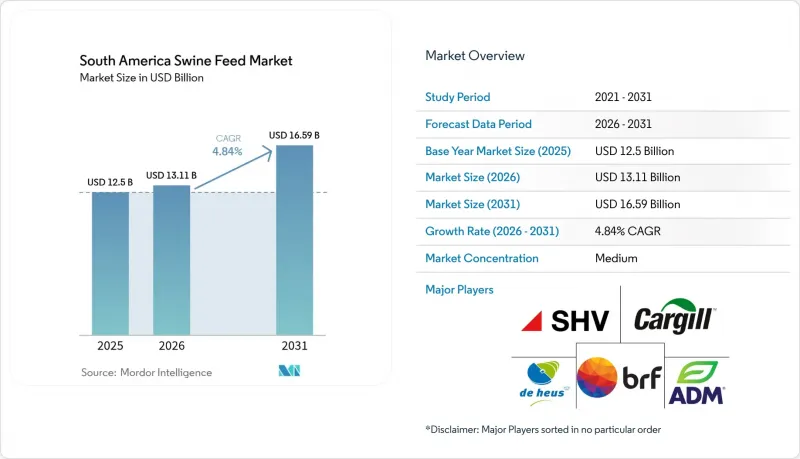
據 Mordor Intelligence 稱,南美豬飼料市場預計到 2026 年價值 131.1 億美元,高於 2025 年的 125 億美元,預計到 2031 年將達到 165.9 億美元。
預計從 2026 年到 2031 年,其複合年成長率將達到 4.84%。
本報告按飼料類型(幼畜飼料、育成豬飼料、母豬飼料等)、添加劑(維生素、胺基酸、酵素、有機酸、益生菌和益生元、抗生素及其他飼料添加劑)和地區(巴西、阿根廷、智利、秘魯、哥倫比亞及其他南美國家)進行細分。市場預測以美元(USD)計價。
南美洲豬飼料市場趨勢與洞察
巴西出口導引型豬肉生產規模擴大
2024年前九個月,巴西豬肉出口量達990,700噸(990.7千公噸),年增7.7%,進一步提振了飼料需求。儘管面臨外匯波動的不利因素,但收入仍顯著成長,反映出市場對高營養、專業飼料的需求。 JBS和BRF等大型綜合企業正在擴大豬隻存欄量,推高了垂直整合飼料廠對生長和育肥飼料的需求。聖卡塔琳娜州和巴拉那州新建的肉類增加了該地區的玉米消費量,同時也刺激了對大豆蛋白飼料的需求。與墨西哥、智利和日本的貿易協定正在降低市場風險,並確保飼料的長期供應。在出口機會的支撐下,預計南美豬飼料市場將在2030年之前保持穩定成長。
引進抗生素替代品(益生菌、有機酸)
隨著監管機構和進口客戶逐步淘汰抗生素生長促進劑的使用,一體化養豬場正在重新思考飼料配方,採用芽孢桿菌衍生的益生菌、有機酸和特定用途的酵素。同行評審的研究表明,用芽孢桿菌菌株替代飼料中的抗生素可減少斷奶後腹瀉30%。智利和巴西的飼料生產商正在率先開發商業混合飼料,這些飼料在提高胴體均勻度的同時,還能保持平均每日增重,從而使出口商能夠滿足歐洲和北美的優質標籤檢視要求。為了因應這一轉變,原料供應商正積極擴大其區域研發中心,以便調整多菌株產品,使其與當地的玉米和大豆粕比例相符。隨著監管措施的推廣,預計益生菌配方將在南美豬飼料市場的常規飼料配方中廣泛應用。
非洲豬瘟(ASF):目前尚未爆發疫情,但生物安全措施的成本正在增加。
儘管南美洲尚未確認爆發非洲豬瘟疫情,但進口商正在收緊衛生要求,導致在預防性生物安全方面的投資激增。巴西和新加坡之間的雙邊協議透過區域分類確保貿易的持續進行,但同時也強制要求嚴格的可追溯性和飼料消毒規程。生產商目前採用有機酸處理飼料,研究表明,有機酸可以降低非洲豬瘟病毒在原料中的存活率,從而增加每噸飼料的成本。用於生物消除措施的資金擠佔了對提高生產力的投資,減緩了南美豬飼料市場短期利潤成長。
細分市場分析
生長飼料佔最大的市場佔有率,預計到2025年將佔總市場的76.32%。這反映了生豬從25公斤到100公斤的較長生長期,在此期間,生豬的日飼料量最大。南美飼料市場的成長得益於巴西2024年創紀錄的出口量,將促進聖卡塔琳娜州和巴拉那州的工廠生產。擁有多個生產基地的綜合企業正透過在大豆粕,從而發揮規模經濟效益。配方飼料生產商正在配方中添加植酸酶等酶,以提高磷的利用率並降低每公斤增重成本。雖然母豬飼料的銷售量不大,但由於遺傳改良帶來的產仔數增加,其戰略地位仍十分重要。飼料生產商正在試用精準的微瓶系統,可根據懷孕階段調整維生素E和硒的含量,確保母豬產犢期間的生產效率。
預計2026年至2031年間,幼畜飼料將以6.56%的複合年成長率快速成長,這反映了行業正朝著改善仔豬斷奶後早期營養的方向發展。目前的配方混合了易消化的血漿蛋白、耐熱益生菌和短鏈脂肪酸,以促進腸道發育成熟。提高飼料轉換率和降低保育死亡率證明了對特種蛋白的大量資本投入是合理的。據智利一位綜合養豬戶稱,改良型開食料包的引入使仔豬從斷奶到上市的時間縮短了5天。隨著出口客戶對合理使用抗生素的要求越來越嚴格,預計早期腸道健康計畫將進一步推動南美豬飼料市場的成長。
其他好處:
- Excel格式的市場預測(ME)表
- 3個月的分析師支持
目錄
第1章:引言
- 研究假設和市場定義
- 調查範圍
第2章:調查方法
第3章執行摘要
第4章 市場狀況
- 市場概覽
- 市場促進因素
- 巴西出口導引型豬肉生產規模擴大
- 採用抗生素替代品(益生菌、有機酸)
- 2024年收成恢復後,玉米和大豆的投入價格將會下降。
- 政府稅改革獎勵措施促進飼料生產
- 在商業飼料廠引進精準營養技術
- 針對特異性飼料客製化的特種預混合料的成長
- 市場限制因素
- 雖然目前尚未確認爆發非洲豬瘟疫情,但所需的生物安全措施成本高。
- 匯率波動推高了食品添加劑的進口成本。
- 氣候相關因素對玉米和大豆供應的收成風險
- 公眾壓力要求遏制大豆供應鏈中的森林砍伐行為。
- 監理情勢
- 技術展望
- 波特五力分析
第5章 市場規模與成長預測
- 按飼料類型
- 幼畜飼料
- 生產者飼料
- 母豬飼料
- 其他類型的飼料
- 添加劑
- 維他命
- 胺基酸
- 酵素
- 有機酸
- 益生菌和益生元
- 抗生素
- 其他飼料添加劑
- 國家
- 巴西
- 阿根廷
- 智利
- 秘魯
- 哥倫比亞
- 其他南美國家
第6章 競爭情勢
- 市場集中度
- 策略趨勢
- 市佔率分析
- 公司簡介
- Cargill, Incorporated
- Archer-Daniels-Midland Company
- SHV Holdings
- Charoen Pokphand Group Company Limited
- New Hope Group Co., Ltd
- BRF SA
- De Heus Animal Nutrition BV
- Alltech, Inc
- CJ Corporation
- Hueber Feed, LLC
- JDH
- Land O'Lakes, Inc.
第7章 市場機會與未來展望
According to Mordor Intelligence, South America swine feed market size in 2026 is estimated at USD 13.11 billion, growing from 2025 value of USD 12.5 billion with 2031 projections showing USD 16.59 billion, growing at 4.84% CAGR over 2026-2031.
This report is Segmented by Feed Type (Starter Feed, Grower Feed, Sow Feed and Others), Additives (Vitamins, Amino Acids, Enzymes, Organic Acids, Probiotics and Prebiotics, Antibiotics, and Rest of Feed Additives), and Geography (Brazil, Argentina, Chile, Peru, Colombia, and Rest of South America). The Market Forecasts are Provided in Terms of Value (USD).
South America Swine Feed Market Trends and Insights
Expansion of Export-Oriented Pork Production in Brazil
Brazil shipped 990.7 thousand metric tons of pork during the first nine months of 2024, a 7.7% year-over-year jump that intensified feed demand. Revenue increased significantly, despite currency headwinds, reflecting the demand for specialized nutrient-rich feed formulations. Major integrated companies like JBS and BRF are increasing their hog populations, driving higher demand for grow-finish feed across their vertically integrated feed mills. New slaughter facilities in Santa Catarina and Parana are increasing regional corn consumption while boosting demand for soybean-based protein concentrates. Trade agreements with Mexico, Chile, and Japan are reducing market risks and securing long-term feed volume commitments. The South American swine feed market is projected to maintain steady growth through 2030, supported by export opportunities.
Adoption of Antibiotic Alternatives (Probiotics, Organic Acids)
Regulators and import customers are phasing out antibiotic growth promoters, prompting swine integrators to reformulate diets with Bacillus-based probiotics, organic acids and targeted enzymes. Peer-reviewed trials show a 30% reduction in post-weaning diarrhea when Bacillus strains replace in-feed antibiotics. Chilean and Brazilian mills have pioneered commercial blends that preserve average daily gain while enhancing carcass uniformity, allowing exporters to qualify for premium label claims in Europe and North America. The shift has motivated ingredient suppliers to expand regional R&D centers capable of tailoring multi-strain products to local corn-soy meal matrices. As regulatory momentum spreads, probiotic inclusion is poised to permeate everyday rations across the South America swine feed market.
African Swine Fever Biosecurity Costs Despite No Outbreaks Yet
South America remains ASF-free, yet preventive biosecurity investments have surged as importers tighten sanitary requirements. Brazil's bilateral agreement with Singapore guarantees trade continuity via compartmentalization but mandates rigorous traceability and feed decontamination protocols . Producers now employ organic-acid feed treatments shown to lower ASFV viability in ingredients, raising per-ton feed costs. Capital diverted to bio-exclusion measures restrains spending on productivity drivers, tempering near-term gains in the South America swine feed market.
Other drivers and restraints analyzed in the detailed report include:
- Lower Corn and Soybean Input Prices After 2024 Harvest Recovery
- Government Tax-Reform Incentives for Feed Manufacturing
- High Currency Volatility Raising Additive Import Costs
For complete list of drivers and restraints, kindly check the Table Of Contents.
Segment Analysis
Grower rations constitute the largest slice, with 76.32% of the total market in 2025, reflecting the extended 25-100 kg phase when pigs consume the highest daily intake. The South America swine feed market size for grower diets benefited from Brazil's record export shipments in 2024, lifting factory output in Santa Catarina and Parana. Multisite integrators exploit scale economies by sourcing high-energy corn locally and balancing amino-acid profiles with domestically crushed soybean meal. Formulators are layering enzymes such as phytase to elevate phosphorus availability and control cost per kilogram of gain. Although sow diets claim modest tonnage, they remain strategically important as genetic lines push litter sizes higher. Mills are piloting precision micro-bin systems that modulate vitamin E and selenium inclusion according to gestation stage, safeguarding farrowing performance.
Starter diets are the fastest climber with an estimated CAGR of 6.56% during 2026-2031, mirroring the industry's pivot toward improved early-life nutrition. Formulas now blend highly digestible plasma proteins, heat-stable probiotics, and short-chain fatty acids to support gut maturation. Larger capital outlays for specialty proteins are justified by tighter feed conversion and lower nursery mortality. Chilean integrators report weaning-to-sale improvements of 5 days following the adoption of enhanced starter packs. As export customers demand tighter antibiotic stewardship, early gut-health programs are expected to unlock further growth within the South America swine feed market.
Complete Report Scope:
- By Feed Type
- Starter Feed
- Grower Feed
- Sow Feed
- Rest of Feed Types
- By Additives
- Vitamins
- Amino Acids
- Enzymes
- Organic Acids
- Probiotics and Prebiotics
- Antibiotics
- Rest of Feed Additives
- By Country
- Brazil
- Argentina
- Chile
- Peru
- Colombia
- Rest of South America
List of Companies Covered in this Report:
- Cargill, Incorporated
- Archer-Daniels-Midland Company
- SHV Holdings
- Charoen Pokphand Group Company Limited
- New Hope Group Co., Ltd
- BRF S.A.
- De Heus Animal Nutrition B.V.
- Alltech, Inc
- CJ Corporation
- Hueber Feed, LLC
- JDH
- Land O'Lakes, Inc.
Additional Benefits:
- The market estimate (ME) sheet in Excel format
- 3 months of analyst support
TABLE OF CONTENTS
1 Introduction
- 1.1 Study Assumptions and Market Definition
- 1.2 Scope of the Study
2 Research Methodology
3 Executive Summary
4 Market Landscape
- 4.1 Market Overview
- 4.2 Market Drivers
- 4.2.1 Expansion of export-oriented pork production in Brazil
- 4.2.2 Adoption of antibiotic alternatives (probiotics, organic acids)
- 4.2.3 Lower corn and soybean input prices after 2024 harvest recovery
- 4.2.4 Government tax-reform incentives for feed manufacturing
- 4.2.5 Precision-nutrition tech deployment in commercial feed mills
- 4.2.6 Growth of specialty premixes tailored to genotype-specific diets
- 4.3 Market Restraints
- 4.3.1 African swine fever biosecurity costs despite no outbreaks yet
- 4.3.2 High currency volatility raising additive import costs
- 4.3.3 Climate-linked harvest risks for corn and soy supplies
- 4.3.4 Public pressure to curb deforestation in soy supply chains
- 4.4 Regulatory Landscape
- 4.5 Technological Outlook
- 4.6 Porter's Five Forces Analysis
- 4.6.1 Threat of New Entrants
- 4.6.2 Bargaining Power of Suppliers
- 4.6.3 Bargaining Power of Buyers
- 4.6.4 Threat of Substitutes
- 4.6.5 Industry Rivalry
5 Market Size and Growth Forecasts (Value)
- 5.1 By Feed Type
- 5.1.1 Starter Feed
- 5.1.2 Grower Feed
- 5.1.3 Sow Feed
- 5.1.4 Rest of Feed Types
- 5.2 By Additives
- 5.2.1 Vitamins
- 5.2.2 Amino Acids
- 5.2.3 Enzymes
- 5.2.4 Organic Acids
- 5.2.5 Probiotics and Prebiotics
- 5.2.6 Antibiotics
- 5.2.7 Rest of Feed Additives
- 5.3 By Country
- 5.3.1 Brazil
- 5.3.2 Argentina
- 5.3.3 Chile
- 5.3.4 Peru
- 5.3.5 Colombia
- 5.3.6 Rest of South America
6 Competitive Landscape
- 6.1 Market Concentration
- 6.2 Strategic Moves
- 6.3 Market Share Analysis
- 6.4 Company Profiles (Includes Global Level Overview, Market Level Overview, Core Segments, Financials as Available, Strategic Information, Market Rank/Share, Products and Services, Recent Developments)
- 6.4.1 Cargill, Incorporated
- 6.4.2 Archer-Daniels-Midland Company
- 6.4.3 SHV Holdings
- 6.4.4 Charoen Pokphand Group Company Limited
- 6.4.5 New Hope Group Co., Ltd
- 6.4.6 BRF S.A.
- 6.4.7 De Heus Animal Nutrition B.V.
- 6.4.8 Alltech, Inc
- 6.4.9 CJ Corporation
- 6.4.10 Hueber Feed, LLC
- 6.4.11 JDH
- 6.4.12 Land O'Lakes, Inc.
7 Market Opportunities and Future Outlook

 亞太地區豬飼料預混合料:市佔率分析、產業趨勢與統計及成長預測(2026-2031)
 豬飼料市場:按類型、形態、原料、添加劑和分銷管道分類-2026-2032年全球市場預測中國豬飼料市場:市場佔有率分析、產業趨勢與統計及成長預測(2026-2031年)
 豬飼料市場機會、成長要素、產業趨勢分析及2026-2035年預測。
 豬飼料市場:依產品種類、原料、添加劑及地區分類。
 豬飼料添加劑市場-策略分析與預測(2026-2031)全球豬飼料市場規模、佔有率、趨勢和成長分析報告(2026-2034年)
 豬飼料市場規模、佔有率及成長分析(按類型、添加劑、形態和地區分類)-產業預測(2026-2033 年)