


 |
市場調查報告書
商品編碼
2027591
豬飼料市場機會、成長要素、產業趨勢分析及2026-2035年預測。Swine Feed Market Opportunity, Growth Drivers, Industry Trend Analysis, and Forecast 2026 - 2035 |
||||||

2025年全球豬飼料市場價值1129億美元,預計2035年將達1757億美元,年複合成長率為4.5%。
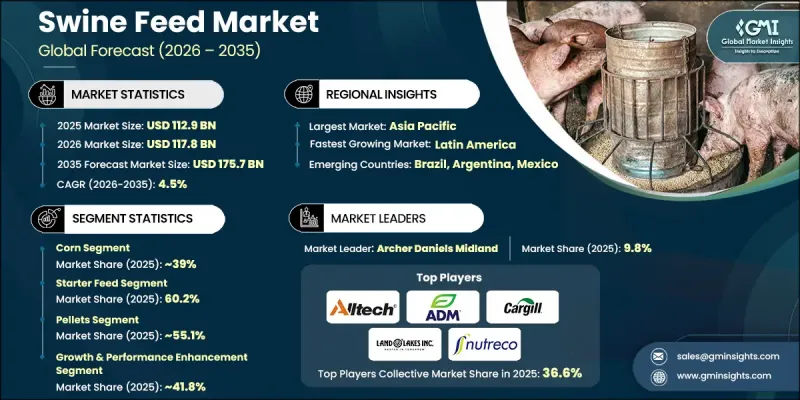
在全球豬肉消費量不斷成長和動物營養科學持續進步的推動下,全球豬飼料產業正經歷穩定成長。隨著生產者致力於提高動物生長性能、飼料轉換率和整體豬群健康水平,對科學均衡飼料配方的需求日益成長。現代飼料解決方案擴大採用功能性成分,以支持消化、免疫力和營養吸收,同時最佳化生產成本。酵素、胺基酸和益生菌等添加劑在先進飼料配方中變得至關重要,有助於提高豬群的代謝效率和抗病能力。永續性議題也影響市場,人們越來越重視環境友善採購和減少畜牧系統對生態環境的影響。精準飼餵技術和數位化監測工具透過在每個生長階段實現更精準的營養管理,進一步改變了農場運作模式。這些進步提高了生產者的生產力和盈利,同時確保了肉質的穩定性。因此,市場正朝著高度客製化、以性能為導向的飼料解決方案發展,以支持全球豬肉生產系統的經濟和環境目標。
| 市場範圍 | |
|---|---|
| 開始年份 | 2025 |
| 預測期 | 2026-2035 |
| 上市時的市場規模 | 1129億美元 |
| 預測金額 | 1757億美元 |
| 複合年成長率 | 4.5% |
預計到2025年,玉米市佔率將達到39%,並在2035年之前以4.3%的複合年成長率成長。玉米的高能量密度和成本效益使其成為豬飼料生產中最廣泛使用的原料,並且仍然是全球畜牧業營養策略的重要組成部分。其廣泛的供應和營養特性繼續鞏固了其在商業飼料配方中的主導地位。
預計到2025年,幼畜飼料市佔率將達到60.2%,並在2026年至2035年間以4.7%的複合年成長率成長。隨著生產者日益認知到早期營養管理對提高仔豬成活率和長期生長性能的重要性,該細分市場呈現強勁成長勢頭。幼畜飼料專為支持仔豬早期發育而設計,透過提高消化效率和增強關鍵生長階段的免疫反應來實現這一目標。
預計到2025年,北美豬飼料市佔率將達到21.9%。該地區受益於先進的農業技術、高度機械化以及嚴格的法律規範,從而確保了飼料的品質和安全標準。成熟的生豬生產系統支撐著對永續飼料解決方案的穩定需求。消費者對永續生產的高品質豬肉產品的日益偏好,也推動了專用天然飼料成分的使用。精準飼餵系統和自動化技術的整合進一步提高了營運效率,而持續的研發投入則推動了功能性飼料產品的創新,旨在提高豬隻的免疫力、生長速度和繁殖能力。
目錄
第1章:調查方法和範圍
第2章執行摘要
第3章業界考察
- 生態系分析
- 供應商情況
- 利潤率
- 每個階段增加的價值
- 影響價值鏈的因素
- 中斷
- 影響產業的因素
- 促進因素
- 產業潛在風險與挑戰
- 市場機遇
- 成長潛力分析
- 監理情勢
- 北美洲
- 歐洲
- 亞太地區
- 拉丁美洲
- 中東和非洲
- 波特的分析
- PESTEL 分析
- 價格趨勢
- 按地區
- 按類型
- 未來市場趨勢
- 科技與創新趨勢
- 當前技術趨勢
- 新興技術
- 專利趨勢
- 貿易統計(HS編碼)
- 主要進口國
- 主要出口國
- 永續性和環境方面
- 永續計劃
- 減少廢棄物策略
- 生產中的能源效率
- 環保意識的舉措
- 考慮碳足跡
第4章 競爭情勢
- 介紹
- 企業市佔率分析
- 按地區
- 北美洲
- 歐洲
- 亞太地區
- 拉丁美洲
- 中東和非洲
- 按地區
- 企業矩陣分析
- 主要市場公司的競爭分析
- 競爭定位矩陣
- 主要進展
- 併購
- 夥伴關係與合作
- 新產品發布
- 業務拓展計劃
第5章 市場估算與預測:依原料分類,2022-2035年
- 玉米
- 大豆粕
- 燕麥
- 米糠
- 木薯
- 蔬菜
- 高粱
- 小麥
- 其他
第6章 市場估計與預測:依類型分類,2022-2035年
- 幼畜飼料
- 生長階段的飼料
- 牲畜飼料
- 母豬飼料
第7章 市場估計與預測:依類型分類,2022-2035年
- 顆粒
- 搗碎
- 崩潰
- 其他
第8章 市場估計與預測:依功能分類,2022-2035年
- 成長和生產力提升
- 免疫力和疾病預防
- 繁殖/繁殖支持
- 泌乳/產乳量
- 維持和一般營養
第9章 市場估計與預測:依地區分類,2022-2035年
- 北美洲
- 美國
- 加拿大
- 歐洲
- 德國
- 英國
- 法國
- 西班牙
- 義大利
- 其他歐洲地區
- 亞太地區
- 中國
- 印度
- 日本
- 澳洲
- 韓國
- 亞太其他地區
- 拉丁美洲
- 巴西
- 墨西哥
- 阿根廷
- 其他拉丁美洲地區
- 中東和非洲
- 沙烏地阿拉伯
- 南非
- 阿拉伯聯合大公國
- 其他中東和非洲地區
第10章:公司簡介
- Alltech Inc.
- Archer Daniels Midland(ADM)Company
- Cargill Inc.
- Charoen Pokphand Foods PCL(CPF)
- De Heus Animal Nutrition
- Forfarmers NV
- Godrej Agrovet Limited
- Guangdong Haid Group
- Kent Nutrition Group
- Land O'Lakes Inc.
- New Hope Group
- Nutreco NV
The Global Swine Feed Market was valued at USD 112.9 billion in 2025 and is estimated to grow at a CAGR of 4.5% to reach USD 175.7 billion by 2035.
The global swine feed industry is experiencing steady expansion driven by rising pork consumption worldwide and continuous improvements in livestock nutrition science. Demand for scientifically balanced feed formulations is increasing as producers focus on improving animal growth performance, feed efficiency, and overall herd health outcomes. Modern feed solutions are increasingly designed with functional ingredients that support digestion, immunity, and nutrient absorption while also optimizing production costs. Additives such as enzymes, amino acids, and probiotics are becoming integral to advanced feed formulations, helping enhance metabolic efficiency and disease resistance in swine populations. Sustainability considerations are also shaping the market, with growing emphasis on environmentally responsible sourcing and reduced ecological impact in livestock production systems. Precision feeding technologies and digital monitoring tools are further transforming farm operations by enabling more accurate nutrient management across different growth stages. These advancements are improving productivity and profitability for farmers while ensuring consistent meat quality. As a result, the market is evolving toward highly customized and performance-oriented feed solutions that support both economic and environmental objectives across global pork production systems.
| Market Scope | |
|---|---|
| Start Year | 2025 |
| Forecast Year | 2026-2035 |
| Start Value | $112.9 Billion |
| Forecast Value | $175.7 Billion |
| CAGR | 4.5% |
The corn segment accounted for 39% share in 2025 and is expected to grow at a CAGR of 4.3% through 2035. It remains the most widely used raw material in swine feed production due to its high energy density and cost efficiency, making it a foundational ingredient in global livestock nutrition strategies. Its broad availability and nutritional profile continue to support its strong dominance across commercial feed formulations.
The starter feed segment held a 60.2% share in 2025 and is projected to grow at a CAGR of 4.7% from 2026 to 2035. This segment has gained strong traction as producers increasingly recognize the importance of early-stage nutrition in improving piglet survival rates and long-term growth performance. Starter formulations are specifically designed to support early development, enhancing digestive efficiency and strengthening immune response during critical growth phases.
North America Swine Feed Market accounted for 21.9% share in 2025. The region benefits from advanced farming technologies, high levels of mechanization, and strict regulatory oversight that ensures feed quality and safety standards. Established pork production systems support consistent demand for high-performance feed solutions. Increasing consumer preference for sustainably produced and premium pork products is also encouraging the use of specialized and natural feed ingredients. The integration of precision feeding systems and automation is further improving operational efficiency, while ongoing research and development efforts are driving innovation in functional feed products designed to enhance immunity, growth, and reproductive performance.
Key companies operating in the Swine Feed Market include Cargill Inc., Nutreco N.V., Archer Daniels Midland (ADM) Company, Alltech Inc., Charoen Pokphand Foods PCL (CPF), New Hope Group, De Heus Animal Nutrition, Guangdong Haid Group, Forfarmers N.V., Land O'Lakes Inc., Kent Nutrition Group, and Godrej Agrovet Limited. Companies in the Swine Feed Market are adopting a range of strategic initiatives to strengthen their competitive positioning and expand market reach. A primary focus is on research and development to create advanced feed formulations that improve growth efficiency, immunity, and feed conversion ratios. Manufacturers are increasingly integrating functional ingredients such as probiotics, enzymes, and amino acids to enhance nutritional value and animal performance. Strategic partnerships with raw material suppliers and livestock producers are being used to ensure supply chain stability and product consistency. Companies are also expanding production capacities and modernizing manufacturing facilities to meet rising global demand. Digital technologies and precision feeding systems are being adopted to optimize nutrient delivery and reduce feed wastage. In addition, businesses are investing in sustainability initiatives and natural ingredient sourcing to align with environmental expectations and evolving consumer preferences. Mergers and acquisitions are further helping companies expand geographic presence and strengthen their product portfolios.
Table of Contents
Chapter 1 Methodology & Scope
- 1.1 Market scope and definition
- 1.2 Research design
- 1.2.1 Research approach
- 1.2.2 Data collection methods
- 1.3 Data mining sources
- 1.3.1 Global
- 1.3.2 Regional/Country
- 1.4 Base estimates and calculations
- 1.4.1 Base year calculation
- 1.4.2 Key trends for market estimation
- 1.5 Primary research and validation
- 1.5.1 Primary sources
- 1.6 Forecast model
- 1.7 Research assumptions and limitations
Chapter 2 Executive Summary
- 2.1 Industry 360° synopsis
- 2.2 Key market trends
- 2.2.1 Regional
- 2.2.2 Ingredient
- 2.2.3 Type
- 2.2.4 Form
- 2.2.5 Function
- 2.3 TAM Analysis, 2026-2035
- 2.4 CXO perspectives: Strategic imperatives
- 2.4.1 Executive decision points
Chapter 3 Industry Insights
- 3.1 Industry ecosystem analysis
- 3.1.1 Supplier landscape
- 3.1.2 Profit margin
- 3.1.3 Value addition at each stage
- 3.1.4 Factor affecting the value chain
- 3.1.5 Disruptions
- 3.2 Industry impact forces
- 3.2.1 Growth drivers
- 3.2.2 Industry pitfalls and challenges
- 3.2.3 Market opportunities
- 3.3 Growth potential analysis
- 3.4 Regulatory landscape
- 3.4.1 North America
- 3.4.2 Europe
- 3.4.3 Asia Pacific
- 3.4.4 Latin America
- 3.4.5 Middle East & Africa
- 3.5 Porter’s analysis
- 3.6 PESTEL analysis
- 3.7 Price trends
- 3.7.1 By region
- 3.7.2 By type
- 3.8 Future market trends
- 3.9 Technology and Innovation landscape
- 3.9.1 Current technological trends
- 3.9.2 Emerging technologies
- 3.10 Patent Landscape
- 3.11 Trade statistics (HS code)
- 3.11.1 Major importing countries
- 3.11.2 Major exporting countries
- 3.12 Sustainability and environmental aspects
- 3.12.1 Sustainable practices
- 3.12.2 Waste reduction strategies
- 3.12.3 Energy efficiency in production
- 3.12.4 Eco-friendly initiatives
- 3.13 Carbon footprint consideration
Chapter 4 Competitive Landscape, 2025
- 4.1 Introduction
- 4.2 Company market share analysis
- 4.2.1 By region
- 4.2.1.1 North America
- 4.2.1.2 Europe
- 4.2.1.3 Asia Pacific
- 4.2.1.4 LATAM
- 4.2.1.5 MEA
- 4.2.1 By region
- 4.3 Company matrix analysis
- 4.4 Competitive analysis of major market players
- 4.5 Competitive positioning matrix
- 4.6 Key developments
- 4.6.1 Mergers & acquisitions
- 4.6.2 Partnerships & collaborations
- 4.6.3 New Product Launches
- 4.6.4 Expansion Plans
Chapter 5 Market Estimates and Forecast, By Ingredient, 2022-2035 (USD Billion) (Kilo Tons)
- 5.1 Key trends
- 5.2 Corn
- 5.3 Soyabean meal
- 5.4 Oats
- 5.5 Rice bran
- 5.6 Cassava
- 5.7 Vegetables
- 5.8 Sorghum
- 5.9 Wheat
- 5.10 Other
Chapter 6 Market Estimates and Forecast, By Type, 2022-2035 (USD Billion) (Kilo Tons)
- 6.1 Key trends
- 6.2 Starter feed
- 6.3 Grower feed
- 6.4 Finisher feed
- 6.5 Sow feed
Chapter 7 Market Estimates and Forecast, By Form, 2022-2035 (USD Billion) (Kilo Tons)
- 7.1 Key trends
- 7.2 Pellets
- 7.3 Mash
- 7.4 Crumbles
- 7.5 Others
Chapter 8 Market Estimates and Forecast, By Function, 2022-2035 (USD Billion) (Kilo Tons)
- 8.1 Key trends
- 8.2 Growth & performance enhancement
- 8.3 Immunity & disease prevention
- 8.4 Reproduction & breeding support
- 8.5 Lactation & milk production
- 8.6 Maintenance & general nutrition
Chapter 9 Market Estimates and Forecast, By Region, 2022-2035 (USD Billion) (Kilo Tons)
- 9.1 Key trends
- 9.2 North America
- 9.2.1 U.S.
- 9.2.2 Canada
- 9.3 Europe
- 9.3.1 Germany
- 9.3.2 UK
- 9.3.3 France
- 9.3.4 Spain
- 9.3.5 Italy
- 9.3.6 Rest of Europe
- 9.4 Asia Pacific
- 9.4.1 China
- 9.4.2 India
- 9.4.3 Japan
- 9.4.4 Australia
- 9.4.5 South Korea
- 9.4.6 Rest of Asia Pacific
- 9.5 Latin America
- 9.5.1 Brazil
- 9.5.2 Mexico
- 9.5.3 Argentina
- 9.5.4 Rest of Latin America
- 9.6 Middle East and Africa
- 9.6.1 Saudi Arabia
- 9.6.2 South Africa
- 9.6.3 UAE
- 9.6.4 Rest of Middle East and Africa
Chapter 10 Company Profiles
- 10.1 Alltech Inc.
- 10.2 Archer Daniels Midland (ADM) Company
- 10.3 Cargill Inc.
- 10.4 Charoen Pokphand Foods PCL (CPF)
- 10.5 De Heus Animal Nutrition
- 10.6 Forfarmers N.V.
- 10.7 Godrej Agrovet Limited
- 10.8 Guangdong Haid Group
- 10.9 Kent Nutrition Group
- 10.10 Land O'Lakes Inc.
- 10.11 New Hope Group
- 10.12 Nutreco N.V.

 亞太地區豬飼料預混合料:市佔率分析、產業趨勢與統計及成長預測(2026-2031)南美豬飼料:市場佔有率分析、行業趨勢和統計數據以及成長預測(2026-2031 年)
 豬飼料市場:按類型、形態、原料、添加劑和分銷管道分類-2026-2032年全球市場預測中國豬飼料市場:市場佔有率分析、產業趨勢與統計及成長預測(2026-2031年)
 豬飼料市場:依產品種類、原料、添加劑及地區分類。
 豬飼料添加劑市場-策略分析與預測(2026-2031)全球豬飼料市場規模、佔有率、趨勢和成長分析報告(2026-2034年)
 豬飼料市場規模、佔有率及成長分析(按類型、添加劑、形態和地區分類)-產業預測(2026-2033 年)