


 |
市場調查報告書
商品編碼
2113702
南美洲複合飼料:市場佔有率分析、產業趨勢與統計、成長預測(2026-2031)South America Compound Feed - Market Share Analysis, Industry Trends & Statistics, Growth Forecasts (2026 - 2031) |
||||||

※ 本網頁內容可能與最新版本有所差異。詳細情況請與我們聯繫。
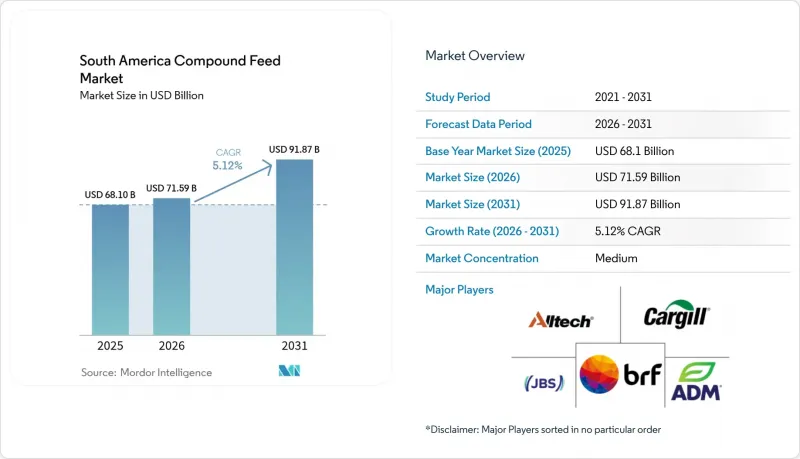
據 Mordor Intelligence 稱,南美洲複合飼料市場預計到 2026 年價值將達到 715.9 億美元,高於 2025 年的 681 億美元,預計到 2031 年將達到 918.7 億美元。
預計 2026 年至 2031 年的複合年成長率為 5.12%。
本報告按動物類型(反芻動物、家禽、豬、水產養殖和其他動物種類)、原料(穀物、餅粕、副產品和補充劑)和地區(巴西、阿根廷和其他南美國家)對產業進行分類。
南美洲複合飼料市場趨勢與洞察
畜牧業產量增加及出口需求上升
巴西預計2024年將出口490萬噸雞肉,鞏固其作為全球最大雞肉出口國的地位,並對高性能肉雞飼料產生結構性需求。出口活性化的成長要求綜合畜牧企業將飼料轉換率最佳化至1.60以下,此閾值需要精確配製胺基酸和酵素。隨著非洲豬瘟疫情的影響逐漸緩解,阿根廷對中國的豬肉出口在2024年恢復成長。這促使當地飼料生產商擴大其豬飼料產品線,使用合成離胺酸和蘇氨酸混合物。出口競爭力與飼料品質之間存在反饋循環,這意味著任何原料供應中斷或配方穩定性問題都會立即損害農場的獲利能力。巴西中西部地區的畜牧業正日益集約化,育肥牛的屠宰量已佔總屠宰量的30%以上。這種轉變推動了畜牧業從放牧轉向集約化飼料,並擴大了對高能量顆粒飼料的需求。
引入營養補充品和特殊飼料添加劑
2024年,巴西南部各州家禽飼料中添加酵素製劑的比例超過85%。這反映出一種策略轉變,即採用植酸酶和木聚醣酶的組合,從植物來源原料中釋放磷和能量。這一趨勢正在減少對無機磷酸鹽補充劑的依賴,因為無機磷酸鹽補充劑的價格容易受到全球化肥市場價格波動的影響。枯草芽孢桿菌和嗜酸乳桿菌等益生菌菌株在豬飼料中越來越受歡迎,此前田間試驗表明,它們可以改善斷奶仔豬的腸道健康並降低死亡率。巴西對新添加劑的監管流程遵循農業部的指導方針,並要求提交國內試驗的功效數據。這項限制有利於擁有完善研發基礎設施的跨國原料供應商。
商品和飼料原料價格波動
2024年,芝加哥期貨交易所(CBOT)玉米期貨價格在每蒲式耳4.20美元至5.80美元之間波動,波動幅度高達38%,迫使飼料生產商每週調整配方以維持目標利潤率。在巴西國內市場,由於南里奧格蘭德州乾旱導致豆粕出油率下降18%,大豆粕價格在2024年年中飆升至每噸2400雷亞爾(約合每噸480美元)。由於牲畜合約價格通常在交付前幾個月就已確定,這些價格波動擠壓了飼料利潤空間,使飼料生產商面臨投入成本上漲而收入卻無法相應調整的風險。這種財務壓力對以獨立農民為客戶的商業飼料生產商最為嚴重。這些客戶缺乏承受飼料價格暴漲的財力,可能會推遲訂單或轉而使用成本更低的飼料,從而損害牲畜生產力。一體化生產商透過期貨合約對沖糧食採購風險,從而部分緩解了這種風險,但這種策略需要財務管理專業知識和資本儲備,而小規模企業往往缺乏這些。
細分市場分析
2025年,南美洲複合飼料市場中,家禽飼料佔42.55%。這一主導地位主要得益於巴西的肉雞出口體係以及阿根廷雞蛋產量的復甦。一體化肉雞生產商要求飼料轉換率低於1.60,而要實現這一目標,需要精確平衡代謝能和可消化氨基酸,這迫使飼料加工商採用近紅外線光譜技術進行即時原料分析。由於家禽飼料市場已趨於成熟,其成長將主要由效率的逐步提升所驅動,而非銷售量的增加。這一趨勢有利於提供新型酵素製劑和腸道健康添加劑的原料供應商,而非普通穀物貿易商。豬飼料受益於阿根廷恢復對華豬肉出口,其配方正轉向使用合成離胺酸和低粗蛋白飼料。這些措施有助於減少氮排放,並符合新頒布的環境標準。
預計到2031年,水產養殖飼料市場將以7.42%的複合年成長率成長。這主要得益於動物養殖業中成長最快的領域,包括巴西水庫吳郭魚箱養殖的擴張以及厄瓜多爾沿海各州蝦類養殖的集約化。水產養殖業的卓越表現反映了其結構性套利優勢。魚類比陸生牲畜更能有效地將飼料轉化為體重,吳郭魚的飼料轉換率約為1.20,而肉雞為1.60,牛為2.80。這種效率優勢使水產養殖成為一種低成本的蛋白質來源,尤其是在水資源豐富且具備密集生產能力的地區。法律規範也不斷完善,巴西漁業部將於2024年發布新的水產養殖飼料標示指南。這些指南強制要求揭露魚粉和魚油的含量,以提高透明度,從而解決人們對永續性的擔憂。
其他好處:
- Excel格式的市場預測(ME)表
- 3個月的分析師支持
目錄
第1章:引言
- 市場分析與定義的前提條件
- 分析範圍
第2章 分析方法
第3章執行摘要
第4章 市場狀況
- 市場概覽
- 市場促進因素
- 畜牧業產量增加及出口需求上升
- 採用營養及特殊飼料添加劑
- 政府採取措施促進動物性蛋白質供應鏈。
- 擴大一體化飼料生產能力
- 亞馬遜河流域水產養殖業蓬勃發展,沿海漁業蓬勃發展
- 與排碳權掛鉤的永續飼料計劃
- 市場限制因素
- 產品價格與飼料原料價格的波動
- 嚴格的環境和土地利用法規
- 物流瓶頸和港口堵塞
- 消費者轉向植物蛋白
- 監理情勢
- 技術展望
- 波特五力分析
第5章:預測市場規模與成長率
- 依動物類型
- 反芻動物
- 家禽
- 豬
- 水產養殖
- 其他動物物種
- 按成分
- 穀類
- 蛋糕餐
- 依產品
- 補充
- 維他命
- 胺基酸
- 酵素
- 益生元和益生菌
- 酸味劑
- 其他補充劑
- 按地區
- 巴西
- 阿根廷
- 其他南美國家
第6章 競爭情勢
- 策略趨勢
- 市佔率分析
- 公司簡介
- Cargill, Incorporated
- ADM
- JBS SA
- BRF SA
- Alltech, Inc.
- Kemin Industries, Inc.
- Nutreco NV
- Royal De Heus Group BV
- Evonik Industries AG
- Phibro Animal Health Corporation
- Adisseo France SAS
- Vitapro SA
- Italcol SA
- Aurora Alimentos Cooperativa Central
- DSM-Firmenich AG
第7章 市場機會與未來展望
According to Mordor Intelligence, South America compound feed market size in 2026 is estimated at USD 71.59 billion, growing from 2025 value of USD 68.1 billion with 2031 projections showing USD 91.87 billion, growing at 5.12% CAGR over 2026-2031.
This report Segments the Industry Into Animal Type (Ruminants, Poultry, Swine, Aquaculture, Other Animal Types), Ingredient (Cereals, Cakes & Meals, By-Products, Supplements), and Geography (Brazil, Argentina, Rest of South America).
South America Compound Feed Market Trends and Insights
Rising Livestock Production and Export Demand
Brazil exported 4.9 million metric tons of chicken meat in 2024, solidifying its position as the world's leading exporter and creating a structural demand for high-performance broiler feed . This export intensity compels integrators to optimize feed conversion ratios below 1.60, a threshold that necessitates the precise formulation of amino acids and enzymes. Argentina's pork shipments to China rebounded in 2024 after disruptions from African swine fever eased, prompting local millers to expand their swine-feed lines with synthetic lysine and threonine blends. The feedback loop between export competitiveness and feed quality means that any disruption in ingredient supply or formulation consistency immediately erodes margin at the farm gate. Cattle ranching in Brazil's Center-West continues to intensify, with feedlot finishing now accounting for over 30% of the slaughter volume. This shift replaces pasture grazing with concentrated rations, driving demand for high-energy pellets.
Adoption of Nutritional and Specialty Feed Additives
Enzyme inclusion rates in poultry feed exceeded 85% penetration in Brazil's southern states in 2024, reflecting a strategic shift toward phytase and xylanase combinations that unlock phosphorus and energy from plant-based ingredients. This trend reduces reliance on inorganic phosphate supplements, which are subject to price volatility tied to global fertilizer markets. Probiotic strains, such as Bacillus subtilis and Lactobacillus acidophilus, gained traction in swine rations after field trials demonstrated improved gut health and reduced mortality in weanling pigs. The regulatory pathway for novel additives in Brazil follows Ministry of Agriculture guidelines that require efficacy data from local trials, a barrier that favors multinational ingredient suppliers with established research infrastructure.
Volatility in Commodity and Feed Ingredient Prices
Corn futures on the Chicago Board of Trade traded in a USD 4.20 to USD 5.80 per bushel range during 2024, a 38% swing that forced feed millers to adjust formulations weekly to maintain target margins. Soybean meal prices in Brazil's domestic market surged to BRL 2,400 per metric ton (USD 480 per metric ton) in mid-2024, following a drought in Rio Grande do Sul that reduced crushing volumes by 18%. This price volatility compresses feed margins because livestock contracts are often locked in months ahead of delivery, leaving millers exposed to input-cost inflation without a corresponding revenue adjustment. The financial strain is most acute for commercial mills serving independent farmers, as these customers lack the balance-sheet flexibility to absorb sudden feed-price increases and may delay orders or switch to lower-cost rations that compromise animal performance. Integrated producers partially mitigate this risk by hedging their grain purchases through futures contracts, but this strategy requires treasury expertise and capital reserves that smaller players often cannot afford.
Other drivers and restraints analyzed in the detailed report include:
- Government Programs That Incentivize Animal Protein Supply Chains
- Expansion of Integrated Feed Milling Capacity
- Stringent Environmental and Land-Use Regulations
For complete list of drivers and restraints, kindly check the Table Of Contents.
Segment Analysis
Poultry feed captured 42.55% of South America's 2025 compound feed market, a dominance rooted in Brazil's broiler export machine and Argentina's resurgence in egg production. Broiler integrators demand feed-conversion ratios below 1.60, a target that requires precision balancing of metabolizable energy and digestible amino acids, pushing millers to adopt near-infrared spectroscopy for real-time ingredient analysis. The poultry segment's maturity means growth will come from incremental efficiency gains rather than volume expansion, a dynamic that favors ingredient suppliers offering novel enzymes or gut-health additives over commodity grain traders. Swine feed benefits from Argentina's renewed pork exports to China, with formulations shifting toward synthetic lysine and low-crude-protein diets that reduce nitrogen excretion and comply with emerging environmental standards.
Aquaculture feed is expected to expand at a 7.42% CAGR through 2031, driven by the fastest growth among animal types, as tilapia cage farming scales up in Brazil's reservoirs and shrimp production intensifies in Ecuador's coastal provinces. The aquaculture segment's outperformance reflects a structural arbitrage: fish convert feed into body mass more efficiently than terrestrial livestock, with tilapia achieving feed-conversion ratios of nearly 1.20 compared to 1.60 for broilers and 2.80 for cattle. This efficiency advantage positions aquaculture as a lower-cost protein source, particularly in regions where water resources are abundant and support intensive production. Regulatory frameworks are catching up, with Brazil's Ministry of Fisheries issuing new guidelines in 2024 for aquafeed labeling that mandate disclosure of fishmeal and fish-oil content, a transparency measure aimed at addressing sustainability concerns .
Complete Report Scope:
- By Animal Type
- Ruminants
- Poultry
- Swine
- Aquaculture
- Other Animal Types
- By Ingredient
- Cereals
- Cakes and Meals
- By-products
- Supplements
- Vitamins
- Amino Acids
- Enzymes
- Prebiotics and Probiotics
- Acidifiers
- Other Supplements
- By Geography
- Brazil
- Argentina
- Rest of South America
List of Companies Covered in this Report:
- Cargill, Incorporated
- ADM
- JBS S.A.
- BRF S.A
- Alltech, Inc.
- Kemin Industries, Inc.
- Nutreco N.V.
- Royal De Heus Group B.V.
- Evonik Industries AG
- Phibro Animal Health Corporation
- Adisseo France S.A.S.
- Vitapro S.A
- Italcol S.A.
- Aurora Alimentos Cooperativa Central
- DSM-Firmenich AG
Additional Benefits:
- The market estimate (ME) sheet in Excel format
- 3 months of analyst support
TABLE OF CONTENTS
1 INTRODUCTION
- 1.1 Study Assumptions and Market Definition
- 1.2 Scope of the Study
2 RESEARCH METHODOLOGY
3 EXECUTIVE SUMMARY
4 MARKET LANDSCAPE
- 4.1 Market Overview
- 4.2 Market Drivers
- 4.2.1 Rising livestock production and export demand
- 4.2.2 Adoption of nutritional and specialty feed additives
- 4.2.3 Government programs that incentivize animal protein supply chains
- 4.2.4 Expansion of integrated feed milling capacity
- 4.2.5 Aquaculture boom in Amazon basin and coastal fisheries
- 4.2.6 Carbon-credit linked sustainable feed initiatives
- 4.3 Market Restraints
- 4.3.1 Volatility in commodity and feed ingredient prices
- 4.3.2 Stringent environmental and land-use regulations
- 4.3.3 Logistics bottlenecks and port congestion
- 4.3.4 Consumer shift toward plant-based protein
- 4.4 Regulatory Landscape
- 4.5 Technological Outlook
- 4.6 Porter's Five Forces Analysis
- 4.6.1 Bargaining Power of Suppliers
- 4.6.2 Bargaining Power of Buyers
- 4.6.3 Threat of New Entrants
- 4.6.4 Threat of Substitutes
- 4.6.5 Intensity of Competitive Rivalry
5 MARKET SIZE AND GROWTH FORECASTS (VALUE)
- 5.1 By Animal Type
- 5.1.1 Ruminants
- 5.1.2 Poultry
- 5.1.3 Swine
- 5.1.4 Aquaculture
- 5.1.5 Other Animal Types
- 5.2 By Ingredient
- 5.2.1 Cereals
- 5.2.2 Cakes and Meals
- 5.2.3 By-products
- 5.2.4 Supplements
- 5.2.4.1 Vitamins
- 5.2.4.2 Amino Acids
- 5.2.4.3 Enzymes
- 5.2.4.4 Prebiotics and Probiotics
- 5.2.4.5 Acidifiers
- 5.2.4.6 Other Supplements
- 5.2.5 By Geography
- 5.2.5.1 Brazil
- 5.2.5.2 Argentina
- 5.2.5.3 Rest of South America
6 COMPETITIVE LANDSCAPE
- 6.1 Strategic Moves
- 6.2 Market Share Analysis
- 6.3 Company Profiles (Includes Global level Overview, Market level Overview, Core Segments, Financials as available, Strategic Information, Market Rank/Share, Products and Services, Recent Developments)
- 6.3.1 Cargill, Incorporated
- 6.3.2 ADM
- 6.3.3 JBS S.A.
- 6.3.4 BRF S.A
- 6.3.5 Alltech, Inc.
- 6.3.6 Kemin Industries, Inc.
- 6.3.7 Nutreco N.V.
- 6.3.8 Royal De Heus Group B.V.
- 6.3.9 Evonik Industries AG
- 6.3.10 Phibro Animal Health Corporation
- 6.3.11 Adisseo France S.A.S.
- 6.3.12 Vitapro S.A
- 6.3.13 Italcol S.A.
- 6.3.14 Aurora Alimentos Cooperativa Central
- 6.3.15 DSM-Firmenich AG
7 MARKET OPPORTUNITIES AND FUTURE OUTLOOK

 印度複合飼料:市場佔有率分析、行業趨勢和統計數據、成長預測(2026-2031)
 複合飼料市場-2026-2032年全球市場預測複合飼料:市場佔有率分析、產業趨勢與統計、成長預測(2026-2031)歐洲複合飼料:市場佔有率分析、行業趨勢和統計數據、成長預測(2026-2031)德國複合飼料:市場佔有率分析、行業趨勢和統計數據、成長預測(2026-2031)
 全球複合飼料市場
 複合飼料市場:依原料種類、動物種類及地區分類
 全球配方飼料市場規模、佔有率、趨勢和成長分析報告(2026-2034年)複合飼料市場規模、佔有率、成長及全球產業分析:按類型、應用和地區分類,並預測至2026-2034年
 配方飼料市場規模、佔有率和成長分析(按成分、添加劑、牲畜、形態、來源和地區分類)-產業預測,2026-2033年