


 |
市場調查報告書
商品編碼
2113662
印度複合飼料:市場佔有率分析、行業趨勢和統計數據、成長預測(2026-2031)India Compound Feed - Market Share Analysis, Industry Trends & Statistics, Growth Forecasts (2026 - 2031) |
||||||

※ 本網頁內容可能與最新版本有所差異。詳細情況請與我們聯繫。
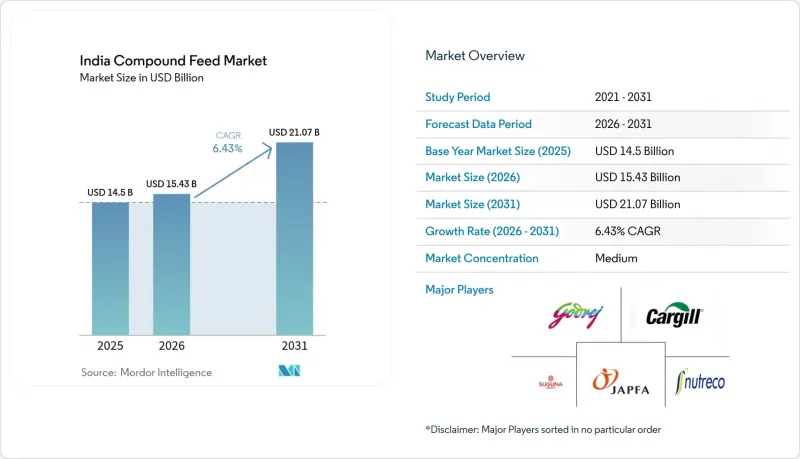
據 Mordor Intelligence 稱,印度複合飼料市場預計到 2026 年價值將達到 154.3 億美元,高於 2025 年的 145 億美元,預計到 2031 年將達到 210.7 億美元。
預計從 2026 年到 2031 年,其複合年成長率將達到 6.43%。
本報告依動物種類(反芻動物、家禽、豬、水產養殖及其他動物種類)及原料(穀物、油籽及粕類、產品及補充品)分類。市場預測以美元計價。
印度複合飼料市場的趨勢與洞察
牲畜數量增加
印度牲畜數量的不斷成長,尤其是家禽和乳牛的牛,推動了對複合飼料的需求,因為傳統的放牧和以作物殘茬為基礎的飼養方式已不足以滿足其營養需求。在家禽業,預計年銷售額將成長8-10%,這主要得益於肉雞數量的增加和蛋雞生產力的提高,而蛋雞的生產力提高需要科學配製的飼料。這種轉變在北方邦和西孟加拉邦等邦尤為顯著,這些小規模農戶正從自給自足的畜牧業轉型為商業性畜牧業。都市化加速了這項轉變,導致牧場面積減少,迫使生產者採用密集飼養方式。政府牲畜普查數據顯示,多種牲畜的數量持續成長,其中乳牛和家禽的成長率最高。飼養密度的增加,加上現代牲畜品種遺傳潛力的提高,使得複合飼料提供的精準營養管理變得特別必要。
對動物性產品的需求增加
印度蛋白質消費量的成長,尤其是在都市區和二線城市,推動了對複合飼料的需求,因為畜牧養殖戶正努力提高動物生產力。印度人均雞蛋供應量從2022-23年度的101枚增加到2023-24年度的103枚。 2024年雞蛋總產量達1,427.7億枚,較2023年成長3.18%。在印度南部和西部地區,需求成長強勁,這得益於完善的零售網路和低溫運輸基礎設施,這些設施促進了畜產品的分銷。年輕消費者對動物性蛋白質的偏好日益成長,顯示消費模式正從傳統模式轉變。加工肉品和乳製品的出口市場也促進了國內生產需求的成長。二線城市居民可支配收入的增加,催生了一群更注重食品品質和安全的消費者,從而促使商業養殖戶更多地採用高品質的複合飼料。
原料成本上漲
關鍵飼料原料,尤其是玉米和大豆粕的價格波動,正給飼料生產商的利潤空間帶來壓力,並給畜牧養殖戶帶來價格挑戰。這些價格波動可能會限制價格敏感族群對複合飼料的採用。玉米價格已大幅上漲,遠超過每公斤20-22盧比的歷史水平,目前已超過每公斤26盧比。這意味著成本增加了20-25%,直接影響飼料配方的獲利能力和終端用戶的採用率。飼料生產商被迫在自行承擔成本和將其轉嫁給資源有限的農民之間做出選擇。一些碾米廠試圖使用碎米和高粱來調整配方,但這通常會導致消化率降低,抵消任何成本節約。酪農合作社為了維持其成員資格,對複合飼料設定了價格上限,迫使生產者降低利潤率。此外,暫時的供不應求導致了投機性囤積,這進一步推高了價格,並打擊了小規模農戶的信心。
細分市場分析
到2025年,家禽養殖業將佔印度複合飼料市場佔有率的44.70%,反映出其在有組織的蛋白質供應鏈中的主導地位。飼料生產商提供針對不同品種的雛雞、育成雞和育肥雞複合飼料,每種飼料都添加了酵素和合成氨基酸,以最佳化飼料轉換率。消費成長與快餐店的擴張密切相關,這迫使綜合水產養殖企業簽訂長期糧食合約。
預計到2031年,印度水產養殖複合飼料市場規模將以9.12%的複合年成長率快速成長,這主要得益於蝦類出口的持續成長以及政府對養殖池塘曝氣設備的補貼。集約化養殖池中日益嚴重的疾病壓力促使養殖戶轉向使用含有免疫增強劑的漂浮擠壓顆粒飼料。技術先進的飼料廠目前正在生產針對幼蟲階段客製化的微顆粒飼料,從而提高了孵化場的存活率。乳牛飼料的採用情況仍參差不齊。有些合作社會採購濃縮複合飼料,但乳牛養殖區的許多小規模農戶仍依賴青飼料和油籽粕的混合飼料。豬飼料的需求具有地域性,主要集中在東北部各邦,因為這些地區對豬肉的食用習性較為普遍。拉賈斯坦邦的肉羊飼料和特倫甘納邦的綿羊育肥顆粒飼料等細分市場也呈現出成長趨勢,這反映了印度複合飼料市場的廣泛適應性。
其他好處:
- Excel格式的市場預測(ME)表
- 3個月的分析師支持
目錄
第1章:引言
- 研究假設和市場定義
- 調查範圍
第2章:調查方法
第3章執行摘要
第4章 市場狀況
- 市場概覽
- 市場促進因素
- 牲畜數量增加
- 動物性產品的需求增加
- 政府支持和舉措
- 二線城市有組織的肉類和乳製品零售市場的發展
- 引進精密送料技術(相容物聯網)
- 擴大國內油籽加工能力
- 市場限制因素
- 原料高成本
- 小規模農戶的意識有限。
- 對不含抗生素的藥品配方制定更嚴格的規定,導致藥品成本上漲。
- 氣候變遷導致供應鏈波動
- 監理情勢
- 技術展望
- 波特五力分析
第5章 市場規模與成長預測
- 依動物類型
- 反芻動物
- 家禽
- 豬
- 水產養殖
- 其他動物類型
- 按成分
- 穀類
- 蛋糕和餐點
- 依產品
- 補充
第6章 競爭情勢
- 市場集中度
- 策略趨勢
- 市佔率分析
- 公司簡介
- Godrej Agrovet Limited
- Cargill Incorporated
- Suguna Group
- PT Japfa Comfeed Indonesia Tbk
- Nutreco NV
- Royal De Heus Group
- Alltech Incorporated
- New Hope Group Co., Ltd
- Archer Daniels Midland Company
- BASF SE
- Avanti Group
第7章 市場機會與未來展望
According to Mordor Intelligence, India compound feed market size in 2026 is estimated at USD 15.43 billion, growing from 2025 value of USD 14.5 billion with 2031 projections showing USD 21.07 billion, growing at 6.43% CAGR over 2026-2031.
This report is Segmented by Animal Type (Ruminants, Poultry, Swine, Aquaculture, and Other Animal Types) and by Ingredients (Cereal, Cakes and Meals, By-Products, and Supplements). The Market Forecasts are Provided in Terms of Value (USD).
India Compound Feed Market Trends and Insights
Rising Livestock Population
The growth of India's livestock population, particularly in poultry and dairy cattle, drives the demand for compound feeds as traditional grazing and crop residue feeding cannot meet nutritional requirements. The poultry sector anticipates 8-10% annual revenue growth, driven by broiler flock expansion and layer productivity improvements that require scientifically formulated feeds. This transition is prominent in states like Uttar Pradesh and West Bengal, where smallholder farmers are moving from subsistence to commercial livestock operations. The shift intensifies as urbanization reduces grazing land availability, compelling producers to adopt intensive feeding systems. Government livestock census data shows consistent herd growth across multiple species, with dairy cattle and poultry demonstrating the highest expansion rates. The combination of higher stocking densities and improved genetic potential in modern livestock breeds requires precision nutrition that compound feeds provide.
Increasing Demand for Animal-Based Products
The increasing protein consumption in India, particularly in urban and tier-II markets, is driving the demand for compound feeds as livestock producers aim to increase animal productivity. India's per capita egg availability rose to 103 eggs per person per year in 2023-24, an increase from 101 eggs in 2022-23. Total egg production grew to 142.77 billion eggs in 2024, showing a 3.18% increase from the previous year 2023 . South and West India demonstrate strong demand growth, supported by organized retail networks and cold-chain infrastructure that facilitate animal product distribution. Younger consumers show increased preference for animal proteins, indicating a shift from traditional consumption patterns. The export market for processed meat and dairy products contributes to higher domestic production requirements. Rising disposable income in tier-II cities has created consumer segments prioritizing food quality and safety, leading to increased adoption of quality compound feeds among commercial producers.
High Costs of Raw Materials
The volatile pricing of key feed ingredients, particularly maize and soybean meal, creates margin pressure for feed manufacturers and affordability challenges for livestock producers. This volatility potentially limits compound feed adoption among price-sensitive segments. Maize prices have exceeded Rs 26 per kg compared to historical ranges of Rs 20-22 per kg, representing a 20-25% cost increase that directly impacts feed formulation economics and end-user adoption rates. Feed producers must either absorb costs or transfer them to farmers with limited resources. While some mills attempt to reformulate using broken rice and sorghum, the reduced digestibility often negates any cost savings. Dairy cooperatives implement price caps on compound feed to retain members, forcing manufacturers to operate on reduced margins. Additionally, spot shortages lead to speculative hoarding, which causes further price increases and reduces confidence among smallholder farmers.
Other drivers and restraints analyzed in the detailed report include:
- Government Support and Initiatives
- Growth Of Organized Retail Meat and Dairy In Tier-II Cities
- Limited Awareness Among Small-Scale Farmers
For complete list of drivers and restraints, kindly check the Table Of Contents.
Segment Analysis
The poultry segment captured 44.70% of the India compound feed market share in 2025, reflecting its dominance in organized protein supply chains. Feed manufacturers offer breed-specific starter, grower, and finisher rations, each fortified with enzymes and synthetic amino acids to optimize feed conversion. Consumption growth aligns with quick-service restaurant expansion, prompting integrators to secure long-term grain contracts.
The India compound feed market size for aquaculture is projected to surge at a 9.12% CAGR through 2031 on the back of shrimp export momentum and government subsidies for pond aeration equipment. Rising disease pressures in intensive ponds are steering farmers toward floating extruded pellets enriched with immune boosters. Technologically advanced mills nowadays produce micro-pellets tailored for larval stages, improving survival rates in hatcheries. Dairy feed adoption remains mixed, organized cooperatives procure compound concentrates, but many smallholders in milk belts still rely on green fodder and oil-cake mixes. Swine feed demand stays regional, concentrated in northeastern states where pork is culturally accepted. Niche growth pockets include meat goat feed in Rajasthan and sheep fattening pellets in Telangana, each reflecting the adaptive breadth within the India compound feed market.
Complete Report Scope:
- By Animal Type
- Ruminants
- Poultry
- Swine
- Aquaculture
- Other Animal Types
- By Ingredient
- Cereals
- Cakes and Meals
- By-Products
- Supplements
List of Companies Covered in this Report:
- Godrej Agrovet Limited
- Cargill Incorporated
- Suguna Group
- PT Japfa Comfeed Indonesia Tbk
- Nutreco N.V.
- Royal De Heus Group
- Alltech Incorporated
- New Hope Group Co., Ltd
- Archer Daniels Midland Company
- BASF SE
- Avanti Group
Additional Benefits:
- The market estimate (ME) sheet in Excel format
- 3 months of analyst support
TABLE OF CONTENTS
1 Introduction
- 1.1 Study Assumptions and Market Definition
- 1.2 Scope of the Study
2 Research Methodology
3 Executive Summary
4 Market Landscape
- 4.1 Market Overview
- 4.2 Market Drivers
- 4.2.1 Rising livestock population
- 4.2.2 Increasing demand for animal-based products
- 4.2.3 Government support and initiatives
- 4.2.4 Growth of organized retail meat and dairy in tier-ii cities
- 4.2.5 Adoption of precision feeding technologies (IOT-enabled)
- 4.2.6 Expansion of domestic oilseed processing capacity
- 4.3 Market Restraints
- 4.3.1 High costs of raw materials
- 4.3.2 Limited awareness among small-scale farmers
- 4.3.3 Stricter antibiotic-free regulations are elevating formulation cost
- 4.3.4 Climate-linked supply chain volatility
- 4.4 Regulatory Landscape
- 4.5 Technological Outlook
- 4.6 Porter's Five Forces Analysis
- 4.6.1 Bargaining Power of Suppliers
- 4.6.2 Bargaining Power of Buyers/Consumers
- 4.6.3 Threat of New Entrants
- 4.6.4 Threat of Substitute Products
- 4.6.5 Intensity of Competitive Rivalry
5 Market Size and Growth Forecasts (Value)
- 5.1 By Animal Type
- 5.1.1 Ruminants
- 5.1.2 Poultry
- 5.1.3 Swine
- 5.1.4 Aquaculture
- 5.1.5 Other Animal Types
- 5.2 By Ingredient
- 5.2.1 Cereals
- 5.2.2 Cakes and Meals
- 5.2.3 By-Products
- 5.2.4 Supplements
6 Competitive Landscape
- 6.1 Market Concentration
- 6.2 Strategic Moves
- 6.3 Market Share Analysis
- 6.4 Company Profiles (includes Global Level Overview, Market Level Overview, Core Segments, Financials as available, Strategic Information, Market Rank/Share for Key Companies, Products and Services, and Recent Developments)
- 6.4.1 Godrej Agrovet Limited
- 6.4.2 Cargill Incorporated
- 6.4.3 Suguna Group
- 6.4.4 PT Japfa Comfeed Indonesia Tbk
- 6.4.5 Nutreco N.V.
- 6.4.6 Royal De Heus Group
- 6.4.7 Alltech Incorporated
- 6.4.8 New Hope Group Co., Ltd
- 6.4.9 Archer Daniels Midland Company
- 6.4.10 BASF SE
- 6.4.11 Avanti Group
7 Market Opportunities and Future Outlook

 南美洲複合飼料:市場佔有率分析、產業趨勢與統計、成長預測(2026-2031)
 複合飼料市場-2026-2032年全球市場預測複合飼料:市場佔有率分析、產業趨勢與統計、成長預測(2026-2031)歐洲複合飼料:市場佔有率分析、行業趨勢和統計數據、成長預測(2026-2031)德國複合飼料:市場佔有率分析、行業趨勢和統計數據、成長預測(2026-2031)
 全球複合飼料市場
 複合飼料市場:依原料種類、動物種類及地區分類
 全球配方飼料市場規模、佔有率、趨勢和成長分析報告(2026-2034年)複合飼料市場規模、佔有率、成長及全球產業分析:按類型、應用和地區分類,並預測至2026-2034年
 配方飼料市場規模、佔有率和成長分析(按成分、添加劑、牲畜、形態、來源和地區分類)-產業預測,2026-2033年