


 |
市場調查報告書
商品編碼
2113342
歐洲複合飼料:市場佔有率分析、行業趨勢和統計數據、成長預測(2026-2031)Europe Compound Feed - Market Share Analysis, Industry Trends & Statistics, Growth Forecasts (2026 - 2031) |
||||||

※ 本網頁內容可能與最新版本有所差異。詳細情況請與我們聯繫。
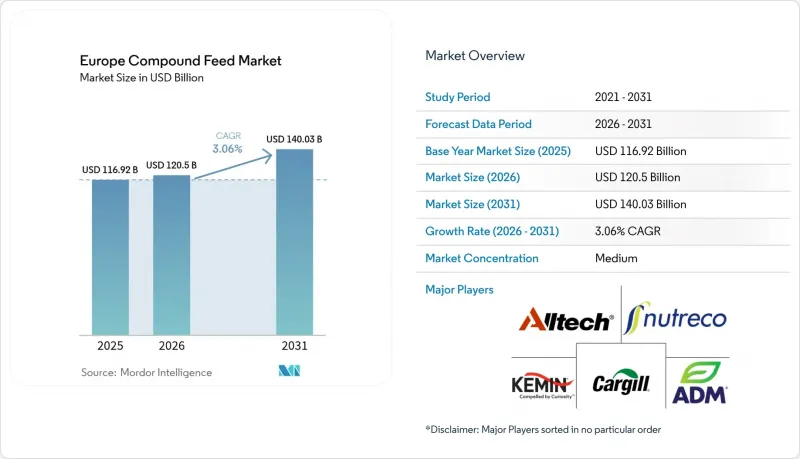
根據 Mordor Intelligence 預測,歐洲複合飼料市場規模將從 2025 年的 1,169.2 億美元成長到 2026 年的 1,205 億美元,然後在 2031 年達到 1,400.3 億美元,2026 年至 2031 年的複合年成長率為 3.06%。
本報告按動物類型(反芻動物、家禽、豬及其他)、原料類型(穀物、副產品及其他)、形態(粉狀、顆粒狀、碎粒狀及其他)和地區(法國、德國、義大利、英國及其他)進行細分。市場預測以價值(美元)和數量(噸)表示。
歐洲複合飼料市場的趨勢與洞察
肉品消費量增加和對動物性蛋白質的需求上升
2024年,人均禽肉消費量增加至24.8公斤,而豬肉消費量維持穩定在32.4公斤。這兩個因素共同支撐了歐洲複合飼料市場的基本需求,即便都市區正轉向植物來源替代品。隨著波蘭和羅馬尼亞收入的成長,消費模式正從加工肉品轉向新鮮雞肉和高價值豬肉,這兩種肉類都需要更高的氨基酸濃度和酵素補充劑才能達到嚴格的飼料轉換率目標。在西班牙,對北非和中東出口的增加推動了2024年肉雞產量增加4.2%,抵消了因控制非洲豬瘟而導致的德國豬肉產量下降2.1%。水產養殖是第三大支柱,預計2024年鮭魚和鱒魚產量將達到280萬噸,從而催生了對高品質海洋飼料的需求,而海洋飼料的價格比陸生複合飼料高出20-30%。歐洲複合飼料市場向高附加價值蛋白轉型,迫使生產商投資於微量元素稱重和液體添加設備。這使得酵素、有機酸、精油和其他成分能夠以低於0.5%的濃度均勻分散,而這對於普通飼料生產商來說難以實現。雖然此類投資會增加資本密集度,但供應商可以透過實際有效的績效提升來維持利潤率,從而推動市場轉向品質主導競爭。
一體化製造商對生產能力的策略性投資
2024年,一體化飼料公司在西班牙、波蘭和德國運作了18家飼料廠,年加工能力增加320萬噸,旨在確保獲利能力並加強生物安全。嘉吉公司對其克雷費爾德工廠進行了升級改造,引入了精密研磨技術和包埋丁酸,目標是將飼料轉換率提高到1.85,並力爭將育肥成本降低每公斤活重0.09美元(0.08歐元)。隨後,For Farmers公司在波蘭運作了一家年產能24萬噸的工廠,配備了近紅外線分析儀,將營養成分的波動性降低了40%。獨立飼料生產商則透過建立聯合採購系統和引入模組化擠壓生產線來保持競爭力,這些生產線可以快速切換用於家禽、豬和水產養殖的飼料。大量新增的實體投資集中在小麥和大麥產區,例如法國的博塞平原和德國的下薩克森州,降低了糧食運輸和物流成本。這些策略舉措凸顯了參與企業歐洲複合飼料市場的企業如何競相確保高品質的糧食供應管道,並建立靈活的生產能力,以便快速調整配方。
穀物和油籽價格波動
2024年,乾旱導致法國和德國小麥減產820萬噸,歐洲小麥平均價格跌至每噸262.10美元(每噸245歐元)。同時,大豆粕價格一度飆升至每噸518.90美元(每噸485歐元),隨後隨著南美供應趨於穩定,價格回落至每噸449.40美元(每噸420歐元)。缺乏避險手段的小規模工廠受到的衝擊最大,進一步加速了糧食貿易和倉儲業務向大規模合作社轉移的結構性轉變。為應對這一局面,飼料生產商提高了混合飼料中菜籽粕和葵花籽粕的比例,但由於氨基酸濃度降低,需要添加合成離胺酸和甲硫胺酸,導致補充劑支出增加。鑑於利率已居高不下,企業不得不增加安全庫存,佔用了大量營運資金。因此,歐洲複合飼料市場的飼料買家面臨著價格波動和營養風險之間的權衡,儘管需要更多酵素才能有效利用小麥的能量,但對本地產穀物的興趣仍在成長。在黑海地區的物流恢復正常且氣候變遷緩解之前,原物料價格的波動可能會繼續阻礙短期成長。
細分市場分析
2025年,家禽飼料在歐洲複合飼料市場仍佔40.55%的佔有率。家禽飼料受益於更精細的研磨過程以及木聚醣酶和澱粉酶的添加,這些過程提高了澱粉的消化率,並抵消了小麥含量較高的問題。豬飼料正在緩慢復甦,而反芻動物飼料的出貨量則因符合甲烷和氨排放減排目標的牲畜數量減少而下降了1.2%。預計到2031年,水產養殖飼料將以5.82%的複合年成長率達到最高成長。這主要得益於挪威和蘇格蘭鮭魚以及地中海鱸魚和鯛魚對富含魚粉的複合飼料的需求,這些魚類通常含有25-35%的海洋蛋白。隨著荷蘭和西班牙循環水產養殖系統的擴張,對高消化率和蝦青素著色劑的需求日益成長,蝦飼料的需求也隨之進一步攀升。
粒徑小於1毫米且在水中能穩定保存兩小時的微型顆粒飼料的需求日益成長,正在改變鮭魚幼苗和蝦苗孵化場的設備訂單。德國和丹麥的養豬戶正在轉向液態飼餵系統,將乾飼料與乳清和麵包製作副產品混合使用,從而降低成本。反芻動物飼料中添加了3-硝基氧丙醇等甲烷阻斷劑,雖然這會增加成本,但也帶來了排碳權支付的機會。因此,飼料類型的多樣化正在影響資本投資,飼料廠正在部署靈活的生產線,可以交替生產高密度魚飼料和傳統顆粒飼料,以維持運轉率。
其他好處
- Excel格式的市場預測(ME)表
- 3個月的分析師支持
目錄
第1章:引言
- 研究假設和市場定義
- 調查範圍
第2章:調查方法
第3章執行摘要
第4章 市場狀況
- 市場概覽
- 市場促進因素
- 肉品消費量增加和對動物性蛋白質的需求上升
- 一體化製造商對生產能力的策略性投資
- 人們對能夠提高飼料轉換率和改善腸道環境的添加劑越來越感興趣。
- 歐盟的「綠色交易」旨在推廣低碳畜牧業。
- 在飼料配方中引入數位孿生技術
- 昆蟲粉在複合飼料中的應用日益廣泛
- 市場限制因素
- 穀物和油籽價格波動
- 加強對無抗生素實務的監管
- 向植物來源飲食的轉變正在加速。
- 歐盟在批准新飼料方面,協調一致的進展緩慢。
- 監理情勢
- 技術展望
- 波特五力分析
第5章 市場規模與成長預測
- 依動物類型
- 反芻動物
- 肉牛
- 乳牛
- 其他反芻動物
- 家禽
- 肉雞
- 產蛋母雞
- 其他家禽
- 豬
- 水產養殖
- 魚
- 蝦
- 其他養殖物種
- 其他動物類型
- 反芻動物
- 依原料類型
- 穀類
- 油渣/油粉
- 依產品
- 補充
- 維他命
- 胺基酸
- 酵素
- 益生元和益生菌
- 酸味劑
- 其他補充劑
- 按形式
- 搗碎
- 顆粒
- 崩潰
- 微顆粒
- 按地區
- 西班牙
- 英國
- 法國
- 德國
- 俄羅斯
- 義大利
- 其他歐洲國家
第6章 競爭情勢
- 市場集中度
- 策略趨勢
- 市佔率分析
- 公司簡介
- Cargill, Incorporated
- Alltech
- Archer Daniels Midland Company
- Nutreco NV
- ForFarmers NV
- Royal De Heus BV
- AB Agri Ltd.(Associated British Foods plc)
- Danish Agro amba
- Agrifirm Group
- DLG Group
- Sodrugestvo Group SA
- Miavit GmbH
- Veronesi Mangimi(Gruppo Veronesi)
- Sanders Nutrition Animale(Avril SCA)
- Le Gouessant Cooperative
第7章 市場機會與未來展望
According to Mordor Intelligence, the Europe compound feed market size is expected to grow from USD 116.92 billion in 2025 to USD 120.5 billion in 2026 and is forecast to reach USD 140.03 billion by 2031 at 3.06% CAGR over 2026-2031.
This report is Segmented by Animal Type (Ruminants, Poultry, Swine, and More), by Ingredient Type (Cereals, By-Products, and More), by Form (Mash, Pellets, Crumbles, and More), and by Geography (France, Germany, Italy, United Kingdom, and More). The Market Forecasts are Provided in Terms of Value (USD) and Volume (Metric Tons).
Europe Compound Feed Market Trends and Insights
Rising Meat Consumption and Animal Protein Demand
Poultry intake climbed to 24.8 kilograms per capita in 2024 while pork remained steady at 32.4 kilograms, together safeguarding basal demand for Europe compound feed market supplies despite urban shifts toward plant alternatives. Rising incomes in Poland and Romania are shifting consumption from processed meats toward fresh poultry and value-added pork, both of which rely on higher amino acid densities and enzyme enrichment to meet tight feed conversion targets. Spain lifted broiler output 4.2% in 2024 on export gains to North Africa and the Middle East, offsetting a 2.1% decline in German pork linked to African swine fever containment. Aquaculture is acting as a third anchor, with salmon and trout volumes reaching 2.8 million metric tons in 2024 and demanding premium marine-ingredient rations that cost 20 to 30% more than terrestrial formulas. The pivot toward higher value proteins is forcing mills in the Europe compound feed market to invest in micro-ingredient dosing and liquid application equipment so that enzymes, organic acids, and essential oils are dispersed at below 0.5% inclusion with uniformity that commodity producers struggle to match. Those upgrades increase capital intensity, yet enable suppliers to defend their margins through demonstrated performance improvements, reinforcing the market's transition toward quality-led competition.
Strategic Production Capacity Investments by Integrators
During 2024, integrators commissioned eighteen new feed mills across Spain, Poland, and Germany, adding 3.2 million metric tons of annual throughput aimed at securing margins and enhancing biosecurity. Cargill's upgrade in Krefeld introduced precision grinding and encapsulated butyric acid, targeting a 1.85 feed conversion ratio and lowering grow-out costs by USD 0.09 (EUR 0.08) per kilogram of liveweight. ForFarmers followed with a 240,000 metric tons Polish plant equipped with near-infrared analyzers that trim nutrient variance by 40%. Independent mills are attempting to remain relevant by forming purchasing pools and installing modular extrusion lines that are capable of switching quickly between poultry, swine, and aquaculture diets. Most new brick-and-mortar investments are clustered in wheat and barley belts, such as the Beauce plain in France and Lower Saxony in Germany, which cuts inbound grain logistics costs. These strategic moves underscore how Europe compound feed market participants are racing to secure quality grain pipelines and build flexible capacity that can reformulate quickly.
Volatility in Cereal and Oilseed Prices
European wheat averaged USD 262.1 per metric ton (EUR 245 per metric ton) in 2024 after drought cut French and German harvests by 8.2 million metric tons, while soybean meal peaked at USD 518.9 per metric ton (EUR 485 per metric ton) before easing to USD 449.4 per metric ton (EUR 420 per metric ton) as South American supply stabilized. Smaller plants, lacking hedging tools, were hit hardest, amplifying the structural shift toward large cooperatives that operate grain desks and storage silos. Formulators responded by increasing the shares of rapeseed and sunflower meal, yet the lower amino-acid density required additional synthetic lysine and methionine, thereby increasing supplement expenditure. The need to carry higher safety stocks tied up working capital at a time when interest rates were already elevated. Feed buyers in the European compound feed market, therefore, are confronted with a trade-off between price volatility and nutrient risk, prompting greater interest in locally grown cereals, despite the need for more enzymes to unlock wheat energy. Until Black Sea logistics normalize and climate volatility subsides, raw material swings will continue to weigh on near-term growth.
Other drivers and restraints analyzed in the detailed report include:
- Increasing Focus on Feed Efficiency and Gut-Health Additives
- European Union Green Deal Pushes for Low-Carbon Livestock Production
- Stricter Antibiotic-Free Regulations
For complete list of drivers and restraints, kindly check the Table Of Contents.
Segment Analysis
Poultry preserved a 40.55% share of the Europe compound feed market size in 2025. Poultry blends benefit from finer grinding, as well as the addition of xylanase and amylase, which enhance starch digestibility and offset the higher inclusion of wheat. Swine recovers modestly while ruminant tonnage contracts 1.2% amid herd reductions driven by methane and ammonia targets. Aquaculture feeds are projected to grow at the fastest 5.82% CAGR through 2031, driven by the demand for fishmeal-rich formulas, which are required for Norwegian and Scottish salmon, as well as Mediterranean seabass and seabream, which typically contain 25 to 35% marine protein. Shrimp diets add even more momentum, as the Netherlands and Spain expand recirculating systems that need high digestibility and astaxanthin pigmentation.
Rising demand for micro-pellets measuring less than one millimeter, with two-hour water stability, is reshaping equipment orders across mills that serve salmon smolt and shrimp hatcheries. Swine producers in Germany and Denmark are transitioning to liquid feeding systems that combine dry feed with whey and bakery co-products, reducing costs. In ruminant feed, methane blockers such as 3-nitrooxypropanol are being incorporated at an additional cost, while also providing access to carbon credit payments. As a result, species diversification is influencing capital investments, with feed mills installing flexible production lines that can alternate between high-density fish feed and traditional pellets to maintain utilization rates.
Complete Report Scope:
- By Animal Type
- Ruminants
- Beef Cattle
- Dairy Cattle
- Other Ruminants
- Poultry
- Broiler
- Layer
- Other Poultry
- Swine
- Aquaculture
- Fish
- Shrimp
- Other Aquaculture Species
- Other Animal Types
- Ruminants
- By Ingredient Type
- Cereals
- Cakes and Meals
- By-products
- Supplements
- Vitamins
- Amino Acids
- Enzymes
- Prebiotics and Probiotics
- Acidifiers
- Other Supplements
- By Form
- Mash
- Pellets
- Crumbles
- Micro-Pellets
- By Geography
- Spain
- United Kingdom
- France
- Germany
- Russia
- Italy
- Rest of Europe
List of Companies Covered in this Report:
- Cargill, Incorporated
- Alltech
- Archer Daniels Midland Company
- Nutreco N.V.
- ForFarmers N.V.
- Royal De Heus B.V.
- AB Agri Ltd. (Associated British Foods plc)
- Danish Agro a.m.b.a.
- Agrifirm Group
- DLG Group
- Sodrugestvo Group S.A.
- Miavit GmbH
- Veronesi Mangimi (Gruppo Veronesi)
- Sanders Nutrition Animale (Avril SCA)
- Le Gouessant Cooperative
Additional Benefits:
- The market estimate (ME) sheet in Excel format
- 3 months of analyst support
TABLE OF CONTENTS
1 Introduction
- 1.1 Study Assumptions and Market Definition
- 1.2 Scope of the Study
2 Research Methodology
3 Executive Summary
4 Market Landscape
- 4.1 Market Overview
- 4.2 Market Drivers
- 4.2.1 Rising meat consumption and animal protein demand
- 4.2.2 Strategic production capacity investments by integrators
- 4.2.3 Increasing focus on feed efficiency and gut-health additives
- 4.2.4 European Union Green Deal pushes for low-carbon livestock production
- 4.2.5 Digital twin adoption in feed formulation
- 4.2.6 Expansion of insect-meal inclusion in compound feed
- 4.3 Market Restraints
- 4.3.1 Volatility in cereal and oilseed prices
- 4.3.2 Stricter antibiotic-free regulations
- 4.3.3 Accelerating shift toward plant-based diets
- 4.3.4 Slow harmonization of European Union novel-feed approvals
- 4.4 Regulatory Landscape
- 4.5 Technological Outlook
- 4.6 Porter's Five Forces Analysis
- 4.6.1 Bargaining Power of Buyers
- 4.6.2 Bargaining Power of Suppliers
- 4.6.3 Threat of New Entrants
- 4.6.4 Threat of Substitute Products
- 4.6.5 Intensity of Competitive Rivalry
5 Market Size and Growth Forecasts (Value and Volume)
- 5.1 By Animal Type
- 5.1.1 Ruminants
- 5.1.1.1 Beef Cattle
- 5.1.1.2 Dairy Cattle
- 5.1.1.3 Other Ruminants
- 5.1.2 Poultry
- 5.1.2.1 Broiler
- 5.1.2.2 Layer
- 5.1.2.3 Other Poultry
- 5.1.3 Swine
- 5.1.4 Aquaculture
- 5.1.4.1 Fish
- 5.1.4.2 Shrimp
- 5.1.4.3 Other Aquaculture Species
- 5.1.5 Other Animal Types
- 5.1.1 Ruminants
- 5.2 By Ingredient Type
- 5.2.1 Cereals
- 5.2.2 Cakes and Meals
- 5.2.3 By-products
- 5.2.4 Supplements
- 5.2.4.1 Vitamins
- 5.2.4.2 Amino Acids
- 5.2.4.3 Enzymes
- 5.2.4.4 Prebiotics and Probiotics
- 5.2.4.5 Acidifiers
- 5.2.4.6 Other Supplements
- 5.3 By Form
- 5.3.1 Mash
- 5.3.2 Pellets
- 5.3.3 Crumbles
- 5.3.4 Micro-Pellets
- 5.4 By Geography
- 5.4.1 Spain
- 5.4.2 United Kingdom
- 5.4.3 France
- 5.4.4 Germany
- 5.4.5 Russia
- 5.4.6 Italy
- 5.4.7 Rest of Europe
6 Competitive Landscape
- 6.1 Market Concentration
- 6.2 Strategic Moves
- 6.3 Market Share Analysis
- 6.4 Company Profiles (Includes Global-Level Overview, Market-Level Overview, Core Segments, Financials as Available, Strategic Information, Market Rank/Share for Key Companies, Products and Services, and Recent Developments)
- 6.4.1 Cargill, Incorporated
- 6.4.2 Alltech
- 6.4.3 Archer Daniels Midland Company
- 6.4.4 Nutreco N.V.
- 6.4.5 ForFarmers N.V.
- 6.4.6 Royal De Heus B.V.
- 6.4.7 AB Agri Ltd. (Associated British Foods plc)
- 6.4.8 Danish Agro a.m.b.a.
- 6.4.9 Agrifirm Group
- 6.4.10 DLG Group
- 6.4.11 Sodrugestvo Group S.A.
- 6.4.12 Miavit GmbH
- 6.4.13 Veronesi Mangimi (Gruppo Veronesi)
- 6.4.14 Sanders Nutrition Animale (Avril SCA)
- 6.4.15 Le Gouessant Cooperative
7 Market Opportunities and Future Outlook

 南美洲複合飼料:市場佔有率分析、產業趨勢與統計、成長預測(2026-2031)印度複合飼料:市場佔有率分析、行業趨勢和統計數據、成長預測(2026-2031)
 複合飼料市場-2026-2032年全球市場預測複合飼料:市場佔有率分析、產業趨勢與統計、成長預測(2026-2031)德國複合飼料:市場佔有率分析、行業趨勢和統計數據、成長預測(2026-2031)
 全球複合飼料市場
 複合飼料市場:依原料種類、動物種類及地區分類
 全球配方飼料市場規模、佔有率、趨勢和成長分析報告(2026-2034年)複合飼料市場規模、佔有率、成長及全球產業分析:按類型、應用和地區分類,並預測至2026-2034年
 配方飼料市場規模、佔有率和成長分析(按成分、添加劑、牲畜、形態、來源和地區分類)-產業預測,2026-2033年