


 |
市場調查報告書
商品編碼
2113619
南美洲飼料酵母:市場佔有率分析、產業趨勢與統計及成長預測(2026-2031 年)South America Feed Yeast - Market Share Analysis, Industry Trends & Statistics, Growth Forecasts (2026 - 2031) |
||||||

※ 本網頁內容可能與最新版本有所差異。詳細情況請與我們聯繫。
預計到 2026 年,南美洲飼料酵母市值將達到 4.8515 億美元,從 2025 年的 4.5 億美元成長到 2031 年的 7.0682 億美元。
預計 2026 年至 2031 年的複合年成長率為 7.81%。
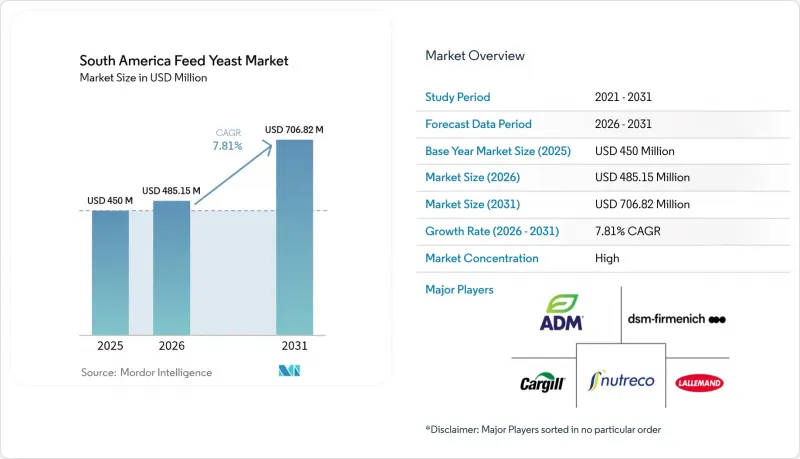
本報告依產品類型(活性酵母、廢酵母等)、劑型(活性產品、即溶產品等)、動物種類(反芻動物、家禽等)、功能用途(腸道健康/免疫力、生長表現、緩解熱壓力等)及地區(巴西、阿根廷、秘魯等)分類。市場預測以美元計價。
南美洲飼料酵母市場趨勢與洞察
提高畜牧業產量
南美洲在全球動物性蛋白質生產的佔有率持續成長。 2000年至2018年間,該地區家禽產量加倍多,豬肉產量增加了64.3%。光是巴西目前每年就消耗25.39億蒲式耳飼料玉米,凸顯了生產商迫切需要提高生產效率。各國飼料協會預測,2025年,南美洲的飼料需求將進一步成長,巴西的雞肉出口預計將成長1.9%。隨著產量的成長,人們對能夠改善腸道健康和提高飼料轉換率的酵母補充劑的興趣也日益濃厚。因此,隨著畜禽數量的持續成長,南美洲飼料酵母市場的需求將維持結構性的下限。
巴西和智利禽肉出口蓬勃發展
以出口主導的一體化企業必須符合美國和歐盟買家設定的零殘留標準。像Agrosuper這樣的智利垂直整合企業也積極開拓高階出口細分市場,這些市場重視天然飼料原料。由於巴西的糧食產量持續維持在歷史高點,各企業正致力於確保穩定的原料供應,以掌握中美貿易流向轉變帶來的機會。在這個高階市場,酵母的利潤率高於合成生長促進劑,這進一步增強了南美飼料酵母市場的成長前景。
發酵和乾燥設備方面前期投入巨大。
建造一座符合GMP標準的酵母生產廠需要耗資數千萬美元。 DSM-Firmenich位於塞特拉戈阿斯的工廠就清楚地展現了新參與企業必須克服的資金障礙。此外,巴西58個碼頭需要進行疏浚工程以適應巴拿馬型超大型船舶的停靠,港口維修也需要額外的支出。這些因素阻礙了新企業的進入,並維持了現有企業在南美洲飼料酵母市場的主導地位。
細分市場分析
至2025年,活酵母將佔南美飼料酵母市場最大佔有率,銷售額達42.10%。生產商高度重視其在瘤胃發酵和病原體清除方面的顯著功效。酵母衍生物雖然市場規模仍較小,但由於富含BETA-聚葡萄糖(可吸附黃麴毒素B1並改善肉雞絨毛高度),正以10.79%的複合年成長率快速成長。到2025年,廢棄啤酒酵母將憑藉其低廉的投入成本佔據28.30%的市場佔有率,而乾燥的惰性酵母將佔據15.70%的市場佔有率,主要用於水產養殖飼料。
高硒酵母正受到廣泛關注,預計年成長率將達到9.38%,因為飼料生產商正將微量營養素的供應與益生菌功效相結合。改質BETA-D-聚葡萄糖能夠有效捕捉Zearalenone和T-2毒素。供應商若能提供多功能衍生產品,便可搶佔南美飼料酵母市場的高階細分領域,並加強其向高價值單品的轉換。
由於配方簡便、保存期限長,即溶酵母在2025年仍維持45.60%的銷售佔有率。該細分市場支撐著巴西和阿根廷對飼料預混合料的基本需求。液態漿料市場表現特別強勁,預計到2031年將以每年11.27%的速度成長,因為自動化工廠對微量添加且無粉塵損失的產品提出了更高的要求。活性酵母在對活性要求較高的應用中仍保持著24.80%的市場佔有率,但由於冷藏物流的限制,其向附近農場的供應範圍有限。
液態酵母產品的成長動能源自於一項發現:液態布拉氏酵母菌能夠降低肥育豬的熱壓力指標,此外,其添加的穩定劑還能將保存期限延長至90天以上。擁有成熟的無菌包裝和低溫運輸物流系統的供應商可以充分利用南美飼料酵母市場快速成長的管道。
其他好處:
- Excel格式的市場預測(ME)表
- 3個月的分析師支持
目錄
第1章:引言
- 研究假設和市場定義
- 調查範圍
第2章:調查方法
第3章執行摘要
第4章 市場狀況
- 市場概覽
- 市場促進因素
- 畜牧業生產增加
- 巴西和智利禽肉出口激增。
- 禁止使用抗生素生長促進劑(AGP)
- 對天然添加劑永續性的承諾
- 甘蔗乙醇生產的副產品使得低成本單細胞酵母的生產成為可能。
- 強制要求肉類加工商在飼料和溯源方面使用區塊鏈技術。
- 市場限制因素
- 發酵和乾燥過程所需的初始資本投資相對較高。
- 糖蜜和玉米糖漿價格波動趨勢
- 與細菌來源的益生菌和酵素的競爭
- 亞馬遜河和拉普拉塔河沿岸港口的物流瓶頸
- 監理情勢
- 技術展望
- 波特五力分析
第5章 市場規模與成長預測
- 依產品類型
- 新鮮酵母
- 用過的酵母
- 乾酵母/惰性酵母
- 酵母衍生成分(BETA-葡聚醣、甘露寡糖等)
- 高硒酵母
- 其他
- 按形式
- 活躍(濕潤)
- 立即的
- 新鮮蛋糕
- 液態漿
- 依動物類型
- 反芻動物
- 家禽
- 豬
- 水產養殖
- 伴侶動物(寵物)
- 功能用途
- 腸道健康與免疫力
- 成長表現
- 黴菌毒素結合
- 緩解熱應激
- 其他
- 按地區
- 巴西
- 阿根廷
- 智利
- 秘魯
- 哥倫比亞
- 其他南美國家
第6章 競爭情勢
- 市場集中度
- 策略趨勢
- 市佔率分析
- 公司簡介
- Archer Daniels Midland Company
- Cargill, Incorporated
- Lallemand Inc.
- dsm-firmenich AG
- Nutreco NV(SHV Holdings)
- Alltech, Inc.
- Lesaffre et Compagnie SA
- Kemin Industries, Inc.
- ICC Brazil
- Evonik Industries AG
- Provita Supplements SAS
第7章 市場機會與未來展望
According to Mordor Intelligence, south american feed yeast market size in 2026 is estimated at USD 485.15 million, growing from 2025 value of USD 450 million with 2031 projections showing USD 706.82 million, growing at 7.81% CAGR over 2026-2031.
This report is Segmented by Product Type (Live Cell Yeast, Spent Yeast, and More), by Form (Active, Instant, and More), by Animal Type (Ruminant, Poultry, and More), by Functional Objective (Gut Health and Immunity, Growth Performance, Heat-Stress Mitigation, and More), and by Geography (Brazil, Argentina, Peru, and More). The Market Forecasts are Provided in Terms of Value (USD).
South America Feed Yeast Market Trends and Insights
Growing Livestock Production Volumes
South America's share of global animal protein output keeps climbing. Between 2000 and 2018 regional poultry tonnage more than doubled, while pork output rose 64.3%. Brazil alone now consumes 2,539 million bushels of corn annually for feed, underscoring the scale at which producers are searching for efficiency boosters. National feed associations forecast further expansion in 2025, with chicken exports from Brazil projected to rise by 1.9%. Those volumes amplify interest in yeast supplements that improve gut integrity and feed conversion. The South American feed yeast market, therefore, gains a structural demand floor as herd and flock sizes climb.
Poultry-Export Boom from Brazil and Chile
Export-driven integrators must satisfy residue-free protocols set by buyers in the United States and the European Union. Chile's vertically integrated firms, such as Agrosuper, also chase premium export niches that reward natural feed profiles. As Brazil's grain output stays on a record-setting path, companies lock in raw material security to capitalize on shifting U.S.-China trade flows. In this premium channel, yeast commands higher margins than synthetic growth promoters, reinforcing the growth outlook for the South American feed yeast market.
High Upfront Fermentation and Drying CAPEX
Greenfield yeast plants that meet GMP standards cost tens of millions of USD. DSM-Firmenich's facility in Sete Lagoas illustrates the capital hurdle newcomers must clear. Port upgrade needs to add further spending as 58 Brazilian terminals require dredging for post-Panamax traffic. These factors deter entrants and preserve incumbent power within the South American feed yeast market.
Other drivers and restraints analyzed in the detailed report include:
- Ban on Antibiotic Growth Promoters (AGPs)
- Sustainability Push Toward Natural Additives
- Volatile Molasses and Corn Syrup Pricing
For complete list of drivers and restraints, kindly check the Table Of Contents.
Segment Analysis
Live cell yeast generated the largest slice of the South American feed yeast market size in 2025, accounting for 42.10% of sales. Producers favor its proven benefits in rumen fermentation and pathogen exclusion. Yeast derivatives, though still a smaller base, are accelerating at a 10.79% CAGR thanks to Beta-glucan-rich fractions that bind aflatoxin B1 and improve villus height in broilers. In 2025, spent brewer's yeast supplied a 28.30% share, leveraged by low input costs, while dry inactive formats provided a 15.70% share, mainly to aquafeed.
Looking ahead, high-selenium yeast is gaining traction, growing 9.38% annually as integrators bundle micronutrient delivery with probiotic action. Modified Beta-D-glucans now capture zearalenone and T-2 toxin efficiently. Suppliers responding with multi-functional derivatives can capture premium niches and reinforce conversion to value-added SKUs in the South American feed yeast market.
Instant yeast maintained 45.60% of 2025 revenue due to ease of batching and long shelf life. The segment anchors baseline demand for feed premixes across Brazil and Argentina. Liquid slurry is the star performer, forecast to expand 11.27% annually through 2031 as automated mills seek micro-dosing accuracy without dust loss. Active wet yeast still holds a 24.80% share for high-viability uses, though chilled logistics limit its reach to nearby farms.
Liquid's momentum stems from stabilizers that extend viability beyond 90 days, and findings that liquid Saccharomyces boulardii reduces heat-stress markers in finishing pigs. Suppliers that master aseptic packaging and cold chain distribution can tap the fast-growing channel inside the South American feed yeast market.
Complete Report Scope:
- By Product Type
- Live Cell Yeast
- Spent Yeast
- Dry/Inactive Yeast
- Yeast Derivatives (Beta-glucan, MOS, etc.)
- High-Selenium Yeast
- Others
- By Form
- Active (Wet)
- Instant
- Fresh Cake
- Liquid Slurry
- By Animal Type
- Ruminant
- Poultry
- Swine
- Aquaculture
- Companion Animals (Pets)
- By Functional Objective
- Gut Health and Immunity
- Growth Performance
- Mycotoxin Binding
- Heat-Stress Mitigation
- Others
- By Geography
- Brazil
- Argentina
- Chile
- Peru
- Colombia
- Rest of South America
List of Companies Covered in this Report:
- Archer Daniels Midland Company
- Cargill, Incorporated
- Lallemand Inc.
- dsm-firmenich AG
- Nutreco N.V. (SHV Holdings)
- Alltech, Inc.
- Lesaffre et Compagnie S.A.
- Kemin Industries, Inc.
- ICC Brazil
- Evonik Industries AG
- Provita Supplements S.A.S
Additional Benefits:
- The market estimate (ME) sheet in Excel format
- 3 months of analyst support
TABLE OF CONTENTS
1 Introduction
- 1.1 Study Assumptions and Market Definition
- 1.2 Scope of the Study
2 Research Methodology
3 Executive Summary
4 Market Landscape
- 4.1 Market Overview
- 4.2 Market Drivers
- 4.2.1 Growing livestock production volumes
- 4.2.2 Poultry-export boom from Brazil and Chile
- 4.2.3 Ban on antibiotic growth promoters (AGPs)
- 4.2.4 Sustainability push toward natural additives
- 4.2.5 Sugarcane-ethanol sidestreams enabling low-cost single-cell yeast
- 4.2.6 Blockchain feed-traceability mandates by meat packers
- 4.3 Market Restraints
- 4.3.1 High upfront fermentation and drying CAPEX
- 4.3.2 Volatile molasses and corn syrup pricing
- 4.3.3 Competition from bacterial probiotics and enzymes
- 4.3.4 Logistics chokepoints at Amazonian and Plata ports
- 4.4 Regulatory Landscape
- 4.5 Technological Outlook
- 4.6 Porter's Five Forces Analysis
- 4.6.1 Bargaining Power of Suppliers
- 4.6.2 Bargaining Power of Buyers
- 4.6.3 Threat of New Entrants
- 4.6.4 Threat of Substitutes
- 4.6.5 Intensity of Competitive Rivalry
5 Market Size and Growth Forecasts (Value)
- 5.1 By Product Type
- 5.1.1 Live Cell Yeast
- 5.1.2 Spent Yeast
- 5.1.3 Dry/Inactive Yeast
- 5.1.4 Yeast Derivatives (Beta-glucan, MOS, etc.)
- 5.1.5 High-Selenium Yeast
- 5.1.6 Others
- 5.2 By Form
- 5.2.1 Active (Wet)
- 5.2.2 Instant
- 5.2.3 Fresh Cake
- 5.2.4 Liquid Slurry
- 5.3 By Animal Type
- 5.3.1 Ruminant
- 5.3.2 Poultry
- 5.3.3 Swine
- 5.3.4 Aquaculture
- 5.3.5 Companion Animals (Pets)
- 5.4 By Functional Objective
- 5.4.1 Gut Health and Immunity
- 5.4.2 Growth Performance
- 5.4.3 Mycotoxin Binding
- 5.4.4 Heat-Stress Mitigation
- 5.4.5 Others
- 5.5 By Geography
- 5.5.1 Brazil
- 5.5.2 Argentina
- 5.5.3 Chile
- 5.5.4 Peru
- 5.5.5 Colombia
- 5.5.6 Rest of South America
6 Competitive Landscape
- 6.1 Market Concentration
- 6.2 Strategic Moves
- 6.3 Market Share Analysis
- 6.4 Company Profiles (includes Global level Overview, Market level overview, Core Segments, Financials as available, Strategic Information, Market Rank/Share for key companies, Products and Services, and Recent Developments)
- 6.4.1 Archer Daniels Midland Company
- 6.4.2 Cargill, Incorporated
- 6.4.3 Lallemand Inc.
- 6.4.4 dsm-firmenich AG
- 6.4.5 Nutreco N.V. (SHV Holdings)
- 6.4.6 Alltech, Inc.
- 6.4.7 Lesaffre et Compagnie S.A.
- 6.4.8 Kemin Industries, Inc.
- 6.4.9 ICC Brazil
- 6.4.10 Evonik Industries AG
- 6.4.11 Provita Supplements S.A.S
7 Market Opportunities and Future Outlook

 飼料酵母市場:2026-2032年全球市場預測(依形態、類型、最終用途、應用及通路分類)
 中東飼料酵母:市場佔有率分析、產業趨勢與統計、成長預測(2026-2031)非洲飼料酵母:市場佔有率分析、產業趨勢與統計及成長預測(2026-2031)
 2026-2034年全球飼料酵母市場規模、佔有率、趨勢和成長分析報告飼料酵母市場-2026-2031年預測
 飼料酵母市場規模、佔有率及成長分析(按類型、畜種、屬和地區分類)-2026-2033年產業預測
 飼料酵母市場-全球產業規模、佔有率、趨勢、機會和預測,按類型、形態、畜種、地區和競爭格局分類,2020-2030年預測
 動物飼料酵母市場機會、成長動力、產業趨勢分析與 2025 - 2034 年預測