


 |
市場調查報告書
商品編碼
2073219
中東飼料酵母:市場佔有率分析、產業趨勢與統計、成長預測(2026-2031)Middle East Feed Yeast - Market Share Analysis, Industry Trends & Statistics, Growth Forecasts (2026 - 2031) |
||||||

※ 本網頁內容可能與最新版本有所差異。詳細情況請與我們聯繫。
根據 Mordor Intelligence 預測,中東飼料酵母市場規模將從 2025 年的 3,791 萬美元和 2026 年的 4,281 萬美元成長到 2031 年的 4,837 萬美元,2026 年至 2031 年的年複合成長率(CAGR)為 2.47%。
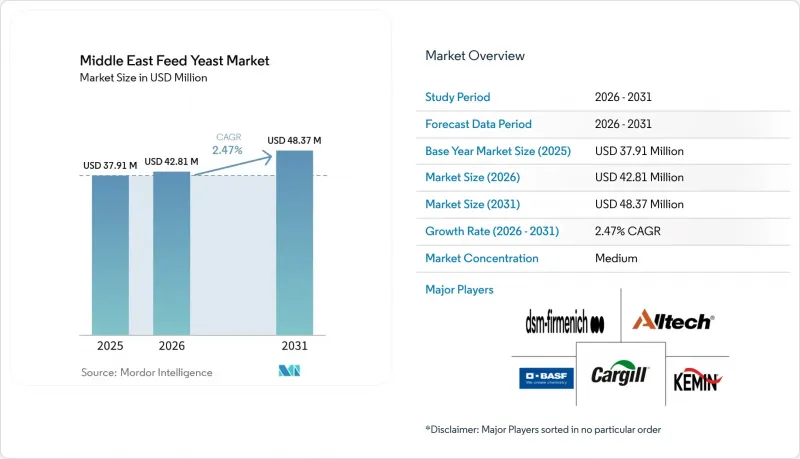
本報告按添加劑(活性酵母、硒酵母、廢酵母等)、目標動物(水產養殖、家禽養殖等)和地區(沙烏地阿拉伯、伊朗及其他中東國家)進行細分。市場預測以價值(美元)和數量(公噸)表示。
中東飼料酵母市場趨勢與洞察
沙烏地阿拉伯擴大家禽肉自給自足能力
預計到2024年,沙烏地阿拉伯的肉雞產量將達到120萬噸,屆時該國的自給率將達到72%。據沙烏地阿拉伯統計總局(GASTAT)稱,國內畜牧業生產的擴張與實現「2030願景」中設定的90%糧食安全目標密切相關。這種生產擴張推動了中東飼料酵母市場對更穩定飼料性能的需求,尤其是在大規模綜合家禽養殖場。大規模養殖場通常依賴標準化的飼料方案,並傾向於選擇能夠增強免疫力、提高飼料轉換率且不影響現有配方的添加劑。這種擴張也提高了人們對供應商服務品質、註冊準備以及商品飼料產品一致性的期望。隨著沙烏地阿拉伯生產商擴大生產規模,中東飼料酵母市場對既能滿足生產目標又能符合出口導向生產標準的酵母產品的需求日益成長。
過渡到功能性酵母添加劑以減少抗生素的使用
阿拉伯聯合大公國的《2025-2031年國家抗菌素抗藥性行動計畫》以及沙烏地阿拉伯基於世界衛生組織(世衛組織)「同一健康」理念的類似框架,正在推動畜牧業減少對抗生素生長促進劑的依賴。這種轉變在中東飼料酵母市場尤其明顯,尤其是在肉雞和蝦類養殖領域,即使停止使用抗生素,維持腸道健康和確保飼料轉換率仍然至關重要。 2025年發表在《獸醫科學》雜誌上的一篇綜述表明,酵母衍生產品和益生菌即使在停止使用抗生素生長促進劑後,仍有助於維持家禽早期生長階段的生產力。這項證據對於為買家提供從傳統合成飼料轉向功能性酵母添加劑的科學依據至關重要。因此,中東飼料酵母市場的需求趨勢並非由短期成本波動所驅動,而是由監管合規壓力所驅動。
進口依賴性和運費波動
該地區飼料產業嚴重依賴進口玉米、大豆粕和發酵相關原料,而中東飼料酵母市場極易受到運費波動、港口中斷以及運輸路線地緣政治風險的影響。伊朗貨幣疲軟、國內糧食產量下降,導致其食品購買力降低,因此在該領域面臨嚴峻挑戰。此外,根據伊朗統計中心(SCI)的數據顯示,飼料供應狀況和生產商的利潤率仍承受相當大的壓力。活性酵母產品由於其保存期限短且對溫度敏感,尤其容易受到影響,這限制了進口商可以安全持有的庫存量。因此,與其他風險較低且可以儲存在倉庫中的產品相比,中東飼料酵母市場更容易受到外部供應衝擊的影響。
細分市場分析
預計到2025年,酵母衍生物將佔據最大的市場佔有率,達到44.3%,成為整個中東飼料酵母市場中家禽和反芻動物商業飼料飼料的核心產品。其主導地位源自於其實用價值而非單一的專業化特性,因為它們可以在單一配方中發揮蛋白質來源、活化和黴菌毒素吸附劑的作用。在飼料成本壓力巨大的中東地區,產品組合至關重要,買家通常更傾向於多功能產品。硒酵母在乳牛和反芻動物飼料應用中日益重要,乾旱地區硒缺乏症凸顯了對有機硒來源的需求。活酵母、托魯拉酵母、乳清酵母和酵母衍生物各自在更細分的市場中佔有一席之地,在這些市場中,性能聲明比簡單的價格競爭更容易得到證實。
在中東飼料酵母市場,預計廢酵母將成為成長最快的添加劑細分市場,2026年至2031年的複合年成長率將達到2.7%。這表明,即使高階產品不斷擴張,主流市場的需求仍將保持強勁。 2024年發表於《獸醫學前沿》(Frontiers in Veterinary Science)的一項研究表明,在熱應激肉雞飼料中添加水解酵母可以改善腸道氧化還原平衡並降低死亡率。這支持了向標準化酵母組分的轉變,因為這些組分可以更清晰地展現其性能提升效果。這為中東飼料酵母市場開發高利潤配方創造了機遇,尤其是對於那些能夠從散裝廢酵母過渡到檢驗的衍生產品的供應商而言。此外,由於沙烏地阿拉伯的監管環境適用於所有功能類別,因此該添加劑的市場環境對預先註冊產品有利。因此,該細分市場具有足夠的廣度,既可以支持銷售量成長,也可以支持選擇性的優質化。
其他好處:
- Excel格式的市場預測(ME)表
- 3個月的分析師支持
目錄
第1章:引言
- 研究假設和市場定義
- 調查範圍
- 調查方法
第2章:本報告的內容
第3章:執行摘要和主要發現
第4章:主要產業趨勢
- 飼養的動物數量
- 家禽
- 反芻動物
- 豬
- 飼料生產
- 水產養殖
- 家禽
- 反芻動物
- 豬
- 法律規範
- 中東
- 價值鍊和通路分析
- 市場促進因素
- 擴大沙烏地阿拉伯家禽自給自足能力
- 從減少抗生素使用到轉向功能性酵母添加劑
- 最佳化沙烏地阿拉伯及海灣合作理事會(GCC)國家的牛奶生產
- 阿拉伯聯合大公國擴大水產養殖產能
- 市場對腸道穩定的酵母產品的需求旨在緩解熱應激
- 進口飼料穀物中黴菌毒素污染問題令人擔憂
- 市場限制因素
- 對進口的依賴以及運費的波動
- 註冊飼料添加劑並用阿拉伯語標註的負擔。
- 清真認證及基礎資料可追溯性的審查
- 高溫氣候下顆粒化田間效果的差異。
第5章 市場規模與成長預測
- 按添加劑類型
- 新鮮酵母
- 硒酵母
- 用過的酵母
- 托魯拉乾酵母
- 乳清酵母
- 酵母衍生成分
- 動物
- 水產養殖
- 魚
- 蝦
- 其他養殖物種
- 家禽
- 肉雞
- 產蛋母雞
- 其他家禽
- 反芻動物
- 牛
- 牛
- 其他反芻動物
- 豬
- 其他動物
- 水產養殖
- 國家
- 沙烏地阿拉伯
- 伊朗
- 其他中東國家
第6章 競爭情勢
- 關鍵策略趨勢
- 市佔率分析
- 企業狀況
- 公司簡介。
- DSM-Firmenich AG
- Kemin Industries, Inc.
- Alltech, Inc.
- Cargill, Incorporated
- BASF SE
- Bluestar Adisseo Company
- Archer Daniels Midland Company
- EW Nutrition GmbH
- Clariant AG
- Nutreco NV
- Novus International, Inc.
- Phibro Animal Health Corporation
- Special Nutrients, LLC
- Impextraco NV
- Bentoli, Inc.
第7章:執行長面臨的關鍵策略問題
According to Mordor Intelligence, the middle east feed yeast market size is projected to expand from USD 37.91 million in 2025 and USD 42.81 million in 2026 to USD 48.37 million by 2031, registering a CAGR of 2.47% between 2026 and 2031.
This report is Segmented by Sub Additive (Live Yeast, Selenium Yeast, Spent Yeast, and More), by Animal (Aquaculture, Poultry, and More), and by Geography (Saudi Arabia, Iran, and the Rest of Middle East). The Market Forecasts are Provided in Terms of Value (USD) and Volume (Metric Tons).
Middle East Feed Yeast Market Trends and Insights
Saudi Poultry Self-Sufficiency Expansion
Saudi Arabia's broiler meat production reached 1.2 million metric tons in 2024, and the country's self-sufficiency rate stood at 72%, keeping domestic livestock expansion closely tied to the Vision 2030 food security target of 90%, as per General Authority for Statistics (GASTAT). This production push is raising the need for more consistent feed performance across large integrated poultry operations in the Middle East feed yeast market. Bigger farms usually rely on standardized feed programs, which favor additives that support immunity and improve feed conversion without disrupting existing formulations. The same expansion is also tightening quality expectations for supplier service, registration readiness, and product stability in commercial rations. As Saudi producers scale output, the Middle East feed yeast market is seeing stronger demand for yeast-based products that fit both productivity goals and export-oriented production standards.
Antibiotic-Reduction Shift Toward Functional Yeast Additives
The United Arab Emirates National Action Plan on Antimicrobial Resistance 2025 to 2031 and Saudi Arabia's comparable framework are pushing livestock systems toward lower reliance on antibiotic growth promoters under the World Health Organization One Health approach. In the Middle East feed yeast market, that change is most visible in broiler and shrimp production, where gut health support and feed efficiency remain critical after antibiotic withdrawal. A 2025 review in Veterinary Science found that yeast-derived products and probiotics can help maintain productivity during early growth stages in poultry after antibiotic growth promoters are removed. That evidence matters because it gives buyers a scientific basis for replacing older synthetic pathways with functional yeast inputs. The Middle East feed yeast market is therefore gaining support from a demand stream driven by compliance pressure rather than short-term cost shifts.
Import Dependence and Freight Volatility
The region's feed sector depends heavily on imported corn, soybean meal, and fermentation-linked inputs, leaving the Middle East feed yeast market exposed to freight volatility, port disruptions, and geopolitical routing risks. Iran experiences significant challenges in this area due to reduced food affordability, driven by currency depreciation and a decline in domestic grain production. Additionally, feed availability and producer margins continued to face significant pressure, according to the Statistical Center of Iran (SCI). Live yeast products are especially vulnerable because shelf life and temperature sensitivity limit how much stock importers can safely hold. That makes the Middle East feed yeast market more sensitive to external supply shocks than categories that can be warehoused with fewer performance risks.
Other drivers and restraints analyzed in the detailed report include:
- Dairy Yield Optimization Across Saudi Arabia and Gulf Cooperation Council
- United Arab Emirates Aquaculture Capacity Build-Out
- Feed Additive Registration and Arabic Labeling Burden
For complete list of drivers and restraints, kindly check the Table Of Contents.
Segment Analysis
Yeast Derivatives held the largest market share at 44.3% in 2025, making it the anchor product in commercial poultry and ruminant rations across the Middle East feed yeast market. Its leading position stems from practical value rather than narrow specialization, as it can serve as a protein contributor, an immunostimulant, and a mycotoxin-binding support ingredient in a single formulation. The product mix is significant in a region where feed cost pressures are high, and buyers typically favor products with multiple functional roles. Selenium yeast is gaining relevance in dairy and ruminant applications where selenium deficiency in arid conditions supports demand for organic selenium sources. Live yeast, torula dried yeast, whey yeast, and yeast derivatives each remain present in more targeted niches where performance claims are easier to defend than simple price points.
Within the Middle East feed yeast market size, spent yeast is projected to be the fastest-growing sub-additive segment, with a 2.7% CAGR from 2026 to 2031, indicating that mainstream demand will remain durable even as premium formats expand. A 2024 Frontiers in Veterinary Science study found that hydrolyzed yeast supplementation in heat-stressed broilers improved intestinal redox balance and reduced mortality, supporting the move toward more standardized yeast fractions with clearer performance claims. This creates opportunities for higher-margin formulations within the Middle East feed yeast market, particularly for suppliers capable of transitioning from bulk spent yeast to validated derivative products. The same sub-additive landscape also gives pre-registered products an advantage because Saudi regulatory compliance applies across all functional categories. As a result, the segment is broad enough to support both volume growth and selective premiumization.
Complete Report Scope:
- By Sub Additive
- Live Yeast
- Selenium Yeast
- Spent Yeast
- Torula Dried Yeast
- Whey Yeast
- Yeast Derivatives
- By Animal
- Aquaculture
- Fish
- Shrimp
- Other Aquaculture Species
- Poultry
- Broiler
- Layer
- Other Poultry Birds
- Ruminants
- Beef Cattle
- Dairy Cattle
- Other Ruminants
- Swine
- Other Animals
- Aquaculture
- By Country
- Saudi Arabia
- Iran
- Rest of Middle East
List of Companies Covered in this Report:
- DSM-Firmenich AG
- Kemin Industries, Inc.
- Alltech, Inc.
- Cargill, Incorporated
- BASF SE
- Bluestar Adisseo Company
- Archer Daniels Midland Company
- EW Nutrition GmbH
- Clariant AG
- Nutreco N.V.
- Novus International, Inc.
- Phibro Animal Health Corporation
- Special Nutrients, LLC
- Impextraco NV
- Bentoli, Inc.
Additional Benefits:
- The market estimate (ME) sheet in Excel format
- 3 months of analyst support
TABLE OF CONTENTS
1 INTRODUCTION
- 1.1 Study Assumptions & Market Definition
- 1.2 Scope of the Study
- 1.3 Research Methodology
2 REPORT OFFERS
3 EXECUTIVE SUMMARY & KEY FINDINGS
4 KEY INDUSTRY TRENDS
- 4.1 Animal Headcount
- 4.1.1 Poultry
- 4.1.2 Ruminants
- 4.1.3 Swine
- 4.2 Feed Production
- 4.2.1 Aquaculture
- 4.2.2 Poultry
- 4.2.3 Ruminants
- 4.2.4 Swine
- 4.3 Regulatory Framework
- 4.3.1 Middle East
- 4.4 Value Chain & Distribution Channel Analysis
- 4.5 Market Drivers
- 4.5.1 Saudi poultry self-sufficiency expansion
- 4.5.2 Antibiotic-reduction shift toward functional yeast additives
- 4.5.3 Dairy yield optimization across Saudi Arabia and Gulf Cooperation Council
- 4.5.4 United Arab Emirates aquaculture capacity build-out
- 4.5.5 Heat-stress mitigation demand for gut-stable yeast products
- 4.5.6 Mycotoxin pressure in imported feed grains
- 4.6 Market Restraints
- 4.6.1 Import dependence and freight volatility
- 4.6.2 Feed additive registration and Arabic labeling burden
- 4.6.3 Halal and substrate traceability scrutiny
- 4.6.4 Field-level efficacy variability in hot-climate pelleting
5 MARKET SIZE AND GROWTH FORECASTS (VALUE AND VOLUME)
- 5.1 By Sub Additive
- 5.1.1 Live Yeast
- 5.1.2 Selenium Yeast
- 5.1.3 Spent Yeast
- 5.1.4 Torula Dried Yeast
- 5.1.5 Whey Yeast
- 5.1.6 Yeast Derivatives
- 5.2 By Animal
- 5.2.1 Aquaculture
- 5.2.1.1 Fish
- 5.2.1.2 Shrimp
- 5.2.1.3 Other Aquaculture Species
- 5.2.2 Poultry
- 5.2.2.1 Broiler
- 5.2.2.2 Layer
- 5.2.2.3 Other Poultry Birds
- 5.2.3 Ruminants
- 5.2.3.1 Beef Cattle
- 5.2.3.2 Dairy Cattle
- 5.2.3.3 Other Ruminants
- 5.2.4 Swine
- 5.2.5 Other Animals
- 5.2.1 Aquaculture
- 5.3 By Country
- 5.3.1 Saudi Arabia
- 5.3.2 Iran
- 5.3.3 Rest of Middle East
6 COMPETITIVE LANDSCAPE
- 6.1 Key Strategic Moves
- 6.2 Market Share Analysis
- 6.3 Company Landscape
- 6.4 Company Profiles (Includes Global Level Overview, Market Level Overview, Core Business Segments, Financials, Headcount, Key Information, Market Rank, Market Share, Products and Services, and Analysis of Recent Developments).
- 6.4.1 DSM-Firmenich AG
- 6.4.2 Kemin Industries, Inc.
- 6.4.3 Alltech, Inc.
- 6.4.4 Cargill, Incorporated
- 6.4.5 BASF SE
- 6.4.6 Bluestar Adisseo Company
- 6.4.7 Archer Daniels Midland Company
- 6.4.8 EW Nutrition GmbH
- 6.4.9 Clariant AG
- 6.4.10 Nutreco N.V.
- 6.4.11 Novus International, Inc.
- 6.4.12 Phibro Animal Health Corporation
- 6.4.13 Special Nutrients, LLC
- 6.4.14 Impextraco NV
- 6.4.15 Bentoli, Inc.
7 KEY STRATEGIC QUESTIONS FOR FEED ADDITIVE CEOS

 飼料酵母市場:2026-2032年全球市場預測(依形態、類型、最終用途、應用及通路分類)
 非洲飼料酵母:市場佔有率分析、產業趨勢與統計及成長預測(2026-2031)
 2026-2034年全球飼料酵母市場規模、佔有率、趨勢和成長分析報告飼料酵母市場-2026-2031年預測
 飼料酵母市場規模、佔有率及成長分析(按類型、畜種、屬和地區分類)-2026-2033年產業預測
 飼料酵母市場-全球產業規模、佔有率、趨勢、機會和預測,按類型、形態、畜種、地區和競爭格局分類,2020-2030年預測
 動物飼料酵母市場機會、成長動力、產業趨勢分析與 2025 - 2034 年預測