


 |
市場調查報告書
商品編碼
2073127
非洲飼料酵母:市場佔有率分析、產業趨勢與統計及成長預測(2026-2031)Africa Feed Yeast - Market Share Analysis, Industry Trends & Statistics, Growth Forecasts (2026 - 2031) |
||||||

※ 本網頁內容可能與最新版本有所差異。詳細情況請與我們聯繫。
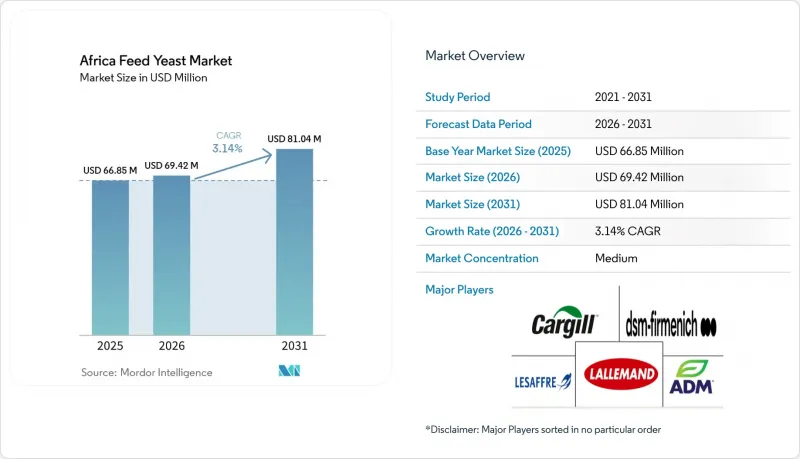
根據 Mordor Intelligence 預測,非洲飼料酵母市場規模將從 2025 年的 6,685 萬美元成長到 2026 年的 6,942 萬美元,到 2031 年將達到 804 萬美元,2026 年至 2031 年的複合年成長率為 3.14%。
本報告按副產品(活性酵母、硒酵母、廢酵母等)、目標動物(水產養殖、家禽養殖等)和地區(南非、肯亞、埃及及其他非洲國家)進行細分。市場預測以價值(美元)和數量(公噸)呈現。
非洲飼料酵母市場趨勢與洞察
家禽飼料的工業化
家禽生產的擴張正推動非洲飼料酵母市場走向系統化。這是因為大規模農場和一體化飼料系統依賴穩定的配方,而非在農場現場混合。這種轉變意義重大,因為酵母在配方穩定且與可衡量的生產目標(例如腸道健康、飼料轉換率、畜群適應性和產量均勻性)掛鉤時才能發揮最佳性能。即便如此,二手酵母仍佔據著重要的地位。這是因為它可以以適合飼料微薄的買家的價格提供蛋白質、核苷酸和BETA-葡聚醣。此外,隨著商業飼料產能的擴張,家禽養殖是第一個實現系統化的動物養殖領域,這也有利於非洲飼料酵母市場的發展。這使得家禽養殖成為添加劑持續應用最快的領域。隨著南非、埃及、奈及利亞和衣索比亞等國的複合飼料系統逐步建立,非洲飼料酵母市場正受益於採購基礎設施的完善、技術支援的加強以及經濟型和高性能酵母解決方案之間清晰的產品差異化。
利用酵母基抗性解決方案降低黃麴毒素風險
由於在許多畜牧系統中,黃麴毒素污染不再被視為偶然的品質問題,黃麴毒素暴露正成為非洲飼料酵母市場中日益重要的購買動機。 2024年發表於《熱帶動物健康與生產》雜誌的一項研究表明,添加曼氏畢赤酵母(Pichia manshurica)可改善受黃麴毒素B1污染飼料的瘤胃發酵和營養物質分解,這支持了功能性酵母在基礎營養供應之外的應用。此外,2025年發表於《世界微生物學與生物技術雜誌》的一項研究表明,在肉雞飼料中添加庫氏畢赤酵母(Pichia kudriavzevii)可減輕與黃麴毒素應激相關的不良影響,這支持了菌株特異性酵母產品的商業性價值。在衣索比亞,2025年的一項研究報告稱,在85.4%的牛濃縮飼料樣本中檢測到了黃麴毒素B1,這凸顯了對飼料安全的擔憂可能會促使酵母細胞壁和粘合劑產品的使用從「可選用途」轉變為「標準用途」。因此,非洲飼料酵母市場正受益於更廣泛的價值提案,酵母同時支持合規性、飼料安全性和生產穩定性。
貨幣波動和進口原料通貨膨脹
貨幣不穩定持續限制非洲飼料酵母市場的發展。這是因為許多特種原料、發酵原料和進口成品添加劑的價格都是以硬通貨計價。該地貨幣貶值時,經銷商的利潤率會受到擠壓,飼料廠往往會推遲轉向高附加價值酵母產品,即使技術上的理由仍然成立。小規模商業飼料廠受到的影響最大,因為它們通常缺乏避險能力、充足的庫存或足夠的財務基礎來應對短期成本衝擊。因此,非洲飼料酵母市場的部分領域仍然受限於低成本產品的選擇,從而減緩了向活性酵母、硒酵母和先進衍生產品的過渡。雖然預計該地區製造地的增加將逐步緩解這種壓力,但短期價格敏感度仍然是非洲飼料酵母市場面臨的關鍵阻礙因素。
細分市場分析
2025年,廢棄酵母在非洲飼料酵母市場佔最大佔有率,達24%。這反映了其符合注重成本的商業飼料買家的需求。如今,廢棄酵母仍然被廣泛使用,因為它可以在不增加額外成本的情況下,為飼料添加蛋白質、核苷酸和BETA-葡聚醣,而這些額外成本通常高於更專業的酵母產品。因此,在非洲飼料酵母市場,當家禽和反芻動物的複合飼料需要功能性補充,而預算又很緊張時,廢棄酵母便成為實用的選擇。隨著有機硒的價值日益凸顯,人們越來越認知到它與動物健康、產品品質和優質飼料方案之間的關聯,硒酵母在更先進的牛和蛋雞養殖系統中也越來越受歡迎。托魯拉酵母、乳清酵母和酵母衍生物雖然目前的市場佔有率較小,但它們各自在改善偏好、瘤胃穩定性、腸道健康和飼料安全性等方面發揮著獨特的作用。
在非洲飼料酵母市場,活酵母預計將以最快的速度成長,到2031年複合年成長率將達到3.5%,這反映出消費者購買趨勢正朝著以性能為導向的方向發展。這個細分市場受益於人們對減少抗生素使用的日益關注、瘤胃調節中應用範圍的擴大,以及人們對肉雞和乳牛腸道健康解決方案日益成長的興趣。 2025年發表在《獸醫學前沿》(Frontiers in Veterinary Science)上的一項研究表明,有機硒源的硒生物利用度高於無機硒源,這支持了有機硒源的高階定位。這有助於解釋硒酵母在系統化商業營運中的長期成長潛力。因此,非洲飼料酵母市場正朝著更多元化的產品組合轉變,其中廢酵母保持其市場佔有率,而活酵母及其衍生物則佔據了更大的價值佔有率。這一趨勢表明產品會逐步優質化,而不是快速替換,因此,低成本、高性能的產品可能會在整個預測期內共存。
其他好處:
- Excel格式的市場預測(ME)表
- 3個月的分析師支持
目錄
第1章:引言
- 研究假設和市場定義
- 調查範圍
- 調查方法
第2章:本報告的內容
第3章:執行摘要和主要發現
第4章:主要產業趨勢
- 飼養的動物數量
- 家禽
- 反芻動物
- 豬
- 飼料生產
- 水產養殖
- 家禽
- 反芻動物
- 豬
- 法律規範
- 非洲
- 價值鍊和通路分析
- 市場促進因素
- 家禽飼料的工業化
- 水產養殖飼料的擴張
- 商業飼料正變得越來越普及。
- 在高飼料成本壓力下最佳化飼料效率
- 加速埃及飼料的註冊和許可程序
- 利用酵母基抗性解決方案降低黃麴毒素風險
- 市場限制因素
- 外匯波動與進口投入價格上漲
- 複合飼料透過非官方通路的滲透率較低。
- 東非大豆和蛋白質飼料短缺
- 儲存環境的不均勻性和添加劑的品質保證
第5章 市場規模與成長預測
- 按添加劑類型
- 新鮮酵母
- 硒酵母
- 用過的酵母
- 托魯拉乾酵母
- 乳清酵母
- 酵母衍生成分
- 動物
- 水產養殖
- 魚
- 蝦
- 其他養殖物種
- 家禽
- 肉雞
- 產蛋母雞
- 其他家禽
- 反芻動物
- 牛
- 牛
- 其他反芻動物
- 豬
- 其他動物
- 水產養殖
- 國家
- 南非
- 肯亞
- 埃及
- 其他非洲國家
第6章 競爭情勢
- 關鍵策略趨勢
- 市佔率分析
- 市佔率分析
- 公司簡介。
- Lesaffre et Compagnie
- Angel Yeast Co., Ltd.
- Lallemand Inc.
- Archer Daniels Midland Company
- Cargill, Incorporated
- Alltech, Inc.
- Nutreco NV
- Novonesis A/S
- Leiber GmbH
- Kemin Industries, Inc.
- Royal Agrifirm Group
- DSM-Firmenich AG
- Novus International, Inc.
- Adisseo France SAS
- Evonik Industries AG
第7章:執行長面臨的關鍵策略問題
According to Mordor Intelligence, the africa feed yeast market size is anticipated to grow from USD 66.85 million in 2025 to USD 69.42 million in 2026 and is forecast to reach USD 8.04 million by 2031 at 3.14% CAGR over 2026-2031.
This report is Segmented by Sub Additive (Live Yeast, Selenium Yeast, Spent Yeast, and More), by Animal (Aquaculture, Poultry, and More), and by Geography (South Africa, Kenya, Egypt, and the Rest of Africa). The Market Forecasts are Provided in Terms of Value (USD) and Volume (Metric Tons).
Africa Feed Yeast Market Trends and Insights
Poultry Feed Industrialization
Poultry production is making the Africa feed yeast market more structured because larger farms and integrated feed systems depend on consistent formulations rather than variable on-farm mixing. That shift matters because yeast performs best when inclusion rates are stable and tied to measurable production targets such as gut integrity, feed conversion, flock resilience, and output uniformity. In this setting, spent yeast has remained relevant because it delivers protein, nucleotides, and beta-glucans at a price point that works for buyers managing narrow feed margins. The Africa feed yeast market also benefits from the fact that poultry is the first animal segment to formalize when commercial feed capacity expands, which makes it the earliest route for repeat additive adoption. As compound feed systems deepen across South Africa, Egypt, Nigeria, and Ethiopia, the Africa feed yeast market gains from better procurement discipline, stronger technical support, and clearer product differentiation between value-grade and performance-grade yeast solutions.
Aflatoxin-Risk Mitigation Through Yeast-Based Resilience Solutions
Aflatoxin exposure is becoming a stronger purchase driver in the Africa feed yeast market because contamination is no longer treated as an occasional quality issue in many livestock systems. A 2024 study in Tropical Animal Health and Production found that Pichia manshurica supplementation improved rumen fermentation and nutrient degradability in aflatoxin B1-contaminated diets, which supports the case for functional yeast use beyond basic nutrition. A 2025 study in World Journal of Microbiology and Biotechnology also showed that Pichia kudriavzevii supplementation in broiler feed reduced the adverse effects linked with aflatoxin stress, which strengthens the commercial case for strain-specific yeast products. In Ethiopia, a 2025 study reported aflatoxin B1 contamination in 85.4% of sampled dairy concentrates, which underlines how feed safety concerns can shift yeast cell wall and binder products from optional use toward standard use. The Africa feed yeast market therefore gains from a broader value proposition where yeast supports compliance, feed safety, and production stability at the same time.
Currency Volatility and Imported-Input Inflation
Currency instability still limits the Africa feed yeast market because many specialty inputs, fermentation materials, and imported finished additives are priced against hard currencies. When local currencies weaken, distributors face margin pressure and feed mills often postpone upgrades to higher-value yeast formats even if the technical case remains intact. The impact is strongest on smaller commercial mills because they usually lack hedging capacity, deep inventories, or the balance sheet needed to absorb short-term cost shocks. This keeps part of the Africa feed yeast market tied to low-cost product choices and slows the move into live yeast, selenium yeast, and advanced derivatives. The pressure should ease gradually where more in-region manufacturing comes online, but near-term pricing sensitivity remains a defining restraint in the Africa feed yeast market.
Other drivers and restraints analyzed in the detailed report include:
- Aquaculture Feed Expansion
- Feed-Efficiency Optimization Under High Feed-Cost Pressure
- Soybean and Protein-Meal Deficits in East Africa
For complete list of drivers and restraints, kindly check the Table Of Contents.
Segment Analysis
Spent yeast held the largest Africa feed yeast market share at 24% in 2025, which reflects its strong fit with cost-conscious commercial feed buyers. It remains widely used because it adds protein, nucleotides, and beta-glucans without the price premium attached to more specialized yeast formats. In the Africa feed yeast market, this makes spent yeast the practical choice where poultry and ruminant formulas need functional support, but budget discipline remains strict. Selenium yeast is gaining ground in more formal dairy and layer systems because organic selenium positioning is increasingly tied to animal health, product quality, and premium feeding programs. Torula dried yeast, whey yeast, and yeast derivatives remain smaller today, but each plays a defined role in palatability support, rumen stability, gut health, and feed safety applications.
In Africa feed yeast market size terms, live yeast is set to expand at the fastest 3.5% CAGR through 2031, reflecting a stronger shift toward performance-led buying. The segment benefits from tighter scrutiny of antibiotic reduction, broader use in rumen modulation, and stronger interest in gut integrity solutions for broilers and dairy cattle. In 2025, Research published in Frontiers in Veterinary Science also supported the premium positioning of organic selenium sources by showing greater selenium bioavailability than inorganic forms, which helps explain the longer-term upside for selenium yeast in structured operations. The Africa feed yeast market is therefore moving toward a more layered product mix, where spent yeast keeps scale, but live yeast and derivatives take a larger part of the value. That pattern points to gradual premiumization rather than rapid replacement, which is why lower-cost and higher-function products are likely to coexist through the forecast period.
Complete Report Scope:
- By Sub Additive
- Live Yeast
- Selenium Yeast
- Spent Yeast
- Torula Dried Yeast
- Whey Yeast
- Yeast Derivatives
- Animal
- Aquaculture
- Fish
- Shrimp
- Other Aquaculture Species
- Poultry
- Broiler
- Layer
- Other Poultry Birds
- Ruminants
- Beef Cattle
- Dairy Cattle
- Other Ruminants
- Swine
- Other Animals
- Aquaculture
- Country
- South Africa
- Kenya
- Egypt
- Rest of Africa
List of Companies Covered in this Report:
- Lesaffre et Compagnie
- Angel Yeast Co., Ltd.
- Lallemand Inc.
- Archer Daniels Midland Company
- Cargill, Incorporated
- Alltech, Inc.
- Nutreco N.V.
- Novonesis A/S
- Leiber GmbH
- Kemin Industries, Inc.
- Royal Agrifirm Group
- DSM-Firmenich AG
- Novus International, Inc.
- Adisseo France S.A.S.
- Evonik Industries AG
Additional Benefits:
- The market estimate (ME) sheet in Excel format
- 3 months of analyst support
TABLE OF CONTENTS
1 INTRODUCTION
- 1.1 Study Assumptions & Market Definition
- 1.2 Scope of the Study
- 1.3 Research Methodology
2 REPORT OFFERS
3 EXECUTIVE SUMMARY & KEY FINDINGS
4 KEY INDUSTRY TRENDS
- 4.1 Animal Headcount
- 4.1.1 Poultry
- 4.1.2 Ruminants
- 4.1.3 Swine
- 4.2 Feed Production
- 4.2.1 Aquaculture
- 4.2.2 Poultry
- 4.2.3 Ruminants
- 4.2.4 Swine
- 4.3 Regulatory Framework
- 4.3.1 Africa
- 4.4 Value Chain & Distribution Channel Analysis
- 4.5 Market Drivers
- 4.5.1 Poultry feed industrialization
- 4.5.2 Aquaculture feed expansion
- 4.5.3 Commercial feed penetration gains
- 4.5.4 Feed-efficiency optimization under high feed-cost pressure
- 4.5.5 Faster feed registration and licensing in Egypt
- 4.5.6 Aflatoxin-risk mitigation through yeast-based resilience solutions
- 4.6 Market Restraints
- 4.6.1 Currency volatility and imported-input inflation
- 4.6.2 Low compound-feed penetration in informal channels
- 4.6.3 Soybean and protein-meal deficits in East Africa
- 4.6.4 Uneven storage hygiene and additive quality assurance
5 Market Size and Growth Forecasts (Value and Volume)
- 5.1 By Sub Additive
- 5.1.1 Live Yeast
- 5.1.2 Selenium Yeast
- 5.1.3 Spent Yeast
- 5.1.4 Torula Dried Yeast
- 5.1.5 Whey Yeast
- 5.1.6 Yeast Derivatives
- 5.2 Animal
- 5.2.1 Aquaculture
- 5.2.1.1 Fish
- 5.2.1.2 Shrimp
- 5.2.1.3 Other Aquaculture Species
- 5.2.2 Poultry
- 5.2.2.1 Broiler
- 5.2.2.2 Layer
- 5.2.2.3 Other Poultry Birds
- 5.2.3 Ruminants
- 5.2.3.1 Beef Cattle
- 5.2.3.2 Dairy Cattle
- 5.2.3.3 Other Ruminants
- 5.2.4 Swine
- 5.2.5 Other Animals
- 5.2.1 Aquaculture
- 5.3 Country
- 5.3.1 South Africa
- 5.3.2 Kenya
- 5.3.3 Egypt
- 5.3.4 Rest of Africa
6 COMPETITIVE LANDSCAPE
- 6.1 Key Strategic Moves
- 6.2 Market Share Analysis
- 6.3 Market Share Analysis
- 6.4 Company Profiles (Includes Global Level Overview, Market Level Overview, Core Business Segments, Financials, Headcount, Key Information, Market Rank, Market Share, Products and Services, and Analysis of Recent Developments).
- 6.4.1 Lesaffre et Compagnie
- 6.4.2 Angel Yeast Co., Ltd.
- 6.4.3 Lallemand Inc.
- 6.4.4 Archer Daniels Midland Company
- 6.4.5 Cargill, Incorporated
- 6.4.6 Alltech, Inc.
- 6.4.7 Nutreco N.V.
- 6.4.8 Novonesis A/S
- 6.4.9 Leiber GmbH
- 6.4.10 Kemin Industries, Inc.
- 6.4.11 Royal Agrifirm Group
- 6.4.12 DSM-Firmenich AG
- 6.4.13 Novus International, Inc.
- 6.4.14 Adisseo France S.A.S.
- 6.4.15 Evonik Industries AG
7 KEY STRATEGIC QUESTIONS FOR FEED ADDITIVE CEOS

 飼料酵母市場:2026-2032年全球市場預測(依形態、類型、最終用途、應用及通路分類)
 中東飼料酵母:市場佔有率分析、產業趨勢與統計、成長預測(2026-2031)
 2026-2034年全球飼料酵母市場規模、佔有率、趨勢和成長分析報告飼料酵母市場-2026-2031年預測
 飼料酵母市場規模、佔有率及成長分析(按類型、畜種、屬和地區分類)-2026-2033年產業預測
 飼料酵母市場-全球產業規模、佔有率、趨勢、機會和預測,按類型、形態、畜種、地區和競爭格局分類,2020-2030年預測
 動物飼料酵母市場機會、成長動力、產業趨勢分析與 2025 - 2034 年預測