


 |
市場調查報告書
商品編碼
2113613
義大利作物保護化學品(殺蟲劑):市場佔有率分析、行業趨勢和統計數據以及成長預測(2026-2031 年)Italy Crop Protection Chemicals (Pesticides) - Market Share Analysis, Industry Trends & Statistics, Growth Forecasts (2026 - 2031) |
||||||

※ 本網頁內容可能與最新版本有所差異。詳細情況請與我們聯繫。
根據 Mordor Intelligence 預測,義大利作物保護化學品(殺蟲劑)市場規模將從 2025 年的 12.8 億美元成長到 2026 年的 13.3 億美元,到 2031 年將達到 15.8 億美元,2026 年至 2031 年的複合年成長率為 3.55%。
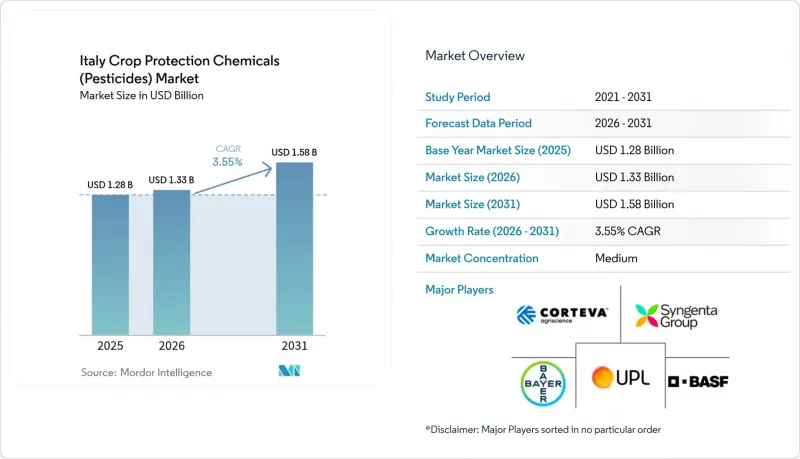
本報告按產品類型(除草劑、殺蟲劑、殺菌劑等)、應用方式(化學灌溉、葉面噴布、燻蒸、種子處理等)和作物類型(穀物、油籽/豆類、水果/蔬菜、經濟作物等)進行分類。市場預測以美元(USD)計價。
義大利作物保護化學品(殺蟲劑)市場趨勢及洞察。
對糧食和農業生產力日益成長的需求
2020年至2024年間,人均新鮮蔬菜消費量年均成長3.2%,迫使生產商與北歐零售商簽訂數量契約,契約規定如果供不應求將受到處罰。農業勞動力的減少導致農民更加依賴農藥,以避免未經處理的加工番茄田間損失高達40%。 2024年,極端天氣事件造成89億美元的農作物損失,其中大部分與真菌和細菌的大規模爆發有關,而這些病害無法透過基本的綜合蟲害管理(IPM)措施控制。儘管面臨成本壓力,但這些因素導致用於已驗證有效的殺菌劑和除草劑的預算撥款缺乏靈活性。
氣候變遷導致病蟲害發生率增加
自2015年以來,冬季氣溫升高導致葡萄園霜霉病的發病期延長了三週,需要額外噴灑兩次殺菌劑,每公頃成本高達150歐元(157美元)。目前,日本甲蟲侵染了80%的榛果和面積,增加了殺蟲劑的使用頻率,並加劇了作物保護化學物質的市場壓力。雖然快速木黴菌(Xylella fastidiosa)已導致普利亞大區三分之一的橄欖歉收,但種植者仍在繼續使用殺蟲劑和銅基殺菌劑,這表明即使在生物脅迫下,化學農藥仍然發揮著重要作用。BASF的生物來源殺菌劑Celifer於2024年獲批,可作為銅基殺菌劑的替代品,顯示抗藥性壓力正在加速新產品的推出。
歐盟和各國都有嚴格的農藥法規
儘管《永續成分的核准被撤銷,使得病害防治的選擇範圍縮小到有限的化學製劑,增加了病蟲害產生抗藥性的風險。在特倫托,學校周圍設立緩衝區限制了部分蘋果園的空中和無人機噴灑作業,導致義大利作物保護化學品(農藥)市場的銷售大幅下降。
細分市場分析
2025年,殺菌劑佔義大利作物保護化學品(農藥)市佔率的41.60%。這主要是由於64萬公頃葡萄園和130萬公頃番茄田需要全年進行病害防治。由於銅的使用受到限制以及零售商的需求,生產商紛紛轉向使用含有枯草芽孢桿菌和木霉的產品,這些產品的價格比合成農藥高出100%,因此殺菌劑市場正以9.15%的複合年成長率成長。除草劑市場緊隨其後,這主要是因為穀物輪作中高度依賴Glyphosate和二甲戊靈,但由於Glyphosate的批准能否在2025年後得到續期不確定性,因此人們對科迪華的“Arylex”和BASF的“Luximo”等高級產品的興趣日益濃厚。地中海果蠅和日本甲蟲造成的損害推動了殺蟲劑的需求,其餘市場佔有率由殺軟體動物劑和其他次要產品構成。
在義大利的作物保護化學品(農藥)市場,隨著高價值葡萄和溫室蔬菜種植面積的減少,殺菌劑的市場規模預計將持續擴大。生物來源殺菌劑的市佔率正在逐步成長,但成本壓力限制了其在經審核的連鎖商店以外的滲透。除草劑的成長將因監管風險而保持溫和,但抗藥性壓力正在推動具有新作用機制的產品上市。殺蟲劑的需求正轉向適用於無人機且具有快速殺蟲劑效果的懸浮劑,這是一個跨國公司在配方方面保持優勢的細分市場。
其他好處:
- Excel格式的市場預測(ME)表
- 3個月的分析師支持
目錄
第1章:引言
- 研究假設和市場定義
- 調查範圍
第2章:調查方法
第3章執行摘要
第4章 市場狀況
- 市場概覽
- 市場促進因素
- 糧食需求不斷成長和農業生產力提高
- 氣候變遷導致病蟲害爆發加劇
- 抗除草劑雜草數量增加
- 擴大出口型蔬果生產群集
- 特色葡萄園的擴張推高了對高階殺菌劑的需求。
- 隨著無人機定點噴灑技術的迅速普及,高效能配方引起了人們的注意。
- 市場限制因素
- 歐盟及各成員國均有嚴格的農藥管理規定。
- 消費者對健康和環境風險的日益關注
- 假冒偽劣農藥和平行輸入農藥流入增加
- 零售商的零殘留標準正在減少傳統化學品的使用。
- 監理情勢
- 波特五力分析
第5章 市場規模與成長預測
- 依產品類型
- 除草劑
- 殺蟲劑
- 消毒劑
- 軟體動物滅蟲員
- 其他產品類型
- 透過使用
- 化學
- 葉面噴布
- 燻蒸
- 種子處理
- 土壤處理
- 按作物類型
- 穀物和穀類
- 油籽/豆類
- 水果和蔬菜
- 經濟作物
- 草坪和觀賞植物
第6章 競爭情勢
- 市場集中度
- 策略趨勢
- 市佔率分析
- 公司簡介
- Bayer CropScience AG
- BASF SE
- Syngenta Group
- Corteva Inc
- Adama Ltd
- UPL Ltd
- Sumitomo Chemical Co., Ltd.
- FMC Agro Italia Srl
- Nufarm Limited
- Sipcam Oxon SpA
- Certis Belchim BV
- Gowan Company, LLC
- Ascenza Agro SA
- CBC Europe SpA
- Koppert Biological Systems BV
第7章 市場機會與未來展望
According to Mordor Intelligence, the Italy crop protection chemicals (pesticides) market size is expected to grow from USD 1.28 billion in 2025 to USD 1.33 billion in 2026 and is forecast to reach USD 1.58 billion by 2031 at 3.55% CAGR over 2026-2031.
This report is Segmented by Product Type (Herbicides, Insecticides, Fungicides, and More), by Application (Chemigation, Foliar, Fumigation, Seed Treatment, and More), by Crop Type (Grains and Cereals, Oilseeds and Pulses, Fruits and Vegetables, Commercial Crops, and More). The Market Forecasts are Provided in Terms of Value (USD).
Italy Crop Protection Chemicals (Pesticides) Market Trends and Insights
Rising Demand for Food and Agricultural Productivity
Per-capita consumption of fresh vegetables climbed 3.2% a year between 2020 and 2024, locking growers into volume contracts with northern European retailers that penalize supply shortfalls. Shrinking farm labor prompts heavier reliance on crop protection chemicals market tools to avoid field losses that can reach 40% in untreated processing tomatoes. Extreme weather caused USD 8.9 billion in crop damage during 2024, much of it linked to fungal and bacterial outbreaks that overwhelmed basic integrated pest management practices . These forces keep budget allocations for proven fungicides and herbicides inelastic despite cost pressures.
Increasing Pest and Disease Outbreaks Driven by Climate Volatility
Since 2015, warmer winters added three weeks to the downy mildew season in vineyards, forcing two extra fungicide rounds that cost EUR 150 (USD 157) per hectare. The brown marmorated stink bug now infests 80% of hazelnut and pear acreage, raising insecticide rotations and straining the crop protection chemicals market. Xylella fastidiosa has destroyed one-third of Puglia's olives, yet growers still spray insect vectors and copper, illustrating chemistry's residual role under biological stress . BASF's Serifel biological fungicide secured 2024 approval as a copper alternative, showing how resistance pressure accelerates new product uptake.
Stringent European Union and National Pesticide Regulations
The Farm to Fork Strategy continues to aim for a significant reduction in pesticide use by 2030, despite the withdrawal of the Sustainable Use Regulation in February 2024. Italy has seen a decline in pesticide distribution over recent years. However, per-hectare usage among remaining growers has remained consistent, suggesting that regulation alone does not reduce usage intensity. In recent years, several active ingredients have lost approval, limiting disease control options to fewer chemical solutions and increasing the risk of resistance. In Trentino, buffer zones around schools have restricted aerial or drone spraying on a portion of apple acreage, resulting in notable sales losses for the Italy crop protection chemicals (pesticides) market.
Other drivers and restraints analyzed in the detailed report include:
- Growing Herbicide-Resistant Weed Populations
- Expansion of Export-Oriented Fruit and Vegetable Production Clusters
- Heightened Health and Environmental Risk Concerns Among Consumers
For complete list of drivers and restraints, kindly check the Table Of Contents.
Segment Analysis
Fungicides delivered 41.60% of the Italy crop protection chemicals (pesticides) market share in 2025, as 640,000 hectares of vineyards and 1.3 million hectares of tomatoes demanded season-long disease control. The fungicides expand at a 9.15% CAGR as copper limits and retailer mandates move growers toward Bacillus amyloliquefaciens or Trichoderma formulas priced 100% higher than synthetics. Herbicides follow because cereal rotations rely on glyphosate and pendimethalin, though uncertainty around glyphosate renewal after 2025 elevates interest in Corteva's Arylex and BASF's Luximo premium entrants. Insecticides demand is driven by Mediterranean fruit fly and brown marmorated stink bug, while molluscicides and other minor products share the remaining.
The Italy crop protection chemicals (pesticides) market size tied to fungicides will keep expanding as high-value grapes and greenhouse vegetables offset acreage loss in cereals. Biological fungicides win incremental share, but cost headwinds limit penetration outside audited chains. Herbicide growth stays modest given regulatory risk, yet resistance pressure supplies a floor for new mode-of-action launches. Insecticide demand pivots toward drone-ready suspensions with rapid knockdown, a niche where multinationals hold formulation advantages.
Complete Report Scope:
- By Product Type
- Herbicides
- Insecticides
- Fungicides
- Molluscicides
- Other Product Types
- By Application
- Chemigation
- Foliar
- Fumigation
- Seed Treatment
- Soil Treatment
- By Crop Type
- Grains and Cereals
- Oilseeds and Pulses
- Fruits and Vegetables
- Commercial Crops
- Turf and Ornamental
List of Companies Covered in this Report:
- Bayer CropScience AG
- BASF SE
- Syngenta Group
- Corteva Inc
- Adama Ltd
- UPL Ltd
- Sumitomo Chemical Co., Ltd.
- FMC Agro Italia S.r.l.
- Nufarm Limited
- Sipcam Oxon S.p.A.
- Certis Belchim B.V.
- Gowan Company, LLC
- Ascenza Agro SA
- CBC Europe S.p.A.
- Koppert Biological Systems BV
Additional Benefits:
- The market estimate (ME) sheet in Excel format
- 3 months of analyst support
TABLE OF CONTENTS
1 INTRODUCTION
- 1.1 Study Assumptions and Market Definition
- 1.2 Scope of the Study
2 RESEARCH METHODOLOGY
3 EXECUTIVE SUMMARY
4 MARKET LANDSCAPE
- 4.1 Market Overview
- 4.2 Market Drivers
- 4.2.1 Rising demand for food and agricultural productivity
- 4.2.2 Increasing pest and disease outbreaks driven by climate volatility
- 4.2.3 Growing herbicide-resistant weed populations
- 4.2.4 Expansion of export-oriented fruit and vegetable production clusters
- 4.2.5 Specialty vineyard growth boosting premium fungicide demand
- 4.2.6 Rapid adoption of drone-based spot-spraying favoring high-potency formulations
- 4.3 Market Restraints
- 4.3.1 Stringent European Union and national pesticide regulations
- 4.3.2 Heightened health and environmental risk concerns among consumers
- 4.3.3 Rising inflow of counterfeit or parallel-import pesticides
- 4.3.4 Retailer zero-residue standards reducing conventional chemical use
- 4.4 Regulatory Landscape
- 4.5 Porter's Five Forces Analysis
- 4.5.1 Bargaining Power of Suppliers
- 4.5.2 Bargaining Power of Buyers
- 4.5.3 Threat of New Entrants
- 4.5.4 Threat of Substitutes
- 4.5.5 Intensity of Competitive Rivalry
5 MARKET SIZE AND GROWTH FORECAST (VALUE)
- 5.1 By Product Type
- 5.1.1 Herbicides
- 5.1.2 Insecticides
- 5.1.3 Fungicides
- 5.1.4 Molluscicides
- 5.1.5 Other Product Types
- 5.2 By Application
- 5.2.1 Chemigation
- 5.2.2 Foliar
- 5.2.3 Fumigation
- 5.2.4 Seed Treatment
- 5.2.5 Soil Treatment
- 5.3 By Crop Type
- 5.3.1 Grains and Cereals
- 5.3.2 Oilseeds and Pulses
- 5.3.3 Fruits and Vegetables
- 5.3.4 Commercial Crops
- 5.3.5 Turf and Ornamental
6 COMPETITIVE LANDSCAPE
- 6.1 Market Concentration
- 6.2 Strategic Moves
- 6.3 Market Share Analysis
- 6.4 Company Profiles (Includes Global Level Overview, Market Level Overview, Core Segments, Financials as Available, Strategic Information, Market Rank/Share for Key Companies, Products and Services, and Recent Developments)
- 6.4.1 Bayer CropScience AG
- 6.4.2 BASF SE
- 6.4.3 Syngenta Group
- 6.4.4 Corteva Inc
- 6.4.5 Adama Ltd
- 6.4.6 UPL Ltd
- 6.4.7 Sumitomo Chemical Co., Ltd.
- 6.4.8 FMC Agro Italia S.r.l.
- 6.4.9 Nufarm Limited
- 6.4.10 Sipcam Oxon S.p.A.
- 6.4.11 Certis Belchim B.V.
- 6.4.12 Gowan Company, LLC
- 6.4.13 Ascenza Agro SA
- 6.4.14 CBC Europe S.p.A.
- 6.4.15 Koppert Biological Systems BV
7 MAEKET OPPORTUNITIES AND FUTURE OUTLOOK

 拉丁美洲作物保護化學品(殺蟲劑):市場佔有率分析、行業趨勢和統計數據以及成長預測(2026-2031 年)泰國作物保護化學品:市場佔有率分析、產業趨勢與統計及成長預測(2026-2031)
 作物保護化學品市場:2026-2032年全球市場預測(依產品類型、作物類型、施用方法、製劑形式及銷售管道)
 作物保護化學殺蟲劑市場預測至2034年-全球分析(按產品類型、產地、劑型、施用方法、作物類型、害蟲類型、通路和地區分類)永續作物保護市場預測至2034年—按產品類型、作物類型、應用、原料、最終用戶和地區分類的全球分析
 作物保護化學品市場機會、成長促進因素、產業趨勢分析及預測(2026-2035)作物保護化學品市場預測至2034年-按產品類型、作物類型、產地、配方、應用方法和地區分類的全球分析
 作物保護化學品市場規模、佔有率、趨勢和預測:按產品類型、產地、作物類型、劑型、應用方法和地區分類,2026-2034年
 農藥市場:依產地、類型、應用及地區分類
 作物保護化學品市場規模、佔有率和趨勢分析報告:按產品、應用、地區和細分市場分類(2026-2033 年)