


 |
市場調查報告書
商品編碼
2061491
作物保護化學品市場機會、成長促進因素、產業趨勢分析及預測(2026-2035)Crop Protection Chemicals Market Opportunity, Growth Drivers, Industry Trend Analysis, and Forecast 2026 - 2035 |
||||||

2025年全球作物保護化學品市場價值為993億美元,預計2035年將以4.2%的複合年成長率成長至1,498億美元。
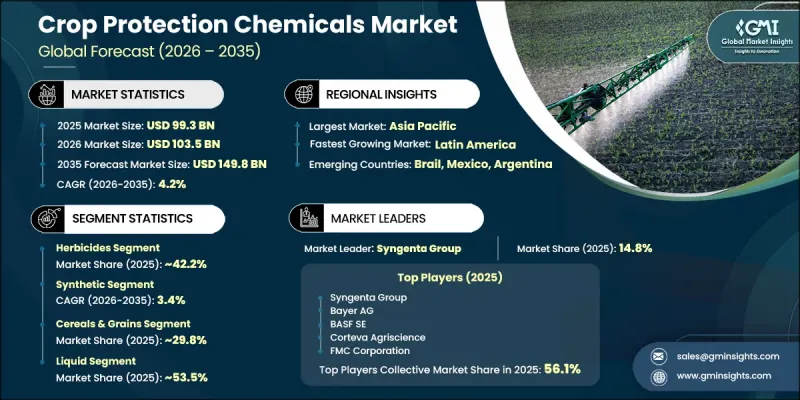
隨著產量保護、糧食安全和永續農業實踐在全球農業中日益重要,市場也穩步擴張。農民和農業相關企業正逐步採用先進的作物保護解決方案,以減少病蟲害造成的損失,同時在各種氣候條件下維持生產力。精密農業的興起推動了對提高效率和減少化學浪費的靶向噴灑方法的需求。同時,人們對環境影響的日益關注也加速了環保配方和低毒性解決方案的研發。主要經濟體不斷收緊的監管促使製造商開發更安全、更合規的產品。配方科學領域的技術進步,包括基於奈米技術的解決方案和生物替代品,正在進一步改變產品開發策略。全球糧食需求的成長和耕地面積的減少,進一步凸顯了高效能作物保護系統作為現代農業關鍵投入的重要性。
| 市場範圍 | |
|---|---|
| 開始年份 | 2025 |
| 預測期 | 2026-2035 |
| 初始市場規模 | 993億美元 |
| 預測金額 | 1498億美元 |
| 複合年成長率 | 4.2% |
預計到2025年,除草劑市佔率將達到42.2%,並在2035年之前以3.5%的複合年成長率成長。雜草管理仍然是農業生產中的一項重大挑戰,選擇性配方被廣泛用於清除雜草,同時保持作物健康。殺菌劑在控制主要作物的真菌感染疾病方面發揮至關重要的作用,有助於提高產量並減少收穫後損失。殺蟲劑,包括有機磷類、擬除蟲菊酯類和新菸鹼類殺蟲劑,仍在整個農業系統中廣泛使用,儘管法規結構的變化正在影響其使用模式。對殺線蟲劑的需求正在逐步成長,尤其是在高價值農業領域保護土壤健康方面。
預計到2025年,合成作物保護化學品市場佔有率將達到80.5%,並在2026年至2035年間以3.4%的複合年成長率成長。其主導地位得益於其高效率、成本效益、易用性以及在主要產業區完善的生產基礎設施。然而,隨著農業系統向有機和永續生產模式轉型,生物來源和天然替代品正日益受到關注,尤其是在監管嚴格且消費者越來越偏好無殘留食品的地區。
預計到2025年,北美作物保護化學品市佔率將達到21.8%。該地區的特點是技術應用率高、法規結構嚴格,以及對環保農業材料的需求不斷成長。綜合蟲害管理(IPM)已廣泛應用,這得益於消費者對有機食品和低殘留食品需求的不斷成長。噴灑技術的創新,例如精準噴灑系統和無人機(UAV)噴灑方法,進一步推動了該地區的市場發展。監管機構對產品安全性和環境合規性的重視,持續推動產品配方和應用趨勢的發展。
目錄
第1章:調查方法和範圍
第2章執行摘要
第3章 行業洞察
- 產業生態系分析
- 供應商情況
- 利潤率
- 每個階段增加的價值
- 影響價值鏈的因素
- 中斷
- 影響產業的因素
- 促進因素
- 產業潛在風險與挑戰
- 市場機遇
- 成長潛力分析
- 監理情勢
- 波特的分析
- PESTLE分析
- 價格趨勢
- 按地區
- 按類型
- 未來市場趨勢
- 技術與創新展望
- 最新科技趨勢
- 新興技術
- 專利趨勢
- 貿易統計
- 主要進口國
- 主要出口國
- 永續性和環境方面
- 永續計劃
- 減少廢棄物策略
- 生產中的能源效率
- 具有環保意識的舉措
- 考慮碳足跡
第4章 競爭情勢
- 介紹
- 企業市佔率分析
- 按地區
- 北美洲
- 歐洲
- 亞太地區
- LATAM
- 中東和非洲
- 按地區
- 企業矩陣分析
- 主要市場公司的競爭分析
- 競爭定位矩陣
- 主要進展
- 併購
- 夥伴關係和聯盟
- 新產品發布
- 業務拓展計劃
第5章 市場估算與預測:依產品類型分類,2022-2035年
- 除草劑
- 選擇性除草劑
- 非選擇性除草劑
- 消毒劑
- 內吸性殺菌劑
- 接觸式消毒劑
- 殺蟲劑
- 有機磷殺蟲劑
- 擬除蟲菊酯類殺蟲劑
- 新菸鹼類殺蟲劑
- 其他
- 線蟲防治劑
- 燻蒸殺線蟲劑
- 無需燻蒸的殺線蟲劑
- 軟體動物滅蟲員
- 其他
第6章 市場估計與預測:依來源分類,2022-2035年
- 合成
- 天然/生物來源
第7章 市場估計與預測:依作物類型分類,2022-2035年
- 穀類和穀類食品
- 小麥
- 米
- 玉米
- 大麥
- 其他
- 水果和蔬菜
- 水果(柑橘類水果、蘋果、葡萄等)
- 蔬菜(番茄、馬鈴薯、綠葉蔬菜等)
- 油籽/豆類
- 大豆
- 菜籽
- 向日葵
- 豆類(扁豆、鷹嘴豆等)
- 經濟作物
- 棉布
- 甘蔗
- 菸草
- 其他
- 草坪和觀賞植物
- 高爾夫球場和運動草坪
- 住宅草坪和景觀美化
- 觀賞植物和幼苗
- 其他
第8章 市場估算與預測:依形式分類,2022-2035年
- 液體
- 濃縮液(EC)
- 懸浮濃縮液(SC)
- 可溶性液體(SL)
- 乾粉
- 可濕性粉劑(WP)
- 顆粒狀可濕性粉劑(WDG)
- 水溶性溶劑(SP)
- 顆粒狀
- 可分散顆粒
- 緩釋顆粒
第9章 市場估計與預測:依應用方法分類,2022-2035年
- 葉面噴布
- 種子處理
- 土壤處理
- 化學
- 燻蒸
- 其他
第10章 市場估價與預測:依地區分類,2022-2035年
- 北美洲
- 美國
- 加拿大
- 歐洲
- 德國
- 英國
- 法國
- 西班牙
- 義大利
- 其他歐洲國家
- 亞太地區
- 中國
- 印度
- 日本
- 澳洲
- 韓國
- 其他亞太國家
- 拉丁美洲
- 巴西
- 墨西哥
- 阿根廷
- 其他拉丁美洲國家
- 中東和非洲
- 沙烏地阿拉伯
- 南非
- UAE
- 其他中東和非洲國家
第11章:公司簡介
- BASF SE
- ADAMA Ltd.
- Albaugh LLC
- American Vanguard Corporation
- Bayer AG
- Certis USA LLC
- Corteva Agriscience
- FMC Corporation
- Marrone Bio Innovations
- Nufarm Limited
- Sipcam Oxon SpA
- Sumitomo Chemical Co., Ltd.
- Syngenta Group
- UPL Limited
- Valent BioSciences LLC
The Global Crop Protection Chemicals Market was valued at USD 99.3 billion in 2025 and is estimated to grow at a CAGR of 4.2% to reach USD 149.8 billion by 2035.
The market is experiencing steady expansion as global agriculture increasingly prioritizes yield protection, food security, and sustainable farming practices. Farmers and agribusinesses are progressively adopting advanced crop protection solutions to reduce losses caused by pests, weeds, and diseases while maintaining productivity across diverse climatic conditions. The shift toward precision agriculture is strengthening demand for targeted application methods that improve efficiency and reduce chemical wastage. At the same time, rising awareness regarding environmental impact is accelerating the development of eco-friendly formulations and reduced-toxicity solutions. Continuous regulatory tightening across major economies is pushing manufacturers toward safer and more compliant products. Technological progress in formulation science, including nano-enabled solutions and biological alternatives, is further reshaping product development strategies. Growing global food demand, coupled with shrinking arable land, is reinforcing the importance of effective crop protection systems as a critical input in modern agriculture.
| Market Scope | |
|---|---|
| Start Year | 2025 |
| Forecast Year | 2026-2035 |
| Start Value | $99.3 Billion |
| Forecast Value | $149.8 Billion |
| CAGR | 4.2% |
The herbicides segment accounted for 42.2% share in 2025 and is projected to grow at a CAGR of 3.5% through 2035. Weed management continues to be a primary concern in agricultural production, and selective formulations are widely used to eliminate unwanted vegetation while preserving crop integrity. Fungicide solutions play an essential role in controlling fungal infections across key crops, supporting healthier yields and reduced post-harvest losses. Insect control products, including organophosphates, pyrethroids, and neonicotinoids, remain widely applied across farming systems, although evolving regulatory frameworks are influencing usage patterns. Demand for nematicides is gradually increasing, particularly for protecting soil health in high-value agricultural segments.
The synthetic crop protection chemicals segment held a share of 80.5% in 2025 and is expected to grow at a CAGR of 3.4% from 2026 to 2035. Their dominance is supported by strong efficacy, cost efficiency, ease of application, and well-established production infrastructure across major industrial regions. However, biological and naturally derived alternatives are gaining traction as agricultural systems shift toward organic and sustainable production models, particularly in regions with stringent regulatory oversight and rising consumer preference for residue-free food products.
North America Crop Protection Chemicals Market held a 21.8% share in 2025. The region is characterized by high technological adoption, stringent regulatory frameworks, and increasing demand for environmentally responsible agricultural inputs. Integrated pest management practices are widely implemented, supported by rising consumer demand for organic and low-residue food products. Innovation in application technologies, including precision spraying systems and unmanned aerial application methods, is further strengthening regional market development. Regulatory emphasis on product safety and environmental compliance continues to guide formulation and adoption trends.
Key companies operating in the Crop Protection Chemicals Market include Corteva Agriscience, Bayer AG, Syngenta Group, BASF SE, FMC Corporation, UPL Limited, Sumitomo Chemical Co., Ltd., ADAMA Ltd., Nufarm Limited, American Vanguard Corporation, Albaugh LLC, Sipcam Oxon S.p.A., Certis USA LLC, Marrone Bio Innovations, and Valent BioSciences LLC. Companies in the crop protection chemicals market are strengthening their position through sustained investment in research and development aimed at improving product efficacy while reducing environmental impact. Many players are expanding portfolios to include biological and low-toxicity solutions in response to evolving regulatory frameworks and sustainability expectations. Strategic collaborations with agricultural technology providers are enabling integration of precision farming tools and digital agriculture platforms. Firms are also focusing on advanced formulation technologies such as nano-based delivery systems to enhance performance efficiency. Geographic expansion into emerging agricultural markets is helping companies diversify revenue streams.
Table of Contents
Chapter 1 Methodology & Scope
- 1.1 Market scope and definition
- 1.2 Research design
- 1.2.1 Research approach
- 1.2.2 Data collection methods
- 1.3 Data mining sources
- 1.3.1 Global
- 1.3.2 Regional/Country
- 1.4 Base estimates and calculations
- 1.4.1 Base year calculation
- 1.4.2 Key trends for market estimation
- 1.5 Primary research and validation
- 1.5.1 Primary sources
- 1.6 Forecast model
- 1.7 Research assumptions and limitations
Chapter 2 Executive Summary
- 2.1 Industry 360° synopsis
- 2.2 Key market trends
- 2.2.1 Regional
- 2.2.2 Product type
- 2.2.3 Source
- 2.2.4 Crop type
- 2.2.5 Form
- 2.2.6 Mode of application
- 2.3 TAM Analysis, 2026-2035
- 2.4 CXO perspectives: Strategic imperatives
- 2.4.1 Executive decision points
Chapter 3 Industry Insights
- 3.1 Industry ecosystem analysis
- 3.1.1 Supplier landscape
- 3.1.2 Profit margin
- 3.1.3 Value addition at each stage
- 3.1.4 Factor affecting the value chain
- 3.1.5 Disruptions
- 3.2 Industry impact forces
- 3.2.1 Growth drivers
- 3.2.2 Industry pitfalls and challenges
- 3.2.3 Market opportunities
- 3.3 Growth potential analysis
- 3.4 Regulatory landscape
- 3.4.1 North America
- 3.4.2 Europe
- 3.4.3 Asia Pacific
- 3.4.4 Latin America
- 3.4.5 Middle East & Africa
- 3.5 Porter's analysis
- 3.6 PESTEL analysis
- 3.7 Price trends
- 3.7.1 By region
- 3.7.2 By type
- 3.8 Future market trends
- 3.9 Technology and Innovation landscape
- 3.9.1 Current technological trends
- 3.9.2 Emerging technologies
- 3.10 Patent Landscape
- 3.11 Trade statistics (HS code)
- 3.11.1 Major importing countries
- 3.11.2 Major exporting countries
- 3.12 Sustainability and environmental aspects
- 3.12.1 Sustainable practices
- 3.12.2 Waste reduction strategies
- 3.12.3 Energy efficiency in production
- 3.12.4 Eco-friendly initiatives
- 3.13 Carbon footprint consideration
Chapter 4 Competitive Landscape, 2025
- 4.1 Introduction
- 4.2 Company market share analysis
- 4.2.1 By region
- 4.2.1.1 North America
- 4.2.1.2 Europe
- 4.2.1.3 Asia Pacific
- 4.2.1.4 LATAM
- 4.2.1.5 MEA
- 4.2.1 By region
- 4.3 Company matrix analysis
- 4.4 Competitive analysis of major market players
- 4.5 Competitive positioning matrix
- 4.6 Key developments
- 4.6.1 Mergers & acquisitions
- 4.6.2 Partnerships & collaborations
- 4.6.3 New Product Launches
- 4.6.4 Expansion Plans
Chapter 5 Market Estimates and Forecast, By Product Type, 2022-2035 (USD Billion) (Kilo Tons)
- 5.1 Key trends
- 5.2 Herbicides
- 5.2.1 Selective herbicides
- 5.2.2 Non-selective herbicides
- 5.3 Fungicides
- 5.3.1 Systemic fungicides
- 5.3.2 Contact fungicides
- 5.4 Insecticides
- 5.4.1 Organophosphates
- 5.4.2 Pyrethroids
- 5.4.3 Neonicotinoids
- 5.4.4 Others
- 5.5 Nematicides
- 5.5.1 Fumigant nematicides
- 5.5.2 Non-fumigant nematicides
- 5.6 Molluscicides
- 5.7 Others
Chapter 6 Market Estimates and Forecast, By Source, 2022-2035 (USD Billion) (Kilo Tons)
- 6.1 Key trends
- 6.2 Synthetic
- 6.3 Natural/Biological
Chapter 7 Market Estimates and Forecast, By Crop Type, 2022-2035 (USD Billion) (Kilo Tons)
- 7.1 Key trends
- 7.2 Cereals & grains
- 7.2.1 Wheat
- 7.2.2 Rice
- 7.2.3 Corn/maize
- 7.2.4 Barley
- 7.2.5 Others
- 7.3 Fruits & vegetables
- 7.3.1 Fruits (citrus, apple, grapes, others)
- 7.3.2 Vegetables (tomato, potato, leafy greens, others)
- 7.4 Oilseeds & pulses
- 7.4.1 Soybean
- 7.4.2 Canola/rapeseed
- 7.4.3 Sunflower
- 7.4.4 Pulses (lentils, chickpeas, others)
- 7.5 Commercial crops
- 7.5.1 Cotton
- 7.5.2 Sugarcane
- 7.5.3 Tobacco
- 7.5.4 Others
- 7.6 Turf & ornamental
- 7.6.1 Golf courses & sports turf
- 7.6.2 Residential lawns & landscapes
- 7.6.3 Ornamental plants & nurseries
- 7.7 Others
Chapter 8 Market Estimates and Forecast, By Form, 2022-2035 (USD Billion) (Kilo Tons)
- 8.1 Key trends
- 8.2 Liquid
- 8.2.1 Emulsifiable concentrate (EC)
- 8.2.2 Suspension concentrate (SC)
- 8.2.3 Soluble liquid (SL)
- 8.3 Dry/powder
- 8.3.1 Wettable powder (WP)
- 8.3.2 Water dispersible granules (WDG)
- 8.3.3 Soluble powder (SP)
- 8.4 Granular
- 8.4.1 Dispersible granules
- 8.4.2 Controlled release granules
Chapter 9 Market Estimates and Forecast, By Mode of Application, 2022-2035 (USD Billion) (Kilo Tons)
- 9.1 Key trends
- 9.2 Foliar spray
- 9.3 Seed treatment
- 9.4 Soil treatment
- 9.5 Chemigation
- 9.6 Fumigation
- 9.7 Others
Chapter 10 Market Estimates and Forecast, By Region, 2022-2035 (USD Billion) (Kilo Tons)
- 10.1 Key trends
- 10.2 North America
- 10.2.1 U.S.
- 10.2.2 Canada
- 10.3 Europe
- 10.3.1 Germany
- 10.3.2 UK
- 10.3.3 France
- 10.3.4 Spain
- 10.3.5 Italy
- 10.3.6 Rest of Europe
- 10.4 Asia Pacific
- 10.4.1 China
- 10.4.2 India
- 10.4.3 Japan
- 10.4.4 Australia
- 10.4.5 South Korea
- 10.4.6 Rest of Asia Pacific
- 10.5 Latin America
- 10.5.1 Brazil
- 10.5.2 Mexico
- 10.5.3 Argentina
- 10.5.4 Rest of Latin America
- 10.6 Middle East and Africa
- 10.6.1 Saudi Arabia
- 10.6.2 South Africa
- 10.6.3 UAE
- 10.6.4 Rest of Middle East and Africa
Chapter 11 Company Profiles
- 11.1 BASF SE
- 11.2 ADAMA Ltd.
- 11.3 Albaugh LLC
- 11.4 American Vanguard Corporation
- 11.5 Bayer AG
- 11.6 Certis USA LLC
- 11.7 Corteva Agriscience
- 11.8 FMC Corporation
- 11.9 Marrone Bio Innovations
- 11.10 Nufarm Limited
- 11.11 Sipcam Oxon S.p.A.
- 11.12 Sumitomo Chemical Co., Ltd.
- 11.13 Syngenta Group
- 11.14 UPL Limited
- 11.15 Valent BioSciences LLC

 泰國作物保護化學品:市場佔有率分析、產業趨勢與統計及成長預測(2026-2031)
 作物保護化學品市場:2026-2032年全球市場預測(依產品類型、作物類型、施用方法、製劑形式及銷售管道)
 作物保護化學殺蟲劑市場預測至2034年-全球分析(按產品類型、產地、劑型、施用方法、作物類型、害蟲類型、通路和地區分類)永續作物保護市場預測至2034年—按產品類型、作物類型、應用、原料、最終用戶和地區分類的全球分析作物保護化學品市場預測至2034年-按產品類型、作物類型、產地、配方、應用方法和地區分類的全球分析
 作物保護化學品市場規模、佔有率、趨勢和預測:按產品類型、產地、作物類型、劑型、應用方法和地區分類,2026-2034年
 農藥市場:依產地、類型、應用及地區分類
 作物保護化學品市場規模、佔有率和趨勢分析報告:按產品、應用、地區和細分市場分類(2026-2033 年)
 作物保護化學品市場規模、佔有率、成長率和全球市場分析:按類型、應用和地區分類,並預測至2026-2034年越南農作物保護化學品:市場佔有率分析、產業趨勢與統計、成長預測(2026-2031)