

 |
市場調查報告書
商品編碼
2113189
泰國作物保護化學品:市場佔有率分析、產業趨勢與統計及成長預測(2026-2031)Thailand Crop Protection Chemicals - Market Share Analysis, Industry Trends & Statistics, Growth Forecasts (2026 - 2031) |
||||||

※ 本網頁內容可能與最新版本有所差異。詳細情況請與我們聯繫。
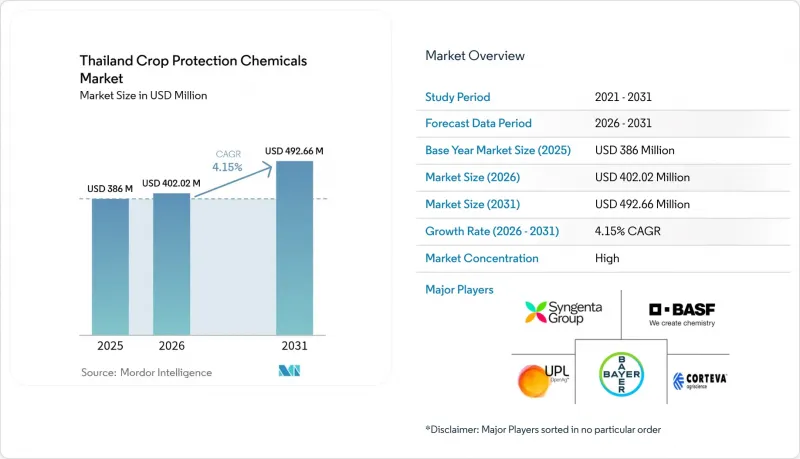
據 Mordor Intelligence 稱,2025 年泰國作物保護化學品市場價值為 3.86 億美元,預計到 2031 年將達到 4.9266 億美元,而 2026 年為 4.0202 億美元,預測期(2026-2031 年)的複合年成長率為 4.15%。
本報告按來源(合成和生物來源)、產品類型(除草劑、殺蟲劑、殺菌劑、軟體動物防治劑、殺線蟲劑和生物農藥)、施用方法(葉面噴布、種子處理、土壤處理等)以及作物類型(經濟作物、水果和蔬菜、穀類和其他)進行分類。市場預測以美元計價。
泰國作物保護化學品市場趨勢及洞察。
中原地區稻瘟病疫情日益嚴重。
未處理地塊的病害發生率已達27.85%,迫使農民增加殺菌劑的使用頻率。一項主要使用三環唑的防治方案已將產量提高至每公頃最高3.93噸,有助於在利潤率下降的情況下維持盈利。預計持續到2025年的拉尼娜現象(降雨量增加)正在加劇主要水稻種植區的病原體感染壓力。因此,密切監測和及時施藥支撐了泰國作物保護化學品市場對高效殺菌劑的穩定需求。預計到2025年,與拉尼娜現象相關的氣候變遷將進一步加劇病害壓力,降雨量的增加全部區域的病原體繁殖創造有利條件。
政府對引進精密噴塗設備提供補貼
農業部為湄南河流域26個府的小規模農戶提供高達40%的GPS定位噴桿式噴霧器補貼,並分發入門套件。這些入門套件包括先進的噴灑設備和個人防護設備。試點測試表明,工人接觸農藥的風險降低了98.23%,有效成分的使用量減少了15%。這些獎勵鼓勵採用現代噴灑技術,最佳化農藥使用,並確保按時補種。此舉符合將精密農業與永續農業實踐相結合的更廣泛的數位化目標。基於農業部安全規程的監管合規要求進一步促進了先進噴灑技術的應用,最大限度地降低了環境暴露風險。
加強《危險物質法》下對百草枯和Chlorpyrifos的監管
2020年禁令實施後,價值100億泰銖(約3.077億美元)的農業農藥庫存註銷。雖然替代農藥價格昂貴,但其防治目標害蟲的效果往往不如原先有效成分,無法繼續使用原先依賴的有效成分的農民正面臨產量下降帶來的經濟壓力。此外,黑市通路持續供應違禁物質,使得禁令的執行更加複雜,不僅削弱了監管的目的,也讓不遵守規定的企業獲得了不公平的競爭優勢。替代化學品的高昂價格和有時低下的功效,正在擠壓泰國農作物保護化學品市場的利潤空間。
細分市場分析
到2025年,合成製劑將佔泰國農藥市場佔有率的83.92%,這凸顯了農民對經證實有效的活性成分的高度依賴,這些成分即使在嚴重的蟲害侵襲條件下也能保持穩定的防治效果。生物農藥雖然基數較小,但到2031年將以9.49%的複合年成長率成長,成為泰國作物保護化學品市場成長最快的細分市場,因為出口商需要符合榴槤、芒果和龍眼殘留標準的解決方案。成本優勢仍然是合成製劑的關鍵優勢,因為大規模生產可以分攤固定成本,使其成為對小規模農戶極具吸引力的每公升裝產品。現有的分銷網路提供季節性信貸,這進一步鞏固了許多農民對傳統產品的依賴,因為這些產品無需接受新的使用方法培訓。
監管政策的轉變正在改變格局。農業部推廣服務機構目前正以補貼價格分發蘇雲金芽孢蘇力菌和木黴菌粉劑,顯示國家支持環境友善作用機制。跨國公司也透過建立技術合作夥伴關係積極響應。隨著「管理計畫」強調綜合蟲害管理(IPM),生產者擴大將低劑量合成農藥與標靶生物農藥混合使用,預計農藥組合將逐步調整,同時又不影響泰國集約化農業仍需要的防治效果。
預計到2025年,除草劑將佔據泰國作物保護化學品市場44.32%的佔有率,這反映了水稻和甘蔗種植中對雜草控制的需求。相較之下,生物農藥的複合年成長率(CAGR)為11.03%,主要得益於政府對蘇力菌和信息素產品的支持。跨國公司和本土新創企業都在加大研發投入,以抓住這一機會。在泰國作物保護化學品市場中,由於持續的毛蟲災害,殺蟲劑市場依然保持強勁;而由於稻瘟病發病率的上升,殺菌劑市場則呈現溫和成長。
儘管軟體動物和線蟲防治劑仍屬於小眾市場,但由於中部地區稻田根結線蟲疫情日益嚴重,市場需求正在成長。生物農藥推廣應用的障礙,例如保存期限短和每公頃成本高,正在逐漸得到緩解,因為田間試驗表明,生物農藥的產量可與合成農藥相媲美。先正達的費洛蒙相關合作計畫旨在2026年實現全國各地的商業化部署。產品組合多元化有助於保護生產商免受合規風險的影響,並支持泰國整個作物保護化學品市場的綜合蟲害管理(IPM)策略。
其他好處:
- Excel格式的市場預測(ME)表
- 3個月的分析師支持
目錄
第1章:引言
- 研究假設和市場定義
- 調查範圍
第2章:調查方法
第3章執行摘要
第4章 市場狀況
- 市場概覽
- 市場促進因素
- 中原地區稻瘟病疫情正在加劇。
- 政府對引進精密噴塗設備提供補貼
- 透過合約農業擴大水果出口
- 迅速擴大除草劑防治甘蔗雜草計劃
- 小規模農戶農業用品電商平台激增
- 與皇家調查局生物防治計畫合作
- 市場限制因素
- 加強《危險物質法》中關於Paraquat和Chlorpyrifos的監管
- 北部各省有機稻種植面積增加
- 季節性勞動力流動限制了農藥的及時施用。
- 消費者強烈反對榴槤出口中的化學殘留物
- 監理情勢
- 技術展望
- 波特五力分析
第5章 市場規模與成長預測
- 依化學類型
- 合成
- 生物來源
- 依產品
- 除草劑
- 殺蟲劑
- 消毒劑
- 軟體動物滅蟲員
- 尼馬奇賽德
- 生物農藥
- 透過應用方法
- 葉面噴布
- 種子處理
- 土壤處理
- 化學
- 燻蒸
- 按作物
- 經濟作物
- 水果和蔬菜
- 穀物和穀類
- 豆類和油籽
- 用於觀賞和草坪
第6章 競爭情勢
- 市場集中度
- 策略趨勢
- 市佔率分析
- 公司簡介
- Bayer AG
- BASF SE
- Syngenta Group
- Corteva Inc.
- UPL Ltd.
- Sumitomo Chemical Co. Ltd.(Mitsui Chemicals Agro, Inc.)
- Sotus International
- Gowan Company LLC
- Nufarm Ltd.
- Albaugh Asia-Pacific(Albaugh LLC)
- Helm AG
- Shandong Weifang Rainbow Chemical Co., Ltd
- ISK Biosciences Thailand(Ishihara Sangyo Kaisha Ltd.)
- FMC Corporation
- Nisso Chemical(Nippon Soda Co. Ltd.)
第7章 市場機會與未來展望
According to Mordor Intelligence, the Thailand crop protection chemicals market size was valued at USD 386 million in 2025 and estimated to grow from USD 402.02 million in 2026 to reach USD 492.66 million by 2031, at a CAGR of 4.15% during the forecast period (2026-2031).
This report is Segmented by Origin (Synthetic and Biological), by Product (Herbicides, Insecticides, Fungicides, Molluscicides, Nematicides, and Bio-Pesticides), by Application Method (Foliar Spray, Seed Treatment, Soil Treatment, and More), and by Crop (Commercial Crops, Fruits and Vegetables, Grains and Cereals, and Others). The Market Forecasts are Provided in Terms of Value (USD).
Thailand Crop Protection Chemicals Market Trends and Insights
Intensifying rice blast outbreaks in the Central Plains
Disease severity has reached 27.85% in untreated plots, compelling growers to increase fungicide spray frequency. Tricyclazole-based programs raise yields by up to 3.93 metric ton/ha, helping sustain profitability despite tighter margins. Wetter La Nina patterns forecast through 2025 bolster inoculum pressure across the core rice belt. Close monitoring and timely applications, therefore, underpin demand stability for high-efficacy fungicides within the Thailand crop protection chemicals market. Climate variability associated with La Nina conditions is anticipated to intensify disease pressure through 2025, with increased rainfall creating favorable conditions for pathogen proliferation across major rice-growing regions.
Government subsidies for precision-sprayer adoption
The Ministry of Agriculture covers up to 40% of the cost of Global Positioning System (GPS)-enabled boom sprayers, distributing starter kits to smallholders in 26 provinces along the Chao Phraya River Basin. These starter kits include advanced application equipment and personal protective gear. Demonstrations show a 98.23% reduction in operator exposure and a 15% savings in active ingredients. These incentives strengthen the adoption of modern delivery technologies that optimize chemical volumes and compliance with re-entry intervals. The initiative aligns with broader digitalization objectives that integrate precision agriculture with sustainable farming practices. Regulatory compliance requirements under the Department of Agriculture's safety protocols further incentivize the adoption of advanced application technologies that minimize environmental exposure risks.
Stricter Hazardous Substance Act restrictions on paraquat and chlorpyrifos
On-farm inventories worth THB 10 billion (USD 307.7 million) were written off after the 2020 ban. Alternative chemistries command premium pricing while often delivering inferior efficacy against target pests, creating economic pressure on farmers who face yield penalties without access to previously relied-upon active ingredients. The ban's enforcement has been complicated by black market distribution channels that continue to supply prohibited substances, undermining regulatory objectives while creating unfair competitive advantages for non-compliant operatorsSubstitute chemistries carry premium pricing and sometimes lower efficacy, pressuring margins within the Thailand crop protection chemicals market.
Other drivers and restraints analyzed in the detailed report include:
- Expansion of contract-farming fruit exports
- Rapid growth of sugarcane ratoon herbicide programs
- Rising organic rice acreage in northern provinces
For complete list of drivers and restraints, kindly check the Table Of Contents.
Segment Analysis
Synthetic formulations controlled 83.92% of the Thailand crop protection chemicals market share in 2025, underscoring farmer reliance on proven active ingredients that deliver consistent results under high pest pressure. Biologicals, though starting from a small base, are advancing at a 9.49% CAGR through 2031, making them the fastest-growing slice of the Thailand crop protection chemicals market as exporters demand residue-compliant solutions for durian, mango, and longan. Cost remains a pivotal advantage for synthetics because large-scale manufacturing spreads fixed costs and keeps per-liter prices attractive to smallholders. The embedded dealer network that offers seasonal credit further locks many farmers into legacy products that require no new application training.
Regulatory shifts are changing the calculus. Department of Agriculture extension services now distribute Bacillus thuringiensis and Trichoderma powders at subsidized rates, signaling state backing for eco-friendly modes of action. Multinationals have responded by striking technology alliances. As stewardship programs emphasize integrated pest management, growers are likely to blend lower-dose synthetics with targeted biologicals, gradually reshaping the chemical mix without eroding the efficacy safeguards that intensive Thai agriculture still requires.
Herbicides held 44.32% of the Thailand crop protection chemicals market share in 2025, reflecting the weed-control needs of rice and cane systems. In contrast, bio-pesticides are growing at an 11.03% CAGR, bolstered by government support for Bacillus thuringiensis and pheromone-based products. Multinationals and local start-ups alike ramp up R&D spending to capture this opportunity. The Thailand crop protection chemicals market size allocated to insecticides remains resilient as armyworm incursions persist, while fungicides expand modestly on escalating rice blast prevalence.
Molluscicides and nematicides remain niche but benefit from intensifying root-knot nematode outbreaks documented in central paddies. Adoption barriers for biologicals' short shelf life, higher per-hectare cost are easing as field trials verify yield parity with synthetics. Syngenta's pheromone partnership targets nationwide commercial roll-out by 2026. Portfolio diversification protects growers from compliance risks and supports integrated pest-management strategies across the Thailand crop protection chemicals market.
Complete Report Scope:
- By Chemical Type
- Synthetic
- Biological
- By Product
- Herbicides
- Insecticides
- Fungicides
- Molluscicides
- Nematicides
- Bio-pesticides
- By Application Method
- Foliar Spray
- Seed Treatment
- Soil Treatment
- Chemigation
- Fumigation
- By Crop
- Commercial Crops
- Fruits and Vegetables
- Grains and Cereals
- Pulses and Oil seeds
- Ornamental and Turf
List of Companies Covered in this Report:
- Bayer AG
- BASF SE
- Syngenta Group
- Corteva Inc.
- UPL Ltd.
- Sumitomo Chemical Co. Ltd.(Mitsui Chemicals Agro, Inc.)
- Sotus International
- Gowan Company LLC
- Nufarm Ltd.
- Albaugh Asia-Pacific (Albaugh LLC)
- Helm AG
- Shandong Weifang Rainbow Chemical Co., Ltd
- ISK Biosciences Thailand (Ishihara Sangyo Kaisha Ltd.)
- FMC Corporation
- Nisso Chemical (Nippon Soda Co. Ltd.)
Additional Benefits:
- The market estimate (ME) sheet in Excel format
- 3 months of analyst support
TABLE OF CONTENTS
1 Introduction
- 1.1 Study Assumptions and Market Definition
- 1.2 Scope of the Study
2 Research Methodology
3 Executive Summary
4 Market Landscape
- 4.1 Market Overview
- 4.2 Market Drivers
- 4.2.1 Intensifying rice blast outbreaks in the Central Plains
- 4.2.2 Government subsidies for precision-sprayer adoption
- 4.2.3 Expansion of contract-farming fruit exports
- 4.2.4 Rapid growth of sugarcane ratoon herbicide programs
- 4.2.5 Surge in e-commerce ag-input platforms among smallholders
- 4.2.6 Biocontrol partnerships with royal research projects
- 4.3 Market Restraints
- 4.3.1 Stricter Hazardous Substance Act restrictions on paraquat and chlorpyrifos
- 4.3.2 Rising organic rice acreage in northern provinces
- 4.3.3 Seasonal labor migration limiting timely pesticide application
- 4.3.4 Consumer backlash against chemical residues in durian exports
- 4.4 Regulatory Landscape
- 4.5 Technological Outlook
- 4.6 Porter's Five Forces Analysis
- 4.6.1 Bargaining Power of Suppliers
- 4.6.2 Bargaining Power of Buyers
- 4.6.3 Threat of New Entrants
- 4.6.4 Threat of Substitutes
- 4.6.5 Intensity of Competitive Rivalry
5 Market Size and Growth Forecasts (Value)
- 5.1 By Chemical Type
- 5.1.1 Synthetic
- 5.1.2 Biological
- 5.2 By Product
- 5.2.1 Herbicides
- 5.2.2 Insecticides
- 5.2.3 Fungicides
- 5.2.4 Molluscicides
- 5.2.5 Nematicides
- 5.2.6 Bio-pesticides
- 5.3 By Application Method
- 5.3.1 Foliar Spray
- 5.3.2 Seed Treatment
- 5.3.3 Soil Treatment
- 5.3.4 Chemigation
- 5.3.5 Fumigation
- 5.4 By Crop
- 5.4.1 Commercial Crops
- 5.4.2 Fruits and Vegetables
- 5.4.3 Grains and Cereals
- 5.4.4 Pulses and Oil seeds
- 5.4.5 Ornamental and Turf
6 Competitive Landscape
- 6.1 Market Concentration
- 6.2 Strategic Moves
- 6.3 Market Share Analysis
- 6.4 Company Profiles (Includes Global Level Overview, Market Level Overview, Core Segments, Financials As Available, Strategic Information, Market Rank/Share For Key Companies, Products And Services, And Recent Developments)
- 6.4.1 Bayer AG
- 6.4.2 BASF SE
- 6.4.3 Syngenta Group
- 6.4.4 Corteva Inc.
- 6.4.5 UPL Ltd.
- 6.4.6 Sumitomo Chemical Co. Ltd.(Mitsui Chemicals Agro, Inc.)
- 6.4.7 Sotus International
- 6.4.8 Gowan Company LLC
- 6.4.9 Nufarm Ltd.
- 6.4.10 Albaugh Asia-Pacific (Albaugh LLC)
- 6.4.11 Helm AG
- 6.4.12 Shandong Weifang Rainbow Chemical Co., Ltd
- 6.4.13 ISK Biosciences Thailand (Ishihara Sangyo Kaisha Ltd.)
- 6.4.14 FMC Corporation
- 6.4.15 Nisso Chemical (Nippon Soda Co. Ltd.)
7 Market Opportunities and Future Outlook

 作物保護化學品市場:2026-2032年全球市場預測(依產品類型、作物類型、施用方法、製劑形式及銷售管道)
 作物保護化學殺蟲劑市場預測至2034年-全球分析(按產品類型、產地、劑型、施用方法、作物類型、害蟲類型、通路和地區分類)永續作物保護市場預測至2034年—按產品類型、作物類型、應用、原料、最終用戶和地區分類的全球分析
 作物保護化學品市場機會、成長促進因素、產業趨勢分析及預測(2026-2035)作物保護化學品市場預測至2034年-按產品類型、作物類型、產地、配方、應用方法和地區分類的全球分析
 作物保護化學品市場規模、佔有率、趨勢和預測:按產品類型、產地、作物類型、劑型、應用方法和地區分類,2026-2034年
 農藥市場:依產地、類型、應用及地區分類
 作物保護化學品市場規模、佔有率和趨勢分析報告:按產品、應用、地區和細分市場分類(2026-2033 年)
 作物保護化學品市場規模、佔有率、成長率和全球市場分析:按類型、應用和地區分類,並預測至2026-2034年
 越南農作物保護化學品:市場佔有率分析、產業趨勢與統計、成長預測(2026-2031)