


 |
市場調查報告書
商品編碼
2113404
南美洲熱可塑性橡膠(TPE)市場:市場佔有率分析、產業趨勢與統計及成長預測(2026-2031)South America Thermoplastic Elastomer (TPE) - Market Share Analysis, Industry Trends & Statistics, Growth Forecasts (2026 - 2031) |
||||||

※ 本網頁內容可能與最新版本有所差異。詳細情況請與我們聯繫。
據 Mordor Intelligence 稱,南美洲熱可塑性橡膠(TPE) 的市場規模預計在 2026 年達到 20.9 億美元,高於 2025 年的 19.9 億美元,預計到 2031 年將達到 26.8 億美元。
預計 2026 年至 2031 年的複合年成長率為 5.06%。
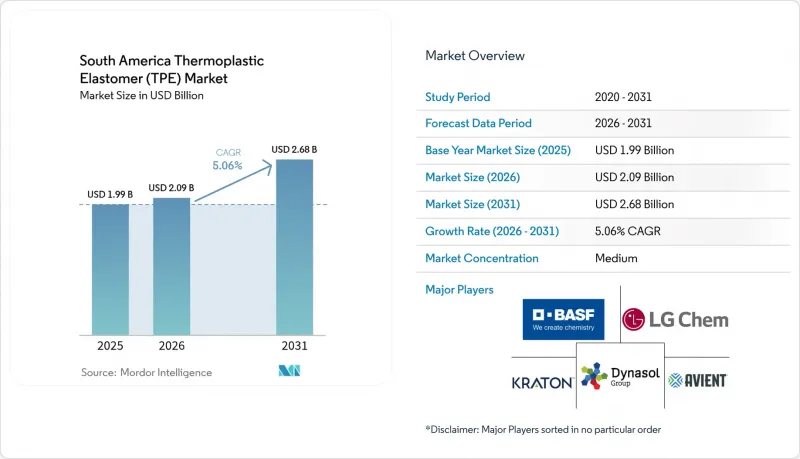
本報告按產品類型(苯乙烯嵌段共聚物、熱塑性烯烴、彈性體合金等)、應用領域(汽車及交通運輸、建築施工、鞋類及體育用品、電氣電子、醫療等)及地區(巴西、阿根廷及其他南美國家)進行細分。市場預測以美元計價。
南美熱可塑性橡膠(TPE)市場趨勢與洞察
更輕的汽車和電動車產量激增
Stellantis、大眾和通用汽車已在巴西「Mover」獎勵計畫下投資超過220億美元用於混合動力汽車和電池式電動車(BEV)計畫。這推動了從三元乙丙橡膠(EPDM)到熱塑性硫化橡膠(TPV)的廣泛轉變,TPV可減輕30%的重量並縮短40%的生產週期。無鹵熱塑性聚氨酯目前在高壓電纜護套市場佔據主導地位,路博潤的「Estane」牌號符合IEC 62893阻燃標準,並能承受125 度C的持續高溫。隨著布宜諾斯艾利斯和科爾多瓦充電基礎設施的擴建,阿根廷的電動車註冊量在2022年至2023年間激增。然而,當地供應商仍缺乏線上脫氣和低VOC混煉技術,迫使他們進口彩色顆粒,導致前置作業時間延長至12週。
用於基礎設施維修和環保公共工程的支出
阿根廷已從北美和南美開發銀行獲得10億美元貸款用於巴拉那河大橋建設,並從中國機械設備工程股份有限公司獲得8.16億美元貸款用於鐵路資金籌措,從而鞏固了其到2040年耗資4520億美元的公共工程藍圖。省級競標規範要求使用耐臭氧裂解且即使在-20 度C以下的溫度下也能保持彈性的熱塑性烯烴複合材料。含有9-35%再生材料的等級現已符合ASTM C1401黏合標準,有助於承包商獲得綠建築積分。由於投資回收期較長,即使購置成本較高,規範制定者也更傾向於選擇耐沿海潮濕環境水解的高品質共聚酯和聚醯胺彈性體。
苯乙烯和石油基原料價格波動劇烈
2024年,巴西裂解裝置的運轉率率僅60%,天然氣價格約為每百萬英熱單位15美元,導致乙烯和丙烯成本上升。因此,當巴西化學集團(Braschem)位於特里溫福(Triunfo)的工廠意外停產時,苯乙烯現貨價格在每噸1100美元至1450美元之間波動。阿根廷的巴伊亞布蘭卡樞紐在2023年遭受風暴襲擊,儘管2024年12月原料產量恢復了37.1%,但下游塑膠需求卻下降了5.1%。目前,混煉廠的庫存量相當於90天的用量,而季度附加費正在削弱熱可塑性橡膠相對於熱固性橡膠的成本優勢。巴西的「Presiq」計畫將於2027年啟動,年度預算為40億雷亞爾,旨在穩定原物料價格,但該計畫的實施取決於議會預算的批准。
細分市場分析
苯乙烯基嵌段共聚物預計在2025年將佔銷售額的38.92%,其具有透明、柔軟觸感和與聚丙烯良好的黏合性,廣泛應用於鞋底和消費品包覆成型等領域。其密度低於1.0 g/cm³,符合汽車製造商的輕量化策略,同時也為包裝製造商提供熱熔膠的應用。熱塑性烯烴具有優異的耐化學性和抗紫外線性能,常用於車身外部裝飾和引擎室通風管道。熱塑性硫化橡膠等彈性體合金正在取代EPDM車門密封條,從而減輕車輛重量30%並縮短組裝週期。共聚酯和聚醯胺彈性體能夠在130°C的高溫下持續使用,應用於排氣吊架和變速箱支架等動力傳動系統零件,因此價格較高。
預計到2031年,熱塑性聚氨酯(TPU)將以5.49%的複合年成長率(CAGR)實現最高成長。這主要得益於採礦業的持續轉型,在泥漿泵中,澆鑄聚氨酯正被TPU所取代,從而延長了20-50%的使用壽命並減少了停機時間。無鹵聚醚基TPU也被用於高壓電動車電纜的護套,這些護套必須能夠承受125 度C的持續使用和-40 度C的低溫啟動。源自蓖麻油多元醇的生物基TPU使鞋類品牌能夠在不影響邵氏A硬度或彈性的前提下,宣傳高達30%的可再生原料含量。原料供應壓力仍令人擔憂,因為由於中東多元醇供應商將產能轉向特種化學品,預計2024年多元醇價格將上漲12-18%。
其他好處:
- Excel格式的市場預測(ME)表
- 3個月的分析師支持
目錄
第1章:引言
- 研究假設和市場定義
- 調查範圍
第2章:調查方法
第3章執行摘要
第4章 市場狀況
- 市場概覽
- 市場促進因素
- 更輕的汽車和電動車產量激增
- 用於基礎設施維修和環保公共工程的支出
- 加速醫療設備生產,恢復國內生產。
- 鞋類產業轉向生物基TPE鞋底的轉變
- 採礦和能源領域採用耐磨TPE零件
- 市場限制因素
- 苯乙烯和石油基原料價格的波動
- 區域性複合/母粒生產能力短缺
- 加強對鄰苯二甲酸酯和揮發性有機化合物的監管
- 價值鏈分析
- 波特五力模型
第5章 市場規模與成長預測
- 依產品類型
- 苯乙烯基嵌段共聚物(TPE-S)
- 熱塑性烯烴(TPE-O)
- 彈性體合金(TPE-V/TPV)
- 熱塑性聚氨酯(TPU)
- 熱塑性共聚酯
- 熱塑性聚醯胺
- 透過使用
- 汽車和運輸業
- 建築/施工
- 鞋類和體育用品
- 電氣和電子設備
- 醫學領域
- 家用電器
- HVAC
- 黏合劑、密封劑和塗料
- 其他
- 按地區
- 巴西
- 阿根廷
- 其他南美國家
第6章 競爭情勢
- 市場集中度
- 策略趨勢
- 市佔率和排名分析
- 公司簡介
- Arkema
- Avient Corporation
- BASF
- DuPont
- Dynasol Group
- Evonik Industries AG
- Huntsman International LLC
- INEOS
- KRATON CORPORATION
- KURARAY CO., LTD.
- LG Chem
- Lubrizol Corporation
- LyondellBasell Industries Holdings BV
- Mitsubishi Chemical Corporation
- Mitsui Chemicals, Inc.
- RTP Company
- SABIC
- Wanhua
第7章 市場機會與未來展望
According to Mordor Intelligence, South America thermoplastic elastomer (TPE) market size in 2026 is estimated at USD 2.09 billion, growing from 2025 value of USD 1.99 billion with 2031 projections showing USD 2.68 billion, growing at 5.06% CAGR over 2026-2031.
This report is Segmented by Product Type (Styrenic Block Copolymer, Thermoplastic Olefin, Elastomeric Alloy, and More), Application (Automotive and Transportation, Building and Construction, Footwear and Sporting Goods, Electrical and Electronics, Medical, and More), and Geography (Brazil, Argentina, and Rest of South America). Market Forecasts are Provided in Terms of Value (USD).
South America Thermoplastic Elastomer (TPE) Market Trends and Insights
Automotive Lightweighting and EV Production Surge
Stellantis, Volkswagen, and General Motors committed more than USD 22 billion in hybrid and battery-electric projects under Brazil's Mover incentive scheme, prompting widespread substitution of EPDM with thermoplastic vulcanizates that deliver 30% weight savings and 40% faster cycle times. Halogen-free thermoplastic polyurethane now dominates high-voltage cable jackets because Lubrizol's Estane grades meet IEC 62893 flammability and withstand continuous 125 °C exposure. Argentina's EV registrations increased sharply between 2022 and 2023 as charging corridors expanded in Buenos Aires and Cordoba. Yet regional suppliers still lack in-line degassing and low-VOC compounding, forcing importation of pre-colored pellets and lengthening lead times to as much as 12 weeks.
Infrastructure Rehabilitation and Green Public Works Spend
Argentina secured USD 1 billion from the Inter-American Development Bank for the Parana River bridge and USD 816 million from China Machinery Engineering Corporation for rail upgrades, anchoring a USD 452 billion public-works roadmap through 2040. Provincial tenders specify thermoplastic-olefin combinations that resist ozone cracking and remain elastic below -20 °C. Grades with 9-35% post-consumer recycled content now meet the ASTM C1401 adhesion standard and help contractors earn green-building credits. Long payback horizons mean specifiers favor premium copolyester and polyamide elastomers that resist hydrolysis in coastal humidity, even when acquisition costs are higher.
Volatile Styrene and Petro-Feedstock Pricing
Brazilian crackers ran at 60% utilization in 2024, and natural-gas prices near USD 15 per million Btu inflated ethylene and propylene costs, pushing styrene spot quotes between USD 1,100 and USD 1,450 per ton during unplanned outages at Braskem's Triunfo complex. Argentina's Bahia Blanca hub suffered storm damage in 2023, and although feedstock output rebounded 37.1% in December 2024, downstream plastics demand fell 5.1%. Compounders now carry up to 90 days of inventory, and quarterly surcharges erode the cost advantage that thermoplastic elastomers hold over thermoset rubber. Brazil's Presiq program, valued at R$4.0 billion per year starting in 2027, aims to stabilize raw material prices, but its execution hinges on congressional budget approvals.
Other drivers and restraints analyzed in the detailed report include:
- Accelerated Medical-Device Manufacturing and Reshoring
- Footwear Sector Pivot to Bio-Based TPE Soles
- Limited Regional Compounding and Masterbatch Capacity
For complete list of drivers and restraints, kindly check the Table Of Contents.
Segment Analysis
Styrenic block copolymers generated 38.92% of 2025 revenue, delivering transparency, a soft-touch feel, and adhesion to polypropylene for footwear soles and consumer overmolding applications. Their density below 1.0 g/cm3 supports automakers' mass-reduction strategies, while the segment also underpins the use of hot-melt adhesives by packaging converters. Thermoplastic olefins are used in exterior trim and under-hood air-duct applications because they resist chemicals and ultraviolet exposure. Elastomeric alloys, such as thermoplastic vulcanizates, are displacing EPDM door seals, reducing vehicle weight by 30% and compressing assembly cycles. Copolyester and polyamide elastomers withstand continuous service at 130 °C in exhaust hangers and transmission mounts, justifying premium pricing in powertrain components.
Thermoplastic polyurethane will post the fastest 5.49% CAGR through 2031, fueled by mining conversions where TPU replaces cast polyurethane in slurry pumps, raising service life by 20-50% and cutting downtime. Halogen-free polyether-based TPU also anchors high-voltage EV cable jackets that must withstand continuous duty at 125 °C and cold starts at -40°C. Bio-attributed TPU derived from castor oil polyols enables footwear brands to claim up to 30% renewable content without compromising Shore A hardness or rebound. Raw-material pressure remains a concern because Middle Eastern polyol suppliers diverted capacity to specialty chemicals, lifting polyol prices 12-18% in 2024.
Complete Report Scope:
- By Product Type
- Styrenic Block Copolymer (TPE-S)
- Thermoplastic Olefin (TPE-O)
- Elastomeric Alloy (TPE-V / TPV)
- Thermoplastic Polyurethane (TPU)
- Thermoplastic Copolyester
- Thermoplastic Polyamide
- By Application
- Automotive and Transportation
- Building and Construction
- Footwear and Sporting Goods
- Electrical and Electronics
- Medical
- Household Appliances
- HVAC
- Adhesives, Sealants and Coatings
- Others
- By Geography
- Brazil
- Argentina
- Rest of South America
List of Companies Covered in this Report:
- Arkema
- Avient Corporation
- BASF
- DuPont
- Dynasol Group
- Evonik Industries AG
- Huntsman International LLC
- INEOS
- KRATON CORPORATION
- KURARAY CO., LTD.
- LG Chem
- Lubrizol Corporation
- LyondellBasell Industries Holdings B.V.
- Mitsubishi Chemical Corporation
- Mitsui Chemicals, Inc.
- RTP Company
- SABIC
- Wanhua
Additional Benefits:
- The market estimate (ME) sheet in Excel format
- 3 months of analyst support
TABLE OF CONTENTS
1 Introduction
- 1.1 Study Assumptions and Market Definition
- 1.2 Scope of the Study
2 Research Methodology
3 Executive Summary
4 Market Landscape
- 4.1 Market Overview
- 4.2 Market Drivers
- 4.2.1 Automotive lightweighting and EV production surge
- 4.2.2 Infrastructure rehabilitation and green public-works spend
- 4.2.3 Accelerated medical-device manufacturing and reshoring
- 4.2.4 Footwear sector's pivot to bio-based TPE soles
- 4.2.5 Mining and energy uptake of abrasion-resistant TPE parts
- 4.3 Market Restraints
- 4.3.1 Volatile styrene and petro-feedstock pricing
- 4.3.2 Limited regional compounding/masterbatch capacity
- 4.3.3 Tightening phthalate and VOC regulations
- 4.4 Value Chain Analysis
- 4.5 Porter's Five Forces
- 4.5.1 Bargaining Power of Suppliers
- 4.5.2 Bargaining Power of Consumers
- 4.5.3 Threat of New Entrants
- 4.5.4 Threat of Substitute Products and Services
- 4.5.5 Degree of Competition
5 Market Size and Growth Forecasts (Value)
- 5.1 By Product Type
- 5.1.1 Styrenic Block Copolymer (TPE-S)
- 5.1.2 Thermoplastic Olefin (TPE-O)
- 5.1.3 Elastomeric Alloy (TPE-V / TPV)
- 5.1.4 Thermoplastic Polyurethane (TPU)
- 5.1.5 Thermoplastic Copolyester
- 5.1.6 Thermoplastic Polyamide
- 5.2 By Application
- 5.2.1 Automotive and Transportation
- 5.2.2 Building and Construction
- 5.2.3 Footwear and Sporting Goods
- 5.2.4 Electrical and Electronics
- 5.2.5 Medical
- 5.2.6 Household Appliances
- 5.2.7 HVAC
- 5.2.8 Adhesives, Sealants and Coatings
- 5.2.9 Others
- 5.3 By Geography
- 5.3.1 Brazil
- 5.3.2 Argentina
- 5.3.3 Rest of South America
6 Competitive Landscape
- 6.1 Market Concentration
- 6.2 Strategic Moves
- 6.3 Market Share (%)/Ranking Analysis
- 6.4 Company Profiles (includes Global level Overview, Market level overview, Core Segments, Financials as available, Strategic Information, Market Rank/Share for key companies, Products and Services, and Recent Developments)
- 6.4.1 Arkema
- 6.4.2 Avient Corporation
- 6.4.3 BASF
- 6.4.4 DuPont
- 6.4.5 Dynasol Group
- 6.4.6 Evonik Industries AG
- 6.4.7 Huntsman International LLC
- 6.4.8 INEOS
- 6.4.9 KRATON CORPORATION
- 6.4.10 KURARAY CO., LTD.
- 6.4.11 LG Chem
- 6.4.12 Lubrizol Corporation
- 6.4.13 LyondellBasell Industries Holdings B.V.
- 6.4.14 Mitsubishi Chemical Corporation
- 6.4.15 Mitsui Chemicals, Inc.
- 6.4.16 RTP Company
- 6.4.17 SABIC
- 6.4.18 Wanhua
7 Market Opportunities and Future Outlook
- 7.1 White-space and Unmet-Need Assessment

 熱可塑性橡膠市場預測至2034年-按產品類型、加工方法、應用和地區分類的全球分析
 歐洲熱可塑性橡膠:市場佔有率分析、行業趨勢和統計數據以及成長預測(2026-2031 年)
 熱可塑性橡膠市場-2026-2032年全球市場預測
 2026年全球醫療設備熱可塑性橡膠市場報告熱可塑性橡膠(TPE):市場佔有率分析、產業趨勢與統計數據、成長預測(2026-2031)中東和非洲熱可塑性橡膠(TPE)市場:市場佔有率分析、行業趨勢和統計數據以及成長預測(2026-2031 年)醫療設備用熱可塑性橡膠:市場佔有率分析、產業趨勢和統計數據以及成長預測(2026-2031 年)
 熱可塑性橡膠市場:依類型、應用、終端用戶產業及地區分類
 全球熱可塑性橡膠市場規模、佔有率、趨勢和成長分析報告(2026-2034年)全球熱塑性聚醯胺彈性體市場規模、佔有率、趨勢和成長分析報告(2026-2034年)