


 |
市場調查報告書
商品編碼
2100566
熱可塑性橡膠(TPE):市場佔有率分析、產業趨勢與統計數據、成長預測(2026-2031)Thermoplastic Elastomer (TPE) - Market Share Analysis, Industry Trends & Statistics, Growth Forecasts (2026 - 2031) |
||||||

※ 本網頁內容可能與最新版本有所差異。詳細情況請與我們聯繫。
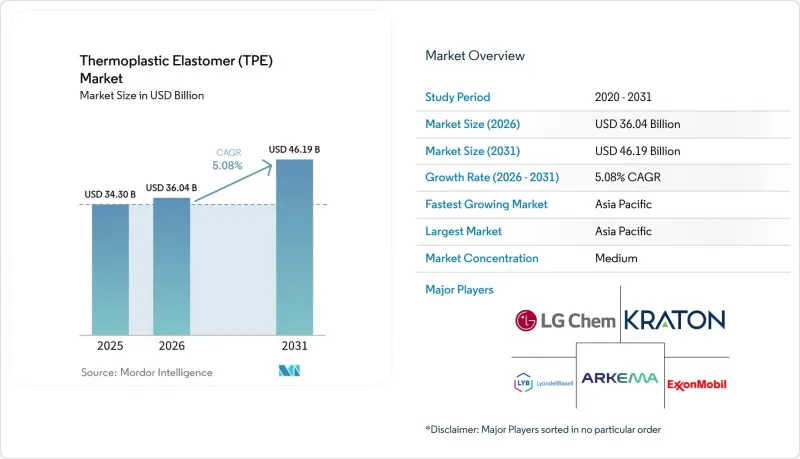
據 Mordor Intelligence 稱,熱可塑性橡膠市場預計到 2026 年價值 360.4 億美元,高於 2025 年的 343 億美元,預計到 2031 年將達到 461.9 億美元。
預計從 2026 年到 2031 年,其複合年成長率將達到 5.08%。
本報告按產品類型(苯乙烯基嵌段共聚物 (TPE-S)、熱塑性烯烴 (TPE-O)、熱塑性硫化橡膠 (TPV) 等)、應用領域(汽車和交通運輸、建築和施工、鞋類等)以及地區(亞太地區、北美地區、歐洲地區、南美地區、中東和非洲地區)進行細分。市場預測以美元 (USD) 為單位。
全球熱可塑性橡膠(TPE)市場趨勢與洞察
促進電動車電線電纜的輕量化
電動車 (EV) 革命正在從根本上重新定義電線電纜的規格,熱可塑性橡膠)正成為減輕重量和最佳化性能的關鍵驅動力。塞拉尼斯 (Celanese) 的「Hytrel TPC-LCF」展示了聚合物塗層如何幫助電動車線束減重 50%,同時也能承受 -40 度C至 130 度C的溫度。交聯聚烯正在高壓線路中取代矽橡膠,透過提供耐磨性並減少銅用量來縮短佈線路徑。在以中國汽車製造商主導的亞太地區推動電動車生產的背景下,當地的複合材料生產商正在獲得首批銷售量成長。 TPE 塗層也被應用於汽車充電板和冷卻液管路,提高了每輛車的平均聚合物含量,並擴大了熱可塑性橡膠市場的收入。
在暖氣、通風和空調(HVAC)行業中的應用拓展
熱泵的廣泛應用和新型冷媒的引入,對密封性能和抗振性能提出了更高的要求。 TE Connectivity 將「終身可靠性」作為採購標準之一,這推動了墊圈和軟管內襯材料從 EPDM 轉向更耐熱的 TPE 的轉變。使用 DSM 的「Arnitel HT」材料,可以製造一體成型的熱風管道,從而減輕 40% 的重量並降低 50% 的組件成本。這對於致力於節能維修的承包商來說是一項直接的優勢。此外,數位化控制的壓縮機需要能夠容納感測器並降低噪音的軟性安裝支架,而熱可塑性橡膠市場中的專用 TPE 化合物恰好滿足了這一細分市場的需求。
由於供不應求。
原料成本飆升給整個熱塑性聚氨酯(TPU)價值鏈的利潤率帶來了巨大壓力,其中己二酸供應受限已成為影響價格穩定和生產計畫的主要瓶頸。BASF提高了丁二醇衍生物的價格,進一步加劇了TPU生產商的成本波動。科騰也提高了SIS的價格,每噸上漲330美元,顯示嵌段共聚物的價格也將出現類似上漲。隨著石油基原料價格飆升和物流中斷,加工商面臨利潤率下降的困境,導致一些目的地設備製造商(OEM)推遲了熱可塑性橡膠市場中一些不太重要的TPU相關項目。
細分市場分析
預計到2025年,熱塑性烯烴(TPO)將以25.32%的市場佔有率引領市場,並在熱可塑性橡膠市場中保持最大佔有率,到2031年將以7.24%的複合年成長率(CAGR)保持該細分市場的最高水平。汽車製造商在保險桿飾板、氣壩密封件和底盤護板中使用TPE-O,因為這種混合物易於黏附在聚丙烯基材上,並具有優異的耐候性。建築型材和消費品產業也在擴大市場規模,尤其是在那些出於成本考量而更傾向於使用聚丙烯基合金的領域。
以以金額為準計算,TPU佔據第二大市場佔有率,在耐磨性至關重要的應用領域,例如運動鞋、輸送機和導管塗層,TPU是首選材料。儘管己二酸價格波動抑制了TPU的成長勢頭,但高價值細分市場仍維持著較高的利潤率。 TPV緊接在TPU之後,應用於引擎室空氣管理零件,這些零件必須承受高達140 度C的峰值溫度。苯乙烯基嵌段共聚物在黏合劑和拋棄式刮鬍刀保持著市場佔有率,而TPC和TPA的應用範圍正在擴展到傳動帶、氣動管路和增壓空氣管道等領域。諸如Teknor Apex公司用於電動車電池的Sarlink TPV密封劑等特殊化合物,體現了配方技術如何推動熱可塑性橡膠市場的溢價。
區域分析
預計到2025年,亞太地區將佔熱可塑性橡膠市場總值的46.25%,在所有地區中佔據最高市場佔有率,並預計到2031年將以6.34%的複合年成長率成長。中國在其中扮演核心角色,全球近三分之一的汽車產量都來自中國,同時中國也擁有大規模的智慧型手機和消費性電子產業叢集。英威達(INVISTA)將其上海尼龍6,6產能翻倍至每年40萬噸,凸顯了原料自給自足對於支持複合材料生產商發展的重要性。韓國供應顯示器和電池組件,而印度正在擴大其可再生能源用電線電纜的生產,從而促進了區域內貿易。
北美仍是熱塑性彈性體(TPE)市場創新的熱點。底特律的原始設備製造商(OEM)正在指定使用生物基熱塑性聚苯乙烯(TPV)窗口密封件,而波士頓地區的醫療設備新創公司正在試驗新型導管塗層,從而鎖定盈利的細分市場。 Serene公司在ChinaPlus展會上發表的Hytrel TPC-LCF塗層在德克薩斯州研發,可減少50%的碳足跡,符合美國《通膨控制法案》的要求。預計2025年生效的石化產品進口關稅可能會使樹脂成本增加12%至20%。這可能促使複合材料生產商將中間產品生產遷回國內,從而釋放國內TPU生產線的產能。
歐洲環境指令正加速採用含有60%消費後原料的再生熱塑性彈性體(TPE),例如Aviento公司的「reSound REC GP 7820」。德國一級供應商正在測試符合歐盟7冷啟動要求的熱塑性聚苯乙烯(TPV)散熱器軟管。同時,西班牙和義大利正在使用Arnitell HT風管維修熱泵,以實現脫碳目標。南美洲、中東和非洲目前規模較小,但隨著基礎設施的擴建,長期來看預計將實現成長。墨西哥現在是全球第四大聚氨酯市場,這反映了美國汽車供應鏈的近岸外包,並使TPU射出成型製造商更靠近原始設備製造商(OEM)。海灣合作理事會(GCC)成員國正在投資特種彈性體生產設施,以實現經濟多元化,擺脫對原油出口的依賴,這表明該地區對熱可塑性橡膠市場存在下游需求。
其他好處:
- Excel格式的市場預測(ME)表
- 3個月的分析師支持
目錄
第1章:引言
- 研究假設和市場定義
- 調查範圍
第2章:調查方法
第3章執行摘要
第4章 市場狀況
- 市場概覽
- 市場促進因素
- 促進電動車用汽車電線電纜輕量化
- 在暖氣、通風和空調(HVAC)行業中的應用拓展
- 家用電器使用範圍的擴大
- 醫療產業需求增加
- 鞋類和體育用品需求強勁。
- 市場限制因素
- 由於己二酸的供應情況,TPU(熱塑性聚氨酯)的價格出現波動。
- 高昂的製造成本和設備成本
- 使用軟性熱塑性樹脂進行 3D 列印的挑戰
- 價值鏈分析
- 波特五力模型
第5章 市場規模與成長預測
- 依產品類型
- 苯乙烯基嵌段共聚物(TPE-S)
- 熱塑性烯烴(TPE-O)
- 熱塑性硫化橡膠(TPV)
- 熱塑性聚氨酯(TPU)
- 熱塑性共聚酯(TPC)
- 熱塑性聚醯胺(TPA)
- 透過使用
- 汽車和運輸業
- 建築/施工
- 鞋類
- 電氣和電子設備
- 醫學領域
- 其他用途(家居用品、黏合劑和密封劑、暖通空調)
- 按地區
- 亞太地區
- 中國
- 日本
- 印度
- 韓國
- 東南亞國協
- 其他亞太國家
- 北美洲
- 美國
- 加拿大
- 墨西哥
- 歐洲
- 德國
- 英國
- 法國
- 義大利
- 西班牙
- 俄羅斯
- 北歐國家
- 其他歐洲國家
- 南美洲
- 巴西
- 阿根廷
- 其他南美國家
- 中東和非洲
- 沙烏地阿拉伯
- 南非
- 其他中東和非洲國家
- 亞太地區
第6章 競爭情勢
- 市場集中度
- 策略趨勢
- 市佔率和排名分析
- 公司簡介
- Arkema
- Asahi Kasei Corporation.
- Avient Corporation
- BASF
- Celanese
- Covestro AG
- Group Dynasol
- dsm-firmenich
- DuPont
- Evonik Industries AG
- Exxon Mobil Corporation
- Huntsman International LLC
- Kraton Corporation
- Lanxess
- LCY
- LG Chem
- LyondellBasell Industries Holdings BV
- Mitsubishi Chemical Group Corporation.
- SABIC
- Teknor Apex
- Sumitomo Chemical Co., Ltd.
- APAR Industries Ltd.
- The Lubrizol Corporation
第7章 市場機會與未來展望
According to Mordor Intelligence, the thermoplastic elastomer market size in 2026 is estimated at USD 36.04 billion, growing from 2025 value of USD 34.30 billion with 2031 projections showing USD 46.19 billion, growing at 5.08% CAGR over 2026-2031.
This report is Segmented by Product Type (Styrenic Block Copolymers (TPE-S), Thermoplastic Olefins (TPE-O), Thermoplastic Vulcanizates (TPV), and More), Application (Automotive and Transportation, Building and Construction, Footwear, and More), and Geography (Asia-Pacific, North America, Europe, South America, and Middle East and Africa). The Market Forecasts are Provided in Terms of Value (USD).
Global Thermoplastic Elastomer (TPE) Market Trends and Insights
EV Light Weighting Push in Automotive Wire and Cable
The electric vehicle revolution is fundamentally reshaping wire and cable specifications, with thermoplastic elastomers emerging as critical enablers of weight reduction and performance optimization. Celanese's Hytrel TPC-LCF delivers a 50% carbon-footprint cut while enduring -40 °C to 130 °C, illustrating how polymeric jacketing helps reduce harness weight in electric vehicles. Cross-linked polyolefins now displace silicone in high-voltage lines, providing abrasion resistance that shortens routing paths and trims copper usage. Asia-Pacific, led by Chinese OEMs, dominates EV output, so local compounders secure volume growth first. TPE jacketing is also moving into onboard charging pads and coolant tubes, lifting average polymer content per vehicle and magnifying revenue inside the thermoplastic elastomers market.
Growing Application in the Heating, Ventilation, and Air Conditioning (HVAC) Industry
Heat-pump adoption and new refrigerants intensify sealing and vibration requirements. TE Connectivity cites lifetime reliability as a procurement benchmark, spurring substitution of EPDM with higher-temperature TPEs in gaskets and hose liners. DSM's Arnitel HT permits single-piece hot-air ducts, cutting weight 40% and part cost 50%, a direct gain for installers targeting energy-efficient retrofits. Digitally controlled compressors also need flexible mounts that dampen noise while hosting sensors, a niche well served by specialty TPE compounds in the thermoplastic elastomers market.
Thermoplastic Polyurethane (TPU) Price Volatility Due to Adipic Acid Supply
Raw material cost inflation is creating significant margin pressure across the Thermoplastic Polyurethane (TPU) value chain, with adipic acid supply constraints representing a critical bottleneck that affects pricing stability and production planning. BASF raised butanediol derivative prices, amplifying cost swings for TPU makers . Kraton implemented a USD 330 t increase on SIS, signifying parallel inflation across block copolymers. When petroleum feedstocks spike and logistics falter, converters face slimmer spreads, prompting some Original Equipment Manufacturers (OEMs) to defer non-critical projects that rely on TPU inside the thermoplastic elastomers market.
Other drivers and restraints analyzed in the detailed report include:
- Increasing Utilization in Consumer Electronics
- Increasing Demand from Healthcare Industry
- High Manufacturing and Equipment Cost
For complete list of drivers and restraints, kindly check the Table Of Contents.
Segment Analysis
Thermoplastic olefins led with 25.32% 2025 revenue and are forecast to post the segment-best 7.24% CAGR through 2031, sustaining the largest slice of the thermoplastic elastomers market size at segment level. Automakers rely on TPE-O for bumper fascia, air-dam seals, and under-body panels because the blends bond readily with polypropylene substrates and resist weathering. Construction profiles and consumer goods add volume, especially where cost targets favor PP-based alloys.
TPU holds the number-two spot by value, favored for abrasion-critical uses in athletic shoes, conveyor belts, and catheter jacketing. Growth momentum remains tempered by adipic-acid price instability, yet high value-added niches preserve margins. TPV follows closely in under-hood air-management parts that must tolerate 140 °C peaks. Styrenic block copolymers keep share in adhesives and disposable razors, while TPC and TPA extend reach into drive belts, pneumatic tubing, and charge-air ducts. Specialty compounding, such as Teknor Apex's Sarlink TPV for EV battery seals, demonstrates how formulation know-how unlocks premium pricing within the thermoplastic elastomers market.
Complete Report Scope:
- By Product Type
- Styrenic Block Copolymers (TPE-S)
- Thermoplastic Olefins (TPE-O)
- Thermoplastic Vulcanizates (TPV)
- Thermoplastic Polyurethane (TPU)
- Thermoplastic Copolyester (TPC)
- Thermoplastic Polyamide (TPA)
- By Application
- Automotive and Transportation
- Building and Construction
- Footwear
- Electrical and Electronics
- Medical
- Other Applications (Household Goods, Adhesive and Sealants, HVAC)
- By Geography
- Asia-Pacific
- China
- Japan
- India
- South Korea
- ASEAN Countries
- Rest of Asia-Pacific
- North America
- United States
- Canada
- Mexico
- Europe
- Germany
- United Kingdom
- France
- Italy
- Spain
- Russia
- NORDIC Countries
- Rest of Europe
- South America
- Brazil
- Argentina
- Rest of South America
- Middle East and Africa
- Saudi Arabia
- South Africa
- Rest of Middle East and Africa
- Asia-Pacific
Geography Analysis
Asia-Pacific claimed 46.25% of 2025 value, the highest thermoplastic elastomers market share among regions, and is on course for a 6.34% CAGR to 2031. China represents the fulcrum, producing nearly one in three vehicles globally and hosting expansive smartphone and appliance clusters. INVISTA's move to double Nylon 6,6 capacity to 400,000 t/y in Shanghai underscores raw-material self-sufficiency that underpins compounder growth. South Korea supplies display and battery components, while India escalates wire-and-cable builds for renewable energy, sustaining intra-regional trade.
North America remains innovation-heavy in the TPE Market. Detroit OEMs specify bio-based TPV window seals, and Boston-area medical device startups pilot new catheter coatings, locking in profitable niches. Celanese's Hytrel TPC-LCF, launched at Chinaplas yet developed in Texas, achieves a 50% carbon-footprint cut, aligning with US Inflation Reduction Act incentives. Tariffs on petrochemical imports, effective 2025, could add 12-20% to resin costs, nudging compounders to reshore intermediate production and potentially opening capacity for domestic TPU lines.
Europe's environmental directives accelerate uptake of recycled-content TPEs such as Avient's reSound REC GP 7820, which contains 60% post-consumer feedstock . German Tier 1s test TPV radiator hoses that meet Euro 7 cold-start requirements. Meanwhile, Spain and Italy deploy heat-pump retrofits that use Arnitel HT ducting to meet decarbonization targets. South America and the Middle East & Africa are smaller today yet offer long-run upside as infrastructure expands. Mexico is now the world's fourth-largest polyurethane market, reflecting near-shoring of US automotive supply chains and drawing TPU injection molders closer to OEMs. Gulf Cooperation Council countries invest in specialty elastomer hubs to diversify away from crude exports, hinting at localized downstream demand within the thermoplastic elastomers market.
- Arkema
- Asahi Kasei Corporation.
- Avient Corporation
- BASF
- Celanese
- Covestro AG
- Group Dynasol
- dsm-firmenich
- DuPont
- Evonik Industries AG
- Exxon Mobil Corporation
- Huntsman International LLC
- Kraton Corporation
- Lanxess
- LCY
- LG Chem
- LyondellBasell Industries Holdings B.V.
- Mitsubishi Chemical Group Corporation.
- SABIC
- Teknor Apex
- Sumitomo Chemical Co., Ltd.
- APAR Industries Ltd.
- The Lubrizol Corporation
Additional Benefits:
- The market estimate (ME) sheet in Excel format
- 3 months of analyst support
TABLE OF CONTENTS
1 Introduction
- 1.1 Study Assumptions and Market Definition
- 1.2 Scope of the Study
2 Research Methodology
3 Executive Summary
4 Market Landscape
- 4.1 Market Overview
- 4.2 Market Drivers
- 4.2.1 EV Light Weighting Push in Automotive Wire and Cable
- 4.2.2 Growing Application in the Heating, Ventilation, and Air Conditioning (HVAC) Industry
- 4.2.3 Increasing Utilization in Consumer Electronics
- 4.2.4 Increasing Demand from Healthcare Industry
- 4.2.5 Subtantial Demand from Footwear and Sports Equipment
- 4.3 Market Restraints
- 4.3.1 TPU (Thermoplastic Polyurethane) Price Volatility Due to Adipic Acid Supply
- 4.3.2 High Manufacturing and Equipment Cost
- 4.3.3 Challenges of 3D Printing with Soft Thermoplastics
- 4.4 Value Chain Analysis
- 4.5 Porter's Five Forces
- 4.5.1 Bargaining Power of Suppliers
- 4.5.2 Bargaining Power of Buyers
- 4.5.3 Threat of New Entrants
- 4.5.4 Threat of Substitutes
- 4.5.5 Degree of Competition
5 Market Size and Growth Forecasts (Value)
- 5.1 By Product Type
- 5.1.1 Styrenic Block Copolymers (TPE-S)
- 5.1.2 Thermoplastic Olefins (TPE-O)
- 5.1.3 Thermoplastic Vulcanizates (TPV)
- 5.1.4 Thermoplastic Polyurethane (TPU)
- 5.1.5 Thermoplastic Copolyester (TPC)
- 5.1.6 Thermoplastic Polyamide (TPA)
- 5.2 By Application
- 5.2.1 Automotive and Transportation
- 5.2.2 Building and Construction
- 5.2.3 Footwear
- 5.2.4 Electrical and Electronics
- 5.2.5 Medical
- 5.2.6 Other Applications (Household Goods, Adhesive and Sealants, HVAC)
- 5.3 By Geography
- 5.3.1 Asia-Pacific
- 5.3.1.1 China
- 5.3.1.2 Japan
- 5.3.1.3 India
- 5.3.1.4 South Korea
- 5.3.1.5 ASEAN Countries
- 5.3.1.6 Rest of Asia-Pacific
- 5.3.2 North America
- 5.3.2.1 United States
- 5.3.2.2 Canada
- 5.3.2.3 Mexico
- 5.3.3 Europe
- 5.3.3.1 Germany
- 5.3.3.2 United Kingdom
- 5.3.3.3 France
- 5.3.3.4 Italy
- 5.3.3.5 Spain
- 5.3.3.6 Russia
- 5.3.3.7 NORDIC Countries
- 5.3.3.8 Rest of Europe
- 5.3.4 South America
- 5.3.4.1 Brazil
- 5.3.4.2 Argentina
- 5.3.4.3 Rest of South America
- 5.3.5 Middle East and Africa
- 5.3.5.1 Saudi Arabia
- 5.3.5.2 South Africa
- 5.3.5.3 Rest of Middle East and Africa
- 5.3.1 Asia-Pacific
6 Competitive Landscape
- 6.1 Market Concentration
- 6.2 Strategic Moves
- 6.3 Market Share(%)/Ranking Analysis
- 6.4 Company Profiles (includes Global level Overview, Market level Overview, Core Segments, Financials as available, Strategic Information, Market Rank/Share for Key Companies, Products and Services, and Recent Developments)
- 6.4.1 Arkema
- 6.4.2 Asahi Kasei Corporation.
- 6.4.3 Avient Corporation
- 6.4.4 BASF
- 6.4.5 Celanese
- 6.4.6 Covestro AG
- 6.4.7 Group Dynasol
- 6.4.8 dsm-firmenich
- 6.4.9 DuPont
- 6.4.10 Evonik Industries AG
- 6.4.11 Exxon Mobil Corporation
- 6.4.12 Huntsman International LLC
- 6.4.13 Kraton Corporation
- 6.4.14 Lanxess
- 6.4.15 LCY
- 6.4.16 LG Chem
- 6.4.17 LyondellBasell Industries Holdings B.V.
- 6.4.18 Mitsubishi Chemical Group Corporation.
- 6.4.19 SABIC
- 6.4.20 Teknor Apex
- 6.4.21 Sumitomo Chemical Co., Ltd.
- 6.4.22 APAR Industries Ltd.
- 6.4.23 The Lubrizol Corporation
7 Market Opportunities and Future Outlook
- 7.1 White-Space and Unmet-Need Assessment
- 7.2 Bio-Based Thermoplastic Elastomers

 熱可塑性橡膠市場預測至2034年-按產品類型、加工方法、應用和地區分類的全球分析
 歐洲熱可塑性橡膠:市場佔有率分析、行業趨勢和統計數據以及成長預測(2026-2031 年)南美洲熱可塑性橡膠(TPE)市場:市場佔有率分析、產業趨勢與統計及成長預測(2026-2031)
 熱可塑性橡膠市場-2026-2032年全球市場預測
 2026年全球醫療設備熱可塑性橡膠市場報告中東和非洲熱可塑性橡膠(TPE)市場:市場佔有率分析、行業趨勢和統計數據以及成長預測(2026-2031 年)醫療設備用熱可塑性橡膠:市場佔有率分析、產業趨勢和統計數據以及成長預測(2026-2031 年)
 熱可塑性橡膠市場:依類型、應用、終端用戶產業及地區分類
 全球熱可塑性橡膠市場規模、佔有率、趨勢和成長分析報告(2026-2034年)全球熱塑性聚醯胺彈性體市場規模、佔有率、趨勢和成長分析報告(2026-2034年)