


 |
市場調查報告書
商品編碼
2113264
歐洲飼料色素:市場佔有率分析、產業趨勢與統計及成長預測(2026-2031)Europe Feed Pigments - Market Share Analysis, Industry Trends & Statistics, Growth Forecasts (2026 - 2031) |
||||||

※ 本網頁內容可能與最新版本有所差異。詳細情況請與我們聯繫。
據 Mordor Intelligence 稱,2025 年歐洲飼料色素市值為 13.5 億美元,預計到 2031 年將從 2026 年的 14.2 億美元成長至 18.4 億美元,預測期(2026-2031 年)複合年成長率為 5.27%。
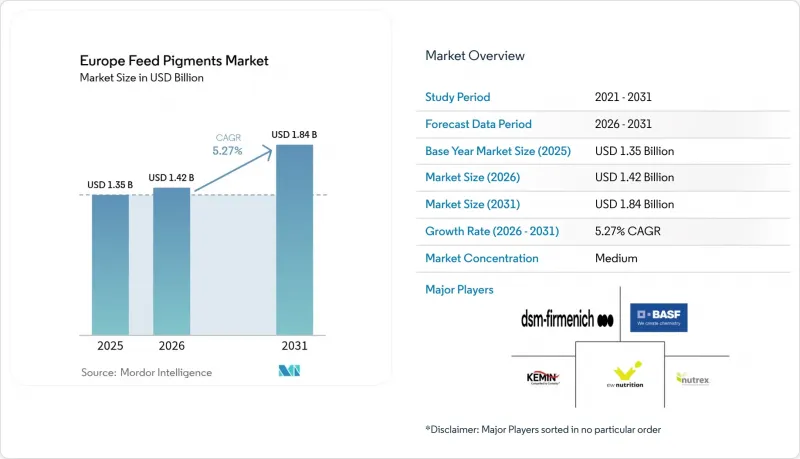
本報告按類型(類胡蘿蔔素、薑黃素、焦糖、螺旋藻及其他)、目標動物(反芻動物、家禽、豬和水產養殖)以及地區(西班牙、英國、德國、法國、義大利、俄羅斯及其他歐洲國家)進行分類。市場預測以美元計價。
歐洲飼料色素市場的趨勢與洞察
對富含類胡蘿蔔素的禽類產品的需求不斷成長
德國、法國和西班牙的零售商越來越傾向於使用顏色較深的蛋黃來表明雞蛋的新鮮度和營養價值,超級市場連鎖店甚至規定其高階雞蛋的羅氏評分必須達到14分或更高。這項視覺標準與蛋雞飼料中每公斤添加20-30毫克葉黃素和玉米黃素直接相關,預計到2024年,類胡蘿蔔素的需求量將年增8%。根據帝斯曼-菲美尼奇公司2024年發布的測試數據,脫輔基類胡蘿蔔素酯製劑在蛋黃中的沉積效率為46.2%,而角黃素的沉積效率僅31.9%。這使得配方負責人能夠在保持目標顏色評分的同時減少這些成分的用量,從而有可能降低3%的飼料成本。德國一項消費者調查顯示,68%的消費者認為蛋黃顏色深與omega-3含量高相關,但事實上蛋黃顏色與脂肪酸組成並無關聯。這種認知偏差正在推動整個雞蛋價值鏈的優質化策略。
向天然顏料來源過渡
歐盟事實上禁止使用包括紅色2G在內的合成偶氮染料,加速了植物和藻類來源色素的普及,其中螺旋藻和辣椒油樹脂正從化學合成替代品中搶佔市場佔有率。螺旋藻中的藻藍素和類胡蘿蔔素賦予其在水產養殖中的雙重功能:它能使觀賞魚呈現藍綠色,與蝦青素結合使用時,則能使鮭科魚類呈現紅橙色。 2024年,歐洲食品安全局(EFSA)加快了多種藻類萃取物的核准程序,將擁有可靠安全數據的申請的核准期限從18個月縮短至不到12個月。這鼓勵了原料供應商積極投資歐洲的養殖產能。在西班牙的辣椒產區,2024年的乾旱和夏季氣溫上升導致辣椒產量下降了12%。這導致油樹脂供應短缺,現貨價格較去年同期上漲18%。因此,法國和義大利的綜合家禽生產商被迫要麼簽訂期貨合約,要麼改用含有合成角黃素的配方。
原料成本波動劇烈
2024年,源自雨生紅球藻的天然蝦青素交易價格為每公斤6000至7150美元,約為合成蝦青素(每公斤1000美元)價格的六倍。這給銷售優質全天然鮭魚飼料的水產養殖飼料生產商的利潤率帶來了壓力。 2024年,萬壽菊油樹脂的價格年增了18%。這主要是由於印度和墨西哥這兩個最大的出口國的收成減少,以及西班牙辣椒因乾旱導致產量下降12%,造成歐洲辣椒供應緊張。為了因應這一局面,挪威和蘇格蘭的水產養殖戶正蝦青素30:70或40:60的比例混合天然蝦紅素和蝦青素。這樣既能讓他們維持產品含有天然色素的標籤,又能控制原料成本。然而,如果原料透明度成為競爭對手之間的爭論焦點,這種策略可能會引發消費者的強烈反對。
細分市場分析
至2025年,類胡蘿蔔素將佔歐洲飼料色素市場規模的61.45%。這得益於其在禽類、水產養殖和豬類養殖中的多功能性,其中葉黃素、玉米黃素、蝦青素和角黃素兼具著色和免疫支持功能。薑黃素仍處於小眾市場,主要用於有機家禽養殖系統,薑黃的抗氧化特性與其淡黃色著色效果相得益彰。雖然歐洲食品安全局(EFSA)尚未制定具體的配方指南,但配方設計人員會參考食品領域「公認安全(GRAS)」的先例。色素在飼料應用領域佔比很小,主要用於寵物食品的特殊配方。在這種情況下,其對人類消費者的視覺吸引力超過了其(微乎其微的)營養價值。
預計到2031年,螺旋藻的複合年成長率將達到9.25%,這主要得益於歐洲水產養殖業轉向使用符合「潔淨標示」定位的藻類色素,以及歐洲食品安全局(EFSA)簡化了植物萃取物的核准流程。螺旋藻兼具蛋白質來源和著色劑的雙重功能,有望擴大其在水產養殖領域的市場佔有率,尤其是在挪威和蘇格蘭的鮭魚養殖戶尋求與依賴合成蝦青素素的智利競爭對手區分開來之際。然而,歐洲目前的螺旋藻養殖能力仍低於每年2,000噸,迫使加工商以25-30%的溢價從亞洲進口乾生質能。
其他好處:
- Excel格式的市場預測(ME)表
- 3個月的分析師支持
目錄
第1章:引言
- 研究假設和市場定義
- 調查範圍
第2章:調查方法
第3章執行摘要
第4章 市場狀況
- 市場概覽
- 市場促進因素
- 對富含類胡蘿蔔素的禽類產品的需求不斷成長
- 向天然顏料原料過渡
- 微膠囊化技術的進步提高了穩定性
- 放寬藻類衍生色素核准的管制
- 消費者偏好潔淨標示的肉蛋
- 無抗生素飼料的成長推動了對功能性染料的需求。
- 市場限制因素
- 原物料價格波動
- 歐洲食品安全局 (EFSA) 對最高含量有嚴格限制
- 中歐和東歐農民採用率下降
- 天然顏料生質能供應的限制
- 監理情勢
- 技術展望
- 波特五力分析
第5章 市場規模與成長預測
- 按類型
- 類胡蘿蔔素
- 薑黃素
- 焦糖
- 螺旋藻
- 其他
- 動物
- 家禽
- 豬
- 反芻動物
- 水產養殖
- 按地區
- 德國
- 西班牙
- 法國
- 義大利
- 英國
- 俄羅斯
- 其他歐洲國家
第6章 競爭情勢
- 策略趨勢
- 市佔率分析
- 公司簡介
- DSM-Firmenich AG
- BASF SE
- Kemin Industries Inc.
- EW Nutrition GmbH
- Nutrex NV
- Synthite Industries Ltd
- Impextraco NV
- Bordas Chacn SA
- Biochem Holding GmbH
- AstaReal AB
- Camlin Fine Sciences Europe Ltd
- DuPont Nutrition Biosciences ApS
- Givaudan Natural Colorants SAS
- ADM
- Kalsec Europe Ltd
第7章 市場機會與未來展望
According to Mordor Intelligence, the Europe feed pigments market size was valued at USD 1.35 billion in 2025 and estimated to grow from USD 1.42 billion in 2026 to reach USD 1.84 billion by 2031, at a CAGR of 5.27% during the forecast period (2026-2031).
This report is Segmented by Type (Carotenoids, Curcumin, Caramel, Spirulina, and Others), by Animal (Ruminant, Poultry, Swine, and Aquaculture), and by Geography (Spain, United Kingdom, Germany, France, Italy, Russia, and Rest of Europe). The Market Forecasts are Provided in Terms of Value (USD).
Europe Feed Pigments Market Trends and Insights
Rising Demand for Carotenoid-Enriched Poultry Products
Retailers across Germany, France, and Spain are mandating deeper yolk colors to signal freshness and nutritional density, with supermarket chains specifying Roche scores of 14 or higher for premium egg lines. This visual benchmark translates directly into lutein and zeaxanthin inclusion rates of 20 to 30 milligrams per kilogram of layer feed, which is projected to increase carotenoid demand by an 8% year-over-year in 2024. DSM-Firmenich's trial data, published in 2024, showed that apocarotenoid-ester formulations achieved 46.2% deposition efficiency in egg yolks, compared with 31.9% for canthaxanthin . This enabled formulators to reduce inclusion rates while maintaining target color scores and lowering feed costs by 3%. Consumer surveys in Germany indicate that 68% of shoppers associate darker yolks with higher omega-3 content, even though yolk color is unrelated to fatty-acid profile, creating a perception gap that drives premiumization strategies across the egg value chain.
Shift Toward Natural Pigment Sources
The European Union's de facto ban on synthetic azo dyes, including Red 2G, has accelerated adoption of plant- and algae-derived pigments, with spirulina and paprika oleoresin capturing share from chemically synthesized alternatives. Spirulina's phycocyanin and carotenoid content make it a dual-function ingredient for aquaculture, providing both blue-green hues for ornamental fish and red-orange tones for salmonids when combined with astaxanthin. The European Food Safety Authority (EFSA) fast-tracked approvals for several algal extracts in 2024, reducing the regulatory timeline from 18 months to under 12 months for dossiers with robust safety data. This has emboldened ingredient suppliers to invest in European cultivation capacity. Spain's paprika-growing regions experienced a 12% decline in yield in 2024 due to drought and elevated summer temperatures, which tightened the oleoresin supply and pushed spot prices up 18% year-over-year. This, in turn, prompted poultry integrators in France and Italy to lock in forward contracts or reformulate with synthetic canthaxanthin blends.
Volatile Raw-Material Costs
Natural astaxanthin derived from Haematococcus algae was traded between USD 6,000 and USD 7,150 per kilogram in 2024, roughly six times the cost of synthetic astaxanthin at USD 1,000 per kilogram, creating margin pressure for aquafeed mills that market premium, all-natural salmon diets . Marigold oleoresin prices surged 18% year-over-year in 2024, driven by reduced harvests in India and Mexico, the two largest exporters, as well as a tightening European paprika supply following Spain's 12% yield decline due to drought. Aquaculture operators in Norway and Scotland have responded by blending natural and synthetic astaxanthin at ratios of 30:70 or 40:60, preserving the label claims of containing natural pigments while managing input costs, though this strategy risks consumer backlash if ingredient transparency becomes a competitive battleground.
Other drivers and restraints analyzed in the detailed report include:
- Technological Advances in Microencapsulation for Stability
- Regulatory Easing on Algal Pigment Approvals
- Stringent Maximum Inclusion limits by European Food Safety Authority (EFSA)
For complete list of drivers and restraints, kindly check the Table Of Contents.
Segment Analysis
Carotenoids captured 61.45% of the Europe feed pigments market size in 2025, underpinned by their versatility across poultry, aquaculture, and swine applications, where lutein, zeaxanthin, astaxanthin, and canthaxanthin serve both pigmentation and immune-support functions. Curcumin remains a niche segment, primarily deployed in organic poultry systems, where turmeric's antioxidant properties complement its mild yellow pigmentation. Although the Europe Food Safety Authority (EFSA) has not issued specific inclusion guidelines, formulators rely on Generally Recognized as Safe (GRAS) precedents from the food sector. Caramel colorants capture a minimal share in feed applications, primarily used in specialty pet-food formulations where the visual appeal to human purchasers outweighs the ingredient's negligible nutritional contribution.
Spirulina is projected to grow at a 9.25% CAGR through 2031, driven by European aquaculture's pivot toward algae-derived pigments that align with clean-label positioning and the Europe Food Safety Authority (EFSA) streamlined approval pathway for botanical extracts. Spirulina's dual functionality as a protein source and pigment positions it for incremental share gains in aquaculture, particularly as Norwegian and Scottish salmon farms seek to differentiate from Chilean competitors that rely on synthetic astaxanthin, though European cultivation capacity remains below 2,000 metric tons annually and forces mills to import dried biomass from Asia at a 25 to 30% cost premium .
Complete Report Scope:
- By Type
- Carotenoids
- Curcumin
- Caramel
- Spirulina
- Others
- By Animal
- Poultry
- Swine
- Ruminant
- Aquaculture
- By Geography
- Germany
- Spain
- France
- Italy
- United Kingdom
- Russia
- Rest of Europe
List of Companies Covered in this Report:
- DSM-Firmenich AG
- BASF SE
- Kemin Industries Inc.
- EW Nutrition GmbH
- Nutrex N.V.
- Synthite Industries Ltd
- Impextraco N.V.
- Bordas Chacn S.A.
- Biochem Holding GmbH
- AstaReal AB
- Camlin Fine Sciences Europe Ltd
- DuPont Nutrition Biosciences ApS
- Givaudan Natural Colorants SAS
- ADM
- Kalsec Europe Ltd
Additional Benefits:
- The market estimate (ME) sheet in Excel format
- 3 months of analyst support
TABLE OF CONTENTS
1 INTRODUCTION
- 1.1 Study Assumptions and Market Definition
- 1.2 Scope of the Study
2 RESEARCH METHODOLOGY
3 EXECUTIVE SUMMARY
4 MARKET LANDSCAPE
- 4.1 Market Overview
- 4.2 Market Drivers
- 4.2.1 Rising demand for carotenoid-enriched poultry products
- 4.2.2 Shift toward natural pigment sources
- 4.2.3 Technological advances in microencapsulation for stability
- 4.2.4 Regulatory easing on algal pigment approvals
- 4.2.5 Consumer preference for clean-label meat and eggs
- 4.2.6 Growth of antibiotic-free feed driving functional pigments
- 4.3 Market Restraints
- 4.3.1 Volatile raw-material costs
- 4.3.2 Stringent maximum inclusion limits by European Food Safety Authority (EFSA)
- 4.3.3 Slow farmer adoption in Central and Eastern Europe
- 4.3.4 Supply constraints of natural pigment biomass
- 4.4 Regulatory Landscape
- 4.5 Technological Outlook
- 4.6 Porter's Five Forces Analysis
- 4.6.1 Bargaining Power of Suppliers
- 4.6.2 Bargaining Power of Buyers
- 4.6.3 Threat of New Entrants
- 4.6.4 Threat of Substitutes
- 4.6.5 Intensity of Competitive Rivalry
5 MARKET SIZE AND GROWTH FORECASTS (VALUE)
- 5.1 By Type
- 5.1.1 Carotenoids
- 5.1.2 Curcumin
- 5.1.3 Caramel
- 5.1.4 Spirulina
- 5.1.5 Others
- 5.2 By Animal
- 5.2.1 Poultry
- 5.2.2 Swine
- 5.2.3 Ruminant
- 5.2.4 Aquaculture
- 5.3 By Geography
- 5.3.1 Germany
- 5.3.2 Spain
- 5.3.3 France
- 5.3.4 Italy
- 5.3.5 United Kingdom
- 5.3.6 Russia
- 5.3.7 Rest of Europe
6 COMPETITIVE LANDSCAPE
- 6.1 Strategic Moves
- 6.2 Market Share Analysis
- 6.3 Company Profiles (Includes Global Level Overview, Market Level Overview, Core Segments, Financials as Available, Strategic Information, Market Rank/Share, Products and Services, Recent Developments)
- 6.3.1 DSM-Firmenich AG
- 6.3.2 BASF SE
- 6.3.3 Kemin Industries Inc.
- 6.3.4 EW Nutrition GmbH
- 6.3.5 Nutrex N.V.
- 6.3.6 Synthite Industries Ltd
- 6.3.7 Impextraco N.V.
- 6.3.8 Bordas Chacn S.A.
- 6.3.9 Biochem Holding GmbH
- 6.3.10 AstaReal AB
- 6.3.11 Camlin Fine Sciences Europe Ltd
- 6.3.12 DuPont Nutrition Biosciences ApS
- 6.3.13 Givaudan Natural Colorants SAS
- 6.3.14 ADM
- 6.3.15 Kalsec Europe Ltd
7 MARKET OPPORTUNITIES AND FUTURE OUTLOOK

 南美洲飼料色素:市佔率分析、產業趨勢與統計及成長預測(2026-2031 年)
 飼料著色劑市場:依形態、原料、目標動物、顏色類別和應用分類-2026-2032年全球市場預測非洲飼料著色劑:市場佔有率分析、產業趨勢與統計及成長預測(2026-2031 年)中東飼料色素:市場佔有率分析、產業趨勢與統計及成長預測(2026-2031)
 全球飼料著色劑市場規模、佔有率、趨勢和成長分析報告(2026-2034年)
 飼料色素市場-全球產業規模、佔有率、趨勢、機會和預測,按類型、類胡蘿蔔素來源、牲畜、地區和競爭情況細分,2020-2030 年
 2032 年飼料色素市場預測:按產品類型、來源、牲畜、應用和地區進行的全球分析