


 |
市場調查報告書
商品編碼
2099977
南美洲飼料色素:市佔率分析、產業趨勢與統計及成長預測(2026-2031 年)South America Feed Pigments - Market Share Analysis, Industry Trends & Statistics, Growth Forecasts (2026 - 2031) |
||||||

※ 本網頁內容可能與最新版本有所差異。詳細情況請與我們聯繫。
2025年南美飼料色素市值為6,200萬美元,預計到2031年將達到8,100萬美元,而2026年為6,480萬美元,2026年至2031年預測期內的複合年成長率為4.56%。
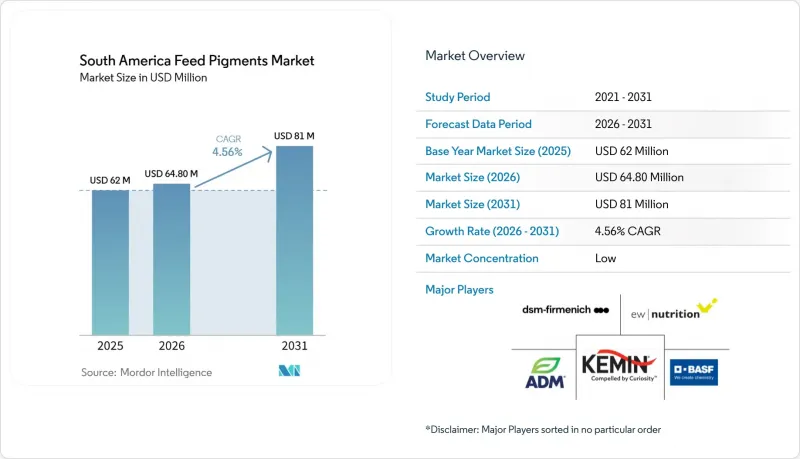
本報告按添加劑類型(類胡蘿蔔素、薑黃素、螺旋藻)、目標動物(水產養殖、家禽、反芻動物等)和地區(巴西、阿根廷、智利等)進行細分。市場預測以價值(美元)和數量(公噸)表示。
南美洲飼料色素市場趨勢與洞察
出口家禽著色標準。
巴西家禽出口產業為南美飼料色素市場提供了強勁的需求基礎,在國際貿易中,產品的外觀和顏色均勻性仍然是重要的品質屬性。根據巴西動物蛋白協會(ABPA)2026年年度報告,日本是最大的單一出口目的地,預計2025年進口雞肉40.29萬噸,這凸顯了維持高品質家禽產品外觀品質的重要性。一項發表於2025年《熱帶動物生產雜誌》(TERNAK TROPIKA Journal of Tropical Animal Production)的研究也印證了這一趨勢,該研究表明,添加角黃素可以提高蛋黃色素評分和生產效率,強調了類胡蘿蔔素色素在家禽營養中的技術重要性。因此,南美飼料色素市場與出口型家禽生產系統的需求緊密相連,色素的作用不僅體現在飼料成本方面,也體現在對產品品質和市場接受度的提升。
巴西家禽生產的韌性
儘管2025年5月巴西一家商業養雞場首次確診爆發禽流感,但巴西家禽業仍保持了韌性,支撐了南美洲對飼料色素的持續需求。根據巴西動物蛋白協會(ABPA)基於農業、畜牧業和食品供應部(MAPA)營運數據發布的《2026年年度報告》,2025年巴西雞肉產量為1528.9萬噸,加工禽隻57.06億隻。該報告預測,2026年產量將增加至1,560萬噸,顯示色素需求並非源自於產量的大幅成長,而是得益於家禽業規模的持續支撐。 ABPA《2026年年度報告》引述MAPA的數據指出,巴拉那州佔全國雞肉加工量的38.9%,凸顯了家禽相關色素需求在該州的集中度。此外,歐盟委員會 2025 年關於角黃素的規定將使殘留物控制要求更加重要,這導致出口導向生產系統逐漸轉向天然類胡蘿蔔素混合物,這也對南美飼料色素市場產生了積極影響。
合成類胡蘿蔔素的供應與價格波動
合成蝦青素和角黃素的生產主要由少數幾家製造商主導,這種全球供應集中度高的格局仍然是南美飼料色素市場的主要阻礙因素。主要供應商包括BASF公司、浙江新和生物技術股份有限公司以及帝斯曼-芬美意集團的動物營養與健康(ANH)業務,這使得南美買家極易受到全球供應和價格波動的影響。 2026年2月,帝斯曼-芬美意宣布已同意以22億歐元(26億美元)的價格將其ANH業務出售給CVC Capital Partners。該公司將保留20%的股份,這反映了業界正在進行的結構性變革。此外,天然蝦蝦青素在南美飼料色素市場的應用正在放緩。這是因為對於大規模家禽和水產飼料應用而言,天然蝦紅素的價格仍然遠高於合成產品。因此,飼料生產商在採購策略方面面臨越來越大的不確定性,尤其是在貨幣貶值導致進口原料成本上升的市場中,長期籌資策略也變得更加複雜。
細分市場分析
2025年,類胡蘿蔔素仍保持其主要地位,佔據南美飼料色素市場84.0%的佔有率,貢獻了大部分收入。該領域的需求仍然集中,因為蝦青素是鮭魚飼料的重要組成部分,而葉黃素和角黃素則廣泛用於家禽生產,以保持蛋黃和蛋皮顏色的均勻性。BASF公司的「Lucantin Pink」產品線體現了配方和應用設計的重要性。該公司將該產品定位為一種用於魚類和甲殼類動物的微膠囊化蝦青素溶液,並聲稱其適用於擠壓後應用。智利漁業管理委員會(Sernapesca)2025年的官方統計數據顯示,鮭魚漁獲量豐富,這進一步印證了智利類胡蘿蔔素的需求基礎是由生產規模驅動的。此外,Alltech Coppens 在其 2025 年技術指南中指出,飼料轉換率、蝦青素濃度和飼料整體組成都會影響魚片顏色,並強調著色劑的性能不僅取決於用量,還取決於更廣泛的飼料配方。這種技術複雜性鞏固了現有供應商在南美洲飼料色素市場的地位,增強了他們的定價能力和客戶維繫。
預計到2031年,薑黃素和螺旋藻的複合年成長率將達到7.8%,成為南美洲飼料色素市場成長最快的添加劑類別。 2024年發表在《BMC獸醫研究》雜誌上的一項研究表明,每公斤飼料添加5克鈍頂螺旋藻可提高尼羅吳郭魚的抗氧化能力、免疫反應和飼料轉換率。這些發現拓展了天然色素的作用範圍,使其不再局限於外觀,從而推動了其在高級產品(性能特性日益重要)和需要考慮殘留因素的生產系統中得到應用。
其他好處:
- Excel格式的市場預測(ME)表
- 3個月的分析師支持
目錄
第1章:引言
- 研究假設和市場定義
- 調查範圍
第2章:調查方法
第3章執行摘要
第4章 市場狀況
- 市場概覽
- 市場促進因素
- 出口禽肉顏色標準
- 巴西家禽生產的韌性
- 智利鮭魚染色的經濟學
- 巴西水產養殖業的擴張與安地斯蝦類走廊
- 由於水產飼料配方中植物蛋白的增加,最佳化著色劑的需求日益成長。
- 優質動物性蛋白質項目中天然色素的轉移
- 市場限制因素
- 合成類胡蘿蔔素的供應與價格波動
- 產品授權和使用限制的複雜性
- 高濃度植物飼料會降低蝦青素的累積效率
- 儲存、氧化和造粒過程中造成的色素流失。
- 技術展望
- 監理情勢
- 波特五力分析
第5章 市場規模與成長預測
- 透過輔助添加劑
- 類胡蘿蔔素
- 薑黃素和螺旋藻
- 動物
- 水產養殖
- 魚
- 蝦
- 其他養殖物種
- 家禽
- 肉雞
- 產蛋母雞
- 其他家禽
- 反芻動物
- 肉牛
- 乳牛
- 其他反芻動物
- 豬
- 其他動物
- 水產養殖
- 國家
- 巴西
- 阿根廷
- 智利
- 哥倫比亞
- 秘魯
- 其他南美國家
第6章 競爭情勢
- 市場集中度
- 策略趨勢
- 市佔率分析
- 公司簡介
- dsm-firmenich AG
- BASF SE
- Kemin Industries, Inc.
- EW Nutrition GmbH
- Archer-Daniels-Midland Company
- Nutreco NV
- Impextraco NV
- Orffa International Holding BV
- Corbion NV
- Innov Ad NV/SA
- Adisseo
- Synthite Industries Ltd.
- ZAGRO Asia Limited
- Alltech Inc.
- Cargill, Incorporated
第7章 市場機會與未來展望
According to Mordor Intelligence, the South America feed pigments market size was valued at USD 62.0 million in 2025 and estimated to grow from USD 64.8 million in 2026 to reach USD 81.0 million by 2031, at a CAGR of 4.56% during the forecast period 2026 to 2031.
This report is Segmented by Sub-Additive (Carotenoids, Curcumin, and Spirulina), by Animal (Aquaculture, Poultry, Ruminants, and More), and by Geography (Brazil, Argentina, Chile, and More). The Market Forecasts are Provided in Terms of Value (USD) and Volume (Metric Tons).
South America Feed Pigments Market Trends and Insights
Export-Grade Poultry Color Standards
Brazil's poultry export industry provides a strong demand base for the South America feed pigments market, product appearance and color consistency remain important quality attributes in international trade. The Associacao Brasileira de Proteina Animal (ABPA) 2026 Annual Report identified Japan as the largest individual destination, importing 402,900 metric tons of chicken meat in 2025, which reinforces the importance of maintaining visual quality in premium poultry shipments. Supporting this trend, a 2025 study published in TERNAK TROPIKA Journal of Tropical Animal Production found that canthaxanthin supplementation improved egg yolk pigmentation scores and production efficiency, underlining the technical importance of carotenoid pigments in poultry nutrition. As a result, the South America feed pigments market remains closely aligned with the requirements of export-oriented poultry systems, where pigmentation supports product quality and market acceptance rather than serving solely as a feed cost consideration.
Brazil Poultry Production Resilience
Brazil's poultry industry remained resilient despite the first documented avian influenza outbreak in a commercial flock in May 2025, helping preserve the demand foundation of the South America feed pigments market. The Associacao Brasileira de Proteina Animal (ABPA) 2026 Annual Report recorded chicken meat production of 15,289,000 metric tons in 2025 and the slaughter of 5.706 billion birds, based on Ministry of Agriculture, Livestock and Food Supply (MAPA) operational data. The same report projects production to increase to 15,600,000 metric tons in 2026, indicating that pigment demand continues to be supported by the scale of the poultry industry rather than by an exceptional rise in output. According to MAPA data cited in the Associacao Brasileira de Proteina Animal 2026 Annual Report, Parana accounted for 38.9% of national chicken slaughter, underscoring the concentration of poultry-linked pigment demand within a single state. The South America feed pigments market is also benefiting from a gradual shift toward natural carotenoid blends in export-oriented production systems, as residue management requirements become more important following the European Commission's 2025 canthaxanthin rule.
Synthetic Carotenoid Supply and Price Volatility
A concentrated global supply structure remains a key constraint for the South America feed pigments market, as synthetic astaxanthin and canthaxanthin production is controlled by a relatively small group of manufacturers. Major supply anchors include BASF SE, Zhejiang NHU Co., and the Animal Nutrition and Health (ANH) business of dsm-firmenich AG, leaving South American buyers vulnerable to fluctuations in global availability and pricing. In February 2026, dsm-firmenich announced that it had agreed to divest its ANH business to CVC Capital Partners for EUR 2.2 billion (USD 2.6 billion), while retaining a 20% equity stake, reflecting ongoing structural changes within the industry. The South America feed pigments market also faces slower adoption of natural astaxanthin, as naturally derived alternatives remain significantly more expensive than synthetic products in large-scale poultry and aquafeed applications. As a result, feed manufacturers face greater procurement uncertainty, particularly in markets where currency depreciation increases the cost of imported inputs and complicates long-term purchasing strategies.
Other drivers and restraints analyzed in the detailed report include:
- Chile Salmon Pigmentation Economics
- Aquaculture Expansion in Brazil and The Andean Shrimp Corridor
- Product Authorization and Usage-Limit Complexity
For complete list of drivers and restraints, kindly check the Table Of Contents.
Segment Analysis
Carotenoids accounted for 84.0% of the South America feed pigments market share in 2025, maintaining their position as the dominant revenue-generating category. Demand remains concentrated in this segment because astaxanthin is an essential component of salmonid diets, while xanthophylls and canthaxanthin are widely used to maintain yolk and skin color consistency in poultry production. BASF SE's Lucantin Pink portfolio illustrates the importance of formulation and application design, as the company positions the product as a microencapsulated astaxanthin solution for fish and crustaceans, suitable for post-extrusion applications. Strong salmonid harvest volumes reported in Sernapesca's 2025 official statistics further reinforce the scale-driven demand base for carotenoids in Chile. In addition, Alltech Coppens noted in its 2025 technical guidance that feed conversion ratio, astaxanthin concentration, and overall diet composition all influence fillet coloration, highlighting that pigment performance depends on broader feed formulation rather than dosage alone. This technical complexity strengthens the position of established suppliers and supports pricing power and customer retention in the South America feed pigments market.
Curcumin and spirulina are projected to register a CAGR of 7.8% through 2031, making them the fastest-growing sub-additive category in the South America feed pigments market. A 2024 study published in BMC Veterinary Research reported that supplementation with Spirulina platensis at 5 grams per kilogram improved antioxidant capacity, immune response, and feed efficiency in Nile tilapia. These findings are expanding the role of natural pigments beyond appearance, supporting their adoption in premium and residue-sensitive production systems where performance attributes are becoming increasingly important.
Complete Report Scope:
- By Sub-Additive
- Carotenoids
- Curcumin and Spirulina
- By Animal
- Aquaculture
- Fish
- Shrimp
- Other Aquaculture Species
- Poultry
- Broiler
- Layer
- Other Poultry Birds
- Ruminants
- Beef Cattle
- Dairy Cattle
- Other Ruminants
- Swine
- Other Animals
- Aquaculture
- By Country
- Brazil
- Argentina
- Chile
- Colombia
- Peru
- Rest of South America
List of Companies Covered in this Report:
- dsm-firmenich AG
- BASF SE
- Kemin Industries, Inc.
- EW Nutrition GmbH
- Archer-Daniels-Midland Company
- Nutreco N.V.
- Impextraco N.V.
- Orffa International Holding B.V.
- Corbion N.V.
- Innov Ad NV/SA
- Adisseo
- Synthite Industries Ltd.
- ZAGRO Asia Limited
- Alltech Inc.
- Cargill, Incorporated
Additional Benefits:
- The market estimate (ME) sheet in Excel format
- 3 months of analyst support
TABLE OF CONTENTS
1 INTRODUCTION
- 1.1 Study Assumptions and Market Definition
- 1.2 Scope of the Study
2 RESEARCH METHODOLOGY
3 EXECUTIVE SUMMARY
4 MARKET LANDSCAPE
- 4.1 Market Overview
- 4.2 Market Drivers
- 4.2.1 Export-Grade Poultry Color Standards
- 4.2.2 Brazil Poultry Production Resilience
- 4.2.3 Chile Salmon Pigmentation Economics
- 4.2.4 Aquaculture Expansion in Brazil and The Andean Shrimp Corridor
- 4.2.5 Plant-Protein Aquafeed Reformulation Raising Pigment Optimization Needs
- 4.2.6 Natural Pigment Migration in Premium Animal Protein Programs
- 4.3 Market Restraints
- 4.3.1 Synthetic Carotenoid Supply and Price Volatility
- 4.3.2 Product Authorization and Usage-Limit Complexity
- 4.3.3 High-Inclusion Plant Diets Reducing Astaxanthin Deposition Efficiency
- 4.3.4 Pigment Losses During Storage, Oxidation, and Pelleting
- 4.4 Technological Outlook
- 4.5 Regulatory Landscape
- 4.6 Porter's Five Forces Analysis
- 4.6.1 Bargaining Power of Suppliers
- 4.6.2 Bargaining Power of Buyers
- 4.6.3 Threat of New Entrants
- 4.6.4 Threat of Substitutes
- 4.6.5 Intensity of Competitive Rivalry
5 MARKET SIZE AND GROWTH FORECASTS
- 5.1 By Sub-Additive
- 5.1.1 Carotenoids
- 5.1.2 Curcumin and Spirulina
- 5.2 By Animal
- 5.2.1 Aquaculture
- 5.2.1.1 Fish
- 5.2.1.2 Shrimp
- 5.2.1.3 Other Aquaculture Species
- 5.2.2 Poultry
- 5.2.2.1 Broiler
- 5.2.2.2 Layer
- 5.2.2.3 Other Poultry Birds
- 5.2.3 Ruminants
- 5.2.3.1 Beef Cattle
- 5.2.3.2 Dairy Cattle
- 5.2.3.3 Other Ruminants
- 5.2.4 Swine
- 5.2.5 Other Animals
- 5.2.1 Aquaculture
- 5.3 By Country
- 5.3.1 Brazil
- 5.3.2 Argentina
- 5.3.3 Chile
- 5.3.4 Colombia
- 5.3.5 Peru
- 5.3.6 Rest of South America
6 COMPETITIVE LANDSCAPE
- 6.1 Market Concentration
- 6.2 Strategic Moves
- 6.3 Market Share Analysis
- 6.4 Company Profiles (Includes Global Level Overview, Market Level Overview, Core Segments, Financials as Available, Strategic Information, Market Rank/Share, Products and Services, Recent Developments)
- 6.4.1 dsm-firmenich AG
- 6.4.2 BASF SE
- 6.4.3 Kemin Industries, Inc.
- 6.4.4 EW Nutrition GmbH
- 6.4.5 Archer-Daniels-Midland Company
- 6.4.6 Nutreco N.V.
- 6.4.7 Impextraco N.V.
- 6.4.8 Orffa International Holding B.V.
- 6.4.9 Corbion N.V.
- 6.4.10 Innov Ad NV/SA
- 6.4.11 Adisseo
- 6.4.12 Synthite Industries Ltd.
- 6.4.13 ZAGRO Asia Limited
- 6.4.14 Alltech Inc.
- 6.4.15 Cargill, Incorporated
7 MARKET OPPORTUNITIES AND FUTURE OUTLOOK

 歐洲飼料色素:市場佔有率分析、產業趨勢與統計及成長預測(2026-2031)
 飼料著色劑市場:依形態、原料、目標動物、顏色類別和應用分類-2026-2032年全球市場預測非洲飼料著色劑:市場佔有率分析、產業趨勢與統計及成長預測(2026-2031 年)中東飼料色素:市場佔有率分析、產業趨勢與統計及成長預測(2026-2031)
 全球飼料著色劑市場規模、佔有率、趨勢和成長分析報告(2026-2034年)
 飼料色素市場-全球產業規模、佔有率、趨勢、機會和預測,按類型、類胡蘿蔔素來源、牲畜、地區和競爭情況細分,2020-2030 年
 2032 年飼料色素市場預測:按產品類型、來源、牲畜、應用和地區進行的全球分析