


 |
市場調查報告書
商品編碼
2073236
中東飼料色素:市場佔有率分析、產業趨勢與統計及成長預測(2026-2031)Middle East Feed Pigments - Market Share Analysis, Industry Trends & Statistics, Growth Forecasts (2026 - 2031) |
||||||

※ 本網頁內容可能與最新版本有所差異。詳細情況請與我們聯繫。
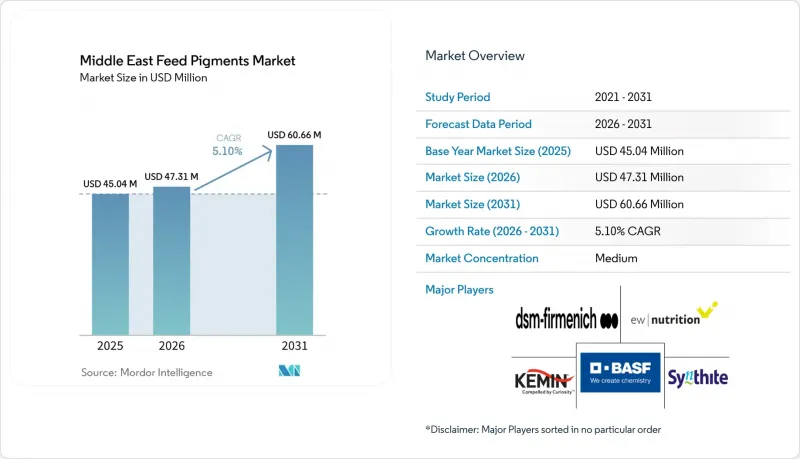
根據 Mordor Intelligence 預測,中東飼料著色劑市場規模將從 2025 年的 4,504 萬美元和 2026 年的 4,731 萬美元成長到 2031 年的 6,066 萬美元,2026 年至 2031 年的複合年成長率為 5.10%。
本報告按類型(類胡蘿蔔素、薑黃素、螺旋藻及其他)、動物種類(水產養殖、家禽、反芻動物、豬及其他動物種類)和地區(沙烏地阿拉伯、阿拉伯聯合大公國、以色列、卡達、科威特、阿曼及其他中東國家)進行細分。市場預測以價值(美元)和數量(公噸)呈現。
中東飼料著色劑市場趨勢與洞察
高溫氣候下家禽和水產養殖生產系統中食用色素的使用量增加。
由於沿岸地區的家禽和水產養殖系統長期運作高溫脅迫下,色素穩定性不僅關乎外觀,更是日常配方中的關鍵問題。類胡蘿蔔素在高溫脅迫下容易分解,飼料生產商通常需要更穩定的形式來保護活性成分,防止其沉積在蛋黃、皮膚或魚組織中。這凸顯了包覆、妥善處理和可靠施用在中東飼料色素市場的重要性。BASF公司正帶著其產品飼料色素市場,這些產品能夠幫助家禽和水產養殖戶在維持產品品質和一致性的同時,實現其理想的蛋黃和肉色目標。帝斯曼-菲美意公司也闡明了儲存和加工條件對類胡蘿蔔素穩定性的影響,強調了在氣候溫暖的地區環境中保護色素供應的必要性。水產養殖業也存在類似的趨勢,高溫環境會降低蝦青素在飼料儲存和處理過程中的保留率。這就是為什麼在中東飼料著色劑市場,那些能夠在製粒、運輸和農場使用等各個環節都保持穩定性能的供應商仍然備受青睞的原因之一。因此,市場對技術差異化的著色劑有著穩定的需求,而不是簡單地轉向成本較低的進口原料。
在沿岸地區的零售通路中,蛋黃、肉雞皮和魚肉顏色的優質化。
在沿岸地區的零售通路中,顏色仍然是鮮禽、雞蛋和養殖魚類最顯著的產品特徵之一。蛋黃的深邃色澤、肉雞皮的均勻色澤以及魚肉的誘人色澤,仍然是消費者在購買時判斷產品新鮮度和價值的重要因素。因此,即使面臨飼料預算壓力,著色方案仍佔有重要的商業性地位。生產商廣泛使用飼料著色劑來實現顏色的一致性,反映出視覺品質特徵在產品差異化和消費者接受度方面的重要性。在中東飼料著色劑市場,這一趨勢推動了持續使用而非偶爾添加,尤其是在為現代零售和餐飲服務管道供貨的綜合性企業中。這也進一步強化了引入標準化顏色評估標準和更嚴格的添加程序的必要性。水產養殖生產商也從中受益,因為外觀在高階銷售管道和重複購買行為中至關重要。因此,中東飼料著色劑市場不斷與零售展示標準以及動物營養需求保持一致。
對進口類胡蘿蔔素和螺旋藻原料的高度依賴
中東飼料著色劑市場仍然嚴重依賴進口類胡蘿蔔素和螺旋藻作為功能性成分的供應。這使得飼料生產商和相關企業面臨許多風險,例如前置作業時間、運輸中斷以及原料價格波動不定。由於市場上本地原料的供應基礎非常有限,上游供應的任何問題都可能迅速影響供應狀況和成本。 2024年9月,帝斯曼-菲美尼奇在埃及開設了一家新的製造工廠,以服務整個中東地區的客戶,這反映了市場對加強本地服務和降低交付風險的需求。同時,沙烏地阿拉伯水產養殖業的擴張持續推動對特殊飼料著色劑的需求,而目前尚未建立相應的本地供應解決方案。這種供需失衡影響顯著,因為在一個高度依賴進口的快速成長的市場中,客戶的計畫會更加嚴格,庫存管理決策也往往更加保守。通常議價能力較弱、供應選擇較少的小規模買家首當其沖地受到影響。只要市場仍高度依賴進口,與其他擁有穩固國內生產基礎的類別相比,中東飼料顏料市場仍將更容易受到供應方面的壓力。
細分市場分析
2025年,類胡蘿蔔素在中東飼料著色劑市場持續保持主導地位,以以金額為準計算佔58.4%的市佔率。緊隨其後的是螺旋藻、薑黃素和其他類型的類胡蘿蔔素,它們主要針對小規模和特殊用途。類胡蘿蔔素仍然是家禽蛋黃和皮膚顏色改良項目以及水產養殖肉類著色需求的核心成分。BASF和帝斯曼-菲美意公司繼續透過其專門的類胡蘿蔔素產品線和耐熱產品形式為該領域提供支援。已獲得的監管批准、已證實的著色效率以及與市售飼料生產商的兼容性進一步推動了市場需求。
預計2026年至2031年間,螺旋藻將以7.4%的複合年成長率(CAGR)實現最快成長,其次是薑黃素、類胡蘿蔔素和其他類型的營養素。螺旋藻的優點在於其能夠從單一成分中同時提供著色效果和功能性營養價值,這在水產養殖中尤其重要。沙烏地阿拉伯利雅德環境、水利和農業部於2024年開展的一項關於螺旋藻蛋白質、能量和氨基酸消化率的研究證實,目標魚類對螺旋藻的飼料反應良好且消化率高,這支持了螺旋藻在中東飼料著色劑市場日益成長的應用。此外,螺旋藻作為天然著色劑和功能性營養素的雙重作用,也促使其在水產養殖中的應用日益廣泛,尤其是在飼料和特殊飼料配方中。
其他好處:
- Excel格式的市場預測(ME)表
- 3個月的分析師支持
目錄
第1章:引言
- 研究假設和市場定義
- 調查範圍
第2章:調查方法
第3章執行摘要
第4章 市場狀況
- 市場概覽
- 市場促進因素
- 高溫氣候下家禽和水產養殖生產系統的色素沉澱增加。
- 在沿岸地區的零售通路中,蛋黃、肉雞皮和魚肉顏色的優質化。
- 沙烏地阿拉伯和阿拉伯聯合大公國將透過糧食安全計畫來提高對特種飼料添加劑的需求。
- 以物種特異性胡蘿蔔素混合物取代廣譜合成色素
- 出口型家禽供應鏈對清真認證天然色素的需求日益成長
- 將積層製造本地化,以提高當地供應鏈的可靠性。
- 市場限制因素
- 對進口類胡蘿蔔素和螺旋藻原料的高度依賴
- 除了家禽和水產養殖業之外,其應用範圍很窄。
- 在中東多個司法管轄區,身分識別和註冊面臨挑戰
- 天然顏料對熱和儲存的敏感性及其在區域物流中的作用
- 監理情勢
- 技術展望
- 波特五力分析
第5章 市場規模與成長預測
- 按類型
- 類胡蘿蔔素
- 薑黃素
- 螺旋藻
- 其他類型
- 依動物類型
- 水產養殖
- 魚
- 蝦
- 其他養殖物種
- 家禽
- 肉雞
- 產蛋母雞
- 其他家禽
- 反芻動物
- 牛
- 牛
- 其他反芻動物
- 豬
- 其他動物
- 水產養殖
- 按地區
- 沙烏地阿拉伯
- 阿拉伯聯合大公國
- 以色列
- 卡達
- 科威特
- 阿曼
- 其他中東國家
第6章 競爭情勢
- 市場集中度
- 策略趨勢
- 市佔率分析
- 公司簡介
- DSM-Firmenich
- BASF SE
- Bordas SA
- Kemin Industries, Inc.
- EW Nutrition
- Nutreco NV(SHV Holdings NV)
- Innovad(PAI Partners)
- Synthite Industries Ltd.
- Camlin Fine Sciences Ltd.
- Impextraco NV
- Unichemie International Private Limited
- Behn Meyer
第7章 市場機會與未來展望
According to Mordor Intelligence, the middle east feed pigments market size is projected to expand from USD 45.04 million in 2025 and USD 47.31 million in 2026 to USD 60.66 million by 2031, registering a 5.10% CAGR between 2026 and 2031.
This report is Segmented by Type (Carotenoids, Curcumin, Spirulina, and Other Types), by Animal Type (Aquaculture, Poultry, Ruminants, Swine, and Other Animal Types), and by Geography (Saudi Arabia, United Arab Emirates, Israel, Qatar, Kuwait, Oman, and Rest of the Middle East). The Market Forecasts are Provided in Terms of Value (USD) and Volume (Metric Tons).
Middle East Feed Pigments Market Trends and Insights
Rising Poultry and Aquaculture Pigment Intensity in Hot-Climate Production Systems
Poultry and aquaculture systems in the Gulf operate under persistent heat stress, which makes pigment stability a daily formulation issue rather than a cosmetic choice. Carotenoids break down more easily under thermal stress, which means feed producers often need more stable forms to protect active value before deposition in yolk, skin, or fish tissue. This raises the importance of encapsulation, controlled handling, and dependable dosing in the Middle East feed pigments market. BASF SE participates in the feed pigment market through products that help poultry and aquaculture producers achieve targeted yolk and flesh color characteristics while maintaining product quality and consistency. DSM-Firmenich has also documented the effects of storage and processing conditions on carotenoid stability, supporting the need for protected pigment delivery in warm regional conditions. The aquaculture side follows the same pattern because high ambient temperatures can reduce astaxanthin retention during feed storage and handling. This is one reason the Middle East feed pigments market continues to reward suppliers that can prove stable performance across pelleting, transport, and on-farm use. The result is steady demand for technically differentiated pigments instead of a simple shift toward low-cost imported material.
Premiumization of Egg Yolk, Broiler Skin, and Fish Flesh Color in Gulf Retail Channels
Color remains one of the clearest product signals in fresh poultry, eggs, and farmed fish across Gulf retail channels. Deep yolk color, uniform broiler skin tone, and attractive fish flesh color continue to influence how buyers judge freshness and value at the point of purchase. That keeps pigmentation programs commercially relevant even when feed budgets come under pressure. Feed pigments are widely used to help producers achieve consistent coloration, reflecting the importance of visual quality attributes for product differentiation and consumer acceptance. In the Middle East feed pigments market, this preference supports repeat use rather than occasional supplementation, especially among integrated operations serving modern retail and hospitality channels. It also strengthens the case for standardized color scoring and tighter dosing routines. Fish producers benefit similarly because appearance matters in premium sales channels and repeat purchase behavior. This keeps the Middle East feed pigments market aligned with retail presentation standards as much as with animal nutrition needs.
High Dependence on Imported Carotenoid and Spirulina Inputs
The Middle East feed pigments market still depends on imported carotenoids and spirulina for most of its functional supply. That leaves feed mills and integrators exposed to changes in lead times, shipping disruptions, and shifts in raw material pricing that they cannot fully control. The market has very limited local raw material depth, so any issue in upstream supply tends to quickly affect availability and cost. In September 2024, DSM-Firmenich opened a new manufacturing plant in Egypt to serve customers across the Middle East, reflecting the need for stronger local service and lower delivery risk. At the same time, aquaculture expansion in Saudi Arabia continues to drive demand for specialized pigment inputs that lack a regional supply solution. This imbalance matters because a growing market with imported dependence often sees periods of tighter customer planning and more conservative inventory decisions. Smaller buyers feel this first because they usually have less bargaining power and fewer supply alternatives. As long as import reliance stays high, the Middle East feed pigments market will remain more vulnerable to supply-side pressure than categories with stronger domestic production support.
Other drivers and restraints analyzed in the detailed report include:
- Food Security Programs Favoring Specialized Feed Additives in Saudi Arabia and the United Arab Emirates
- Replacement of Broad-Spectrum Synthetic Colorants with Species-Specific Carotenoid Blends
- Narrow Application Base Outside Poultry and Aquaculture
For complete list of drivers and restraints, kindly check the Table Of Contents.
Segment Analysis
Carotenoids accounted for 58.4% of the Middle East feed pigments market share in 2025, making them the clear leader by value. They were followed by spirulina, curcumin, and other types, which together served smaller and more specialized use cases. Carotenoids remain central because they meet both poultry yolk and skin programs and the needs of aquaculture flesh coloration. BASF SE and DSM-Firmenich continue to support this segment through dedicated carotenoid portfolios and heat-protected product formats. Their established regulatory acceptance, proven pigmentation efficiency, and compatibility with commercial feed manufacturing further strengthen demand.
Spirulina is anticipated to record the fastest growth at a 7.4% CAGR from 2026 to 2031, followed by curcumin, carotenoids, and other types. Its appeal lies in providing color support and functional nutritional value in a single ingredient, which is especially useful in aquaculture. Research conducted by the Ministry of Environment, Water and Agriculture, Riyadh, Saudi Arabia, on the Protein, Energy, and Amino Acid Digestibility of Spirulina in 2024 showed a positive feed response and strong digestibility in relevant fish species, which supports its rising adoption in the Middle East feed pigments market. It is also gaining traction in aquaculture applications due to its dual role as a natural pigment source and functional nutritional ingredient, supporting its use in premium and specialized feed formulations.
Complete Report Scope:
- By Type
- Carotenoids
- Curcumin
- Spirulina
- Other Types
- By Animal Type
- Aquaculture
- Fish
- Shrimp
- Other Aquaculture Species
- Poultry
- Broiler
- Layer
- Other Poultry Birds
- Ruminants
- Beef Cattle
- Dairy Cattle
- Other Ruminants
- Swine
- Other Animals
- Aquaculture
- By Geography
- Saudi Arabia
- United Arab Emirates
- Israel
- Qatar
- Kuwait
- Oman
- Rest of Middle East
List of Companies Covered in this Report:
- DSM-Firmenich
- BASF SE
- Bordas S.A.
- Kemin Industries, Inc.
- EW Nutrition
- Nutreco N.V. (SHV Holdings N.V.)
- Innovad (PAI Partners)
- Synthite Industries Ltd.
- Camlin Fine Sciences Ltd.
- Impextraco N.V.
- Unichemie International Private Limited
- Behn Meyer
Additional Benefits:
- The market estimate (ME) sheet in Excel format
- 3 months of analyst support
TABLE OF CONTENTS
1 Introduction
- 1.1 Study Assumptions and Market Definition
- 1.2 Scope of the Study
2 Research Methodology
3 Executive Summary
4 Market Landscape
- 4.1 Market Overview
- 4.2 Market Drivers
- 4.2.1 Rising Poultry and Aquaculture Pigment Intensity in Hot-Climate Production Systems
- 4.2.2 Premiumization of Egg Yolk, Broiler Skin, and Fish Flesh Color in Gulf Retail Channels
- 4.2.3 Food Security Programs Favoring Specialized Feed Additives in Saudi Arabia and the United Arab Emirates
- 4.2.4 Replacement of Broad-Spectrum Synthetic Colorants with Species-Specific Carotenoid Blends
- 4.2.5 Expansion of Halal-Positioned Natural Pigment Demand in Export-Oriented Poultry Supply Chains
- 4.2.6 Localization of Additive Manufacturing to Improve Regional Supply Reliability
- 4.3 Market Restraints
- 4.3.1 High Dependence on Imported Carotenoid and Spirulina Inputs
- 4.3.2 Narrow Application Base Outside Poultry and Aquaculture
- 4.3.3 Approval and Registration Friction Across Multiple Middle Eastern Jurisdictions
- 4.3.4 Heat and Storage Sensitivity of Natural Pigments in Regional Logistics
- 4.4 Regulatory Landscape
- 4.5 Technological Outlook
- 4.6 Porter's Five Forces Analysis
- 4.6.1 Threat of New Entrants
- 4.6.2 Bargaining Power of Suppliers
- 4.6.3 Bargaining Power of Buyers
- 4.6.4 Threat of Substitutes
- 4.6.5 Intensity of Competitive Rivalry
5 Market Size and Growth Forecasts (Value and Volume)
- 5.1 By Type
- 5.1.1 Carotenoids
- 5.1.2 Curcumin
- 5.1.3 Spirulina
- 5.1.4 Other Types
- 5.2 By Animal Type
- 5.2.1 Aquaculture
- 5.2.1.1 Fish
- 5.2.1.2 Shrimp
- 5.2.1.3 Other Aquaculture Species
- 5.2.2 Poultry
- 5.2.2.1 Broiler
- 5.2.2.2 Layer
- 5.2.2.3 Other Poultry Birds
- 5.2.3 Ruminants
- 5.2.3.1 Beef Cattle
- 5.2.3.2 Dairy Cattle
- 5.2.3.3 Other Ruminants
- 5.2.4 Swine
- 5.2.5 Other Animals
- 5.2.1 Aquaculture
- 5.3 By Geography
- 5.3.1 Saudi Arabia
- 5.3.2 United Arab Emirates
- 5.3.3 Israel
- 5.3.4 Qatar
- 5.3.5 Kuwait
- 5.3.6 Oman
- 5.3.7 Rest of Middle East
6 Competitive Landscape
- 6.1 Market Concentration
- 6.2 Strategic Moves
- 6.3 Market Share Analysis
- 6.4 Company Profiles (Includes Global Level Overview, Market Level Overview, Core Segments, Financials as Available, Strategic Information, Market Rank/Share, Products and Services, Recent Developments)
- 6.4.1 DSM-Firmenich
- 6.4.2 BASF SE
- 6.4.3 Bordas S.A.
- 6.4.4 Kemin Industries, Inc.
- 6.4.5 EW Nutrition
- 6.4.6 Nutreco N.V. (SHV Holdings N.V.)
- 6.4.7 Innovad (PAI Partners)
- 6.4.8 Synthite Industries Ltd.
- 6.4.9 Camlin Fine Sciences Ltd.
- 6.4.10 Impextraco N.V.
- 6.4.11 Unichemie International Private Limited
- 6.4.12 Behn Meyer
7 Market Opportunities and Future Outlook

 歐洲飼料色素:市場佔有率分析、產業趨勢與統計及成長預測(2026-2031)南美洲飼料色素:市佔率分析、產業趨勢與統計及成長預測(2026-2031 年)
 飼料著色劑市場:依形態、原料、目標動物、顏色類別和應用分類-2026-2032年全球市場預測非洲飼料著色劑:市場佔有率分析、產業趨勢與統計及成長預測(2026-2031 年)
 全球飼料著色劑市場規模、佔有率、趨勢和成長分析報告(2026-2034年)
 飼料色素市場-全球產業規模、佔有率、趨勢、機會和預測,按類型、類胡蘿蔔素來源、牲畜、地區和競爭情況細分,2020-2030 年
 2032 年飼料色素市場預測:按產品類型、來源、牲畜、應用和地區進行的全球分析