


 |
市場調查報告書
商品編碼
2113262
歐洲燃氣渦輪機:市場佔有率分析、產業趨勢與統計及成長預測(2026-2031)Europe Gas Turbine - Market Share Analysis, Industry Trends & Statistics, Growth Forecasts (2026 - 2031) |
||||||

※ 本網頁內容可能與最新版本有所差異。詳細情況請與我們聯繫。
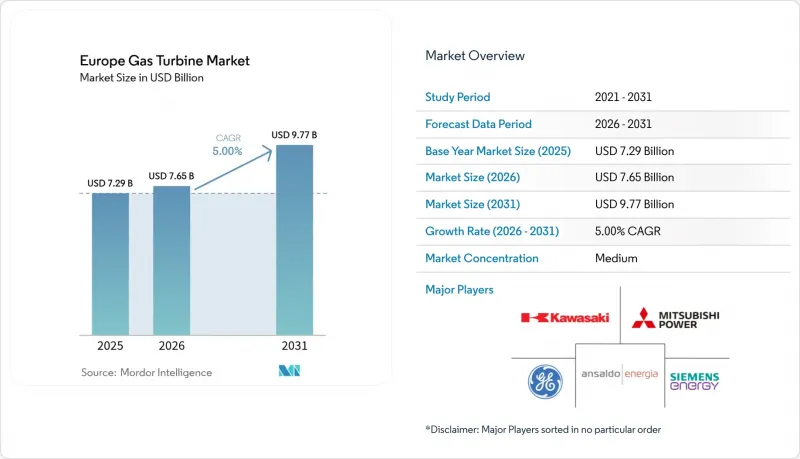
據 Mordor Intelligence 稱,歐洲燃氣渦輪機市場預計到 2026 年價值 76.5 億美元,高於 2025 年的 72.9 億美元,預計到 2031 年將達到 97.7 億美元。
預計從 2026 年到 2031 年,年複合成長率將達到 5.0%。
本報告按輸出功率(30 兆瓦以下、31-120 兆瓦、120 兆瓦以上)、運行循環(聯合循環、簡單/開式循環、汽電共生/CHP)、燃料類型(天然氣、液體燃料、其他燃料類型)、終端用戶行業(電力、石油和天然氣、其他終端用戶行業)和地區(英國、德國、法國燃料類型)、終端用戶行業(電力、石油和天然氣、其他終端用戶行業)和地區(英國、德國、法國燃料類型)。
歐洲燃氣渦輪機市場趨勢與洞察
老舊燃煤核能發電廠的關閉正在加速 CCGT(燃氣渦輪機和球形燃氣渦輪機聯合機組)的建設。
隨著歐洲老舊燃煤和核能發電廠逐步淘汰,對氫能合併循環燃氣渦輪機(CCGT)計畫的需求日益成長。德國能源與能源部(EnBW)已撥款16億歐元(約17.3億美元),用於在海爾布隆和阿爾特巴赫/迪齊紹地區建造1.34吉瓦的燃氣電站,以取代現有的燃煤電廠。此舉凸顯了在2030年淘汰燃煤電廠的最後期限前填補基本負載缺口的迫切性。英國和法國也正在推動類似的替代計劃,這兩個國家分別面臨老舊燃氣電站和核能發電發電容量快速成長的問題。最新的H級燃氣渦輪機已被證實聯合循環效率高達64%,其熱效率高,啟動時間不到30分鐘,因此非常適合在碳價飆升導致投資週期受限的情況下使用。由於時間緊迫,電力公司面臨優先發展成熟的天然氣技術而非新興的長期儲能技術的壓力,同時還要保持一條清晰的道路,爭取最早在 2028 年燃燒氫燃料。
可再生能源的間歇性增加了對能夠快速調節輸出功率的燃氣渦輪機的需求。
預計到2030年,可再生能源將在歐盟發電結構中佔比超過60%,屆時電網營運商將面臨更陡峭的電力輸出波動「鴨子曲線」和週期性的「電力停滯期」(Dunkelfraute)。通用電氣(GE)的LM2500等源自航空技術的燃氣渦輪機可在10分鐘內達到滿載。安薩爾多能源(Ansaldo Energia)在馬爾巴赫(Malbach)安裝的AE94.3A燃氣渦輪機可實現高達50兆瓦/分鐘的快速功率變化。目前,電網運作法規優先考慮靈活啟動而非創紀錄的熱效率,因此原始設備製造商(OEM)正在投資可變進氣導葉和吹掃式排氣技術,這些技術在不超出排放標準的前提下,已將最低負載降低了19%。歐盟委員會預測,到2030年,將需要新增19吉瓦的快速啟動燃氣發電容量,即使電池儲能系統日益普及,這一規模也足以維持訂單儲備。
電網級電池儲能成本的快速下降正在削弱高峰發電廠的獲利能力。
目前,鋰離子儲能系統的往返效率可達80-90%,低於開式循環燃氣調峰電廠35-45%的淨效率。義大利Terna公司預計到2030年將新增71吉瓦時的儲能容量,模擬結果預測,這將使電廠的尖峰運作時間減少15-20%。由於電池能夠以亞秒級的反應時間響應頻率響應市場,曾經僅限於燃氣渦輪機的獲利機會正轉向儲能領域。原始設備製造商(OEM)正透過整合燃氣渦輪機和電池的混合動力系統來應對這一趨勢,但電池部分的利潤率仍然很低。
細分市場分析
到2025年,額定功率超過120兆瓦的燃氣渦輪機將佔歐洲燃氣渦輪機市場佔有率的39.40%,這印證了電力公司對大型H級機組的日益依賴。這類機組的複合循環效率高達64%,慣性可在可再生能源輸出波動時進行調節。這種規模優勢支撐了歐洲燃氣渦輪機市場相當大的佔有率,因為它確保了長期的輔助服務收入,並在碳成本內部化後仍能維持較高的產能利用率。對30-120兆瓦中型機組的需求依然強勁,這主要得益於工業園區和中型城市中汽電共生機組的日益標準化,這些機組在平衡電力和蒸氣負載的同時,還能滿足歐盟工業排放指令的要求。專案發起人傾向於選擇包含燃氣渦輪機、餘熱鍋爐和數位孿生系統的承包採購方案,這可以將實施時間縮短至24-30個月,並有助於資金籌措核准。
儘管目前30兆瓦以下功率段的市場佔有率不大,但預計到2031年將以5.4%的複合年成長率成長,這主要得益於資料中心微電網、區域供熱維修和獨立製造群的推動——該功率段的成長速度在所有功率段中位居榜首。源自航空技術的燃氣渦輪機,例如GE Vernova的LM2500XPRESS,可在10分鐘內達到額定功率,並可直接以ISO集裝箱的形式通過卡車運輸,從而避免了大規模新建項目漫長的土木工程週期。分散待開發區資源的授權簡化,以及小規模機組缺乏嚴格的併網規定,進一步降低了開發風險。製造商正在這些機組中整合乾式低排放燃燒器,無需注水即可將氮氧化物排放量控制在25ppm以下,這項特性符合都市區空氣品質法規的要求。到 2027 年,隨著歐洲大型科技產業的伺服器面積加倍,預計微電網訂單將繼續逐步增加,從而提振歐洲燃氣渦輪機市場這一高成長領域的零件和服務收入。
到2025年,聯合循環燃氣渦輪機(CCGT)將佔據歐洲燃氣渦輪機市場60.40%的主導佔有率。這是因為CCGT能夠在30分鐘內啟動,且熱效率超過60%,滿足了電力公司的兩大目標:柔軟性平衡煤改氣和可再生能源發電。英國的容量市場競標和德國的「電廠策略」(Kraftwerkstrategie)指導方針明確傾向於能夠快速啟動並持續輸出4小時的CCGT資產,從而鞏固了CCGT的採購優先地位。營運商正在升級進氣冷卻系統和快速爬坡控制閥,以將冷啟動時間縮短5-10分鐘,從而在電池價格快速下降的情況下保持競爭力。在歐洲燃氣渦輪機市場,基於油氣天然氣田供電和緊急黑啟動任務的簡單迴圈調峰發電機市場規模仍然較小但穩健。在這些應用中,資本支出(CAPEX)和面積比熱效率更為重要。
預計到2031年,被歸類為熱電聯產(CHP)的熱電汽電共生和區域供熱系統的比例將以5.9%的複合年成長率成長。這反映了其能夠將80-90%的燃料能量轉化為可供工廠和區域供熱網路使用的可用輸出。丹麥、芬蘭和波蘭已經立法規定了熱力基礎設施現代化補貼,補貼高達30%的熱電聯產資本支出,使投資經濟效益轉向現場燃氣渦輪機而非進口生質能鍋爐。歐盟分類標準下的高效汽電共生認證使得優惠融資成為可能,鼓勵化學、紙漿和造紙以及飲料生產商利用現場發電來對沖電價波動風險。目前,競爭性競標要求供應商提供整合式冷凝水水再熱器、吸收式製冷機和氫氣相容燃燒器的承包熱電聯產系統,以確保符合監管要求直至2040年。這些特點使得先進的熱電聯產機組成為歐洲燃氣渦輪機市場中運作週期成長最快的細分市場。
其他好處:
- Excel格式的市場預測(ME)表
- 3個月的分析師支持
目錄
第1章:引言
- 研究假設和市場定義
- 調查範圍
第2章:調查方法
第3章執行摘要
第4章 市場狀況
- 市場概覽
- 市場促進因素
- 老舊燃煤核能發電廠的關閉正在加速 CCGT(燃氣渦輪機聯合循環)設施的建設。
- 可再生能源的間歇性使得人們越來越需要能夠快速調節輸出功率的燃氣渦輪機。
- 歐盟工業排放指令下更嚴格的氮氧化物排放限制正在加速設備的現代化。
- 氫能相容型渦輪機進行改造符合綠色金融分類標準。
- 為了提高容錯能力,資料中心微電網採用了飛機渦輪機。
- 斯堪的斯堪地那維亞的合成甲烷示範計畫正在打造滿足小眾需求的中心。
- 市場限制因素
- 電網級電池儲能成本的快速下降給高峰發電廠的獲利能力帶來了壓力。
- 歐盟碳排放交易體系的碳價已超過 90 歐元/噸,增加了燃氣複合循環發電的成本。
- 液化天然氣進口價格的波動給OEM服務合約的利潤率帶來了壓力。
- 環保人士針對甲烷外洩採取的行動正在延緩新建天然氣管道的核准進程。
- 供應鏈分析
- 監理情勢
- 技術展望
- 波特五力模型
第5章 市場規模與成長預測
- 按產能
- 30兆瓦或以下
- 30~120 MW
- 超過120兆瓦
- 按商業週期
- 複合循環
- 簡單/開放式循環
- 汽電共生/CHP
- 按燃料類型
- 天然氣
- 液體燃料(柴油/煤油/液化石油氣)
- 其他燃料類型(氫氣、沼氣)
- 按最終用戶行業分類
- 電力公司
- 石油和天然氣
- 其他終端用戶產業(工業、船舶)
- 國家
- 英國
- 德國
- 法國
- 義大利
- 西班牙
- 俄羅斯
- 其他歐洲國家
第6章 競爭情勢
- 市場集中度
- 策略趨勢(併購、聯盟、購電協議)
- 市場佔有率分析(主要公司的市場排名和佔有率)
- 公司簡介
- General Electric Co.
- Siemens Energy AG
- Mitsubishi Power Europe
- Kawasaki Heavy Industries Ltd.
- Solar Turbines Europe SA
- Ansaldo Energia SpA
- Rolls-Royce plc(MTU Aero Engines/Vericor)
- MAN Energy Solutions SE
- Harbin Electric International Co.
- Bharat Heavy Electricals Ltd.
- Doosan Skoda Power
- Capstone Green Energy Corp.
- OPRA Turbines BV
- Shanghai Electric Group Co.
- Zorya-Mashproekt
- ALSTOM(legacy fleet services)
- Siemens Industrial Turbomachinery AB(Sweden)
- Dresser-Rand(Siemens)
- EthosEnergy Group
- Turboden SpA(micro-turbines)
第7章 市場機會與未來展望
According to Mordor Intelligence, Europe gas turbine market size in 2026 is estimated at USD 7.65 billion, growing from 2025 value of USD 7.29 billion with 2031 projections showing USD 9.77 billion, growing at 5.0% CAGR over 2026-2031.
This report is Segmented by Capacity (Up To 30 MW, 31 To 120 MW, Above 120 MW), Operating Cycle (Combined Cycle, Simple/Open Cycle, and Cogeneration/CHP), Fuel Type (Natural Gas, Liquid Fuels, and Other Fuel Types), End-User Industry (Power, Oil and Gas, and Other End-User Industries), and Geography (United Kingdom, Germany, France, Italy, Spain, Russia, and Rest of Europe).
Europe Gas Turbine Market Trends and Insights
Closure of ageing coal & nuclear fleets accelerates CCGT build-out
Europe's retirement of legacy coal and nuclear units is concentrating demand on hydrogen-ready CCGT projects. Germany's EnBW has allocated EUR 1.6 billion (USD 1.73 billion) to replace coal units with 1.34 GW of gas capacity across Heilbronn and Altbach/Deizisau, underlining the urgency to plug baseload gaps before 2030 phase-out deadlines. Similar replacement campaigns are unfolding in the UK and France, where ageing gas and nuclear fleets, respectively, require swift capacity injections. Modern H-class turbines, already proven at 64% combined-cycle efficiency, pair that thermal performance with sub-30-minute start times and therefore fit the constrained investment window created by high carbon prices. The compressed timeline is pushing utilities to favour proven gas technology over nascent long-duration storage options while maintaining a clear pathway to burn hydrogen blends as soon as 2028.
Renewables intermittency amplifies need for fast-ramping gas turbines
With renewables set to account for over 60% of the EU's generation mix by 2030, grid operators face sharper "duck-curve" ramp events and regular Dunkelflaute periods. Aero-derivative turbines, such as GE's LM2500, reach full load in under 10 minutes. Ansaldo Energia's AE94.3A, installed at Marbach, delivers up to 50 MW/minute ramp rates. Grid codes now value flexible starts over record thermal efficiency, so OEMs are investing in variable inlet guide vanes and blow-off extraction that trim minimum load by 19% without breaching emissions limits. The European Commission projects an additional 19 GW of fast-start gas assets will be required by 2030, a volume significant enough to sustain order books even as batteries proliferate.
Rapid cost declines in grid-scale batteries erode peaking-plant revenues
Lithium-ion storage now delivers 80-90% round-trip efficiency, undercutting the 35-45% net efficiency of open-cycle gas peakers. Italy's Terna expects 71 GWh of new storage by 2030, and, in modeling scenarios, peaker fleet run-hours fall by 15-20%. Because batteries can clear frequency-response markets with sub-second reaction, revenue stacking opportunities once reserved for turbines are migrating to storage. OEMs are responding by bundling turbine-plus-battery hybrids, but margins on the battery portion are slimmer.
Other drivers and restraints analyzed in the detailed report include:
- EU Industrial Emissions Directive tightening NOx limits drives upgrades
- Hydrogen-ready turbine retrofits qualify for green-finance taxonomy
- EU ETS carbon-price surpassing EUR 90/t raises CCGT dispatch costs
For complete list of drivers and restraints, kindly check the Table Of Contents.
Segment Analysis
Turbines rated above 120 MW captured 39.40% of the European gas turbine market share in 2025, confirming utilities' reliance on large H-class frames that deliver 64% combined-cycle efficiency and dispatchable inertia during renewable ramp events. This scale advantage secures long-term ancillary-service revenue and maintains high capacity factors even after carbon costs are internalized, thereby underpinning a sizable portion of the European gas turbine market size. Demand for the middle 30-120 MW class remains steady because industrial parks and mid-scale municipals continue to standardize cogeneration packages that balance electricity and steam loads while maintaining compliance with the EU Industrial Emissions Directive. Project sponsors favor turnkey procurement that bundles turbine, HRSG, and digital twin, shortening execution windows to 24-30 months and easing financing approval.
The sub-30 MW tier, although contributing a modest share today, is advancing at a 5.4% CAGR through 2031, the fastest within the capacity spectrum, driven by data center microgrids, district heating upgrades, and islanded manufacturing clusters. Aeroderivative machines, such as GE Vernova's LM2500XPRESS, reach full load in 10 minutes and are rolled off trucks as ISO containers, attributes that bypass the protracted civil works timelines plaguing large greenfield builds. Favorable permitting for distributed resources and the absence of stringent grid connection codes for small units further reduce development risk. Manufacturers are layering dry-low-emission combustors onto these frames, enabling emissions of < 25 ppm NOx without water injection, a feature that aligns with urban air-quality regulations. As Europe's Big Tech sector doubles its server footprint by 2027, incremental micro-grid orders are expected to compound, lifting both parts and service revenue across this high-growth slice of the European gas turbine market.
Combined-cycle plants held a commanding 60.40% share of the European gas turbine market in 2025, as their 30-minute start capability and thermal efficiency of over 60% meet utilities' twin goals of coal-to-gas replacement and renewable balancing flexibility. Capacity-market auctions in the UK and Germany's Kraftwerkstrategie guidelines explicitly reward CCGT assets that can sustain 4-hour continuous output at short notice, a criterion that entrenches their procurement priority. Operators are upgrading inlet-chilling and fast-ramp valve control to shave 5-10 minutes off cold-start curves, preserving competitiveness against rapidly falling battery prices. The European gas turbine market size for simple-cycle peakers remains niche yet persistent, anchored by oil-and-gas field power and emergency black-start duties, where capital expenditure (CAPEX) and footprint take precedence over thermal performance.
Cogeneration and district-heating configurations, clustered under CHP, are projected to expand at a 5.9% CAGR to 2031, reflecting their ability to convert 80-90% of fuel energy into useful output for factories and communal heat grids. Denmark, Finland, and Poland have already legislated heat infrastructure modernisation subsidies that reimburse up to 30% of CHP capital expenditure, tilting investment economics toward on-site turbines over imported biomass boilers. EU taxonomy recognition of high-efficiency cogeneration unlocks concessional debt, luring chemicals, pulp and paper, and beverage producers to hedge volatile power prices with embedded generation. Competitive procurement now asks vendors to deliver turnkey CHP islands that integrate condensing reheaters, absorption chillers,s, and hydrogen-ready burners, ensuring regulatory compliance through 2040. These features position advanced CHP packages as the fastest-growing segment within the European gas turbine market in terms of operating cycles.
Complete Report Scope:
- By Capacity
- Up to 30 MW
- 30 to 120 MW
- Above 120 MW
- By Operating Cycle
- Combined Cycle
- Simple/Open Cycle
- Cogeneration/CHP
- By Fuel Type
- Natural Gas
- Liquid Fuels (Diesel/Kerosene/LPG)
- Other Fuel Types (Hydrogen, Biogas)
- By End-User Industry
- Power Utilities
- Oil and Gas
- Other End-user Indutries (Industrial, Marine)
- By Country
- United Kingdom
- Germany
- France
- Italy
- Spain
- Russia
- Rest of Europe
List of Companies Covered in this Report:
- General Electric Co.
- Siemens Energy AG
- Mitsubishi Power Europe
- Kawasaki Heavy Industries Ltd.
- Solar Turbines Europe S.A.
- Ansaldo Energia S.p.A.
- Rolls-Royce plc (MTU Aero Engines / Vericor)
- MAN Energy Solutions SE
- Harbin Electric International Co.
- Bharat Heavy Electricals Ltd.
- Doosan Skoda Power
- Capstone Green Energy Corp.
- OPRA Turbines B.V.
- Shanghai Electric Group Co.
- Zorya-Mashproekt
- ALSTOM (legacy fleet services)
- Siemens Industrial Turbomachinery AB (Sweden)
- Dresser-Rand (Siemens)
- EthosEnergy Group
- Turboden S.p.A. (micro-turbines)
Additional Benefits:
- The market estimate (ME) sheet in Excel format
- 3 months of analyst support
TABLE OF CONTENTS
1 Introduction
- 1.1 Study Assumptions & Market Definition
- 1.2 Scope of the Study
2 Research Methodology
3 Executive Summary
4 Market Landscape
- 4.1 Market Overview
- 4.2 Market Drivers
- 4.2.1 Closure of ageing coal & nuclear fleets accelerates CCGT build-out
- 4.2.2 Renewables intermittency amplifies need for fast-ramping gas turbines
- 4.2.3 EU Industrial Emissions Directive tightening NOx limits drives upgrades
- 4.2.4 Hydrogen-ready turbine retrofits qualify for green-finance taxonomy
- 4.2.5 Data-centre micro-grids adopting aero-derivative turbines for resilience
- 4.2.6 Synthetic-methane pilots in Scandinavia create niche demand pockets
- 4.3 Market Restraints
- 4.3.1 Rapid cost declines in grid-scale batteries erode peaking-plant revenues
- 4.3.2 EU ETS carbon-price surpassing €90/t raises CCGT dispatch costs
- 4.3.3 Volatile LNG import prices compress OEM service-contract margins
- 4.3.4 Methane-leakage activism triggers permit delays for new gas pipes
- 4.4 Supply-Chain Analysis
- 4.5 Regulatory Landscape
- 4.6 Technological Outlook
- 4.7 Porter's Five Forces
- 4.7.1 Bargaining Power of Suppliers
- 4.7.2 Bargaining Power of Buyers
- 4.7.3 Threat of New Entrants
- 4.7.4 Threat of Substitutes
- 4.7.5 Competitive Rivalry
5 Market Size & Growth Forecasts
- 5.1 By Capacity
- 5.1.1 Up to 30 MW
- 5.1.2 30 to 120 MW
- 5.1.3 Above 120 MW
- 5.2 By Operating Cycle
- 5.2.1 Combined Cycle
- 5.2.2 Simple/Open Cycle
- 5.2.3 Cogeneration/CHP
- 5.3 By Fuel Type
- 5.3.1 Natural Gas
- 5.3.2 Liquid Fuels (Diesel/Kerosene/LPG)
- 5.3.3 Other Fuel Types (Hydrogen, Biogas)
- 5.4 By End-User Industry
- 5.4.1 Power Utilities
- 5.4.2 Oil and Gas
- 5.4.3 Other End-user Indutries (Industrial, Marine)
- 5.5 By Country
- 5.5.1 United Kingdom
- 5.5.2 Germany
- 5.5.3 France
- 5.5.4 Italy
- 5.5.5 Spain
- 5.5.6 Russia
- 5.5.7 Rest of Europe
6 Competitive Landscape
- 6.1 Market Concentration
- 6.2 Strategic Moves (M&A, Partnerships, PPAs)
- 6.3 Market Share Analysis (Market Rank/Share for key companies)
- 6.4 Company Profiles (includes Global level Overview, Market level overview, Core Segments, Financials as available, Strategic Information, Products & Services, and Recent Developments)
- 6.4.1 General Electric Co.
- 6.4.2 Siemens Energy AG
- 6.4.3 Mitsubishi Power Europe
- 6.4.4 Kawasaki Heavy Industries Ltd.
- 6.4.5 Solar Turbines Europe S.A.
- 6.4.6 Ansaldo Energia S.p.A.
- 6.4.7 Rolls-Royce plc (MTU Aero Engines / Vericor)
- 6.4.8 MAN Energy Solutions SE
- 6.4.9 Harbin Electric International Co.
- 6.4.10 Bharat Heavy Electricals Ltd.
- 6.4.11 Doosan Skoda Power
- 6.4.12 Capstone Green Energy Corp.
- 6.4.13 OPRA Turbines B.V.
- 6.4.14 Shanghai Electric Group Co.
- 6.4.15 Zorya-Mashproekt
- 6.4.16 ALSTOM (legacy fleet services)
- 6.4.17 Siemens Industrial Turbomachinery AB (Sweden)
- 6.4.18 Dresser-Rand (Siemens)
- 6.4.19 EthosEnergy Group
- 6.4.20 Turboden S.p.A. (micro-turbines)
7 Market Opportunities & Future Outlook
- 7.1 White-space & Unmet-Need Assessment

 複合循環 (CC)的全球市場 (以季度為基礎)
 燃氣渦輪機
燃氣渦輪機 北美燃氣渦輪機:市場佔有率分析、產業趨勢與統計及成長預測(2026-2031 年)燃氣渦輪機:市場佔有率分析、產業趨勢與統計、成長預測(2026-2031)
 聯合循環燃氣渦輪機市場:按零件、燃料類型、渦輪功率、運轉模式、循環配置、安裝類型和最終用戶分類-2026-2032年全球市場預測
 H/J級燃氣渦輪機市場規模:依產品類型、技術、終端用戶產業、地區和預測分類燃氣渦輪機市場:2026-2032年全球市場預測(按產品、零件、功率輸出、技術、冷卻系統、最終用戶和分銷管道分類)
 氫燃料相容燃氣渦輪機市場預測至2034年-按發電容量、氫燃料相容程度、技術、最終用戶和地區分類的全球分析
 燃氣渦輪機市場-全球產業規模、佔有率、趨勢、機會、預測:產能、技術、週期、產業、地區和競爭格局,2021-2031年
 燃氣渦輪機機服務市場規模、佔有率和趨勢分析報告:按渦輪機類型、渦輪機功率、服務類型、服務供應商、最終用途、地區和細分市場預測(2026-2033 年)