


 |
市場調查報告書
商品編碼
2100649
木質顆粒:市場佔有率分析、產業趨勢與統計、成長預測(2026-2031)Wood Pellet - Market Share Analysis, Industry Trends & Statistics, Growth Forecasts (2026 - 2031) |
||||||

※ 本網頁內容可能與最新版本有所差異。詳細情況請與我們聯繫。
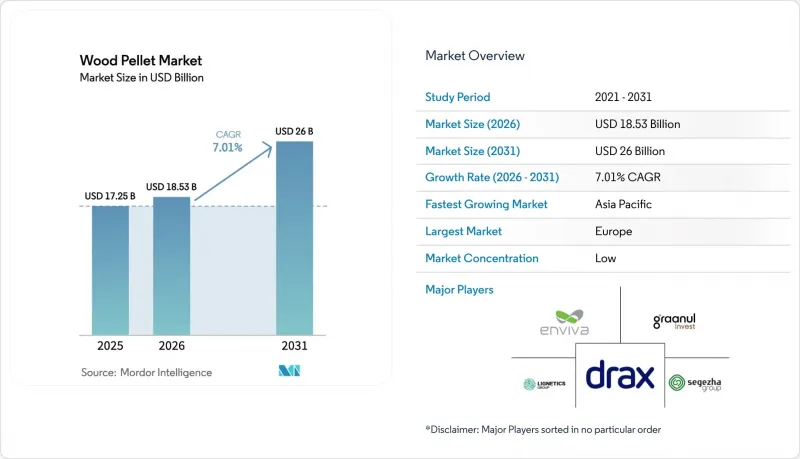
據 Mordor Intelligence 稱,2025 年木質顆粒市場價值為 172.5 億美元,預計到 2031 年將達到 260 億美元,而 2026 年為 185.3 億美元,預測期(2026-2031 年)的複合年成長率為 7.01%。
本報告按原料(森林和木材殘渣、農業殘渣、能源作物和鋸末的混合物)、等級(公用事業級、優質級、標準級和熱處理黑顆粒)、應用(供暖、發電、熱電聯產)、最終用戶(住宅、商業和其他)和地區(北美、歐洲、亞太地區、南美以及中東和非洲)進行分類。
全球木質顆粒市場趨勢及洞察
日本和韓國強制推行生質混燒,將加速工業進口。
根據日本政府的上網電價補貼(FIT)政策,日本電力公司每年進口約300萬噸工業顆粒燃料。儘管2024年補助削減,韓國發電公司也必須透過可再生能源組合標準(RPS)採購經認證的生質燃料。與美國和加拿大供應商簽訂的長期照付不議協議確保了2029年之前的供應,這種穩定的收入前景支撐著墨西哥灣沿岸和大西洋沿岸新建鋸木廠的投資。由於日圓和韓元兌美元匯率波動劇烈,區域買家正在尋求靈活的條款來對沖運費和外匯風險。進口量也取決於棕櫚仁殼和氨的相對價格,這兩種替代燃料是亞洲電力公司在製定2030年脫碳藍圖時正在考慮的競爭性選項。如果混燒義務在2027年的政策審查中得以保留,木質顆粒市場可望為亞洲需求提供持續的下限,從而緩解歐洲需求的週期性下滑。
歐盟的 RED III永續性標準正在推動對經過認證的優質顆粒的需求。
第三版可再生能源指令(RED III)包含嚴格的生產歷史管理要求,旨在降低與生物多樣性和土地利用變化相關的風險,實際上將供應分為兩大類:認證和非認證。獲得永續生質能計畫(SBP)和森林管理委員會(FSC)認證的垂直整合生產商目前享有5-10%的價格溢價,這一利潤成長抵消了不斷上漲的物流和合規成本。歐洲電力公司引入了“轉嫁條款”,允許其在供應商違規的情況下追回罰款,進一步加劇了採購生態系統的兩極化。作為回應,北美鋸木廠正在升級其監控技術,並擴大採購領域的審計範圍,以滿足新的跨大西洋競標要求。雖然提高文件標準需要小規模資金,但也會導致規模較小、未經認證的企業無法簽訂長期契約,並將交易量集中在五家主要公司手中。
由於對生命週期排放的擔憂,英國和荷蘭削減了補貼。
英國於2024年4月取消了對生質能的直接補貼,每年削減約5億英鎊的補貼,導致2024年下半年木屑顆粒進口量下降15%。 Drax公司正在就一項過渡性差價合約(CFD)進行談判,以維持其年產能300萬噸工廠的運營,直至碳捕獲基礎設施在2027年後運作。但政策的不確定性打擊了投資者的信心,並縮小了其資金籌措選擇範圍。荷蘭監管機構正在進行一項平行審查,重點關注短期碳排放強度,初步草案顯示,對森林來源木屑顆粒更嚴格的限制措施可能在2027年生效。先前依賴比荷盧經濟聯盟電力公司的波羅的海生產商如今面臨銷售量風險,轉而加大力度吸引韓國和日本的買家。補貼政策的改變導致區域需求分散,使木質顆粒市場的長期生產力計畫變得更加複雜。
細分市場分析
2025年,森林和木材殘渣佔供應量的57.2%。這主要得益於美國東南部和不列顛哥倫比亞省豐富的原料來源,這些地區根據多年合約供應低品質原木和鋸木片。預計到2031年,農業殘渣,特別是麥秸、稻殼、玉米秸稈和葉片,將以7.2%的複合年成長率成長,因為美國中西部、東歐和印度的顆粒生產商正在將能夠處理更高二氧化矽含量的高密度生產線商業化。預計到2031年,使用農業殘渣的木質顆粒市場規模將達到近1,200萬噸,並且預計區域供應的韌性將有所提高。
事實上,秸稈顆粒在高溫爐膛下會產生大量爐渣,為了解決這個問題,設備製造商正在引入耐火襯裡和自動吹灰系統。這雖然增加了資本投入,但卻能確保木質顆粒產業的鍋爐運作時間。生產商透過位置在農場集中區域附近來彌補其低堆積密度並簡化物流。森林殘餘物在能量密度和灰分化學性質方面具有固有優勢,但其成長受到生物多樣性保護措施和紙漿廠競爭需求的限制。因此,擴大農作物殘餘物顆粒的市場佔有率有助於分散風險,並符合循環經濟理念,這引起了尋求檢驗廢棄物利用的企業買家的共鳴。
到2025年,基於與歐洲和日本發電企業的長期供應契約,用於發電的白色顆粒將佔出貨量的56.7%。獲得ENplus A1認證的優質住宅顆粒佔了18%的市場佔有率,並維持了10%至15%的價格溢價,即使在商品價格波動時期也能保障利潤率。預計熱處理黑色顆粒的成長最為顯著,到2031年複合年成長率將達到9.0%。這項預測主要受亞洲燃煤發電廠維修需求的推動,旨在提高生質能替代率,而無需購買新的破碎設備。預計到2031年,熱處理顆粒的加工量將超過600萬噸,約佔全球木質顆粒市場規模的3%。
市場接受度取決於先導工廠能否擴大規模,達到25萬噸的商業化生產規模,從而分攤固定成本並彌補熱解中固有的20-30%的原料品質損失。優質白顆粒燃料仍然是住宅需求的基礎,因為嚴格的灰分含量標準可以防止煙囪結垢,並符合都市區排放法規。標準級顆粒燃料則用於小規模工業鍋爐和區域供熱網路,在這些應用中,成本和性能的平衡至關重要。公用事業級顆粒燃料仍然佔據主導地位,但鑑於歐洲政策主導的煤炭逐步淘汰,除非熱處理解決方案得到更廣泛的應用,否則其成長速度可能會放緩。
區域分析
預計到2025年,歐洲將佔全球需求的72.4%。這得益於英國從傳統煤炭轉向生質能、瑞典和丹麥的區域供熱基礎設施以及德國的爐灶安裝補助。儘管英國將於2024年停止生質能補貼以及荷蘭監管機構啟動生命週期排放審查,政策風險有所增加,但根據歐盟的RED III指令,經認證的供應商仍享有合規優勢。隨著進口量趨於穩定,歐洲的木質顆粒市場佔有率預計將略有下降,但其絕對進口量預計仍將保持全球最大,直至2031年。
亞太地區是成長最快的市場,預計將以14.3%的複合年成長率成長,這主要得益於日本為期20年的生質能混燒上網電價補貼計畫和韓國的可再生能源組合競標。日本預計在2024年進口約300萬噸,而韓國電力公司儘管面臨補貼削減,仍購買了180萬噸。中國沿海燃煤發電廠的先導計畫以及印度的農業廢棄物高密度利用舉措,一旦政策支持成熟,將帶來長期的成長潛力。由於棕櫚仁殼的競爭,印尼和馬來西亞的市場滲透率已趨於穩定,但一旦熱處理產品達到商業規模,這種情況可能會改變。
北美主要扮演出口樞紐的角色,預計2024年年產能將達到1,200萬噸。儘管Enviva的重組凸顯了槓桿風險,但加拿大不列顛哥倫比亞省和亞伯達的鋸木廠仍然受益於鋸木廠的剩餘物以及通往魯珀特王子港和溫哥華港的鐵路運輸。墨西哥目前的消費量極低,但如果有相應的扶持性法規,其豐富的玉米秸稈和玉米葉資源可能成為潛在的供應來源。美國國內需求有限,僅限於一些小眾的熱電聯產(CHP)設施,但加州和紐約州的脫碳權計畫可能會在本十年後半期催生區域需求中心。
其他好處:
- Excel格式的市場預測(ME)表
- 3個月的分析師支持
目錄
第1章:引言
- 研究假設和市場定義
- 調查範圍
第2章:調查方法
第3章執行摘要
第4章 市場狀況
- 市場概覽
- 市場促進因素
- 日本和韓國強制要求生質能混燒,加速了工業顆粒的進口。
- 歐盟 RED III永續性標準正在推動對經認證的優質顆粒燃料的需求。
- 企業簽訂的淨零排放合約正在促進美國出口生產。
- 北歐國家區域供熱系統的發展正在促進顆粒鍋爐的普及。
- 歐洲天然氣價格的波動正在推動住宅爐灶轉向替代燃料。
- 經過熱處理的「黑色顆粒」現在可用於燃煤發電廠的維修。
- 市場限制因素
- 英國和荷蘭逐步減少補貼,原因是擔心生命週期排放問題。
- 美國東南部永續原料供應瓶頸
- 在東協能源結構中與棕櫚仁生質能的競爭
- 新建顆粒燃料工廠因高利率而面臨的資本投資負擔
- 供應鏈分析
- 監理展望
- 技術展望
- 波特五力模型
第5章 市場規模與成長預測
- 按原料
- 森林/木材殘渣
- 農業殘餘物
- 能源作物和鋸末混合物
- 按年級
- 實用級(白色)
- 優質級
- 標準級
- 熱處理“黑色”顆粒
- 透過使用
- 加熱
- 發電
- 熱電聯產(CHP)
- 最終用戶
- 住宅
- 商業的
- 工業和公共產業
- 動物墊料
- 按地區
- 北美洲
- 美國
- 加拿大
- 墨西哥
- 歐洲
- 英國
- 德國
- 法國
- 義大利
- 西班牙
- 北歐國家
- 俄羅斯
- 其他歐洲國家
- 亞太地區
- 中國
- 印度
- 日本
- 韓國
- 東南亞國協
- 其他亞太國家
- 南美洲
- 巴西
- 阿根廷
- 哥倫比亞
- 其他南美國家
- 中東和非洲
- 阿拉伯聯合大公國
- 沙烏地阿拉伯
- 南非
- 其他中東和非洲國家
- 北美洲
第6章 競爭情勢
- 市場集中度
- 策略趨勢(併購、聯盟、購電協議)
- 市場佔有率分析(主要公司的市場排名和佔有率)
- 公司簡介
- Enviva Inc.
- Drax Group PLC
- AS Graanul Invest
- Lignetics Inc.
- Segezha Group JSC
- Fram Renewable Fuels LLC
- Pinnacle Renewable Energy Inc.
- Pacific BioEnergy Corp.
- Viridis Energy Inc.
- Georgia Biomass LLC
- Rentech Inc.
- German Pellets GmbH
- Pannonia Bio Zrt.
- PT South Pacific Viscose
- Asia Biomass Public Co. Ltd.
- Energex Inc.
- Highland Pellets LLC
- Pfeifer Group
- Nova Pellet Srl
第7章 市場機會與未來展望
According to Mordor Intelligence, the wood pellet market was valued at USD 17.25 billion in 2025 and expected to grow from USD 18.53 billion in 2026 to reach USD 26 billion by 2031, at a CAGR of 7.01% during the forecast period (2026-2031).
This report is Segmented by Feedstock (Forest/Wood Residue, Agricultural Residue, and Energy-Crop and Sawdust Mix), Grade (Utility-Grade, Premium-Grade, Standard-Grade, and Torrefied Black Pellets), Application (Heating, Power Generation, and Combined Heat and Power), End-User (Residential, Commercial, and More), and Geography (North America, Europe, Asia-Pacific, South America, and Middle East and Africa).
Global Wood Pellet Market Trends and Insights
Japan-South Korea Biomass Co-Firing Mandates Accelerating Industrial Imports
Japanese utilities import nearly 3 million t of industrial pellets each year under the national feed-in tariff, and South Korean generators are obligated to source certified biomass through the renewable portfolio standard despite a 2024 subsidy haircut. Long-term, take-or-pay contracts signed with U.S. and Canadian suppliers lock in volumes to 2029, providing revenue certainty that underpins new mill investments along the Gulf and Atlantic coasts. Regional buyers are demanding flexible clauses that hedge freight and currency risk because the yen and won remain volatile against the U.S. dollar. Import volumes also hinge on the relative price of palm-kernel shells and ammonia, two competing alternatives under review by Asian utilities planning 2030 decarbonization pathways. If the co-firing mandates survive scheduled policy reviews in 2027, the wood pellet market could secure a durable Asian demand floor that buffers any cyclical softness in Europe.
EU REDIII Sustainability Criteria Fueling Demand for Certified Premium Pellets
The Renewable Energy Directive III embeds strict chain-of-custody obligations that de-risk biodiversity and land-use change, effectively bifurcating supply into certified and non-certified streams. Vertically integrated producers holding Sustainable Biomass Program and Forest Stewardship Council credentials now command 5%-10% price premiums, a margin uplift that offsets higher logistics and compliance costs. European utilities are inserting pass-through provisions that claw back penalties if suppliers fall out of compliance, reinforcing a two-tier procurement ecosystem. North American mills have responded by upgrading monitoring technology and expanding catchment-area audits to meet new transatlantic tender requirements. The higher bar for documentation is capital-intensive, but it also locks smaller, non-certified operators out of long-term contracts, consolidating volume among the top five players.
Subsidy Rollbacks in U.K./NL over Lifecycle-Emission Concerns
The United Kingdom scrapped direct biomass subsidies in April 2024, removing roughly GBP 500 million in annual support and triggering a 15% drop in pellet imports during H2 2024. Drax is negotiating a bridging contract-for-difference to keep its 3 million tons per year plant running until carbon-capture infrastructure is commissioned post-2027, but policy uncertainty has depressed investor sentiment and narrowed refinancing options. Dutch regulators are conducting a parallel review focused on near-term carbon intensity, and early drafts suggest stricter limits on forest-sourced pellets could take effect in 2027. Baltic producers that once relied on Benelux utilities now face volume risk, prompting them to court Korean and Japanese buyers instead. The subsidy changes fragment regional demand and complicate long-range capacity planning for the wood pellet market.
Other drivers and restraints analyzed in the detailed report include:
- Corporate Net-Zero Contracts Boosting U.S. Export-Grade Production
- District-Heating Build-Out in Nordics Propelling Pellet Boiler Adoption
- Competition from Palm-Kernel-Shell Biomass in ASEAN Power Mix
For complete list of drivers and restraints, kindly check the Table Of Contents.
Segment Analysis
Forest and wood residue generated 57.2% of the 2025 volume, bolstered by expansive fiber baskets in the U.S. Southeast and British Columbia that supply low-grade roundwood and sawmill chips on multi-year contracts. Agricultural residues, notably wheat straw, rice husks, and corn stover, are forecast to post a 7.2% CAGR to 2031 as pelletizers in the U.S. Midwest, Eastern Europe, and India commercialize densification lines that handle higher silica content. The wood pellet market size for agricultural residues is expected to approach 12 million t by 2031, improving regional supply resilience.
In practice, straw-based pellets suffer from slagging at high furnace temperatures, prompting equipment makers to install refractory linings and automated soot-blowing systems that add capex but preserve boiler uptime in the wood pellet industry. Producers offset lower bulk density by co-locating mills near farm clusters, trimming inbound logistics. Forest residue retains an intrinsic advantage in energy density and ash chemistry, yet its growth ceiling is constrained by biodiversity safeguards and competing demand from pulp mills. A rising share of crop-waste pellets, therefore, diversifies risk and aligns with circular-economy narratives that resonate with corporate buyers seeking verifiable waste valorization claims.
Utility-grade white pellets held 56.7% of shipments in 2025 under long-term supply deals with European and Japanese generators. Premium residential pellets, certified to ENplus A1, captured a niche 18% slice, commanding a 10%-15% price uplift that shields margins during commodity cycles. The highest growth resides in torrefied black pellets, slated for a 9.0% CAGR through 2031, a forecast underpinned by Asian coal-fleet retrofits eager to raise biomass substitution ratios without new pulverizers. Torrefied throughput is expected to surpass 6 million t by 2031, equal to about 3% of the global wood pellet market size.
Market acceptance hinges on scaling pilot plants into 250,000-t commercial modules that spread fixed costs and mitigate the 20%-30% feedstock mass loss intrinsic to torrefaction. Premium-grade white pellets still anchor residential demand because strict ash thresholds avoid chimney fouling and meet urban emission caps. Standard-grade pellets service small industrial boilers and district-heating grids that balance cost and performance. Utility-grade dominance persists, yet policy-driven coal phase-outs in Europe could flatten growth unless torrefied solutions gain a wider footing.
Complete Report Scope:
- By Feedstock
- Forest/Wood Residue
- Agricultural Residue
- Energy-Crop and Sawdust Mix
- By Grade
- Utility-Grade (White)
- Premium-Grade
- Standard-Grade
- Torrefied "Black" Pellets
- By Application
- Heating
- Power Generation
- Combined Heat and Power (CHP)
- By End-user
- Residential
- Commercial
- Industrial and Utility
- Animal Bedding
- By Geography
- North America
- United States
- Canada
- Mexico
- Europe
- United Kingdom
- Germany
- France
- Italy
- Spain
- NORDIC Countries
- Russia
- Rest of Europe
- Asia-Pacific
- China
- India
- Japan
- South Korea
- ASEAN Countries
- Rest of Asia-Pacific
- South America
- Brazil
- Argentina
- Colombia
- Rest of South America
- Middle East and Africa
- United Arab Emirates
- Saudi Arabia
- South Africa
- Rest of Middle East and Africa
- North America
Geography Analysis
Europe controlled 72.4% of global demand in 2025, supported by legacy coal-to-biomass conversions in the U.K., Sweden's and Denmark's district-heating backbone, and Germany's subsidy-backed stove installations. Policy risk rose after the U.K. ended biomass subsidies in 2024 and Dutch regulators launched a lifecycle-emission review, but certified supply still enjoys compliance advantages under EU REDIII. The wood pellet market share for Europe is projected to slip modestly as imports plateau, yet its absolute volume remains the world's largest through 2031.
Asia-Pacific is the fastest riser, forecast to expand at a 14.3% CAGR, propelled by Japan's 20-year feed-in tariff for biomass co-firing and South Korea's renewable-portfolio auctions. Japan imported roughly 3 million t in 2024, while Korean utilities sought 1.8 million t despite subsidy cuts. Pilot projects in China's coastal coal fleet and India's ag-residue densification initiatives add long-tail upside if policy support matures. Competition from palm-kernel shells caps penetration in Indonesia and Malaysia, but torrefied products could alter the equation once commercial volumes scale.
North America acts chiefly as an export platform, operating 12 million t of annual capacity in 2024. Enviva's restructuring cast a spotlight on leverage risk, yet Canadian mills in British Columbia and Alberta continue to benefit from sawmill residuals and railway access to Prince Rupert and Vancouver ports. Mexican consumption is negligible today, though abundant corn stover offers latent supply potential pending supportive regulation. Domestic U.S. demand is limited outside niche CHP sites, but decarbonization credits in California and New York could birth regional offtake hubs later in the decade.
- Enviva Inc.
- Drax Group PLC
- AS Graanul Invest
- Lignetics Inc.
- Segezha Group JSC
- Fram Renewable Fuels LLC
- Pinnacle Renewable Energy Inc.
- Pacific BioEnergy Corp.
- Viridis Energy Inc.
- Georgia Biomass LLC
- Rentech Inc.
- German Pellets GmbH
- Pannonia Bio Zrt.
- PT South Pacific Viscose
- Asia Biomass Public Co. Ltd.
- Energex Inc.
- Highland Pellets LLC
- Pfeifer Group
- Nova Pellet Srl
Additional Benefits:
- The market estimate (ME) sheet in Excel format
- 3 months of analyst support
TABLE OF CONTENTS
1 Introduction
- 1.1 Study Assumptions & Market Definition
- 1.2 Scope of the Study
2 Research Methodology
3 Executive Summary
4 Market Landscape
- 4.1 Market Overview
- 4.2 Market Drivers
- 4.2.1 Japan-South Korea Biomass Co-Firing Mandates Accelerating Industrial Pellet Imports
- 4.2.2 EU REDIII Sustainability Criteria Fueling Demand for Certified Premium Pellets
- 4.2.3 Corporate Net-Zero Contracts Boosting U.S. Export-Grade Production
- 4.2.4 District-Heating Build-out in Nordics Propelling Pellet Boiler Adoption
- 4.2.5 Volatile European Gas Prices Driving Residential Stove Conversions
- 4.2.6 Emergence of Torrefied "Black Pellets" for Coal-Plant Retrofits
- 4.3 Market Restraints
- 4.3.1 Subsidy Rollbacks in U.K./NL over Lifecycle-Emission Concerns
- 4.3.2 Sustainable Feedstock Bottlenecks in U.S. Southeast
- 4.3.3 Competition from Palm-Kernel-Shell Biomass in ASEAN Power Mix
- 4.3.4 High-Interest-Rate Capex Burden for New Pellet Mills
- 4.4 Supply-Chain Analysis
- 4.5 Regulatory Outlook
- 4.6 Technological Outlook
- 4.7 Porter's Five Forces
- 4.7.1 Bargaining Power of Suppliers
- 4.7.2 Bargaining Power of Consumers
- 4.7.3 Threat of New Entrants
- 4.7.4 Threat of Substitutes
- 4.7.5 Intensity of Competitive Rivalry
5 Market Size & Growth Forecasts
- 5.1 By Feedstock
- 5.1.1 Forest/Wood Residue
- 5.1.2 Agricultural Residue
- 5.1.3 Energy-Crop and Sawdust Mix
- 5.2 By Grade
- 5.2.1 Utility-Grade (White)
- 5.2.2 Premium-Grade
- 5.2.3 Standard-Grade
- 5.2.4 Torrefied "Black" Pellets
- 5.3 By Application
- 5.3.1 Heating
- 5.3.2 Power Generation
- 5.3.3 Combined Heat and Power (CHP)
- 5.4 By End-user
- 5.4.1 Residential
- 5.4.2 Commercial
- 5.4.3 Industrial and Utility
- 5.4.4 Animal Bedding
- 5.5 By Geography
- 5.5.1 North America
- 5.5.1.1 United States
- 5.5.1.2 Canada
- 5.5.1.3 Mexico
- 5.5.2 Europe
- 5.5.2.1 United Kingdom
- 5.5.2.2 Germany
- 5.5.2.3 France
- 5.5.2.4 Italy
- 5.5.2.5 Spain
- 5.5.2.6 NORDIC Countries
- 5.5.2.7 Russia
- 5.5.2.8 Rest of Europe
- 5.5.3 Asia-Pacific
- 5.5.3.1 China
- 5.5.3.2 India
- 5.5.3.3 Japan
- 5.5.3.4 South Korea
- 5.5.3.5 ASEAN Countries
- 5.5.3.6 Rest of Asia-Pacific
- 5.5.4 South America
- 5.5.4.1 Brazil
- 5.5.4.2 Argentina
- 5.5.4.3 Colombia
- 5.5.4.4 Rest of South America
- 5.5.5 Middle East and Africa
- 5.5.5.1 United Arab Emirates
- 5.5.5.2 Saudi Arabia
- 5.5.5.3 South Africa
- 5.5.5.4 Rest of Middle East and Africa
- 5.5.1 North America
6 Competitive Landscape
- 6.1 Market Concentration
- 6.2 Strategic Moves (M&A, Partnerships, PPAs)
- 6.3 Market Share Analysis (Market Rank/Share for key companies)
- 6.4 Company Profiles (includes Global level Overview, Market level overview, Core Segments, Financials as available, Strategic Information, Products & Services, and Recent Developments)
- 6.4.1 Enviva Inc.
- 6.4.2 Drax Group PLC
- 6.4.3 AS Graanul Invest
- 6.4.4 Lignetics Inc.
- 6.4.5 Segezha Group JSC
- 6.4.6 Fram Renewable Fuels LLC
- 6.4.7 Pinnacle Renewable Energy Inc.
- 6.4.8 Pacific BioEnergy Corp.
- 6.4.9 Viridis Energy Inc.
- 6.4.10 Georgia Biomass LLC
- 6.4.11 Rentech Inc.
- 6.4.12 German Pellets GmbH
- 6.4.13 Pannonia Bio Zrt.
- 6.4.14 PT South Pacific Viscose
- 6.4.15 Asia Biomass Public Co. Ltd.
- 6.4.16 Energex Inc.
- 6.4.17 Highland Pellets LLC
- 6.4.18 Pfeifer Group
- 6.4.19 Nova Pellet Srl
7 Market Opportunities & Future Outlook
- 7.1 White-Space & Unmet-Need Assessment

 北美木質顆粒市場:市場佔有率分析、產業趨勢與統計及成長預測(2026-2031)歐洲木質顆粒:市場佔有率分析、行業趨勢和統計數據以及成長預測(2026-2031 年)
 木質顆粒市場-2026-2032年全球市場預測
 工業木質顆粒市場-全球產業規模、佔有率、趨勢、機會與預測:按應用、最終用途、地區和競爭格局分類,2021-2031年
 全球工業木質顆粒市場規模、佔有率、趨勢和成長分析報告(2026-2034年)木質顆粒市場規模、佔有率、成長及全球產業分析:按類型、應用和地區分類的洞察,2026-2034 年預測
 木質顆粒市場規模、佔有率和趨勢分析報告:按應用、最終用途、地區和細分市場預測(2026-2033 年)
 木質顆粒燃料市場:依原料、應用、終端用戶產業及地區分類
 2026-2030年全球木質顆粒市場全球木質顆粒市場規模、佔有率、趨勢和成長分析報告(2026-2034)