


 |
市場調查報告書
商品編碼
2116775
北美木質顆粒市場:市場佔有率分析、產業趨勢與統計及成長預測(2026-2031)North America Wood Pellet - Market Share Analysis, Industry Trends & Statistics, Growth Forecasts (2026 - 2031) |
||||||

※ 本網頁內容可能與最新版本有所差異。詳細情況請與我們聯繫。
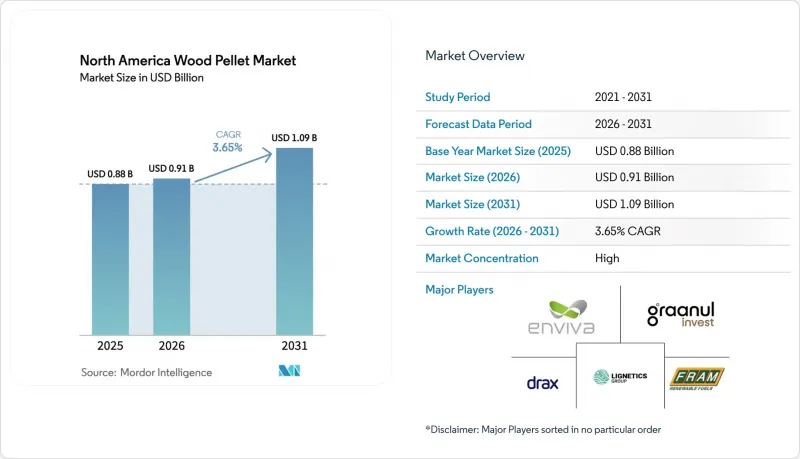
根據 Mordor Intelligence 預測,北美木質顆粒市場預計將從 2025 年的 8.8 億美元成長到 2026 年的 9.1 億美元,到 2031 年達到 10.9 億美元,2026 年至 2031 年的複合年成長率預計為 3.65%。
本報告按原料(森林和木材殘渣、農業殘渣、能源作物和鋸末的混合物)、等級(公用級、優質級、標準級、烘焙黑顆粒)、應用(供暖、發電和熱電聯產)、最終用戶(住宅、商業、工業和公共產業以及動物墊料)和地區(美國、加拿大、墨西哥)進行分類。
北美木質顆粒市場趨勢與洞察
聯邦和各州的可再生能源目標正在推動電力公司的需求。
全州可再生能源組合標準 (RPS) 和聯邦政府加強的清潔能源激勵措施仍然是電力公司籌資策略的基礎。德拉克斯公司承諾在 2030 年在美國投資 125 億美元新建生質能發電廠,每個項目都計劃配備碳捕獲系統,以獲得優質的 45Q 碳權額度。同樣,喬治亞電力公司也提案了一項超過 30 年的契約,計劃建造 80 兆瓦的生質能發電裝置容量,以確保發電的靈活性並對沖天然氣價格波動。監管機構支持這一做法,2024 年 3 月,密西根州公共產業委員會駁回了提前終止合約的請求,認定可調節的生質能發電對於電力供應的穩定性仍然至關重要。這些決定支持了這樣一種觀點:木質顆粒是一種“過渡燃料”,既可以實現短期脫碳目標,又能維持電網的可靠性。
石化燃料價格波動提高了顆粒燃料的競爭力。
2025-2026年冬季丙烷和暖氣油價格的急劇上漲縮小了顆粒燃料與天然氣之間的成本差距,縮短了爐灶和鍋爐升級的投資回收期。亨利樞紐天然氣的平均價格為每百萬英熱單位(MMBtu)4.30美元,而農村家庭購買丙烷的成本相當於每百萬英熱單位27.50美元,相較之下,送貨上門的優質顆粒燃料價格約為每百萬英熱單位15美元。這種價格差異帶來的好處在東北部、中西部北部以及加拿大大西洋沿岸未鋪設管道的地區最為顯著,但根據《通貨膨脹控制法》,聯邦政府提供的2000美元熱泵稅額扣抵以及各省高達8000美元的補貼也在鼓勵住宅使用電力供暖。因此,住宅顆粒燃料供應商需要強調燃料成本的可預測性和本地採購,以避免競爭,尤其是在電力公司實施分時電價機制,鼓勵夜間運作熱泵的情況下。
物流成本上漲給顆粒燃料的利潤率帶來了壓力。
2025年,鐵路貨運費率上漲和卡車運輸成本飆升推高了木屑顆粒的價格。對於向中西部電力公司供貨的東南部鋸木廠而言,鐵路運輸成本可能占到交付成本的40%,尤其是在薩凡納和莫比爾等港口出現擁擠時,還會產生交付費。擁有熱解線的生產商正透過提高每噸木屑顆粒的能量產出來部分抵消這些成本,但這需要5000萬至1億美元的投資,使得小規模企業難以進入市場。零售鋸木廠也面臨著自身的壓力,因為短程卡車運輸成本的上漲速度超過了爐用木屑顆粒的價格,迫使一些企業合併或倒閉。
細分市場分析
到2025年,林業和木材殘餘物將佔北美木質顆粒市場佔有率的66.6%,這反映出來自綜合木材企業的鋸末、木片和疏伐木材佔據主導地位。然而,由於生產商為應對2024年至2025年鋸木廠產量下降導致的纖維供應受限而採取對沖措施,預計到2031年,以農業殘餘物為基礎的木屑顆粒的複合年成長率將達到4.8%。玉米秸稈和麥稈等農業原料理論上每年可供應2億至3億乾噸,但季節性收割物流挑戰、水分含量波動以及3%至6%的高灰分含量使得規模化生產困難。掌握預處理和減灰技術的生產商,如果能夠獲得可加工低純度燃料的鍋爐,就能滿足工業和電力公司的需求。
到本十年末,雜交楊樹和柳樹等短輪伐期木本作物有望供應給一些願意投資建造專用種植園的鋸木廠,從而即使在生產力較低的土地上也能實現可預測的產量。雖然這些能源作物目前仍屬於小眾市場,但其策略價值在於價格穩定和碳封存效益,這吸引了注重環境、社會和治理(ESG)的買家。因此,原料趨勢正呈現兩極化。木材殘渣仍然是住宅爐灶通用白色顆粒燃料的主要原料,而工業和電力公司買家則越來越接受多種混合燃料,以確保供應並獲得碳權額度。
2025年,根據多年期外購合約供應給發電廠的公用事業級白色顆粒燃料將佔總銷售量的58.2%。優質顆粒燃料的特點是水分含量低於8%,灰分含量低於0.5%,深受希望最大限度減少維護的住宅和商業用戶的青睞。標準級產品則佔據了中端市場,主要面向小規模工業鍋爐,這類鍋爐對雜質含量的要求略高。同時,熱處理黑色顆粒燃料憑藉其20-22吉焦/噸的能量密度和優異的防水性能,預計到2031年將以8.4%的複合年成長率成長。
安德里茨公司2025年的商業化生產線已證明,其品質收成率可超過85%,能源收成率可超過95%。同時,德拉克斯公司在阿拉巴馬州的試點計畫表明,美國正認真致力於擴大生產規模。經熱處理的顆粒燃料無需封閉式儲存,並可最大限度地減少跨太平洋運輸過程中水分的劣化,從而使其能夠進入此前對白色顆粒燃料而言風險較高的亞洲和中東市場。電力公司看重其能夠在不大幅降低鍋爐輸出的情況下以高負荷進行混燒,這使得儘管生產需要高額資本投入,但仍有可能獲得溢價。因此,預計產品等級結構將轉變為兩級系統:價格適中的白色顆粒燃料用於供暖,而高階黑色顆粒燃料則面向優先考慮降低物流成本和碳排放策略的電力公司和工業買家。
其他好處:
- Excel格式的市場預測(ME)表
- 3個月的分析師支持
目錄
第1章:引言
- 研究假設和市場定義
- 調查範圍
第2章:調查方法
第3章執行摘要
第4章 市場狀況
- 市場概覽
- 市場促進因素
- 聯邦和各州的可再生能源目標正在推動電力公司的需求。
- 石化燃料價格的波動提高了顆粒燃料的競爭力。
- 加拿大的無污染燃料標準(CFS)積分正在促進更廣泛的應用。
- 已發布面向碳中和企業的熱能證書。
- 熱處理顆粒技術可提高能量密度並降低成本。
- 市場限制因素
- 物流成本上漲給顆粒燃料的利潤率帶來了壓力。
- 由於鋸木廠減產,木材原料供應日益緊張。
- 對森林生質能的嚴格ESG審查正在減緩投資。
- 熱泵在寒冷地區迅速普及
- 供應鏈分析
- 監理情勢
- 技術展望
- 波特五力模型
第5章 市場規模與成長預測
- 按原料
- 森林/木材殘渣
- 農業殘餘物
- 能源作物和鋸末混合物
- 按年級
- 實用級(白色)
- 優質級
- 標準級
- 熱處理“黑色”顆粒
- 透過使用
- 加熱
- 發電
- 熱電聯產(CHP)
- 最終用戶
- 住宅
- 商業的
- 工業和公共產業
- 動物墊料
- 按地區
- 美國
- 加拿大
- 墨西哥
第6章 競爭情勢
- 市場集中度
- 策略趨勢(併購、聯盟、購電協議)
- 市場佔有率分析(主要公司的市場排名和佔有率)
- 公司簡介
- Enviva Inc.
- Drax Group plc(incl. Pinnacle Renewable Energy)
- Lignetics, Inc.
- Highland Pellets LLC
- Fram Renewable Fuels LLC
- Fiber Energy Products
- Curran Renewable Energy LLC
- Westervelt Renewable Energy(LaSalle BioEnergy)
- Pacific BioEnergy Corp.
- AS Graanul Invest
- Energy Pellets of America LLC
- Biopower Sustainable Energy Corp.
- Green Circle Bio Energy(Enviva)
- Rentech Inc.
- Maine Energy Systems
- Energex Pellet Fuel, Inc.
- Great Northern Timber Group
- Viridis Energy Inc.
- Lost Creek Holdings
- Georgia Biomass(Enviva-Jesup Plant)
第7章 市場機會與未來展望
According to Mordor Intelligence, the North America wood pellet market size is expected to increase from USD 0.88 billion in 2025 to USD 0.91 billion in 2026 and reach USD 1.09 billion by 2031, growing at a CAGR of 3.65% over 2026-2031.
This report is Segmented by Feedstock (Forest/Wood Residue, Agricultural Residue, and Energy-Crop and Sawdust Mix), Grade (Utility-Grade, Premium-Grade, Standard-Grade, and Torrefied Black Pellets), Application (Heating, Power Generation, and Combined Heat and Power), End-User (Residential, Commercial, Industrial and Utility, and Animal Bedding), and Geography (United States, Canada, and Mexico).
North America Wood Pellet Market Trends and Insights
Federal and State Renewable Targets Drive Utility Demand
State renewable portfolio standards and enhanced federal clean-energy incentives continue to anchor the offtake strategies of electric utilities. Drax committed USD 12.5 billion to build new U.S. biomass power plants by 2030, and each project is being designed with carbon-capture systems to qualify for premium 45Q credits. Georgia Power likewise proposed 80 MW of biomass capacity under contracts exceeding 30 years to lock in dispatchable generation and hedge gas-price volatility. Regulators are validating this approach; in March 2024, the Michigan Public Service Commission ruled that dispatchable biomass remains vital for resource adequacy, rejecting early contract terminations. These decisions reinforce the view that wood pellets are a bridge fuel capable of meeting near-term decarbonization targets while preserving grid reliability.
Volatile Fossil-Fuel Prices Enhance Pellet Competitiveness
Propane and heating-oil price spikes during the 2025-26 winter narrowed the cost gap with pellets, improving payback periods for stove and boiler upgrades. Henry Hub natural gas averaged USD 4.30 per MMBtu, yet rural households paid the propane equivalent of USD 27.50 per MMBtu, while delivered premium pellets cost roughly USD 15 per MMBtu. The arbitrage is most compelling in off-pipeline regions of the Northeast, Upper Midwest, and Atlantic Canada, although the Inflation Reduction Act's USD 2,000 federal heat-pump tax credit, alongside state rebates up to USD 8,000, is incentivizing homeowners to electrify. Residential pellet suppliers must therefore emphasize predictable fuel costs and local sourcing to remain competitive, particularly as utilities introduce time-of-use tariffs that favor overnight heat-pump operation.
Logistics Inflation Squeezes Pellet Margins
Railroad tariff increases and trucking cost inflation pushed delivered pellet prices higher in 2025. For Southeast mills serving Midwest utilities, rail can account for up to 40% of delivered cost, especially when ports such as Savannah and Mobile experience congestion that triggers demurrage fees. Producers with torrefaction lines partially offset these costs by shipping more energy per tonne, yet the USD 50-100 million capex requirement sidelines smaller operators. Retail-oriented mills face their own pressure as short-haul trucking rates rise faster than stove-grade pellet prices, forcing some to consolidate or close.
Other drivers and restraints analyzed in the detailed report include:
- Clean Fuel Standard Credits in Canada Stimulate Uptake
- Torrefied-Pellet Technology Boosts Energy Density and Lowers Logistics Cost
- Sawmill Curtailments Tighten Fiber Supply
For complete list of drivers and restraints, kindly check the Table Of Contents.
Segment Analysis
Forest and wood residues commanded 66.6% of the North America wood pellet market share in 2025, reflecting the dominance of sawdust, chips, and forest thinnings sourced from integrated timber operations. Agricultural residue pellets, however, are projected to register a 4.8% CAGR to 2031 as producers hedge against sawmill curtailments that constrained fiber supply during 2024-25. Agricultural feedstocks such as corn stover and wheat straw can theoretically provide 200-300 million dry tonnes annually, but seasonal collection logistics, variable moisture, and higher ash contents of 3-6% complicate scale-up. Producers that master preprocessing and ash-mitigation technologies can capture industrial and utility demand, provided they secure boilers capable of handling less-pure fuels.
Toward the end of the decade, short-rotation woody crops like hybrid poplar and willow may supply select mills willing to invest in dedicated plantations, enabling predictable yields on marginal land. Although these energy crops remain a niche today, their strategic value lies in stable pricing and carbon-sequestration benefits that appeal to ESG-minded buyers. The feedstock landscape is therefore bifurcating: commodity white pellets destined for residential stoves remain wood-residue dominant, while industrial and utility buyers increasingly accept diversified blends to secure volume and carbon-credit eligibility.
Utility-grade white pellets accounted for 58.2% of 2025 revenues, serving power plants under multi-year offtake agreements. Premium-grade pellets, distinguished by moisture below 8% and ash under 0.5%, capture residential and commercial users who prioritize low maintenance. Standard-grade material fills the middle tier for small industrial boilers that tolerate slightly higher impurities. Torrefied black pellets, however, are forecast to grow at an 8.4% CAGR through 2031, fueled by their 20-22 GJ/t energy density and hydrophobic properties.
ANDRITZ's 2025 commercial line proved that mass and energy yields above 85% and 95% are attainable, while Drax's Alabama pilot signals U.S. commitment to scale. Torrefied pellets eliminate the need for covered storage and minimize moisture-linked degradation during trans-Pacific shipments, opening Asian and Middle Eastern markets that were previously risky for white pellets. Utilities value the ability to co-fire at higher rates without costly boiler derates, reinforcing the premium pricing potential despite higher production capex. The grade mix is therefore expected to evolve toward a dual-track system: affordable white pellets for heating and premium black pellets for utility and industrial buyers focused on logistics savings and carbon strategy.
Complete Report Scope:
- By Feedstock
- Forest/Wood Residue
- Agricultural Residue
- Energy-Crop and Sawdust Mix
- By Grade
- Utility-Grade (White)
- Premium-Grade
- Standard-Grade
- Torrefied "Black" Pellets
- By Application
- Heating
- Power Generation
- Combined Heat and Power (CHP)
- By End-user
- Residential
- Commercial
- Industrial and Utility
- Animal Bedding
- By Geography
- United States
- Canada
- Mexico
List of Companies Covered in this Report:
- Enviva Inc.
- Drax Group plc (incl. Pinnacle Renewable Energy)
- Lignetics, Inc.
- Highland Pellets LLC
- Fram Renewable Fuels LLC
- Fiber Energy Products
- Curran Renewable Energy LLC
- Westervelt Renewable Energy (LaSalle BioEnergy)
- Pacific BioEnergy Corp.
- AS Graanul Invest
- Energy Pellets of America LLC
- Biopower Sustainable Energy Corp.
- Green Circle Bio Energy (Enviva)
- Rentech Inc.
- Maine Energy Systems
- Energex Pellet Fuel, Inc.
- Great Northern Timber Group
- Viridis Energy Inc.
- Lost Creek Holdings
- Georgia Biomass (Enviva-Jesup Plant)
Additional Benefits:
- The market estimate (ME) sheet in Excel format
- 3 months of analyst support
TABLE OF CONTENTS
1 Introduction
- 1.1 Study Assumptions & Market Definition
- 1.2 Scope of the Study
2 Research Methodology
3 Executive Summary
4 Market Landscape
- 4.1 Market Overview
- 4.2 Market Drivers
- 4.2.1 Federal & state renewable targets drive utility demand
- 4.2.2 Volatile fossil-fuel prices enhance pellet competitiveness
- 4.2.3 Clean Fuel Standard credits in Canada stimulate uptake
- 4.2.4 Carbon-neutral corporate thermal certificates emerge
- 4.2.5 Torrefied-pellet tech boosts energy density & lowers cost
- 4.3 Market Restraints
- 4.3.1 Logistics inflation squeezes pellet margins
- 4.3.2 Sawmill curtailments tighten fiber supply
- 4.3.3 ESG scrutiny on forest biomass dampens investment
- 4.3.4 Rapid heat-pump adoption in cold-climate states
- 4.4 Supply-Chain Analysis
- 4.5 Regulatory Landscape
- 4.6 Technological Outlook
- 4.7 Porter's Five Forces
- 4.7.1 Bargaining Power of Suppliers
- 4.7.2 Bargaining Power of Consumers
- 4.7.3 Threat of New Entrants
- 4.7.4 Threat of Substitutes
- 4.7.5 Intensity of Competitive Rivalry
5 Market Size & Growth Forecasts
- 5.1 By Feedstock
- 5.1.1 Forest/Wood Residue
- 5.1.2 Agricultural Residue
- 5.1.3 Energy-Crop and Sawdust Mix
- 5.2 By Grade
- 5.2.1 Utility-Grade (White)
- 5.2.2 Premium-Grade
- 5.2.3 Standard-Grade
- 5.2.4 Torrefied "Black" Pellets
- 5.3 By Application
- 5.3.1 Heating
- 5.3.2 Power Generation
- 5.3.3 Combined Heat and Power (CHP)
- 5.4 By End-user
- 5.4.1 Residential
- 5.4.2 Commercial
- 5.4.3 Industrial and Utility
- 5.4.4 Animal Bedding
- 5.5 By Geography
- 5.5.1 United States
- 5.5.2 Canada
- 5.5.3 Mexico
6 Competitive Landscape
- 6.1 Market Concentration
- 6.2 Strategic Moves (M&A, Partnerships, PPAs)
- 6.3 Market Share Analysis (Market Rank/Share for key companies)
- 6.4 Company Profiles (includes Global level Overview, Market level overview, Core Segments, Financials as available, Strategic Information, Products & Services, and Recent Developments)
- 6.4.1 Enviva Inc.
- 6.4.2 Drax Group plc (incl. Pinnacle Renewable Energy)
- 6.4.3 Lignetics, Inc.
- 6.4.4 Highland Pellets LLC
- 6.4.5 Fram Renewable Fuels LLC
- 6.4.6 Fiber Energy Products
- 6.4.7 Curran Renewable Energy LLC
- 6.4.8 Westervelt Renewable Energy (LaSalle BioEnergy)
- 6.4.9 Pacific BioEnergy Corp.
- 6.4.10 AS Graanul Invest
- 6.4.11 Energy Pellets of America LLC
- 6.4.12 Biopower Sustainable Energy Corp.
- 6.4.13 Green Circle Bio Energy (Enviva)
- 6.4.14 Rentech Inc.
- 6.4.15 Maine Energy Systems
- 6.4.16 Energex Pellet Fuel, Inc.
- 6.4.17 Great Northern Timber Group
- 6.4.18 Viridis Energy Inc.
- 6.4.19 Lost Creek Holdings
- 6.4.20 Georgia Biomass (Enviva-Jesup Plant)
7 Market Opportunities & Future Outlook
- 7.1 White-space & Unmet-Need Assessment

 歐洲木質顆粒:市場佔有率分析、行業趨勢和統計數據以及成長預測(2026-2031 年)
 木質顆粒市場-2026-2032年全球市場預測木質顆粒:市場佔有率分析、產業趨勢與統計、成長預測(2026-2031)
 工業木質顆粒市場-全球產業規模、佔有率、趨勢、機會與預測:按應用、最終用途、地區和競爭格局分類,2021-2031年
 全球工業木質顆粒市場規模、佔有率、趨勢和成長分析報告(2026-2034年)木質顆粒市場規模、佔有率、成長及全球產業分析:按類型、應用和地區分類的洞察,2026-2034 年預測
 木質顆粒市場規模、佔有率和趨勢分析報告:按應用、最終用途、地區和細分市場預測(2026-2033 年)
 木質顆粒燃料市場:依原料、應用、終端用戶產業及地區分類
 2026-2030年全球木質顆粒市場全球木質顆粒市場規模、佔有率、趨勢和成長分析報告(2026-2034)