


 |
市場調查報告書
商品編碼
2100612
切割機械及設備:市場佔有率分析、產業趨勢及統計、成長預測(2026-2031)Cutting Machine and Equipment - Market Share Analysis, Industry Trends & Statistics, Growth Forecasts (2026 - 2031) |
||||||

※ 本網頁內容可能與最新版本有所差異。詳細情況請與我們聯繫。
根據 Mordor Intelligence 預測,切割機和切割設備的市場規模預計將從 2025 年的 344.1 億美元和 2026 年的 358.4 億美元成長到 2031 年的 426.1 億美元,2026 年至 2031 年的複合年成長率為 3.52%。
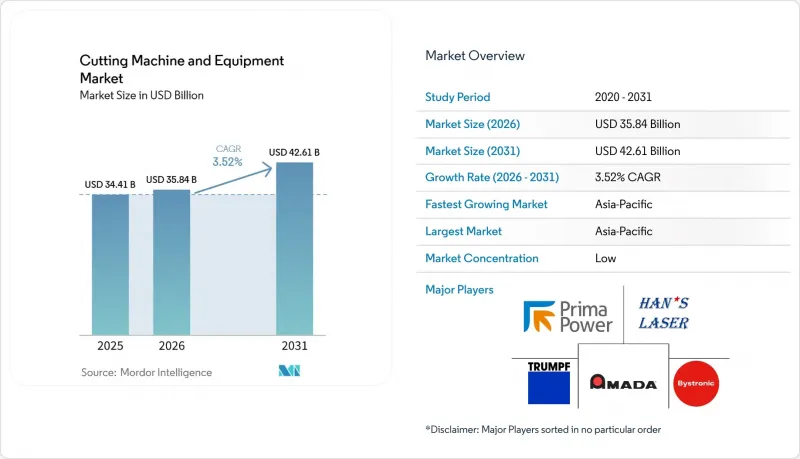
本報告按應用領域(鈑金、管材等)、技術(雷射、等離子等)、自動化程度(手動、半自動、機器人/全自動)、終端用戶產業(汽車、航太與國防等)以及地區(北美、歐洲、亞太等)進行細分。市場預測以價值(美元)和數量(單位)表示。
全球切割機及切割設備市場趨勢及洞察
全球國防和造船業的重新武裝週期正在推動重型鋼板切割系統訂單的激增。
預計到2025年,全球軍事開支將達到2.887兆美元,其中歐洲軍費開支將增加14%,達到8,640億美元,這將顯著擴大重型加工設備的市場。歐洲北約成員國和加拿大也已將總合軍事支出總額提高到2025年的5,710億美元以上,這符合北約到2035年軍費支出佔GDP 5%的承諾。這增強了切割機和切割設備市場的長期採購前景。美國2026會計年度國防預算撥款474億美元用於海軍造船和整修,為建造19艘新型作戰艦艇提供資金,這些艦艇需要將厚重的海軍鋼板切割成高精度規格。這不僅對直接的國防合約產生重大影響,因為經過認證的軍用鋼材佔用了鋼鐵廠的優質產能,導致民用鋼板加工商的供應緊張和投入成本飆升。相較之下,切割機和切割設備市場的買家往往更喜歡速度更快、產量更高的系統,以維持每噸加工的利潤率,而韓國和澳洲正在進一步深化全球海軍採購週期。
超級工廠和氫氣電解設備對鋼板的需求激增。
2021年至2025年間,全球電解槽裝置容量從0.6吉瓦增加到4.9吉瓦,年產能達57吉瓦。這擴大了切割機和切割設備市場的製造基礎。由於1兆瓦鹼性電解槽堆根據配置不同需要4365公斤至13095公斤鋼材,因此產能的提升並非僅僅是抽象的資本投資,而是直接轉化為實際的鋼板切割需求。歐洲佔氫動力煉鋼領域新增投資的70%以上。該地區是短期精密鋼板需求中心,預計到2024年,其在清潔工業技術領域的投資將達到約150億美元,其中80%用於鋼鐵脫碳專案。電池工廠也增加了對鋼材的需求,因為它們需要大量的預切割鋼材和鋁材來製造各種子組件,包括機殼、框架和冷卻組件。隨著電解槽和超級工廠的買家要求切割機和切割設備市場受益,因為標準等離子或火焰系統無法始終如一地實現切割品質和加工精度,而需求正在轉向先進的雷射和水刀平台。
工業用電價格波動劇烈,對產能超過 15 kW 的雷射加工廠的營業利潤率帶來了壓力。
功率超過15千瓦的高功率光纖雷射系統每小時運作耗電量為30-60千瓦時,其中包括冷卻器和輔助系統,這使得電力成本成為影響切割機和切割設備市場獲利能力的直接因素。預計到2026年,美國全國平均工業用電價格將達到每千瓦時8.54美分,這也是北美用戶成本結構與許多歐洲加工商不同的原因之一。此外,天然氣價格上漲和資料中心需求增加導致電網供電量增加,預計到2025年美國批發電力價格將上漲超過12%,顯示即使在競爭激烈的地區,能源成本壓力也在蔓延。這種成本差異會影響採購,因為跨國製造商在比較供應商位置時,不僅要考慮人事費用,還要考慮能源價格波動所帶來的風險。因此,儘管切割機和切割設備市場對高效雷射系統的需求不斷成長,但無法將增加的營運成本轉嫁給客戶的工廠往往會推遲設備升級的決策。
細分市場分析
至2025年,鈑金加工產業將佔切割機及切割設備市場佔有率的34.4%,並且由於對汽車面板、電氣外殼和暖通空調組件的持續需求,該應用仍將是產生收入的主要來源。切割機及切割設備市場仍依賴此細分市場作為運轉率的基礎。這是因為該領域的訂單頻繁、標準化,並且與更廣泛的加工活動緊密相關。這種穩定性至關重要,因為更專業化的應用需求波動迅速,而鈑金加工能夠維持機器設備在更廣泛基本客群中的生產效率。這也是為什麼供應商在標準平面零件加工領域,在加工能力、排樣精度和服務支援方面持續展開激烈競爭的原因。
「管材」產業是成長最快的應用領域。受可再生能源塔架、輕型車輛結構和結構加工等領域需求不斷成長的影響,預計到2031年,該產業將以4.1%的複合年成長率成長。 TRUMPF公司於2026年3月發布的「TruLaser Tube 7000」正是為了因應這項變化,其自動坡口切割功能和進給速度較上一代產品提升高達150%,顯示供應商正在投入大量研發資源用於管材加工。同樣在2026年3月,漢氏雷射推出了“WTX15055T”,這是一款超大直徑管材切割機,可加工直徑達550毫米的管道。這顯示海洋工程、石油化工和造船等行業的需求正在不斷成長。此外,隨著國防相關規範的日益嚴格,鈑金加工產業對光纖雷射的投資也不斷增加。同時,在結構鋼和小規模先進材料領域,切割機和切割設備市場正透過基礎設施、電動車和航太領域的加工需求而不斷擴大。
到2025年,雷射技術將佔據41.7%的市場佔有率,成為技術領域的主導力量。在切割機和切割設備市場中如此高的市場佔有率表明,雷射系統仍然是滿足各種製造需求的首選。由於雷射平台能夠提供高切割精度、更乾淨的邊緣和卓越的製程一致性,因此在鈑金、管材和精密零件的生產中,市場對雷射平台的需求仍然強勁。與人工干預相比,雷射系統也非常適合自動化生產線,因為在這些生產線中,重複性和運作至關重要。因此,雷射系統將繼續在切割機和切割設備市場中保持競爭的核心地位。
此外,雷射技術是成長最快的技術領域,預計到2031年將以4.5%的複合年成長率成長。這一成長速度表明,隨著生產標準日益嚴格、營運效率變得愈發重要,買家將繼續增加對雷射平台的投資。汽車、航太、電氣設備和先進製造等領域對雷射技術的穩定應用,正推動這一領域的蓬勃發展,因為在這些領域,切割品質和產量直接影響著生產價值。同時,老舊切割設備的廣泛替換,也得益於軟體整合度更高、生產效率更高的系統,進一步促進了雷射技術的發展。憑藉其在當前市場佔有率和預期成長率方面的主導地位,雷射技術仍然是切割機和切割設備市場規模成長的主要技術驅動力。
區域分析
預計到2025年,亞太地區將佔據切割機及切割設備市場47.7%的佔有率,並以4.4%的複合年成長率成長至2031年,繼續保持其作為全球需求中心的地位。中國持續發揮核心作用,佔全球電解槽和最終投資產能的65%,以及電解槽消費量的成長以及鼓勵資本財投資的政策支持,印度市場也正經歷快速擴張。日本和韓國憑藉著強大的運動控制和光學相關價值鏈,提供精密附加價值,幫助該地區在滿足大量需求的同時,兼顧高規格的生產能力。
2026年,歐洲在切割機和切割設備市場仍將佔有重要地位,但市場格局也更為複雜。預計到2025年,德國軍費開支將成長24%,達到1,140億美元,這將支撐裝甲車輛和海軍項目對鋼板切割的需求。歐盟的碳邊境調節機制將於2026年進入最後階段,屆時將加強對高碳鋼鐵生產路線的合規要求,進一步強化雷射切割系統的投資理由。西班牙、北歐國家和英國也仍是活躍的買家,離岸風力發電製造、航太維護和高精度加工等領域的需求將支撐設備需求。
在北美,切割機和切割設備市場持續受益於國防採購、製造業回歸美國以及對電池工廠的投資,從而保持了多元化的基礎。美國2026會計年度474億美元的造船預算為潛艦和驅逐艦計畫提供了多年設備需求支援。在加拿大,電動車供應鏈計畫和潔淨科技製造稅額扣抵進一步加強了市場支持,提升了用光纖雷射取代老舊二氧化碳系統的效益。目前,南美洲、中東和非洲的市場規模仍然較小。然而,巴西、智利、沙烏地阿拉伯和南非的需求正隨著基礎建設、採礦業、產業多元化以及對節能製造的投資而成長。
其他好處:
- Excel格式的市場預測(ME)表
- 3個月的分析師支持
目錄
第1章:引言
- 研究假設和市場定義
- 調查範圍
第2章:調查方法
第3章執行摘要
第4章 市場狀況
- 市場概覽
- 市場促進因素
- 全球國防和造船業的重新武裝週期正在推動重型鋼板切割系統訂單的激增。
- 超級工廠和氫電解對電解槽的需求激增
- 永續性措施正在加速向節能型光纖雷射的過渡。
- 我們致力於實現淨零排放,並推動採用氮氣保護的高功率雷射來減少爐渣的產生。
- 循環經濟中對陸上風力渦輪機葉片的強制性要求,正在推動複合材料切割和加工需求的激增。
- 隨著結合積層製造和機械加工的混合製造技術的擴展,精確的列印後處理變得至關重要。
- 市場限制因素
- 工業電費波動劇烈,對產能超過 15kW 的雷射加工廠的營業利潤率帶來了壓力。
- 供不應求。
- 隨著禁止使用含 PFAS 的冷卻劑的日期臨近,維修拋光水刀設備的成本正在上升。
- 歐盟對高能耗等離子體/火焰工藝徵收碳關稅
- 價值供應鏈分析
- 監理情勢
- 技術展望
- 五力分析-產業吸引力評估
- 新進入者的威脅
- 供應商的議價能力
- 買方的議價能力
- 替代品的威脅
- 產業競爭
- 全球製造業概覽
- 顧客購買決策分析
- 地緣政治事件對市場的影響
第5章 市場規模與成長預測
- 透過使用
- 金屬薄板
- 盤子
- 管材和管道
- 結構鋼
- 其他
- 透過技術
- 雷射
- 纖維
- CO2
- 其他
- 電漿
- 高畫質
- 傳統的
- 水刀
- 磨料
- 純的
- 火焰/氧氣燃料
- 超音波和新興技術
- 雷射
- 按自動化級別
- 手動的
- 半自動
- 機器人/全自動
- 按最終用戶行業分類
- 車
- 航太/國防
- 電氣和電子設備
- 建築和基礎設施
- 金屬加工承包商
- 造船
- 能源與電力
- 其他(醫療設備等)
- 按地區
- 北美洲
- 美國
- 加拿大
- 墨西哥
- 南美洲
- 巴西
- 阿根廷
- 智利
- 秘魯
- 其他南美國家
- 歐洲
- 德國
- 英國
- 法國
- 義大利
- 西班牙
- 比荷盧經濟聯盟(比利時、荷蘭、盧森堡)
- 北歐國家(丹麥、芬蘭、冰島、挪威、瑞典)
- 其他歐洲國家
- 亞太地區
- 中國
- 印度
- 日本
- 韓國
- 澳洲
- 東南亞(印尼、越南、泰國、馬來西亞、菲律賓)
- 其他亞太國家
- 中東和非洲
- 阿拉伯聯合大公國
- 沙烏地阿拉伯
- 南非
- 奈及利亞
- 其他中東和非洲國家
- 北美洲
第6章 競爭情勢
- 市場集中度
- 策略趨勢
- 市佔率分析
- 公司簡介
- TRUMPF
- Bystronic
- Amada
- Prima Power
- Han's Laser
- Bodor Laser
- Penta Laser
- Mitsubishi Electric
- Mazak Optonics
- Hypertherm
- ESAB
- Lincoln Electric
- Messer Cutting Systems
- Koike Aronson
- Flow International
- LVD Group
- KMT Waterjet
- HSG Laser
- Salvagnini
- Eagle Group
第7章 市場機會與未來展望
According to Mordor Intelligence, the cutting machine and Equipment Market size is projected to expand from USD 34.41 billion in 2025 and USD 35.84 billion in 2026 to USD 42.61 billion by 2031, registering a CAGR of 3.52% between 2026 to 2031.
This report is Segmented by Application (Sheet Metal, Tube & Pipe, and More), by Technology (Laser, Plasma, and More), by Automation Level (Manual, Semi-Automated, Robotic/Fully-automated), by End-User Industry (Automotive, Aerospace & Defense, and More), and by Geography (North America, Europe, Asia-Pacific, and More). The Market Forecasts are Provided in Terms of Value (USD) and Volume (Units).
Global Cutting Machine and Equipment Market Trends and Insights
Global Defense and Shipbuilding Rearmament Cycle Fuels Surge in Orders for Thick-Plate Cutting Systems
Global military expenditure reached USD 2,887 billion in 2025, and European spending rose 14% to USD 864 billion, which sharply widened the addressable base for heavy-fabrication equipment demand. European NATO allies and Canada also raised combined outlays to more than USD 571 billion in 2025, following the alliance's commitment to move toward 5% of GDP by 2035, which strengthens long-term procurement visibility supporting the cutting machine and equipment market. The United States FY2026 defense budget assigns USD 47.4 billion to Navy shipbuilding and conversion, funding 19 new battle-force vessels that require thick naval-grade plate cut to tight tolerances. This matters beyond direct defense contracts because certified military steel consumes premium mill capacity, leaving commercial plate fabricators with tighter supply and higher input costs. In response, buyers in the cutting machine and equipment market are favoring faster and higher-yield systems that can protect margins per ton processed, while South Korea and Australia add further depth to the global naval procurement cycle.
Surge in Demand for Plates from Giga-factories and Hydrogen Electrolyzers
Installed global electrolyzer capacity rose from 0.6 GW to 4.9 GW between 2021 and 2025, while manufacturing capacity reached 57 GW per year, thereby expanding the fabrication base that feeds the cutting machine and equipment market. At the 1 MW scale, each alkaline electrolyzer stack requires 4,365 kg to 13,095 kg of steel, depending on configuration, so every capacity addition translates into real plate-cutting demand rather than only abstract capital spending. Europe accounted for more than 70% of new investment in hydrogen-based steelmaking. It invested nearly USD 15 billion in clean industrial technologies in 2024, with 80% directed toward steel decarbonization projects, which places the region at the center of near-term precision plate demand. Battery plants add another layer because enclosures, frames, and cooling components require large volumes of cut steel and aluminum across many subassemblies. The cutting machine and equipment market benefits because electrolyzer and gigafactory buyers specify edge quality and handling precision that standard plasma and flame systems cannot consistently deliver, pushing demand toward advanced laser and waterjet platforms.
Volatile Industrial Electricity Tariffs Squeezing Operating Margins of Greater Than 15 kW Laser Shops
High-power fiber laser systems above 15 kW consume 30-60 kWh per operating hour when chillers and support systems are included, making electricity costs a direct margin variable for the cutting machine and equipment market. The United States national average industrial electricity price is projected at 8.54 cents per kWh in 2026, which helps explain why North American users face a different cost structure than many European shops. United States wholesale power prices also rose by more than 12% in 2025 as natural gas costs increased and data center demand pulled more electricity into the grid, indicating that energy pressure is spreading even in more competitive regions. This cost gap affects procurement because multinational manufacturers compare supplier locations not only on labor and logistics, but also on exposure to energy price volatility. The cutting machine and equipment market, therefore, sees stronger demand for efficient laser systems, but also slower upgrade decisions from shops that cannot pass through operating cost increases to customers.
Other drivers and restraints analyzed in the detailed report include:
- Sustainability Push Accelerates Shift Towards Energy-Efficient Fiber Lasers
- Net-Zero Initiatives Propel Adoption of High-Power Lasers, Shielded by Nitrogen for Low-Dross Output
- Semiconductor-Grade Motion-Controller Shortages Delaying Delivery of Advanced CNC Gantries
For complete list of drivers and restraints, kindly check the Table Of Contents.
Segment Analysis
Sheet Metal held 34.4% of the cutting machine and equipment market share in 2025, keeping this application at the center of revenue generation through repeat demand for automotive panels, electrical enclosures, and HVAC components. The cutting machine and equipment market still relies on this segment as a baseline for utilization because these orders are frequent, standardized, and closely tied to broader fabrication activity. That stability matters when more specialized applications move in sharper cycles, because sheet-based work keeps machine fleets productive across a wider customer base. It also explains why vendors continue to compete hard on throughput, nesting accuracy, and service support in standard flat-part processing.
Tube & Pipe is the fastest-growing application segment. It is projected to expand at a 4.1% CAGR through 2031, reflecting stronger demand for renewable energy towers, lightweight vehicle structures, and structural fabrication. TRUMPF's March 2026 TruLaser Tube 7000 supports this shift with automated bevel cutting and feed rates up to 150% higher than its predecessor, demonstrating that suppliers are allocating meaningful development effort to tube processing. Han's Laser also delivered its WTX15055T ultra-large-diameter tube cutter in March 2026 for pipes up to 550 mm, indicating rising demand from offshore, petrochemical, and shipbuilding environments. Plate processing is also attracting more fiber laser investment as defense-related specifications tighten, while Structural Steel and smaller advanced-material categories are adding breadth to the cutting machine and equipment market through infrastructure, EV, and aerospace fabrication demand.
Laser held 41.7% of the market in 2025, giving it the largest position within the technology landscape. This level of market share in the cutting machine and equipment market shows that laser systems remain the preferred choice across a broad range of fabrication needs. Demand remains firm because laser platforms deliver high cutting accuracy, cleaner edges, and better process consistency across sheet metal, tube, and precision part production. Their use also fits well with automated production lines where repeatability and uptime matter more than manual intervention. As a result, laser systems continue to define the competitive center of the cutting machine and equipment market.
Laser is also the fastest-growing technology segment, forecast to expand at a 4.5% CAGR through 2031. This pace shows that buyers are still moving investment toward laser-based platforms as production standards become stricter and operating efficiency becomes more important. The segment benefits from steady adoption in automotive, aerospace, electrical equipment, and advanced fabrication environments where cut quality and throughput directly affect output value. It also gains from the broader replacement of older cutting setups with systems that support stronger software integration and higher productivity. With leadership in both current revenue share and forecast growth, laser remains the main technology driver in the cutting machine and equipment market size outlook.
Complete Report Scope:
- By Application
- Sheet Metal
- Plate
- Tube & Pipe
- Structural Steel
- Others
- By Technology
- Laser
- Fiber
- CO2
- Others
- Plasma
- High-definition
- Conventional
- Water-Jet
- Abrasive
- Pure
- Flame / Oxy-fuel
- Ultrasonic & Emerging
- Laser
- By Automation Level
- Manual
- Semi-automated
- Robotic / Fully-automated
- By End-User Industry
- Automotive
- Aerospace & Defense
- Electrical & Electronics
- Construction & Infrastructure
- Metal-Fabrication Job Shops
- Shipbuilding
- Energy & Power
- Others (Medical Devices, etc.)
- By Geography
- North America
- United States
- Canada
- Mexico
- South America
- Brazil
- Argentina
- Chile
- Peru
- Rest of South America
- Europe
- Germany
- United Kingdom
- France
- Italy
- Spain
- BENELUX (Belgium, Netherlands, and Luxembourg)
- NORDICS (Denmark, Finland, Iceland, Norway, and Sweden)
- Rest of Europe
- Asia-Pacific
- China
- India
- Japan
- South Korea
- Australia
- Southeast Asia (Indonesia, Vietnam, Thailand, Malaysia, Philippines)
- Rest of Asia-Pacific
- Middle East & Africa
- United Arab Emirates
- Saudi Arabia
- South Africa
- Nigeria
- Rest of Middle East & Africa
- North America
Geography Analysis
Asia-Pacific held 47.7% of the cutting machine and equipment market share in 2025 and is projected to grow at a 4.4% CAGR through 2031, which keeps the region at the center of global demand. China remains the anchor because it accounts for 65% of globally installed and final-investment-decision electrolyzer capacity and nearly 60% of electrolyzer manufacturing capacity, both of which directly support heavy fabrication demand. That manufacturing scale gives the cutting machine and equipment market in Asia-Pacific a wide base across energy transition hardware, metal fabrication, and export-oriented production. India is also emerging more quickly as domestic steel use rises and policy support improves the case for capital goods investment. Japan and South Korea add precision value through strong motion control and optical supply chains, helping the region combine high-volume demand with high-specification production capability.
Europe remains an important but more complex part of the cutting machine and equipment market in 2026. Germany's military expenditure rose 24% to USD 114 billion in 2025, which supports demand for heavy-plate cutting in armored vehicle and naval programs. The EU Carbon Border Adjustment Mechanism entered its definitive phase in 2026, which is increasing the compliance burden on carbon-intensive steel routes and giving laser-based systems a stronger investment case. Spain, the Nordics, and the United Kingdom also remain active buyers, with offshore wind manufacturing, aerospace maintenance, and high-definition fabrication supporting equipment demand.
North America continues to benefit from defense procurement, manufacturing reshoring, and battery plant investment, which keeps the cutting machine and equipment market on a diversified footing. The United States shipbuilding allocation of USD 47.4 billion in FY2026 supports multi-year equipment demand across submarine and destroyer programs. Canada adds support through EV supply chain projects and its clean technology manufacturing tax credit, which improves the case for replacing older CO2 systems with fiber lasers. South America, the Middle East, and Africa remain smaller today. Still, Brazil, Chile, Saudi Arabia, and South Africa show demand tied to infrastructure, mining, industrial diversification, and investment in energy-efficient fabrication.
- TRUMPF
- Bystronic
- Amada
- Prima Power
- Han's Laser
- Bodor Laser
- Penta Laser
- Mitsubishi Electric
- Mazak Optonics
- Hypertherm
- ESAB
- Lincoln Electric
- Messer Cutting Systems
- Koike Aronson
- Flow International
- LVD Group
- KMT Waterjet
- HSG Laser
- Salvagnini
- Eagle Group
Additional Benefits:
- The market estimate (ME) sheet in Excel format
- 3 months of analyst support
TABLE OF CONTENTS
1 Introduction
- 1.1 Study Assumptions & Market Definition
- 1.2 Scope of the Study
2 Research Methodology
3 Executive Summary
4 Market Landscape
- 4.1 Market Overview
- 4.2 Market Drivers
- 4.2.1 Global Defense and Shipbuilding Rearmament Cycle Fuels Surge in Orders for Thick-Plate Cutting Systems
- 4.2.2 Surge in Demand for Plates from Giga-factories and Hydrogen Electrolyzers
- 4.2.3 Sustainability Push Accelerates Shift Towards Energy-Efficient Fiber Lasers
- 4.2.4 Net-Zero Initiatives Propel Adoption of High-Power Lasers, Shielded by Nitrogen for Low-Dross Output
- 4.2.5 On-Shore Wind-Blade Mandates in Circular Economy Drive Surge in Demand for Composite Sectioning
- 4.2.6 Precise Post-Print Finishing Becomes Crucial as Additive-Subtractive Hybrid Manufacturing Scales Up
- 4.3 Market Restraints
- 4.3.1 Volatile Industrial Electricity Tariffs Squeezing Operating Margins of Greater than 15 kW Laser Shops
- 4.3.2 Semiconductor-Grade Motion-Controller Shortages Delaying Delivery of Advanced CNC Gantries
- 4.3.3 Impending PFAS-Coolant Bans Elevating Retrofit Costs for Abrasive Water-Jet Installations
- 4.3.4 EU CBAM Carbon Tariffs Penalizing Energy-Intensive Plasma/Flame Processes
- 4.4 Value / Supply-Chain Analysis
- 4.5 Regulatory Landscape
- 4.6 Technological Outlook
- 4.7 Porter's Five Forces - Industry Attractiveness Scoring
- 4.7.1 Threat of New Entrants
- 4.7.2 Bargaining Power of Suppliers
- 4.7.3 Bargaining Power of Buyers
- 4.7.4 Threat of Substitutes
- 4.7.5 Industry Rivalry
- 4.8 Global Manufacturing-Sector Snapshot
- 4.9 Customer Purchasing Decision Analysis
- 4.10 Impact of Geopolitical Events on the market
5 Market Size & Growth Forecasts
- 5.1 By Application
- 5.1.1 Sheet Metal
- 5.1.2 Plate
- 5.1.3 Tube & Pipe
- 5.1.4 Structural Steel
- 5.1.5 Others
- 5.2 By Technology
- 5.2.1 Laser
- 5.2.1.1 Fiber
- 5.2.1.2 CO2
- 5.2.1.3 Others
- 5.2.2 Plasma
- 5.2.2.1 High-definition
- 5.2.2.2 Conventional
- 5.2.3 Water-Jet
- 5.2.3.1 Abrasive
- 5.2.3.2 Pure
- 5.2.4 Flame / Oxy-fuel
- 5.2.5 Ultrasonic & Emerging
- 5.2.1 Laser
- 5.3 By Automation Level
- 5.3.1 Manual
- 5.3.2 Semi-automated
- 5.3.3 Robotic / Fully-automated
- 5.4 By End-User Industry
- 5.4.1 Automotive
- 5.4.2 Aerospace & Defense
- 5.4.3 Electrical & Electronics
- 5.4.4 Construction & Infrastructure
- 5.4.5 Metal-Fabrication Job Shops
- 5.4.6 Shipbuilding
- 5.4.7 Energy & Power
- 5.4.8 Others (Medical Devices, etc.)
- 5.5 By Geography
- 5.5.1 North America
- 5.5.1.1 United States
- 5.5.1.2 Canada
- 5.5.1.3 Mexico
- 5.5.2 South America
- 5.5.2.1 Brazil
- 5.5.2.2 Argentina
- 5.5.2.3 Chile
- 5.5.2.4 Peru
- 5.5.2.5 Rest of South America
- 5.5.3 Europe
- 5.5.3.1 Germany
- 5.5.3.2 United Kingdom
- 5.5.3.3 France
- 5.5.3.4 Italy
- 5.5.3.5 Spain
- 5.5.3.6 BENELUX (Belgium, Netherlands, and Luxembourg)
- 5.5.3.7 NORDICS (Denmark, Finland, Iceland, Norway, and Sweden)
- 5.5.3.8 Rest of Europe
- 5.5.4 Asia-Pacific
- 5.5.4.1 China
- 5.5.4.2 India
- 5.5.4.3 Japan
- 5.5.4.4 South Korea
- 5.5.4.5 Australia
- 5.5.4.6 Southeast Asia (Indonesia, Vietnam, Thailand, Malaysia, Philippines)
- 5.5.4.7 Rest of Asia-Pacific
- 5.5.5 Middle East & Africa
- 5.5.5.1 United Arab Emirates
- 5.5.5.2 Saudi Arabia
- 5.5.5.3 South Africa
- 5.5.5.4 Nigeria
- 5.5.5.5 Rest of Middle East & Africa
- 5.5.1 North America
6 Competitive Landscape
- 6.1 Market Concentration
- 6.2 Strategic Moves
- 6.3 Market Share Analysis
- 6.4 Company Profiles (Includes Global Level Overview, Market Level Overview, Core Segments, Financials as Available, Strategic Information, Products & Services, and Recent Developments)
- 6.4.1 TRUMPF
- 6.4.2 Bystronic
- 6.4.3 Amada
- 6.4.4 Prima Power
- 6.4.5 Han's Laser
- 6.4.6 Bodor Laser
- 6.4.7 Penta Laser
- 6.4.8 Mitsubishi Electric
- 6.4.9 Mazak Optonics
- 6.4.10 Hypertherm
- 6.4.11 ESAB
- 6.4.12 Lincoln Electric
- 6.4.13 Messer Cutting Systems
- 6.4.14 Koike Aronson
- 6.4.15 Flow International
- 6.4.16 LVD Group
- 6.4.17 KMT Waterjet
- 6.4.18 HSG Laser
- 6.4.19 Salvagnini
- 6.4.20 Eagle Group
7 Market Opportunities & Future Outlook
- 7.1 White-Space & Unmet-Need Assessment

 中國切割機械及設備:市場佔有率分析、產業趨勢與統計及成長預測(2026-2031)德國切割機械及設備:市場佔有率分析、產業趨勢與統計及成長預測(2026-2031)美國切割機械及設備:市場佔有率分析、產業趨勢及統計、成長預測(2026-2031)印度切割機械及設備:市場佔有率分析、產業趨勢與統計及成長預測(2026-2031)
 切割設備市場:依設備類型、動力來源、控制方式、機器尺寸、銷售管道、應用及最終用戶產業分類-2026-2032年全球市場預測
 切割設備市場規模、佔有率和成長分析:按設備類型、技術類型、自動化程度、最終用戶產業、分銷管道和地區分類-2026-2033年產業預測
 2026年全球自動化鋼筋切割生產線市場報告工業PCB分板機械設備市場:依技術、機器類型、動力來源、生產速度、應用複雜性、通路、終端用戶產業分類,全球預測,2026-2032年拉片切割設備市場:全球預測(按最終用戶產業、技術、自動化程度、產品類型、應用和銷售管道),2026-2032年盾形滾刀市場:依產品類型、材料、應用、最終用戶、通路分類,全球預測(2026-2032)