


 |
市場調查報告書
商品編碼
2098527
中國切割機械及設備:市場佔有率分析、產業趨勢與統計及成長預測(2026-2031)China Cutting Machine and Equipment - Market Share Analysis, Industry Trends & Statistics, Growth Forecasts (2026 - 2031) |
||||||

※ 本網頁內容可能與最新版本有所差異。詳細情況請與我們聯繫。
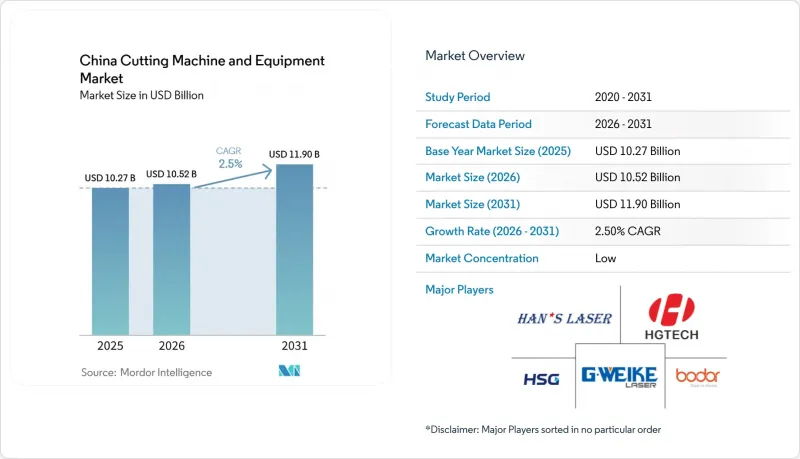
根據 Mordor Intelligence 預測,中國切割機及設備市場規模預計將從 2025 年的 102.7 億美元成長到 2026 年的 105.2 億美元,並將從 2026 年到 2031 年以 2.5% 的複合年成長率成長,到 2031 億美元達到 1199 億美元。
本報告按應用領域(鈑金、板材、管材、結構鋼及其他)、技術(雷射、等離子、水刀及其他)、自動化程度(手動、半自動、機器人/全自動)以及終端用戶產業(汽車、航太與國防及其他)進行細分。市場預測以價值(美元)和數量(單位)呈現。
中國切割機及設備市場趨勢及洞察。
國內製造業和工業生產的擴張
2025年,中國製造業基礎持續擴大,增加價值達34.7兆元人民幣(約5兆美元),連續第16年維持全球領先的工業生產國地位。 2025年,工業產值成長5.9%,其中裝備製造業成長9.2%,顯示資本財需求成長超過整體工業成長趨勢。 2025年,工業機器人產量成長28%,3D列印設備產量成長52.5%,顯示工廠設備和工具的上游運作週期普遍擴大。截至2025年底,已有超過8,200家工廠根據工信部分階段計畫獲得「先進級」智慧工廠認證,這標誌著滿足更高精度和整合化要求的設備基礎不斷擴大。實際上,經過認證的工廠正擴大用光纖雷射切割單元和高精度數控系統取代老舊的等離子切割和氧氣切割生產線,這推動了中國切割機及設備市場的升級需求。這也為切割機及設備市場創造了更穩定的需求基礎。
汽車、電子和機械產業的成長
預計到2025年,中國汽車產量將達到3,450萬輛,其中新能源汽車銷量將達到1,650萬輛,較去年同期成長28.2%。這確保了汽車生產仍然是中國切割機及設備市場最大的需求來源之一。 2025年,汽車製造業增加增加價值額將成長11.5%,電腦、通訊和電子製造業增加價值將成長10.6%,均顯著高於產業平均。這些行業不僅在新生產線上引入切割系統,而且在現有工廠的維修中也引入了切割系統,因為這些改造對公差的要求越來越高。電池外殼、匯流排、馬達罩和電力電子元件等零件,在大規模生產中,需要比傳統等離子切割系統更光滑的邊緣和更精確的切割。預計到2025年,漢氏雷射的汽車電子業務將實現197%的成長,充分展現了汽車和電子領域之間的強大協同效應,並推動了設備需求的成長。因此,新的製造投資和老舊設備的加速更新換代也為市場提供了支撐。
先進雷射切割設備高成本
對於先進的光纖雷射系統而言,建造完整的生產線仍然需要大量的初始投資,包括增加運動軸、切割頭、冷卻器、軟體和自動化硬體。這對於中小加工企業來說尤其重要,因為許多企業仍在努力證明生產效率的提升是合理的,並且難以在一次採購週期內承擔高昂的初始資本負擔。近年來,國內湧現一系列技術創新,例如高功率雷射光源的生產以及大型企業研發投入的增加,這些都提升了國內的技術能力,但並未消除系統總成本的障礙。因此,中國切割機和設備市場的買家仍在仔細權衡投資回報期,尤其是在從半自動生產線向全整合機器人單元過渡的過程中。這導致中階市場採用率放緩,而大型客戶則繼續升級換代。這也解釋了為什麼等離子切割和其他低成本技術在一些重型加工應用領域仍佔據重要地位。
細分市場分析
到2025年,鈑金加工將佔中國切割機及設備市場45.8%的佔有率,成為最大的應用領域。這項需求主要受汽車產量(3,450萬輛)和電子製造業成長的推動,這兩個產業都依賴薄型和中型板材的精密切割。鈑金加工之所以能維持最大的應用領域地位,是因為其在出口導向製造和國內組裝流程中的廣泛應用。新能源汽車(NEV)平台進一步推動了需求成長,對電池外殼、馬達外殼和充電硬體的尺寸控制提出了更高的要求。因此,具有卓越邊緣品質和重複性特徵的光纖雷射系統備受青睞。現有工廠的設備升級改造受到現代化、自動化和精度提升等多重需求的驅動,重點在於投資更快、更有效率的設備以降低廢品率。這也增強了供應商銷售軟體、服務和自動化相關附加元件的能力。
預計到2031年,結構鋼將以3.2%的複合年成長率保持最高增速,這主要得益於公共建築、基礎設施和重工業結構領域對結構鋼需求的不斷成長。雖然結構鋼加工在總銷售額中所佔比例較小,但由於公共工程、工業建築和重工業領域對預製梁、型材和板材的需求不斷增加,其重要性日益凸顯。與鈑金加工不同,結構鋼加工需要加工更重的工件,對公差有特定要求,且加工能力取決於材料厚度和專案進度,因此等離子切割和厚板雷射系統仍然發揮著至關重要的作用。結構鋼的基本客群正在不斷擴大,涵蓋建築製造商、造船廠和能源承包商,儘管訂單模式存在波動,但需求仍然多元化。內陸工業的擴張為結構鋼加工提供了支持,並透過推動重工業加工的成長,對核心精密加工業務起到了補充作用。供應商受益於提供廣泛的產品線,以滿足大量生產的鈑金和結構應用需求。
2025年,雷射技術將佔中國切割機及設備市場的47.5%,成為成長最快的技術領域,預計2031年複合年成長率將達到4.1%。這一趨勢表明,在能源效率提高、營運成本降低、精度提升以及易於整合到自動化生產線等因素的推動下,市場正向光纖雷射系統進行大規模轉型。 Raykas公司於2026年4月開始量產220kW工業連續光纖雷射器,凸顯了國內在高功率應用領域日益增強的技術能力。 Hans Lasers公司報告稱,其2025年高高功率設備的銷售業績強勁,顯示市場正從老舊設備轉向先進平台。高階雷射的推出正在重塑市場競爭格局,擁有獨特光源、控制系統和應用支援的供應商將佔據優勢,市場的焦點也從機器價格轉向整體生產效率和可靠性。主要需求來自汽車電子、電池系統、機械和高階加工零件等行業,這些行業對重複性和速度要求極高。光纖雷射正日益取代二氧化碳雷射器,推高了高階市場的價格。雷射技術是市場中成長最快、附加價值最高的領域。
儘管發生了這些變化,等離子切割、水刀切割、火焰切割、氧氣切割和超音波系統仍然發揮著重要作用,並保持著技術的多樣性。等離子切割是加工厚板和結構的首選,因為在這些情況下,高功率光纖雷射的成本效益不高。水刀切割適用於不適合熱切割的材料,例如複合材料和特殊合金。火焰切割和氧氣切割系統對於加工厚重材質至關重要,因為速度和成本比表面光潔度更為重要。預計到2035年,追求高品質和高精度的技術將獲得更大的市場佔有率,但傳統技術仍將在特定應用場景中繼續使用。在中國切割工具機和設備市場,多種技術仍會根據材料類型、厚度和精度要求進行組合使用。這確保了技術的多樣性,同時雷射技術也將逐漸佔據主導地位。
其他好處:
- Excel格式的市場預測(ME)表
- 3個月的分析師支持
目錄
第1章:引言
- 研究假設和市場定義
- 調查範圍
第2章:調查方法
第3章執行摘要
第4章 市場狀況
- 市場概覽
- 市場促進因素
- 國內製造業和工業生產的擴張
- 汽車、電子和機械產業的成長
- 自動化數控切割系統應用範圍擴大
- 對光纖雷射和高精度切割技術的需求日益成長
- 政府支持先進製造業和工業發展
- 金屬加工和出口導向生產的成長
- 市場限制因素
- 先進雷射切割設備高成本
- 對進口高階組件的依賴
- 國內製造商之間競爭激烈,價格壓力大
- 操作先進設備所需的技術純熟勞工短缺
- 價值供應鏈分析
- 監理情勢
- 技術展望
- 波特五力模型
- 全球製造業概覽
- 顧客購買決策分析
- 地緣政治事件對市場的影響
第5章 市場規模與成長預測
- 透過使用
- 金屬薄板
- 盤子
- 管材和管道
- 結構鋼
- 其他
- 透過技術
- 雷射
- 纖維
- CO2
- 其他
- 電漿
- 高畫質
- 傳統的
- 水刀
- 拋光
- 純的
- 火焰/氧氣燃料
- 超音波和新興技術
- 雷射
- 按自動化級別
- 手動的
- 半自動
- 機器人/全自動
- 按最終用戶行業分類
- 車
- 航太/國防
- 電氣和電子設備
- 建築和基礎設施
- 金屬加工承包商
- 造船
- 能源與電力
- 其他
第6章 競爭情勢
- 市場集中度
- 策略趨勢
- 市佔率分析
- 公司簡介
- Han's Laser Technology Industry Group Co. Ltd
- HGTECH Co. Ltd
- Bodor Laser Co. Ltd
- HSG Laser Co. Ltd
- Jinan G.Weike Science & Technology Co. Ltd
- Jinan Blue Elephant CNC Machinery Co. Ltd
- Penta Laser(Wenzhou)Co. Ltd
- Shenzhen DNE Laser Science and Technology Co. Ltd
- Farley Laserlab Co. Ltd
- Wuhan Chutian Laser Group Co. Ltd
- Jinan Senfeng Technology Co. Ltd
- Hymson Laser Technology Group Co. Ltd
- Suzhou Tianhong Laser Co. Ltd
- Perfect Laser Co. Ltd
- Wuhan Golden Laser Co. Ltd
- Shandong Oree Laser Technology Co. Ltd
- Jinan DXTECH CNC Machine Co. Ltd
- Suzhou Quick Laser Technology Co. Ltd
- Lead Laser Technology Co. Ltd
- Wuhan Unity Laser Technology Co. Ltd
第7章 市場機會與未來展望
According to Mordor Intelligence, the China cutting machine and Equipment Market size is expected to grow from USD 10.27 billion in 2025 to USD 10.52 billion in 2026 and is forecast to reach USD 11.90 billion by 2031 at 2.5% CAGR over 2026-2031.
This report is Segmented by Application (Sheet Metal, Plate, Tube & Pipe, Structural Steel, and Others), by Technology (Laser, Plasma, Waterjet, and More), by Automation Level (Manual, Semi-Automated, and Robotic/Fully-automated), and by End-User Industry (Automotive, Aerospace & Defense, and More). The Market Forecasts are Provided in Terms of Value (USD) and Volume (Units).
China Cutting Machine and Equipment Market Trends and Insights
Expansion of Domestic Manufacturing and Industrial Production
China's manufacturing base continued to expand in 2025, with value-added output reaching CNY 34.7 trillion (USD 5.0 trillion) and keeping the country in the top global position for the 16th straight year. Industrial output rose 5.9% in 2025, while equipment manufacturing grew 9.2%, indicating that capital goods demand outpaced the broader industrial trend. Industrial robot output increased 28%, and 3D printing equipment output rose 52.5% in 2025, pointing to a broader upstream investment cycle in factory equipment and tooling. More than 8,200 factories had reached advanced-level smart factory certification by the end of 2025 under MIIT's tiered program, meaning that a larger installed base is now operating with more demanding precision and integration requirements. In practice, this raises replacement demand in the China cutting machine and equipment market, as certified facilities tend to replace older plasma and oxy-fuel lines with fiber laser cells and higher-control CNC systems. This provides a more stable baseline demand for the cutting machine and equipment market.
Growth in Automotive, Electronics, and Machinery Industries
China produced 34.5 million vehicles in 2025, and new energy vehicle sales reached 16.5 million units, up 28.2% year on year, keeping automotive production as one of the largest sources of demand for the China cutting machine and equipment market. Automotive manufacturing value-added rose 11.5% in 2025, while computer, communication, and electronics manufacturing increased 10.6%, both clearly ahead of the broader industrial average. These sectors purchase cutting systems not only for new production lines but also for retrofits within existing plants where tolerance demands have tightened. Battery housings, busbars, motor covers, and power electronics parts require cleaner edges and more repeatable cuts than older plasma systems can usually deliver at scale. Han's Laser reported 197% growth in its automotive electronics segment in 2025, underscoring the strong overlap between automotive and electronics, which is driving equipment demand. As a result, the market is supported by new manufacturing investments and accelerated replacement of older equipment.
High Cost of Advanced Laser Cutting Equipment
Advanced fiber laser systems still require a significant upfront investment when buyers add motion axes, cutting heads, chillers, software, and automation hardware to build a complete production line. This is especially relevant for small and mid-sized fabricators, as many can justify the productivity gains but still struggle to absorb the initial capital burden in a single purchase cycle. The recent wave of domestic innovation, including the production of ultra-high-power laser sources and increased R&D spending by leading firms, improves local capability but does not remove the cost hurdle for the full system. Buyers in the China cutting machine and equipment market, therefore, continue to closely weigh payback periods, especially as they move from semi-automated lines to fully integrated robotic cells. That slows adoption in the broad middle of the market even while large accounts keep upgrading. It also helps explain why plasma and other lower-cost technologies remain relevant across several heavy-fabrication use cases.
Other drivers and restraints analyzed in the detailed report include:
- Increasing Adoption of Automated CNC Cutting Systems
- Rising Demand for Fiber Laser and High-Precision Cutting Technologies
- Dependence on Imported High-End Components
For complete list of drivers and restraints, kindly check the Table Of Contents.
Segment Analysis
Sheet metal accounted for 45.8% of the China cutting machine and equipment market share in 2025, making it the largest application segment. Vehicle production of 34.5 million units and growth in electronics manufacturing sustain this demand, as both sectors rely on thin- and medium-gauge precision cutting. Sheet metal remains the largest application segment due to its extensive use in export-oriented manufacturing and domestic assembly operations. New energy vehicle platforms further support demand, requiring tighter dimensional control for battery housings, motor covers, and charging hardware, favoring fiber laser systems for edge quality and repeatability. Machine upgrades in existing plants highlight the overlap of replacement, automation, and precision demand, focusing capital spending on faster, more efficient machines with lower scrap rates. This also strengthens suppliers' ability to sell software, service, and automation add-ons.
Structural steel is projected to register the fastest 3.2% CAGR through 2031, supported by rising use in public buildings, infrastructure, and heavy fabrication. Structural steel processing, though a smaller revenue share, is gaining importance as public works, industrial buildings, and heavy fabrication demand prepared beams, sections, and plates. Unlike sheet metal, this segment involves heavier workpieces, application-specific tolerances, and throughput tied to material thickness and project timing, keeping plasma and heavy-plate laser systems relevant. Structural steel broadens the customer base to construction fabricators, shipyards, and energy contractors, diversifying demand despite uneven order patterns. Inland industrial expansion supports this segment, complementing the precision fabrication core by driving growth in heavier industrial work. Suppliers benefit by offering broad product lines for both high-volume sheet work and structural applications.
Laser accounted for 47.5% of the China cutting machine and equipment market in 2025 and is also the fastest-growing technology segment, with a projected 4.1% CAGR through 2031. This trend indicates a broader shift toward fiber laser systems, driven by greater energy efficiency, lower operating costs, higher precision, and easier integration into automated production lines. Raycus' April 2026 mass production of a 220 kW industrial continuous fiber laser highlights rising domestic capability in high-power applications. Han's Laser reported strong momentum in high-power equipment sales in 2025, indicating a shift toward advanced platforms over older machines. High-end laser adoption is reshaping competition, favoring suppliers with proprietary sources, controls, and application support, shifting the focus from machine price to total productivity and reliability. Key demand comes from automotive electronics, battery systems, machinery, and premium fabricated components, where repeatability and speed are critical. Fiber lasers are increasingly replacing CO2 systems and driving premium pricing in the upper market segment. Laser technology is the fastest-growing and highest-value segment of the market.
Despite this shift, plasma, waterjet, flame, oxy-fuel, and ultrasonic systems remain relevant, maintaining a diverse technology mix. Plasma is preferred for heavy plate and structural work where high-wattage fiber lasers may not justify the cost. Waterjet is suitable for materials unsuitable for thermal cutting, such as composites and specialty alloys. Flame and oxy-fuel systems are vital for thick heavy fabrication where speed and cost outweigh finish quality. By 2035, premium, precision-driven technologies are expected to gain market share, but older technologies will persist in specific use cases. The China cutting machine and equipment market continues to use multiple technologies depending on material type, thickness, and precision requirements. This ensures technical diversity alongside the growing dominance of laser technology.
Complete Report Scope:
- By Application
- Sheet Metal
- Plate
- Tube & Pipe
- Structural Steel
- Others
- By Technology
- Laser
- Fiber
- CO2
- Others
- Plasma
- High-definition
- Conventional
- Water-Jet
- Abrasive
- Pure
- Flame / Oxy-fuel
- Ultrasonic & Emerging
- Laser
- By Automation Level
- Manual
- Semi-automated
- Robotic / Fully-automated
- By End-User Industry
- Automotive
- Aerospace & Defense
- Electrical & Electronics
- Construction & Infrastructure
- Metal-Fabrication Job Shops
- Shipbuilding
- Energy & Power
- Others
List of Companies Covered in this Report:
- Han's Laser Technology Industry Group Co. Ltd
- HGTECH Co. Ltd
- Bodor Laser Co. Ltd
- HSG Laser Co. Ltd
- Jinan G.Weike Science & Technology Co. Ltd
- Jinan Blue Elephant CNC Machinery Co. Ltd
- Penta Laser (Wenzhou) Co. Ltd
- Shenzhen DNE Laser Science and Technology Co. Ltd
- Farley Laserlab Co. Ltd
- Wuhan Chutian Laser Group Co. Ltd
- Jinan Senfeng Technology Co. Ltd
- Hymson Laser Technology Group Co. Ltd
- Suzhou Tianhong Laser Co. Ltd
- Perfect Laser Co. Ltd
- Wuhan Golden Laser Co. Ltd
- Shandong Oree Laser Technology Co. Ltd
- Jinan DXTECH CNC Machine Co. Ltd
- Suzhou Quick Laser Technology Co. Ltd
- Lead Laser Technology Co. Ltd
- Wuhan Unity Laser Technology Co. Ltd
Additional Benefits:
- The market estimate (ME) sheet in Excel format
- 3 months of analyst support
TABLE OF CONTENTS
1 Introduction
- 1.1 Study Assumptions & Market Definition
- 1.2 Scope of the Study
2 Research Methodology
3 Executive Summary
4 Market Landscape
- 4.1 Market Overview
- 4.2 Market Drivers
- 4.2.1 Expansion of Domestic Manufacturing and Industrial Production
- 4.2.2 Growth in Automotive, Electronics, and Machinery Industries
- 4.2.3 Increasing Adoption of Automated CNC Cutting Systems
- 4.2.4 Rising Demand for Fiber Laser and High-Precision Cutting Technologies
- 4.2.5 Government Support for Advanced Manufacturing and Industry Upgrades
- 4.2.6 Growth in Metal Fabrication and Export-Oriented Production
- 4.3 Market Restraints
- 4.3.1 High Cost of Advanced Laser Cutting Equipment
- 4.3.2 Dependence on Imported High-End Components
- 4.3.3 Intense Competition and Price Pressure Among Domestic Manufacturers
- 4.3.4 Skilled Labor Shortage for Advanced Equipment Operation
- 4.4 Value / Supply-Chain Analysis
- 4.5 Regulatory Landscape
- 4.6 Technological Outlook
- 4.7 Porter's Five Forces
- 4.7.1 Threat of New Entrants
- 4.7.2 Bargaining Power of Suppliers
- 4.7.3 Bargaining Power of Buyers
- 4.7.4 Threat of Substitutes
- 4.7.5 Industry Rivalry
- 4.8 Global Manufacturing-Sector Snapshot
- 4.9 Customer Purchasing Decision Analysis
- 4.10 Impact of Geopolitical Events on the market
5 Market Size & Growth Forecasts
- 5.1 By Application
- 5.1.1 Sheet Metal
- 5.1.2 Plate
- 5.1.3 Tube & Pipe
- 5.1.4 Structural Steel
- 5.1.5 Others
- 5.2 By Technology
- 5.2.1 Laser
- 5.2.1.1 Fiber
- 5.2.1.2 CO2
- 5.2.1.3 Others
- 5.2.2 Plasma
- 5.2.2.1 High-definition
- 5.2.2.2 Conventional
- 5.2.3 Water-Jet
- 5.2.3.1 Abrasive
- 5.2.3.2 Pure
- 5.2.4 Flame / Oxy-fuel
- 5.2.5 Ultrasonic & Emerging
- 5.2.1 Laser
- 5.3 By Automation Level
- 5.3.1 Manual
- 5.3.2 Semi-automated
- 5.3.3 Robotic / Fully-automated
- 5.4 By End-User Industry
- 5.4.1 Automotive
- 5.4.2 Aerospace & Defense
- 5.4.3 Electrical & Electronics
- 5.4.4 Construction & Infrastructure
- 5.4.5 Metal-Fabrication Job Shops
- 5.4.6 Shipbuilding
- 5.4.7 Energy & Power
- 5.4.8 Others
6 Competitive Landscape
- 6.1 Market Concentration
- 6.2 Strategic Moves
- 6.3 Market Share Analysis
- 6.4 Company Profiles (Includes Global Level Overview, Market Level Overview, Core Segments, Financials as Available, Strategic Information, Products & Services, and Recent Developments)
- 6.4.1 Han's Laser Technology Industry Group Co. Ltd
- 6.4.2 HGTECH Co. Ltd
- 6.4.3 Bodor Laser Co. Ltd
- 6.4.4 HSG Laser Co. Ltd
- 6.4.5 Jinan G.Weike Science & Technology Co. Ltd
- 6.4.6 Jinan Blue Elephant CNC Machinery Co. Ltd
- 6.4.7 Penta Laser (Wenzhou) Co. Ltd
- 6.4.8 Shenzhen DNE Laser Science and Technology Co. Ltd
- 6.4.9 Farley Laserlab Co. Ltd
- 6.4.10 Wuhan Chutian Laser Group Co. Ltd
- 6.4.11 Jinan Senfeng Technology Co. Ltd
- 6.4.12 Hymson Laser Technology Group Co. Ltd
- 6.4.13 Suzhou Tianhong Laser Co. Ltd
- 6.4.14 Perfect Laser Co. Ltd
- 6.4.15 Wuhan Golden Laser Co. Ltd
- 6.4.16 Shandong Oree Laser Technology Co. Ltd
- 6.4.17 Jinan DXTECH CNC Machine Co. Ltd
- 6.4.18 Suzhou Quick Laser Technology Co. Ltd
- 6.4.19 Lead Laser Technology Co. Ltd
- 6.4.20 Wuhan Unity Laser Technology Co. Ltd
7 Market Opportunities & Future Outlook
- 7.1 White-Space & Unmet-Need Assessment

 切割機械及設備:市場佔有率分析、產業趨勢及統計、成長預測(2026-2031)德國切割機械及設備:市場佔有率分析、產業趨勢與統計及成長預測(2026-2031)美國切割機械及設備:市場佔有率分析、產業趨勢及統計、成長預測(2026-2031)印度切割機械及設備:市場佔有率分析、產業趨勢與統計及成長預測(2026-2031)
 切割設備市場:依設備類型、動力來源、控制方式、機器尺寸、銷售管道、應用及最終用戶產業分類-2026-2032年全球市場預測
 切割設備市場規模、佔有率和成長分析:按設備類型、技術類型、自動化程度、最終用戶產業、分銷管道和地區分類-2026-2033年產業預測
 2026年全球自動化鋼筋切割生產線市場報告工業PCB分板機械設備市場:依技術、機器類型、動力來源、生產速度、應用複雜性、通路、終端用戶產業分類,全球預測,2026-2032年拉片切割設備市場:全球預測(按最終用戶產業、技術、自動化程度、產品類型、應用和銷售管道),2026-2032年盾形滾刀市場:依產品類型、材料、應用、最終用戶、通路分類,全球預測(2026-2032)