


 |
市場調查報告書
商品編碼
2098594
德國切割機械及設備:市場佔有率分析、產業趨勢與統計及成長預測(2026-2031)Germany Cutting Machine and Equipment - Market Share Analysis, Industry Trends & Statistics, Growth Forecasts (2026 - 2031) |
||||||

※ 本網頁內容可能與最新版本有所差異。詳細情況請與我們聯繫。
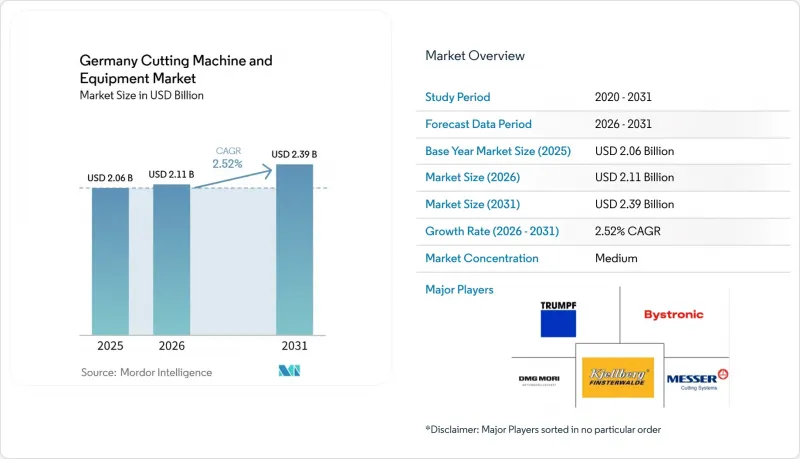
根據 Mordor Intelligence 預測,德國切割機和設備市場規模預計將在 2025 年達到 20.6 億美元,2026 年達到 21.1 億美元,到 2031 年達到 23.9 億美元,2026 年至 2031 年的複合年成長率為 2.52%。
本報告按應用領域(鈑金、平板、管材、結構鋼及其他)、技術(雷射、等離子、水刀及其他)、自動化程度(手動、半自動、機器人/全自動)和技術用戶產業(汽車、航太與國防及其他)進行細分。市場預測以價值(美元)和數量(單位)呈現。
德國切割機及設備市場趨勢及洞察。
擴大工業4.0和工廠自動化的應用
德國切割機及設備市場正受益於生產環境從試點階段的數位化向工廠級自動化的顯著轉變。德國機械設備製造商協會2026年的一項調查顯示,超過80%的德國機械製造商認知到人工智慧日益成長的重要性,近三分之一的製造商已在實際生產環境中應用人工智慧,從而推動了對具備自適應控制和網路監控功能的切割系統的需求。該調查還強調了對工程師進行大規模再培訓的趨勢,並提高了工廠部署更先進切割平台的實際能力。這在德國切割機及設備市場意義重大,因為在高運轉率下,以連網切割單元取代舊有系統的經濟效益會降低。此外,買家面臨越來越大的壓力,需要部署符合自動化生產線佈局、遠端監控協議和最新安全配置的設備。這些因素綜合起來意味著,在許多專案中,自動化正成為一項強制性要求,而不僅僅是可選的升級選項。
對高精度雷射切割系統的需求日益成長
金屬加工和製造領域日益嚴格的品質要求也推動了德國切割機和設備市場的發展。一項2025年的研究表明,在要求嚴苛的航太和汽車應用領域,雷射製造與傳統方法相比,可將生產效率提高30%,從而促進精密切割系統的應用。領先的供應商持續增加研發投入,顯示他們仍然看好高效光纖雷射系統和自動噴嘴控制的產品開發價值。此外,德國一家工廠於2025年獲準進行裝甲彈道鋼的雷射切割,顯示雷射加工正在擴展到國防領域,而這些領域需要更嚴格的認證。這提升了高精度、製程穩定性和可追溯切割品質在德國切割機和設備市場的商業性價值。同時,這也加速了在那些對邊緣質量和重複性要求高於切割速度的客戶群中,等離子切割和火焰切割系統被更高精度的雷射系統所取代。
高昂的人事費用和製造營運成本
德國切割機械及設備市場正面臨高昂的人事費用、社會保障繳款和一般營運費用帶來的直接壓力。根據德國機械設備製造業聯合會(VDMA)2025年的數據,到2025年9月,德國機械設備產業的員工人數下降了2.4%,降至約100萬人。這不僅反映了短期需求的下降,也反映了結構性的成本問題。 VDMA在2026年也報告稱,2025年德國64%的汽車零件供應商裁員,其中87%的供應商表示,位置競爭力下降是主要或非常重要的原因。在德國切割機械及設備市場,這種情況導致用於升級專案的資本預算捉襟見肘,審核時間也延長了。仍需要新設備的公司越來越傾向於選擇能夠減少工時、廢棄物和整個運作能源消耗的系統。因此,即使是小規模的採購活動也從單純的低成本替換轉向了高生產力的平台。
細分市場分析
到2025年,鈑金加工廠將佔德國切割機和設備市場43.5%的市場佔有率,成為該市場最大的應用領域。這一主導地位反映了汽車車體結構、電氣設備機殼、暖通空調組件和通用金屬加工產品等領域的穩定需求。鈑金切割系統在德國主要製造業區域的廣泛應用,使其在該領域擁有成熟的市場地位。同時,它仍然是工業生產中高通量雷射切割生產線最成熟的應用場景。儘管新增設備數量有限,但龐大的替換需求確保了鈑金加工在資本投資中仍佔據核心地位。
管材是成長最快的應用領域,預計2026年至2031年將以3.1%的複合年成長率成長。這一成長主要得益於可再生能源系統、國防硬體和工業熱交換器生產中加工需求的不斷成長。與鈑金相比,管材的基數較小,但其應用場景正在不斷擴展,尤其是在大量使用截面形狀的製造領域。向結構管組件和中空截面部件的轉變也增加了對高精度切割系統的需求。因此,在德國切割工具機和設備市場,鈑金預計仍將是銷售的主要驅動力,而管材預計將在整個預測期內保持更強勁的成長動能。
到2025年,雷射技術將佔據德國切割機和設備市場50.2%的佔有率,成為該市場最大的技術細分領域。其主導地位體現在其廣泛的應用領域,包括鈑金、管材、板材和精密零件的加工。雷射系統之所以備受青睞,是因為它具有切割速度快、邊緣品質高、加工穩定以及與自動化生產線高度相容等優點。此外,供應商持續投資於提高光纖雷射的效率、軟體整合和更智慧的製程控制,也使該細分領域受益匪淺。這些因素使雷射技術在等離子切割、水刀切割、火焰切割和其他特殊技術中脫穎而出。
此外,雷射技術是成長最快的技術領域,預計2026年至2031年將以3.7%的複合年成長率成長。這一成長主要得益於以高效、數位化整合平台取代老舊系統。在那些對公差要求更高、廢料更少、能源效率更高的應用領域,雷射技術正日益普及。雖然等離子雷射和水射流雷射在厚壁材料加工和溫度敏感型應用中仍然發揮重要作用,但預計其市場擴張仍將相對有限。因此,雷射技術在當前德國切割機和設備市場佔有率以及未來的成長中將繼續佔據核心地位。
其他好處:
- Excel格式的市場預測(ME)表
- 3個月的分析師支持
目錄
第1章:引言
- 研究假設和市場定義
- 調查範圍
第2章:調查方法
第3章執行摘要
第4章 市場狀況
- 市場概覽
- 市場促進因素
- 工業4.0和工廠自動化的廣泛應用。
- 高精度雷射切割系統的需求日益成長
- 擁有強大的汽車和工業機械製造基地。
- 在航太、國防和工程領域不斷拓展應用。
- 增加對先進金屬加工技術的投資
- 注重節能與永續製造
- 市場限制因素
- 高昂的人事費用和製造營運成本
- 先進切割設備高成本
- 熟練技術人員短缺
- 經濟放緩對工業投資的影響
- 價值供應鏈分析
- 監理情勢
- 技術展望
- 波特五力模型
- 全球製造業概覽
- 顧客購買決策分析
- 地緣政治事件對市場的影響
第5章 市場規模與成長預測
- 透過使用
- 金屬薄板
- 平板
- 管材和管道
- 結構鋼
- 其他
- 透過技術
- 雷射
- 纖維
- CO2
- 其他
- 電漿
- 高畫質
- 傳統的
- 水刀
- 磨料
- 純的
- 火焰/氧氣燃料
- 超音波和新興技術
- 雷射
- 按自動化級別
- 手動的
- 半自動
- 機器人/全自動
- 按最終用戶行業分類
- 車
- 航太/國防
- 電氣和電子設備
- 建築和基礎設施
- 金屬加工承包商
- 造船
- 能源與電力
- 其他(醫療設備等)
第6章 競爭情勢
- 市場集中度
- 策略趨勢
- 市佔率分析
- 公司簡介
- TRUMPF Group
- Messer Cutting Systems GmbH
- Kjellberg Finsterwalde Plasma und Maschinen GmbH
- DMG MORI AG
- Bystronic Deutschland GmbH
- Laserline GmbH
- Jenoptik AG
- LVD GmbH
- Precitec GmbH & Co. KG
- SCANLAB GmbH
- IPG Laser GmbH
- Kaltenbach GmbH
- MicroStep Europa GmbH
- LASERFACT GmbH
- Behringer GmbH
- AMADA GmbH
- ECKERT Cutting Technology GmbH
- HG Farley LaserLab Germany GmbH
- Coherent Germany GmbH
- ALPHA LASER GmbH
第7章 市場機會與未來展望
According to Mordor Intelligence, the Germany cutting machine and Equipment Market size is projected to be USD 2.06 billion in 2025, USD 2.11 billion in 2026, and reach USD 2.39 billion by 2031, growing at a CAGR of 2.52% from 2026 to 2031.
This report is Segmented by Application (Sheet Metal, Plate, Tube & Pipe, Structural Steel, and Others), by Technology (Laser, Plasma, Waterjet, and More), by Automation Level (Manual, Semi-Automated, and Robotic/Fully-automated), and by End-User Industry (Automotive, Aerospace & Defense, and More). The Market Forecasts are Provided in Terms of Value (USD) and Volume (Units).
Germany Cutting Machine and Equipment Market Trends and Insights
Growing Adoption of Industry 4.0 and Factory Automation
The Germany cutting machine and equipment market is benefiting from a clear shift from pilot-stage digitalization to plant-level automation in production environments. A German Machinery and Plant Manufacturers Association survey in 2026 showed that more than 80% of German mechanical engineering companies viewed AI as increasingly important, and close to one-third had already begun using AI in live production, supporting demand for cutting systems with adaptive controls and connected monitoring. The same body of research also pointed to a significant retraining push across the engineering workforce, which improves factories' practical readiness to adopt more advanced cutting platforms. In the Germany cutting machine and equipment market, this matters because connected cutting cells shorten the economic case for replacing legacy systems when utilization is high. Buyers are also under greater pressure to install equipment that aligns with automated line layouts, remote monitoring protocols, and modern safety configurations. That combination is making automation a purchasing requirement in many projects rather than an optional upgrade.
Rising Demand for High-Precision Laser Cutting Systems
Stricter quality requirements in metalworking and fabrication are also driving the Germany cutting machine and equipment market. Research reported in 2025 found that laser-based manufacturing can increase production throughput by up to 30% compared with conventional methods in demanding aerospace and automotive applications, supporting the broader use of precision cutting systems. Premium suppliers have continued investing heavily in research and development, indicating they still see strong product development value in higher-efficiency fiber laser systems and automated nozzle management. A 2025 approval for laser cutting of armor-grade ballistic steel at a German facility also showed that laser processing is moving into more tightly certified defense applications. In the Germany cutting machine and equipment market, this raises the commercial value of higher precision, process stability, and traceable cutting quality. It also speeds up the replacement of lower-tolerance plasma and flame systems in customer groups where edge quality and repeatability now matter more than simple cutting speed.
High Labor and Manufacturing Operating Costs
The Germany cutting machine and equipment market faces direct pressure from high labor costs, social charges, and general operating expenses. VDMA data referenced in 2025 showed that employment in Germany's machinery and equipment sector fell by 2.4% to nearly 1 million workers by September 2025, reflecting a structural cost problem rather than only a short-term demand decline. VDA also reported in 2026 that 64% of automotive suppliers reduced German headcount during 2025, and 87% cited weak location competitiveness as a major or very major cause. In the Germany cutting machine and equipment market, this reduces the capital budget available for replacement projects and extends approval timelines. Companies that still need new equipment are placing greater weight on systems that reduce labor hours, scrap, and energy intensity over the full operating life. This is why even modest purchasing activity is shifting toward higher-productivity platforms rather than simple low-cost substitutions.
Other drivers and restraints analyzed in the detailed report include:
- Strong Automotive and Industrial Machinery Manufacturing Base
- Expansion of Aerospace, Defense, and Engineering Applications
- Elevated Cost of Advanced Cutting Equipment
For complete list of drivers and restraints, kindly check the Table Of Contents.
Segment Analysis
Sheet metal accounted for 43.5% of the market in 2025, making it the largest application segment in the Germany cutting machine and equipment market. Its leading position reflects steady demand from automotive body structures, electrical enclosures, HVAC parts, and general fabricated metal products. This segment benefits from a wide installed base of flat sheet cutting systems across Germany's major manufacturing regions. It also remains the most established use case for high-throughput laser cutting lines in industrial production. The scale of replacement demand keeps sheet metal at the center of equipment spending even when new capacity additions remain selective.
Tube and pipe is the fastest-growing application segment and is projected to expand at a 3.1% CAGR during 2026-2031. Growth is supported by rising demand for fabrication in renewable energy systems, defense hardware, and industrial heat exchanger production. Compared with sheet metal, this segment is starting from a smaller base, but its use cases are broadening across profile-intensive manufacturing. The shift toward structural tube assemblies and hollow-section components is also improving demand for higher-precision cutting systems. As a result, the Germany cutting machine and equipment market is expected to retain sheet metal as the volume anchor, while tube and pipe delivers stronger growth momentum through the forecast period.
Laser technology held 50.2% share in 2025, making it the largest technology segment in the Germany cutting machine and equipment market. This leadership is reflected in its wide use across sheet metal, tube, plate, and precision component applications. Laser systems are preferred because they offer high cutting speed, high edge quality, consistent processing, and better compatibility with automated production setups. The segment has also benefited from continued supplier investment in fiber laser efficiency, software integration, and smarter process control. These factors have helped lasers maintain a clear lead over plasma, waterjet, flame, and other specialized technologies.
Laser is also the fastest-growing technology segment, projected to expand at a 3.7% CAGR during 2026-2031. Its growth is supported by replacing older systems with higher-efficiency, digitally integrated platforms. The technology is gaining further ground in applications where tighter tolerances, lower scrap, and energy performance matter more in procurement decisions. While plasma and waterjet remain relevant in thicker materials and temperature-sensitive applications, their expansion is expected to remain more limited. This keeps the laser at the center of both the current Germany cutting machine and equipment market share and future growth.
Complete Report Scope:
- By Application
- Sheet Metal
- Plate
- Tube & Pipe
- Structural Steel
- Others
- By Technology
- Laser
- Fiber
- CO2
- Others
- Plasma
- High-definition
- Conventional
- Waterjet
- Abrasive
- Pure
- Flame / Oxy-fuel
- Ultrasonic & Emerging
- Laser
- By Automation Level
- Manual
- Semi-automated
- Robotic / Fully-automated
- By End-User Industry
- Automotive
- Aerospace & Defense
- Electrical & Electronics
- Construction & Infrastructure
- Metal-Fabrication Job Shops
- Shipbuilding
- Energy & Power
- Others (Medical Devices, etc.)
List of Companies Covered in this Report:
- TRUMPF Group
- Messer Cutting Systems GmbH
- Kjellberg Finsterwalde Plasma und Maschinen GmbH
- DMG MORI AG
- Bystronic Deutschland GmbH
- Laserline GmbH
- Jenoptik AG
- LVD GmbH
- Precitec GmbH & Co. KG
- SCANLAB GmbH
- IPG Laser GmbH
- Kaltenbach GmbH
- MicroStep Europa GmbH
- LASERFACT GmbH
- Behringer GmbH
- AMADA GmbH
- ECKERT Cutting Technology GmbH
- HG Farley LaserLab Germany GmbH
- Coherent Germany GmbH
- ALPHA LASER GmbH
Additional Benefits:
- The market estimate (ME) sheet in Excel format
- 3 months of analyst support
TABLE OF CONTENTS
1 Introduction
- 1.1 Study Assumptions & Market Definition
- 1.2 Scope of the Study
2 Research Methodology
3 Executive Summary
4 Market Landscape
- 4.1 Market Overview
- 4.2 Market Drivers
- 4.2.1 Growing Adoption of Industry 4.0 and Factory Automation
- 4.2.2 Rising Demand for High-Precision Laser Cutting Systems
- 4.2.3 Strong Automotive and Industrial Machinery Manufacturing Base
- 4.2.4 Expansion of Aerospace, Defense, and Engineering Applications
- 4.2.5 Increasing Investment in Advanced Metal Processing Technologies
- 4.2.6 Focus on Energy-Efficient and Sustainable Manufacturing
- 4.3 Market Restraints
- 4.3.1 High Labor and Manufacturing Operating Costs
- 4.3.2 Elevated Cost of Advanced Cutting Equipment
- 4.3.3 Shortage of Skilled Technical Workforce
- 4.3.4 Economic Slowdown Affecting Industrial Investments
- 4.4 Value / Supply-Chain Analysis
- 4.5 Regulatory Landscape
- 4.6 Technological Outlook
- 4.7 Porter's Five Forces
- 4.7.1 Threat of New Entrants
- 4.7.2 Bargaining Power of Suppliers
- 4.7.3 Bargaining Power of Buyers
- 4.7.4 Threat of Substitutes
- 4.7.5 Industry Rivalry
- 4.8 Global Manufacturing-Sector Snapshot
- 4.9 Customer Purchasing Decision Analysis
- 4.10 Impact of Geopolitical Events on the market
5 Market Size & Growth Forecasts
- 5.1 By Application
- 5.1.1 Sheet Metal
- 5.1.2 Plate
- 5.1.3 Tube & Pipe
- 5.1.4 Structural Steel
- 5.1.5 Others
- 5.2 By Technology
- 5.2.1 Laser
- 5.2.1.1 Fiber
- 5.2.1.2 CO2
- 5.2.1.3 Others
- 5.2.2 Plasma
- 5.2.2.1 High-definition
- 5.2.2.2 Conventional
- 5.2.3 Waterjet
- 5.2.3.1 Abrasive
- 5.2.3.2 Pure
- 5.2.4 Flame / Oxy-fuel
- 5.2.5 Ultrasonic & Emerging
- 5.2.1 Laser
- 5.3 By Automation Level
- 5.3.1 Manual
- 5.3.2 Semi-automated
- 5.3.3 Robotic / Fully-automated
- 5.4 By End-User Industry
- 5.4.1 Automotive
- 5.4.2 Aerospace & Defense
- 5.4.3 Electrical & Electronics
- 5.4.4 Construction & Infrastructure
- 5.4.5 Metal-Fabrication Job Shops
- 5.4.6 Shipbuilding
- 5.4.7 Energy & Power
- 5.4.8 Others (Medical Devices, etc.)
6 Competitive Landscape
- 6.1 Market Concentration
- 6.2 Strategic Moves
- 6.3 Market Share Analysis
- 6.4 Company Profiles (Includes Global Level Overview, Market Level Overview, Core Segments, Financials as Available, Strategic Information, Products & Services, and Recent Developments)
- 6.4.1 TRUMPF Group
- 6.4.2 Messer Cutting Systems GmbH
- 6.4.3 Kjellberg Finsterwalde Plasma und Maschinen GmbH
- 6.4.4 DMG MORI AG
- 6.4.5 Bystronic Deutschland GmbH
- 6.4.6 Laserline GmbH
- 6.4.7 Jenoptik AG
- 6.4.8 LVD GmbH
- 6.4.9 Precitec GmbH & Co. KG
- 6.4.10 SCANLAB GmbH
- 6.4.11 IPG Laser GmbH
- 6.4.12 Kaltenbach GmbH
- 6.4.13 MicroStep Europa GmbH
- 6.4.14 LASERFACT GmbH
- 6.4.15 Behringer GmbH
- 6.4.16 AMADA GmbH
- 6.4.17 ECKERT Cutting Technology GmbH
- 6.4.18 HG Farley LaserLab Germany GmbH
- 6.4.19 Coherent Germany GmbH
- 6.4.20 ALPHA LASER GmbH
7 Market Opportunities & Future Outlook
- 7.1 White-Space & Unmet-Need Assessment

 中國切割機械及設備:市場佔有率分析、產業趨勢與統計及成長預測(2026-2031)切割機械及設備:市場佔有率分析、產業趨勢及統計、成長預測(2026-2031)美國切割機械及設備:市場佔有率分析、產業趨勢及統計、成長預測(2026-2031)印度切割機械及設備:市場佔有率分析、產業趨勢與統計及成長預測(2026-2031)
 切割設備市場:依設備類型、動力來源、控制方式、機器尺寸、銷售管道、應用及最終用戶產業分類-2026-2032年全球市場預測
 切割設備市場規模、佔有率和成長分析:按設備類型、技術類型、自動化程度、最終用戶產業、分銷管道和地區分類-2026-2033年產業預測
 2026年全球自動化鋼筋切割生產線市場報告工業PCB分板機械設備市場:依技術、機器類型、動力來源、生產速度、應用複雜性、通路、終端用戶產業分類,全球預測,2026-2032年拉片切割設備市場:全球預測(按最終用戶產業、技術、自動化程度、產品類型、應用和銷售管道),2026-2032年盾形滾刀市場:依產品類型、材料、應用、最終用戶、通路分類,全球預測(2026-2032)