


 |
市場調查報告書
商品編碼
2099243
美國切割機械及設備:市場佔有率分析、產業趨勢及統計、成長預測(2026-2031)United States Cutting Machine and Equipment - Market Share Analysis, Industry Trends & Statistics, Growth Forecasts (2026 - 2031) |
||||||

※ 本網頁內容可能與最新版本有所差異。詳細情況請與我們聯繫。
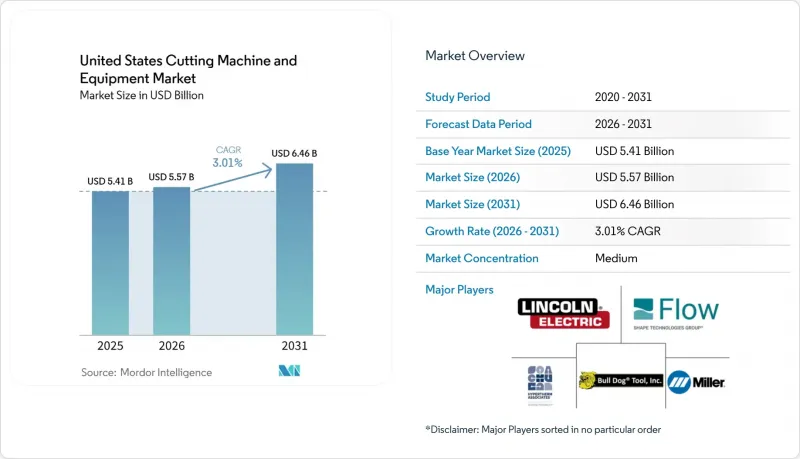
據 Mordor Intelligence 稱,2025 年美國切割機和設備市值為 54.1 億美元,預計到 2031 年將從 2026 年的 55.7 億美元成長到 64.6 億美元,預測期(2026-2031 年)的複合年成長率為 3.01%。
本報告按應用領域(鈑金、板材、管材等)、技術(雷射、等離子、水刀等)、自動化程度(手動、半自動、機器人/全自動)以及終端用戶產業(汽車、航太與國防、電氣電子等)進行細分。市場預測以價值(美元)和數量(台)表示。
美國切割機及設備市場的趨勢與洞見。
製造業回流及國內製造業擴張
聯邦產業政策正在推動要素美國切割設備市場結構性回流需求。截至2026年3月,MEP國家網路共有44個正在進行的國內供應商收購項目,顯示OEM廠商的需求已超過國內分包商的供給能力。這種供需失衡促使新的二級和三級供應商、加工車間和區域加工商將切割系統部署在更靠近OEM採購地點的位置。美國製造業協會(Manufacturing USA)報告稱,其17個實驗室在2023會計年度投資了5.4億美元用於先進製造項目,重點關注自動化、數位化製造和材料加工,以支持製程開發和設備在規模化生產階段的利用。聯邦合約中「購買美國貨」的合規要求進一步加強了國內加工活動,並擴大了美國切割設備市場已安裝設備的運作基礎。
航太、國防和汽車生產的成長
航太、國防和汽車製造業持續為美國切削機床和設備市場創造強勁的需求基礎。預計到2024年,美國航太和國防產業的總商業活動將超過9,950億美元,創造4,430億美元的經濟價值,並實現1,386億美元的出口額,使其成為美國唯一實現貿易順差的製造業部門。 2026會計年度的預算調整將216億美元分配給與太空相關的國防項目,其中138億美元用於太空部隊(美國太空部隊,美國第六個也是最新的軍種)。這支撐了對精密加工的推進和結構部件的需求。美國航空航太工業協會(AIA)和科爾尼顧問公司(Kearney)共同進行的2025年調查顯示,近60%的美國航太航太和國防企業正在考慮將其國內供應鏈本地化,其中15%的企業已經採取了具體措施。這些因素共同維持了對光纖雷射和精密拋光水刀系統的需求,這些設備能夠大規模加工鈦、因科鎳合金和複合材料。同時,儘管面臨關稅壓力,汽車製造業的產量仍在持續成長。
引進和安裝設備成本高昂
高昂的設備購置和安裝成本仍然是美國切割機和設備市場,尤其是中小型加工企業的一大阻礙因素。聯準會在2025年4月表示,在不確定性加劇的時期,企業可能會延後大型、不可逆的資本投資,這將直接影響20萬至100萬美元切割系統的採購。 《晶片與科學法案》提供的25%先進製造業投資稅額扣抵僅限於半導體相關製造業,並未涵蓋更廣泛的金屬加工產業,因此只能部分抵銷此負擔。將現有工廠維修為機器人切割單元還需要進行結構改造、安裝符合標準的防護罩和通風系統,這將在生產開始前使基本系統成本增加15%至30%。此外,遵守美國國家標準協會(ANSI)Z136雷射安全標準及相關培訓要求也會增加額外開支,而小規模企業往往難以有效管理這些開支。
細分市場分析
到2025年,鈑金加工將占美國切割機和設備市場佔有率的41.2%,成為最大的應用領域。這一主導地位得益於眾多領域的需求,包括暖通空調系統、電氣外殼、汽車車身面板、消費性電子產品機殼和建築覆層。由於許多製造業都需要加工薄鈑金,這些廣泛的工業應用維持了較高的設備運轉率。此外,鈑金切割在重型機械、能源和結構製造領域也佔據重要地位,因為專案週期保證了穩定的設備需求。
預計2026年至2031年間,「管材和管道」產業將以3.8%的複合年成長率成長,成為美國切割設備市場前景中成長最快的應用領域。這一成長主要得益於管道項目、可再生能源支撐結構、氫氣運輸系統以及擴大使用鋼管的汽車底盤設計。 TRUMPF將於2026年3月在北美推出TruLaser Tube 7000,這反映了原始設備製造商(OEM)對管道加工和高通量雷射應用需求的持續信心。結構鋼和特殊材料仍然十分重要,因為工廠主導和國防相關製造業的持續發展滿足了各種不同的切割需求。
到2025年,雷射將占美國切割機和設備市場44.3%的佔有率,成為最大的技術領域。這一地位反映了雷射技術在許多領域的廣泛應用,包括鈑金加工、管材加工、精密零件加工和熱成型零件加工等,在這些領域,速度、切割品質和數位化控制至關重要。與許多傳統替代方案相比,雷射系統還具有許多優勢,例如耗材消耗量更低,以及與聯網數控環境的卓越整合。美國國家標準與技術研究院(NIST)將雷射加工定位為國家先進製造業架構中的關鍵基礎技術,強調其在工業生產中的長期作用。
雷射技術也是成長最快的技術領域之一,預計2026年至2031年將以4.2%的複合年成長率成長。這一成長反映了二氧化碳雷射系統的持續替代以及在需要高精度、高能源效率和高產量的應用領域中日益成長的採用率。 2026年5月,通快公司宣布其「X-Blast 2.0」解決方案可在汽車產業的熱成型應用中將零件成本降低高達20%。這表明雷射設備製造商在生產流程中扮演著日益重要的角色。等離子切割、水刀、火焰切割和新興技術在厚材料、熱敏基材和特殊製造環境中繼續發揮至關重要的作用。
其他好處:
- Excel格式的市場預測(ME)表
- 3個月的分析師支持
目錄
第1章:引言
- 研究假設和市場定義
- 調查範圍
第2章:調查方法
第3章執行摘要
第4章 市場狀況
- 市場概覽
- 市場促進因素
- 製造業回流及國內製造業擴張
- 航太、國防和汽車生產擴張
- 自動化數控切割系統應用範圍擴大
- 高精度光纖雷射切割的需求日益成長
- 對智慧製造和工業4.0的投資
- 對客製化金屬製品的需求日益成長
- 市場限制因素
- 購置和安裝設備成本高昂
- 熟練機械操作員短缺
- 高昂的維護和營運成本
- 工業生產投資的波動性
- 價值供應鏈分析
- 原料和關鍵部件的生態系統
- OEM製造和系統整合
- 分銷、通路合作夥伴、售後市場網路
- 最終用戶採納和生命週期價值的創造
- 監理情勢
- 技術趨勢和當前創新投資狀況
- 數控自動化和智慧切割技術
- 等離子切割技術
- 全球製造業概覽
- 價格分析
- 主要市場參與企業的平均售價 (ASP) 基準
- 按自動化程度分類的平均售價 (ASP) 分析
- 按技術分類的平均售價 (ASP) 分析
- 採購標準與採購分析
- 五力分析-產業吸引力評估
- 新進入者的威脅
- 供應商的議價能力
- 買方的議價能力
- 替代品的威脅
- 產業競爭
- 地緣政治事件對市場的影響
第5章 市場規模與成長預測
- 透過使用
- 金屬薄板
- 盤子
- 管材和管道
- 結構鋼
- 其他
- 透過技術
- 雷射
- 纖維
- CO2
- 其他
- 電漿
- 高畫質
- 傳統的
- 水刀
- 磨料
- 純的
- 火焰/氧氣燃料
- 超音波和新興技術
- 雷射
- 按自動化級別
- 手動的
- 半自動
- 機器人技術/全自動
- 按最終用戶行業分類
- 車
- 航太/國防
- 電氣和電子設備
- 建築和基礎設施
- 金屬加工承包商
- 造船
- 能源與電力
- 其他(醫療設備等)
第6章 競爭情勢
- 市場集中度
- 策略趨勢
- 市佔率分析
- Competitive Benchmarking Analysis
- 公司簡介
- Hypertherm Associates
- Lincoln Electric Holdings, Inc.
- Flow International Corporation
- Bully Dog Cutting Systems
- Miller Electric Mfg. LLC
- Koike Aronson, Inc.
- ESAB Corporation
- TRUMPF Inc.
- Bystronic Inc.
- Mazak Corporation
- AKS Cutting Systems, Inc.
- KMT Waterjet Systems Inc.
- Hornet Cutting Systems
- Messer Cutting Systems, Inc.
- Jet Edge Inc.
- Epilog Laser
- Cincinnati Incorporated
- Thermal Dynamics Corporation
- MultiCam Inc.
- ShopSabre CNC
第7章 市場機會與未來展望
According to Mordor Intelligence, the United States cutting machine and equipment market size was valued at USD 5.41 billion in 2025 and is estimated to grow from USD 5.57 billion in 2026 to reach USD 6.46 billion by 2031, at a CAGR of 3.01% during the forecast period (2026-2031).
This report is Segmented by Application (Sheet Metal, Plate, Tube & Pipe, and More), by Technology (Laser, Plasma, Waterjet, and More), by Automation Level (Manual, Semi-Automated, and Robotic/Fully-automated), by End-User Industry (Automotive, Aerospace & Defense, Electrical & Electronics, and More). The Market Forecasts are Provided in Terms of Value (USD) and Volume (Units).
United States Cutting Machine and Equipment Market Trends and Insights
Reshoring and Domestic Manufacturing Expansion
Federal industrial policy has turned reshoring into a structural demand driver in the United States cutting machine and equipment market. The MEP National Network had 44 active domestic supplier-scouting opportunities open in March 2026, indicating that OEM demand remained ahead of available domestic sub-tier capacity. That imbalance is encouraging new Tier 2 and Tier 3 suppliers, job shops, and regional fabricators to commission cutting systems closer to OEM sourcing hubs. Manufacturing USA reported that its 17 institutes invested USD 540 million in FY 2023 across advanced manufacturing programs focused on automation, digital manufacturing, and materials processing, supporting process development and equipment use at scale-up stages. Buy American compliance requirements in federal contracts are further reinforcing domestic processing activity and expanding the operating base for equipment installed within the United States cutting machine and equipment market.
Growth in Aerospace, Defense, and Automotive Production
Aerospace, defense, and automotive output continue to create a durable demand base for the United States cutting machine and equipment market. The United States aerospace and defense sector generated more than USD 995 billion in total business activity in 2024, contributed USD 443 billion in economic value, and produced USD 138.6 billion in exports, making it the only United States manufacturing sector with a net-positive trade balance. The FY 2026 reconciliation act designated USD 21.6 billion for space-focused defense projects, including USD 13.8 billion for the Space Force (The United States Space Force is the sixth and newest branch of the United States Armed Forces), which supports demand for precision-cut propulsion and structural components. A 2025 study by AIA (Aerospace Industries Association) and Kearney found that nearly 60% of United States aerospace and defense companies are exploring domestic supply chain localization, and 15% are already taking concrete action. This combination is sustaining demand for fiber laser and precision abrasive waterjet systems that can process titanium, Inconel, and composites at production scale. At the same time, automotive fabrication continues to add volume even under tariff-related pressure.
High Equipment Acquisition and Installation Costs
High acquisition and installation costs remain a direct restraint on the United States cutting machine and equipment market, especially for small and medium fabricators. The Federal Reserve stated in April 2025 that firms are most likely to delay large irreversible capital expenditures during periods of elevated uncertainty, which directly applies to cutting system purchases in the USD 200,000 to USD 1 million range. The 25% Advanced Manufacturing Investment Credit under the CHIPS and Science Act only partly offsets this burden because it is limited to semiconductor-adjacent manufacturing and does not cover the broader metal fabrication base. Retrofitting existing plants for robotic cutting cells also requires structural modifications, compliant enclosures, and ventilation systems, which can add 15% to 30% to the base system cost before production starts. ANSI (American National Standard Institute) Z136 laser safety compliance and related training requirements add another layer of overhead that smaller operators often struggle to manage efficiently.
Other drivers and restraints analyzed in the detailed report include:
- Increasing Adoption of Automated CNC Cutting Systems
- Rising Demand for High-Precision Fiber Laser Cutting
- Shortage of Skilled Machine Operators
For complete list of drivers and restraints, kindly check the Table Of Contents.
Segment Analysis
Sheet Metal accounted for 41.2% of the United States cutting machine and equipment market share in 2025, which made it the largest application segment. Its lead came from broad demand across HVAC systems, electrical enclosures, automotive body panels, appliance housings, and construction cladding. This broad industrial use keeps utilization high because thin-gauge metal processing is required across many fabrication settings. Plate cutting also remained important in heavy equipment, energy, and structural fabrication, where project cycles support steady equipment demand.
Tube & Pipe is projected to grow at a 3.8% CAGR from 2026 to 2031, making it the fastest-growing application in the United States cutting machine and equipment market outlook. Growth is being supported by pipeline activity, renewable energy support structures, hydrogen transport systems, and automotive chassis designs that use more tubular steel. TRUMPF's March 2026 launch of the TruLaser Tube 7000 in North America reflected continued OEM confidence in tube-processing demand and higher-throughput laser applications. Structural steel and specialty materials also remain relevant because reshoring-led factory construction and defense-linked fabrication continue to support varied cutting requirements.
Laser held 44.3% of the United States cutting machine and equipment market share in 2025, making it the largest technology segment. Its position reflects strong use across sheet metal, tube, precision parts, and hot-formed components where speed, cut quality, and digital control matter. Laser systems also benefit from lower consumable intensity and better integration with connected CNC environments than many legacy alternatives. NIST identified laser processing as a critical enabling technology within the national advanced manufacturing framework, underscoring its long-term role in industrial production.
Laser is also the fastest-growing technology segment, projected to expand at a 4.2% CAGR from 2026 to 2031. This growth reflects continued replacement of CO2 systems and broader adoption in applications that require precision, energy efficiency, and higher throughput. TRUMPF stated in May 2026 that its X-Blast 2.0 solution can reduce component costs by up to 20% in automotive hot-forming applications, which shows how laser suppliers are deepening their role in production workflows. Plasma, waterjet, flame, and emerging technologies still retain important roles in thick materials, thermally sensitive substrates, and niche fabrication environments.
Complete Report Scope:
- By Application
- Sheet Metal
- Plate
- Tube & Pipe
- Structural Steel
- Others
- By Technology
- Laser
- Fiber
- CO2
- Others
- Plasma
- High-definition
- Conventional
- Water-Jet
- Abrasive
- Pure
- Flame/Oxy-fuel
- Ultrasonic & Emerging
- Laser
- By Automation Level
- Manual
- Semi-automated
- Robotic/Fully-automated
- By End-User Industry
- Automotive
- Aerospace & Defense
- Electrical & Electronics
- Construction & Infrastructure
- Metal-Fabrication Job Shops
- Shipbuilding
- Energy & Power
- Others (Medical Devices, etc.)
List of Companies Covered in this Report:
- Hypertherm Associates
- Lincoln Electric Holdings, Inc.
- Flow International Corporation
- Bully Dog Cutting Systems
- Miller Electric Mfg. LLC
- Koike Aronson, Inc.
- ESAB Corporation
- TRUMPF Inc.
- Bystronic Inc.
- Mazak Corporation
- AKS Cutting Systems, Inc.
- KMT Waterjet Systems Inc.
- Hornet Cutting Systems
- Messer Cutting Systems, Inc.
- Jet Edge Inc.
- Epilog Laser
- Cincinnati Incorporated
- Thermal Dynamics Corporation
- MultiCam Inc.
- ShopSabre CNC
Additional Benefits:
- The market estimate (ME) sheet in Excel format
- 3 months of analyst support
TABLE OF CONTENTS
1 Introduction
- 1.1 Study Assumptions & Market Definition
- 1.2 Scope of the Study
2 Research Methodology
3 Executive Summary
4 Market Landscape
- 4.1 Market Overview
- 4.2 Market Drivers
- 4.2.1 Reshoring and Domestic Manufacturing Expansion
- 4.2.2 Growth in Aerospace, Defense, and Automotive Production
- 4.2.3 Increasing Adoption of Automated CNC Cutting Systems
- 4.2.4 Rising Demand for High-Precision Fiber Laser Cutting
- 4.2.5 Investments in Smart Manufacturing and Industry 4.0
- 4.2.6 Growing Demand for Customized Metal Fabrication
- 4.3 Market Restraints
- 4.3.1 High Equipment Acquisition and Installation Costs
- 4.3.2 Shortage of Skilled Machine Operators
- 4.3.3 High Maintenance and Operating Expenses
- 4.3.4 Volatility in Industrial Manufacturing Investments
- 4.4 Value / Supply-Chain Analysis
- 4.4.1 Raw Material & Critical Component Ecosystem
- 4.4.2 OEM Manufacturing & System Integration
- 4.4.3 Distribution, Channel Partners & Aftermarket Network
- 4.4.4 End-User Adoption & Lifecycle Value Creation
- 4.5 Regulatory Landscape
- 4.6 Technological Outlook & Innovation Investment Landscape
- 4.6.1 CNC Automation & Smart Cutting Technology
- 4.6.2 Plasma Cutting Technology
- 4.7 Global Manufacturing-Sector Snapshot
- 4.8 Pricing Analysis
- 4.8.1 Average Selling Price (ASP) Benchmarking of Key Market Participants
- 4.8.2 Average Selling Price (ASP) Analysis, by Automation Level
- 4.8.3 Average Selling Price (ASP) Analysis, by Technology
- 4.9 Buying Criteria & Procurement Analysis
- 4.10 Porter's Five Forces Analysis - Industry Attractiveness Scoring
- 4.10.1 Threat of New Entrants
- 4.10.2 Bargaining Power of Suppliers
- 4.10.3 Bargaining Power of Buyers
- 4.10.4 Threat of Substitutes
- 4.10.5 Industry Rivalry
- 4.11 Impact of Geopolitical Events on the Market
5 Market Size & Growth Forecasts
- 5.1 By Application
- 5.1.1 Sheet Metal
- 5.1.2 Plate
- 5.1.3 Tube & Pipe
- 5.1.4 Structural Steel
- 5.1.5 Others
- 5.2 By Technology
- 5.2.1 Laser
- 5.2.1.1 Fiber
- 5.2.1.2 CO2
- 5.2.1.3 Others
- 5.2.2 Plasma
- 5.2.2.1 High-definition
- 5.2.2.2 Conventional
- 5.2.3 Water-Jet
- 5.2.3.1 Abrasive
- 5.2.3.2 Pure
- 5.2.4 Flame/Oxy-fuel
- 5.2.5 Ultrasonic & Emerging
- 5.2.1 Laser
- 5.3 By Automation Level
- 5.3.1 Manual
- 5.3.2 Semi-automated
- 5.3.3 Robotic/Fully-automated
- 5.4 By End-User Industry
- 5.4.1 Automotive
- 5.4.2 Aerospace & Defense
- 5.4.3 Electrical & Electronics
- 5.4.4 Construction & Infrastructure
- 5.4.5 Metal-Fabrication Job Shops
- 5.4.6 Shipbuilding
- 5.4.7 Energy & Power
- 5.4.8 Others (Medical Devices, etc.)
6 Competitive Landscape
- 6.1 Market Concentration
- 6.2 Strategic Moves
- 6.3 Market Share Analysis
- 6.4 Competitive Benchmarking Analysis
- 6.5 Company Profiles (Includes Global Level Overview, Market Level Overview, Core Segments, Financials as Available, Strategic Information, Products & Services, and Recent Developments)
- 6.5.1 Hypertherm Associates
- 6.5.2 Lincoln Electric Holdings, Inc.
- 6.5.3 Flow International Corporation
- 6.5.4 Bully Dog Cutting Systems
- 6.5.5 Miller Electric Mfg. LLC
- 6.5.6 Koike Aronson, Inc.
- 6.5.7 ESAB Corporation
- 6.5.8 TRUMPF Inc.
- 6.5.9 Bystronic Inc.
- 6.5.10 Mazak Corporation
- 6.5.11 AKS Cutting Systems, Inc.
- 6.5.12 KMT Waterjet Systems Inc.
- 6.5.13 Hornet Cutting Systems
- 6.5.14 Messer Cutting Systems, Inc.
- 6.5.15 Jet Edge Inc.
- 6.5.16 Epilog Laser
- 6.5.17 Cincinnati Incorporated
- 6.5.18 Thermal Dynamics Corporation
- 6.5.19 MultiCam Inc.
- 6.5.20 ShopSabre CNC
7 Market Opportunities & Future Outlook
- 7.1 White-Space & Unmet-Need Assessment

 中國切割機械及設備:市場佔有率分析、產業趨勢與統計及成長預測(2026-2031)切割機械及設備:市場佔有率分析、產業趨勢及統計、成長預測(2026-2031)德國切割機械及設備:市場佔有率分析、產業趨勢與統計及成長預測(2026-2031)印度切割機械及設備:市場佔有率分析、產業趨勢與統計及成長預測(2026-2031)
 切割設備市場:依設備類型、動力來源、控制方式、機器尺寸、銷售管道、應用及最終用戶產業分類-2026-2032年全球市場預測
 切割設備市場規模、佔有率和成長分析:按設備類型、技術類型、自動化程度、最終用戶產業、分銷管道和地區分類-2026-2033年產業預測
 2026年全球自動化鋼筋切割生產線市場報告工業PCB分板機械設備市場:依技術、機器類型、動力來源、生產速度、應用複雜性、通路、終端用戶產業分類,全球預測,2026-2032年拉片切割設備市場:全球預測(按最終用戶產業、技術、自動化程度、產品類型、應用和銷售管道),2026-2032年盾形滾刀市場:依產品類型、材料、應用、最終用戶、通路分類,全球預測(2026-2032)