


 |
市場調查報告書
商品編碼
2100523
印度二手車市場:市場佔有率分析、產業趨勢與統計及成長預測(2026-2031)India Used Car - Market Share Analysis, Industry Trends & Statistics, Growth Forecasts (2026 - 2031) |
||||||

※ 本網頁內容可能與最新版本有所差異。詳細情況請與我們聯繫。
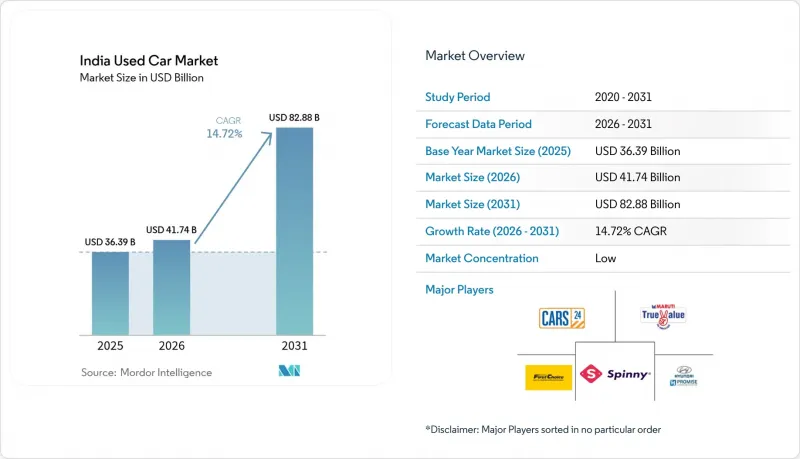
據 Mordor Intelligence 稱,2025 年印度二手車市場價值 363.9 億美元,預計到 2031 年將從 2026 年的 417.4 億美元成長至 828.8 億美元,預測期(2026-2031 年)複合年成長率為 14.72%。
本報告按車輛類型(微型車/掀背車、SUV 等)、供應商類型(OEM 認證特許經銷商等)、燃料類型(汽油、電池式電動車等)、車齡(車齡小於 3 年等)、車主數量(首次購車者等)、變速箱類型(手排、自排)、價格區間和地區進行分類。市場預測以價值(美元)和銷售(輛)表示。
印度二手車市場趨勢與洞察
有組織零售平台和數位零售平台的興起
數位轉型正為以往不透明的市場帶來前所未有的透明度,預計到2030年,正規零售商的市佔率將從30%成長到50%。 Cars24在技術方面投資50億印度盧比,並聘請了100多名技術專家,這表明建立即時評估演算法和維護追蹤系統需要大量的資金投入。 CarTrade Tech每年擁有1.5億不重複訪客,其中90%為自然流量,凸顯了輕資產數位平台模式的擴充性。女性購車者對數位化交易的偏好特別顯著,女性購車者的比例已從2024年第三季的35%成長到目前的46%,其中新德里(NCR)的女性參與率最高,達48%。隨著融資整合變得至關重要,平台整合也在加速推進,目前Cars24 60%的交易都包含嵌入式融資解決方案。在二、三線城市引進科技正在緩解以前有利於當地經銷商的資訊不對稱現象,並透過改進價格發現機制,對市場產生民主化的影響,使買賣雙方都受益。
新車價格飆升,價值迅速貶值
新車價格上漲正從根本上改變印度二手車市場的消費者購買決策。預計2023年二手車銷量將達到517萬輛,到2028年將翻倍,達到1,000萬輛。平均車齡已從6-8年縮短至4-5年,提高了車輛的周轉率,對二手車生態系統產生了正面影響。 Cars24的平均售價已升至55萬盧比,反映了這一優質化趨勢,其中40%的銷量集中在40萬至80萬盧比的價格區間。在這個價格區間,注重成本績效的買家追求的是最大的便利性。供需失衡導致價格每年上漲8-10%,對首次購車者的影響尤其顯著。首次購車者佔所有汽車擁有量的63%,他們的購買力日益受到限制。高階車型的折舊加速最為明顯,技術過時和功能升級加快了更換週期。市場動態表明,二手車正成為汽車擁有的主要途徑,而新車銷售越來越專注於更換,而不是首次購車者。
品質低劣和里程表讀數造假
資訊不對稱仍是市場擴張的主要障礙,品質評估的挑戰在佔市場佔有率70%的非正規市場尤為嚴峻。傳統的檢測方法缺乏標準化,導致消費者不信任,限制了市場參與度,並削弱了授權經銷商的定價權。數位平台正在大力投資標準化檢測流程,例如Cars24實施了200項檢測流程和即時競標機制,以確保價格透明且具競爭力。區塊鏈技術在印度汽車產業的應用有望透過防篡改記錄來緩解可追溯性問題,但與全球汽車製造商相比,其應用仍然有限。品質不透明的問題在車車齡八年的車輛中最為突出,因為評估車輛的機械狀況需要專業知識,而許多買家缺乏這種技能。消費者教育和標準化評級系統正在成為競爭優勢,授權經銷商利用技術來建立信任,並以此證明其高於非授權經銷商的價格是合理的。
細分市場分析
到2025年,微型車/掀背車將佔據33.82%的市場佔有率,這反映了它們作為入門級交通工具的地位。同時,SUV的成長速度最快,2026年至2031年的複合年成長率將達到15.95%,主要得益於消費者對保值性和多功能性的預期。福特翼搏(EcoSport)儘管已於2021年停產,但其經久不衰的受歡迎程度表明,可靠的性能和完善的售後服務網路使得某些車型能夠保持強勁的二手車需求。隨著消費者轉向SUV和掀背車,轎車的受歡迎程度正在下降,傳統的三廂設計對那些更注重離地間隙和載貨空間柔軟性的年輕買家來說也失去了吸引力。多功能車/MPV細分市場則滿足了特定的商業需求和大家庭的需求,在二線城市(大家庭仍然很普遍)保持著穩定的需求。
豪華車和跑車市場受益於大都會圈以身分為導向的購買行為,寶馬、奧迪和賓士等品牌紛紛推出認證二手車項目,以滿足這一需求並維護其品牌價值。這種市場細分反映了汽車行業的更廣泛趨勢:SUV 憑藉更高的燃油效率和更舒適的駕駛體驗,克服了傳統 SUV 的局限性,正逐漸成為各個價位段的主流車型。由於消費者偏好不斷變化,SUV 的市場佔有率預計將持續成長,製造商,尤其是緊湊型和中型 SUV 製造商,正在推出新車型以滿足新車和未來二手的需求。
截至2025年,非正規本地經銷商將維持70.83%的市場佔有率,反映出市場的分散性以及消費者在高價值交易中日益重視人際關係。線上平台成長最快,2026年至2031年的複合年成長率將達到26.85%,這主要得益於更高的透明度和一體化融資模式,以應對二手車交易中的傳統挑戰。原廠認證的特許經銷商專案利用品牌信譽和標準化流程,吸引注重品質、願意為車輛狀況和保固服務支付溢價的買家。大規模品牌線下經銷商則處於中間位置,它們提供的選擇比原廠認證專案更廣泛,同時也具備線上平台無法提供的現場車輛偵測能力。
隨著數位平台公司在技術基礎設施和客戶獲取方面投入巨資,供應商格局正在迅速演變,Cars24 高達 50 億印度盧比的投資清晰地展現了其引領市場所需的資本規模。 CarTrade Tech 每年 1.5 億的不重複訪客(其中 90% 為自然成長用戶)凸顯了數位平台模式的擴充性和高效的客戶獲取能力。由於正規業者在資金籌措、物流和客戶服務方面獲得了非正規經銷商無法比擬的規模經濟效益,市場整合似乎不可避免。然而,考慮到本地經銷商已建立的穩固關係和成本優勢,這項轉型的具體時間表仍存在不確定性。
預計到2025年,汽油動力汽車將主導市場,佔據60.77%的市場。這主要得益於完善的加油基礎設施和消費者對其的熟悉程度。同時,儘管目前電池式電動車(BEV)的基數較低,但預計從2026年到2031年,其複合年成長率將達到驚人的34.10%。然而,電動車的成長軌跡面臨二手車殘值方面的挑戰,51%的電動車車主由於充電焦慮和維護成本,正在考慮轉換購買內燃機車。柴油汽車由於排放氣體法規和高昂的購買成本而逐漸失去市場,但在商業和長途運輸領域仍然具有吸引力。壓縮天然氣(CNG)汽車在已開發市場,尤其是在德里-NCR地區,佔據一定的市場佔有率,並受益於監管支援和成本優勢。
混合動力汽車是一種過渡性技術,它既能提高燃油效率,又能解決續航里程的擔憂,但由於購置成本高且車型選擇有限,其市場滲透率仍然有限。燃料類型的細分反映了印度能源轉型的複雜性,基礎設施的限制和成本考量導致多種可行的動力傳動系統方案並存,而非出現一種明顯的技術贏家。市場動態表明,內燃機汽車在短期內仍將佔據主導地位,而隨著充電基礎設施的擴展和電池成本的下降,電動車的普及速度將會加快。然而,鑑於目前二手車殘值方面的挑戰,轉型的時間表仍存在不確定性。
其他好處:
- Excel格式的市場預測(ME)表
- 3個月的分析師支持
目錄
第1章:引言
- 研究假設和市場定義
- 調查範圍
第2章:調查方法
第3章執行摘要
第4章 市場狀況
- 市場概覽
- 市場促進因素
- 有組織零售平台和數位零售平台的興起
- 新車價格上漲和折舊免稅額加速
- 擴大貸款限額和金融科技貸款
- 從保值角度來看,SUV越來越受歡迎。
- 車輛報廢制度正在加速更換的趨勢。
- 減少出行車隊規模並取消訂閱合約
- 市場限制因素
- 品質低劣和里程表讀數造假
- 車齡超過 8 年的車輛的融資限制
- 更嚴格的排放法規和零排放車輛標準將降低舊內燃機(ICE)車輛的價值。
- 微出行和叫車服務正在降低人們首次購車的需求。
- 價值供應鏈分析
- 監理情勢
- 技術展望
- 波特五力分析
第5章 市場規模與成長預測
- 車輛類型
- 微型/掀背車
- 轎車
- SUV
- MPV
- 豪華轎車和跑車
- 依供應商類型
- OEM認證特許經營
- 線上平台
- 大型多品牌線下經銷商
- 非正式的本地經銷商
- 按燃料類型
- 汽油
- 柴油引擎
- CNG
- 混合
- 電池電量
- 按車輛年份
- 不到3年
- 3-5年
- 6-8歲
- 8年以上
- 依所有權類型
- 第一任車主
- 第二任車主
- 第三任及後續所有者
- 按價格範圍
- 不到30萬盧比
- 30萬至50萬盧比
- 50萬至80萬盧比
- 80萬至120萬盧比
- 超過120萬盧比
- 按變速器類型
- 手動的
- 自動的
- 按地區
- 印度北部
- 西印度群島
- 南印度
- 東印度
- 印度中部
- 印度東北部
第6章 競爭情勢
- 市場集中度
- 策略趨勢
- 市佔率分析
- 公司簡介
- CARS24
- Maruti Suzuki True Value
- Mahindra First Choice Wheels
- Hyundai H Promise
- Honda Auto Terrace
- Toyota U Trust
- Ford Assured
- Big Boy Toyz
- BMW Premium Selection
- Audi Approved Plus
- Mercedes-Benz Certified
- CarTrade Exchange
- OLX Autos
- Spinny
- CarDekho Gaadi
- Droom Auto
- Truebil
- Quikr Cars
- Tata Motors Certified Advantage
- Volkswagen Das WeltAuto
- MG Reassure
- Renault Selection
- Nissan Intelligent Choice
第7章 市場機會與未來展望
According to Mordor Intelligence, the India used car market size was valued at USD 36.39 billion in 2025 and estimated to grow from USD 41.74 billion in 2026 to reach USD 82.88 billion by 2031, at a CAGR of 14.72% during the forecast period (2026-2031).
This report is Segmented by Vehicle Type (Micro/Hatchback, SUV, and More), Vendor Type (OEM-Certified Franchise, and More), Fuel Type (Petrol, Battery-Electric, and More), Vehicle Age (Less Than 3 Years, and More), Ownership Count (First-Owner, and More), Transmission (Manual and Automatic), Price Band, and Region. The Market Forecasts are Provided in Terms of Value (USD) and Volume (Units).
India Used Car Market Trends and Insights
Rise of Organized and Digital Retail Platforms
Digital transformation is creating unprecedented transparency in a traditionally opaque market, with organized retail expected to grow from 30% to 50% market share by 2030. Cars24's INR 5 billion technology investment and hiring of 100+ tech experts demonstrate the capital intensity required to build real-time valuation algorithms and maintenance tracking systems. CarTrade Tech's achievement of 150 million yearly unique users with 90% organic traffic validates the asset-light digital platform model's scalability. The shift toward digital-first transactions is particularly pronounced among women buyers, who now represent 46% of purchases compared to 35% in Q3 FY2024, with Delhi-NCR leading at 48% female participation. Platform consolidation accelerates as financing integration becomes critical, with 60% of Cars24 transactions now including embedded lending solutions. Technology adoption in tier-2 and tier-3 cities reduces information asymmetry that historically favored local dealers, creating market democratization effects that benefit buyers and sellers through improved price discovery mechanisms.
High New-Car Prices and Faster Depreciation
New vehicle pricing pressures fundamentally reshape consumer purchase decisions in the India Used Car Market, with used car sales reaching 5.17 million units in FY23 and projected to double to 10 million by FY28. The average ownership period has contracted from 6-8 to 4-5 years, creating increased supply velocity that benefits the used car ecosystem. Cars24's average selling price increase to INR 5.5 lakh reflects this premium migration, with 40% of sales concentrated in the INR 4-8 lakh range, where value-conscious buyers seek maximum utility. Supply-demand imbalances generate annual price appreciation of 8-10%, particularly affecting first-time buyers who represent 63% of ownership count but face increasing affordability constraints. The depreciation acceleration is most pronounced in premium segments, where technology obsolescence and feature updates drive faster replacement cycles. Market dynamics suggest that used cars are becoming the primary entry point for vehicle ownership, with new car sales increasingly concentrated among replacement buyers rather than first-time purchasers.
Quality Opacity and Odometer Fraud
Information asymmetry remains the primary barrier to market expansion, with quality assessment challenges particularly acute in the unorganized segment that controls 70% of the market share. Traditional inspection methods lack standardization, creating consumer distrust that limits market participation and constrains pricing power for legitimate dealers. Digital platforms are investing heavily in standardized inspection protocols, with Cars24 implementing 200-point inspection processes and live auction mechanisms to ensure competitive pricing transparency. Blockchain technology adoption in the Indian automotive industry could address traceability concerns through immutable record-keeping, though implementation remains limited compared to global automotive giants. The quality opacity problem is most pronounced in vehicles over 8 years old, where mechanical condition assessment requires specialized expertise that many buyers lack. Consumer education and standardized grading systems are emerging as competitive differentiators, with organized players leveraging technology to build trust and justify premium pricing over unorganized alternatives.
Other drivers and restraints analyzed in the detailed report include:
- Expanding Credit Availability and Fintech Lending
- Growing Preference for SUVs in Value-Retention
- Limited Financing for More Than 8-Year-Old Vehicles
For complete list of drivers and restraints, kindly check the Table Of Contents.
Segment Analysis
Micro/hatchbacks command 33.82% market share in 2025, reflecting their role as entry-level mobility solutions, while SUVs demonstrate the fastest growth at 15.95% CAGR (2026-2031), driven by value retention perceptions and versatility demands. The Ford EcoSport's continued popularity despite production discontinuation in 2021 illustrates how certain models maintain strong resale demand due to proven reliability and service network availability. Sedans face declining preference as consumers migrate toward SUVs and hatchbacks, with traditional three-box designs losing appeal among younger buyers who prioritize ground clearance and cargo flexibility. MUV/MPV segments serve niche commercial and large family requirements, maintaining steady demand in tier-2 cities where joint family structures remain prevalent.
Luxury and sports car segments benefit from aspirational purchasing in metro cities, with brands like BMW, Audi, and Mercedes-Benz establishing certified pre-owned programs to capture this demand while maintaining brand equity. The segmentation reflects broader automotive trends where SUVs are becoming the dominant body style across price points, supported by improved fuel efficiency and ride quality that address traditional SUV limitations. Consumer preference evolution suggests continued SUV market share expansion, particularly in compact and mid-size categories, where manufacturers are launching new models to capture both new and eventual used car demand.
Unorganized local dealers maintain 70.83% market share in 2025, reflecting the market's fragmented nature and consumers' preference for personal relationships in high-value transactions. Online platforms achieve the fastest growth at 26.85% CAGR (2026-2031), driven by transparency initiatives and financing integration that address traditional pain points in used car transactions. OEM-certified franchise programs leverage brand trust and standardized processes to capture quality-conscious buyers willing to pay premiums for assured vehicle condition and warranty coverage. Large multi-brand offline dealers occupy the middle ground, offering a wider selection than OEM programs while providing physical inspection capabilities that online platforms cannot match.
The vendor landscape is experiencing rapid evolution as digital platforms invest heavily in technology infrastructure and customer acquisition, with Cars24's INR 5 billion investment demonstrating the capital requirements for market leadership. CarTrade Tech's 150 million yearly unique users with 90% organic traffic validate the digital platform model's scalability and customer acquisition efficiency. Market consolidation appears inevitable as organized players gain scale advantages in financing, logistics, and customer service that unorganized dealers cannot match. However, the transition timeline remains uncertain given local dealers' embedded relationships and cost advantages.
Petrol vehicles dominate with a 60.77% market share in 2025, benefiting from widespread refueling infrastructure and consumer familiarity, while battery-electric vehicles demonstrate an exceptional 34.10% CAGR (2026-2031) despite a current low base. The EV growth trajectory faces headwinds from resale value concerns, with 51% of EV owners considering switching to ICE vehicles due to charging anxiety and maintenance costs. Diesel vehicles face declining preference due to emission norms and higher acquisition costs, though they maintain appeal in commercial applications and long-distance usage scenarios. CNG vehicles occupy a niche position in markets with established infrastructure, particularly in Delhi-NCR, where regulatory support and cost advantages drive adoption.
Hybrid vehicles represent a transitional technology that addresses range anxiety while providing fuel efficiency benefits, though market penetration remains limited due to higher acquisition costs and limited model availability. The fuel type segmentation reflects India's energy transition complexity, where infrastructure limitations and cost considerations create multiple viable powertrain options rather than clear technology winners. Market dynamics suggest continued ICE dominance in the near term, with electric vehicle adoption accelerating as charging infrastructure expands and battery costs decline. However, the transition timeline remains uncertain given the challenges of the current resale value.
Complete Report Scope:
- By Vehicle Type
- Micro/Hatchback
- Sedan
- Sport Utility Vehicle
- Multi-Purpose Vehicle
- Luxury and Sports
- By Vendor Type
- OEM-Certified Franchise
- Online Platforms
- Large Multi-brand Offline Dealers
- Unorganized Local Dealers
- By Fuel Type
- Petrol
- Diesel
- CNG
- Hybrid
- Battery-Electric
- By Vehicle Age
- Less than 3 Years
- 3 to 5 Years
- 6 to 8 Years
- More than 8 Years
- By Ownership Count
- First-Owner
- Second-Owner
- Third-Owner and Above
- By Price Band
- Less than ₹3 lakh
- ₹3 to ₹5 lakh
- ₹5 to ₹8 lakh
- ₹8 to ₹12 lakh
- More than ₹12 lakh
- By Transmission
- Manual
- Automatic
- By Region
- North India
- West India
- South India
- East India
- Central India
- North-East India
List of Companies Covered in this Report:
- CARS24
- Maruti Suzuki True Value
- Mahindra First Choice Wheels
- Hyundai H Promise
- Honda Auto Terrace
- Toyota U Trust
- Ford Assured
- Big Boy Toyz
- BMW Premium Selection
- Audi Approved Plus
- Mercedes-Benz Certified
- CarTrade Exchange
- OLX Autos
- Spinny
- CarDekho Gaadi
- Droom Auto
- Truebil
- Quikr Cars
- Tata Motors Certified Advantage
- Volkswagen Das WeltAuto
- MG Reassure
- Renault Selection
- Nissan Intelligent Choice
Additional Benefits:
- The market estimate (ME) sheet in Excel format
- 3 months of analyst support
TABLE OF CONTENTS
1 Introduction
- 1.1 Study Assumptions and Market Definition
- 1.2 Scope of the Study
2 Research Methodology
3 Executive Summary
4 Market Landscape
- 4.1 Market Overview
- 4.2 Market Drivers
- 4.2.1 Rise of organised and digital retail platforms
- 4.2.2 High new-car prices and faster depreciation
- 4.2.3 Expanding credit availability and fintech lending
- 4.2.4 Growing preference for SUVs in value-retention
- 4.2.5 Vehicle-scrappage policy accelerating turnover
- 4.2.6 Mobility-fleet de-fleeting and subscription returns
- 4.3 Market Restraints
- 4.3.1 Quality opacity and odometer fraud
- 4.3.2 Limited financing for more than 8-year-old vehicles
- 4.3.3 Stricter emission / ZEV norms devaluing older ICE stock
- 4.3.4 Micro-mobility and ride-hailing reducing first-car demand
- 4.4 Value / Supply-Chain Analysis
- 4.5 Regulatory Landscape
- 4.6 Technological Outlook
- 4.7 Porter's Five Forces Analysis
- 4.7.1 Threat of New Entrants
- 4.7.2 Bargaining Power of Buyers
- 4.7.3 Bargaining Power of Suppliers
- 4.7.4 Threat of Substitutes
- 4.7.5 Intensity of Competitive Rivalry
5 Market Size and Growth Forecasts (Value (USD) and Volume (Units))
- 5.1 By Vehicle Type
- 5.1.1 Micro/Hatchback
- 5.1.2 Sedan
- 5.1.3 Sport Utility Vehicle
- 5.1.4 Multi-Purpose Vehicle
- 5.1.5 Luxury and Sports
- 5.2 By Vendor Type
- 5.2.1 OEM-Certified Franchise
- 5.2.2 Online Platforms
- 5.2.3 Large Multi-brand Offline Dealers
- 5.2.4 Unorganized Local Dealers
- 5.3 By Fuel Type
- 5.3.1 Petrol
- 5.3.2 Diesel
- 5.3.3 CNG
- 5.3.4 Hybrid
- 5.3.5 Battery-Electric
- 5.4 By Vehicle Age
- 5.4.1 Less than 3 Years
- 5.4.2 3 to 5 Years
- 5.4.3 6 to 8 Years
- 5.4.4 More than 8 Years
- 5.5 By Ownership Count
- 5.5.1 First-Owner
- 5.5.2 Second-Owner
- 5.5.3 Third-Owner and Above
- 5.6 By Price Band
- 5.6.1 Less than ₹3 lakh
- 5.6.2 ₹3 to ₹5 lakh
- 5.6.3 ₹5 to ₹8 lakh
- 5.6.4 ₹8 to ₹12 lakh
- 5.6.5 More than ₹12 lakh
- 5.7 By Transmission
- 5.7.1 Manual
- 5.7.2 Automatic
- 5.8 By Region
- 5.8.1 North India
- 5.8.2 West India
- 5.8.3 South India
- 5.8.4 East India
- 5.8.5 Central India
- 5.8.6 North-East India
6 Competitive Landscape
- 6.1 Market Concentration
- 6.2 Strategic Moves
- 6.3 Market Share Analysis
- 6.4 Company Profiles (includes Global Level Overview, Market Level Overview, Core Segments, Financials as Available, Strategic Information, Market Rank/Share for Key Companies, Products and Services, SWOT Analysis, and Recent Developments)
- 6.4.1 CARS24
- 6.4.2 Maruti Suzuki True Value
- 6.4.3 Mahindra First Choice Wheels
- 6.4.4 Hyundai H Promise
- 6.4.5 Honda Auto Terrace
- 6.4.6 Toyota U Trust
- 6.4.7 Ford Assured
- 6.4.8 Big Boy Toyz
- 6.4.9 BMW Premium Selection
- 6.4.10 Audi Approved Plus
- 6.4.11 Mercedes-Benz Certified
- 6.4.12 CarTrade Exchange
- 6.4.13 OLX Autos
- 6.4.14 Spinny
- 6.4.15 CarDekho Gaadi
- 6.4.16 Droom Auto
- 6.4.17 Truebil
- 6.4.18 Quikr Cars
- 6.4.19 Tata Motors Certified Advantage
- 6.4.20 Volkswagen Das WeltAuto
- 6.4.21 MG Reassure
- 6.4.22 Renault Selection
- 6.4.23 Nissan Intelligent Choice
7 Market Opportunities and Future Outlook
- 7.1 White-space and Unmet-Need Assessment

 二手車市場-2026-2032年全球市場預測
 日本二手車市場:市佔率分析、產業趨勢與統計及成長預測(2026-2031)美國二手車市場:市場佔有率分析、產業趨勢與統計及成長預測(2026-2031)泰國二手車市場:市場佔有率分析、產業趨勢與統計及成長預測(2026-2031)
 二手車交易服務市場:依車輛類型、燃料類型、銷售管道、銷售形式及地區分類。
 二手電動車市場規模、佔有率和成長分析:按車輛類型、驅動方式、年份、續航里程、電池狀況、電池容量和地區分類-2026-2033年產業預測
 2026-2030年全球二手車市場二手車市場:依供應商、車款、銷售管道、地區分類
 全球二手車市場規模、佔有率、趨勢和成長分析報告(2026-2034)
 二手半拖車市場分析及預測(至2035年):按類型、產品類型、服務、技術、組件、應用、流程及最終用戶二手