


 |
市場調查報告書
商品編碼
2073584
泰國二手車市場:市場佔有率分析、產業趨勢與統計及成長預測(2026-2031)Thailand Used Car - Market Share Analysis, Industry Trends & Statistics, Growth Forecasts (2026 - 2031) |
||||||

※ 本網頁內容可能與最新版本有所差異。詳細情況請與我們聯繫。
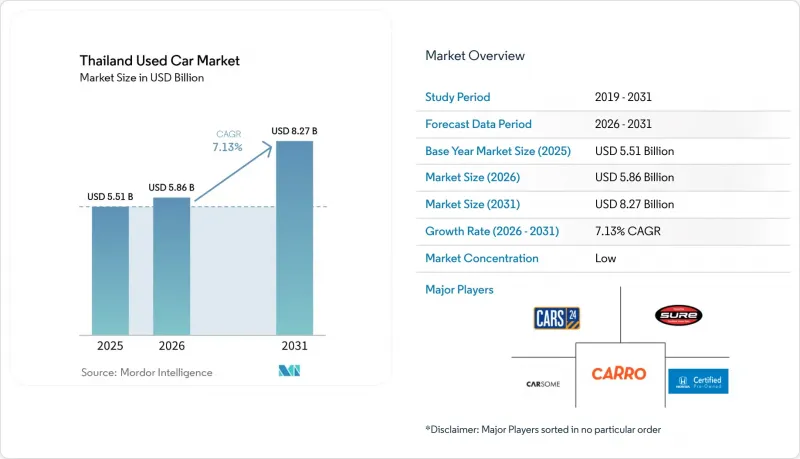
據 Mordor Intelligence 稱,2025 年泰國二手車市場價值為 55.1 億美元,預計到 2031 年將從 2026 年的 58.6 億美元成長至 82.7 億美元,預測期(2026-2031 年)複合年成長率為 7.13%。
本報告按車輛類型(掀背車、轎車等)、燃料類型(汽油、柴油、混合動力汽車、電動、其他)、購買方式(線上和線下)、銷售商類型(正規銷售商和非正規銷售商)、車齡(0-2年、3-8年、8年以上)和價格區間進行細分。市場預測以貨幣價值(美元)和銷售(輛)兩種形式呈現。
泰國二手車市場趨勢與洞察
在經濟逆風之下,注重成本的消費者
由於家庭債務接近歷史最高水平,貸款拒貸率居高不下,消費者擴大轉向價格實惠的二手車。這些車輛通常車齡較長,可靠性高,不像新車那樣貶值迅速。近期,房屋法拍數量顯著增加,使得經銷商能夠以低於疫情前的價格購入庫存。這些成本節約最終惠及了消費者。皮卡車的銷售量大幅下滑,導致市場供應過剩,使得本地企業能夠以更低的價格購入皮卡車。泰國銀行的二手車價格指數顯示,二手車價格已顯著回升,這表明如果新車產量恢復緩慢,二手車供應將會趨緊。這種逆勢而行的趨勢凸顯了泰國二手車市場在普遍經濟壓力下所扮演的「安全閥」角色。
數位二手車交易平台快速發展
近年來,線上通路的交易量已佔據主導地位,且成長速度遠超線下通路。 Krungsri Auto旗下的「GO Auto Station」擁有大量車輛庫存,並透過其「PromptStart」快速貸款核准流程提供便利服務,同時還提供保險續保、保養預約等整合服務,所有服務均可透過應用程式完成。過去一年,該平台的每月有效用戶數量顯著成長,鞏固了Krungsri Auto在泰國國內二手車金融市場的領先地位。引入虛擬檢測流程和標準化評級,有效降低了里程表造假風險,並與泰國行動購物者熟悉的信任機制相契合,他們早已習慣使用智慧型手機進行購物。隨著網路普及率的不斷提高,數位市場的影響力正從曼谷擴展到周邊地區城市。
假汽車和非法進口汽車
規避泰國工業標準協會 (TISI) 認證的灰色市場車輛不僅會削弱買家的信心,還可能導致車輛註冊被拒,並增加車主為符合安全法規而進行改裝的費用。儘管執法力度正在加強,但大多數交易仍透過監管不力的非正規管道進行。對不合規車輛心存疑慮的買家可能會推遲購車或選擇經過認證的平台,這可能會降低泰國二手車市場的整體需求。合規成本雖然有利於授權經銷商,但也推高了交易成本,並可能抑制價格敏感型細分市場的需求。
細分市場分析
2025年,運動型多用途車(SUV)和多用途車(MPV)的銷量佔比達到37.81%,預計到2031年,該細分市場的複合年成長率將達到7.15%。泰國二手車市場的佔有率正向內部空間寬敞、座椅佈局靈活的車型轉變,這反映了人口結構的變化,例如核心家庭的興起以及人們對商務和私人用途車輛的需求。雖然隨著跨界車燃油效率的提升,轎車的市佔率有所萎縮,但掀背車在停車位有限的都市區仍保持著一定的市場需求。由於2024年新車進口量下降25%以及認證二手車殘值增加,豪華車的供應仍然較為緊張,因此其市場佔有率仍然較小。
該細分市場的強勁勢頭源於其廣泛的實用性。家庭用戶平日用車通勤,週末出行,而中小企業則將多用途車改裝用於輕型貨物運輸。租賃期滿的國產SUV正成為新的供應來源,但經銷商對殘值估價仍持謹慎態度。皮卡單獨統計後,在2024年10月銷量暴跌41.6%之後,需求出現了外溢效應,供應轉向農村市場。政府對皮卡貸款的擔保或許能夠穩定這種外溢效應,但其有效性仍有待驗證。
預計到2025年,汽油車在泰國二手車交易中佔比63.47%,但電池式電動車(BEV)預計將以7.24%的複合年成長率(CAGR)實現最快成長,直至2031年。由於歐盟5排放法規帶來的合規成本增加,柴油車的市場佔有率正在下降,而混合動力汽車正成為關注續航里程的購車者的折衷方案。隨著2025年前七個月新註冊的電動車開始進入二手車市場,泰國二手車市場中純電動車的市場規模預計將從小規模的基數擴大。比亞迪位於羅勇府的工廠以及政府的「電動車3.0」獎勵(將持續到2026年)將為未來的供應提供支持。
補貼到期後,電動車消費稅的小幅上調可能會減緩新進業者的速度,並維持汽油車的市場主導地位。液化石油氣和壓縮天然氣汽車的市場仍處於小眾階段,受到TIS 3055-2563法規合規成本的限制。儘管電池健康狀況的持續不確定性限制了電動車的流動性,但建立標準化的評級體係可能會加速其普及化。
其他好處:
- Excel格式的市場預測(ME)表
- 3個月的分析師支持
目錄
第1章:引言
- 研究假設和市場定義
- 調查範圍
第2章:調查方法
第3章執行摘要
第4章 市場狀況
- 市場概覽
- 市場促進因素
- 經濟逆風下的對價格敏感的消費者
- 數位二手車交易平台的快速崛起
- 多種型號,滿足不同價位需求。
- 基於使用量的保險和金融科技貸款提供了價格合理的選擇。
- 擴大原廠支援的認證二手車項目
- 以前由已返回本國的外國居住者擁有的車輛正在擴大供應來源。
- 市場限制因素
- 利用人工智慧進行更嚴格的信用評分將限制汽車貸款。
- 車輛歷史記錄不完整且里程表被竄改。
- 假汽車和非法進口汽車
- 二手電動車和混合動力汽車電池狀況的不確定性
- 價值供應鏈分析
- 監理情勢
- 技術展望
- 波特五力模型
第5章 市場規模與成長預測
- 車輛類型
- 掀背車
- 轎車
- 運動型多用途車與多用途車
- 豪華轎車
- 按燃料類型
- 汽油
- 柴油引擎
- 混合動力汽車
- 電池式電動車
- 其他
- 按預訂類型
- 線上
- 離線
- 供應商
- 按分類
- 非組織性的
- 車輛年份
- 0-2歲
- 3-8歲
- 8年以上
- 價格範圍(美元)
- 不足10,000
- 10,001~20,000
- 超過20000
第6章 競爭情勢
- 市場集中度
- 策略趨勢
- 市佔率分析
- 公司簡介
- Carsome Thailand
- CARS24 Thailand
- Carro Thailand
- Toyota Sure
- Honda Certified Used Car
- iCarAsia/One2Car
- SiamMotorworld
- Motors.co.th
- Chobrod.com
- Fast2car.com
- GuruCar Thailand
第7章 市場機會與未來展望
According to Mordor Intelligence, the thailand used car market size was valued at USD 5.51 billion in 2025 and estimated to grow from USD 5.86 billion in 2026 to reach USD 8.27 billion by 2031, at a CAGR of 7.13% during the forecast period (2026-2031).
This report is Segmented by Vehicle Type (Hatchbacks, Sedans, and More), Fuel Type (Petrol, Diesel, Hybrid Electric, Battery Electric, and Others), Booking Type (Online and Offline), Vendor Type (Organized and Unorganized), Vehicle Age (0-2 Years, 3-8 Years, and More Than 8 Years), and Price Band. The Market Forecasts are Provided in Terms of Value (USD) and Volume (Units).
Thailand Used Car Market Trends and Insights
Cost-Conscious Consumers Amid Economic Headwinds
With household debt nearing record highs and loan rejection rates remaining significantly high, consumers are increasingly turning to affordable pre-owned vehicles. These are often several years old, providing reliability without the steep depreciation of new cars. In recent times, repossessions have risen considerably, allowing dealers to stock up at lower prices compared to pre-pandemic levels, a saving they readily passed on to buyers. Sales of pickups have seen a substantial decline, flooding the market with trucks now available to rural operators at more accessible prices. The Bank of Thailand's Used Vehicle Price Index has shown a notable rebound, hinting at a tighter supply once new-car production sees a modest recovery. This counter-cyclical trend underscores the Thai used car market's role as a safety valve during broader economic stresses .
Rapid Rise of Digital Used-Car Marketplaces
In recent years, online channels have accounted for a significant portion of trades and are growing at a faster pace compared to offline channels. Krungsri Auto's GO Auto Station features a vast inventory of vehicles, offers quick loan approvals through its PromptStart workflow, and provides integrated services such as insurance renewal and maintenance scheduling within the app. Over the past year, the platform has seen a notable increase in monthly active users, solidifying the bank's position as a leader in the national used-car finance market. The adoption of virtual inspection protocols and standardized grading has effectively reduced odometer fraud risks, aligning with the trust mechanisms familiar to Thai mobile shoppers, most of whom already make purchases via smartphones. With a large portion of the population now online, the digital landscape is expanding its influence beyond Bangkok into secondary cities .
Counterfeit and Illegally Imported Vehicles
Gray-market cars that bypass Thai Industrial Standards Institute (TISI) certification erode buyer trust, expose owners to the risk of registration denial, and impose retrofitting costs to meet safety regulations. Enforcement has tightened, yet the majority of trade still runs through unorganized vendors where oversight is weak. Buyers wary of non-compliant units may delay purchases or default to certified platforms, trimming overall demand in the Thailand used car market. Compliance burdens favor organized dealers but also raise transaction expenses that can dampen price-sensitive segments.
Other drivers and restraints analyzed in the detailed report include:
- Expansion of OEM-Backed Certified-Pre-Owned Programs
- Repatriated Expat-Owned Vehicles Enlarging Supply Pool
- Battery-Health Uncertainty in Used EVs and Hybrids
For complete list of drivers and restraints, kindly check the Table Of Contents.
Segment Analysis
Sport utility vehicles and multi-purpose vehicles accounted for 37.81% of 2025 volume, and this cohort is forecast to post a 7.15% CAGR through 2031. The Thailand used car market share tilted toward spacious cabins and flexible seating, reflecting demographic shifts toward nuclear families and dual-use business needs. Sedans surrendered ground as crossovers deliver comparable fuel economy, and hatchbacks retain urban niches where parking is scarce. Luxury cars remain a thin slice after new-vehicle imports fell 25% in 2024, tightening supply and elevating certified residuals.
Resilience in this segment arises from broad utility: families commute during the week and travel on weekends, while SMEs repurpose multi-purpose vehicles for light cargo. Chinese-brand sport utility vehicles entering off-lease cycles add fresh stock, though dealers still price residuals cautiously. Pickup trucks, counted separately, overflow into this demand after the 41.6% sales collapse in October 2024, supplying rural buyers. Government guarantees for pickup loans could stabilize this spill-over, but remain untested.
Petrol models accounted for 63.47% of trades in 2025, yet battery electric vehicles are the fastest climber at a 7.24% CAGR through 2031. Diesel share is tapering as Euro-5 rules raise compliance costs, while hybrids fill a middle ground for buyers wary of range anxiety. The Thailand used car market size for BEVs will grow off a small base, as new electric vehicle registrations in the first seven months of 2025 begin flowing into trade-ins. BYD's Rayong factory and government EV 3.0 incentives until 2026 underpin future supply.
Excise tax hikes on BEVs slightly after subsidies expire could slow fresh entries and keep petrol leadership intact. LPG and CNG conversions remain niche, handicapped by retrofit compliance costs under TIS 3055-2563. Persistent uncertainty about battery health tempers battery electric vehicle liquidity; however, the development of standardized grading would accelerate adoption.
Complete Report Scope:
- By Vehicle Type
- Hatchbacks
- Sedans
- Sport Utility Vehicle and Multi-Purpose Vehicle
- Luxury Cars
- By Fuel Type
- Petrol
- Diesel
- Hybrid Electric
- Battery Electric
- Others
- By Booking Type
- Online
- Offline
- By Vendor Type
- Organized
- Unorganized
- By Vehicle Age
- 0 - 2 Years
- 3 - 8 Years
- More than 8 Years
- By Price Band (USD)
- Less than 10,000
- 10,001 - 20,000
- More than 20,000
List of Companies Covered in this Report:
- Carsome Thailand
- CARS24 Thailand
- Carro Thailand
- Toyota Sure
- Honda Certified Used Car
- iCarAsia / One2Car
- SiamMotorworld
- Motors.co.th
- Chobrod.com
- Fast2car.com
- GuruCar Thailand
Additional Benefits:
- The market estimate (ME) sheet in Excel format
- 3 months of analyst support
TABLE OF CONTENTS
1 Introduction
- 1.1 Study Assumptions and Market Definition
- 1.2 Scope of the Study
2 Research Methodology
3 Executive Summary
4 Market Landscape
- 4.1 Market Overview
- 4.2 Market Drivers
- 4.2.1 Cost-Conscious Consumers Amid Economic Headwinds
- 4.2.2 Rapid Rise of Digital Used-Car Marketplaces
- 4.2.3 Diverse Model Availability Across Price-Points
- 4.2.4 Usage-Based Insurance and Fintech Lending Boosting Affordability
- 4.2.5 Expansion of OEM-Backed Certified-Pre-Owned Programmes
- 4.2.6 Repatriated Expat-Owned Vehicles Enlarging Supply Pool
- 4.3 Market Restraints
- 4.3.1 Stricter AI-Driven Credit-Scoring Limiting Auto Loans
- 4.3.2 Fragmented Vehicle-History and Odometer Fraud
- 4.3.3 Counterfeit and Illegally Imported Vehicles
- 4.3.4 Battery-Health Uncertainty in Used EVs and Hybrids
- 4.4 Value / Supply-Chain Analysis
- 4.5 Regulatory Landscape
- 4.6 Technological Outlook
- 4.7 Porter's Five Forces
- 4.7.1 Bargaining Power of Suppliers
- 4.7.2 Bargaining Power of Buyers
- 4.7.3 Threat of New Entrants
- 4.7.4 Threat of Substitutes
- 4.7.5 Competitive Rivalry
5 Market Size and Growth Forecasts (Value (USD) and Volume (Units))
- 5.1 By Vehicle Type
- 5.1.1 Hatchbacks
- 5.1.2 Sedans
- 5.1.3 Sport Utility Vehicle and Multi-Purpose Vehicle
- 5.1.4 Luxury Cars
- 5.2 By Fuel Type
- 5.2.1 Petrol
- 5.2.2 Diesel
- 5.2.3 Hybrid Electric
- 5.2.4 Battery Electric
- 5.2.5 Others
- 5.3 By Booking Type
- 5.3.1 Online
- 5.3.2 Offline
- 5.4 By Vendor Type
- 5.4.1 Organized
- 5.4.2 Unorganized
- 5.5 By Vehicle Age
- 5.5.1 0 - 2 Years
- 5.5.2 3 - 8 Years
- 5.5.3 More than 8 Years
- 5.6 By Price Band (USD)
- 5.6.1 Less than 10,000
- 5.6.2 10,001 - 20,000
- 5.6.3 More than 20,000
6 Competitive Landscape
- 6.1 Market Concentration
- 6.2 Strategic Moves
- 6.3 Market Share Analysis
- 6.4 Company Profiles (Includes Global Level Overview, Market Level Overview, Core Segments, Financials as Available, Strategic Information, Market Rank/Share for Key Companies, Products and Services, SWOT Analysis, and Recent Developments)
- 6.4.1 Carsome Thailand
- 6.4.2 CARS24 Thailand
- 6.4.3 Carro Thailand
- 6.4.4 Toyota Sure
- 6.4.5 Honda Certified Used Car
- 6.4.6 iCarAsia / One2Car
- 6.4.7 SiamMotorworld
- 6.4.8 Motors.co.th
- 6.4.9 Chobrod.com
- 6.4.10 Fast2car.com
- 6.4.11 GuruCar Thailand
7 Market Opportunities and Future Outlook
- 7.1 White-space and Unmet-need Assessment

 二手車交易服務市場:依車輛類型、燃料類型、銷售管道、銷售形式及地區分類。
 二手電動車市場規模、佔有率和成長分析:按車輛類型、驅動方式、年份、續航里程、電池狀況、電池容量和地區分類-2026-2033年產業預測
 2026-2030年全球二手車市場二手車市場:依供應商、車款、銷售管道、地區分類
 二手車市場:2026-2032年全球市場預測(按車輛類型、燃料類型、年份、變速箱類型、所有權、用途和銷售管道)
 全球二手車市場規模、佔有率、趨勢和成長分析報告(2026-2034)
 二手半拖車市場分析及預測(至2035年):按類型、產品類型、服務、技術、組件、應用、流程及最終用戶二手
 東南亞二手車市場:市場佔有率分析、產業趨勢與統計、成長預測(2026-2031)越南二手車市場:市場佔有率分析、產業趨勢與統計、成長預測(2026-2031)非洲二手車市場:市場佔有率分析、產業趨勢與統計、成長預測(2026-2031年)