


 |
市場調查報告書
商品編碼
2100284
馬來西亞超大規模資料中心:市場佔有率分析、產業趨勢與統計及成長預測(2025-2030 年)Malaysia Hyperscale Data Center - Market Share Analysis, Industry Trends & Statistics, Growth Forecasts (2025 - 2030) |
||||||

※ 本網頁內容可能與最新版本有所差異。詳細情況請與我們聯繫。
據 Mordor Intelligence 稱,馬來西亞超大規模資料中心市場在 2025 年的價值為 60.3 億美元,預計到 2031 年將達到 401.6 億美元,複合年成長率為 37.15%。
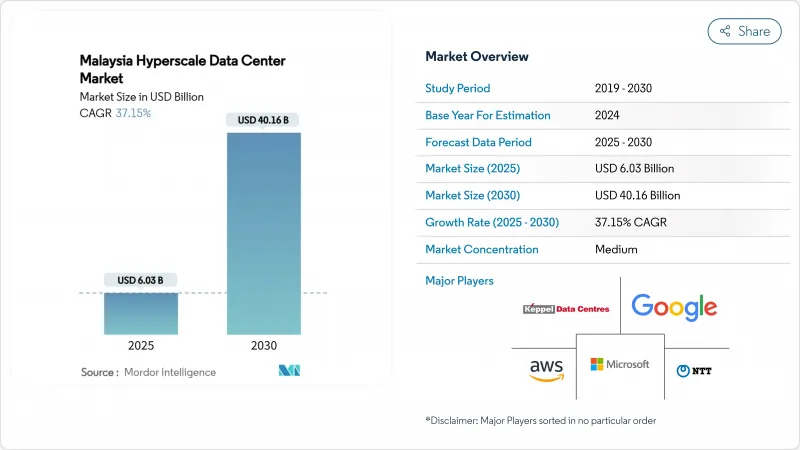
本報告按資料中心類型(超大規模自建、超大規模託管)、元件(IT基礎設施、電力基礎設施、其他)、等級標準(Tier III、Tier IV)、最終用戶產業(雲端/IT服務、電信、其他)以及資料中心規模(大型:25兆瓦以下、其他)進行細分。市場規模和預測均以美元計價。
馬來西亞超大規模資料中心市場趨勢與洞察
超大規模資料中心業者宣布的資本支出(CAPEX)激增正在推動市場擴張。
憑藉谷歌、AWS、甲骨文和微軟前所未有的147億美元投資計劃,馬來西亞的超大規模資料中心市場在短短18個月內就確立了其作為區域領先樞紐的地位。這些投資遠超新加坡過去十年累積的總投資額,並帶動了電力分配設備、液冷系統和園區區間光纖環網等領域的同步投資。四大巨頭之間的競爭正在提升設計標準,並推動建造超過300兆瓦的人工智慧訓練叢集園區。從開關設備到冷水模組,各級供應商正在加速在馬來西亞的業務擴張,從而強化了該領域的良性循環供應鏈。
電子商務和數位銀行的轉型正在加速雲端運算的普及。
2025年,在電子商務需求高峰和新核准的數位銀行(要求延遲低於10毫秒)的推動下,數位經濟產出預計將超過國內生產總值的25%。諸如「雙十一」和「雙十二」之類的購物節已將交易量推至只有超大規模資料中心才能處理的水平,而TikTok Shops在區域內的快速成長凸顯了人工智慧驅動的內容審核節點的重要性。 GXBank等數位銀行申請者引用了Tier IV標準對不間斷帳簿處理的要求。儘管5G貨幣化尚未達到預期,但未來與該國獨立組網5G部署相關的邊緣區域有望提高分散式叢集的整體利用率。
可再生能源供不應求限制了超大規模資料中心業者。
併入電網的可再生能源僅佔該國總發電量的19%,遠低於超大規模資料中心業者設定的「100%碳中和」目標。煤炭和天然氣仍佔電力供應的81%,儘管「綠色電力價格體系」將於2024年推出,但購電協議(PPA)的簽訂仍有限。國家能源公司(Tenaga Nacional Belhad)斥資103億美元打造的電網現代化計畫旨在進一步整合可再生能源,但其進度可能無法滿足2026-2027年新增人工智慧工作負載的需求。砂拉越的剩餘水力發電或許可以作為一種替代方案,但向馬來半島負載中心輸送電力的瓶頸問題仍未解決。
細分市場分析
2024年,自建園區佔據了馬來西亞超大規模資料中心市場佔有率的55%,因為超大規模資料中心超大規模資料中心業者優先考慮客製化佈局以及對機電管道(MEP)系統的直接控制。谷歌在巴生谷投資20億美元的園區以及AWS承諾投資62億美元建造三個可用區,都支撐了馬來西亞超大規模資料中心市場中自建計畫的規模。甲骨文公司65億美元的投資承諾進一步鞏固了這個模式,吸引了關鍵租戶,這些租戶利用這些園區升級了上游配電設施。然而,自建工程也面臨土地稀缺和併網前置作業時間長等挑戰。
託管資料中心以38.4%的複合年成長率快速擴張,透過共用電力和冷卻模組,實現了服務的快速部署。普林斯頓數位集團位於柔佛州的150兆瓦人工智慧賦能型JH1園區,展示了大規模託管資料中心如何確保綠色融資符合超大規模資料中心業者的永續性要求。 Digital Edge和STT GDC正在利用多租戶成本攤銷,並大規模部署浸沒式冷卻機架。儘管由於對人工智慧推理區域的需求增加以及資本預算柔軟性提高,預計2025年至2031年間,本地部署的佔有率將會下降,但預計這兩種模式將在所有工作負載層級上繼續共存。
到2024年,IT堆疊(伺服器、儲存和網路)將佔總支出的40%,這主要得益於高密度GPU節點和支援人工智慧及高頻分析的400G/800G交換器。馬來西亞的超大規模資料中心市場正受惠於持久記憶體的普及,以降低尖峰負載的讀取延遲。在電力系統這一第二大成本組成部分中,模組化和容器化UPS串聯方案的採用率不斷提高,以縮短建設週期。
由於功率超過 70 kW 的機架需要液冷和單相浸沒式冷卻解決方案,機械基礎設施的成長速度最快,複合年成長率高達 38.1%。營運商正在測試和部署「直接到終端」冷板迴路,該迴路可將設施的 PUE 降低高達 0.15 個百分點。永續金屬雲公司在對比測試中證明了其節能效果高達 50%,其他公司也正在轉向類似的設計。隨著機械設備資本投資的增加,延長設備使用壽命的策略,例如砂拉越水力發電廠園區採用的無冷媒隔熱系統,正日益受到關注。
其他好處
- Excel格式的市場預測(ME)表
- 3個月的分析師支持
目錄
第1章:引言
- 研究假設和市場定義
- 調查範圍
第2章:調查方法
第3章執行摘要
第4章 市場狀況
- 市場概覽
- 市場促進因素
- 超大規模資料中心業者(AWS、微軟、Google)宣布的資本支出(CAPEX)激增
- 電子商務和數位銀行的快速發展對低延遲雲端區域提出了更高的要求。
- 政府透過「MyDIGITAL」和「免稅綠色通道」計畫提供激勵措施。
- 新的國際海底光纜的鋪設正在推動頻寬多樣化。
- 一個能夠實現全天候可再生能源購電協議的綠色電力定價系統(媒體報告不足)
- 沙撈越和沙巴的水力發電過剩,導致東馬各校區的PUE(電力使用效率)降低(相關通報不足)。
- 市場限制因素
- 將有限的併網可再生能源與超大規模企業的永續性目標進行比較。
- 由於進口機電設備和地價飛漲,導致建設成本高。
- 雪蘭莪州缺水限制了蒸發冷卻系統的部署(相關報告不足)。
- 5G DWN 貨幣化速度緩慢,阻礙了邊緣資料中心的利用(報告不足)。
- 價值供應鏈分析
- 技術展望
第5章:在超大規模資料中心實施人工智慧(AI)(子章節可能會根據資料可用性而有所變化)
- 人工智慧工作負載的影響:高密度GPU機架的興起和高熱負載的管理
- 快速過渡到 400G 和 800G 以太網,以及與本地 OEM 整合和相容性的需求。
- 液冷技術創新:浸沒式冷卻和冷板的發展趨勢
- 雲端供應商在實施人工智慧驅動的資料中心管理 (DCIM) 中的作用。
第6章:監理與合規框架
第7章 資料中心關鍵統計數據
- 馬來西亞現有超大規模資料中心設施(單位:兆瓦)(超大規模自建資料中心與託管資料中心)
- 馬來西亞計劃建造的超大規模資料中心清單
- 馬來西亞超大規模資料中心營運商列表
- 馬來西亞資料中心資本支出(CAPEX)分析
第8章 市場規模與成長預測
- 依資料中心類型
- 超大規模自建類型
- 超大規模機房託管
- 按組件
- IT基礎設施
- 伺服器基礎架構
- 儲存基礎設備
- 網路基礎設施
- 電力基礎設施
- UPS系統
- 發電機
- 配電單元
- 傳輸開關和開關設備
- 其他電力基礎設施
- 機械基礎設施
- 冷卻系統
- 架子
- 其他機械基礎設施
- 一般建築
- 核心和外殼開發
- 安裝試運行服務
- 設計工程
- 火災偵測、滅火和物理安全
- DCIM/BMS解決方案
- IT基礎設施
- 基於層級的標準
- 三級
- 四級
- 按最終用戶行業分類
- 雲端IT服務
- 溝通
- 媒體與娛樂
- 政府
- BFSI
- 製造業
- 電子商務
- 其他
- 按資料中心規模
- 大型(25兆瓦或以下)
- 超大規模(超過 25 兆瓦至低於 60 兆瓦)
- 兆瓦級(超過 60 兆瓦)
第9章 競爭情勢
- 市佔率分析
- 公司簡介
- Amazon Web Services
- Microsoft Corporation
- Alphabet Inc.(Google)
- Meta Platforms Inc.
- Alibaba Cloud
- Tencent Cloud
- Oracle Cloud
- Digital Realty
- Equinix Inc.
- NTT Ltd.
- AirTrunk
- Keppel Data Centres
- YTL Data Center
- TM One/AIMS DC
- Princeton Digital Group
- EdgeConneX
- GDS Holdings
- SCALA Data Centers
- Iron Mountain Data Centers
- STACK Infrastructure
- Vantage Data Centers
- CoreWeave Inc.
- OVHcloud
第10章 市場機會與未來展望
- 未開發市場和未滿足需求的評估
According to Mordor Intelligence, the Malaysia hyperscale data center market size is valued at USD 6.03 Billion in 2025 and is forecast to reach USD 40.16 Billion by 2031, expanding at a 37.15% CAGR.
This report is Segmented by Data Center Type (Hyperscale Self-Build, Hyperscale Colocation), Component (IT Infrastructure, Electrical Infrastructure, and More), Tier Standard (Tier III, Tier IV), End-User Industry (Cloud and IT Services, Telecom, and More), Data Center Size (Large <=25 MW, and More). The Market Size and Forecasts are Provided in Terms of Value (USD).
Malaysia Hyperscale Data Center Market Trends and Insights
Surge in Hyperscaler CAPEX Announcements Drives Market Expansion
An unprecedented USD 14.7 billion pipeline from Google, AWS, Oracle and Microsoft has repositioned the Malaysia hyperscale data center market as a top-tier regional hub within 18 months. These investments dwarf Singapore's decade-long tally, sparking parallel spending on power distribution, liquid-cooling systems and inter-campus fiber rings. Competitive dynamics among the "big four" are elevating design standards, prompting 300 MW-plus campuses built for AI training clusters. Secondary suppliers-from switchgear to chilled-water modules-have accelerated footprint expansions inside Malaysia, reinforcing a virtuous supply-chain cycle for the sector.
E-commerce and Digital Banking Transformation Accelerates Cloud Adoption
Digital-economy output will exceed 25% of national GDP in 2025, propelled by e-commerce peaks and newly licensed digital banks that demand sub-10 ms latency. Shopping festivals 11.11 and 12.12 push transaction volumes that only hyperscale facilities can absorb, while TikTok Shop's regional surge underscores the importance of AI-driven content moderation nodes. Digital-bank applicants such as GXBank cite Tier IV mandates for uninterrupted ledger processing. Although 5G monetisation trails expectations, forthcoming edge-zones tied to national stand-alone 5G roll-outs will lift utilisation rates across distributed clusters.
Limited Renewable Energy Supply Constrains Hyperscaler Expansion
Grid renewables cover just 19% of national generation, well below hyperscalers' 100% carbon-free targets. Coal and gas still represent 81% of supply, limiting issuance of corporate PPAs despite the 2024 Green Electricity Tariff. Tenaga Nasional Berhad's USD 10.3 billion grid-modernisation plan aims to integrate more renewables, but timelines risk lagging new AI workloads scheduled for 2026-2027. Sarawak's hydropower surplus offers a workaround, yet transmission bottlenecks to Peninsular load centres remain unresolved.
Other drivers and restraints analyzed in the detailed report include:
- Government Policy Framework Provides Competitive Advantages
- International Subsea Cable Infrastructure Enhances Connectivity
- Rising Construction and Operational Costs Challenge Profitability
For complete list of drivers and restraints, kindly check the Table Of Contents.
Segment Analysis
Self-built campuses held 55% of the Malaysia hyperscale data center market share in 2024 as hyperscalers prioritised bespoke layouts and direct control over mechanical-electrical-plumbing systems. The Malaysia hyperscale data center market size linked to self-build projects is supported by Google's USD 2 billion Klang Valley campus and AWS's USD 6.2 billion tri-availability-zone commitment. Oracle's USD 6.5 billion pledge further entrenches the model, ensuring anchor tenants for upstream power-distribution upgrades. Yet self-builds face land scarcity and lengthy grid connection lead times.
Colocation, expanding at 38.4% CAGR, offers rapid turn-up through shared power and cooling blocks. Princeton Digital Group's 150 MW AI-ready JH1 campus in Johor illustrates how large-scale colocation can secure green financing aligned with hyperscaler sustainability clauses. Digital Edge and STT GDC leverage multi-tenant cost amortisation to deploy immersion-cooling racks at scale. Over 2025-2031, rising AI inference-zone demand and capital-budget flexibility are expected to erode the self-build share, although both models will coexist across workload tiers.
IT stacks-servers, storage and networking-absorbed 40% of 2024 spending as GPU-dense nodes and 400G/800G switches powered AI and high-frequency analytics. The Malaysia hyperscale data center market benefits from persistent-memory adoption that reduces read-latency for e-commerce peak loads. Electrical systems, the next largest cost block, increasingly employ modular, containerised UPS strings to shorten build times.
Mechanical infrastructure rises fastest at 38.1% CAGR because liquid-cooling and single-phase immersion solutions are essential for racks surpassing 70 kW. Operators trial direct-to-chip cold-plate loops that lower facility PUE by up to 0.15 points. Sustainable Metal Cloud demonstrates 50% energy savings in comparative trials, nudging peers toward similar designs. As mechanical capex rises, service-life extension strategies-such as refrigerant-free adiabatic systems for Sarawak's hydropower-backed campuses-gain traction.
Complete Report Scope:
- By Data Center Type
- Hyperscale Self-build
- Hyperscale Colocation
- By Component
- IT Infrastructure
- Server Infrastructure
- Storage Infrastructure
- Network Infrastructure
- Electrical Infrastructure
- UPS Systems
- Generators
- Power Distribution Units
- Transfer Switches and Switchgear
- Other Electrical Infrastructure
- Mechanical Infrastructure
- Cooling Systems
- Racks
- Other Mechanical Infrastructure
- General Construction
- Core and Shell Development
- Installation and Commissioning Services
- Design Engineering
- Fire Detection, Suppression and Physical Security
- DCIM / BMS Solutions
- IT Infrastructure
- By Tier Standard
- Tier III
- Tier IV
- By End-user Industry
- Cloud and IT Services
- Telecom
- Media and Entertainment
- Government
- BFSI
- Manufacturing
- E-Commerce
- Other End-users
- By Data Center Size
- Large ( Less than or equal to 25 MW)
- Massive (Greater than 25 MW and Less than equal to 60 MW)
- Mega (Greater than 60 MW)
List of Companies Covered in this Report:
- Amazon Web Services
- Microsoft Corporation
- Alphabet Inc. (Google)
- Meta Platforms Inc.
- Alibaba Cloud
- Tencent Cloud
- Oracle Cloud
- Digital Realty
- Equinix Inc.
- NTT Ltd.
- AirTrunk
- Keppel Data Centres
- YTL Data Center
- TM One / AIMS DC
- Princeton Digital Group
- EdgeConneX
- GDS Holdings
- SCALA Data Centers
- Iron Mountain Data Centers
- STACK Infrastructure
- Vantage Data Centers
- CoreWeave Inc.
- OVHcloud
Additional Benefits:
- The market estimate (ME) sheet in Excel format
- 3 months of analyst support
TABLE OF CONTENTS
1 INTRODUCTION
- 1.1 Study Assumptions and Market Definition
- 1.2 Scope of the Study
2 RESEARCH METHODOLOGY
3 EXECUTIVE SUMMARY
4 MARKET LANDSCAPE
- 4.1 Market Overview
- 4.2 Market Drivers
- 4.2.1 Surge in hyperscaler CAPEX announcements (AWS, Microsoft, Google)
- 4.2.2 Rapid adoption of e-commerce and digital banking requiring low-latency cloud zones
- 4.2.3 Government incentives under MyDIGITAL and Tax-free Green Lane schemes
- 4.2.4 New international subsea cable landings boosting bandwidth diversity
- 4.2.5 Green Electricity Tariff enabling 24x7 renewable PPAs (under-reported)
- 4.2.6 Hydropower surplus in Sarawak and Sabah lowering PUE for East-Malaysia campuses (under-reported)
- 4.3 Market Restraints
- 4.3.1 Limited on-grid renewable energy versus hyperscaler sustainability targets
- 4.3.2 High construction costs driven by imported MEP equipment and land premiums
- 4.3.3 Water-stress restrictions in Selangor limiting evaporative cooling deployments (under-reported)
- 4.3.4 Slow 5G DWN monetisation delaying edge-DC utilisation (under-reported)
- 4.4 Value / Supply-Chain Analysis
- 4.5 Technological Outlook
5 ARTIFICIAL INTELLIGENCE (AI) INCLUSION IN HYPERSCALE DATA CENTER (Sub-segments are subject to change depending on Availability of Data)
- 5.1 AI Workload Impact: Rise of GPU-Packed Racks and High Thermal Load Management
- 5.2 Rapid Shift toward 400G and 800G Ethernet Local OEM Integration and Compatibility Demands
- 5.3 Innovations in Liquid Cooling: Immersion and Cold Plate Trends
- 5.4 AI-Based Data Center Management (DCIM) Adoption Role of Cloud Providers
6 REGULATORY AND COMPLIANCE FRAMEWORK
7 KEY DATA CENTER STATISTICS
- 7.1 Existing Hyperscale Data Center Facilities in Malaysia (in MW) (Hyperscale Self build VS Colocation)
- 7.2 List of Upcoming Hyperscale Data Center in Malaysia
- 7.3 List of Hyperscale Data Center Operators in Malaysia
- 7.4 Analysis on Data Center CAPEX in Malaysia
8 MARKET SIZE AND GROWTH FORECASTS (VALUE AND VOLUME)
- 8.1 By Data Center Type
- 8.1.1 Hyperscale Self-build
- 8.1.2 Hyperscale Colocation
- 8.2 By Component
- 8.2.1 IT Infrastructure
- 8.2.1.1 Server Infrastructure
- 8.2.1.2 Storage Infrastructure
- 8.2.1.3 Network Infrastructure
- 8.2.2 Electrical Infrastructure
- 8.2.2.1 UPS Systems
- 8.2.2.2 Generators
- 8.2.2.3 Power Distribution Units
- 8.2.2.4 Transfer Switches and Switchgear
- 8.2.2.5 Other Electrical Infrastructure
- 8.2.3 Mechanical Infrastructure
- 8.2.3.1 Cooling Systems
- 8.2.3.2 Racks
- 8.2.3.3 Other Mechanical Infrastructure
- 8.2.4 General Construction
- 8.2.4.1 Core and Shell Development
- 8.2.4.2 Installation and Commissioning Services
- 8.2.4.3 Design Engineering
- 8.2.4.4 Fire Detection, Suppression and Physical Security
- 8.2.4.5 DCIM / BMS Solutions
- 8.2.1 IT Infrastructure
- 8.3 By Tier Standard
- 8.3.1 Tier III
- 8.3.2 Tier IV
- 8.4 By End-user Industry
- 8.4.1 Cloud and IT Services
- 8.4.2 Telecom
- 8.4.3 Media and Entertainment
- 8.4.4 Government
- 8.4.5 BFSI
- 8.4.6 Manufacturing
- 8.4.7 E-Commerce
- 8.4.8 Other End-users
- 8.5 By Data Center Size
- 8.5.1 Large ( Less than or equal to 25 MW)
- 8.5.2 Massive (Greater than 25 MW and Less than equal to 60 MW)
- 8.5.3 Mega (Greater than 60 MW)
9 COMPETITIVE LANDSCAPE
- 9.1 Market Share Analysis
- 9.2 Company Profiles {(includes Global level Overview, Market level overview, Core Segments, Financials as available, Strategic Information, Market Rank/Share for key companies, Products and Services, and Recent Developments)}
- 9.2.1 Amazon Web Services
- 9.2.2 Microsoft Corporation
- 9.2.3 Alphabet Inc. (Google)
- 9.2.4 Meta Platforms Inc.
- 9.2.5 Alibaba Cloud
- 9.2.6 Tencent Cloud
- 9.2.7 Oracle Cloud
- 9.2.8 Digital Realty
- 9.2.9 Equinix Inc.
- 9.2.10 NTT Ltd.
- 9.2.11 AirTrunk
- 9.2.12 Keppel Data Centres
- 9.2.13 YTL Data Center
- 9.2.14 TM One / AIMS DC
- 9.2.15 Princeton Digital Group
- 9.2.16 EdgeConneX
- 9.2.17 GDS Holdings
- 9.2.18 SCALA Data Centers
- 9.2.19 Iron Mountain Data Centers
- 9.2.20 STACK Infrastructure
- 9.2.21 Vantage Data Centers
- 9.2.22 CoreWeave Inc.
- 9.2.23 OVHcloud
10 MARKET OPPORTUNITIES AND FUTURE OUTLOOK
- 10.1 White-space and Unmet-Need Assessment

 超大規模資料中心全球市場規模、佔有率、趨勢和成長分析報告(2026-2034)超大規模資料中心市場規模、佔有率、成長率、全球產業分析、區域趨勢以及 2026 年至 2034 年的預測。
 超大規模資料中心:市場佔有率分析、產業趨勢與統計、成長預測(2026-2031)超級資料中心:市場佔有率分析、產業趨勢與統計、成長預測(2026-2031)
 超大規模資料中心市場機會、成長要素、產業趨勢分析及2026-2035年預測
 全球超大規模資料中心市場(至2040年):按組件類型、部署模式、資料中心類型、最終用戶、工作負載類型、冷卻技術、地區和主要參與者分類的趨勢和預測
 超大規模資料中心市場:按組件、電力容量、冷卻方式、所有權類型、部署模式、應用和最終用戶產業分類-2026-2032年全球市場預測德國超大規模資料中心:市場佔有率分析、產業趨勢與統計及成長預測(2025-2031 年)
 全球超大規模資料中心市場:機會與策略展望(至2035年)
 超級資料中心市場規模、佔有率和趨勢分析報告:按解決方案、資料中心類型、冷卻技術、地區和細分市場預測(2026-2033 年)