


 |
市場調查報告書
商品編碼
2100256
CMS:市場佔有率分析、產業趨勢和統計數據、成長預測(2026-2031 年)CMS - Market Share Analysis, Industry Trends & Statistics, Growth Forecasts (2026 - 2031) |
||||||

※ 本網頁內容可能與最新版本有所差異。詳細情況請與我們聯繫。
據 Mordor Intelligence 稱,2025 年 CMS 市值為 309.1 億美元,預計到 2031 年將達到 481.7 億美元,而 2026 年為 332.8 億美元,預測期(2026-2031 年)的複合年成長率為 7.68%。
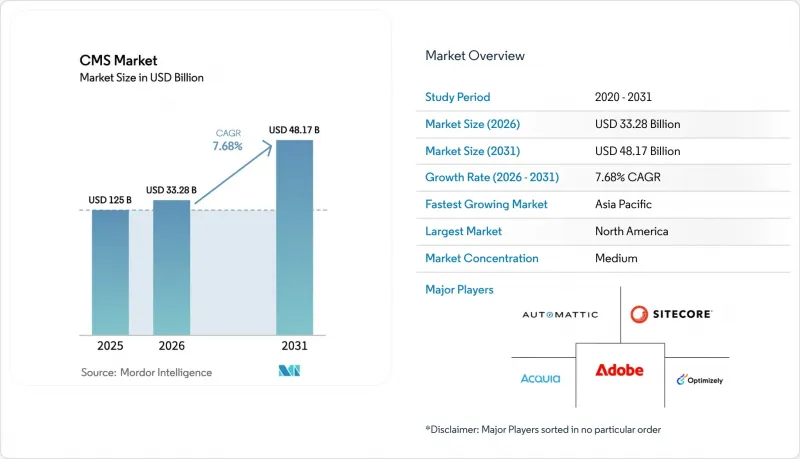
本報告按元件(軟體和服務)、類型(Web 內容管理、企業內容管理、其他)、部署模式(本地部署、雲端部署、混合部署)、企業規模(大型企業、中小企業)、最終用戶行業(銀行、金融服務和保險、醫療保健和生命科學、零售和電子商務、IT 和電信、其他)以及地區進行分類。
全球內容管理系統市場趨勢與洞察
電子商務的興起和全通路零售的快速發展
零售商和B2B經銷商如今能夠即時同步網頁、行動裝置、社群媒體和店內展示等各種管道的產品數據、價格和促銷資訊。先進的工作流程使他們能夠處理相關人員核准流程和複雜的商品目錄,而這些在傳統平台上難以管理。隨著越來越多的消費者使用社群電商,即時一致性正在提升客戶信任度、購買量和客戶客戶維繫,這使得全通路功能成為內容管理系統(CMS)市場中至關重要的選擇標準。
在可組合架構中實現雲端原生CMS
企業正優先採用「API優先」系統,在維持管治的同時,整合各領域的最佳工具。 Sitecore 的 XM Cloud 在 2024 年的營收加倍,這凸顯了市場對能夠為開發者提供靈活交付 API,同時又能讓行銷人員繼續使用視覺化編輯器的平台的需求日益成長。更快的升級速度、自動擴展和全球 CDN 進一步降低了基礎設施成本,並強化了雲端的優勢。
從傳統堆疊遷移相關的初始成本
企業平台遷移可能耗資超過 42 萬美元,並且需要新舊系統運作長達 18 個月。由於遷移需要重建內容模型、自訂模組並重新培訓員工技能,因此延誤會導致成本增加,並顯著超出最初商業計劃的投資回報率盈虧平衡點。
細分市場分析
預計到2025年,CMS市場中軟體將佔61.75%的市場佔有率,但隨著企業對遷移藍圖、客製化整合和管治框架的需求不斷成長,專業服務預計將以16.02%的複合年成長率成長。諮詢和管理服務可以幫助企業從本地部署遷移到雲端,整合內容和商務引擎,並重新培訓員工。像Clarks這樣的零售商利用可組合架構和合作夥伴的專業知識,在短短九個月內就在51個國家推出了電商網站,此後雲端遷移專案激增。
實施專家正利用 API 優先模式的蓬勃發展,開發無頭設計方案,將內容管理系統 (CMS) 與行銷技術 (MarTech)、客戶資料平台 (CDP) 和數位資產管理 (DAM) 系統整合。隨著關注點從一次性部署轉向持續最佳化,基於結果的託管服務正在擴展,涵蓋效能調優、安全性修補程式和人工智慧驅動的內容測試。這些持續性服務加強了供應商與客戶之間的長期合作關係,並在整個預算週期中保持 CMS 市場的穩健發展。
儘管網路內容管理仍佔據 41.05% 的市場佔有率,但由於全通路策略的需求,無頭平台正以 18.85% 的複合年成長率快速成長。解耦模型使行銷人員能夠繼續使用所見即所得 (WYSIWYG) 的方式創建內容,而開發人員則可以將內容交付到 Web、行動裝置、物聯網設備和自助服務終端等終端。在零售和媒體產業,延遲和可擴展性會影響轉換率,因此企業正在用 API 中心取代耦合技術棧,從而將內容交付到任何前端。
這股無頭架構浪潮正在推動對配套的數位資產管理 (DAM) 和微服務的需求。據 CoreMedia 等供應商稱,客戶公司正在透過統一的資產中心管理社交媒體、市場和店內螢幕上的數百萬個視覺資產。隨著可組合式商務的日益普及,無頭 CMS 解決方案正成為標準之選,迫使傳統平台維修其 API,否則將面臨客戶流失流失的風險。
區域分析
預計北美將繼續保持主導地位,到2025年將佔全球銷售額的35.85%。成熟的供應商生態系統和充足的IT預算正推動著向無頭、人工智慧融合架構的快速轉型。各州層級的隱私權法正在推動對使用者同意取得和定位模組的需求,而無需像歐洲那樣受到嚴格的跨境限制。
亞太地區是成長最快的內容管理系統(CMS)市場,複合年成長率(CAGR)高達14.52%,主要得益於印尼、菲律賓和越南兩位數的電子商務成長。企業需要支援多語言、多幣種的內容發布,並輔以行動優先的模板,這正在加速全部區域無頭CMS的普及。
歐洲市場雖然成熟,但規模仍龐大。 GDPR 和新近頒布的人工智慧相關法律正在推動整合管治功能和本地託管選項的平台普及。儘管拉丁美洲和中東及非洲的市場佔有率較小,但對阿拉伯語在地化、伊斯蘭金融內容分發和政府數位化投入的增加,正為未來內容管理系統 (CMS) 市場的擴張鋪平道路。
其他好處
- Excel格式的市場預測(ME)表
- 3個月的分析師支持
目錄
第1章:引言
- 市場定義與研究假設
- 調查範圍
第2章:調查方法
第3章執行摘要
第4章 市場狀況
- 市場概覽
- 市場促進因素
- 電子商務的興起和全通路零售的蓬勃發展
- 在可組合架構中實現雲端原生CMS
- 增強個人化的生成式人工智慧外掛(報告不足)
- 新興市場品牌對在地化需求的快速成長(未充分通報)
- 透過 API 優先的方式與電商引擎整合
- 中小企業的低程式碼CMS加速器
- 市場限制因素
- 從傳統堆疊遷移相關的初始成本
- 資料隱私和主權合規負擔
- 缺乏熟練的無頭CMS開發人員(報告功能不足)
- 舊版CMS系統已停止支持,導致技術債不斷增加。
- 價值供應鏈分析
- 重要法規結構的評估
- 對關鍵相關人員的影響評估
- 技術展望
- 波特五力分析
- 宏觀經濟因素的影響
第5章 市場規模與成長預測
- 按組件
- 軟體
- 服務
- 按類型
- 網站內容管理(WCM)
- 企業內容管理(ECM)
- 無頭/API優先的內容管理系統
- 數位資產管理(DAM)
- 文件管理系統(DMS)
- 電子商務內容管理系統
- 按實現類型
- 現場
- 雲
- 混合
- 按公司規模
- 大公司
- 中小企業
- 按最終用戶行業分類
- BFSI
- 醫療保健和生命科學
- 零售與電子商務
- IT/通訊
- 媒體與娛樂
- 教育
- 政府/公共部門
- 製造業
- 其他
- 按地區
- 北美洲
- 美國
- 加拿大
- 墨西哥
- 南美洲
- 巴西
- 阿根廷
- 其他南美國家
- 歐洲
- 德國
- 英國
- 法國
- 義大利
- 西班牙
- 俄羅斯
- 其他歐洲國家
- 亞太地區
- 中國
- 日本
- 印度
- 韓國
- 澳洲和紐西蘭
- 其他亞太國家
- 中東和非洲
- 中東
- 沙烏地阿拉伯
- 阿拉伯聯合大公國
- 土耳其
- 其他中東國家
- 非洲
- 南非
- 奈及利亞
- 埃及
- 其他非洲地區
- 中東
- 北美洲
第6章 競爭情勢
- 市場集中度
- 策略趨勢
- 市佔率分析
- 公司簡介
- Adobe Inc.
- Automattic Inc.
- Sitecore Holding II A/S
- Optimizely Inc.
- Acquia Inc.
- OpenText Corporation
- Oracle Corporation
- Microsoft Corporation
- Squarespace Inc.
- Contentful GmbH
- Kentico Software sro
- Magnolia International Ltd.
- Crownpeak Technology Inc.
- HubSpot Inc.(CMS Hub)
- Liferay Inc.
- Progress Software Corp.(Sitefinity)
- ConcreteCMS Inc.
- Contentstack
- Duda Inc.
- Wix.com Ltd.
- Alfresco Software Ltd.(Hyland)
- Nuxeo SA(Hyland)
- Bloomreach Inc.
- Umbraco HQ ApS
- Prismic IO Inc.
- Sanity AS
第7章 市場機會與未來趨勢
- 對未開發市場和未滿足需求的評估
According to Mordor Intelligence, the CMS market size was valued at USD 30.91 billion in 2025 and estimated to grow from USD 33.28 billion in 2026 to reach USD 48.17 billion by 2031, at a CAGR of 7.68% during the forecast period (2026-2031).
This report is Segmented by Component (Software, and Services), Type (Web Content Management, Enterprise Content Management, and More), Deployment (On-Premise, Cloud, and Hybrid), Enterprise Size (Large Enterprises, Small and Medium-Sized Enterprises), End-User Industry (BFSI, Healthcare and Life Sciences, Retail and ECommerce, IT and Telecom, and More), and Geography.
Global CMS Market Trends and Insights
Rise of eCommerce and Omnichannel Retail Boom
Retailers and B2B sellers now synchronize product data, pricing and promotions across web, mobile, social and in-store displays in real time. Advanced workflows support multi-stakeholder approvals and complex catalogs that legacy platforms struggle to manage. As more consumers adopt social commerce, real-time consistency drives customer trust, basket size and retention, making omnichannel capability an essential selection criterion in the CMS market.
Cloud-native CMS Adoption for Composable Architecture
Enterprises are prioritizing API-first systems that integrate best-of-breed tools while preserving governance. Sitecore's XM Cloud doubled its revenue in 2024, underscoring demand for platforms that let marketers keep visual editors while giving developers flexible delivery APIs . Faster upgrades, auto-scaling and global CDNs also cut infrastructure costs, reinforcing cloud dominance.
Up-front Migration Costs from Legacy Stacks
Enterprise re-platforming can exceed USD 420,000 and require dual-running old and new systems for up to 18 months. Delays amplify spend because content models, custom modules and staff skills must all be rebuilt or retrained, pushing ROI breakeven well beyond initial business cases .
Other drivers and restraints analyzed in the detailed report include:
- Generative-AI Plug-ins Elevating Personalization
- Rapid Localization Demand from Emerging-Market Brands
- Data-privacy and Sovereignty Compliance Burden
For complete list of drivers and restraints, kindly check the Table Of Contents.
Segment Analysis
The CMS market size for software stood at 61.75% in 2025, but professional services are registering a 16.02% CAGR as firms need migration roadmaps, custom integrations and governance frameworks. Advisory and managed services help enterprises shift from on-premise to cloud, integrate content with commerce engines and retrain staff. Cloud migration engagements surged after retailers such as Clarks launched a 51-country commerce site within nine months by leveraging composable architecture and partner expertise.
Implementation specialists also capitalize on API-first adoption waves, designing headless blueprints that connect CMS with martech, CDP and DAM. As continuous optimization replaces one-time rollouts, outcome-based managed services grow, covering performance tuning, security patching and AI-based content testing. This recurring work anchors long-term vendor-client relationships and keeps the CMS market resilient during budget cycles.
Web content management maintained 41.05% share, yet headless platforms clock a 18.85% CAGR thanks to omnichannel imperatives. Decoupled models let marketers keep WYSIWYG authoring while developers serve content to web, mobile, IoT and kiosk endpoints. In retail and media, where latency and scalability affect conversion, businesses replace coupled stacks with API hubs that feed any front-end.
The headless wave boosts demand for complementary Digital Asset Management and micro-services. Vendors such as CoreMedia report clients managing millions of visual assets across social, marketplace and in-store screens through unified asset hubs. As composable commerce proliferates, headless CMS market solutions become default choices, pushing legacy platforms to retrofit APIs or risk churn.
Complete Report Scope:
- By Component
- Software
- Services
- By Type
- Web Content Management (WCM)
- Enterprise Content Management (ECM)
- Headless / API-First CMS
- Digital Asset Management (DAM)
- Document Management System (DMS)
- eCommerce CMS
- By Deployment Mode
- On-premise
- Cloud
- Hybrid
- By Enterprise Size
- Large Enterprises
- Small and Medium-sized Enterprises (SMEs)
- By End-user Industry
- BFSI
- Healthcare and Life Sciences
- Retail and eCommerce
- IT and Telecom
- Media and Entertainment
- Education
- Government and Public Sector
- Manufacturing
- Others
- By Geography
- North America
- United States
- Canada
- Mexico
- South America
- Brazil
- Argentina
- Rest of South America
- Europe
- Germany
- United Kingdom
- France
- Italy
- Spain
- Russia
- Rest of Europe
- Asia-Pacific
- China
- Japan
- India
- South Korea
- Australia and New Zealand
- Rest of Asia-Pacific
- Middle East and Africa
- Middle East
- Saudi Arabia
- United Arab Emirates
- Turkey
- Rest of Middle East
- Africa
- South Africa
- Nigeria
- Egypt
- Rest of Africa
- Middle East
- North America
Geography Analysis
North America sustained leadership with 35.85% revenue in 2025. A mature vendor ecosystem and sizable IT budgets enable rapid upgrades to headless, AI-infused stacks. State-level privacy laws spark demand for consent and localization modules without the stringent cross-border constraints seen in Europe.
Asia-Pacific is the CMS market's fastest riser at 14.52% CAGR, underpinned by double-digit eCommerce expansion in Indonesia, the Philippines and Vietnam. Enterprises need multi-language, multi-currency publishing backed by mobile-first templates, which accelerates headless CMS adoption across the region.
Europe remains sizeable though mature. GDPR and emerging AI Acts drive uptake of platforms with built-in governance and local hosting options. Latin America and the Middle East and Africa hold smaller shares but record growing investments in Arabic localization, Islamic finance content flows and government digitization, paving the way for future CMS market traction.
- Adobe Inc.
- Automattic Inc.
- Sitecore Holding II A/S
- Optimizely Inc.
- Acquia Inc.
- OpenText Corporation
- Oracle Corporation
- Microsoft Corporation
- Squarespace Inc.
- Contentful GmbH
- Kentico Software s.r.o.
- Magnolia International Ltd.
- Crownpeak Technology Inc.
- HubSpot Inc. (CMS Hub)
- Liferay Inc.
- Progress Software Corp. (Sitefinity)
- ConcreteCMS Inc.
- Contentstack
- Duda Inc.
- Wix.com Ltd.
- Alfresco Software Ltd. (Hyland)
- Nuxeo SA (Hyland)
- Bloomreach Inc.
- Umbraco HQ ApS
- Prismic IO Inc.
- Sanity AS
Additional Benefits:
- The market estimate (ME) sheet in Excel format
- 3 months of analyst support
TABLE OF CONTENTS
1 INTRODUCTION
- 1.1 Market Definition and Study Assumptions
- 1.2 Scope of the Study
2 RESEARCH METHODOLOGY
3 EXECUTIVE SUMMARY
4 MARKET LANDSCAPE
- 4.1 Market Overview
- 4.2 Market Drivers
- 4.2.1 Rise of eCommerce and Omnichannel Retail Boom
- 4.2.2 Cloud-native CMS Adoption for Composable Architecture
- 4.2.3 Generative-AI Plug-ins Elevating Personalization (under-reported)
- 4.2.4 Rapid Localization Demand from Emerging-Market Brands (under-reported)
- 4.2.5 API-first integrations with commerce engines
- 4.2.6 Low-code CMS accelerators for SMEs
- 4.3 Market Restraints
- 4.3.1 Up-front Migration Costs from Legacy Stacks
- 4.3.2 Data-privacy and Sovereignty Compliance Burden
- 4.3.3 Shortage of Headless-CMS Skilled Developers (under-reported)
- 4.3.4 Escalating technical debt in unsupported legacy CMS versions
- 4.4 Value / Supply-Chain Analysis
- 4.5 Evaluation of Critical Regulatory Framework
- 4.6 Impact Assessment of Key Stakeholders
- 4.7 Technological Outlook
- 4.8 Porter's Five Forces Analysis
- 4.8.1 Bargaining Power of Suppliers
- 4.8.2 Bargaining Power of Consumers
- 4.8.3 Threat of New Entrants
- 4.8.4 Threat of Substitutes
- 4.8.5 Intensity of Competitive Rivalry
- 4.9 Impact of Macro-economic Factors
5 MARKET SIZE AND GROWTH FORECASTS (VALUE)
- 5.1 By Component
- 5.1.1 Software
- 5.1.2 Services
- 5.2 By Type
- 5.2.1 Web Content Management (WCM)
- 5.2.2 Enterprise Content Management (ECM)
- 5.2.3 Headless / API-First CMS
- 5.2.4 Digital Asset Management (DAM)
- 5.2.5 Document Management System (DMS)
- 5.2.6 eCommerce CMS
- 5.3 By Deployment Mode
- 5.3.1 On-premise
- 5.3.2 Cloud
- 5.3.3 Hybrid
- 5.4 By Enterprise Size
- 5.4.1 Large Enterprises
- 5.4.2 Small and Medium-sized Enterprises (SMEs)
- 5.5 By End-user Industry
- 5.5.1 BFSI
- 5.5.2 Healthcare and Life Sciences
- 5.5.3 Retail and eCommerce
- 5.5.4 IT and Telecom
- 5.5.5 Media and Entertainment
- 5.5.6 Education
- 5.5.7 Government and Public Sector
- 5.5.8 Manufacturing
- 5.5.9 Others
- 5.6 By Geography
- 5.6.1 North America
- 5.6.1.1 United States
- 5.6.1.2 Canada
- 5.6.1.3 Mexico
- 5.6.2 South America
- 5.6.2.1 Brazil
- 5.6.2.2 Argentina
- 5.6.2.3 Rest of South America
- 5.6.3 Europe
- 5.6.3.1 Germany
- 5.6.3.2 United Kingdom
- 5.6.3.3 France
- 5.6.3.4 Italy
- 5.6.3.5 Spain
- 5.6.3.6 Russia
- 5.6.3.7 Rest of Europe
- 5.6.4 Asia-Pacific
- 5.6.4.1 China
- 5.6.4.2 Japan
- 5.6.4.3 India
- 5.6.4.4 South Korea
- 5.6.4.5 Australia and New Zealand
- 5.6.4.6 Rest of Asia-Pacific
- 5.6.5 Middle East and Africa
- 5.6.5.1 Middle East
- 5.6.5.1.1 Saudi Arabia
- 5.6.5.1.2 United Arab Emirates
- 5.6.5.1.3 Turkey
- 5.6.5.1.4 Rest of Middle East
- 5.6.5.2 Africa
- 5.6.5.2.1 South Africa
- 5.6.5.2.2 Nigeria
- 5.6.5.2.3 Egypt
- 5.6.5.2.4 Rest of Africa
- 5.6.5.1 Middle East
- 5.6.1 North America
6 COMPETITIVE LANDSCAPE
- 6.1 Market Concentration
- 6.2 Strategic Moves
- 6.3 Market Share Analysis
- 6.4 Company Profiles (includes Global level Overview, Market level overview, Core Segments, Financials as available, Strategic Information, Market Rank/Share for key companies, Products and Services, and Recent Developments)
- 6.4.1 Adobe Inc.
- 6.4.2 Automattic Inc.
- 6.4.3 Sitecore Holding II A/S
- 6.4.4 Optimizely Inc.
- 6.4.5 Acquia Inc.
- 6.4.6 OpenText Corporation
- 6.4.7 Oracle Corporation
- 6.4.8 Microsoft Corporation
- 6.4.9 Squarespace Inc.
- 6.4.10 Contentful GmbH
- 6.4.11 Kentico Software s.r.o.
- 6.4.12 Magnolia International Ltd.
- 6.4.13 Crownpeak Technology Inc.
- 6.4.14 HubSpot Inc. (CMS Hub)
- 6.4.15 Liferay Inc.
- 6.4.16 Progress Software Corp. (Sitefinity)
- 6.4.17 ConcreteCMS Inc.
- 6.4.18 Contentstack
- 6.4.19 Duda Inc.
- 6.4.20 Wix.com Ltd.
- 6.4.21 Alfresco Software Ltd. (Hyland)
- 6.4.22 Nuxeo SA (Hyland)
- 6.4.23 Bloomreach Inc.
- 6.4.24 Umbraco HQ ApS
- 6.4.25 Prismic IO Inc.
- 6.4.26 Sanity AS
7 MARKET OPPORTUNITIES AND FUTURE TRENDS
- 7.1 White-space and Unmet-need Assessment

 2026年全球內容管理軟體市場報告2026年全球內容管理系統市場報告
 Frost Radar™:娛樂元資料與內容發現平台,2026 年
 醫療保健內容管理系統:市場佔有率分析、行業趨勢和統計數據、成長預測(2026-2031 年)媒體和娛樂企業內容管理 (ECM):市場佔有率分析、行業趨勢和統計數據以及成長預測 (2026-2031)OTT內容管理系統:市場佔有率分析、產業趨勢與統計、成長預測(2026-2031年)2026年全球內容管理市場報告2026年全球學習內容中心市場報告
 內容管理系統市場:按類型、部署方式和地區分類
 內容管理軟體市場:按元件、部署類型、組織規模、應用程式和最終用戶分類-2026年至2032年全球市場預測