


 |
市場調查報告書
商品編碼
2118227
媒體和娛樂企業內容管理 (ECM):市場佔有率分析、行業趨勢和統計數據以及成長預測 (2026-2031)Media and Entertainment Enterprise Content Management (ECM) - Market Share Analysis, Industry Trends & Statistics, Growth Forecasts (2026 - 2031) |
||||||

※ 本網頁內容可能與最新版本有所差異。詳細情況請與我們聯繫。
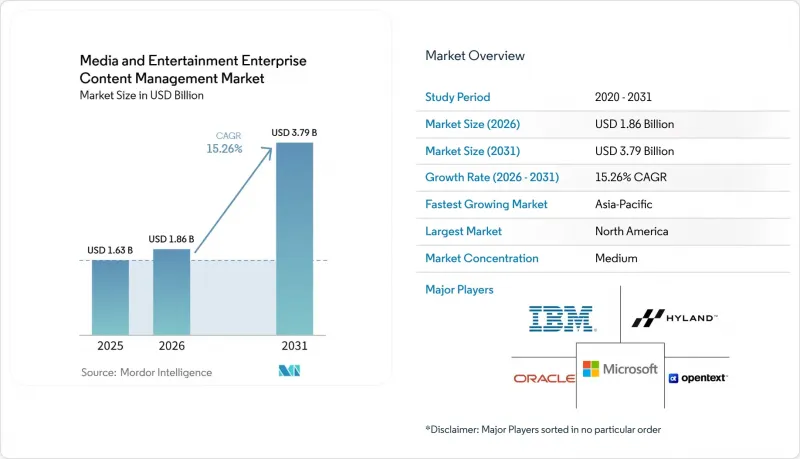
根據 Mordor Intelligence 預測,媒體和娛樂產業的企業內容管理 (ECM) 市場規模預計將從 2025 年的 16.3 億美元和 2026 年的 18.6 億美元成長到 2031 年的 37.9 億美元,2026 年至 2031 年的年複合成長率(CAGR)。
本報告按解決方案類型(文件管理、記錄管理、工作流程和業務流程管理、案例管理、數位資產管理等)、部署模式(雲端、混合等)、企業規模(中小企業、大型企業)和地區進行細分。市場預測以美元計價。
媒體和娛樂企業內容管理 (ECM) 市場的全球趨勢和洞察。
人工智慧驅動的元資料標記和搜尋
隨著元資料品質對搜尋、重複使用和合規性變得至關重要,媒體和娛樂產業的企業內容管理 (ECM) 市場正蓬勃發展。人工智慧驅動的標籤功能縮短了新資產的搜尋時間,減輕了內容團隊的工作負擔。內容團隊透過人工智慧驅動的轉錄、翻譯和片段搜尋工作流程節省了時間;當人工智慧與模板工具結合使用時,每週節省的時間從 11 小時增加到 18 小時。 Cloudinary 於 2026 年 5 月發布了企業級媒體庫的分類、搜尋、審核和工作流程任務的人工智慧代理,進一步推動了這一趨勢。因此,媒體和娛樂產業的企業內容管理 (ECM) 市場正從被動儲存轉向主動內容智慧。結構化儲存庫的價值也再次凸顯,因為準確的元資料對於個人化、建議和發現系統的有效運作至關重要。
OTT和串流內容的數量正在增加。
媒體和娛樂產業的企業內容管理 (ECM) 市場也受到串流媒體播放量成長和內容庫相關成本上升的推動。根據 Backlight 發布的 2026 年「iconik」報告,到 2025 年,該平台管理的數據量將達到 324 Petabyte,年成長率高達 56%,新內容以每小時 11.1 Terabyte的速度注入系統。 Netflix 於 2026 年 3 月 31 日提交的 10-Q 表格顯示,其串流內容支出達到 241.39 億美元,凸顯了大規模內容管線帶來的財務和營運負擔。在如此龐大的規模下,管理非結構化資料變得更具挑戰性,因為版權管理、發行格式、存檔搜尋和重複使用等要素必須在龐大的內容庫中協同運作。因此,當平台需要一個能夠處理當前製作流程和歷史存檔的管治管理環境時,媒體和娛樂產業的企業內容管理 (ECM) 市場將從中受益。存檔重用的速度也變得越來越重要。這是因為加快搜尋和重新包裝流程可以讓我們在不增加初始生產成本的情況下提高利潤率。
遷移複雜的遺留媒體系統
媒體和娛樂產業的企業內容管理 (ECM) 市場仍面臨遷移舊有系統的重大挑戰。許多媒體機構經營過時的儲存庫,其中的元資料、存取權限、工作流程和版權規則都是多年來逐步建立的,這使得平穩遷移變得困難重重。這增加了系統現代化帶來的風險,因為停機、存取控制故障或版權歷史記錄遺失都可能中斷廣播和分發業務。合規性法規進一步加劇了問題的複雜性,因為人工智慧管治、資料保留期限和資料管理要求必須在系統變更過程中保持不變。歐盟人工智慧立法提高了對透明且可審計工作流程的要求,增加了遷移執行不當的風險。因此,一些中型廣播公司和區域媒體業者正在推遲系統更新周期,不願一次性承擔複雜且長期的遷移工作。
細分市場分析
到2025年,數位資產管理(DAM)將佔據媒體和娛樂產業企業內容管理(ECM)市場佔有率的24.11%,鞏固其在大規模管理影像、影片和音訊庫方面的核心地位。 DAM仍然是元資料管治、資產搜尋以及跨工作室、廣播公司和串流媒體提供者的多通道分發的基礎。在媒體和娛樂產業的企業內容管理(ECM)領域,文件管理和記錄管理持續支援合規性和歸檔需求,而個案管理和Web內容管理則主要針對較為有限的營運用例。這種分佈表明,在許多採購決策中,儲存庫管理仍然是比高階自動化更受青睞的選擇。
預計到2031年,工作流程和業務流程管理將以16.71%的複合年成長率成長,成為媒體和娛樂企業內容管理(ECM)市場中成長最快的解決方案領域。這一成長反映了企業正在從單純的內容儲存轉向自動化每個步驟,包括內容攝取、審核、批准、版權驗證和最終交付。歐盟人工智慧立法正在推動這一趨勢,因為媒體公司需要更清晰的流程文件來記錄與製作和發布相關的AI輔助操作。 2026年2月,OpenText宣布被Forrester評為數位資產管理(DAM)領域的“領導者”,這再次印證了企業級DAM在內容豐富的環境中持續的重要性。因此,解決方案之間的競爭焦點正從單純的儲存庫規模轉向工作流程的深度、可追溯性和管治。
區域分析
到2025年,北美將佔據媒體和娛樂產業企業內容管理(ECM)市場41.29%的佔有率,成為最大的區域叢集。該地區受益於主要串流媒體平台、廣播電視網路和大型媒體集團的集中,這些平台和集團均採用複雜的版權和發行模式。 Netflix、Amazon Prime Video、Disney+ 等平台管理大量內容資產,需要進行版權追蹤、歸檔管理以及跨多種格式的協調。 2026年4月,ATSC發布了數位版權管理推薦標準A362,提高了美國對版權意識強的廣播和串流媒體工作流程的期望。因此,北美媒體和娛樂產業的企業內容管理(ECM)市場將繼續受益於高額的內容預算和成熟的供應商生態系統。
預計到2031年,亞太地區將以17.04%的複合年成長率成長,並有望成為媒體和娛樂企業內容管理(ECM)市場成長最快的地區。這一成長與OTT(Over-the-Top)服務的擴張、檔案數位化以及大規模管理多語言元元資料和區域版權差異的需求密切相關。 2026年6月,東芝數位解決方案公司發布了整合影像內容管理系統「meify」。該系統集中管理節目元資料、版權數據和創作者記錄,並為廣播公司提供人工智慧驅動的識別工具。同樣在2026年7月,SONY行銷公司發布了最新版本的“A2 Production”和“Ci Media Cloud”,它們具有人工智慧驅動的影像分析功能、支援多種檔案格式以及自動同步監視資料夾的功能。
歐洲正以「雲端優先」的方式推動供應鏈現代化,而媒體和娛樂產業的企業內容管理領域仍處於起步階段,但在南美、中東和非洲地區卻呈現成長態勢。此外,隨著GDPR和歐盟人工智慧管治的日益完善,歐洲在內容資料、工作流程日誌和自動化決策方面面臨越來越大的政策壓力,這主要源於對可驗證控制的迫切需求。 2026年4月,BCE將「Perfect Memory」整合到其媒體即服務(Media-as-a-Service)服務中,展示了其託管服務模式如何幫助中型廣播公司實現更強大的資產管治和元資料管理。在南美,巴西仍然是重要的投資目的地,媒體集團正在建立用於視訊點播(VOD)和廣告工作流程的系統。與此同時,中東和非洲地區正透過數位化檔案、提高製作水平以及在整個新內容生態系統中不斷成長的雲端技術應用而蓬勃發展。
其他好處:
- Excel格式的市場預測(ME)表
- 3個月的分析師支持
目錄
第1章:引言
- 研究假設和市場定義
- 調查範圍
第2章:調查方法
第3章執行摘要
第4章 市場狀況
- 市場概覽
- 市場促進因素
- OTT和串流內容量增加
- 人工智慧驅動的元資料標記和改進的搜尋
- 需要加快跨多個管道的內容重複使用
- 雲端優先的生產和協作工作流程
- 對尊重權利的內容管治的需求日益成長
- 內容儲存庫與收入工作流程的整合
- 市場限制因素
- 遷移複雜的遺留媒體系統
- 組織元資料和規範內容的工作量很大。
- 整合安全性和權限管理所涉及的複雜性。
- 來自去中心化創新團隊的阻力
- 產業價值鏈分析
- 宏觀經濟因素對市場的影響
- 監理情勢
- 技術展望
- 波特五力分析
第5章 市場規模與成長預測
- 按解決方案類型
- 文件管理
- 記錄管理
- 工作流程和業務流程管理
- 個案管理
- 數位資產管理
- 網站內容管理
- 其他解決方案
- 部署模式
- 現場
- 雲
- 混合
- 按公司規模
- 小型企業
- 大公司
- 按地區
- 北美洲
- 美國
- 加拿大
- 墨西哥
- 南美洲
- 巴西
- 阿根廷
- 其他南美國家
- 歐洲
- 英國
- 德國
- 法國
- 其他歐洲國家
- 亞太地區
- 中國
- 日本
- 印度
- 韓國
- 澳洲
- 其他亞太國家
- 中東
- 阿拉伯聯合大公國
- 沙烏地阿拉伯
- 其他中東國家
- 非洲
- 南非
- 肯亞
- 其他非洲國家
- 北美洲
第6章 競爭情勢
- 市場集中度
- 策略趨勢
- 市佔率分析
- 公司簡介
- Adobe Inc.
- Aprimo LLC
- Box, Inc.
- Bynder BV
- Cloudinary Ltd.
- DocuWare GmbH
- Fabasoft AG
- Hyland Software, Inc.
- IBM Corporation
- Laserfiche, Inc.
- MediaValet Inc.
- M-Files Oy
- Microsoft Corporation
- Newgen Software Technologies Limited
- Objective Corporation Limited
- OpenText Corporation
- Oracle Corporation
- Sitecore A/S
- Wedia SA
- WoodWing Software BV
第7章 市場機會與未來展望
According to Mordor Intelligence, the media and Entertainment Enterprise Content Management (ECM) market size is projected to expand from USD 1.63 billion in 2025 and USD 1.86 billion in 2026 to USD 3.79 billion by 2031, registering a CAGR of 15.26% between 2026 and 2031.
This report is Segmented by Solution Type (Document Management, Records Management, Workflow and Business Process Management, Case Management, Digital Asset Management, and More), Deployment Mode (Cloud, Hybrid, and More), Enterprise Size (Small and Medium Enterprises, and Large Enterprises), and Geography. The Market Forecasts are Provided in Terms of Value (USD).
Global Media and Entertainment Enterprise Content Management (ECM) Market Trends and Insights
AI-Assisted Metadata Tagging and Searchability
The Media and Entertainment Enterprise Content Management (ECM) market is gaining momentum as metadata quality becomes central to search, reuse, and compliance. AI-based tagging is reducing the time required to make new assets searchable and reducing the manual workload on content teams. Content teams saw time savings from AI-powered workflows for transcription, translation, and clip search, while weekly time savings rose from 11 hours to 18 hours when AI was combined with templating tools. Cloudinary strengthened this trend in May 2026 by launching AI agents for taxonomy, search, moderation, and workflow tasks in enterprise-scale media libraries. As a result, the Media and Entertainment Enterprise Content Management (ECM) market is shifting away from passive storage and toward active content intelligence. This also underscores the value of well-structured repositories, as personalization, recommendation, and discovery systems depend on clean metadata to perform effectively.
Rising OTT and Streaming Content Volume
The Media and Entertainment Enterprise Content Management (ECM) market is also being boosted by the scale of streaming output and the costs associated with content libraries. Backlight's 2026 iconik report showed that data managed on the platform reached 324 petabytes in 2025, after 56% annual growth, while new content entered the system at 11.1 terabytes per hour. Netflix stated in its March 31, 2026, Form 10-Q that its streaming content obligations stood at USD 24.139 billion, underscoring the financial and operational burden of large content pipelines. This scale makes unstructured storage harder to manage because rights, delivery formats, archive retrieval, and reuse need to work together across large libraries. The Media and Entertainment Enterprise Content Management (ECM) market, therefore, benefits when platforms need governed environments that can handle both current production flows and older archives. Archive reuse speed is also becoming increasingly important because faster retrieval and repackaging can improve margins without increasing the original production spend.
Complex Legacy Media System Migration
The Media and Entertainment Enterprise Content Management (ECM) market still faces a major hurdle in legacy migration. Many media organizations run older repositories where metadata, permissions, workflows, and rights rules were built over many years and are difficult to transfer cleanly. That makes modernization more risky because downtime, broken access controls, or lost rights history can disrupt broadcast and distribution operations. Compliance rules add another layer of complexity because AI governance, retention, and data control requirements must remain in place during system changes. The EU AI Act has added pressure for transparent, auditable workflows, raising the stakes for poorly executed migrations. This is slowing refresh cycles for some mid-tier broadcasters and regional media operators that do not want to absorb a long and complex transition at once.
Other drivers and restraints analyzed in the detailed report include:
- Cloud-First Production and Collaboration Workflows
- Need for Faster Multi-Channel Content Reuse
- High Metadata Cleanup and Content Normalization Burden
For complete list of drivers and restraints, kindly check the Table Of Contents.
Segment Analysis
Digital asset management held 24.11% of the Media and Entertainment Enterprise Content Management (ECM) market share in 2025, which confirmed its central role in managing image, video, and audio libraries at scale. DAM remains the base layer for metadata governance, asset retrieval, and multichannel distribution across studios, broadcasters, and streaming operators. In the media and entertainment enterprise content management industry, document management and records management continue to support compliance and archival needs, while case management and web content management serve narrower operational use cases. This distribution shows that repository control still comes before advanced automation in many buying decisions.
Workflow and business process management is projected to expand at a 16.71% CAGR through 2031, making it the fastest-growing solution area in the Media and Entertainment Enterprise Content Management (ECM) market. That growth reflects a shift from simply storing content to automating ingestion, review, approval, rights checks, and final delivery steps. The EU AI Act is reinforcing this move because media companies need clearer process records for AI-assisted actions tied to production and publishing. OpenText stated in February 2026 that it was named a Leader in digital asset management by Forrester, which supports the continued importance of enterprise-grade DAM in content-heavy environments. As a result, solution competition is moving toward workflow depth, traceability, and governance rather than solely on repository scale.
Complete Report Scope:
- By Solution Type
- Document Management
- Records Management
- Workflow and Business Process Management
- Case Management
- Digital Asset Management
- Web Content Management
- Other Solutions
- By Deployment Mode
- On-Premises
- Cloud
- Hybrid
- By Enterprise Size
- Small and Medium Enterprises
- Large Enterprises
- By Geography
- North America
- United States
- Canada
- Mexico
- South America
- Brazil
- Argentina
- Rest of South America
- Europe
- United Kingdom
- Germany
- France
- Rest of Europe
- Asia-Pacific
- China
- Japan
- India
- South Korea
- Australia
- Rest of Asia-Pacific
- Middle East
- United Arab Emirates
- Saudi Arabia
- Rest of Middle East
- Africa
- South Africa
- Kenya
- Rest of Africa
- North America
Geography Analysis
North America held 41.29% of the Media and Entertainment Enterprise Content Management (ECM) market share in 2025, which made it the largest regional cluster. The region benefits from the concentration of major streaming platforms, broadcast networks, and large media groups that operate under complex rights and distribution models. Netflix, Amazon Prime Video, Disney+, and similar platforms manage large content estates that require rights tracking, archive control, and coordination across multiple formats. The ATSC published its A362 recommended practice on digital rights management in April 2026, and this is shaping expectations for rights-aware broadcast and streaming workflows in the United States. The Media and Entertainment Enterprise Content Management (ECM) market in North America, therefore, remains anchored by high content budgets and a mature vendor ecosystem.
Asia-Pacific is projected to expand at a 17.04% CAGR through 2031, giving the region the fastest pace in the Media and Entertainment Enterprise Content Management (ECM) market. Growth is tied to OTT expansion, archive digitization, and the need to manage multilingual metadata and regional rights variants at scale. Toshiba Digital Solutions launched its meify integrated video content management system in June 2026, centralizing program metadata, rights data, and creator records, and providing AI-supported recognition tools for broadcasters. Sony Marketing also launched updated versions of A2 Production and Ci Media Cloud in July 2026, featuring AI video analysis, broader file support, and automated watch-folder synchronization.
Europe is moving through cloud-first supply chain modernization, while South America, the Middle East, and Africa remain earlier-stage but growing parts of the media and entertainment enterprise content management industry. Europe also faces stronger policy pressure on governance, as the GDPR and the EU AI Act increase the need for demonstrable control over content data, workflow logs, and automated decisions. In April 2026, BCE integrated Perfect Memory into its Media-as-a-Service offering, demonstrating how managed service models are helping mid-scale broadcasters achieve stronger asset governance and metadata control. In South America, Brazil remains the main investment point as media groups build systems for VOD and advertising workflows, while the Middle East and Africa are growing through archive digitization, production expansion, and rising cloud adoption across newer content ecosystems.
- Adobe Inc.
- Aprimo LLC
- Box, Inc.
- Bynder B.V.
- Cloudinary Ltd.
- DocuWare GmbH
- Fabasoft AG
- Hyland Software, Inc.
- IBM Corporation
- Laserfiche, Inc.
- MediaValet Inc.
- M-Files Oy
- Microsoft Corporation
- Newgen Software Technologies Limited
- Objective Corporation Limited
- OpenText Corporation
- Oracle Corporation
- Sitecore A/S
- Wedia SA
- WoodWing Software B.V.
Additional Benefits:
- The market estimate (ME) sheet in Excel format
- 3 months of analyst support
TABLE OF CONTENTS
1 INTRODUCTION
- 1.1 Study Assumptions and Market Definition
- 1.2 Scope of the Study
2 RESEARCH METHODOLOGY
3 EXECUTIVE SUMMARY
4 MARKET LANDSCAPE
- 4.1 Market Overview
- 4.2 Market Drivers
- 4.2.1 Rising OTT and Streaming Content Volume
- 4.2.2 AI Assisted Metadata Tagging and Searchability
- 4.2.3 Need for Faster Multi Channel Content Reuse
- 4.2.4 Cloud First Production and Collaboration Workflows
- 4.2.5 Greater Demand for Rights Aware Content Governance
- 4.2.6 Integration of Content Repositories With Revenue Workflows
- 4.3 Market Restraints
- 4.3.1 Complex Legacy Media System Migration
- 4.3.2 High Metadata Cleanup and Content Normalization Burden
- 4.3.3 Security and Rights Management Integration Complexity
- 4.3.4 Resistance from Decentralized Creative Teams
- 4.4 Industry Value Chain Analysis
- 4.5 Impact of Macroeconomic Factors on the Market
- 4.6 Regulatory Landscape
- 4.7 Technological Outlook
- 4.8 Porter's Five Forces Analysis
- 4.8.1 Bargaining Power of Suppliers
- 4.8.2 Bargaining Power of Buyers
- 4.8.3 Threat of New Entrants
- 4.8.4 Threat of Substitutes
- 4.8.5 Competitive Rivalry
5 MARKET SIZE AND GROWTH FORECASTS (VALUE)
- 5.1 By Solution Type
- 5.1.1 Document Management
- 5.1.2 Records Management
- 5.1.3 Workflow and Business Process Management
- 5.1.4 Case Management
- 5.1.5 Digital Asset Management
- 5.1.6 Web Content Management
- 5.1.7 Other Solutions
- 5.2 By Deployment Mode
- 5.2.1 On-Premises
- 5.2.2 Cloud
- 5.2.3 Hybrid
- 5.3 By Enterprise Size
- 5.3.1 Small and Medium Enterprises
- 5.3.2 Large Enterprises
- 5.4 By Geography
- 5.4.1 North America
- 5.4.1.1 United States
- 5.4.1.2 Canada
- 5.4.1.3 Mexico
- 5.4.2 South America
- 5.4.2.1 Brazil
- 5.4.2.2 Argentina
- 5.4.2.3 Rest of South America
- 5.4.3 Europe
- 5.4.3.1 United Kingdom
- 5.4.3.2 Germany
- 5.4.3.3 France
- 5.4.3.4 Rest of Europe
- 5.4.4 Asia-Pacific
- 5.4.4.1 China
- 5.4.4.2 Japan
- 5.4.4.3 India
- 5.4.4.4 South Korea
- 5.4.4.5 Australia
- 5.4.4.6 Rest of Asia-Pacific
- 5.4.5 Middle East
- 5.4.5.1 United Arab Emirates
- 5.4.5.2 Saudi Arabia
- 5.4.5.3 Rest of Middle East
- 5.4.6 Africa
- 5.4.6.1 South Africa
- 5.4.6.2 Kenya
- 5.4.6.3 Rest of Africa
- 5.4.1 North America
6 COMPETITIVE LANDSCAPE
- 6.1 Market Concentration
- 6.2 Strategic Moves
- 6.3 Market Share Analysis
- 6.4 Company Profiles (includes Global Level Overview, Market Level Overview, Core Segments, Financials as available, Strategic Information, Market Rank/Share, Products and Services, Recent Developments)
- 6.4.1 Adobe Inc.
- 6.4.2 Aprimo LLC
- 6.4.3 Box, Inc.
- 6.4.4 Bynder B.V.
- 6.4.5 Cloudinary Ltd.
- 6.4.6 DocuWare GmbH
- 6.4.7 Fabasoft AG
- 6.4.8 Hyland Software, Inc.
- 6.4.9 IBM Corporation
- 6.4.10 Laserfiche, Inc.
- 6.4.11 MediaValet Inc.
- 6.4.12 M-Files Oy
- 6.4.13 Microsoft Corporation
- 6.4.14 Newgen Software Technologies Limited
- 6.4.15 Objective Corporation Limited
- 6.4.16 OpenText Corporation
- 6.4.17 Oracle Corporation
- 6.4.18 Sitecore A/S
- 6.4.19 Wedia SA
- 6.4.20 WoodWing Software B.V.
7 MARKET OPPORTUNITIES AND FUTURE OUTLOOK
- 7.1 White Space and Unmet Need Assessment

 醫療保健內容管理系統:市場佔有率分析、行業趨勢和統計數據、成長預測(2026-2031 年)OTT內容管理系統:市場佔有率分析、產業趨勢與統計、成長預測(2026-2031年)
 MCaaS(託管內容即服務)市場:2026-2032年全球市場預測(按組件、內容類型、部署模式、組織規模和最終用戶行業分類)
 2026年全球內容管理市場報告2026年全球學習內容中心市場報告
 教育內容市場預測至2034年:按組成部分、內容類型、獲利模式、平台類型和最終用戶分類的全球分析
 內容管理系統市場:按類型、部署方式和地區分類B2B教育內容市場:2026-2032年全球市場預測(依產品類型、內容格式、學科領域、技術平台、實施服務、支援服務、最終用戶、部署模式和組織規模分類)內容管理軟體市場:按元件、部署類型、組織規模、應用程式和最終用戶分類-2026年至2032年全球市場預測雲端列印市場:按實施方法和區域分類