


 |
市場調查報告書
商品編碼
2117977
OTT內容管理系統:市場佔有率分析、產業趨勢與統計、成長預測(2026-2031年)OTT CMS - Market Share Analysis, Industry Trends & Statistics, Growth Forecasts (2026 - 2031) |
||||||

※ 本網頁內容可能與最新版本有所差異。詳細情況請與我們聯繫。
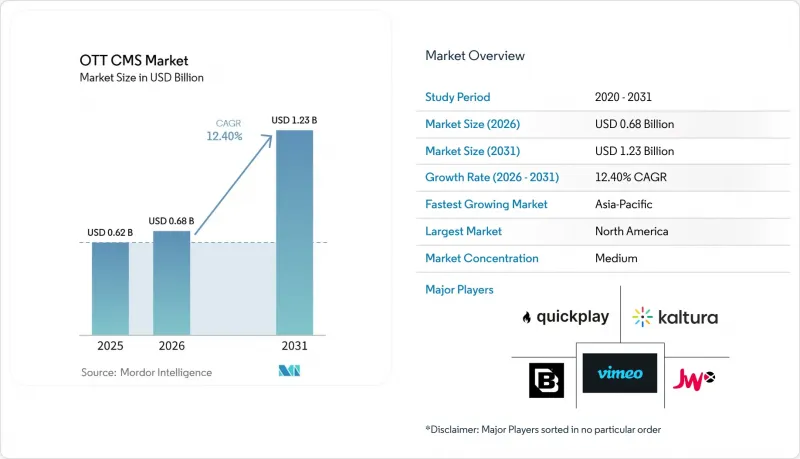
根據 Mordor Intelligence 預測,OTT CMS 市場預計將從 2025 年的 6.2 億美元成長到 2031 年的 12.3 億美元,2026 年至 2031 年的複合年成長率為 12.40%。這主要歸功於營運商加大了對相關系統的投資,這些系統能夠讓他們在一個整合環境中管理內容、數據、存取權限和分發活動。
本報告按部署方式(雲端、本地部署及其他)、收入模式(訂閱式視訊點播 (SVOD)、廣告支援式串流媒體 (AVOD)、交易型和按次付費 (TVOD)、混合盈利模式和免費增值模式)、功能(內容和資產管理、工作流程和發布管理、盈利和商業智慧、版權、安全和合規管理)以及地區進行細分。市場預測以美元 (USD) 為單位。
全球OTT內容管理系統市場趨勢與洞察
對雲端原生OTT工作流程的需求日益成長
由於串流媒體需求會根據內容、地區和活動而快速波動,雲端基礎設施已成為競爭激烈的OTT內容管理系統營運的核心要素。基於雲端的平台允許營運商根據實際觀看需求擴展編碼、打包、儲存和分發能力,而不是維持固定容量來應對偶爾出現的尖峰。它們還支援更短的發布週期,例如在實況活動或大規模發布期間,編輯團隊需要在有限的時限內準備素材和分發設定。容器化服務可讓團隊更新轉碼、DRM、廣告或元資料模組,而無需替換整個系統或中斷核心素材庫。這種方法減輕了傳統、緊密整合的技術堆疊對OTT內容管理系統市場的影響,使營運商能夠逐步實現特定功能的現代化。對於專業供應商而言,這提供了一條清晰的路徑,可以在提供全面平台套件的同時交付單一功能,而買家則可以保持對其現有工作流程設計的控制。
擴大多語言和區域內容傳送
多語言發行增加了OTT內容管理系統(CMS)平台需要管理的每部影片的資訊量。這包括語言版本之間的關係、區域規則和發行週期。即使是同一部影片,即便其底層節目相同,在不同地區也可能需要不同的音軌、字幕、本地化元元資料、節目描述、封面圖和版權管理。 2026年4月,Amagi在「Amagi NOW」中引入了人工智慧推理代理,可自動完成超過25種語言的元資料增強和超過100種語言的本地化。此次發布表明,OTT內容管理系統(CMS)市場需要能夠處理本地化、品質檢查和迭代式資源更新的發布工作流程,而無需增加人員或延遲發布計劃。 2026年,Disney+將其音訊語言支援從41種擴展到58種,新增了阿拉伯語、印地語、泰米爾語、泰盧固語、印尼語等。為同一部電影分發多種語言音軌的區域平台將繼續需要高效的元資料管理和資源版本控制流程,以確保每個本地版本影片記錄的一致性。
平台重組和遷移具有很高的複雜性。
對於擁有多個區域、用戶記錄、版權資料、整合應用程式和既定發布流程的機構而言,更換OTT內容管理系統(CMS)是一個耗時數月的營運專案。營運商可能需要在測試替代環境、核對資產記錄和驗證版權準確性的同時,保持現有平台的運作。即使提案平台功能更強大,這也會增加成本、需要更多人員,並限制切換速度。訂閱中斷、版權資料缺失和觀看體驗不一致等風險也促使那些無法容忍服務中斷的營運商做出謹慎決策。因此,一些業者會長期維護舊平台,選擇有限的升級而非徹底更換,即使功能上的缺陷表明他們應該進行更新。雖然這種更換週期的延遲保護了現有供應商,但可能會降低OTT內容管理系統市場的短期需求,尤其是在平台需要與眾多內部和外部系統整合的情況下。
細分市場分析
到2025年,雲端採用率將佔OTT內容管理系統(CMS)市場的60.46%,這表明對於許多串流媒體服務供應商而言,雲端使用已不再局限於有限的試點階段。這反映出,需要靈活基礎設施來處理內容庫、分發活動和高峰觀看時段的服務供應商已經完成了大規模的雲端遷移。雲端平台可以縮短從內容攝取到發布的時間,並擴展處理能力,即使在固定本地系統難以快速調整的實況活動中也能如此。雲端平台也支援分階段升級AI元資料、數位版權管理(DRM)、廣告功能和其他模組,並可根據需求變化進行部署。這種柔軟性在固定的本地環境中難以複製,尤其是在服務提供者必須從同一平台支援多種服務、地區或內容格式的情況下。
Brightcove 的 2026 年藍圖包括八項新的 AI 套件功能和一個重新設計的 Prism 介面,這些功能將作為雲端平台的更新發布。對於處理高度敏感內容或在連接成本方面處於劣勢的廣播公司而言,本地部署系統仍然十分有用。混合模式將本地處理與雲端儲存、元資料和版權管理結合。這種方法適用於擁有舊有系統和受監管要求的廣播公司。 Wowza Streaming Engine 4.11 透過單一管理介面支援裸機、虛擬機器、Docker、Kubernetes、本地環境、混合環境和公共雲端。因此,OTT 內容管理系統 (CMS) 市場並未將雲端採用視為單一決策,而是為處於不同轉型階段的營運商提供服務。
區域分析
到2025年,北美將佔據OTT內容管理系統(CMS)市場38.73%的佔有率,成為擁有大規模複雜影片營運的供應商的重要區域中心。該地區匯集了眾多領先的訂閱平台、企業影片分銷商和體育版權所有擁有者,他們需要在眾多節目、設備和受眾訪問模式下進行強大的內容管理。該地區的營運商需要基礎設施來處理企業級版權管理、多層級盈利模式以及可能對容量和營運提出高要求的大規模直播觀眾群。美國透過大規模串流媒體服務和以版權主導的內容投資,推動了該地區的大部分技術需求。加拿大和墨西哥也透過廣播公司雲端投資、不斷擴大的串流媒體業務以及對覆蓋國家和地區受眾的內容管理的需求,為市場做出了貢獻。
亞太地區預計到2031年將以13.22%的複合年成長率成長,這主要得益於許多大規模市場和成熟的加值內容市場。在印度,由於平台通常會為每個節目發布多個區域語言版本,因此需要維護元資料,這些工具能夠在不影響詳細資訊管理的前提下,減少手動操作。在中國,愛奇藝和優酷等服務已經形成了大規模的OTT環境,國內平台採用獨特的模式和客製化的基礎設施,與許多西方系統有所不同。 2026年3月,Tving和Wave宣布共用原創內容,凸顯了跨平台同步元資料和版權資訊的必要性。日本和澳洲仍然是成熟的高ARPU市場,加值內容打包和體育賽事轉播權是推動內容管理系統(CMS)投資的主要因素。在選擇平台時,關注點不僅在於用戶數量,還在於服務品質和內容差異化。
中東、非洲和南美洲是OTT內容管理系統市場的新興區域,但各國的營運需求各不相同。在沙烏地阿拉伯和阿拉伯聯合大公國,隨著對本土內容投資的增加和本地內容目錄的不斷擴大,對阿拉伯語元元資料、從右到左的介面以及清真內容分類的需求日益成長。南非、埃及和奈及利亞是非洲的主要市場,行動觀看的成長推動了對頻寬自適應串流媒體配置和可操作分發控制的需求。巴西和阿根廷也為南美洲的需求提供了支持,其中巴西尤其注重支持AVOD(廣告支援的視訊點播)的配置,以滿足不斷成長的廣告需求。這些地區的小規模企業對成本較為敏感,傾向於選擇雲端原生、訂閱式的替代方案,而不是大規模的本地部署。這為能夠提供必要功能而無需複雜部署工作的供應商創造了商機。
其他好處
- Excel格式的市場預測(ME)表
- 3個月的分析師支持
目錄
第1章:引言
- 研究假設和市場定義
- 調查範圍
第2章:調查方法
第3章執行摘要
第4章 市場狀況
- 市場概覽
- 宏觀經濟因素對產業的影響
- 市場促進因素
- 對雲端原生OTT工作流程的需求日益成長
- 擴大多語言和區域內容傳送
- 擴大體育賽事直播和直播範圍
- 對尊重智慧財產權的內容管理的需求日益成長。
- 擴大人工智慧驅動的元資料和搜尋的應用
- SVOD、AVOD 和 TVOD 對獲利模式柔軟性的需求
- 市場限制因素
- 平台重組和遷移具有很高的複雜性。
- 盜版內容傳播的持續性問題以及侵犯版權的風險。
- 分散的傳統媒體供應鏈
- 在隱私、無障礙和當地權利方面面臨的合規負擔
- 產業價值鏈分析
- 監理情勢
- 技術展望
- 波特五力分析
第5章 市場規模與成長預測
- 不同的發展
- 雲
- 現場
- 混合
- 按收入模式
- 訂閱式視訊點播 (SVOD)
- 廣告支援型串流媒體(AVOD)
- 交易型及按次付費(TVOD)
- 混合貨幣化
- 免費增值
- 功能性別
- 內容和資產管理
- 工作流程和發布管理
- 貨幣化和商業智慧
- 權利、安全和合規管理
- 按地區
- 北美洲
- 美國
- 加拿大
- 墨西哥
- 其他北美國家
- 歐洲
- 德國
- 英國
- 法國
- 俄羅斯
- 其他歐洲國家
- 亞太地區
- 中國
- 日本
- 印度
- 韓國
- 澳洲
- 其他亞太國家
- 中東
- 沙烏地阿拉伯
- 阿拉伯聯合大公國
- 土耳其
- 其他中東國家
- 非洲
- 南非
- 埃及
- 奈及利亞
- 其他非洲國家
- 南美洲
- 巴西
- 阿根廷
- 南美洲其他地區
- 北美洲
第6章 競爭情勢
- 市場集中度
- 策略趨勢
- 市佔率分析
- 公司簡介
- Brightcove Inc.
- Kaltura, Inc.
- Vimeo, Inc.
- JW Player, Inc.
- Wowza Media Systems, LLC
- Muvi LLC
- Dacast, Inc.
- Zype, Inc.
- Uscreen, Inc.
- Quickplay Media, Inc.
- Contus Tech
- Bitmovin Inc.
- Akamai Technologies, Inc.
- Cloudflare, Inc.
- Vbrick Systems, Inc.
- Panopto, Inc.
- Wistia, Inc.
- Haivision Systems Inc.
- Axinom GmbH
- BuyDRM, Inc.
- EZDRM LLC
第7章 市場機會與未來展望
According to Mordor Intelligence, the OTT CMS market size is expected to increase from USD 0.62 billion in 2025 to reach USD 1.23 billion by 2031, growing at a CAGR of 12.40% over 2026-2031, as operators invest in systems that can manage content, data, permissions, and publishing activity in one connected environment.
This report is Segmented by Deployment (Cloud, On-Premises, and More), Revenue Model (Subscription Video On Demand (SVOD), AVOD, Transactional and Pay-Per-View (TVOD), Hybrid Monetization, and Freemium), Functionality (Content and Asset Management, Workflow and Publishing Management, Monetization and Business Intelligence, and Rights, and More), and Geography. The Market Forecasts are Provided in Terms of Value (USD).
Global OTT CMS Market Trends and Insights
Rising Demand for Cloud-Native OTT Workflows
Cloud infrastructure has become a core requirement for competitive OTT CMS operations because streaming demand can change sharply by title, territory, and event. Cloud-based platforms allow operators to scale encoding, packaging, storage, and delivery according to actual viewing demand rather than maintaining fixed capacity for occasional peaks. They also support shorter publishing cycles during live events and large releases, when editorial teams must prepare assets and distribution settings within a narrow window. Containerized services allow teams to update transcoding, DRM, advertising, or metadata modules without replacing the entire system or interrupting the core asset library. This approach reduces the effect of older, tightly integrated technology stacks on the OTT content management system market and lets operators modernize selected functions in stages. It also gives specialized vendors a clearer route to offer individual capabilities alongside broader platform suites, while buyers retain control over their existing workflow design.
Growth in Multi-Language and Regional Content Delivery
Multi-language delivery is increasing the amount of information that OTT CMS platforms must manage for every title, including the relationship between language versions, territory rules, and release windows. A single asset may require different audio tracks, subtitles, localized metadata, program descriptions, artwork, and rights settings across many territories, even when the underlying program is identical. In April 2026, Amagi introduced AI reasoning agents within Amagi NOW that automate metadata enrichment in more than 25 languages and localization in more than 100 languages. The release shows why the OTT content management system (CMS) market needs publishing workflows that can handle localization, quality checks, and repeated asset updates without matching increases in staffing or slower release schedules. Disney+ expanded its audio support from 41 to 58 languages in 2026, including Arabic, Hindi, Tamil, Telugu, and Indonesian. Regional platforms that release several language tracks for one title will continue to need efficient metadata and asset-versioning processes that preserve a consistent title record across each local release.
High Re-Platforming and Migration Complexity
Replacing an OTT CMS is a multi-month operational project for organizations with several regions, subscriber records, rights data, connected applications, and established publishing routines. Operators may need to keep the existing platform active while testing the replacement environment, reconciling asset records, and confirming that entitlements remain accurate. This can add cost, require additional staff attention, and limit the speed of a changeover even when the proposed platform offers better features. The risk of disrupted subscriptions, incomplete rights data, or inconsistent viewing experiences also encourages cautious decisions by operators that rely on uninterrupted service. As a result, some operators keep older platforms longer than their feature gaps would otherwise justify and choose narrower upgrades instead of a full replacement. This slower replacement cycle can protect established suppliers and reduce near-term demand in the OTT content management system market, particularly where a platform is connected to many internal and external systems.
Other drivers and restraints analyzed in the detailed report include:
- Expansion of Live Sports and Event Streaming
- Increasing Need for Rights-Aware Content Operations
- Persistent Content Piracy and Rights Leakage Risk
For complete list of drivers and restraints, kindly check the Table Of Contents.
Segment Analysis
Cloud deployment held 60.46% of the OTT CMS market in 2025, confirming that cloud use has moved beyond limited trials for many streaming operators. This position reflects the scale of cloud migration already completed by operators that need flexible infrastructure for content libraries, release activity, and high-demand viewing periods. Cloud platforms can shorten ingest-to-publish work and expand capacity during live events, when a fixed local system may be less able to adjust quickly. They also support incremental upgrades to AI metadata, DRM, advertising functions, and other modules that can be introduced as needs change. This flexibility is difficult to replicate in a fixed local environment, particularly when the operator must support several services, territories, or content formats from the same platform.
Brightcove's 2026 roadmap included 8 new AI Suite capabilities and a redesigned Prism interface delivered as updates to its cloud platform. On-premises systems still serve broadcasters with sensitive content or unfavorable connectivity economics. Hybrid models combine local processing with cloud storage, metadata, and rights controls. This approach is useful for broadcasters with legacy systems and regulatory requirements. Wowza Streaming Engine 4.11 supports bare metal, virtual machines, Docker, Kubernetes, local environments, hybrid environments, and public clouds from one management interface. The OTT Content Management System (CMS) market is therefore serving operators at different stages of the transition rather than treating cloud use as a single decision.
Complete Report Scope:
- By Deployment
- Cloud
- On-Premises
- Hybrid
- By Revenue Model
- Subscription Video on Demand (SVOD)
- Advertising Supported Streaming (AVOD)
- Transactional and Pay-Per-View (TVOD)
- Hybrid Monetization
- Freemium
- By Functionality
- Content and Asset Management
- Workflow and Publishing Management
- Monetization and Business Intelligence
- Rights, Security and Compliance Management
- By Geography
- North America
- United States
- Canada
- Mexico
- Rest of North America
- Europe
- Germany
- United Kingdom
- France
- Russia
- Rest of Europe
- Asia-Pacific
- China
- Japan
- India
- South Korea
- Australia
- Rest of Asia-Pacific
- Middle East
- Saudi Arabia
- United Arab Emirates
- Turkey
- Rest of Middle East
- Africa
- South Africa
- Egypt
- Nigeria
- Rest of Africa
- South America
- Brazil
- Argentina
- Rest of South America
- North America
Geography Analysis
North America accounted for 38.73% of the OTT CMS market in 2025, making it the leading regional base for providers serving large and complex video operations. The region has major subscription platforms, enterprise video publishers, and sports rights holders that require robust content operations across many titles, devices, and viewer access models. Its operators need enterprise-level rights control, multi-tier monetization, and infrastructure for large live audiences that may place sharp demands on capacity and operational response. The United States sets much of the region's technology demand through large streaming services and rights-led content investments. Canada and Mexico also contribute through broadcaster cloud investment, expanding streaming activity, and the need to manage content across national and regional audiences.
Asia-Pacific is projected to grow at a 13.22% CAGR through 2031, supported by a broad mix of high-volume markets and mature premium-content markets. India requires multilingual content operations because platforms often publish several regional language tracks for each title and must maintain reliable data for every version. This creates demand for AI-assisted metadata processes and structured asset libraries that reduce manual work without weakening control over language and territory details. China has high-volume OTT environments through services including iQIYI and Youku, where domestic platforms use local formats and tailored infrastructure that differ from many Western systems. In March 2026, Tving and Wave announced mutual sharing of original content, which highlights the need for cross-platform metadata and rights synchronization. Japan and Australia remain mature, high-ARPU markets where premium content packaging and sports rights shape CMS spending, with platform decisions focused on service quality and content differentiation rather than subscriber scale alone.
Middle East, Africa, and South America represent emerging parts of the OTT content management system market, but the operating needs of their countries are not identical. Saudi Arabia and the United Arab Emirates need Arabic-language metadata, right-to-left interfaces, and Halal content classification as domestic content investment grows and local catalogs develop. South Africa, Egypt, and Nigeria are important African adoption markets, where mobile viewing increases the need for bandwidth-adaptive streaming settings and practical distribution controls. Brazil and Argentina support South American demand, with Brazil placing particular attention on AVOD-capable configurations that can support a growing advertising opportunity. Smaller operators across these regions are cost-sensitive and often favor cloud-native, subscription-priced alternatives to large local installations, creating an opening for vendors that can offer required functions without complex implementation.
- Brightcove Inc.
- Kaltura, Inc.
- Vimeo, Inc.
- JW Player, Inc.
- Wowza Media Systems, LLC
- Muvi LLC
- Dacast, Inc.
- Zype, Inc.
- Uscreen, Inc.
- Quickplay Media, Inc.
- Contus Tech
- Bitmovin Inc.
- Akamai Technologies, Inc.
- Cloudflare, Inc.
- Vbrick Systems, Inc.
- Panopto, Inc.
- Wistia, Inc.
- Haivision Systems Inc.
- Axinom GmbH
- BuyDRM, Inc.
- EZDRM LLC
Additional Benefits:
- The market estimate (ME) sheet in Excel format
- 3 months of analyst support
TABLE OF CONTENTS
1 INTRODUCTION
- 1.1 Study Assumptions and Market Definition
- 1.2 Scope of the Study
2 RESEARCH METHODOLOGY
3 EXECUTIVE SUMMARY
4 MARKET LANDSCAPE
- 4.1 Market Overview
- 4.2 Industry Impact of Macroeconomic Factors
- 4.3 Market Drivers
- 4.3.1 Rising Demand for Cloud-Native OTT Workflows
- 4.3.2 Growth in Multi-Language and Regional Content Delivery
- 4.3.3 Expansion of Live Sports and Event Streaming
- 4.3.4 Increasing Need for Rights-Aware Content Operations
- 4.3.5 Rising Adoption of AI-Assisted Metadata and Search
- 4.3.6 Demand for Monetization Flexibility Across SVOD, AVOD, and TVOD
- 4.4 Market Restraints
- 4.4.1 High Re-Platforming and Migration Complexity
- 4.4.2 Persistent Content Piracy and Rights Leakage Risk
- 4.4.3 Fragmented Legacy Media Supply Chains
- 4.4.4 Compliance Burden Across Privacy, Accessibility, and Territorial Rights
- 4.5 Industry Value Chain Analysis
- 4.6 Regulatory Landscape
- 4.7 Technological Outlook
- 4.8 Porter's Five Forces Analysis
- 4.8.1 Threat of New Entrants
- 4.8.2 Bargaining Power of Suppliers
- 4.8.3 Bargaining Power of Buyers
- 4.8.4 Threat of Substitutes
- 4.8.5 Competitive Rivalry
5 MARKET SIZE AND GROWTH FORECASTS (VALUE)
- 5.1 By Deployment
- 5.1.1 Cloud
- 5.1.2 On-Premises
- 5.1.3 Hybrid
- 5.2 By Revenue Model
- 5.2.1 Subscription Video on Demand (SVOD)
- 5.2.2 Advertising Supported Streaming (AVOD)
- 5.2.3 Transactional and Pay-Per-View (TVOD)
- 5.2.4 Hybrid Monetization
- 5.2.5 Freemium
- 5.3 By Functionality
- 5.3.1 Content and Asset Management
- 5.3.2 Workflow and Publishing Management
- 5.3.3 Monetization and Business Intelligence
- 5.3.4 Rights, Security and Compliance Management
- 5.4 By Geography
- 5.4.1 North America
- 5.4.1.1 United States
- 5.4.1.2 Canada
- 5.4.1.3 Mexico
- 5.4.1.4 Rest of North America
- 5.4.2 Europe
- 5.4.2.1 Germany
- 5.4.2.2 United Kingdom
- 5.4.2.3 France
- 5.4.2.4 Russia
- 5.4.2.5 Rest of Europe
- 5.4.3 Asia-Pacific
- 5.4.3.1 China
- 5.4.3.2 Japan
- 5.4.3.3 India
- 5.4.3.4 South Korea
- 5.4.3.5 Australia
- 5.4.3.6 Rest of Asia-Pacific
- 5.4.4 Middle East
- 5.4.4.1 Saudi Arabia
- 5.4.4.2 United Arab Emirates
- 5.4.4.3 Turkey
- 5.4.4.4 Rest of Middle East
- 5.4.5 Africa
- 5.4.5.1 South Africa
- 5.4.5.2 Egypt
- 5.4.5.3 Nigeria
- 5.4.5.4 Rest of Africa
- 5.4.6 South America
- 5.4.6.1 Brazil
- 5.4.6.2 Argentina
- 5.4.6.3 Rest of South America
- 5.4.1 North America
6 COMPETITIVE LANDSCAPE
- 6.1 Market Concentration
- 6.2 Strategic Moves
- 6.3 Market Share Analysis
- 6.4 Company Profiles (includes Global Level Overview, Market Level Overview, Core Segments, Financials as available, Strategic Information, Market Rank/Share, Products and Services, Recent Developments)
- 6.4.1 Brightcove Inc.
- 6.4.2 Kaltura, Inc.
- 6.4.3 Vimeo, Inc.
- 6.4.4 JW Player, Inc.
- 6.4.5 Wowza Media Systems, LLC
- 6.4.6 Muvi LLC
- 6.4.7 Dacast, Inc.
- 6.4.8 Zype, Inc.
- 6.4.9 Uscreen, Inc.
- 6.4.10 Quickplay Media, Inc.
- 6.4.11 Contus Tech
- 6.4.12 Bitmovin Inc.
- 6.4.13 Akamai Technologies, Inc.
- 6.4.14 Cloudflare, Inc.
- 6.4.15 Vbrick Systems, Inc.
- 6.4.16 Panopto, Inc.
- 6.4.17 Wistia, Inc.
- 6.4.18 Haivision Systems Inc.
- 6.4.19 Axinom GmbH
- 6.4.20 BuyDRM, Inc.
- 6.4.21 EZDRM LLC
7 MARKET OPPORTUNITIES AND FUTURE OUTLOOK
- 7.1 White-Space and Unmet-Need Assessment

 醫療保健內容管理系統:市場佔有率分析、行業趨勢和統計數據、成長預測(2026-2031 年)媒體和娛樂企業內容管理 (ECM):市場佔有率分析、行業趨勢和統計數據以及成長預測 (2026-2031)
 MCaaS(託管內容即服務)市場:2026-2032年全球市場預測(按組件、內容類型、部署模式、組織規模和最終用戶行業分類)
 2026年全球內容管理市場報告2026年全球學習內容中心市場報告
 教育內容市場預測至2034年:按組成部分、內容類型、獲利模式、平台類型和最終用戶分類的全球分析
 內容管理系統市場:按類型、部署方式和地區分類B2B教育內容市場:2026-2032年全球市場預測(依產品類型、內容格式、學科領域、技術平台、實施服務、支援服務、最終用戶、部署模式和組織規模分類)內容管理軟體市場:按元件、部署類型、組織規模、應用程式和最終用戶分類-2026年至2032年全球市場預測雲端列印市場:按實施方法和區域分類