


 |
市場調查報告書
商品編碼
2116482
醫療保健內容管理系統:市場佔有率分析、行業趨勢和統計數據、成長預測(2026-2031 年)Healthcare Content Management System - Market Share Analysis, Industry Trends & Statistics, Growth Forecasts (2026 - 2031) |
||||||

※ 本網頁內容可能與最新版本有所差異。詳細情況請與我們聯繫。
據 Mordor Intelligence 稱,2025 年醫療保健內容管理系統市值為 370.7 億美元,預計到 2031 年將達到 612.8 億美元,而 2026 年為 403.1 億美元,預測期(2026-2031 年)的複合年成長率為 8.74%。
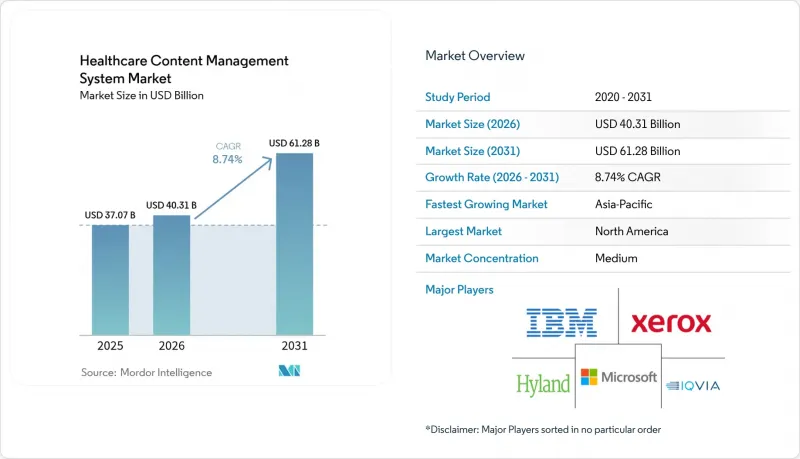
本報告按組件(軟體和服務)、部署模式(本地部署和雲端部署)、應用程式(臨床內容管理、行政和非臨床應用等)、最終用戶(醫院和醫療系統、門診手術中心等)以及地區(北美、歐洲、亞太等)進行細分。報告列出了上述各細分市場的規模(以美元計)。
全球醫療保健內容管理系統市場趨勢與洞察
電子病歷的快速普及使得整合文件和影像工作流程變得至關重要。
《21世紀治癒法案》規定的互通性期限,將醫療保險報銷與無縫資料交換掛鉤,迫使醫療服務提供者將影像和文件管理直接整合到核心電子健康記錄 (EHR) 工作流程中。使用 Epic 和 Oracle Health 的醫院對廠商中立歸檔 (NVA) 和基於 FHIR 的儲存庫的需求日益成長,迫使內容管理供應商用符合基於績效的激勵支付系統 (MERIT) 指標的開放 API 取代專有介面。這種重組正在將醫療內容管理系統市場從單純的合規工具提升為支援臨床工作流程的手段,並重新定義了圍繞延遲、嵌入式分析和臨床醫生使用者體驗的競爭重點。
推動資料儲存和 HIPAA/GDPR 合規方面的法規
除了 HIPAA 規定的至少六年資料保存期限外,各州還強制要求美國醫療機構維護可擴展的存檔,並配備自動刪除策略、加密和審計追蹤功能,最長可達十年。在歐盟,GDPR 增加了關於資料刪除權和資料居住的規定,要求進行精細化的生命週期管理。這促使跨國醫療系統轉向提供區域儲存節點和策略引擎的雲端供應商(hl7.org)。隨著合規複雜性的增加,買家越來越重視那些整合規則庫和證據記錄功能的供應商,這導致醫療內容管理系統市場的平均售價上漲,多年訂閱協議也日益普及。
從舊有系統。
大規模數據轉換、介面開發和用戶再培訓意味著,大規模醫療保健系統典型的六個月部署成本超過1000萬美元,這會延遲投資回報,並抑制醫療保健內容管理系統市場的短期支出。雖然付費使用制可以抵消硬體購置成本,但在舊有系統完全淘汰之前,並行營運期間的人事費用會增加。
細分市場分析
預計到2025年,服務領域市場規模將達到142.3億美元,2025年為228.4億美元,佔醫療保健內容管理系統市場的61.62%。到2031年,專業服務、託管服務和支援合約預計將創造84.2億美元的新收入,這主要得益於買家對整合、最佳化和合規相關外包服務的需求。醫療保健內容管理系統服務市場預計將以9.78%的複合年成長率成長,反映出企業越來越依賴第三方專業知識來應對HIPAA審計和人工智慧模型檢驗。
醫療機構在實施影像化電子健康記錄(EHR) 系統時,通常會將專案預算的 45% 用於諮詢和培訓,凸顯了服務合作夥伴在複雜實施過程中扮演的關鍵角色。對於缺乏全天候安全營運中心的中型醫院而言,託管服務尤其重要。透過促成多年期合約,託管服務能夠穩定供應商的收入,並鞏固醫療內容管理系統市場的平台鎖定效應。
預計到2025年,雲端運算將佔總營收的53.89%,並將以10.21%的複合年成長率持續成長至2031年,超過整體市場成長率,因為服務供應商正在逐步淘汰老舊的資料中心。將本地邊緣節點與區域雲端空間結合的混合模式佔據了新契約的大部分,這一趨勢在歐洲尤為明顯,因為GDPR的資料主權條款限制了公共雲端的全面普及。
採用雲端技術的醫療保健內容管理系統市場佔據了總支出的三分之二,這主要得益於自動化運作等級協定 (SLA) 和內建人工智慧加速器等傳統伺服器所不具備的功能。然而,由於供應商風險評估和網路保險承保審查耗時較長(待續),合約簽署週期有所延遲,這表明 FedRAMP、HITRUST 和 ISO 27001 等安全認證仍將是雲端供應商的關鍵差異化因素。
區域分析
2025年,北美地區佔總收入的38.41%,這主要得益於電子健康記錄(EHR)的日益普及、HIPAA審計活動的開展以及醫院為優先整合臨床影像工作流程而進行的整合。強制性的多因素身份驗證和加密措施,以及對勒索軟體的擔憂,推動了對零信任儲存庫的需求仍然強勁。預計到2031年,該地區的趨勢將維持7.74%的複合年成長率。
亞太地區以11.32%的複合年成長率 (CAGR) 保持最高的成長率,主要得益於印度、泰國和澳洲等國在全國部署電子健康記錄 (EHR) 系統,以及政府對診斷領域人工智慧 (AI) 的大力投入 (whitecase.com)。公私合營的遠端醫療也推動了需求成長,預計這一需求將進一步增加,尤其是對於那些獲準根據不斷發展的地方數據主權法律託管醫療記錄的雲端原生供應商而言。
在歐洲,遵守 GDPR(一般資料保護規則)以及促進跨境資料交換的努力正在推動穩定的買家需求,預計將帶來中等個位數的成長。混合雲端架構在新契約中佔據主導地位,主權雲節點正在緩解德國、法國和北歐國家的資料居住限制(hl7.org)。同時,在中東市場,與醫療旅遊和國家醫療保險數位化相關的 AI 驅動型儲存庫的應用正在興起,這為全球供應商提供了一個雖不顯著但卻具有戰略意義的成長支柱。
其他好處:
- Excel格式的市場預測(ME)表
- 3個月的分析師支持
目錄
第1章:引言
- 研究假設和市場定義
- 調查範圍
第2章:調查方法
第3章執行摘要
第4章 市場狀況
- 市場概覽
- 市場促進因素
- 隨著電子健康記錄(EHR) 的快速普及,整合文件和影像工作流程變得至關重要。
- 推動資料儲存和 HIPAA/GDPR 合規方面的法規
- 從本地部署內容服務向雲端內容服務的轉變正在降低總體擁有成本 (TCO)。
- 隨著遠端醫療和遠距辦公需求的不斷成長,對即時存取內容的需求也日益增加。
- 人工智慧驅動的智慧文檔處理能夠利用非結構化臨床數據。
- 基於價值的醫療保健合約需要一個關於患者的長期資料儲存庫。
- 市場限制因素
- 從舊有系統的初始成本很高。
- 對資料安全和隱私的擔憂阻礙了雲端運算的普及。
- 廠商鎖定風險限制了醫療影像平台之間的互通性。
- 缺乏具備元資料管治專業知識的醫療資訊技術專業人員。
- 價值供應鏈分析
- 監理情勢
- 技術展望
- 波特五力分析
第5章 市場規模與成長預測
- 按組件
- 軟體
- 服務
- 部署模式
- 現場
- 雲
- 混合
- 透過使用
- 臨床內容管理
- 行政工作/非臨床工作
- 診斷影像和診斷
- 患者入口網站和互動
- 最終用戶
- 醫院和醫療保健系統
- 門診手術中心
- 診斷和影像中心
- 付款方/保險公司
- 長期照護機構
- 按地區
- 北美洲
- 美國
- 加拿大
- 墨西哥
- 歐洲
- 英國
- 德國
- 法國
- 義大利
- 西班牙
- 其他歐洲國家
- 亞太地區
- 中國
- 印度
- 日本
- 韓國
- 澳洲
- 其他亞太國家
- 南美洲
- 巴西
- 阿根廷
- 其他南美國家
- 中東和非洲
- GCC
- 南非
- 其他中東和非洲國家
- 北美洲
第6章 競爭情勢
- 市場集中度
- 市佔率分析
- 公司簡介
- Hyland Software(OnBase, Perceptive)
- OpenText(Documentum, Content Suite)
- IBM(FileNet, Cloud Pak for Content)
- Microsoft(SharePoint, Viva, Azure Content Services)
- Adobe(Experience Manager, Document Cloud)
- Alfresco(now Hyland)
- Oracle(WebCenter Content)
- Epic Systems
- Oracle Health(Cerner)
- Veradigm(Allscripts)
- Athenahealth
- Quest Diagnostics(Quanum ECS)
- GE Healthcare
- ImageSoft
- CrownPeak
- Laserfiche
- DocuWare
- Nuxeo(now Hyland)
- Xerox(DocuShare)
- M-Files
- Newgen Software
第7章 市場機會與未來展望
According to Mordor Intelligence, the healthcare content management system market size was valued at USD 37.07 billion in 2025 and estimated to grow from USD 40.31 billion in 2026 to reach USD 61.28 billion by 2031, at a CAGR of 8.74% during the forecast period (2026-2031).
This report is Segmented by Component (Software and Services), by Deployment Mode (On-Premise and Cloud), by Application(Clinical Content Management, Administrative/Non-clinical and More), by End-User (Hospitals & Health Systems, Ambulatory Surgical Centers and More), and Geography (North America, Europe, Asia-Pacific and More). The Report Offers the Value (in USD) for the Above Segments.
Global Healthcare Content Management System Market Trends and Insights
Surge in EHR Adoption Mandates Integrated Document & Imaging Workflows
The 21st Century Cures Act's interoperability deadlines now link Medicare reimbursements to seamless data exchange, driving providers to embed imaging and document management directly inside core EHR workflows. Hospitals running Epic or Oracle Health increasingly demand vendor-neutral archives and FHIR-based repositories, forcing content management vendors to swap proprietary interfaces for open APIs that satisfy Merit-based Incentive Payment System metrics. This realignment elevates the healthcare content management system market from compliance utility to clinical workflow enabler, reshaping competitive priorities around latency, embedded analytics, and clinician user experience.
Regulatory Push for Data Retention & HIPAA/GDPR Compliance
HIPAA's six-year minimum retention rule, coupled with state mandates that stretch to ten years, obligates U.S. providers to maintain scalable archives with automated deletion policies, encryption, and audit trails. Across the EU, GDPR adds "right-to-erasure" and data residency provisions that require granular lifecycle controls, steering multinational health systems toward cloud vendors offering region-specific storage nodes and policy engines hl7.org. As compliance complexity rises, buyers reward vendors that embed rules libraries and evidence logging, lifting average selling prices and locking in multiyear subscription contracts within the healthcare content management system market.
High Upfront Migration & Integration Costs with Legacy Systems
Full-scale data conversion, interface development, and user re-training push typical six-month deployments beyond USD 10 million for large health systems, delaying ROI and depressing near-term healthcare content management system market spending. Although cloud pay-as-you-go pricing offsets hardware purchases, parallel-run periods inflate labor costs until legacy systems fully sunset.
Other drivers and restraints analyzed in the detailed report include:
- Shift from On-Premise to Cloud Content Services Lowering TCO
- Rising Telehealth & Remote Workforce Needs Real-Time Content Access
- Data Security & Privacy Concerns Slowing Cloud Deployments
For complete list of drivers and restraints, kindly check the Table Of Contents.
Segment Analysis
In 2025, software contributed USD 22.84 billion, equal to 61.62% of the healthcare content management system market, while the services slice reached USD 14.23 billion. Professional, managed, and support engagements are expected to add USD 8.42 billion new revenue by 2031 as buyers seek integration, optimization, and compliance outsourcing. The healthcare content management system market size for services is projected to climb at a 9.78% CAGR, reflecting growing reliance on third-party expertise to navigate HIPAA audits and AI model validation.
Healthcare systems adopting image-enabled EHRs typically allocate 45% of project budgets to consulting and training, underscoring why service partners hold center stage in complex deployments. Managed services appeal to mid-tier hospitals lacking 24X7 security operations centers, driving multi-year contracts that stabilize vendor revenue and reinforce platform lock-in within the healthcare content management system market.
Cloud installations retained 53.89% of 2025 revenue, and are tracking a 10.21% CAGR to 2031-outpacing overall market growth as providers retire aging data centers. Hybrid models-on-premise edge nodes combined with regional cloud zones-account for most new contracts, especially in Europe where GDPR data-sovereignty clauses restrict full public-cloud adoption.
The healthcare content management system market size for cloud deployments capturing two-thirds of total spend, aided by automatic uptime SLAs and built-in AI accelerators unavailable in legacy servers. However, prolonged vendor-risk assessments and cyber-insurance underwriting slow(continued) contract finalization cycles, suggesting security certifications-FedRAMP, HITRUST, ISO 27001-will remain decisive differentiators for cloud vendors.
Complete Report Scope:
- By Component
- Software
- Services
- By Deployment Mode
- On-premise
- Cloud
- Hybrid
- By Application
- Clinical Content Management
- Administrative / Non-clinical
- Imaging & Diagnostics
- Patient Portals & Engagement
- By End User
- Hospitals & Health Systems
- Ambulatory Surgical Centers
- Diagnostic & Imaging Centers
- Payers / Insurance Providers
- Long-Term Care Facilities
- By Geography
- North America
- United States
- Canada
- Mexico
- Europe
- United Kingdom
- Germany
- France
- Italy
- Spain
- Rest of Europe
- Asia-Pacific
- China
- India
- Japan
- South Korea
- Australia
- Rest of Asia-Pacific
- South America
- Brazil
- Argentina
- Rest of South America
- Middle East and Africa
- GCC
- South Africa
- Rest of Middle East and Africa
- North America
Geography Analysis
North America contributed 38.41% of 2025 revenue, supported by mature EHR penetration, HIPAA audit activity, and a consolidated hospital landscape that prioritizes integrated clinical-imaging workflows. Multi-factor authentication and encryption mandates, coupled with ransomware fears, sustain demand for zero-trust repositories-a trend expected to keep regional CAGR at 7.74% through 2031.
Asia-Pacific is the fastest-growing territory at 11.32% CAGR, buoyed by national EHR rollouts in India, Thailand, and Australia, plus strong government funding for AI in diagnostics whitecase.com. Public-private telehealth programs in rural provinces add incremental volume, especially for cloud-native vendors licensed to host medical records under evolving local data-sovereignty laws.
Europe delivers mid-single-digit expansion as GDPR compliance and cross-border data-exchange initiatives stabilize buyer demand. Hybrid-cloud architectures dominate new engagements, with sovereign-cloud nodes mitigating residency constraints in Germany, France, and the Nordics hl7.org. Meanwhile, Middle-East markets begin adopting AI-driven repositories tied to medical tourism and national insurance digitization, adding a modest but strategic growth corridor for global vendors.
- Hyland Software (OnBase, Perceptive)
- OpenText (Documentum, Content Suite)
- IBM (FileNet, Cloud Pak for Content)
- Microsoft (SharePoint, Viva, Azure Content Services)
- Adobe (Experience Manager, Document Cloud)
- Alfresco (now Hyland)
- Oracle (WebCenter Content)
- Epic Systems
- Oracle Health (Cerner)
- Veradigm (Allscripts)
- Athenahealth
- Quest Diagnostics (Quanum ECS)
- GE Healthcare
- ImageSoft
- CrownPeak
- Laserfiche
- DocuWare
- Nuxeo (now Hyland)
- Xerox (DocuShare)
- M-Files
- Newgen Software
Additional Benefits:
- The market estimate (ME) sheet in Excel format
- 3 months of analyst support
TABLE OF CONTENTS
1 Introduction
- 1.1 Study Assumptions & Market Definition
- 1.2 Scope of the Study
2 Research Methodology
3 Executive Summary
4 Market Landscape
- 4.1 Market Overview
- 4.2 Market Drivers
- 4.2.1 Surge in EHR adoption mandates integrated document & imaging workflows
- 4.2.2 Regulatory push for data retention & HIPAA/GDPR compliance
- 4.2.3 Shift from on-premise to cloud content services lowering TCO
- 4.2.4 Rising telehealth & remote workforce needs real-time content access
- 4.2.5 AI-powered Intelligent Document Processing unlocks unstructured clinical data
- 4.2.6 Value-based care contracts require longitudinal patient content repositories
- 4.3 Market Restraints
- 4.3.1 High upfront migration & integration costs with legacy systems
- 4.3.2 Data security & privacy concerns slowing cloud deployments
- 4.3.3 Vendor lock-in risk limits interoperability across imaging platforms
- 4.3.4 Shortage of health-IT staff skilled in metadata governance
- 4.4 Value / Supply-Chain Analysis
- 4.5 Regulatory Landscape
- 4.6 Technological Outlook
- 4.7 Porter's Five Forces Analysis
- 4.7.1 Threat of New Entrants
- 4.7.2 Bargaining Power of Buyers
- 4.7.3 Bargaining Power of Suppliers
- 4.7.4 Threat of Substitutes
- 4.7.5 Intensity of Rivalry
5 Market Size & Growth Forecasts (Value)
- 5.1 By Component
- 5.1.1 Software
- 5.1.2 Services
- 5.2 By Deployment Mode
- 5.2.1 On-premise
- 5.2.2 Cloud
- 5.2.3 Hybrid
- 5.3 By Application
- 5.3.1 Clinical Content Management
- 5.3.2 Administrative / Non-clinical
- 5.3.3 Imaging & Diagnostics
- 5.3.4 Patient Portals & Engagement
- 5.4 By End User
- 5.4.1 Hospitals & Health Systems
- 5.4.2 Ambulatory Surgical Centers
- 5.4.3 Diagnostic & Imaging Centers
- 5.4.4 Payers / Insurance Providers
- 5.4.5 Long-Term Care Facilities
- 5.5 By Geography
- 5.5.1 North America
- 5.5.1.1 United States
- 5.5.1.2 Canada
- 5.5.1.3 Mexico
- 5.5.2 Europe
- 5.5.2.1 United Kingdom
- 5.5.2.2 Germany
- 5.5.2.3 France
- 5.5.2.4 Italy
- 5.5.2.5 Spain
- 5.5.2.6 Rest of Europe
- 5.5.3 Asia-Pacific
- 5.5.3.1 China
- 5.5.3.2 India
- 5.5.3.3 Japan
- 5.5.3.4 South Korea
- 5.5.3.5 Australia
- 5.5.3.6 Rest of Asia-Pacific
- 5.5.4 South America
- 5.5.4.1 Brazil
- 5.5.4.2 Argentina
- 5.5.4.3 Rest of South America
- 5.5.5 Middle East and Africa
- 5.5.5.1 GCC
- 5.5.5.2 South Africa
- 5.5.5.3 Rest of Middle East and Africa
- 5.5.1 North America
6 Competitive Landscape
- 6.1 Market Concentration
- 6.2 Market Share Analysis
- 6.3 Company Profiles (includes Global level Overview, Market level overview, Core Segments, Financials as available, Strategic Information, Market Rank/Share for key companies, Products & Services, and Recent Developments)
- 6.3.1 Hyland Software (OnBase, Perceptive)
- 6.3.2 OpenText (Documentum, Content Suite)
- 6.3.3 IBM (FileNet, Cloud Pak for Content)
- 6.3.4 Microsoft (SharePoint, Viva, Azure Content Services)
- 6.3.5 Adobe (Experience Manager, Document Cloud)
- 6.3.6 Alfresco (now Hyland)
- 6.3.7 Oracle (WebCenter Content)
- 6.3.8 Epic Systems
- 6.3.9 Oracle Health (Cerner)
- 6.3.10 Veradigm (Allscripts)
- 6.3.11 Athenahealth
- 6.3.12 Quest Diagnostics (Quanum ECS)
- 6.3.13 GE Healthcare
- 6.3.14 ImageSoft
- 6.3.15 CrownPeak
- 6.3.16 Laserfiche
- 6.3.17 DocuWare
- 6.3.18 Nuxeo (now Hyland)
- 6.3.19 Xerox (DocuShare)
- 6.3.20 M-Files
- 6.3.21 Newgen Software
7 Market Opportunities & Future Outlook
- 7.1 White-space & Unmet-need Assessment

 媒體和娛樂企業內容管理 (ECM):市場佔有率分析、行業趨勢和統計數據以及成長預測 (2026-2031)OTT內容管理系統:市場佔有率分析、產業趨勢與統計、成長預測(2026-2031年)
 MCaaS(託管內容即服務)市場:2026-2032年全球市場預測(按組件、內容類型、部署模式、組織規模和最終用戶行業分類)
 2026年全球內容管理市場報告2026年全球學習內容中心市場報告
 教育內容市場預測至2034年:按組成部分、內容類型、獲利模式、平台類型和最終用戶分類的全球分析
 內容管理系統市場:按類型、部署方式和地區分類B2B教育內容市場:2026-2032年全球市場預測(依產品類型、內容格式、學科領域、技術平台、實施服務、支援服務、最終用戶、部署模式和組織規模分類)內容管理軟體市場:按元件、部署類型、組織規模、應用程式和最終用戶分類-2026年至2032年全球市場預測雲端列印市場:按實施方法和區域分類