


 |
市場調查報告書
商品編碼
2099968
行動應用管理(MAM)軟體:市場佔有率分析、產業趨勢與統計及成長預測(2026-2031)Mobile Application Management (MAM) Software - Market Share Analysis, Industry Trends & Statistics, Growth Forecasts (2026 - 2031) |
||||||

※ 本網頁內容可能與最新版本有所差異。詳細情況請與我們聯繫。
根據 Mordor Intelligence 預測,行動應用管理 (MAM) 軟體市場規模預計將在 2025 年達到 31.8 億美元,到 2031 年達到 68.4 億美元,2026 年至 2031 年的複合年成長率為 14.14%。
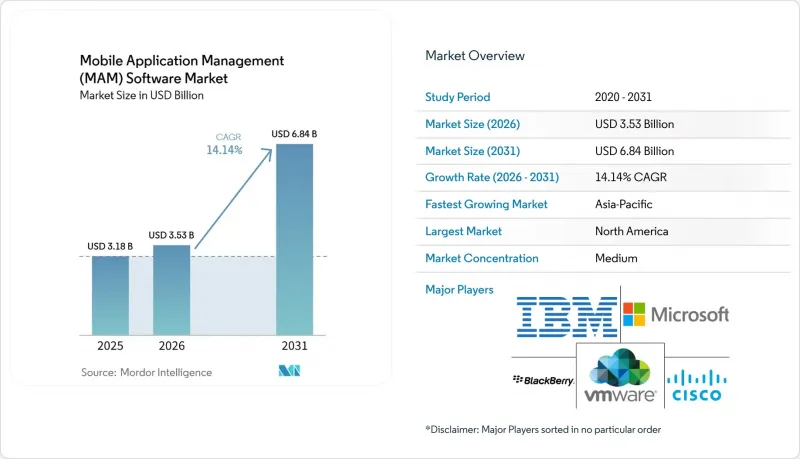
本報告按解決方案(軟體和服務)、部署類型(雲端、混合和本地部署)、企業規模(大型企業和中小企業)、最終用戶(IT和電信、醫療保健和生命科學、零售和電子商務、工業製造等)以及地區進行細分。市場預測以美元(USD)計價。
全球行動應用管理 (MAM) 軟體市場趨勢與洞察
混合辦公環境中對「雲端優先」採用的需求
隨著企業努力支持員工在家工作、在辦公室辦公以及在共用工作空間辦公,雲端管理的終端環境變得越來越普遍。在這樣的環境中,行動應用管理 (MAM) 軟體市場正在擴張。這是因為 MAM 允許快速更新應用程式策略,而無需依賴完整的裝置註冊或更改本機基礎架構。據微軟稱,針對未註冊設備的 MAM 通常與個人設備和 BYOD(自帶設備辦公)模式結合使用,無需註冊整個設備即可保護應用程式中的組織資料。這種模式透過保護電子郵件、文件和協作應用程式,同時將個人設備的控制權置於企業邊界之外,從而減輕了雇主和員工的負擔。此外,行動裝置已成為企業環境中不可或缺的一部分,無論是在企業所有還是個人所有的情況下,都需要集中管理和保護。因此,行動應用管理 (MAM) 軟體市場繼續受益於「雲端優先」策略,該策略將應用層定位為分散式員工最可操作的控制點。
應用層資料防丟失要求
隨著企業資料開始透過通訊應用、雲端盤和人工智慧工具在個人設備上流通,應用層級資料防洩漏 (DLP) 已成為一項核心需求。這種轉變正在推動行動應用管理 (MAM) 軟體市場的發展,因為應用控制可以阻止敏感資訊在授權管道之外的複製、傳輸和移動。應用保護策略還可以允許或阻止特定的應用程式內操作,包括複製和貼上控制,即使在未註冊的個人裝置上也是如此。 2026 年 7 月,一家供應商擴展了其終端平台,增加了原生 DLP、AI 使用情況可見性和集中式策略控制功能,用於控制 AI 應用、Web 應用和雲端服務之間交換的資料。在歐洲,NIS2 框架擴大了關鍵產業的網路安全義務,使報告和風險管理成為企業的優先事項。資料遺失風險和合規壓力的這種協同作用,使得行動應用管理 (MAM) 軟體市場在企業安全規劃中扮演越來越重要的角色。
與傳統 EMM 和 ID 系統整合方面的摩擦
許多公司仍然使用過時的企業行動管理環境、舊式憑證配置和重複的身份目錄,這使得新部署變得複雜。行動應用管理 (MAM) 軟體市場的成長正在放緩,因為公司部署新工具的速度往往超過了其組織這些工具所需連接系統的速度。蘋果公司於 2026 年 3 月發布的遷移功能引起了廣泛關注,該功能允許組織在不擦除設備資料的情況下,在 MDM 平台之間遷移設備,同時保留資料和設定。雖然這減輕了一些遷移負擔,但並沒有完全解決舊式策略結構、應用程式封裝和混合用戶記錄之間的衝突。當本地目錄和雲端身分工具仍然存在重疊時,安全團隊通常會推遲應用程式策略的全面部署,直到解決這些依賴關係。這種整合延遲仍然是行動應用管理 (MAM) 軟體市場快速擴張的最明顯限制因素之一。
細分市場分析
預計到2025年,軟體將佔據行動應用管理 (MAM) 軟體市場72.41%的佔有率,凸顯了策略引擎、合規性儀表板和SDK庫在每次部署中的核心作用。軟體將繼續主導市場,因為企業通常會先購買平台,然後隨著時間的推移,在其基礎上建立工作流程、控制和報告功能。在大多數合約中,軟體層仍然是主要支出,它透過單一介面處理應用程式分發、保護規則、存取控制和管理可見性。這種市場定位也反映出一種趨勢,即買家更傾向於選擇可以整合到大規模的終端和工作區程序中的更廣泛的平台,而不是作為功能單一的獨立工具。隨著行動應用管理 (MAM) 軟體市場的成熟,即使買家之後擴展到外部諮詢和託管支持,軟體仍將是部署的基礎。
預計到2031年,服務領域將以16.82%的複合年成長率成長,成為該領域中成長最快的部分。這一成長加速的原因在於,許多組織仍然缺乏內部人才來制定應用策略、整合式身分系統以及維護跨各種行動裝置組合的合規性規則。隨著應用程式管治的技術複雜性不斷增加,越來越多的買家尋求託管部署、策略微調和持續的諮詢支援。這種轉變正在擴大服務合作夥伴在受監管行業中的作用,在這些行業中,行動控制必須與正式的安全計劃和審計要求保持一致。從長遠來看,行動應用管理 (MAM) 軟體市場預計仍將以軟體為中心,但隨著組織對更多實際部署和管理支援的需求,收入組成將繼續向服務傾斜。
到2025年,基於雲端的部署將佔據行動應用管理(MAM)軟體市場68.19%的佔有率。這主要得益於SaaS交付模式的易用性以及對分散式使用者快速回應的需求。雲端部署之所以備受青睞,是因為它能夠快速反映策略變更、更輕鬆地維護應用程式可見性,並更方便地與雲端身分環境整合。此外,該模式也與「存取個人裝置」模式高度契合,即企業希望在不管理整個智慧型手機的情況下管理應用程式和資料。據報道,在Android、iOS和Windows平台上,企業都採用了針對未註冊裝置的應用程式保護機制,以便用戶能夠透過個人裝置存取企業。有鑑於這些優勢,雲端模式已成為行動應用管理(MAM)軟體市場許多領域的預設部署起點。
預計到2031年,混合部署將以15.43%的複合年成長率成長,繼續保持最快的部署模式。對於那些既需要基於雲端的策略管理,又需要出於資料居住和內部合規性考慮而保留本地控制點的行業而言,混合部署最具吸引力。終端解決方案因其支援雲端管理部署和本地控制,從而滿足資料主權和監管要求而備受關注。這種平衡正在推動那些無法將所有安全決策遷移到第三方雲端環境的企業對混合部署的需求。雖然完全本地部署模式在隔離或高度監管的環境中仍然很重要,但其運行速度較慢,因此對許多分散式團隊的吸引力有所下降。因此,混合部署正在成為行動應用管理 (MAM) 軟體市場中一座切實可行的橋樑,彌合雲端效率和管理需求之間的差距。
區域分析
到2025年,北美將繼續保持其在行動應用管理(MAM)軟體市場的領先地位,佔據34.62%的市場佔有率。該地區受益於企業軟體買家的高度集中、零信任安全模型的日益普及以及在終端和身分管理方面的高額支出。美國仍然是最大的市場貢獻者,金融、醫療保健和科技業的大型企業持續將行動應用管治視為數位安全不可或缺的一部分。加拿大也為該地區的需求做出了貢獻,因為金融機構和其他受監管機構正在加強對行動風險的監控,並收緊對商用應用程式的控制。成熟的買家群體和持續的合規壓力確保了北美繼續保持其在行動應用管理(MAM)軟體市場的領先地位。
預計到2031年,亞太地區將以17.83%的複合年成長率成長,成為成長最快的區域市場。印度是主要的成長引擎,這得益於科技服務公司和銀行中企業智慧型手機和自帶設備辦公室(BYOD)計劃的日益普及。在韓國,大型企業集團需要為其全球分佈的員工製定統一的行動應用政策,因此對行動應用的需求日益成長。隨著雲端交付成本的降低、5G覆蓋範圍的擴大以及印尼、越南和泰國政府數位化計畫的推進,東南亞地區行動辦公室的普及率正在上升。中國則採取了不同的發展路徑,資料本地化法規優先考慮國內託管和混合部署模式。同時,日本對更靈活的工作安排和國內數據處理的偏好也在不斷成長。
預計到2025年,歐洲將成為市佔率第二大的地區,這主要得益於持續的合規性驅動型主導。 NIS2指令將網路安全義務擴展至18個關鍵產業,要求成員國在2024年10月前將此架構納入其國家立法。德國、英國和法國是該地區最大的各國市場,金融服務、製造業和公共部門的市場活動十分活躍。南美洲以及中東和非洲仍處於起步階段,但由於隱私法和更廣泛的數位化舉措推動了對行動裝置應用層控制需求的不斷成長,市場需求正在擴大。
其他好處:
- Excel格式的市場預測(ME)表
- 3個月的分析師支持
目錄
第1章:引言
- 研究假設和市場定義
- 調查範圍
第2章:調查方法
第3章執行摘要
第4章 市場狀況
- 市場概覽
- 市場促進因素
- 混合辦公環境中對「雲端優先」採用的需求
- 應用層預防資料外泄要求
- 將零信任策略應用於託管應用程式
- 應用容器化和沙箱實施現狀
- 將終端和應用控制棧與FinOps整合的壓力
- 承包商和現場負責人的移動通道分隔
- 市場限制因素
- 與傳統企業行動管理 (EMM) 和身分管理堆疊整合方面的摩擦
- 多個行動作業系統版本之間存在策略不一致
- 安全預算有限;所有權不在中央IT部門。
- 公司內部應用程式的應用程式封裝和SDK維護相關的額外開銷。
- 宏觀經濟因素對市場的影響
- 產業價值鏈分析
- 科技趨勢
- 監理情勢
- 波特五力分析
第5章 市場規模與成長預測
- 透過解決方案
- 軟體
- 服務
- 不同的發展
- 基於雲端的
- 混合
- 現場
- 按公司規模
- 大公司
- 小型企業
- 最終用戶
- 資訊科技/通訊
- BFSI
- 醫療保健和生命科學
- 零售與電子商務
- 工業製造
- 教育和研究機構
- 媒體與娛樂
- 政府/行政部門
- 能源公用事業
- 其他終端用戶產業
- 按地區
- 北美洲
- 美國
- 加拿大
- 墨西哥
- 南美洲
- 巴西
- 阿根廷
- 其他南美國家
- 歐洲
- 德國
- 英國
- 法國
- 俄羅斯
- 西班牙
- 其他歐洲國家
- 亞太地區
- 中國
- 日本
- 印度
- 韓國
- 東南亞
- 其他亞太國家
- 中東和非洲
- 中東
- 沙烏地阿拉伯
- 阿拉伯聯合大公國
- 土耳其
- 其他中東國家
- 非洲
- 南非
- 奈及利亞
- 埃及
- 其他非洲國家
- 中東
- 北美洲
第6章 競爭情勢
- 市場集中度
- 策略趨勢
- 市佔率分析
- 公司簡介
- Microsoft Corporation
- VMware, Inc.
- Cisco Systems, Inc.
- Cloud Software Group
- Ivanti Neurons for MDM
- ManageEngine
- 42Gears SureMDM
- Amazon Web Services, Inc.
- Oracle Corporation
- SAP SE
- IBM Corporation
- ProMobi Technologies
- BlackBerry Limited
- Tangoe
- NinjaOne
- Jamf Pro
- Codeproof Technologies
- SOTI MobiControl
- Anysphere, Inc.
- Jamf Pro
第7章 市場機會與未來展望
According to Mordor Intelligence, the mobile application management (MAM) software market size was USD 3.18 billion in 2025 and is forecast to reach USD 6.84 billion by 2031, growing at a CAGR of 14.14% from 2026 to 2031.
This report is Segmented by Solution (Software, and Services), Deployment (Cloud-Based, Hybrid, and On-Premises), Enterprise Size (Large Enterprises, and Small and Medium Enterprises), End User (IT and Telecommunication, Healthcare and Life Sciences, Retail and E-Commerce, Industrial Manufacturing, and More), and Geography. The Market Forecasts are Provided in Terms of Value (USD).
Global Mobile Application Management (MAM) Software Market Trends and Insights
Cloud-First Rollout Demand Across Hybrid Workforces
Cloud-managed endpoint environments became more common as enterprises tried to support workers across homes, offices, and shared workspaces. In that setting, the Mobile Application Management (MAM) Software Market is gaining because app policies can be updated quickly without depending on full device enrollment or local infrastructure changes. Microsoft states that MAM for unenrolled devices is commonly used for personal or BYOD devices and can protect organizational data inside applications without enrolling the full device. This model reduces friction for employers and employees by protecting email, files, and collaboration apps while leaving personal device control outside the enterprise boundary. It is also noted that mobile devices have become a permanent part of enterprise environments and need centralized management and protection across both corporate-owned and personally owned scenarios. As a result, the Mobile Application Management (MAM) Software Market continues to benefit from cloud-first programs that treat the application layer as the most practical control point for distributed workforces.
App-Level Data Loss Prevention Requirements
Application-level data loss prevention moved closer to a core requirement as business data began flowing through messaging apps, cloud drives, and AI tools on personal devices. This shift is supporting the Mobile Application Management (MAM) Software Market because app controls can block copying, forwarding, or moving sensitive information outside approved channels. It is explained that app protection policies can allow or block specific in-app actions, including copy-and-paste controls, on unenrolled personal devices. One vendor expanded its endpoint platform in July 2026 with native DLP, AI usage visibility, and centralized policy controls for data exchanged with AI applications, web applications, and cloud services. In Europe, the NIS2 framework widened cybersecurity obligations across critical sectors and kept reporting and risk management duties high on enterprise agendas. That combination of data exposure risk and compliance pressure is giving the Mobile Application Management (MAM) Software Market a stronger role in enterprise security planning.
Integration Friction with Legacy EMM and Identity Stacks
Many enterprises still use older enterprise mobility management environments, legacy certificate setups, and overlapping identity directories, which complicate new rollouts. This slows the Mobile Application Management (MAM) Software Market because companies often buy modern tools faster than they can clean up the systems that those tools must connect with. A March 2026 Apple migration feature was highlighted that lets organizations move devices between MDM platforms without wiping the device, while retaining data and configurations. That reduces part of the switching burden, but it does not fully solve conflicts across older policy structures, app wrappers, and mixed user records. Where on-premises directories and cloud identity tools still overlap, security teams often delay full app policy rollout until those dependencies are sorted. This integration drag remains one of the clearest restraints on faster expansion in the Mobile Application Management (MAM) Software Market.
Other drivers and restraints analyzed in the detailed report include:
- Zero Trust Policy Enforcement for Managed Apps
- App Containerization and Sandboxing Adoption
- Policy Drift Across Multiple Mobile Operating System Versions
For complete list of drivers and restraints, kindly check the Table Of Contents.
Segment Analysis
Software held 72.41% of the Mobile Application Management (MAM) Software Market share in 2025, underscoring the centrality of policy engines, compliance dashboards, and SDK libraries to every deployment. The largest share remained with software because enterprises usually buy a platform first, then add workflows, controls, and reporting around it over time. In most contracts, the software layer remains the primary spending center because it handles app distribution, protection rules, access controls, and administrative visibility through a single interface. That position also reflects buyer preference for broad platforms that can sit inside larger endpoint and workspace programs rather than operate as narrow standalone tools. As the Mobile Application Management (MAM) Software Market matures, software continues to anchor the installed base even when buyers later expand into outside consulting or managed support.
Services are projected to grow at a 16.82% CAGR through 2031, making them the fastest-growing part of this segment. Growth is picking up because many organizations still lack the in-house staff needed to configure app policies, integrate identity systems, and maintain compliance rules across mixed mobile fleets. The rising technical depth of app governance is pushing more buyers toward managed deployment, policy tuning, and ongoing advisory support. This shift is also widening the role of service partners in regulated sectors, where mobile controls must align with formal security programs and audit expectations. Over time, the Mobile Application Management (MAM) Software Market is likely to maintain its software-heavy structure, but the revenue mix should continue to shift toward services as organizations seek more hands-on implementation and management support.
Cloud-based deployment accounted for 68.19% of the Mobile Application Management (MAM) Software Market size in 2025, supported by the operational ease of SaaS delivery and the need for faster response across distributed users. Cloud deployment is favored because policy changes can be pushed quickly, application visibility is easier to maintain, and integration with cloud identity environments is more straightforward. It also aligns well with personal-device access models, where organizations want to manage the app and data without taking control of the whole phone. It is stated that app protection on unenrolled devices is used across Android, iOS, and Windows for organizational access on personal devices. These advantages have helped the cloud model become the default starting point in much of the Mobile Application Management (MAM) Software Market.
Hybrid deployment is projected to grow at a 15.43% CAGR through 2031 and remains the fastest-expanding deployment model. The appeal is strongest in sectors that want cloud-based policy administration but still need on-premises control points for data residency or internal compliance reasons. It was noted that an endpoint offering supports both cloud-managed deployments and on-premises control to meet data sovereignty and regulatory needs. That same balance is driving hybrid demand across enterprises that cannot move every security decision into a third-party cloud environment. Fully on-premises models still matter in isolated or highly restricted settings, but their slower operating model makes them less attractive for many distributed teams. As a result, the Mobile Application Management (MAM) Software Market is seeing hybrid become the practical bridge between cloud efficiency and control requirements.
Complete Report Scope:
- By Solution
- Software
- Services
- By Deployment
- Cloud-Based
- Hybrid
- On-Premises
- By Enterprise Size
- Large Enterprises
- Small and Medium Enterprises
- By End User
- IT and Telecommunication
- BFSI
- Healthcare and Life Sciences
- Retail and E-Commerce
- Industrial Manufacturing
- Education and Research Institutions
- Media and Entertainment
- Government and administration
- Energy and Utilities
- Other end-user industries
- By Geography
- North America
- United States
- Canada
- Mexico
- South America
- Brazil
- Argentina
- Rest of South America
- Europe
- Germany
- United Kingdom
- France
- Russia
- Spain
- Rest of Europe
- Asia-Pacific
- China
- Japan
- India
- South Korea
- Southeast Asia
- Rest of Asia-Pacific
- Middle East and Africa
- Middle East
- Saudi Arabia
- United Arab Emirates
- Turkey
- Rest of Middle East
- Africa
- South Africa
- Nigeria
- Egypt
- Rest of Africa
- Middle East
- North America
Geography Analysis
North America held 34.62% of the Mobile Application Management (MAM) Software Market share in 2025, maintaining its leading regional position. The region benefits from a dense base of enterprise software buyers, stronger adoption of zero-trust security models, and higher spending on endpoint and identity management. The United States remains the largest national contributor because large enterprises in finance, healthcare, and technology continue to treat mobile app governance as a necessary part of digital security. Canada is also contributing to regional demand as financial institutions and other regulated organizations tighten mobile risk oversight and strengthen controls around work applications. This combination of mature buyers and steady compliance pressure kept North America ahead in the Mobile Application Management (MAM) Software Market.
Asia-Pacific is projected to grow at a 17.83% CAGR through 2031, which makes it the fastest-growing regional segment. India is a major growth engine because enterprise smartphone use and BYOD programs are expanding across technology services firms and banks. South Korea is seeing demand from large conglomerates that need consistent mobile app policies across globally distributed workforces. Southeast Asia is opening new room for adoption as cloud delivery costs ease, 5G coverage expands, and government digitization programs improve the case for business mobility in Indonesia, Vietnam, and Thailand. China follows a different path because data localization rules favor local hosting and hybrid deployment models, while Japan is seeing stronger demand for more flexible work arrangements and a preference for local data-handling practices.
Europe held the second-largest regional share in 2025 and remains driven by compliance-led adoption. The NIS2 Directive widened cybersecurity obligations across 18 critical sectors and required member states to transpose the framework into national law by October 2024. Germany, the United Kingdom, and France are the region's largest country markets, with stronger activity in financial services, manufacturing, and the public sector. South America, the Middle East, and Africa remain early-stage regions, but demand is improving as privacy laws and broader digital initiatives heighten the need for application-layer controls on mobile devices.
- Microsoft Corporation
- VMware, Inc.
- Cisco Systems, Inc.
- Cloud Software Group
- Ivanti Neurons for MDM
- ManageEngine
- 42Gears SureMDM
- Amazon Web Services, Inc.
- Oracle Corporation
- SAP SE
- IBM Corporation
- ProMobi Technologies
- BlackBerry Limited
- Tangoe
- NinjaOne
- Jamf Pro
- Codeproof Technologies
- SOTI MobiControl
- Anysphere, Inc.
- Jamf Pro
Additional Benefits:
- The market estimate (ME) sheet in Excel format
- 3 months of analyst support
TABLE OF CONTENTS
1 INTRODUCTION
- 1.1 Study Assumptions and Market Definition
- 1.2 Scope of the Study
2 RESEARCH METHODOLOGY
3 EXECUTIVE SUMMARY
4 MARKET LANDSCAPE
- 4.1 Market Overview
- 4.2 Market Drivers
- 4.2.1 Cloud-First Rollout Demand Across Hybrid Workforces
- 4.2.2 App-Level Data Loss Prevention Requirements
- 4.2.3 Zero Trust Policy Enforcement For Managed Apps
- 4.2.4 App Containerization And Sandboxing Adoption
- 4.2.5 FinOps Pressure To Consolidate Endpoint And App Control Stacks
- 4.2.6 Mobile Privilege Segregation For Contractor And Frontline Access
- 4.3 Market Restraints
- 4.3.1 Integration Friction With Legacy EMM And Identity Stacks
- 4.3.2 Policy Drift Across Multiple Mobile Operating System Versions
- 4.3.3 Limited Security Budget Ownership Outside Central IT
- 4.3.4 App Wrapping And SDK Maintenance Overhead For In-House Apps
- 4.4 Impact of Macroeconomic Factors on the Market
- 4.5 Industry Value Chain Analysis
- 4.6 Technology Outlook
- 4.7 Regulatory Landscape
- 4.8 Porter's Five Forces Analysis
- 4.8.1 Threat of New Entrants
- 4.8.2 Bargaining Power of Suppliers
- 4.8.3 Bargaining Power of Buyers
- 4.8.4 Threat of Substitutes
- 4.8.5 Intensity of Competitive Rivalry
5 MARKET SIZE AND GROWTH FORECASTS (VALUE)
- 5.1 By Solution
- 5.1.1 Software
- 5.1.2 Services
- 5.2 By Deployment
- 5.2.1 Cloud-Based
- 5.2.2 Hybrid
- 5.2.3 On-Premises
- 5.3 By Enterprise Size
- 5.3.1 Large Enterprises
- 5.3.2 Small and Medium Enterprises
- 5.4 By End User
- 5.4.1 IT and Telecommunication
- 5.4.2 BFSI
- 5.4.3 Healthcare and Life Sciences
- 5.4.4 Retail and E-Commerce
- 5.4.5 Industrial Manufacturing
- 5.4.6 Education and Research Institutions
- 5.4.7 Media and Entertainment
- 5.4.8 Government and administration
- 5.4.9 Energy and Utilities
- 5.4.10 Other end-user industries
- 5.5 By Geography
- 5.5.1 North America
- 5.5.1.1 United States
- 5.5.1.2 Canada
- 5.5.1.3 Mexico
- 5.5.2 South America
- 5.5.2.1 Brazil
- 5.5.2.2 Argentina
- 5.5.2.3 Rest of South America
- 5.5.3 Europe
- 5.5.3.1 Germany
- 5.5.3.2 United Kingdom
- 5.5.3.3 France
- 5.5.3.4 Russia
- 5.5.3.5 Spain
- 5.5.3.6 Rest of Europe
- 5.5.4 Asia-Pacific
- 5.5.4.1 China
- 5.5.4.2 Japan
- 5.5.4.3 India
- 5.5.4.4 South Korea
- 5.5.4.5 Southeast Asia
- 5.5.4.6 Rest of Asia-Pacific
- 5.5.5 Middle East and Africa
- 5.5.5.1 Middle East
- 5.5.5.1.1 Saudi Arabia
- 5.5.5.1.2 United Arab Emirates
- 5.5.5.1.3 Turkey
- 5.5.5.1.4 Rest of Middle East
- 5.5.5.2 Africa
- 5.5.5.2.1 South Africa
- 5.5.5.2.2 Nigeria
- 5.5.5.2.3 Egypt
- 5.5.5.2.4 Rest of Africa
- 5.5.5.1 Middle East
- 5.5.1 North America
6 COMPETITIVE LANDSCAPE
- 6.1 Market Concentration
- 6.2 Strategic Moves
- 6.3 Market Share Analysis
- 6.4 Company Profiles (includes Global Level Overview, Market Level Overview, Core Segments, Financials as available, Strategic Information, Market Rank/Share, Products and Services, Recent Developments)
- 6.4.1 Microsoft Corporation
- 6.4.2 VMware, Inc.
- 6.4.3 Cisco Systems, Inc.
- 6.4.4 Cloud Software Group
- 6.4.5 Ivanti Neurons for MDM
- 6.4.6 ManageEngine
- 6.4.7 42Gears SureMDM
- 6.4.8 Amazon Web Services, Inc.
- 6.4.9 Oracle Corporation
- 6.4.10 SAP SE
- 6.4.11 IBM Corporation
- 6.4.12 ProMobi Technologies
- 6.4.13 BlackBerry Limited
- 6.4.14 Tangoe
- 6.4.15 NinjaOne
- 6.4.16 Jamf Pro
- 6.4.17 Codeproof Technologies
- 6.4.18 SOTI MobiControl
- 6.4.19 Anysphere, Inc.
- 6.4.20 Jamf Pro
7 MARKET OPPORTUNITIES AND FUTURE OUTLOOK
- 7.1 White-Space and Unmet-Need Assessment

 2026年全球叫車應用市場報告
 全球行動應用市場規模、佔有率、趨勢和成長分析報告(2026-2034)
 電子商務應用:市場佔有率分析、產業趨勢與統計、成長預測(2026-2031)印度政府超級應用平台:市場佔有率分析、產業趨勢與統計及成長預測(2026-2031)
 行動應用與網路分析市場:全球市場預測,2026-2032年數位筆記型電腦市場:2026-2032年全球市場預測(按產品類型、筆記型電腦格式、設備生態系統、連接方式、應用、部署和最終用戶分類)行動應用市場:2026-2032年全球市場預測(按平台、裝置類型、定價模式、連線需求、應用程式和最終用戶分類)黑色素瘤檢測行動應用:市佔率分析、產業趨勢與統計及成長預測(2026-2031)
 備忘錄應用市場規模、佔有率和成長分析:按平台、功能、最終用戶、通路和地區分類-2026-2033年產業預測
 分攤帳單應用市場規模、佔有率和成長分析:按產品/服務、平台、採用模式、最終用戶、收入模式、分銷管道和地區分類-2026-2033年產業預測