


 |
市場調查報告書
商品編碼
2097393
黑色素瘤檢測行動應用:市佔率分析、產業趨勢與統計及成長預測(2026-2031)Mobile Applications for Melanoma Detection - Market Share Analysis, Industry Trends & Statistics, Growth Forecasts (2026 - 2031) |
||||||

※ 本網頁內容可能與最新版本有所差異。詳細情況請與我們聯繫。
據 Mordor Intelligence 稱,2026 年黑色素瘤檢測行動應用程式的市場規模估計為 5 億美元,預計在預測期(2026-2031 年)內將以 17.32% 的複合年成長率成長,到 2031 年達到 11.3 億美元。
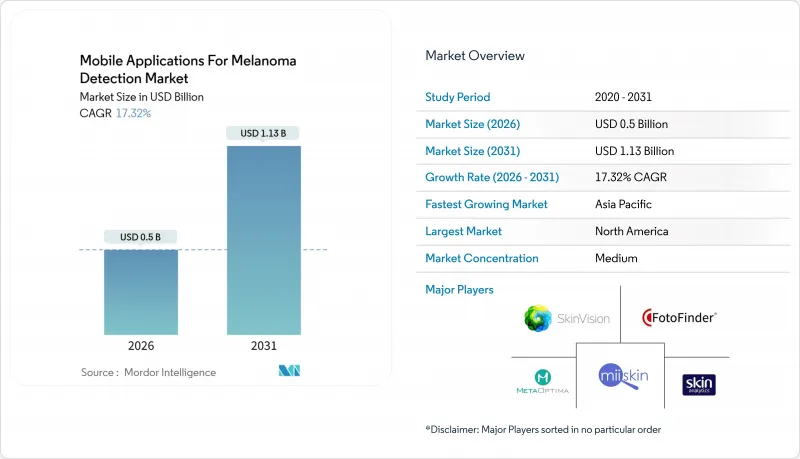
本報告按應用領域(診斷、監測等)、最終用戶(醫療保健專業人員等)、技術(人工智慧、機器學習、影像識別等)、經營模式(免費增值、訂閱、按掃描/按許可收費)和地區(北美、歐洲、亞太、中東和非洲、南美)進行細分。市場預測以美元計價。
全球黑色素瘤檢測行動應用市場趨勢及洞察。
行動醫療技術的普及速度正在加快。
行動醫療生態系統正在取代以診所為中心的皮膚檢測,透過智慧型手機實現早期診斷,從而適應都市區和鄉村的生活方式。預計到2024年,亞太地區的智慧型手機普及率將超過73%,該地區的行動經濟預計到2030年將達到1兆美元,這為黑色素瘤檢測應用程式的硬體基礎設施發展奠定了基礎。美國於2024年發布的指引認可了遠距採集的數位終點,鞏固了檢驗的影像分析軟體在腫瘤學後期臨床試驗中的作用。軟硬體結合的產品,例如FotoFinder的「skeen」皮膚鏡(已於2025年獲得MDR批准),展示了工業設計獎項和監管批准如何能夠並存,從而促進醫療服務提供者的快速採用。企業健康供應商現在將年度皮膚檢測與心理健康和代謝疾病篩檢打包在一起,從而形成持續互動和更豐富的縱向資料集的循環。
全球皮膚癌負擔日益加重。
在紫外線照射量高且人口老化的地區,黑色素瘤的發生率持續上升。國際癌症研究機構(IARC)在2024年報告中指出,經年齡調整後的發生率在澳洲、歐洲和北美仍是成長最快的地區。 2024年美國勞動力預測報告強調了農村地區皮膚科醫師長期短缺的問題,因此需要在基層醫療網路中採用人工智慧輔助的分診系統,以避免轉診瓶頸。澳洲已宣布致力於數位化監測,並計劃於2025年建立自己的黑色素瘤影像卓越中心。製藥公司將這些流行病學壓力作為理由,要求在移動生物標記方面投入預算,因為這些生物標記無需患者額外就診即可豐富生存數據。疾病盛行率與臨床能力之間的差距正在推動對檢驗的電話篩檢的需求。
臨床有效性和準確性仍存在挑戰
2024年發表於《自然醫學》的一項分析得出結論:僅憑監管部門的批准很少能保證在真實世界隊列中獲得可靠的前瞻性檢驗。英國國家衛生與臨床最佳化研究所(NICE)在2025年的早期評估中也認同這一觀點,並呼籲報告亞組療效以識別潛在的偏差。 2025年發生的軟體召回事件,包括持續血糖監測應用程式的故障,凸顯了上市後監測義務的重要性。美國於2025年發布的指南強制要求制定變更管理計劃,記錄演算法在發布後的演變過程。缺乏行業通用的影像品質基準仍然阻礙著不同醫療系統之間進行可比較的採購比較。
細分市場分析
儘管2025年調查應用程式的市場規模較小,但預計到2031年將以19.54%的複合年成長率成長,這主要得益於去中心化的免疫療法研究,該研究傾向於使用遠端採集的病變影像作為數位生物標記。診斷軟體預計仍將是重要的收入來源,在2025年黑色素瘤檢測領域將保持47.54%的市場佔有率,儘管由於更嚴格的檢驗要求,其成長速度有所放緩。高風險患者的監測工具雖然規模小規模,但隨著皮膚科診所擴大將初始的現場病變定位與遠端追蹤相結合以確保臨床能力,該領域正呈現成長態勢。教育類下載擴大了用戶覆蓋範圍,但直接收入微乎其微,其作用在於引導用戶使用付費模組。
更嚴格的人工智慧醫療設備指南於2025年10月實施,提高了證據要求。這降低了面向消費者的應用程式的准入門檻,同時有利於那些已整合到受監管的臨床試驗中的平台。贊助商正在資助多組基於圖像的診斷子研究,以抵消開發人員的成本並加快監管申報。 MIDAS資料集的發佈為研究團隊提供了通用的評估標準,從而縮短了審查週期。尋求付費診斷以確保診斷準確性的患者會被帶有FDA和CE標誌的應用程式所吸引,從而確保商業性成功與臨床嚴謹性能夠兼得。
到2025年,患者和消費者將貢獻52.45%的收入,主要得益於免費增值模式的便利性。然而,預計複合年成長率最高的將是製藥公司和合約研究機構,它們已開始在方案設計中累計基於智慧型手機的病灶成像技術,其複合年成長率預計將達到20.45%。包括皮膚科醫生和基層醫療醫生在內的醫療服務提供者正穩步採用該技術,但在大規模部署之前,他們需要調整與電子健康記錄(EHR)和醫療事故保險的整合。學術研究人員正在使用機構許可收集參考數據,但這仍然是小規模的收入來源。
儘管聯邦醫療保險(Medicare)2025年11月發布的理賠指南將擴大醫療服務提供者的報銷範圍並加速其在臨床實踐中的應用,但隨著基於影像的終點指標的採用減少了患者就診次數,並使臨床試驗能夠擴展到服務不足的地區,製藥公司贊助的進展正在加速。企業健康入口網站構成了一種混合型類別,它結合了消費者主導的採用和組織監管。學術機構和製藥公司組成的聯盟正在提供監管機構所需的外部檢驗,從而在證據生成和市場成長之間形成良性循環。
區域分析
預計到2025年,北美將佔總收入的42.65%,這得益於FDA 510(k)的批准以及永久性的Medicare遠端醫療代碼,該代碼允許將手機拍攝的影像作為可計費事件進行收費。儘管越來越多的雇主正在實施健康計劃,創業投資資金也依然充足,但對演算法偏差的審查正在減緩Fitzpatrick皮膚分型IV-VI型人群比例較高的地區的全面部署。根據HRSA報告,皮膚科醫生短缺正在推動人們對擴充性診的需求,尤其是在農村地區。
亞太地區預計將成為成長最快的地區,2026年至2031年的複合年成長率將達到18.54%,這主要得益於行動優先的醫療模式和人們對皮膚癌日益成長的認知。澳洲政府支持的影像中心正在鞏固該國在該領域的領先地位。與此同時,印度的新創公司正在利用本地語言介面和區域培訓數據來避免西方偏見。除了澳洲和日本外,監管政策的差異和保險公司基礎設施的不足阻礙,但這並不意味著龐大的市場規模機會就此消失。
在歐洲,隨著醫療設備法規(MDR)的日益嚴格,相關技術正穩步普及。德國製造的結合了光學技術和人工智慧的設備已獲得MDR認證,並逐漸成為注重隱私的消費者的高階選擇。英國國家醫療服務體系(NHS)數位試驗計畫對MyMelanoma的推薦表明,該設備已準備好被公共保險公司接受,但遵守GDPR的要求增加了成本,並減緩了消費者的部署速度。在中東、非洲和南美等新興地區,儘管收入基數較低,但由於智慧型手機的普及以及公共衛生組織開展的防紫外線宣傳活動,預計該領域將出現可觀的成長率。
其他好處:
- Excel格式的市場預測(ME)表
- 3個月的分析師支持
目錄
第1章:引言
- 研究假設和市場定義
- 調查範圍
第2章:調查方法
第3章執行摘要
第4章 市場狀況
- 市場概覽
- 市場促進因素
- 加速行動醫療技術的普及
- 全球皮膚癌負擔日益加重
- 人工智慧驅動的皮膚病診斷技術進步
- 高解析度智慧型手機相機的普及
- 將黑色素瘤相關應用納入國家遠端醫療保險報銷框架。
- 擴大雇主主導的數位皮膚篩檢項目
- 市場限制因素
- 臨床有效性和準確性方面仍然存在挑戰。
- 嚴格的資料隱私和網路安全法規
- 世界各國法規核准流程正變得越來越複雜和多樣化。
- 演算法性能在不同膚色類型上的差異
- 價值供應鏈分析
- 監理情勢
- 技術展望
- 波特五力分析
第5章 市場規模與成長預測
- 透過使用
- 診斷用途
- 監控應用程式
- 教育用途
- 出於研究目的
- 其他用途
- 最終用戶
- 醫療服務提供方
- 病人/消費者
- 研究人員和相關人員
- 製藥公司和合約研究組織
- 其他最終用戶
- 透過技術
- 人工智慧
- 機器學習
- 影像識別
- 穿戴式裝置關聯影像
- 遠端醫療解決方案
- 按經營模式
- 免費增值
- 訂閱
- 每次掃描/許可證收費
- 地區
- 北美洲
- 美國
- 加拿大
- 墨西哥
- 歐洲
- 德國
- 英國
- 法國
- 義大利
- 西班牙
- 其他歐洲國家
- 亞太地區
- 中國
- 日本
- 印度
- 澳洲
- 韓國
- 其他亞太國家
- 中東和非洲
- GCC
- 南非
- 其他中東和非洲國家
- 南美洲
- 巴西
- 阿根廷
- 其他南美國家
- 北美洲
第6章 競爭情勢
- 市場集中度
- 市佔率分析
- 公司簡介
- 3Derm Systems
- Coralai
- CureSkin
- DermaCompare
- Dermalyser
- DermaSensor
- DermTech
- FotoFinder-Moleanalyzer Pro
- Map My Mole
- MelApp
- Miiskin
- Mole Detective
- MoleScope(MetaOptima)
- Nomela(Moletest)
- Skin Analytics(DERM)
- SkinIO
- SkinScan(TeleSkin)
- SkinVision
- SpotMole Plus
- UMSkinCheck
第7章 市場機會與未來展望
According to Mordor Intelligence, the mobile applications for melanoma detection market size is estimated at USD 0.5 billion in 2026, and is expected to reach USD 1.13 billion by 2031, at a CAGR of 17.32% during the forecast period (2026-2031).
This report is Segmented by Application (Diagnostic, Monitoring, and More), End-User (Healthcare Providers, and More), Technology (AI, ML, Image Recognition, and More), Commercial Model (Freemium, Subscription, and Pay-Per-Scan/License), and Geography (North America, Europe, Asia-Pacific, MEA, and South America). Market Forecasts are Provided in Value (USD).
Global Mobile Applications for Melanoma Detection Market Trends and Insights
Accelerating Adoption of Mobile Health Technologies
Mobile health ecosystems are displacing clinic-centric skin checks by allowing on-phone triage that fits rural and urban lifestyles alike. Asia-Pacific's smartphone penetration surpassed 73% in 2024, and the regional mobile economy is projected to reach USD 1 trillion by 2030, providing melanoma apps with a ready hardware base. United States guidance released in 2024 recognized digital endpoints captured remotely, a change that cemented the role of validated imaging software in late-phase oncology studies. Hardware-software pairs such as FotoFinder's skeen dermatoscope, which earned MDR clearance in 2025, illustrate how industrial design awards and regulatory nods can coexist to drive rapid provider uptake. Corporate wellness vendors now bundle annual skin checks alongside mental-health or metabolic screenings, creating sticky engagement loops and richer longitudinal datasets.
Escalating Burden of Skin Cancer Worldwide
Melanoma incidence continues to rise across aging populations with high ultraviolet exposure. The International Agency for Research on Cancer reported in 2024 that age-standardized rates are still rising fastest in Australia, Europe, and North America. U.S. workforce forecasts published in 2024 highlight long-term dermatologist shortages in rural counties, pressing primary-care networks to adopt AI-assisted triage to avoid referral bottlenecks. Australia backed its own Centre of Excellence in Melanoma Imaging in 2025, confirming a state-level commitment to digital surveillance. Pharmaceutical firms cite these epidemiological pressures when allocating budget to mobile biomarkers that can enrich survival data without extra site visits. Together, disease prevalence and clinical capacity gaps reinforce the demand pull for validated phone-based screening.
Persistent Clinical Validation and Accuracy Challenges
A Nature Medicine analysis published in 2024 concluded that regulatory authorization alone rarely ensures robust, prospective validation across real-world cohorts. NICE echoed this stance in its 2025 early value assessment that calls for subgroup efficacy reporting to spot hidden bias. Software recalls, including a 2025 bug in a continuous glucose monitoring app, highlight postmarket vigilance duties. U.S. guidance released in 2025 now mandates change-control plans that document how algorithms will evolve after launch. The lack of industry-wide imaging-quality benchmarks continues to hinder apples-to-apples procurement comparisons for health systems.
Other drivers and restraints analyzed in the detailed report include:
- Technological Advancements in AI-Driven Dermatology Diagnostics
- Integration of Melanoma Apps into National Telehealth Reimbursement Frameworks
- Stringent Data Privacy and Cybersecurity Regulations
For complete list of drivers and restraints, kindly check the Table Of Contents.
Segment Analysis
Research apps represented a smaller base in 2025 but are predicted to compound at 19.54% CAGR through 2031, fueled by decentralized immunotherapy studies that prefer remotely captured lesion images as digital biomarkers. Diagnostic software maintained 47.54% of the melanoma detection market share in 2025 and will remain the revenue anchor, though its growth is slower due to tougher validation requirements. Monitoring tools for high-risk patients occupy a modest revenue niche that is expanding as dermatology offices combine initial in-person mapping with remote follow-ups to conserve capacity. Educational downloads generate reach but minimal direct income; they instead funnel users toward paid modules.
The stricter October 2025 AI-medical-device guidance raises evidence thresholds, easing barriers to consumer-only apps while favoring platforms embedded in regulated clinical trials. Sponsors fund multi-arm imaging sub-studies, offsetting developer costs and accelerating regulatory filings. Publication of the MIDAS dataset provides research teams with a shared yardstick, thereby shortening review cycles. Patients wanting paid diagnostic certainty gravitate toward apps with visible FDA or CE marks, aligning commercial success with clinical rigor.
Patients and consumers accounted for 52.45% of 2025 revenue, driven by freemium convenience, yet the highest expected 20.45% CAGR belongs to pharmaceutical companies and contract research organizations that now budget for phone-based lesion capture in protocol design. Healthcare providers-including dermatologists and primary-care physicians-deliver stable uptake but must reconcile EHR integration and malpractice coverage before mass rollout. Academic researchers leverage institutional licenses to gather reference data, but it remains a smaller revenue line.
Medicare's November 2025 billing guidance expands provider reimbursement, fostering clinical uptake, yet pharma sponsors advance faster because imaging endpoints can cut site visits and extend trial reach into underserved zip codes. Employer wellness portals create a hybrid category that combines consumer-driven onboarding with institutional oversight. Academic-pharma consortia supply external validation that regulators want, completing a virtuous circle between evidence generation and market growth.
Complete Report Scope:
- By Application
- Diagnostic Applications
- Monitoring Applications
- Educational Applications
- Research Applications
- Other Applictions
- By End-User
- Healthcare Providers
- Patients / Consumers
- Researchers & Academics
- Pharmaceutical Companies & CROs
- Other End-Users
- By Technology
- Artificial Intelligence
- Machine Learning
- Image Recognition
- Wearable-Linked Imaging
- Telemedicine Solutions
- By Commercial Model
- Freemium
- Subscription
- Pay-Per-Scan / License
- Geography
- North America
- United States
- Canada
- Mexico
- Europe
- Germany
- United Kingdom
- France
- Italy
- Spain
- Rest Of Europe
- Asia-Pacific
- China
- Japan
- India
- Australia
- South Korea
- Rest Of Asia-Pacific
- Middle East & Africa
- GCC
- South Africa
- Rest Of Middle East & Africa
- South America
- Brazil
- Argentina
- Rest Of South America
- North America
Geography Analysis
North America contributed 42.65% of 2025 revenue, anchored by FDA 510(k) clearances and permanent Medicare telehealth codes that allow phone-captured images to be billed as billable events. Employer wellness adoption is advanced, and venture capital remains readily available, yet algorithmic bias scrutiny slows blanket rollout in communities with higher proportions of Fitzpatrick IV-VI skin types. Dermatologist shortages documented by HRSA heighten interest in scalable triage, particularly in rural counties.
Asia-Pacific is the fastest-growing region at 18.54% CAGR for 2026-2031, propelled by mobile-first care models and rising skin cancer awareness. Australia's state-backed imaging center reinforces national leadership, while India-based startups capitalize on vernacular interfaces and local training data to sidestep Western bias. Divergent regulatory timelines and limited payer infrastructure outside Australia and Japan temper expansion, but do not erase the sheer volume opportunity.
Europe shows steady uptake under stricter Medical Device Regulation rules. German-engineered devices that merge optics and AI secure MDR badges, positioning them as premium choices for privacy-conscious customers. NHS DigiTrials' endorsement of MyMelanoma signals public-payer readiness, yet GDPR compliance adds cost layers that slow consumer rollouts. Emerging regions in the Middle East, Africa, and South America have low base revenue but attractive growth rates as smartphone adoption widens and public health agencies launch UV-exposure campaigns.
- 3Derm Systems
- Coralai
- CureSkin
- DermaCompare
- Dermalyser
- DermaSensor
- DermTech
- FotoFinder - Moleanalyzer Pro
- Map My Mole
- MelApp
- Miiskin
- Mole Detective
- MoleScope (MetaOptima)
- Nomela (Moletest)
- Skin Analytics (DERM)
- SkinIO
- SkinScan (TeleSkin)
- SkinVision
- SpotMole Plus
- UMSkinCheck
Additional Benefits:
- The market estimate (ME) sheet in Excel format
- 3 months of analyst support
TABLE OF CONTENTS
1 Introduction
- 1.1 Study Assumptions & Market Definition
- 1.2 Scope Of The Study
2 Research Methodology
3 Executive Summary
4 Market Landscape
- 4.1 Market Overview
- 4.2 Market Drivers
- 4.2.1 Accelerating Adoption of Mobile Health Technologies
- 4.2.2 Escalating Burden of Skin Cancer Worldwide
- 4.2.3 Technological Advancements in AI-Driven Dermatology Diagnostics
- 4.2.4 Ubiquitous Availability of High-Resolution Smartphone Cameras
- 4.2.5 Integration of Melanoma Apps into National Telehealth Reimbursement Frameworks
- 4.2.6 Expansion of Employer-Sponsored Digital Skin Screening Programs
- 4.3 Market Restraints
- 4.3.1 Persistent Clinical Validation and Accuracy Challenges
- 4.3.2 Stringent Data Privacy and Cybersecurity Regulations
- 4.3.3 Complex and Divergent Global Regulatory Approval Processes
- 4.3.4 Algorithmic Performance Variability Across Diverse Skin Phototypes
- 4.4 Value / Supply-Chain Analysis
- 4.5 Regulatory Landscape
- 4.6 Technological Outlook
- 4.7 Porter's Five Forces Analysis
- 4.7.1 Threat Of New Entrants
- 4.7.2 Bargaining Power Of Buyers
- 4.7.3 Bargaining Power Of Suppliers
- 4.7.4 Threat Of Substitutes
- 4.7.5 Competitive Rivalry
5 Market Size & Growth Forecasts (Value, USD)
- 5.1 By Application
- 5.1.1 Diagnostic Applications
- 5.1.2 Monitoring Applications
- 5.1.3 Educational Applications
- 5.1.4 Research Applications
- 5.1.5 Other Applictions
- 5.2 By End-User
- 5.2.1 Healthcare Providers
- 5.2.2 Patients / Consumers
- 5.2.3 Researchers & Academics
- 5.2.4 Pharmaceutical Companies & CROs
- 5.2.5 Other End-Users
- 5.3 By Technology
- 5.3.1 Artificial Intelligence
- 5.3.2 Machine Learning
- 5.3.3 Image Recognition
- 5.3.4 Wearable-Linked Imaging
- 5.3.5 Telemedicine Solutions
- 5.4 By Commercial Model
- 5.4.1 Freemium
- 5.4.2 Subscription
- 5.4.3 Pay-Per-Scan / License
- 5.5 Geography
- 5.5.1 North America
- 5.5.1.1 United States
- 5.5.1.2 Canada
- 5.5.1.3 Mexico
- 5.5.2 Europe
- 5.5.2.1 Germany
- 5.5.2.2 United Kingdom
- 5.5.2.3 France
- 5.5.2.4 Italy
- 5.5.2.5 Spain
- 5.5.2.6 Rest Of Europe
- 5.5.3 Asia-Pacific
- 5.5.3.1 China
- 5.5.3.2 Japan
- 5.5.3.3 India
- 5.5.3.4 Australia
- 5.5.3.5 South Korea
- 5.5.3.6 Rest Of Asia-Pacific
- 5.5.4 Middle East & Africa
- 5.5.4.1 GCC
- 5.5.4.2 South Africa
- 5.5.4.3 Rest Of Middle East & Africa
- 5.5.5 South America
- 5.5.5.1 Brazil
- 5.5.5.2 Argentina
- 5.5.5.3 Rest Of South America
- 5.5.1 North America
6 Competitive Landscape
- 6.1 Market Concentration
- 6.2 Market Share Analysis
- 6.3 Company Profiles {(Includes Global-Level Overview, Market-Level Overview, Core Segments, Financials As Available, Strategic Information, Market Rank/Share, Products & Services, And Recent Developments)}
- 6.3.1 3Derm Systems
- 6.3.2 Coralai
- 6.3.3 CureSkin
- 6.3.4 DermaCompare
- 6.3.5 Dermalyser
- 6.3.6 DermaSensor
- 6.3.7 DermTech
- 6.3.8 FotoFinder - Moleanalyzer Pro
- 6.3.9 Map My Mole
- 6.3.10 MelApp
- 6.3.11 Miiskin
- 6.3.12 Mole Detective
- 6.3.13 MoleScope (MetaOptima)
- 6.3.14 Nomela (Moletest)
- 6.3.15 Skin Analytics (DERM)
- 6.3.16 SkinIO
- 6.3.17 SkinScan (TeleSkin)
- 6.3.18 SkinVision
- 6.3.19 SpotMole Plus
- 6.3.20 UMSkinCheck
7 Market Opportunities & Future Outlook
- 7.1 White-Space & Unmet-Need Assessment

 2026年全球叫車應用市場報告
 全球行動應用市場規模、佔有率、趨勢和成長分析報告(2026-2034)
 電子商務應用:市場佔有率分析、產業趨勢與統計、成長預測(2026-2031)印度政府超級應用平台:市場佔有率分析、產業趨勢與統計及成長預測(2026-2031)
 行動應用與網路分析市場:全球市場預測,2026-2032年行動應用管理(MAM)軟體:市場佔有率分析、產業趨勢與統計及成長預測(2026-2031)數位筆記型電腦市場:2026-2032年全球市場預測(按產品類型、筆記型電腦格式、設備生態系統、連接方式、應用、部署和最終用戶分類)行動應用市場:2026-2032年全球市場預測(按平台、裝置類型、定價模式、連線需求、應用程式和最終用戶分類)
 備忘錄應用市場規模、佔有率和成長分析:按平台、功能、最終用戶、通路和地區分類-2026-2033年產業預測
 分攤帳單應用市場規模、佔有率和成長分析:按產品/服務、平台、採用模式、最終用戶、收入模式、分銷管道和地區分類-2026-2033年產業預測