


 |
市場調查報告書
商品編碼
2119222
印度政府超級應用平台:市場佔有率分析、產業趨勢與統計及成長預測(2026-2031)India Government Super App Platforms - Market Share Analysis, Industry Trends & Statistics, Growth Forecasts (2026 - 2031) |
||||||

※ 本網頁內容可能與最新版本有所差異。詳細情況請與我們聯繫。
據 Mordor Intelligence 稱,印度政府超級應用平台的市場規模預計將從 2025 年的 10.2 億美元成長到 2026 年的 12.3 億美元,到 2031 年達到 32 億美元,2026 年至 2031 年的複合年成長率為 21.07%。
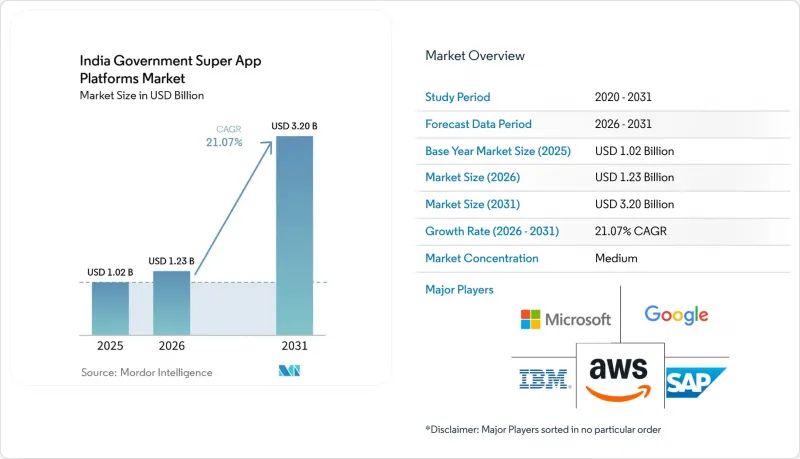
本報告按平台(原生行動應用程式、Web 應用程式和漸進式 Web 應用程式)、部署類型(雲端、本地部署、混合式部署)、應用程式領域(公共服務、身分/認證/錢包服務、支付/收費/收入徵收、其他)以及最終用戶(中央政府、州和地方政府)進行分類。市場預測以美元計價。
印度政府超級應用平台市場的趨勢與洞見。
對一站式市民服務的需求日益成長
印度政府大規模提供福利、身分識別和監管服務的責任,推動了對整合公共平台的需求。 UMANG平台提供的服務從2017年的166項擴展到2026年6月的2572項,累計處理交易量達79.669億筆,顯示整合服務存取方式的持續應用。喀拉拉邦和恰蒂斯加爾邦也在實施或擴展整合邦級服務平台,在中央政府努力的基礎上,進一步加強了邦級採購體系。這種體系持續催生了對能夠處理多個部會、多種語言和本地營運需求的供應商的需求。印度政府的超級應用平台市場也受益於對新型公共數位服務的需求,這些服務需要與現有的身份、支付和文件檢驗基礎設施對接。整合需求增強了支出的永續性,因為每個部會都需要相容的系統才能大規模提供服務。
「IndoStack」作為數位身分和支付的基礎
Aadhaar、UPI、DigiLocker 和 ABHA 為政府服務提供了一個通用平台,減少了各個機構建立獨立識別和交易系統的需求。 Aadhaar 在 2024-2025 會計年度發放了 14.4 億個號碼,並記錄了 270.7 億筆已驗證的交易。同時,UPI 在 2026 年 1 月處理了 217 億筆交易,交易額達 283.3 兆印度盧比(約 3,294.2 億美元)。鑑於這些系統的規模,可靠的整合比添加孤立的前端功能更為重要。 DigiLocker 的「家庭 ID」已在拉賈斯坦邦、馬哈拉斯特拉邦、中央邦和北方邦部署,其功能已從文件儲存擴展到家庭資格驗證。與 ABHA 整合的記錄也支援醫療保健相關服務的提供,從而提升了互通憑證管理的價值。在印度政府的超級應用平台市場中,能夠安全連接到這些公共系統的供應商,在滿足政府採購要求方面擁有更清晰的途徑。
被舊有系統鎖定以及核心系統現代化進程的延遲
許多州政府部門仍然依賴過時的資料庫、單體系統和封閉式的介面,難以與新平台對接。以往電子政府計畫建構的系統往往缺乏互通性,迫使各機構進行成本高昂的現代化改造計畫。當各部門需要在維護現有記錄和服務流程的同時添加即時介面時,這項挑戰尤為突出。能夠利用中介軟體、微服務封裝或模組化實作方法的供應商,可能比那些只專注於新部署的供應商更具優勢。在印度政府超級應用平台市場,需要對舊有系統進行大量客製化的專案可能會面臨發布延遲和更高的支援需求。此外,即使在平台初始部署之後,整合工作仍將繼續,這可能會對供應商的利潤率造成壓力。
細分市場分析
預計到2025年,原生行動應用將佔據印度政府超級應用平台市場67.88%的佔有率。這一主導地位源於其能夠提供離線功能、基於設備的安全性以及一致的身份驗證體驗,此外還具備以智慧型手機為中心的存取方式。根據美國國家應用經濟研究委員會(NCAER)的報告,71.4%的網路用戶僅透過行動裝置存取網路,20.4%的數位服務用戶需要家庭以外的幫助。這些情況推動了對能夠將特定資訊本地儲存並引導使用者完成結構化工作流程的行動應用設計的需求。原生應用程式仍然適用於需要重複存取市政服務、福利服務、交通服務和支付服務的使用者。儘管這些應用的重要性持續存在,但政府機構仍會支援其他存取管道。
預計到2031年,Web和漸進式Web應用將實現22.08%的複合年成長率,在所有平台形式中位居榜首。 UMANG可透過行動應用程式、網站、互動式語音應答系統和簡訊訪問,充分展現了通路柔軟性帶來的實際價值。漸進式Web應用程式幫助政府機構為使用舊款Android裝置的使用者提供服務,因為在這些裝置上下載大型應用程式較為困難。基於瀏覽器的服務交付方式也支援語音介面和通訊鏈接,無需從應用程式商店安裝。恰蒂斯加爾邦的「Seva Setu」和安得拉邦的「Mana Mitra」清晰地展現了向輕量級、基於管道的訪問方式轉變的趨勢。鑑於公民的存取環境因設備、識字率和網路可用性而異,預計印度政府超級應用平台市場將同時支援原生和基於Web的服務交付方式。
預計到2025年,雲端部署將佔印度政府超級應用平台市場的45.66%。雲端部署正成為新部署的首選模式,因為政府機構無需自行建置所有內部資源即可增加容量和保全服務。印度電子資訊技術部(MeitY)的雲端框架指南公共機構根據所涉資訊的敏感程度選擇託管方案。託管雲端環境有助於各邦資訊科技部門應對服務需求的波動,並使服務供應商能夠更持續地更新軟體和安全措施。對於需要嚴格維運管理或具有複雜遷移流程的系統,本地基礎設施仍扮演著至關重要的角色。
預計到2031年,混合部署將以21.89%的複合年成長率成長。 2026年雲端選擇框架將Aadhaar、UPI、PAN、選民證和類似的關鍵資料集歸類為「A類」訊息,這些資訊必須儲存在由主權國家或政府管理的雲端基礎設施上。這種方法允許機構在受控環境中維護高度敏感的記錄,同時在允許的範圍內利用可擴展的容量來提供公共服務。 AWS印度和Yotta數據服務公司宣布就印度國家資訊中心(NIC)的「Meghraj 2.0」舉措建立合作夥伴關係,該計劃將利用AWS Outposts來處理NIC資料中心內的高度敏感工作負載。此次舉措展示了混合架構如何將高度敏感的處理與尖峰時段服務交付分開。在印度政府的超級應用平台市場,這種模式為能夠整合資料管理、整合和營運連續性的服務供應商帶來了新的機會。
其他好處
- Excel格式的市場預測(ME)表
- 3個月的分析師支持
目錄
第1章:引言
- 研究假設和市場定義
- 調查範圍
第2章:調查方法
第3章執行摘要
第4章 市場狀況
- 市場概覽
- 市場促進因素
- 中央和地方政府對一站式公民服務的需求日益成長。
- 「印度堆疊」(Aadhaar、UPI、DigiLocker、ABHA)作為數位身分和支付的基礎。
- 中央和州政府以及部際機構體系面臨互通性壓力。
- 人工智慧驅動的主動服務、本地語言介面和自動案件分類。
- 透過共用平台降低跨機構成本(PM GatiShakti,UMANG 擴充)
- 2023 年《資料保護與資料保護法》及國家資料主權與公共管理要求
- 市場限制因素
- 各州政府部門舊有系統的限制以及核心系統現代化過程的滯後。
- GFR 規則下的採購作業十分複雜,中央和州政府由多個機構管治。
- 2023年《資料保護和資料保護法》規定的隱私、同意和資料儲存限制
- 農村地區、識字率低的地區以及缺乏充足網路連線的地區存在數位落差的風險。
- 價值鏈分析
- 監理情勢
- 技術展望
- 波特五力分析
第5章 市場規模與成長預測
- 按平台
- 原生行動應用
- Web 與漸進式 Web 應用
- 依部署類型
- 雲
- 現場
- 混合
- 透過使用
- 市民服務
- 身分識別資訊、身分驗證資訊、錢包服務
- 付款、費用和收入徵收
- 提供社會福利和服務
- 許可證、授權和登記
- 其他用途
- 最終用戶
- 中央政府
- 州/地方政府
第6章 競爭情勢
- 市場集中度
- 策略趨勢
- 市佔率分析
- 公司簡介
- Infosys Limited
- Wipro Limited
- HCL Technologies Limited
- Tech Mahindra Limited
- Microsoft Corporation
- Google LLC
- Amazon Web Services, Inc.
- IBM Corporation
- Oracle Corporation
- SAP SE
- ServiceNow, Inc.
- Accenture plc
- Capgemini SE
- eGov Foundation
- Newgen Software Technologies Limited
- Persistent Systems Limited
- NIC e-Governance Services India Limited
- C-DAC(Centre for Development of Advanced Computing)
第7章 市場機會與未來展望
According to Mordor Intelligence, the India government super app platforms market size is expected to increase from USD 1.02 billion in 2025 to USD 1.23 billion in 2026 and reach USD 3.20 billion by 2031, registering a CAGR of 21.07% over 2026-2031.
This report is Segmented by Platform (Native Mobile App, and Web and Progressive Web App), Deployment Type (Cloud, On-Premises, and Hybrid), Application (Citizen Services, Identity, Credentials, and Wallet Services, Payments, Fees, and Revenue Collection, and More), and End User (Central Government, and State or Provincial Government). The Market Forecasts are Provided in Terms of Value (USD).
India Government Super App Platforms Market Trends and Insights
Rising Demand for One-Stop Citizen Service Delivery
India's responsibility to deliver welfare, identity, and regulatory services at scale supports the demand for integrated public platforms. UMANG expanded from 166 services in 2017 to 2,572 by June 2026 and processed 796.69 crore cumulative transactions, indicating sustained use of consolidated service access. Kerala and Chhattisgarh have also introduced or expanded integrated state service platforms, adding a state procurement layer alongside central initiatives. This structure creates recurring requirements for vendors capable of supporting multiple departments, languages, and local operating conditions. The India government super-app platforms market also benefits from the requirement that new public digital services connect to established identity, payment, and document-verification rails. Integration requirements can make spending more durable because departments need compatible systems to deliver services at scale.
India Stack as the Digital Identity and Payments Foundation
Aadhaar, UPI, DigiLocker, and ABHA provide shared foundations for government-facing platforms, reducing the need for agencies to build separate identity and transaction systems. Aadhaar generated 144 crore numbers and recorded 2,707 crore authentication transactions in 2024-25, while UPI processed 21.70 billion transactions worth INR 28.33 lakh crore (USD 329.42 billion) in January 2026. The scale of these systems makes reliable integration more important than adding isolated front-end features. DigiLocker's Family ID coverage across Rajasthan, Maharashtra, Madhya Pradesh, and Uttar Pradesh extended its role from document storage to household eligibility verification. ABHA-linked records also support health-related service delivery, which increases the value of interoperable credential management. For the India government super app platforms market, vendors that can securely connect to these public systems have a clearer path to meeting government procurement requirements.
Legacy System Lock-In and Slow Core Modernization
Many state departments still rely on older databases, monolithic systems, and closed interfaces that are difficult to connect with newer platforms. Systems established during earlier e-governance programs often lacked interoperability requirements, leaving agencies with costly modernization work. This challenge is strongest where departments must retain existing records and service processes while adding real-time interfaces. Vendors that can use middleware, microservices wrappers, or modular implementation methods may be better placed than providers focused only on new installations. The India government super app platforms market can face delayed launches and higher support requirements when legacy systems require extensive tailoring. These projects can also pressure vendor margins because integration work continues after the initial platform deployment.
Other drivers and restraints analyzed in the detailed report include:
- AI-Enabled Proactive Services, Vernacular Interfaces, and Automated Case Routing
- Interoperability Across Center-State and Agency Systems
- Procurement Complexity Under GFR Rules and Multi-Agency Governance
For complete list of drivers and restraints, kindly check the Table Of Contents.
Segment Analysis
Native mobile apps are expected to hold 67.88% of the India government super app platforms market share in 2025. Their lead reflects smartphone-led access and their ability to provide offline functions, device-based security, and consistent authentication experiences. NCAER reported that 71.4% of internet users accessed the web only through mobile devices, while 20.4% of digital service users needed assistance from someone outside their household. These conditions support mobile designs that can store selected information locally and guide users through structured workflows. Native applications also remain suitable for users who repeatedly access municipal, welfare, transport, or payment services. Their continued role does not prevent agencies from supporting additional access channels.
Web and progressive web apps are projected to register a CAGR of 22.08% through 2031, the highest among platform formats. UMANG is available through a mobile application, a website, an interactive voice response system, and SMS, demonstrating the practical value of channel flexibility. Progressive web applications can help agencies serve users with older Android devices where downloading a large application is difficult. Browser-based delivery also supports voice interfaces and messaging links without requiring an app store installation. Chhattisgarh's Seva Setu and Andhra Pradesh's Mana Mitra illustrate the shift toward lightweight, channel-based access. The India government super app platforms market is likely to support both native and web-based delivery because citizen access conditions vary by device, literacy level, and network availability.
Cloud deployment is expected to hold 45.66% of the India government super app platforms market share in 2025. It has become a preferred model for new deployments because agencies can add capacity and security services without having to build every resource internally. MeitY's cloud framework guides public agencies in selecting hosting arrangements based on the sensitivity of the information involved. Managed cloud environments can help state information technology departments support fluctuating demand across services. They also allow providers to update software and security controls more consistently. On-premise infrastructure remains relevant for systems that require strict operational control or have complex migration paths.
Hybrid deployment is projected to grow at a CAGR of 21.89% through 2031. The 2026 cloud selection framework classifies Aadhaar, UPI, PAN, voter ID, and similar critical datasets as Category A information that must be stored on sovereign or government-controlled cloud infrastructure. This approach allows agencies to keep sensitive records in controlled environments while using scalable capacity for public-facing services where permitted. AWS India and Yotta Data Services announced a collaboration for NIC's Meghraj 2.0 initiative, which uses AWS Outposts for sensitive workloads within NIC data centers. The arrangement illustrates how a hybrid architecture can separate sensitive processing from peak-load service delivery. For the India government super app platforms market, this model creates opportunities for providers that can manage data controls, integration, and operational continuity together.
Complete Report Scope:
- By Platform
- Native Mobile App
- Web and Progressive Web App
- By Deployment Type
- Cloud
- On-Premise
- Hybrid
- By Application
- Citizen Services
- Identity, Credentials, and Wallet Services
- Payments, Fees, and Revenue Collection
- Social Benefits and Welfare Delivery
- Licensing, Permits, and Registrations
- Other Applications
- By End User
- Central Government
- State Or Provincial Government
List of Companies Covered in this Report:
- Infosys Limited
- Wipro Limited
- HCL Technologies Limited
- Tech Mahindra Limited
- Microsoft Corporation
- Google LLC
- Amazon Web Services, Inc.
- IBM Corporation
- Oracle Corporation
- SAP SE
- ServiceNow, Inc.
- Accenture plc
- Capgemini SE
- eGov Foundation
- Newgen Software Technologies Limited
- Persistent Systems Limited
- NIC e-Governance Services India Limited
- C-DAC (Centre for Development of Advanced Computing)
Additional Benefits:
- The market estimate (ME) sheet in Excel format
- 3 months of analyst support
TABLE OF CONTENTS
1 INTRODUCTION
- 1.1 Study Assumptions and Market Definition
- 1.2 Scope of the Study
2 RESEARCH METHODOLOGY
3 EXECUTIVE SUMMARY
4 MARKET LANDSCAPE
- 4.1 Market Overview
- 4.2 Market Drivers
- 4.2.1 Rising Demand For One-Stop Citizen Service Delivery Across Central And State Governments
- 4.2.2 India Stack (Aadhaar, UPI, DigiLocker, ABHA) As The Digital Identity And Payments Foundation
- 4.2.3 Interoperability Pressure Across Fragmented Centre-State And Inter-Departmental Agency Systems
- 4.2.4 AI-Enabled Proactive Services, Vernacular Interfaces, And Automated Case Routing
- 4.2.5 Cross-Agency Cost Compression Through Shared Platforms (PM GatiShakti, UMANG Expansion)
- 4.2.6 DPDP Act 2023 And National Data Sovereignty And Public-Control Requirements
- 4.3 Market Restraints
- 4.3.1 Legacy System Lock-In And Slow Core Modernization Across State-Level Departments
- 4.3.2 Procurement Complexity Under GFR Rules And Multi-Agency Centre-State Governance
- 4.3.3 Privacy, Consent, And Data Residency Constraints Under DPDP Act 2023
- 4.3.4 Digital Exclusion Risk In Rural, Low-Literacy, And Low-Connectivity Populations
- 4.4 Value Chain Analysis
- 4.5 Regulatory Landscape
- 4.6 Technological Outlook
- 4.7 Porter's Five Forces Analysis
- 4.7.1 Bargaining Power Of Buyers
- 4.7.2 Bargaining Power Of Suppliers
- 4.7.3 Threat Of New Entrants
- 4.7.4 Threat Of Substitutes
- 4.7.5 Competitive Rivalry
5 MARKET SIZE AND GROWTH FORECASTS (VALUE)
- 5.1 By Platform
- 5.1.1 Native Mobile App
- 5.1.2 Web and Progressive Web App
- 5.2 By Deployment Type
- 5.2.1 Cloud
- 5.2.2 On-Premise
- 5.2.3 Hybrid
- 5.3 By Application
- 5.3.1 Citizen Services
- 5.3.2 Identity, Credentials, and Wallet Services
- 5.3.3 Payments, Fees, and Revenue Collection
- 5.3.4 Social Benefits and Welfare Delivery
- 5.3.5 Licensing, Permits, and Registrations
- 5.3.6 Other Applications
- 5.4 By End User
- 5.4.1 Central Government
- 5.4.2 State Or Provincial Government
6 COMPETITIVE LANDSCAPE
- 6.1 Market Concentration
- 6.2 Strategic Moves
- 6.3 Market Share Analysis
- 6.4 Company Profiles (includes Global Level Overview, Market Level Overview, Core Segments, Financials as available, Strategic Information, Market Rank/Share, Products and Services, Recent Developments)
- 6.4.1 Infosys Limited
- 6.4.2 Wipro Limited
- 6.4.3 HCL Technologies Limited
- 6.4.4 Tech Mahindra Limited
- 6.4.5 Microsoft Corporation
- 6.4.6 Google LLC
- 6.4.7 Amazon Web Services, Inc.
- 6.4.8 IBM Corporation
- 6.4.9 Oracle Corporation
- 6.4.10 SAP SE
- 6.4.11 ServiceNow, Inc.
- 6.4.12 Accenture plc
- 6.4.13 Capgemini SE
- 6.4.14 eGov Foundation
- 6.4.15 Newgen Software Technologies Limited
- 6.4.16 Persistent Systems Limited
- 6.4.17 NIC e-Governance Services India Limited
- 6.4.18 C-DAC (Centre for Development of Advanced Computing)
7 MARKET OPPORTUNITIES AND FUTURE OUTLOOK
- 7.1 White-Space and Unmet-Need Assessment

 2026年全球叫車應用市場報告
 全球行動應用市場規模、佔有率、趨勢和成長分析報告(2026-2034)
 電子商務應用:市場佔有率分析、產業趨勢與統計、成長預測(2026-2031)
 行動應用與網路分析市場:全球市場預測,2026-2032年行動應用管理(MAM)軟體:市場佔有率分析、產業趨勢與統計及成長預測(2026-2031)數位筆記型電腦市場:2026-2032年全球市場預測(按產品類型、筆記型電腦格式、設備生態系統、連接方式、應用、部署和最終用戶分類)行動應用市場:2026-2032年全球市場預測(按平台、裝置類型、定價模式、連線需求、應用程式和最終用戶分類)黑色素瘤檢測行動應用:市佔率分析、產業趨勢與統計及成長預測(2026-2031)
 備忘錄應用市場規模、佔有率和成長分析:按平台、功能、最終用戶、通路和地區分類-2026-2033年產業預測
 分攤帳單應用市場規模、佔有率和成長分析:按產品/服務、平台、採用模式、最終用戶、收入模式、分銷管道和地區分類-2026-2033年產業預測