


 |
市場調查報告書
商品編碼
2099967
用於供應鏈最佳化的量子軟體:市場佔有率分析、行業趨勢和統計數據以及成長預測(2026-2031 年)Quantum Software For Supply Chain Optimization - Market Share Analysis, Industry Trends & Statistics, Growth Forecasts (2026 - 2031) |
||||||

※ 本網頁內容可能與最新版本有所差異。詳細情況請與我們聯繫。
預計到 2025 年,供應鏈最佳化量子軟體的市場規模將達到 4.1 億美元,到 2026 年將達到 5.2 億美元,從 2026 年到 2031 年將以 33.07% 的複合年成長率成長,到 2031 年將達到 21.7 億美元。
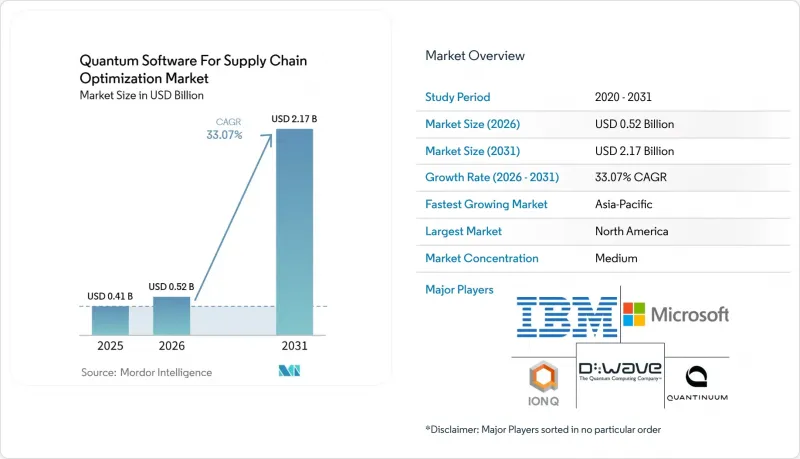
本報告按解決方案(軟體和服務)、部署類型(雲端、混合、本地部署)、應用(運輸和路線最佳化、庫存最佳化、生產計畫和調度等)、最終用戶(工業製造、零售和電子商務等)以及地區進行細分。市場預測以美元計價。
全球量子軟體市場趨勢及供應鏈最佳化洞察
物流領域對最佳化複雜網路的需求日益成長。
供應鏈最佳化領域的量子軟體市場正受益於現代物流網路如今涉及的超大規模配送地圖、多樣化的車輛配置、緊迫的時限以及即時干擾因素。這種情況使得問題規模龐大,傳統求解器難以在實際規劃時間內應對,尤其是在企業需要根據不斷變化的營運條件頻繁重新計算的情況下。一項發表於2025年的同行評審研究表明,使用量子技術進行路線最佳化可降低12%的燃油消耗和18%的配送時間,為買家提供清晰的營運基準,而非空洞的理論承諾。另一項發表於2026年的研究也表明,混合量子禁忌搜尋方法在嚴格約束的車輛路線規劃基準測試中優於同類經典啟發式方法。因此,對於那些停靠點密集且規劃時間窗口緊迫的企業而言,量子技術的價值將比那些僅管理簡單路線結構的營運商更快地體現出來。 Fraunhofer SCS 也正在推進 NISQ 在物流、生產和零售領域的調度和預測方面的研究,這為從研究項目到供應鏈最佳化量子軟體市場的商業部署提供了直接途徑。
在高度可變的規劃中,透過混合量子-經典工作流程儘早實現投資回報。
用於價值鏈最佳化的量子軟體市場也在快速發展。這是因為混合量子-經典工作流程在完全容錯的機器問世之前就已經展現出價值。這縮短了財務團隊對投資回報期的討論,他們先前一直將量子運算視為「短期商業應用有限的長期投資」。 2025年11月,BASF和D-Wave報告稱,混合應用將生產調度時間從10小時縮短至5秒,並將調度延遲減少了14%,設定時間減少了9%,儲罐卸載時間減少了高達18%。 NTT Data Germany和NTT Research在2026年2月進行的一項研究表明,在IonQ硬體上使用混合QUBO模型可以在空中巴士的物流約束下同時最佳化成本、排放和交付時間。這意義重大,因為即使計劃品質略有提高,當製造商和物流運營商全年反覆運行相同的計劃週期時,也能帶來可觀的成本節約。發表在《物流》雜誌上的一項研究也指出,混合量子最佳化與 ERP 和 APS 系統的整合將在 2026 年至 2032 年間加速,這將增強供應鏈最佳化量子軟體市場的中期商業性可行性。
在許多現實世界的供應鏈問題中,量子優勢是有限的。
量子軟體在供應鏈最佳化領域面臨的主要限制因素之一是,許多現實世界的企業規劃問題,即使直接編碼,其規模仍然超出近期硬體的實際處理能力。供應鏈網路通常涉及數百個節點和數千個約束條件,而目前的NISQ系統仍需先進行分解,才能以可管理的方式處理這些問題。 2025年的評估指出,即使嘗試直接編碼,商用系統在處理工業車輛路徑規劃及相關最佳化任務時,其規模仍有其限制。弗勞恩霍夫供應鏈科學研究所(Fraunhofer SCS)也指出,目前最先進的硬體對於企業級供應鏈問題而言仍處於實驗階段,因此許多部署仍停留在試點階段,而無法實現全面運作。這導致了買家的疲勞,因為一些公司資助試點項目,期望即時投入運營,結果卻發現仍然需要對問題進行大量的分解和重新設計。因此,量子軟體在供應鏈最佳化領域的應用,從概念驗證(PoC)到大規模部署的過渡進展緩慢。
細分市場分析
預計到2025年,軟體將佔據64.81%的市場佔有率,而服務業預計到2031年將以36.42%的複合年成長率成長。軟體的領先地位主要得益於平台型解決方案的日益普及,這些解決方案包括演算法庫、QUBO工具、最佳化引擎以及可與現有企業規劃系統無縫整合的連接器。由於許可模式相比完全靈活的諮詢合約能夠提供更清晰的營運模式、更明確的採購流程和更明確的內部責任,因此買家在早期階段往往更傾向於選擇這些產品。即使企業最初只進行有限的先導計畫或採用單一的規劃工作流程,而不是將其部署到整個供應鏈,也能確保平台獲得較高的收入。然而,供應鏈最佳化量子軟體市場表明,軟體需求本身並不能取代實施支援。
預計服務業將成長36.42%,因為許多公司仍在努力將理論用例轉化為可操作的規劃工具。領先的供應商擴大將專有軟體與整合、調優和工作流程支援相結合,從而佔據更大的客戶預算佔有率,並透過客製化的問題定義產生轉換成本。這一趨勢導致專業供應商和大規模實施商進入相同的銷售領域,尤其是在買家希望直接整合到ERP、TMS和APS環境中時。 2025年的調查顯示,缺乏專業人員是採用新技術的一大障礙,這支持了即使軟體工具不斷改進,服務需求仍將保持高位的觀點。在供應鏈最佳化的量子軟體產業,軟體產業的主導與服務業的快速成長之間的差異表明,該市場正處於商業化階段,仍需要切實可行的營運支援。
預計到2025年,基於雲端的部署將佔據71.24%的市場佔有率,而混合部署預計到2031年將以35.18%的複合年成長率成長。雲端部署之所以佔據主導地位,是因為它允許企業在無需承擔專用基礎設施成本的情況下存取量子資源,這在最佳化需求全年波動較大的情況下尤其重要。這種架構也非常適合試驗計畫,因為買家只需在測試階段支付訪問費用,並在用例被證明有效後即可擴展規模。因此,希望在做出長期架構決策之前評估多種工作流程的企業可以更快進入供應鏈最佳化的量子軟體市場。這也有利於平台提供者,他們可以透過開發者工具、API和託管環境簡化存取。
混合部署的快速擴張源於這樣一個事實:許多公司仍然希望在外部存取量子運算能力,同時將傳統工作負載和敏感資料保留在本地系統附近。這種組合在監管嚴格的產業、國防相關業務以及難以完全卸載到雲端的主權資料環境中至關重要。發表在《物流》(Logistics)雜誌上的一項研究預測,連接到ERP、WMS和APS系統的混合求解器將在中期內成為主流部署模式。儘管本地部署在供應鏈最佳化量子軟體市場中仍只佔很小一部分,但對於那些受安全、敏感資訊分類或主權限制的組織而言,它們仍然發揮作用。整體趨勢很明確:雖然雲端目前主導著訪問,但從長遠來看,混合設計越來越有可能成為支撐企業級營運的基礎。
區域分析
2025年,北美在供應鏈最佳化量子軟體市場佔據34.82%的佔有率。這一主導地位歸功於強勁的企業採購需求以及IBM、D-Wave、IonQ、Google、AWS和微軟等主要平台供應商的地理集中。 2025年的研究報告也指出,美國承諾在2028年之前每年投資6.75億美元用於量子資訊科學,以支持深入研究和生態系統的永續發展。 2026年5月,IBM與美國商務部簽署了一份意向書,計劃成立Anderon,這將是美國首家專門的量子晶圓晶圓代工廠。該項目預計將獲得《晶片和資訊安全法案》(CHIPS Act)提供的10億美元津貼以及IBM的10億美元現金投資。在加拿大,IBM和蒙特婁理工學院於2025年11月啟動了舉措,旨在利用人工智慧和量子技術支援林業供應鏈的決策,進一步深化相關研究。同時,隨著近岸外包加劇北美物流的複雜性,墨西哥正崛起成為需求中心。
預計亞太地區將成為供應鏈最佳化量子軟體市場成長最快的地區,到2031年複合年成長率(CAGR)將達到36.93%。該地區的發展得益於中國政府主導的項目、日本在汽車和半導體供應鏈領域的公私合營,以及印度「國家量子任務」(已撥款6,000億印度盧比,約7.18億美元用於國內技術研發)。此外,韓國和東南亞地區高密度的電子產品和工業供應鏈也推動了該地區的發展前景,在這些地區,由於交易量龐大,路線、庫存和生產最佳化已至關重要。 2026年4月,新加坡的Horizon Quantum Holdings與IonQ達成戰略協議,購買IonQ首批基於晶片的第六代256量子比特離子阱系統之一,這進一步表明該地區軟體和基礎設施的成熟度正在不斷提高。中國在量子通訊領域的努力,包括2025年評估報告中重點提到的京滬量子金鑰傳輸網路,也顯示對安全先進的數位供應鏈環境有著相應的需求。
在德國航空航太中心(DLR)量子運算舉措和歐盟「量子旗艦計畫」的支持下,歐洲持續穩居供應鏈最佳化量子軟體市場第三大中心地位。德國的「QuTeNet」計畫就是一個顯著的例子,該計畫透過方位點、多元宇宙運算和弗勞恩霍夫量子機器學習研究所(Fraunhofer CML)的技術,支援海上物流中的張量網路最佳化。英國也透過劍橋大學與IonQ的合作,進一步鞏固了在2026年量子計算領域的地位。該合作被譽為英國規模最大的企業間量子研究合作計畫。南美洲、中東和非洲仍處於起步階段,相關活動主要集中在試點計畫、研究夥伴關係和選擇性的企業探索,而非廣泛的商業應用。
其他好處:
- Excel格式的市場預測(ME)表
- 3個月的分析師支持
目錄
第1章:引言
- 研究假設和市場定義
- 調查範圍
第2章:調查方法
第3章執行摘要
第4章 市場狀況
- 市場概覽
- 市場促進因素
- 物流領域對複雜網路最佳化的需求日益成長
- 在高度可變的規劃中,透過混合量子-經典工作流程儘早實現投資回報。
- 基於雲端的交付降低了企業最佳化團隊的進入門檻。
- 鑑於供應鏈中斷,制定包含各種情境的恢復計畫的需求日益成長。
- 與現有 ERP、TMS 和 APS 系統的整合將加快實施速度。
- 早期合規性和永續性用例擴大了預算分配的合理性。
- 市場限制因素
- 在許多現實世界的供應鏈問題中,量子優勢是有限的。
- 缺乏具備量子運算專業知識的最佳化人才和實施合作夥伴。
- 資料品質和模型建置的缺陷會削弱部署到生產環境的有效性。
- 對專有量子工具鏈和雲端堆疊中供應商鎖定問題的擔憂。
- 宏觀經濟因素對市場的影響
- 產業價值鏈分析
- 科技趨勢
- 監理情勢
- 波特五力分析
第5章 市場規模與成長預測
- 透過解決方案
- 軟體
- 服務
- 不同的發展
- 基於雲端的
- 混合
- 現場
- 透過使用
- 交通運輸和路線最佳化
- 庫存最佳化
- 生產計畫和調度
- 設計供應鏈網路
- 供應鏈風險與韌性規劃
- 最終用戶
- 工業製造
- 零售與電子商務
- 運輸/物流
- 能源公用事業
- 食品/飲料
- IT/通訊
- 建築和基礎設施
- 航太/國防
- 其他終端用戶產業
- 按地區
- 北美洲
- 美國
- 加拿大
- 墨西哥
- 南美洲
- 巴西
- 阿根廷
- 其他南美國家
- 歐洲
- 德國
- 英國
- 法國
- 俄羅斯
- 西班牙
- 其他歐洲國家
- 亞太地區
- 中國
- 日本
- 印度
- 韓國
- 東南亞
- 其他亞太國家
- 中東和非洲
- 中東
- 沙烏地阿拉伯
- 阿拉伯聯合大公國
- 土耳其
- 其他中東國家
- 非洲
- 南非
- 奈及利亞
- 埃及
- 其他非洲國家
- 中東
- 北美洲
第6章 競爭情勢
- 市場集中度
- 策略趨勢
- 市佔率分析
- 公司簡介
- IBM Corporation
- Microsoft Corporation
- D-Wave Quantum Inc.
- Quantinuum Ltd.
- IonQ, Inc.
- Amazon Web Services, Inc.
- Google LLC
- SAP SE
- Oracle Corporation
- Accenture plc
- Atos SE
- Fujitsu Limited
- Classiq Technologies Ltd.
- QC Ware Corp.
- 1QBit
- Xanadu Quantum Technologies Inc.
- Rigetti Computing, Inc.
- Pasqal SAS
- Toshiba Digital Solutions Corporation
- Multiverse Computing
第7章 市場機會與未來展望
According to Mordor Intelligence, the quantum software for supply chain optimization market size was USD 0.41 billion in 2025, USD 0.52 billion in 2026, and is forecast to reach USD 2.17 billion by 2031 at a CAGR of 33.07% over 2026-2031.
This report is Segmented by Solution (Software, and Services), Deployment (Cloud-Based, Hybrid, and On-Premises), Application (Transportation and Route Optimization, Inventory Optimization, Production Planning and Scheduling, and More), End User (Industrial Manufacturing, Retail and E-Commerce, and More), and Geography. The Market Forecasts are Provided in Terms of Value (USD).
Global Quantum Software For Supply Chain Optimization Market Trends and Insights
Rising Demand for Complex Network Optimization In Logistics
The quantum software for supply chain optimization market is gaining from the fact that modern logistics networks now involve very large delivery maps, mixed fleets, strict time windows, and real-time disruption triggers. These conditions create a problem scale that often pushes classical solvers outside practical planning windows, especially when enterprises need frequent reruns under changing operating conditions. A 2025 peer-reviewed study documented fuel consumption reductions of 12% and delivery time improvements of 18% from quantum-assisted route optimization, providing buyers a clear operational benchmark rather than a theoretical promise. Research published in 2026 also showed that a hybrid quantum tabu-search approach outperformed comparable classical heuristics across vehicle routing benchmarks with dense constraints. The practical effect is that companies with denser stop patterns and tighter planning windows can see value sooner than operators that only manage simple route structures. Fraunhofer SCS is also advancing NISQ-compatible scheduling and forecasting work for logistics, production, and retail, which supports a near-term path from research programs to commercial adoption in the quantum software for supply chain optimization market.
Faster ROI from Hybrid Quantum-Classical Workflows in High Variability Planning
The quantum software for supply chain optimization market is also advancing rapidly, as hybrid quantum-classical workflows deliver value before fully fault-tolerant machines are available. This shortens the payback discussion for finance teams that had previously viewed quantum computing as a very long-term commitment with limited near-term business use. BASF and D-Wave reported in November 2025 that a hybrid application reduced production scheduling time from 10 hours to 5 seconds, while cutting scheduling lateness by 14%, setup times by 9%, and tank unloading duration by up to 18%. A February 2026 study by NTT Data Germany and NTT Research showed that hybrid QUBO formulations could jointly optimize cost, emissions, and delivery time across Airbus logistics constraints on IonQ hardware. This matters because even modest gains in plan quality can yield meaningful savings when a manufacturer or logistics operator reruns the same planning cycle multiple times throughout the year. Research published in Logistics also pointed to faster integration of hybrid quantum optimization with ERP and APS systems between 2026 and 2032, which strengthens the medium-term commercial case for the quantum software market for supply chain optimization.
Limited Quantum Advantage for Many Real-World Supply Chain Problem Sizes
A core restraint on the quantum software for supply chain optimization market is that many real-world enterprise planning problems still exceed the practical capacity of near-term hardware when encoded directly. Supply chain networks often involve hundreds of nodes and thousands of constraints, and current NISQ systems still require decomposition before those problems can be handled in a workable form. A 2025 review noted that commercially available systems remain limited in scale for industrial vehicle routing and related optimization tasks when direct encoding is attempted. Fraunhofer SCS similarly describes current leading hardware as experimental for enterprise-scale supply chain problems, which keeps many deployments in the pilot stage rather than full production. This creates buyer fatigue because some companies fund pilots expecting immediate operational deployment, only to discover that substantial problem decomposition and redesign remain required. The result is a slower conversion from proof of concept to scaled rollout across the quantum software for supply chain optimization market.
Other drivers and restraints analyzed in the detailed report include:
- Cloud Delivery Lowers Trial Barriers for Enterprise Optimization Teams
- Growing Need for Scenario-Rich Resilience Planning After Supply Chain Shocks
- Scarcity of Quantum-Literate Optimization Talent And Implementation Partners
For complete list of drivers and restraints, kindly check the Table Of Contents.
Segment Analysis
Software held 64.81% share in 2025, while services are projected to expand at a 36.42% CAGR through 2031. The software lead reflects stronger adoption of platform-based offerings such as algorithm libraries, QUBO tools, optimization engines, and connectors that sit closer to existing enterprise planning systems. Buyers often prefer these products at the start because a software license gives them a defined operating model, a clearer procurement path, and easier internal ownership than a fully open-ended consulting engagement. This keeps platform revenue high even when enterprises begin with a narrow pilot or one planning workflow rather than a broad supply chain rollout. At the same time, the quantum software for supply chain optimization market shows that software demand alone does not eliminate the need for implementation support.
Services is projected to grow at 36.42% because many enterprises still struggle to turn theoretical use cases into deployable planning tools. The strongest vendors increasingly combine proprietary software with integration, tuning, and workflow support, helping them capture a larger share of the account budget and creating switching costs through custom problem formulations. This is drawing both specialist providers and larger implementation firms into the same sales motion, especially where a buyer wants direct links into ERP, TMS, and APS environments. A 2025 review tied wider adoption barriers to the shortage of specialized professionals, which supports the idea that service demand will remain elevated even as software tools improve. Within the quantum software for supply chain optimization industry, the split between software leadership and faster service growth indicates a market that is commercializing but still needs hands-on operational support.
Cloud-based deployment held 71.24% share in 2025, while hybrid deployment is projected to grow at a 35.18% CAGR through 2031. Cloud leads because enterprises can reach quantum resources without paying for dedicated infrastructure, which is especially useful when optimization demand is uneven across the year. This structure also supports pilot programs, because buyers can pay for access during a test phase and expand later if the use case proves useful. The result is a faster path into the quantum software for supply chain optimization market for companies that want to evaluate multiple workflows before making a long-term architecture decision. It also favors platform providers that can make access simple through developer tools, APIs, and managed environments.
Hybrid deployment is growing faster because many enterprises still want classical workloads and sensitive data to remain close to internal systems while quantum processing is accessed externally. That mix is important in regulated industries, defense-adjacent operations, and sovereign-data environments where full cloud offloading is difficult. Research published in Logistics stated that hybrid solvers connected to ERP, WMS, and APS systems are expected to be the dominant deployment pattern through the medium term. On-premises deployment remains a small part of the quantum software for supply chain optimization market, but it still has a place in organizations with security, classification, or sovereignty restrictions. The broader direction is clear: cloud drives access today, while hybrid design appears more likely to anchor enterprise-scale operations over time.
Complete Report Scope:
- By Solution
- Software
- Services
- By Deployment
- Cloud-Based
- Hybrid
- On-Premises
- By Application
- Transportation and Route Optimization
- Inventory Optimization
- Production Planning and Scheduling
- Supply Chain Network Design
- Supply Chain Risk and Resilience Planning
- By End User
- Industrial Manufacturing
- Retail and E-Commerce
- Transportation and Logistics
- Energy and Utilities
- Food and Beverage
- IT and Telecom
- Construction and Infrastructure
- Aerospace and Defense
- Other End-user Industries
- By Geography
- North America
- United States
- Canada
- Mexico
- South America
- Brazil
- Argentina
- Rest of South America
- Europe
- Germany
- United Kingdom
- France
- Russia
- Spain
- Rest of Europe
- Asia-Pacific
- China
- Japan
- India
- South Korea
- Southeast Asia
- Rest of Asia-Pacific
- Middle East and Africa
- Middle East
- Saudi Arabia
- United Arab Emirates
- Turkey
- Rest of Middle East
- Africa
- South Africa
- Nigeria
- Egypt
- Rest of Africa
- Middle East
- North America
Geography Analysis
North America held 34.82% of the quantum software for supply chain optimization market share in 2025. The region leads because it combines enterprise buyer demand with the geographic concentration of major platform vendors, including IBM, D-Wave, IonQ, Google, AWS, and Microsoft. A 2025 review also noted the United States commitment of USD 675 million in annual quantum information science investment through 2028, which supports both research depth and ecosystem continuity. In May 2026, IBM and the U.S. Department of Commerce signed a Letter of Intent to establish Anderon, America's first purpose-built quantum wafer foundry, backed by a proposed USD 1 billion CHIPS Act award and USD 1 billion in IBM cash investment. Canada also adds depth through the IBM and Polytechnique Montreal initiative launched in November 2025 for AI and quantum-enabled forestry supply chain decision support, while Mexico is emerging as a demand pocket as nearshoring raises the complexity of manufacturing logistics across North American corridors.
Asia-Pacific is projected to record the fastest growth in the quantum software for supply chain optimization market, with a 36.93% CAGR through 2031. The region is supported by China's state-backed programs, Japan's government-industry efforts in automotive and semiconductor supply chains, and India's National Quantum Mission, which has allocated INR 6,000 crore (USD 718 million) for indigenous capability development. Dense electronics and industrial supply chains also help the regional outlook in South Korea and Southeast Asia, where route, inventory, and production optimization already matter at very high transaction volumes. In April 2026, Horizon Quantum Holdings in Singapore signed a strategic agreement with IonQ to purchase one of IonQ's first 6th-generation, chip-based 256-qubit trapped-ion systems, indicating deeper regional software and infrastructure readiness. China's work in quantum communications, including the Beijing-Shanghai quantum key distribution network highlighted in the 2025 review, also signals adjacent demand for secure and advanced digital supply chain environments.
Europe remains a credible third center in the quantum software for supply chain optimization market, supported by Germany's DLR Quantum Computing Initiative and the EU Quantum Flagship program. Germany's QuTeNet project is one visible example, with support for tensor-network optimization in maritime logistics through BearingPoint, Multiverse Computing, and Fraunhofer CML. The United Kingdom also strengthened its role in 2026 through the University of Cambridge's partnership with IonQ, described as the country's largest corporate quantum research collaboration. South America, the Middle East, and Africa remain earlier-stage regions where activity is still concentrated in pilots, research partnerships, and selective enterprise exploration rather than broad commercial adoption.
- IBM Corporation
- Microsoft Corporation
- D-Wave Quantum Inc.
- Quantinuum Ltd.
- IonQ, Inc.
- Amazon Web Services, Inc.
- Google LLC
- SAP SE
- Oracle Corporation
- Accenture plc
- Atos SE
- Fujitsu Limited
- Classiq Technologies Ltd.
- QC Ware Corp.
- 1QBit
- Xanadu Quantum Technologies Inc.
- Rigetti Computing, Inc.
- Pasqal SAS
- Toshiba Digital Solutions Corporation
- Multiverse Computing
Additional Benefits:
- The market estimate (ME) sheet in Excel format
- 3 months of analyst support
TABLE OF CONTENTS
1 INTRODUCTION
- 1.1 Study Assumptions and Market Definition
- 1.2 Scope of the Study
2 RESEARCH METHODOLOGY
3 EXECUTIVE SUMMARY
4 MARKET LANDSCAPE
- 4.1 Market Overview
- 4.2 Market Drivers
- 4.2.1 Rising Demand For Complex Network Optimization In Logistics
- 4.2.2 Faster ROI From Hybrid Quantum-Classical Workflows in High Variability Planning
- 4.2.3 Cloud Delivery Lowers Trial Barriers for Enterprise Optimization Teams
- 4.2.4 Growing Need for Scenario-Rich Resilience Planning after Supply Chain Shocks
- 4.2.5 Integration with Existing ERP, TMS, and APS Stacks Accelerates Adoption
- 4.2.6 Early Compliance and Sustainability Use Cases Expand Budget Justification
- 4.3 Market Restraints
- 4.3.1 Limited Quantum Advantage for Many Real-World Supply Chain Problem Sizes
- 4.3.2 Scarcity of Quantum-Literate Optimization Talent and Implementation Partners
- 4.3.3 Data Quality and Model Formulation Gaps Weaken Production Deployment Outcomes
- 4.3.4 Vendor Lock-In Concerns Across Proprietary Quantum Toolchains and Cloud Stacks
- 4.4 Impact of Macroeconomic Factors on the Market
- 4.5 Industry Value Chain Analysis
- 4.6 Technology Outlook
- 4.7 Regulatory Landscape
- 4.8 Porter's Five Forces Analysis
- 4.8.1 Threat of New Entrants
- 4.8.2 Bargaining Power of Suppliers
- 4.8.3 Bargaining Power of Buyers
- 4.8.4 Threat of Substitutes
- 4.8.5 Intensity of Competitive Rivalry
5 MARKET SIZE AND GROWTH FORECASTS (VALUE)
- 5.1 By Solution
- 5.1.1 Software
- 5.1.2 Services
- 5.2 By Deployment
- 5.2.1 Cloud-Based
- 5.2.2 Hybrid
- 5.2.3 On-Premises
- 5.3 By Application
- 5.3.1 Transportation and Route Optimization
- 5.3.2 Inventory Optimization
- 5.3.3 Production Planning and Scheduling
- 5.3.4 Supply Chain Network Design
- 5.3.5 Supply Chain Risk and Resilience Planning
- 5.4 By End User
- 5.4.1 Industrial Manufacturing
- 5.4.2 Retail and E-Commerce
- 5.4.3 Transportation and Logistics
- 5.4.4 Energy and Utilities
- 5.4.5 Food and Beverage
- 5.4.6 IT and Telecom
- 5.4.7 Construction and Infrastructure
- 5.4.8 Aerospace and Defense
- 5.4.9 Other End-user Industries
- 5.5 By Geography
- 5.5.1 North America
- 5.5.1.1 United States
- 5.5.1.2 Canada
- 5.5.1.3 Mexico
- 5.5.2 South America
- 5.5.2.1 Brazil
- 5.5.2.2 Argentina
- 5.5.2.3 Rest of South America
- 5.5.3 Europe
- 5.5.3.1 Germany
- 5.5.3.2 United Kingdom
- 5.5.3.3 France
- 5.5.3.4 Russia
- 5.5.3.5 Spain
- 5.5.3.6 Rest of Europe
- 5.5.4 Asia-Pacific
- 5.5.4.1 China
- 5.5.4.2 Japan
- 5.5.4.3 India
- 5.5.4.4 South Korea
- 5.5.4.5 Southeast Asia
- 5.5.4.6 Rest of Asia-Pacific
- 5.5.5 Middle East and Africa
- 5.5.5.1 Middle East
- 5.5.5.1.1 Saudi Arabia
- 5.5.5.1.2 United Arab Emirates
- 5.5.5.1.3 Turkey
- 5.5.5.1.4 Rest of Middle East
- 5.5.5.2 Africa
- 5.5.5.2.1 South Africa
- 5.5.5.2.2 Nigeria
- 5.5.5.2.3 Egypt
- 5.5.5.2.4 Rest of Africa
- 5.5.5.1 Middle East
- 5.5.1 North America
6 COMPETITIVE LANDSCAPE
- 6.1 Market Concentration
- 6.2 Strategic Moves
- 6.3 Market Share Analysis
- 6.4 Company Profiles (includes Global Level Overview, Market Level Overview, Core Segments, Financials as available, Strategic Information, Market Rank/Share, Products and Services, Recent Developments)
- 6.4.1 IBM Corporation
- 6.4.2 Microsoft Corporation
- 6.4.3 D-Wave Quantum Inc.
- 6.4.4 Quantinuum Ltd.
- 6.4.5 IonQ, Inc.
- 6.4.6 Amazon Web Services, Inc.
- 6.4.7 Google LLC
- 6.4.8 SAP SE
- 6.4.9 Oracle Corporation
- 6.4.10 Accenture plc
- 6.4.11 Atos SE
- 6.4.12 Fujitsu Limited
- 6.4.13 Classiq Technologies Ltd.
- 6.4.14 QC Ware Corp.
- 6.4.15 1QBit
- 6.4.16 Xanadu Quantum Technologies Inc.
- 6.4.17 Rigetti Computing, Inc.
- 6.4.18 Pasqal SAS
- 6.4.19 Toshiba Digital Solutions Corporation
- 6.4.20 Multiverse Computing
7 MARKET OPPORTUNITIES AND FUTURE OUTLOOK
- 7.1 White-Space and Unmet-Need Assessment

 全球量子計算軟體市場規模、佔有率、趨勢和成長分析報告(2026-2034)全球量子計算市場規模、佔有率、趨勢和成長分析報告(2026-2034)
 抗量子安全技術的研究服務
 汽車市場量子計算:全球市場預測(2026-2032年)
 超導性量子位元市場:商業機會、成長要素、產業趨勢分析及2026-2035年預測量子運算市場報告:趨勢、預測與競爭分析(至2035年)中性原子量子計算市場機會、成長要素、產業趨勢分析及2026-2035年預測
 量子計算軟體平台:市場佔有率分析、產業趨勢與統計及成長預測(2026-2031)量子軟體工具鏈:市場佔有率分析、產業趨勢與統計、成長預測(2026-2031)量子軟體開發工具包:市場佔有率分析、產業趨勢與統計及成長預測(2026-2031 年)