


 |
市場調查報告書
商品編碼
2117992
量子軟體工具鏈:市場佔有率分析、產業趨勢與統計、成長預測(2026-2031)Quantum Software Toolchain - Market Share Analysis, Industry Trends & Statistics, Growth Forecasts (2026 - 2031) |
||||||

※ 本網頁內容可能與最新版本有所差異。詳細情況請與我們聯繫。
據 Mordor Intelligence 稱,2025 年量子軟體工具鏈市場價值為 12.4 億美元,預計到 2031 年將從 2026 年的 14.6 億美元成長至 38.8 億美元,預測期(2026-2031 年)複合年成長率為 21.59%。
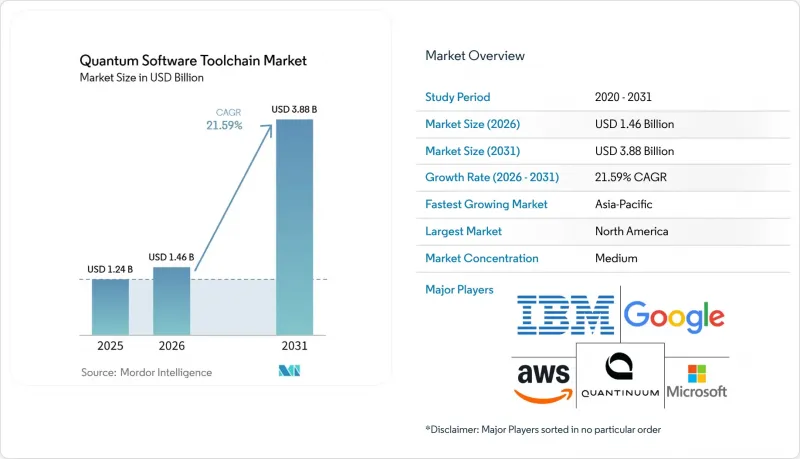
本報告按工具鏈組件(軟體解決方案和服務)、部署模式(雲端、本地部署、混合部署)、應用領域(最佳化、模擬、機器學習等)、最終用戶(IT與電信、銀行、金融服務和保險、醫療保健與生命科學、零售與電子商務等)以及地區進行細分。市場預測以美元計價。
全球量子軟體工具鏈市場趨勢與洞察
企業可透過量子雲端市場取得存取權限
雲端市場正在改變企業取得量子開發工具的方式,它將專業產品整合到IT團隊已經使用且熟悉的採購管道中。買家可以利用現有的雲端帳戶、身分管理、收費結構和管治流程。 Classiq於2025年透過AWS Marketplace上線,允許企業使用AWS積分購買其軟體開發平台。這種方式消除了年度預算有限團隊的採購障礙,尤其是在單獨篩選供應商會延誤有限的試點部署或早期價值驗證(PoV)專案的情況下。因此,能夠透過成熟的雲端環境觸達客戶的供應商在量子軟體工具鏈市場中具有優勢。而那些未進入主流雲端生態系統的供應商在企業試點部署中可能處於劣勢,因為買家往往優先考慮與現有存取、成本管理和安全流程相符的工具。
政府資助的量子計畫和採購
政府專案不僅支援量子硬體,還支援軟體堆疊和通用介面。這是因為公共部門使用者需要一個研究人員、開發人員和商業夥伴能夠連接並一致使用的系統。 2025年12月,德國推出了「QC Next」計劃,旨在支援具有開放介面的模組化量子軟體參考架構。 2026年3月,英國宣布了一項20億英鎊(約25.4億美元)的支援計劃,其中包括對ProQure和愛丁堡量子軟體實驗室的支援。日本的IPA在其2026年「Mitou目標計畫」下遴選了10個量子軟體計畫。這些計劃支援本地開發人員,並為研究團隊和供應商提供清晰的採購管道,同時,由此產生的參考設計將使未來的用戶更容易選擇相容的工具。此外,公共機構的承諾可以降低測試新型量子應用的機構所面臨的一些商業性風險,因為它們允許私人公司在做出大規模部署決策之前檢驗技術優先順序。
量子硬體的錯誤率和容錯功能可用性的限制。
硬體錯誤仍然是軟體商業化的一個根本限制因素,因為它們會影響結果的可靠性、執行成本以及使用者可以放心執行的任務範圍。每增加一項緩解措施,都可能增加延遲、電路深度和取樣要求。目前的工具必須能夠適應雜訊較大的中型量子系統、淺電路以及有限的相干時間。這就帶來了一個艱難的設計選擇:是針對當前硬體進行最佳化,還是為未來的容錯環境做好準備?如果該工具必須在多代不斷發展的設備中保持有效性,那麼這個選擇就尤其具有挑戰性。雖然 IBM 和 NVIDIA 都提供了針對此問題的軟體解決方案,但這些方法並不能取代提高實體量子位元保真度的需求。受監管的用戶可能會推遲關鍵工作負載,直到量子軟體工具鏈市場中的應用能夠證明其可靠的容錯能力。
細分市場分析
到了2025年,軟體解決方案在量子軟體工具鏈組件領域的74.18%。此類別涵蓋了量子軟體工具鏈市場中使用的開發平台、編譯器、轉譯器、中間件、運行時軟體、模擬器、錯誤管理工具和演算法庫。這一佔有率反映了市場對軟體的高度重視,這些軟體能夠簡化量子系統編程並將其與現有工作流程整合,而無需用戶直接處理每個硬體平台的詳細控制和約束。對於許多買家而言,這種抽象化對於確保量子實驗的可複現開發過程至關重要。每個類別都對應著使用者旅程的不同階段,從電路設計到執行和錯誤處理。由於開發團隊可能會組合使用這些組件,因此它們的整合品質與單一產品的功能同等重要。量子軟體工具鏈市場依賴這些層級結構,因為僅憑硬體存取權限不足以建立可操作的企業級工作流程。
預計到2031年,服務板塊的複合年成長率將達到24.82%,成為成長最快的板塊。沒有內部量子團隊的組織通常需要整合支援、客製化演算法和工作流程設計,才能有效利用授權。他們可能還需要協助選擇合適的挑戰、準備數據,以及評估試點計畫是否可以擴展為永續的計畫。富士通、大阪大學、SEC和TIS於2025年3月開放原始碼了“面向運營商和用戶的開放量子工具鏈”,並將其與大阪大學的量子雲端服務整合。開放原始碼使得基礎開發元件更容易被更廣泛的使用者群體所使用。這促使供應商將重心轉向專業服務、特定領域的最佳化以及對複雜部署的支援。雖然軟體授權收入預計仍將成長,但在使用者需要直接專業知識的情況下,以服務主導的參與方式變得越來越重要。
到2025年,基於雲端的解決方案將佔部署模式細分市場的71.24%。透過雲端訪問,企業無需購買或經營量子硬體即可進行實驗。這使得團隊能夠以最小的投入啟動實驗,並測試多個系統,而無需長期依賴單一供應商。此外,雲端還有助於加快資源配置速度,並與現有的雲端管治實務保持一致。當業務部門需要透過已批准的技術流程而非建立獨立的存取架構來進行研究工作時,這些優勢依然至關重要。對於研究團隊和正在評估潛在用例的公司而言,這種模式仍然非常實用。量子軟體工具鏈市場也將繼續受益於這種便利的早期採用途徑。
預計到2031年,量子軟體工具鏈市場的混合部署將以23.69%的複合年成長率成長。最初在公共雲端環境中測試量子工具的組織正擴大考慮將其與本地環境整合,以處理敏感資料、滿足主權要求以及對延遲要求嚴格的工作負載。這種轉變不會消除雲端的使用,但會增加對能夠支援兩種存取模式的架構的需求。根據IQM的一份報告,46%的買家預計在三年內將部署本地基礎設施作為其存取模式的一部分,而只有24%的買家傾向於僅使用公共雲端。對於資料居住受到限制的航太、國防和政府機構使用者而言,本地部署仍然是一個至關重要的選擇。因此,供應商需要支援工作負載在雲端和本地環境之間的遷移。這項需求提升了能夠處理硬體差異而不降低電路效能的中間件的重要性。
區域分析
到2025年,北美將佔據量子軟體工具鏈市場34.62%的佔有率。該地區受益於量子硬體、軟體人才和雲端平台的高度集中。此外,美國後量子密碼學計畫也推動了北美量子軟體工具鏈市場的發展,其需求成長遠超傳統的商業性盈利計算。美國行政管理和預算辦公室(OMB)於2026年6月發布的M-26-15號備忘錄要求聯邦機構在2026年10月前提交後量子密碼學過渡計劃,該計劃概述了到2035年分五個階段完成的過渡流程。這項要求正在推動對密碼審計、機器學習金鑰管理(ML-KEM)實施數位簽章過渡工具的需求。
在量子軟體工具鏈市場,亞太地區預計到2031年將以24.91%的複合年成長率成長。日本、中國和韓國是推動市場成長的主要力量,這主要得益於公共投資、國內平台的發展以及公共部門的需求。日本理化學研究所(RIKEN)於2026年3月啟動了其量子電腦「Ei-II」的運行,從而擴展了量子-經典融合研究的雲端存取。 Origin Quantum於2026年6月完成了30億元人民幣(約4.19億美元)的資金籌措,為其首次股票公開發行(IPO)做準備。 2025年,中國發布了首個量子運算服務平台架構國家標準,建立了五層互通性架構。此外,IonQ和韓國科學技術研究院(KISTI)於2026年3月簽署了合作備忘錄,共同開發韓國的量子高效能運算(HPC)混合技術。
在歐洲,量子軟體工具鏈市場中獨立於硬體的軟體能力正透過「地平線歐洲」(Horizon Europe)、「QC Next」和「FullStaQD」等舉措穩步推進。該地區的努力重點在於開放介面以及學術界和產業界合作夥伴之間的協作。英國提供的20億英鎊(25.4億美元)支援計畫包括為愛丁堡的「量子軟體實驗室」提供資金。南美洲繼續專注於研究,巴西透過與IBM和歐洲機構的合作,主導該地區的研發工作。中東和非洲地區正因阿拉伯聯合大公國和沙烏地阿拉伯的技術多元化計畫而備受關注。儘管目前收入貢獻仍然有限,但政府對技術投資的承諾正在為未來的工具鏈採購奠定基礎。
其他好處:
- Excel格式的市場預測(ME)表
- 3個月的分析師支持
目錄
第1章:引言
- 研究假設和市場定義
- 調查範圍
第2章:調查方法
第3章執行摘要
第4章 市場狀況
- 市場概覽
- 市場促進因素
- 透過量子雲市場實現企業級訪問
- 政府資助的量子技術計畫和採購
- 引入經典-量子混合工作流程
- 對量子糾錯和糾錯的需求日益成長
- 向量子運算賦能的網路安全與密碼技術轉型
- 擴展開放原始碼和進階開發者工具鏈
- 市場限制因素
- 量子硬體錯誤率和有限的容錯能力
- 量子軟體和系統領域人才短缺
- 工具鏈碎片化和互通性標準有限
- 量子技術領域的公司短期投資回報仍不確定。
- 宏觀經濟因素對市場的影響
- 產業價值鏈分析
- 科技趨勢
- 監理情勢
- 波特五力分析
第5章 市場規模與成長預測
- 按工具鏈的組成部分
- 軟體解決方案
- 量子開發平台
- 量子編譯器和轉譯器
- 量子中間件和工作流程編配
- 量子運行時軟體
- 量子模擬軟體
- 量子糾錯和緩解軟體
- 量子演算法庫和特定領域軟體
- 服務
- 軟體解決方案
- 部署模式
- 基於雲端的
- 現場
- 混合
- 透過使用
- 最佳化
- 模擬
- 機器學習
- 密碼學與後量子安全
- 藥物發現與生命科學
- 材料科學
- 其他用途
- 最終用戶
- 資訊科技/通訊
- BFSI
- 醫療保健和生命科學
- 零售與電子商務
- 航太/國防
- 化學和材料工業
- 工業製造
- 教育和研究機構
- 媒體與娛樂
- 政府/行政部門
- 能源公用事業
- 其他最終用戶
- 按地區
- 北美洲
- 美國
- 加拿大
- 墨西哥
- 南美洲
- 巴西
- 阿根廷
- 其他南美國家
- 歐洲
- 德國
- 英國
- 法國
- 俄羅斯
- 西班牙
- 其他歐洲國家
- 亞太地區
- 中國
- 日本
- 印度
- 韓國
- 東南亞
- 其他亞太國家
- 中東和非洲
- 中東
- 沙烏地阿拉伯
- 阿拉伯聯合大公國
- 其他中東國家
- 非洲
- 南非
- 奈及利亞
- 其他非洲國家
- 中東
- 北美洲
第6章 競爭情勢
- 市場集中度
- 策略趨勢
- 市佔率分析
- 公司簡介
- International Business Machines Corporation
- Microsoft Corporation
- Alphabet Inc.
- Amazon Web Services, Inc.
- NVIDIA Corporation
- Quantinuum Ltd.
- D-Wave Quantum Inc.
- IonQ, Inc.
- Rigetti Computing, Inc.
- Xanadu Quantum Technologies Inc.
- Pasqal SAS
- Quantum Computing Inc.
- Classiq Technologies Ltd.
- Q-CTRL Pty Ltd.
- Riverlane Limited
- QC Ware Corp.
- Zapata Computing Holdings Inc.
- Strangeworks, Inc.
- Quantum Machines Ltd.
- QuEra Computing Inc.
- 1QB Information Technologies Inc.
- QunaSys Inc.
- Fujitsu Limited
- Atos SE
第7章 市場機會與未來展望
According to Mordor Intelligence, the quantum software toolchain market size was valued at USD 1.24 billion in 2025 and is estimated to grow from USD 1.46 billion in 2026 to reach USD 3.88 billion by 2031, at a CAGR of 21.59% during the forecast period (2026-2031).
This report is Segmented by Toolchain Component (Software Solutions, and Services), Deployment Mode (Cloud-Based, On-Premises, and Hybrid), Application (Optimization, Simulation, Machine Learning, and More), End User (IT and Telecommunication, BFSI, Healthcare and Life Sciences, Retail and E-Commerce, and More), and Geography. The Market Forecasts are Provided in Terms of Value (USD).
Global Quantum Software Toolchain Market Trends and Insights
Enterprise Access Through Quantum Cloud Marketplaces
Cloud marketplaces are changing how organizations obtain quantum development tools by placing specialist products inside purchasing channels that information technology teams already use and understand. Buyers can use existing cloud accounts, identity controls, billing arrangements, and governance processes. Classiq became available through AWS Marketplace in 2025, allowing enterprises to use AWS credits for its software development platform. This route can remove a procurement obstacle for teams working within annual budgets, especially where a separate vendor review would delay a limited pilot or an initial proof of value. The Quantum Software Toolchain Market, therefore, favors vendors that can reach customers through established cloud environments. Vendors without a presence in a major cloud ecosystem may face a weaker position in enterprise pilots, as buyers may favor tools that align with their existing access, cost-control, and security processes.
Government-Funded Quantum Programs and Procurement
Government programs are supporting software stacks and common interfaces, not only quantum hardware, because public users need systems that researchers, developers, and commercial partners can connect to and use consistently. Germany launched QC Next in December 2025 to support a modular quantum software reference architecture with open interfaces. The United Kingdom announced a GBP 2 billion package in March 2026, equivalent to USD 2.54 billion, including support for ProQure and the Quantum Software Lab in Edinburgh. Japan's IPA selected 10 quantum software projects under its 2026 Mitou Target Program. These programs support local developers and give research groups and suppliers clearer procurement paths, while the resulting reference designs can make it easier for later users to select compatible tools. They also reduce some of the commercial risk facing organizations that are testing new quantum applications, since public commitments can validate technical priorities before a private buyer makes a larger deployment decision.
Quantum Hardware Error Rates and Limited Fault-Tolerant Availability
Hardware errors remain a basic limit on software commercialization because they affect the reliability of results, the cost of execution, and the range of tasks that users can confidently run. Each added mitigation step can increase latency, circuit depth, and sampling requirements. Current tools must work with noisy intermediate-scale quantum systems, shallow circuits, and limited coherence times. This creates a difficult design choice between optimizing for current hardware and preparing for future fault-tolerant environments, particularly when a tool must remain useful across multiple generations of evolving devices. IBM and NVIDIA have introduced software responses to this problem, but these approaches do not replace the need for higher physical qubit fidelity. Regulated users may delay critical workloads until they can show dependable fault tolerance in the Quantum Software Toolchain Market applications.
Other drivers and restraints analyzed in the detailed report include:
- Hybrid Classical-Quantum Workflow Adoption
- Rising Demand for Quantum Error Suppression and Correction
- Shortage of Quantum Software and Systems Talent
For complete list of drivers and restraints, kindly check the Table Of Contents.
Segment Analysis
Software Solutions held 74.18% of the toolchain component segment in 2025. The category includes development platforms, compilers, transpilers, middleware, runtime software, simulators, error management tools, and algorithm libraries used across the Quantum Software Toolchain Market. Its position reflects the value placed on software that makes quantum systems easier to program and integrate with existing workflows, rather than requiring users to work directly with the detailed controls and limitations of each hardware platform. For many buyers, this abstraction is necessary before a quantum experiment can become a repeatable development process. Each category addresses a separate part of the user journey, from circuit design to execution and error handling. Development teams may use several of these components together, which makes the quality of their integration as important as the capabilities of individual products. The Quantum Software Toolchain Market depends on these layers because hardware access alone does not, by itself, create a usable enterprise workflow.
Services are projected to grow at a 24.82% CAGR through 2031, making it the fastest-growing component. Organizations without internal quantum teams often need integration support, custom algorithms, and workflow design before they can use licenses effectively. They may also need help selecting suitable problems, preparing data, and measuring whether a trial can be expanded into a durable program. Fujitsu, Osaka University, SEC, and TIS open-sourced the Open Quantum Toolchain for Operators and Users in March 2025 and integrated it with Osaka University's quantum cloud service. Open releases can make basic development components more accessible to a wider audience. This shifts supplier attention toward specialized services, domain optimization, and support for complex deployments. Software license revenue can still grow, but service-led engagement is becoming more important where users need direct expertise.
Cloud-based solutions accounted for 71.24% of the deployment mode segment in 2025. Cloud access enabled organizations to experiment without buying or operating quantum hardware. It allowed teams to begin with limited commitments and to test several systems without making a long-term decision on a single provider. It also supported faster provisioning and alignment with existing cloud governance practices. These benefits remain important where business units need to start research work through approved technology processes rather than create a separate access arrangement. This model remains useful for research teams and enterprises assessing potential use cases. The Quantum Software Toolchain Market continues to benefit from this accessible route to early adoption.
Hybrid deployment in the Quantum Software Toolchain Market is projected to grow at a 23.69% CAGR through 2031. Organizations that first tested quantum tools in public cloud settings are increasingly considering on-premises links for sensitive data, sovereignty needs, and workloads where latency matters. The change does not eliminate cloud use, but it increases the need for an architecture that can support both access models. IQM reported that 46% of buyers expected on-premises infrastructure to be part of their access model within 3 years, compared with 24% that favored public cloud alone. On-Premises deployment remains relevant for aerospace and defense and government users with data residency restrictions. Vendors must therefore support workload movement between cloud and local environments. That requirement raises the importance of middleware that can handle hardware differences without reducing circuit performance.
Complete Report Scope:
- By Toolchain Component
- Software Solutions
- Quantum Development Platforms
- Quantum Compilers and Transpilers
- Quantum Middleware and Workflow Orchestration
- Quantum Runtime Software
- Quantum Simulation Software
- Quantum Error Correction and Mitigation Software
- Quantum Algorithm Libraries and Domain-Specific Software
- Services
- Software Solutions
- By Deployment Mode
- Cloud-Based
- On-Premises
- Hybrid
- By Application
- Optimization
- Simulation
- Machine Learning
- Cryptography and Post-Quantum Security
- Drug Discovery and Life Sciences
- Materials Science
- Other Applications
- By End User
- IT and Telecommunication
- BFSI
- Healthcare and Life Sciences
- Retail and E-Commerce
- Aerospace and Defense
- Chemical and Materials Industries
- Industrial Manufacturing
- Education and Research Institutions
- Media and Entertainment
- Government and Administration
- Energy and Utilities
- Other End Users
- By Geography
- North America
- United States
- Canada
- Mexico
- South America
- Brazil
- Argentina
- Rest of South America
- Europe
- Germany
- United Kingdom
- France
- Russia
- Spain
- Rest of Europe
- Asia-Pacific
- China
- Japan
- India
- South Korea
- Southeast Asia
- Rest of Asia-Pacific
- Middle East and Africa
- Middle East
- Saudi Arabia
- United Arab Emirates
- Rest of Middle East
- Africa
- South Africa
- Nigeria
- Rest of Africa
- Middle East
- North America
Geography Analysis
North America held 34.62% of the Quantum Software Toolchain Market share in 2025. The region benefits from a high concentration of quantum hardware, software talent, and cloud platforms. The Quantum Software Toolchain Market in North America also benefits from the United States' post-quantum cryptography program, which is driving demand beyond traditional commercial return calculations. OMB Memorandum M-26-15, issued in June 2026, requires federal agencies to submit post-quantum cryptography migration plans by October 2026 and sets a 5-phase migration through 2035. This requirement supports demand for cryptographic auditing, ML-KEM implementation, and digital signature migration tools.
Asia-Pacific is projected to grow at a 24.91% CAGR through 2031 in the Quantum Software Toolchain Market. Japan, China, and South Korea are combining public investment with domestic platform development and public-sector demand. RIKEN began operating the Ei-II quantum computer in March 2026 and expanded cloud access for quantum-classical research. Origin Quantum completed a CNY 3 billion (USD 419 million) funding round in June 2026 as it prepared for an initial public offering. China issued its first national standard for the architecture of quantum computing service platforms in 2025, establishing a 5-layer interoperability framework. IonQ and KISTI also signed a March 2026 memorandum to develop quantum-HPC hybrid technologies in South Korea.
Europe is developing hardware-agnostic software capabilities for the Quantum Software Toolchain Market through Horizon Europe initiatives, QC Next, and the FullStaQD program. The region's approach favors open interfaces and collaboration among academic and industrial partners. The United Kingdom's GBP 2 billion (USD 2.54 billion) package includes support for the Quantum Software Lab in Edinburgh. South America remains focused on research, with Brazil leading regional efforts through collaborations with IBM and European institutions. The Middle East and Africa are gaining attention through technology diversification programs in the UAE and Saudi Arabia. Its revenue contribution remains modest in the near term, but public technology commitments are laying the groundwork for future toolchain procurement.
- International Business Machines Corporation
- Microsoft Corporation
- Alphabet Inc.
- Amazon Web Services, Inc.
- NVIDIA Corporation
- Quantinuum Ltd.
- D-Wave Quantum Inc.
- IonQ, Inc.
- Rigetti Computing, Inc.
- Xanadu Quantum Technologies Inc.
- Pasqal SAS
- Quantum Computing Inc.
- Classiq Technologies Ltd.
- Q-CTRL Pty Ltd.
- Riverlane Limited
- QC Ware Corp.
- Zapata Computing Holdings Inc.
- Strangeworks, Inc.
- Quantum Machines Ltd.
- QuEra Computing Inc.
- 1QB Information Technologies Inc.
- QunaSys Inc.
- Fujitsu Limited
- Atos SE
Additional Benefits:
- The market estimate (ME) sheet in Excel format
- 3 months of analyst support
TABLE OF CONTENTS
1 INTRODUCTION
- 1.1 Study Assumptions and Market Definition
- 1.2 Scope of the Study
2 RESEARCH METHODOLOGY
3 EXECUTIVE SUMMARY
4 MARKET LANDSCAPE
- 4.1 Market Overview
- 4.2 Market Drivers
- 4.2.1 Enterprise Access Through Quantum Cloud Marketplaces
- 4.2.2 Government-Funded Quantum Programs and Procurement
- 4.2.3 Hybrid Classical-Quantum Workflow Adoption
- 4.2.4 Rising Demand for Quantum Error Suppression and Correction
- 4.2.5 Quantum-Ready Cybersecurity and Cryptographic Migration
- 4.2.6 Open-Source and High-Level Developer Toolchain Expansion
- 4.3 Market Restraints
- 4.3.1 Quantum Hardware Error Rates and Limited Fault-Tolerant Availability
- 4.3.2 Shortage of Quantum Software and Systems Talent
- 4.3.3 Fragmented Toolchains and Limited Interoperability Standards
- 4.3.4 Uncertain Near-Term Return on Enterprise Quantum Investment
- 4.4 Impact of Macroeconomic Factors on the Market
- 4.5 Industry Value-Chain Analysis
- 4.6 Technology Outlook
- 4.7 Regulatory Landscape
- 4.8 Porter's Five Forces Analysis
- 4.8.1 Threat of New Entrants
- 4.8.2 Bargaining Power of Suppliers
- 4.8.3 Bargaining Power of Buyers
- 4.8.4 Threat of Substitutes
- 4.8.5 Intensity of Competitive Rivalry
5 MARKET SIZE AND GROWTH FORECASTS (VALUE)
- 5.1 By Toolchain Component
- 5.1.1 Software Solutions
- 5.1.1.1 Quantum Development Platforms
- 5.1.1.2 Quantum Compilers and Transpilers
- 5.1.1.3 Quantum Middleware and Workflow Orchestration
- 5.1.1.4 Quantum Runtime Software
- 5.1.1.5 Quantum Simulation Software
- 5.1.1.6 Quantum Error Correction and Mitigation Software
- 5.1.1.7 Quantum Algorithm Libraries and Domain-Specific Software
- 5.1.2 Services
- 5.1.1 Software Solutions
- 5.2 By Deployment Mode
- 5.2.1 Cloud-Based
- 5.2.2 On-Premises
- 5.2.3 Hybrid
- 5.3 By Application
- 5.3.1 Optimization
- 5.3.2 Simulation
- 5.3.3 Machine Learning
- 5.3.4 Cryptography and Post-Quantum Security
- 5.3.5 Drug Discovery and Life Sciences
- 5.3.6 Materials Science
- 5.3.7 Other Applications
- 5.4 By End User
- 5.4.1 IT and Telecommunication
- 5.4.2 BFSI
- 5.4.3 Healthcare and Life Sciences
- 5.4.4 Retail and E-Commerce
- 5.4.5 Aerospace and Defense
- 5.4.6 Chemical and Materials Industries
- 5.4.7 Industrial Manufacturing
- 5.4.8 Education and Research Institutions
- 5.4.9 Media and Entertainment
- 5.4.10 Government and Administration
- 5.4.11 Energy and Utilities
- 5.4.12 Other End Users
- 5.5 By Geography
- 5.5.1 North America
- 5.5.1.1 United States
- 5.5.1.2 Canada
- 5.5.1.3 Mexico
- 5.5.2 South America
- 5.5.2.1 Brazil
- 5.5.2.2 Argentina
- 5.5.2.3 Rest of South America
- 5.5.3 Europe
- 5.5.3.1 Germany
- 5.5.3.2 United Kingdom
- 5.5.3.3 France
- 5.5.3.4 Russia
- 5.5.3.5 Spain
- 5.5.3.6 Rest of Europe
- 5.5.4 Asia-Pacific
- 5.5.4.1 China
- 5.5.4.2 Japan
- 5.5.4.3 India
- 5.5.4.4 South Korea
- 5.5.4.5 Southeast Asia
- 5.5.4.6 Rest of Asia-Pacific
- 5.5.5 Middle East and Africa
- 5.5.5.1 Middle East
- 5.5.5.1.1 Saudi Arabia
- 5.5.5.1.2 United Arab Emirates
- 5.5.5.1.3 Rest of Middle East
- 5.5.5.2 Africa
- 5.5.5.2.1 South Africa
- 5.5.5.2.2 Nigeria
- 5.5.5.2.3 Rest of Africa
- 5.5.5.1 Middle East
- 5.5.1 North America
6 COMPETITIVE LANDSCAPE
- 6.1 Market Concentration
- 6.2 Strategic Moves
- 6.3 Market Share Analysis
- 6.4 Company Profiles (includes Global Level Overview, Market Level Overview, Core Segments, Financials as available, Strategic Information, Market Rank/Share, Products and Services, Recent Developments)
- 6.4.1 International Business Machines Corporation
- 6.4.2 Microsoft Corporation
- 6.4.3 Alphabet Inc.
- 6.4.4 Amazon Web Services, Inc.
- 6.4.5 NVIDIA Corporation
- 6.4.6 Quantinuum Ltd.
- 6.4.7 D-Wave Quantum Inc.
- 6.4.8 IonQ, Inc.
- 6.4.9 Rigetti Computing, Inc.
- 6.4.10 Xanadu Quantum Technologies Inc.
- 6.4.11 Pasqal SAS
- 6.4.12 Quantum Computing Inc.
- 6.4.13 Classiq Technologies Ltd.
- 6.4.14 Q-CTRL Pty Ltd.
- 6.4.15 Riverlane Limited
- 6.4.16 QC Ware Corp.
- 6.4.17 Zapata Computing Holdings Inc.
- 6.4.18 Strangeworks, Inc.
- 6.4.19 Quantum Machines Ltd.
- 6.4.20 QuEra Computing Inc.
- 6.4.21 1QB Information Technologies Inc.
- 6.4.22 QunaSys Inc.
- 6.4.23 Fujitsu Limited
- 6.4.24 Atos SE
7 MARKET OPPORTUNITIES AND FUTURE OUTLOOK
- 7.1 White-Space and Unmet-Need Assessment

 2026年全球量子計算市場報告
 全球量子計算軟體市場規模、佔有率、趨勢和成長分析報告(2026-2034)全球量子計算市場規模、佔有率、趨勢和成長分析報告(2026-2034)
 抗量子安全技術的研究服務
 汽車市場量子計算:全球市場預測(2026-2032年)
 超導性量子位元市場:商業機會、成長要素、產業趨勢分析及2026-2035年預測量子運算市場報告:趨勢、預測與競爭分析(至2035年)中性原子量子計算市場機會、成長要素、產業趨勢分析及2026-2035年預測
 量子計算軟體平台:市場佔有率分析、產業趨勢與統計及成長預測(2026-2031)量子軟體開發工具包:市場佔有率分析、產業趨勢與統計及成長預測(2026-2031 年)