


 |
市場調查報告書
商品編碼
2117991
量子軟體開發工具包:市場佔有率分析、產業趨勢與統計及成長預測(2026-2031 年)Quantum Software Development Kit - Market Share Analysis, Industry Trends & Statistics, Growth Forecasts (2026 - 2031) |
||||||

※ 本網頁內容可能與最新版本有所差異。詳細情況請與我們聯繫。
根據 Mordor Intelligence 預測,量子軟體開發工具包的市場規模預計將從 2025 年的 5.4 億美元成長到 2026 年的 6.4 億美元,然後從 2026 年到 2031 年以 23.92% 的複合年成長率成長,到 2031 年達到 18.7 億美元。
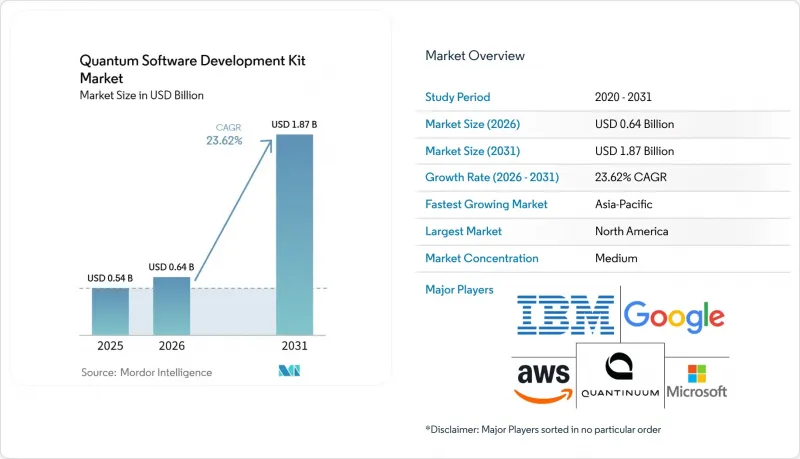
本報告按軟體開發工具包類型(核心量子開發、硬體專用、其他)、部署模式(雲端、本地部署、混合部署)、應用領域(最佳化、量子機器學習、其他)、最終用戶產業(IT與電信、醫療保健與生命科學、其他)以及地區進行細分。市場預測以美元計價。
全球量子軟體開發工具包市場趨勢與洞察
擴展混合量子和經典工作負載
包括橡樹嶺國家實驗室、阿貢國家實驗室、理研國家實驗室、於利希國家實驗室和巴塞隆納超級計算中心在內的頂級超級計算中心已承諾在2028年前實現量子計算單元(QPU)的託管整合。這將為量子軟體開發工具包(SDK)市場建立一條清晰的採購管道,涵蓋各個平台的應用程式介面(API),以及更高層級的中間件和編配工具。混合工作流程編配主導的商業性競爭日益激烈,NVIDIA CUDA-Q和IBM量子運算服務是主要參與企業。 CUDA-Q基準測試表明,混合演算法的收斂速度比僅使用CPU的最佳化循環快5倍,儘管這些結果是基於企業級數據。 2026年3月,克里夫蘭診所和IBM宣布,將使用IBM Quantum Heron r2硬體開發一種用於解析303原子Trp-cage微型蛋白電子結構的混合工作流程。這項成就將設想的工作流程從僅 QPU 電路擴展到 CPU-GPU-QPU 環境,使傳統的高效能運算和資料科學團隊能夠在量子技術的採用中發揮更直接的作用。
政府主導的量子運算計畫和研究經費
政府項目會影響產品藍圖,因為其資金與特定的硬體和生態系統里程碑掛鉤。 2026年5月,美國商務部根據《晶片與科學法案》(CHIPS and Science Act)簽署了20.13億美元的撥款意向書,用於資助九家量子計算公司。其中,IBM獲得10億美元,Atom Computing、Infleqtion、Quantinuum、D-Wave和Rigetti各獲得1億美元。 2026年6月,美國能源部宣布啟動「量子創世」(Quantum Genesis)計劃,旨在2028年實現具有科學意義的容錯運算,並建立整合量子運算和高效能運算資源的使用者設施。已在波茲南、俄斯特拉發和慕尼黑投入運作的EuroHPC系統也需要相容的軟體層供科學用戶使用。新興的互通性要求可能會增加量子軟體開發工具包市場的合規負擔,但也為早期採用者提供了影響通用技術實踐的機會。
量子硬體的可用性有限且效能不穩定
量子軟體開發工具包市場供應仍然有限,且依賴性能因供應商而異的硬體。例如,Rigetti 的 Cepheus-1-108Q 系統對雙量子位元閘的保真度為 99.1%,而 Quantinuum 的 Helios 離子阱系統則超過 99.9%。因此,編譯器和轉譯工具需要隨著每一代硬體的更新而不斷調整,這影響了雲端存取所需的可移植性。硬體採購通常基於多年公共預算,而軟體發布可能按季度進行。這種時間滯後會導致軟體功能的發展速度領先商業部署所需的硬體,從而延遲企業關於生產部署的決策。
細分市場分析
2025年,核心量子開發佔了量子軟體開發工具包(SDK)市場24.81%的佔有率。這是因為基礎電路程式框架仍然是許多開發者的起點。 IBM Qiskit和Google Cirq仍然是該類別的關鍵工具。隨著Qiskit v2.5的發布,多表示編譯器框架被引入,核心開發和專用編譯功能之間的界線正逐漸模糊。硬體專用SDK,包括IQM、Pasqal Pulser和Quantinuum等後端工具,服務需要直接存取特定系統的使用者。隨著供應商推進容錯演示,量子糾錯、量子控制和量子校準工具的普及程度也越來越高。這些工具的進一步推廣將取決於2027年和2028年相關硬體的就緒目標。
預計到 2031 年,編譯器和轉譯器 SDK 的複合年成長率將達到 27.14%,在所有 SDK 類型中成長率最高。通用電路編譯器仍需要針對特定硬體進行調優,因此需要針對所有 QPU 架構單獨最佳化編譯流程。 2026 年 2 月,Amazon Braket 發布了 Qiskit-Braket 提供者 v0.11,使 Qiskit 用戶能夠在 Braket 原生後端(包括 Rigetti 的 Cepheus-1-108Q)上運行最佳化電路,從而實現靈活的電路編譯。特定領域和混合量子-經典 SDK 支援金融建模、藥物發現和材料模擬等用例。它們的普及主要受各行業企業需求的驅動。 「其他」類別包括專用模擬和視覺化工具。雖然缺乏編譯器和垂直軟體層級那樣的需求驅動,但該類別正在穩步成長。
在2025年的量子軟體開發工具包市場中,雲端部署佔了72.36%的市場。大多數用戶透過IBM Quantum、Amazon Braket、Microsoft Azure Quantum和IonQ Cloud等託管服務存取量子硬體。本地部署需要資本投入、低溫基礎設施、微波控制電子設備以及專門的維護。因此,雲端存取已成為許多用戶的預設選擇。對於有資料居住要求的國家實驗室、國防相關企業和金融機構而言,本地部署系統仍然發揮著至關重要的作用。 IBM計劃在2026年9月前在印度阿馬拉瓦蒂安裝印度首批量子電腦之一,這表明對於尋求增強基礎設施管理的國家而言,本地部署模式前景廣闊。
預計到 2031 年,混合部署將以 26.83% 的複合年成長率成長。在這些環境中,電路會根據電路深度、雜訊特性和執行成本在本地模擬器、本地量子運算單元 (QPU) 和雲端後端之間進行路由。這不僅僅是存取方式的組合,它還需要不同運算環境之間可靠的協作。 NVIDIA CUDA-Q 旨在滿足這一需求,其基準測試表明,混合演算法的收斂速度比僅使用 CPU 的最佳化循環快 5 倍。隨著計劃在 2028 年前在 Tier-1 超級運算中心部署 QPU,對支援混合運算的介面的需求預計將會增加。此類介面需要為科學研究和企業用戶提供在傳統和量子工作流程中一致的存取體驗。
區域分析
2025年,北美佔據了量子軟體開發工具包(SDK)市場36.42%的佔有率。該地區擁有強大的供應商基礎、成熟的資本市場、國家實驗室和領先的研究機構。 2026年5月,美國商務部發布了一份總額達20.13億美元的意向書(LOI),進一步強化了美國國內系統和軟體的發展藍圖。美國能源部的「量子創世」(Quantum Genesis)舉措設定了2028年實現容錯運算和整合使用者設施的目標。加拿大的相關措施包括Xanadu和Waterloo研究叢集。墨西哥仍處於起步階段,需求主要集中在學術界。
在歐洲,量子軟體開發工具包市場的發展路徑是由政策主導的。 EuroHPC分別於2025年6月、2025年9月和2026年2月在波茲南、奧斯特拉瓦和慕尼黑啟動了量子電腦運行,由此產生了對相容軟體的需求,以滿足科學研究用戶的需求。德國透過弗勞恩霍夫協會和德國航太中心(DLR)的委託計畫主導了商業活動。英國擁有Quantinuum、Riverlane和Q-CTRL等公司,它們提供差異化的編譯、糾錯和控制工具。南美洲仍處於商業發展的早期階段。巴西擁有該地區最先進的學術基礎設施(透過CBPF和聖保羅大學),但由於資金籌措困難和硬體獲取管道有限,其量子計算技術的普及應用受到阻礙。
預計到2031年,亞太地區的複合年成長率將達到29.16%,在所有地區中成長最高。中國已向三個區域量子基金共撥款1,218億元人民幣(約175億美元),而日本則投資500億日圓(約3.35億美元)用於國內量子技術的產業化。日本的計畫包括支持富士通、KDDI和新創公司Jij。 IBM計劃於2026年9月在阿馬拉瓦蒂設立一個設施,這將為印度的製藥、軟體和金融服務公司提供在地化的服務點。隨著量子軟體開發工具包(SDK)產業對半導體和材料的商業性興趣日益濃厚,韓國科學技術院(KAIST)和國家研究計畫繼續支持學術界的需求。在中東和非洲,阿拉伯聯合大公國科技創新研究院和沙烏地阿拉伯阿卜杜拉國王科技大學(KAUST)已出現初步需求,但由於人才有限,商業化進程可能會較為緩慢。
其他好處
- Excel格式的市場預測(ME)表
- 3個月的分析師支持
目錄
第1章:引言
- 研究假設和市場定義
- 調查範圍
第2章:調查方法
第3章執行摘要
第4章 市場狀況
- 市場概覽
- 市場促進因素
- 擴展混合量子和經典工作負載
- 政府主導的量子運算計畫和研究經費
- 開放原始碼量子軟體生態系統的發展
- 企業對量子演算法開發平台的需求日益成長
- 碎片化QPU架構中的硬體可移植性需求
- 實用規模量子系統中即時糾錯軟體的需求
- 市場限制因素
- 量子硬體的可用性有限且效能不穩定
- 量子軟體工程和演算法開發領域人員短缺
- SDK碎片化與不完整的互通性標準
- 維護特定於硬體的編譯和控制棧高成本
- 宏觀經濟因素對市場的影響
- 產業價值鏈分析
- 科技趨勢
- 監理情勢
- 波特五力分析
第5章 市場規模與成長預測
- 軟體開發工具包類型
- 核心量子開發
- 硬體特定
- 編譯器和轉譯器
- 量子糾錯
- 量子控制與校準
- 混合量子/經典
- 領域特定
- 其他軟體開發工具包類型
- 部署模式
- 基於雲端的
- 現場
- 混合
- 透過使用
- 最佳化
- 量子機器學習
- 化學和材料模擬
- 藥物發現
- 財務建模
- 密碼技術與安全
- 量子自然語言處理(NLP)
- 其他
- 按最終用戶行業分類
- 資訊科技/通訊
- BFSI
- 醫療保健和生命科學
- 零售與電子商務
- 工業製造
- 教育和研究機構
- 媒體與娛樂
- 政府/行政部門
- 能源與公共產業
- 其他
- 按地區
- 北美洲
- 美國
- 加拿大
- 墨西哥
- 南美洲
- 巴西
- 阿根廷
- 其他南美國家
- 歐洲
- 德國
- 英國
- 法國
- 俄羅斯
- 西班牙
- 其他歐洲國家
- 亞太地區
- 中國
- 日本
- 印度
- 韓國
- 東南亞
- 其他亞太國家
- 中東和非洲
- 中東
- 沙烏地阿拉伯
- 阿拉伯聯合大公國
- 其他中東國家
- 非洲
- 南非
- 奈及利亞
- 其他非洲地區
- 中東
- 北美洲
第6章 競爭情勢
- 市場集中度
- 策略趨勢
- 市佔率分析
- 公司簡介
- IBM Corporation
- Google LLC
- Amazon Web Services, Inc.
- Microsoft Corporation
- Quantinuum Ltd.
- D-Wave Quantum Inc.
- IonQ, Inc.
- Rigetti Computing, Inc.
- Xanadu Quantum Technologies Inc.
- Pasqal SAS
- Classiq Technologies Ltd.
- Quantum Computing Inc.
- Riverlane Ltd.
- Q-CTRL Pty Ltd
- QuEra Computing Inc.
- qBraid Inc
- Oxford Quantum Circuits plc
- 1QB Information Technologies
- Quantum Machines
- Infleqtion, Inc.
- QC Ware Corp.
- Strangeworks, Inc.
- BlueQubit, Inc.
- Multiverse Computing SL
- Terra Quantum AG
- Algorithmiq Srl
第7章 市場機會與未來展望
According to Mordor Intelligence, the quantum software development kit market size is expected to grow from USD 0.54 billion in 2025 to USD 0.64 billion in 2026 and is forecast to reach USD 1.87 billion by 2031 at 23.92% CAGR over 2026-2031.
This report is Segmented by Software Development Kit Type (Core Quantum Development, Hardware-Specific, and More), Deployment Mode (Cloud-Based, On-Premises, and Hybrid), Application (Optimization, Quantum Machine Learning, and More), End-User Industry (IT and Telecommunication, Healthcare and Life Sciences, and More), and Geography. The Market Forecasts are Provided in Terms of Value (USD).
Global Quantum Software Development Kit Market Trends and Insights
Expansion of Hybrid Quantum-Classical Workloads
Tier-1 supercomputing centers, including Oak Ridge, Argonne, RIKEN, Julich, and the Barcelona Supercomputing Center, have committed to co-located QPU integration by 2028. This creates a defined procurement path for middleware and orchestration tools above individual platform application programming interfaces in the quantum software development kit market. The commercial contest is increasingly focused on control of hybrid workflow orchestration, where NVIDIA CUDA-Q and IBM Quantum Compute Service are key participants. CUDA-Q benchmarks showed that a hybrid algorithm converged up to 5x faster than CPU-only optimization loops, although this result comes from a company source. Cleveland Clinic and IBM published a hybrid workflow for the electronic structure of the 303-atom Trp-cage miniprotein in March 2026, using IBM Quantum Heron r2 hardware. The work broadens the expected workflow from QPU-only circuits to CPU-GPU-QPU environments, giving classical high-performance computing and data science teams a more direct role in adoption.
Government-Led Quantum Computing Programs and Research Funding
Government programs are shaping product roadmaps because their funding is linked to specific hardware and ecosystem milestones. In May 2026, the U.S. Department of Commerce signed letters of intent for USD 2.013 billion in CHIPS and Science Act incentives across 9 quantum companies. The allocation included USD 1 billion for IBM and USD 100 million each for Atom Computing, Infleqtion, Quantinuum, D-Wave, and Rigetti. The Department of Energy announced Quantum Genesis in June 2026, targeting scientifically relevant fault-tolerant computing by 2028 and a user facility that integrates quantum and high-performance computing resources. EuroHPC systems inaugurated in Poznan, Ostrava, and Munich also require compatible software layers for scientific users. Emerging interoperability requirements may increase compliance work in the quantum software development kit market, but they also allow early adopters to influence common technical practices.
Limited Quantum Hardware Availability and Performance Variability
The quantum software development kit market depends on hardware that remains scarce and has uneven performance across vendors. Two-qubit gate fidelity ranged from 99.1% on Rigetti's Cepheus-1-108Q system to above 99.9% on Quantinuum Helios trapped-ion systems. Compiler and transpiler tools, therefore, need continuing adjustment for each hardware generation. This reduces the portability that cloud access is expected to provide. Hardware procurement often follows multi-year public budgets, while software releases can occur each quarter. The timing difference can leave software functions ahead of the hardware required for commercial deployment, delaying enterprise production decisions.
Other drivers and restraints analyzed in the detailed report include:
- Rising Enterprise Demand for Quantum Algorithm Development Platforms
- Growth of Open-Source Quantum Software Ecosystems
- Shortage of Quantum Software Engineering and Algorithm Development Talent
For complete list of drivers and restraints, kindly check the Table Of Contents.
Segment Analysis
Core Quantum Development held 24.81% of the Quantum Software Development Kit Market share in 2025 because foundational circuit programming frameworks remained the starting point for many developers. IBM Qiskit and Google Cirq remained important tools in this category. Qiskit v2.5 introduced a multi-representation compiler framework that has begun to narrow the distinction between core development and dedicated compilation functions. Hardware-specific SDKs, including tools for IQM, Pasqal Pulser, and Quantinuum backends, serve users who need direct access to specific systems. Quantum Error Correction, Quantum Control, and Quantum Calibration tools have gained widespread use as providers pursue fault-tolerant demonstrations. Wider adoption of these tools depends on the hardware readiness targets linked to 2027 and 2028.
Compiler and Transpiler SDKs are projected to record a 27.14% CAGR through 2031, the fastest rate across SDK types. Every QPU architecture needs tailored compilation optimization because general circuit compilers still require hardware-specific tuning. Amazon Braket released Qiskit-Braket provider v0.11 in February 2026 with flexible circuit compilation for Qiskit users running optimized circuits on Braket-native backends, including Rigetti's Cepheus-1-108Q. Domain-Specific and Hybrid Quantum-Classical SDKs support use cases such as financial modeling, drug discovery, and materials simulation. Their adoption is tied to enterprise demand in those fields. The Others category includes specialized simulation and visualization tools. It is growing steadily, though it lacks the same demand drivers as compiler and vertical software layers.
Cloud-Based deployment accounted for 72.36% of the Quantum Software Development Kit Market share in 2025. Most users accessed quantum hardware through managed offerings such as IBM Quantum, Amazon Braket, Microsoft Azure Quantum, and IonQ Cloud. A local deployment requires cryogenic infrastructure, microwave control electronics, and specialized maintenance in addition to capital spending. Cloud access is therefore the default option for many users. Local systems remain relevant for national laboratories, defense contractors, and financial institutions with data residency requirements. IBM planned to install one of India's first quantum computers in Amaravati by September 2026, indicating a potential local-access model for countries seeking greater infrastructure control.
Hybrid deployment is projected to expand at a 26.83% CAGR through 2031. These environments route circuits across local simulators, local QPUs, and cloud backends based on circuit depth, noise profiles, and execution cost. This is more than a combination of access methods because it requires reliable coordination across different computing environments. NVIDIA CUDA-Q has sought this role, with company benchmarks showing up to 5x faster hybrid-algorithm convergence than CPU-only optimization loops. The expected co-location of QPUs at Tier-1 supercomputing centers by 2028 supports demand for hybrid-capable interfaces. Such interfaces will need to give scientific and enterprise users consistent access across classical and quantum workflows.
Complete Report Scope:
- By Software Development Kit Type
- Core Quantum Development
- Hardware-Specific
- Compiler and Transpiler
- Quantum Error Correction
- Quantum Control and Calibration
- Hybrid Quantum-Classical
- Domain-Specific
- Other Software Development Kit Types
- By Deployment Mode
- Cloud-Based
- On-Premises
- Hybrid
- By Application
- Optimization
- Quantum Machine Learning
- Chemistry and Materials Simulation
- Drug Discovery
- Financial Modeling
- Cryptography and Security
- Quantum NLP
- Other Applications
- By End-User Industry
- IT and Telecommunication
- BFSI
- Healthcare and Life Sciences
- Retail and E-Commerce
- Industrial Manufacturing
- Education and Research Institutions
- Media and Entertainment
- Government and Administration
- Energy and Utilities
- Other End-User Industries
- By Geography
- North America
- United States
- Canada
- Mexico
- South America
- Brazil
- Argentina
- Rest of South America
- Europe
- Germany
- United Kingdom
- France
- Russia
- Spain
- Rest of Europe
- Asia-Pacific
- China
- Japan
- India
- South Korea
- Southeast Asia
- Rest of Asia-Pacific
- Middle East and Africa
- Middle East
- Saudi Arabia
- United Arab Emirates
- Rest of Middle East
- Africa
- South Africa
- Nigeria
- Rest of Africa
- Middle East
- North America
Geography Analysis
North America held 36.42% of the Quantum Software Development Kit Market share in 2025. The region combined a dense supplier base, deep capital markets, national laboratories, and major research institutions. U.S. Department of Commerce letters of intent totaling USD 2.013 billion in May 2026 strengthened domestic system and software roadmaps. The Department of Energy's Quantum Genesis initiative provided a 2028 target for fault-tolerant computing and an integrated user facility. Canada's role includes Xanadu and the Waterloo research cluster. Mexico remained at an earlier stage, with demand concentrated in academic settings.
Europe had a policy-led development path in the Quantum Software Development Kit Market. EuroHPC inaugurated quantum computers in Poznan in June 2025, Ostrava in September 2025, and Munich in February 2026, requiring compatible software for scientific users. Germany led commercial activity through mandates from Fraunhofer and DLR. The United Kingdom hosted Quantinuum, Riverlane, and Q-CTRL, which offer differentiated tools for compilation, error correction, and control. South America remained at an early stage of commercial development. Brazil had the region's most developed academic infrastructure through the CBPF and the University of Sao Paulo, but limited capital availability and access to hardware hindered broader adoption.
Asia-Pacific is projected to expand at a 29.16% CAGR through 2031, the fastest regional rate. China allocated RMB 121.8 billion, equivalent to USD 17.5 billion, across 3 regional quantum funds, while Japan directed JPY 50 billion, equivalent to USD 335 million, toward domestic quantum technology industrialization. Japan's program included support for Fujitsu, KDDI, and startup Jij. IBM planned its Amaravati installation for September 2026, which would provide a local access point for Indian pharmaceutical, software, and financial services organizations. South Korea's KAIST and national research programs continued to support academic demand with emerging commercial interest in semiconductors and materials in the quantum software development kit industry. The Middle East and Africa had early demand from the United Arab Emirates Technology Innovation Institute and Saudi Arabia's KAUST, but limited talent availability could delay commercial uptake.
- IBM Corporation
- Google LLC
- Amazon Web Services, Inc.
- Microsoft Corporation
- Quantinuum Ltd.
- D-Wave Quantum Inc.
- IonQ, Inc.
- Rigetti Computing, Inc.
- Xanadu Quantum Technologies Inc.
- Pasqal SAS
- Classiq Technologies Ltd.
- Quantum Computing Inc.
- Riverlane Ltd.
- Q-CTRL Pty Ltd
- QuEra Computing Inc.
- qBraid Inc
- Oxford Quantum Circuits plc
- 1QB Information Technologies
- Quantum Machines
- Infleqtion, Inc.
- QC Ware Corp.
- Strangeworks, Inc.
- BlueQubit, Inc.
- Multiverse Computing S.L.
- Terra Quantum AG
- Algorithmiq S.r.l.
Additional Benefits:
- The market estimate (ME) sheet in Excel format
- 3 months of analyst support
TABLE OF CONTENTS
1 INTRODUCTION
- 1.1 Study Assumptions and Market Definition
- 1.2 Scope of the Study
2 RESEARCH METHODOLOGY
3 EXECUTIVE SUMMARY
4 MARKET LANDSCAPE
- 4.1 Market Overview
- 4.2 Market Drivers
- 4.2.1 Expansion of Hybrid Quantum-Classical Workloads
- 4.2.2 Government-Led Quantum Computing Programs and Research Funding
- 4.2.3 Growth of Open-Source Quantum Software Ecosystems
- 4.2.4 Rising Enterprise Demand for Quantum Algorithm Development Platforms
- 4.2.5 Hardware-Portability Requirements Across Fragmented QPU Architectures
- 4.2.6 Real-Time Error-Correction Software Requirements for Utility-Scale Quantum Systems
- 4.3 Market Restraints
- 4.3.1 Limited Quantum Hardware Availability and Performance Variability
- 4.3.2 Shortage of Quantum Software Engineering and Algorithm Development Talent
- 4.3.3 SDK Fragmentation and Incomplete Interoperability Standards
- 4.3.4 High Cost of Maintaining Hardware-Specific Compilation and Control Stacks
- 4.4 Impact of Macroeconomic Factors on the Market
- 4.5 Industry Value-Chain Analysis
- 4.6 Technology Outlook
- 4.7 Regulatory Landscape
- 4.8 Porter's Five Forces Analysis
- 4.8.1 Threat of New Entrants
- 4.8.2 Bargaining Power of Suppliers
- 4.8.3 Bargaining Power of Buyers
- 4.8.4 Threat of Substitutes
- 4.8.5 Intensity of Competitive Rivalry
5 MARKET SIZE AND GROWTH FORECASTS (VALUE)
- 5.1 By Software Development Kit Type
- 5.1.1 Core Quantum Development
- 5.1.2 Hardware-Specific
- 5.1.3 Compiler and Transpiler
- 5.1.4 Quantum Error Correction
- 5.1.5 Quantum Control and Calibration
- 5.1.6 Hybrid Quantum-Classical
- 5.1.7 Domain-Specific
- 5.1.8 Other Software Development Kit Types
- 5.2 By Deployment Mode
- 5.2.1 Cloud-Based
- 5.2.2 On-Premises
- 5.2.3 Hybrid
- 5.3 By Application
- 5.3.1 Optimization
- 5.3.2 Quantum Machine Learning
- 5.3.3 Chemistry and Materials Simulation
- 5.3.4 Drug Discovery
- 5.3.5 Financial Modeling
- 5.3.6 Cryptography and Security
- 5.3.7 Quantum NLP
- 5.3.8 Other Applications
- 5.4 By End-User Industry
- 5.4.1 IT and Telecommunication
- 5.4.2 BFSI
- 5.4.3 Healthcare and Life Sciences
- 5.4.4 Retail and E-Commerce
- 5.4.5 Industrial Manufacturing
- 5.4.6 Education and Research Institutions
- 5.4.7 Media and Entertainment
- 5.4.8 Government and Administration
- 5.4.9 Energy and Utilities
- 5.4.10 Other End-User Industries
- 5.5 By Geography
- 5.5.1 North America
- 5.5.1.1 United States
- 5.5.1.2 Canada
- 5.5.1.3 Mexico
- 5.5.2 South America
- 5.5.2.1 Brazil
- 5.5.2.2 Argentina
- 5.5.2.3 Rest of South America
- 5.5.3 Europe
- 5.5.3.1 Germany
- 5.5.3.2 United Kingdom
- 5.5.3.3 France
- 5.5.3.4 Russia
- 5.5.3.5 Spain
- 5.5.3.6 Rest of Europe
- 5.5.4 Asia-Pacific
- 5.5.4.1 China
- 5.5.4.2 Japan
- 5.5.4.3 India
- 5.5.4.4 South Korea
- 5.5.4.5 Southeast Asia
- 5.5.4.6 Rest of Asia-Pacific
- 5.5.5 Middle East and Africa
- 5.5.5.1 Middle East
- 5.5.5.1.1 Saudi Arabia
- 5.5.5.1.2 United Arab Emirates
- 5.5.5.1.3 Rest of Middle East
- 5.5.5.2 Africa
- 5.5.5.2.1 South Africa
- 5.5.5.2.2 Nigeria
- 5.5.5.2.3 Rest of Africa
- 5.5.5.1 Middle East
- 5.5.1 North America
6 COMPETITIVE LANDSCAPE
- 6.1 Market Concentration
- 6.2 Strategic Moves
- 6.3 Market Share Analysis
- 6.4 Company Profiles (includes Global Level Overview, Market Level Overview, Core Segments, Financials as available, Strategic Information, Market Rank/Share, Products and Services, Recent Developments)
- 6.4.1 IBM Corporation
- 6.4.2 Google LLC
- 6.4.3 Amazon Web Services, Inc.
- 6.4.4 Microsoft Corporation
- 6.4.5 Quantinuum Ltd.
- 6.4.6 D-Wave Quantum Inc.
- 6.4.7 IonQ, Inc.
- 6.4.8 Rigetti Computing, Inc.
- 6.4.9 Xanadu Quantum Technologies Inc.
- 6.4.10 Pasqal SAS
- 6.4.11 Classiq Technologies Ltd.
- 6.4.12 Quantum Computing Inc.
- 6.4.13 Riverlane Ltd.
- 6.4.14 Q-CTRL Pty Ltd
- 6.4.15 QuEra Computing Inc.
- 6.4.16 qBraid Inc
- 6.4.17 Oxford Quantum Circuits plc
- 6.4.18 1QB Information Technologies
- 6.4.19 Quantum Machines
- 6.4.20 Infleqtion, Inc.
- 6.4.21 QC Ware Corp.
- 6.4.22 Strangeworks, Inc.
- 6.4.23 BlueQubit, Inc.
- 6.4.24 Multiverse Computing S.L.
- 6.4.25 Terra Quantum AG
- 6.4.26 Algorithmiq S.r.l.
7 MARKET OPPORTUNITIES AND FUTURE OUTLOOK
- 7.1 White-Space and Unmet-Need Assessment

 2026年全球量子計算市場報告
 全球量子計算軟體市場規模、佔有率、趨勢和成長分析報告(2026-2034)全球量子計算市場規模、佔有率、趨勢和成長分析報告(2026-2034)
 抗量子安全技術的研究服務
 汽車市場量子計算:全球市場預測(2026-2032年)
 超導性量子位元市場:商業機會、成長要素、產業趨勢分析及2026-2035年預測量子運算市場報告:趨勢、預測與競爭分析(至2035年)中性原子量子計算市場機會、成長要素、產業趨勢分析及2026-2035年預測
 量子計算軟體平台:市場佔有率分析、產業趨勢與統計及成長預測(2026-2031)量子軟體工具鏈:市場佔有率分析、產業趨勢與統計、成長預測(2026-2031)