


 |
市場調查報告書
商品編碼
2117627
量子計算軟體平台:市場佔有率分析、產業趨勢與統計及成長預測(2026-2031)Quantum Computing Software Platform - Market Share Analysis, Industry Trends & Statistics, Growth Forecasts (2026 - 2031) |
||||||

※ 本網頁內容可能與最新版本有所差異。詳細情況請與我們聯繫。
根據 Mordor Intelligence 預測,量子運算軟體平台市場規模將從 2025 年的 9.6 億美元和 2026 年的 12.2 億美元成長到 2031 年的 39.7 億美元,2026 年至 2031 年的年複合成長率(CAGR)為 26.62%。
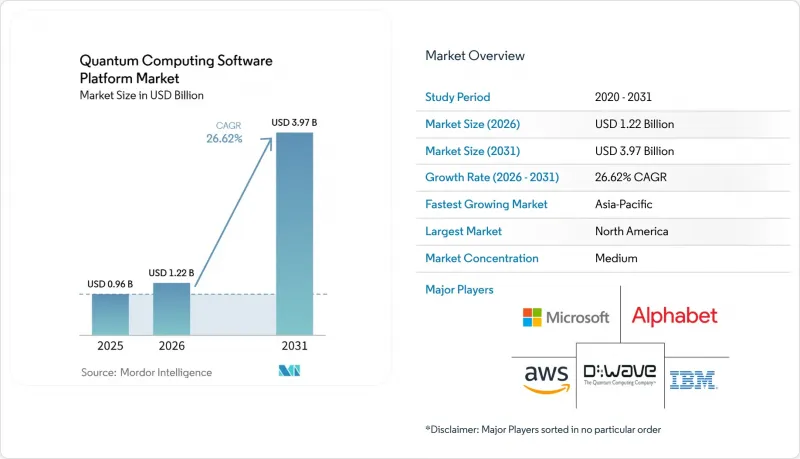
本報告按平台類型(開發套件、演算法設計平台、量子模擬器等)、部署模式(雲端、本地部署、混合部署)、應用領域(模擬建模、機器學習等)、終端用戶產業(醫療保健和生命科學等)以及地區進行細分。市場預測以美元計價。
全球量子運算軟體平台市場趨勢與洞察
企業向「量子即服務」開發堆疊遷移
在量子運算軟體平台市場,分散的概念驗證(PoC) 環境的管理、擴展和長期維護難度日益增加,促使企業團隊將量子相關工作轉移到託管開發平台。這種轉變更符合現有的軟體管治模型,使大型企業能夠輕鬆地將量子實驗與主流開發和檢驗流程整合。 IBM 於 2026 年發布的 Qiskit SDK v2.5 新增了自訂編譯器管線、C API 以及 LightSabre 路由的改進,從而縮短了 100 個或更多量子位元電路的轉換時間。這顯示企業級工具對於大規模技術團隊而言變得越來越實用。隨著這些託管平台的不斷改進,量子運算軟體平台市場的切換成本正從底層硬體層轉移到軟體工作流程和編譯器層。這一趨勢使平台協調者能夠更好地掌控長期客戶關係,尤其是在他們成為混合量子-經典開發環境的預設介面的情況下。
政府資助的量子軟體採購和國家項目
直接公共採購仍然是量子運算軟體平台市場需求的最清晰訊號之一,因為它將長期研究目標轉化為有資金支援的軟體開發、基準測試和整合工作。 2026年5月,美國商務部根據《晶片與科學法案》(CHIPS and Science Act)與包括IBM、Quantinuum、D-Wave和Rigetti在內的九家量子公司簽署了總額達20.13億美元的撥款意向書。這將加強企業軟體所依賴的硬體基礎設施。美國能源局也續簽了對五個國家量子資訊研究中心的資助,累計為6.25億美元。其中包括橡樹嶺國家實驗室與開放原始碼量子-經典工作流程軟體相關的任務,以滿足對中間件和編配的需求。 QC-ADDS計劃是根據白宮於2026年6月22日簽署的行政命令而設立的。此外,《2026年國家量子舉措再授權法案》批准了美國國家標準與技術研究院(NIST)在2030年之前每年8,500萬美元的量子相關活動預算,以加強標準化和性能評估工作,這將影響商業架構的選擇。日本的JHPC-量子計畫預算為100億美元(以2025年平均外匯計算約為6,700萬美元),為期五年,直至2027年,該計畫正在建構用於量子-高效能運算混合工作流程的軟體基礎設施,這顯示採購主導的需求並非僅限於北美。
容錯量子位元的供不應求正在減緩透過實用軟體創造價值的速度。
商用容錯硬體的匱乏持續限制量子運算軟體平台市場供應商能夠大規模銷售的工作負載範圍和深度。儘管Quantinuum公司於2026年7月在《自然》雜誌上發布的98量子位元「Helios」處理器代表著一項重大的技術進步,但它目前仍主要用於研究和試點階段,而非大規模企業部署。此外,軟體開發人員必須支援各種硬體方案,包括超導性、離子阱、中性原子、光子等架構,這增加了整個量子運算軟體平台市場編譯器和錯誤緩解機制的複雜性。 IBM和Quantinuum都將2029年確定為實現可擴展容錯的關鍵目標年份。這意味著在預測期內的大部分時間裡,軟體層仍將局限於混合環境和預生產用例。在此之前,供應商必須透過模擬品質、工作流程整合和基準測試支援來展現訂閱價值,而不是依賴硬體特定的量子優勢。
細分市場分析
2025年,開發套件佔平台收入的39.23%,在量子運算軟體平台市場中佔最大佔有率。這一主導地位表明,企業支出仍然集中在程式設計基礎設施、編譯器存取和測試層,而不是更高層級的編配。在量子運算軟體平台市場,買家仍在致力於建立基礎功能。這包括檢驗電路編譯、確認模擬器行為,以及在部署到更廣泛的生產環境之前建立可複現的開發工作流程。 IBM在2026年透過一系列Qiskit版本強化了這個層面,擴展了C API支援並提升了編譯器對大規模電路的處理能力。這一趨勢凸顯了市場結構的特徵:開發人員最初掌握的工具往往會成為整個量子運算軟體平台市場後續整合選項的基礎。
中間件和編配是成長最快的細分市場,預計到 2031 年將保持 27.18% 的複合年成長率。這表明,隨著混合工作流程變得越來越重要,價值創造方式正在漸進式轉變。隨著硬體的成熟,企業需要更強大的調度、路由和作業管理層,以便在實際運作環境中將量子處理器與 CPU 和 GPU 連接起來。演算法設計平台和量子模擬器仍然至關重要,因為它們可以幫助用戶在將工作移至實際硬體佇列之前檢驗邏輯和資源需求。量子控制軟體目前仍是一個較小的收入細分市場,但隨著大規模系統需要更嚴格的校準、時序控制和誤差回饋迴路,其重要性日益凸顯。 NVIDIA 在日本大規模研究基礎設施中部署 CUDA-Q,顯示在量子運算軟體平台市場中,模擬、編配和控制之間的聯繫正變得日益緊密。
到2025年,基於雲端的部署將佔據63.81%的市場佔有率,成為量子運算軟體平台市場的主導存取模式。這種主導地位反映了硬體所有權相關的成本和複雜性,因為大多數公司不願意僅僅為了測試量子工作流程而建立或租賃專用系統。雲端部署還允許買家透過軟體介面比較不同的硬體配置,這種介面比直接管理基礎架構更容易實現。這種方法加快了評估週期,並減少了開發人員對擁有物理專業知識的內部團隊的依賴。雲端存取的優勢是量子運算軟體平台市場正在從主導機構擴展到傳統研究組織以外的用戶群體的原因之一。
在政府、國防和某些研究環境中,本地部署仍然具有重要的戰略意義,因為在這些環境中,安全性、延遲和系統控制比廣泛的可近性更為重要。混合部署模式是成長最快的部署模式,預計到 2031 年將實現 29.52% 的複合年成長率。這是因為許多用戶需要將本地經典基礎設施與遠端量子處理緊密整合,以處理重複性工作負載。當往返延遲減慢最佳化循環速度,或受監管的使用者希望將部分工作流程保留在受控環境中時,這一點就顯得尤為重要。日本的「ROQUO」平台透過將量子系統與運作環境中的超級電腦「富嶽」連接起來,展示了混合設計如何進入運行階段。儘管數據居住等領域的監管壓力將使雲端繼續成為進入量子運算軟體平台市場的主要入口,但非公開部署模式的重要性仍然存在。
區域分析
到2025年,北美將佔據量子運算軟體平台市場37.26%的佔有率,並繼續保持其在收入方面的領先地位。該地區受益於主要雲端服務供應商、專業軟體供應商和國家實驗室的集中,以及為量子運算軟體平台市場的標準化和整合工作提供資金支持的政策機制。 2026年5月的《CHIPS法案》、2026年6月白宮關於量子創新的行政命令以及2026年的《國家量子舉措再授權法案》均表明,美國在該領域擁有資源彙整的政策環境。加拿大憑藉其研究基礎設施和專業公司的存在,為該地區的量子運算發展提供了支持,而墨西哥仍處於量子運算應用的早期階段,更傾向於依賴雲端服務而非建立自己的國內平台。
預計到2031年,亞太地區將以31.71%的複合年成長率成長,成為量子運算軟體平台市場成長最快的區域叢集。日本是這一成長的主要驅動力,日本理化學研究所(RIKEN)於2026年6月運作了ROQUO量子高效能運算混合超級電腦,將Quantinuum和IBM系統與富嶽超級電腦連接起來,投入實際運作。富士通和大阪大學也於2026年3月發布了STAR架構第三版,將早期容錯量子電腦的分子能量運算精度提高了十倍以上。富士通和理化學研究所已於2025年向外部用戶開放了日本的256量子位元超導性量子電腦,進一步增強了該地區在材料和科學應用領域的軟體需求。新加坡也在透過QAI Ventures支援的專用加速器建立商業化能力,這表明量子運算軟體平台市場正在向亞洲最大的國家項目之外擴展。
歐洲仍然是量子運算軟體平台市場的關鍵區域,其中英國和德國作為研發和商業化中心尤為突出。英國透過Riverlane的Deltakit業務以及Deltaflow 2與橡樹嶺國家實驗室「Frontier」超級電腦的整合,鞏固了其在糾錯軟體領域的地位。 2026年7月,總部位於德國的ParityQC和總部位於以色列的Classiq宣佈建立合作關係,旨在整合硬體最佳化和高階軟體工程。這體現了歐洲對互通性的重視,而非單純關注硬體本身。南美洲、中東和非洲仍處於早期階段,其應用主要集中在金融和公共部門的特定研究和專業用例,而非大規模商業應用。
其他好處:
- Excel格式的市場預測(ME)表
- 3個月的分析師支持
目錄
第1章:引言
- 研究假設和市場定義
- 調查範圍
第2章:調查方法
第3章執行摘要
第4章 市場狀況
- 市場概覽
- 市場促進因素
- 企業向「量子即服務」開發堆疊遷移
- 對量子糾錯和基準測試工具的需求日益成長
- 擴展量子雲端供應商生態系統並整合SDK
- 政府資助的量子軟體採購和國家項目
- 工具鏈碎片化催生了對互通性層的需求。
- 早期將量子技術應用於金融、化工和物流等領域。
- 市場限制因素
- 容錯量子比特供應有限,減緩了透過實用軟體創造價值的速度。
- 量子演算法、編譯器和控制軟體領域缺乏高技能人才。
- 人們擔心專有量子 SDK 和封閉式生態系統會導致供應商鎖定。
- 對於大多數試點用例以外的企業工作負載而言,投資報酬率尚不明確。
- 產業價值鏈分析
- 宏觀經濟因素對市場的影響
- 監理情勢
- 技術展望
- 波特五力分析
- 策略趨勢分析
- 專利和智慧財產權的發展趨勢
第5章 市場規模與成長預測
- 依平台類型
- 開發套件
- 演算法設計平台
- 量子模擬器和模擬器
- 中介軟體和編配
- 量子控制軟體
- 按部署模式
- 基於雲端的
- 現場
- 混合
- 透過使用
- 最佳化
- 模擬與建模
- 機器學習
- 密碼技術和網路安全
- 藥物發現與材料科學
- 供應鍊和物流最佳化
- 按最終用戶行業分類
- 銀行、金融服務和保險(BFSI)
- 政府/國防
- 醫療保健和生命科學
- 能源公用事業
- 汽車和運輸業
- 資訊科技/通訊
- 化學與材料
- 其他終端用戶產業
- 按地區
- 北美洲
- 美國
- 加拿大
- 墨西哥
- 南美洲
- 巴西
- 阿根廷
- 其他南美國家
- 歐洲
- 英國
- 德國
- 法國
- 其他歐洲國家
- 亞太地區
- 中國
- 日本
- 印度
- 韓國
- 澳洲
- 其他亞太國家
- 中東和非洲
- 中東
- 阿拉伯聯合大公國
- 沙烏地阿拉伯
- 其他中東國家
- 非洲
- 南非
- 肯亞
- 其他非洲國家
- 中東
- 北美洲
第6章 競爭情勢
- 市場集中度
- 策略趨勢
- 市佔率分析
- 公司簡介
- IBM Corporation
- Microsoft Corporation
- Alphabet Inc.
- Amazon Web Services, Inc.
- D-Wave Quantum Inc.
- Quantinuum Ltd.
- QC Ware Corporation
- Classiq Technologies Ltd.
- Zapata Computing Holdings Inc.
- 1QBit Information Technologies Inc.
- Riverlane Ltd.
- Q-CTRL Pty Ltd.
- Xanadu Quantum Technologies Inc.
- Pasqal SA
- Aliro Technologies, Inc.
- QuandCo BV
- Horizon Quantum Computing Pte. Ltd.
- Rigetti Computing, Inc.
- IonQ, Inc.
- Fujitsu Limited
- Toshiba Corporation
- Hitachi, Ltd.
- NVIDIA Corporation
第7章 市場機會與未來展望
According to Mordor Intelligence, the quantum computing software platform market size is projected to expand from USD 0.96 billion in 2025 and USD 1.22 billion in 2026 to USD 3.97 billion by 2031, registering a CAGR of 26.62% between 2026 to 2031.
This report is Segmented by Platform Type (Development Kits, Algorithm Design Platforms, Quantum Emulators and Simulators, and More), Deployment Model (Cloud-Based, On-Premises, and Hybrid), Application (Simulation and Modeling, Machine Learning, and More), End User Industry (Healthcare and Life Sciences, and More), and Geography. The Market Forecasts are Provided in Terms of Value (USD).
Global Quantum Computing Software Platform Market Trends and Insights
Enterprise Migration to Quantum-As-A-Service Development Stacks
Enterprise teams are moving quantum work onto managed development stacks because fragmented proof-of-concept environments are harder to govern, scale, and maintain over time in the quantum computing software platform market. This shift fits existing software governance models better, which makes it easier for large organizations to connect quantum experimentation with mainstream development and validation processes. IBM's Qiskit SDK v2.5 release in 2026 added custom compiler pipelines, a C API, and LightSabre routing improvements that reduced transpiration time on circuits of 100 or more qubits, which shows how enterprise tooling is becoming more practical for larger technical teams. As these managed stacks improve, switching costs move toward the software workflow and compiler layer rather than the underlying hardware layer in the quantum computing software platform market. That dynamic gives platform orchestrators more control over long-term customer relationships, especially when they become the default interface for hybrid quantum and classical development environments.
Government-Funded Quantum Software Procurement and National Programs
Direct public procurement remains one of the clearest demand signals for the quantum computing software platform market because it turns long-horizon research goals into funded software, benchmarking, and integration work. In May 2026, the U.S. Department of Commerce signed letters of intent for USD 2.013 billion in CHIPS and Science Act incentives to 9 quantum companies, including IBM, Quantinuum, D-Wave, and Rigetti, which strengthens the hardware base that enterprise software depends on. The U.S. Department of Energy also renewed 5 National Quantum Information Science Research Centers with USD 625 million, including an Oak Ridge mandate tied to open-source quantum-classical workflow software, which supports middleware and orchestration demand. The White House Executive Order signed on June 22, 2026, created the QC-ADDS program, while the National Quantum Initiative Reauthorization Act of 2026 authorized USD 85 million per year for NIST quantum activities through 2030, reinforcing standards and performance assessment work that shapes commercial architecture choices. Japan's JHPC-quantum program, a 5-year JPY 10 billion program running through 2027, or USD 67 million at 2025 average exchange rates, is building the software foundation for quantum-HPC hybrid workflows and shows that procurement-led demand is not limited to North America.
Limited Fault-Tolerant Qubit Availability Slows Production-Grade Software Value Capture
The lack of commercially available fault-tolerant hardware still limits the range and depth of workloads that vendors can sell at scale in the quantum computing software platform market. Quantinuum's 98-qubit Helios processor, published in Nature in July 2026, marked a major technical step, but it still supports research and pilot-stage use more than full production enterprise deployment. Software developers also have to support very different hardware approaches, including superconducting, trapped-ion, neutral atom, photonic, and other architectures, which raises compiler and mitigation complexity across the quantum computing software platform market. IBM and Quantinuum have both pointed to 2029 as a meaningful target for scalable fault tolerance, which means the software layer will remain tied to hybrid and pre-production use cases through much of the forecast window. Until then, vendors must justify subscriptions through simulation quality, workflow integration, and benchmarking support rather than hardware-native quantum advantage.
Other drivers and restraints analyzed in the detailed report include:
- Quantum Cloud Provider Ecosystem Expansion and SDK Integration
- Rising Demand for Quantum Error Mitigation and Benchmarking Tools
- High Talent Scarcity in Quantum Algorithms, Compilers, and Control Software
For complete list of drivers and restraints, kindly check the Table Of Contents.
Segment Analysis
Development Kits accounted for 39.23% of platform revenue in 2025, representing the largest slice of the quantum computing software platform market share by platform type. This leadership shows that enterprise spending is still concentrated in programming infrastructure, compiler access, and testing layers rather than higher-order orchestration. Buyers are still building foundational capability, which includes validating circuit compilation, checking emulator behavior, and establishing repeatable development workflows before wider production deployment in the quantum computing software platform market. IBM strengthened this layer through consecutive Qiskit releases in 2026 that expanded C API support and improved compiler functionality for larger circuits. That pattern supports a market structure where the first tool a developer learns often becomes the foundation for later integration choices across the quantum computing software platform market.
Middleware and orchestration was the fastest-growing segment, projected to record a 27.18% CAGR through 2031, which points to a gradual shift in value creation as hybrid workflows become more central. As hardware matures, enterprises will need stronger scheduling, routing, and job management layers to connect quantum processors with CPUs and GPUs in practical operating environments. Algorithm Design Platforms and Quantum Emulators and Simulators remain important because they help users validate logic and resource requirements before moving work onto live hardware queues. Quantum Control Software is still a smaller revenue layer, yet it is gaining importance as larger systems require tighter calibration, timing control, and error feedback loops. NVIDIA's CUDA-Q deployment within Japan's large-scale research infrastructure shows how simulation, orchestration, and control are moving closer together inside the quantum computing software platform market.
Cloud-Based deployment held 63.81% share in 2025, making it the leading access model in the quantum computing software platform market. This lead reflects the cost and complexity of hardware ownership, since most enterprises do not want to build or lease specialized systems just to begin testing quantum workflows. Cloud deployment also helps buyers compare different hardware modalities through software interfaces that are easier to adopt than direct infrastructure management. That approach speeds up evaluation cycles and makes developer participation less dependent on a physics-heavy internal team. The strength of cloud access is one reason the quantum computing software platform market is reaching users outside research-led institutions.
On-Premises deployment remains strategically relevant for government, defense, and certain research environments where security, latency, and system control carry more weight than broad accessibility. The Hybrid segment is the fastest-growing deployment path, projected to record a 29.52% CAGR through 2031, as many users now need tight integration between local classical infrastructure and remote quantum processing for iterative workloads. This becomes more important when round-trip latency can slow optimization loops or when regulated users want part of the workflow to remain inside controlled environments. Japan's ROQUO platform illustrates how hybrid design is becoming operational, because it links quantum systems with the Fugaku supercomputer in a working production environment. Regulatory pressure in areas such as data residency will keep non-public deployment models relevant even as cloud remains the main entry point for the quantum computing software platform market.
Complete Report Scope:
- By Platform Type
- Development Kits
- Algorithm Design Platforms
- Quantum Emulators and Simulators
- Middleware and Orchestration
- Quantum Control Software
- By Deployment Model
- Cloud-Based
- On-Premises
- Hybrid
- By Application
- Optimization
- Simulation and Modeling
- Machine Learning
- Cryptography and Cybersecurity
- Drug Discovery and Materials Science
- Supply Chain and Logistics Optimization
- By End User Industry
- Banking, Financial Services, and Insurance (BFSI)
- Government and Defense
- Healthcare and Life Sciences
- Energy and Utilities
- Automotive and Transportation
- IT and Telecommunication
- Chemical and Materials
- Other End User Industries
- By Geography
- North America
- United States
- Canada
- Mexico
- South America
- Brazil
- Argentina
- Rest of South America
- Europe
- United Kingdom
- Germany
- France
- Rest of Europe
- Asia-Pacific
- China
- Japan
- India
- South Korea
- Australia
- Rest of Asia-Pacific
- Middle East and Africa
- Middle East
- United Arab Emirates
- Saudi Arabia
- Rest of Middle East
- Africa
- South Africa
- Kenya
- Rest of Africa
- Middle East
- North America
Geography Analysis
North America held 37.26% of the quantum computing software platform market share in 2025, which kept the region in the leading position by revenue. The region benefits from the concentration of major cloud players, specialist software vendors, national labs, and policy support mechanisms that fund standards and integration work in the quantum computing software platform market. The May 2026 CHIPS Act letters of intent, the June 2026 White House Executive Order on quantum innovation, and the National Quantum Initiative Reauthorization Act of 2026 all reinforced the United States as the most resource-intensive policy environment for this field. Canada supports regional depth through its research base and specialist company presence, while Mexico remains earlier in adoption and is more tied to cloud access than domestic platform creation.
Asia-Pacific is projected to expand at a 31.71% CAGR through 2031, which makes it the fastest-growing regional cluster in the quantum computing software platform market. Japan is a major driver because RIKEN launched the ROQUO quantum-HPC hybrid supercomputer in June 2026, connecting Quantinuum and IBM systems with the Fugaku supercomputer in an operational environment. Fujitsu and the University of Osaka also announced STAR Architecture ver. 3 in March 2026, improving computational accuracy by more than 10 times for molecular energy calculations on early fault-tolerant quantum computers. Fujitsu and RIKEN had already made Japan's 256-qubit superconducting quantum computer available to external users in 2025, which strengthens the region's software demand base for materials and scientific applications. Singapore is also building commercialization capacity through a dedicated accelerator backed by QAI Ventures, which shows that the quantum computing software platform market is broadening beyond the largest national programs in Asia.
Europe remains an important region in the quantum computing software platform market, with the United Kingdom and Germany standing out as research and commercialization hubs. The United Kingdom has strengthened its position in error correction software through Riverlane's Deltakit activity and its Deltaflow 2 integration with Oak Ridge's Frontier supercomputer. Germany-based ParityQC and Israel-based Classiq announced a partnership in July 2026 to integrate hardware optimization and higher-level software engineering, which reflects Europe's emphasis on interoperability rather than pure hardware concentration. South America and the Middle East and Africa remain earlier-stage regions, with adoption still centered on selective research and specialized financial or public-sector use cases rather than broad commercial scale.
- IBM Corporation
- Microsoft Corporation
- Alphabet Inc.
- Amazon Web Services, Inc.
- D-Wave Quantum Inc.
- Quantinuum Ltd.
- QC Ware Corporation
- Classiq Technologies Ltd.
- Zapata Computing Holdings Inc.
- 1QBit Information Technologies Inc.
- Riverlane Ltd.
- Q-CTRL Pty Ltd.
- Xanadu Quantum Technologies Inc.
- Pasqal S.A.
- Aliro Technologies, Inc.
- QuandCo B.V.
- Horizon Quantum Computing Pte. Ltd.
- Rigetti Computing, Inc.
- IonQ, Inc.
- Fujitsu Limited
- Toshiba Corporation
- Hitachi, Ltd.
- NVIDIA Corporation
Additional Benefits:
- The market estimate (ME) sheet in Excel format
- 3 months of analyst support
TABLE OF CONTENTS
1 INTRODUCTION
- 1.1 Study Assumptions and Market Definition
- 1.2 Scope of the Study
2 RESEARCH METHODOLOGY
3 EXECUTIVE SUMMARY
4 MARKET LANDSCAPE
- 4.1 Market Overview
- 4.2 Market Drivers
- 4.2.1 Enterprise Migration to Quantum-As-A-Service Development Stacks
- 4.2.2 Rising Demand for Quantum Error Mitigation and Benchmarking Tools
- 4.2.3 Quantum Cloud Provider Ecosystem Expansion and SDK Integration
- 4.2.4 Government-Funded Quantum Software Procurement and National Programs
- 4.2.5 Fragmented Toolchains Creating Demand for Interoperability Layers
- 4.2.6 Early Commercialization of Domain-Specific Quantum Applications in Finance, Chemistry, and Logistics
- 4.3 Market Restraints
- 4.3.1 Limited Fault-Tolerant Qubit Availability Slows Production-Grade Software Value Capture
- 4.3.2 High Talent Scarcity in Quantum Algorithms, Compilers, and Control Software
- 4.3.3 Vendor Lock-In Fears Around Proprietary Quantum SDKs and Closed Ecosystems
- 4.3.4 Unclear ROI for Most Enterprise Workloads Beyond Pilot Use Cases
- 4.4 Industry Value-Chain Analysis
- 4.5 Impact of Macroeconomic Factors on the Market
- 4.6 Regulatory Landscape
- 4.7 Technological Outlook
- 4.8 Porter's Five Forces Analysis
- 4.8.1 Bargaining Power of Buyers
- 4.8.2 Bargaining Power of Suppliers
- 4.8.3 Threat of New Entrants
- 4.8.4 Threat of Substitutes
- 4.8.5 Intensity of Competitive Rivalry
- 4.9 Strategic Moves Analysis
- 4.10 Patent and Intellectual Property Landscape
5 MARKET SIZE AND GROWTH FORECASTS (VALUE)
- 5.1 By Platform Type
- 5.1.1 Development Kits
- 5.1.2 Algorithm Design Platforms
- 5.1.3 Quantum Emulators and Simulators
- 5.1.4 Middleware and Orchestration
- 5.1.5 Quantum Control Software
- 5.2 By Deployment Model
- 5.2.1 Cloud-Based
- 5.2.2 On-Premises
- 5.2.3 Hybrid
- 5.3 By Application
- 5.3.1 Optimization
- 5.3.2 Simulation and Modeling
- 5.3.3 Machine Learning
- 5.3.4 Cryptography and Cybersecurity
- 5.3.5 Drug Discovery and Materials Science
- 5.3.6 Supply Chain and Logistics Optimization
- 5.4 By End User Industry
- 5.4.1 Banking, Financial Services, and Insurance (BFSI)
- 5.4.2 Government and Defense
- 5.4.3 Healthcare and Life Sciences
- 5.4.4 Energy and Utilities
- 5.4.5 Automotive and Transportation
- 5.4.6 IT and Telecommunication
- 5.4.7 Chemical and Materials
- 5.4.8 Other End User Industries
- 5.5 By Geography
- 5.5.1 North America
- 5.5.1.1 United States
- 5.5.1.2 Canada
- 5.5.1.3 Mexico
- 5.5.2 South America
- 5.5.2.1 Brazil
- 5.5.2.2 Argentina
- 5.5.2.3 Rest of South America
- 5.5.3 Europe
- 5.5.3.1 United Kingdom
- 5.5.3.2 Germany
- 5.5.3.3 France
- 5.5.3.4 Rest of Europe
- 5.5.4 Asia-Pacific
- 5.5.4.1 China
- 5.5.4.2 Japan
- 5.5.4.3 India
- 5.5.4.4 South Korea
- 5.5.4.5 Australia
- 5.5.4.6 Rest of Asia-Pacific
- 5.5.5 Middle East and Africa
- 5.5.5.1 Middle East
- 5.5.5.1.1 United Arab Emirates
- 5.5.5.1.2 Saudi Arabia
- 5.5.5.1.3 Rest of Middle East
- 5.5.5.2 Africa
- 5.5.5.2.1 South Africa
- 5.5.5.2.2 Kenya
- 5.5.5.2.3 Rest of Africa
- 5.5.5.1 Middle East
- 5.5.1 North America
6 COMPETITIVE LandSCAPE
- 6.1 Market Concentration
- 6.2 Strategic Moves
- 6.3 Market Share Analysis
- 6.4 Company Profiles (includes Global Level Overview, Market Level Overview, Core Segments, Financials as available, Strategic Information, Market Rank/Share, Products and Services, Recent Developments)
- 6.4.1 IBM Corporation
- 6.4.2 Microsoft Corporation
- 6.4.3 Alphabet Inc.
- 6.4.4 Amazon Web Services, Inc.
- 6.4.5 D-Wave Quantum Inc.
- 6.4.6 Quantinuum Ltd.
- 6.4.7 QC Ware Corporation
- 6.4.8 Classiq Technologies Ltd.
- 6.4.9 Zapata Computing Holdings Inc.
- 6.4.10 1QBit Information Technologies Inc.
- 6.4.11 Riverlane Ltd.
- 6.4.12 Q-CTRL Pty Ltd.
- 6.4.13 Xanadu Quantum Technologies Inc.
- 6.4.14 Pasqal S.A.
- 6.4.15 Aliro Technologies, Inc.
- 6.4.16 QuandCo B.V.
- 6.4.17 Horizon Quantum Computing Pte. Ltd.
- 6.4.18 Rigetti Computing, Inc.
- 6.4.19 IonQ, Inc.
- 6.4.20 Fujitsu Limited
- 6.4.21 Toshiba Corporation
- 6.4.22 Hitachi, Ltd.
- 6.4.23 NVIDIA Corporation
7 MARKET OPPORTUNITIES and FUTURE OUTLOOK
- 7.1 White-Space and Unmet-Need Assessment
- 7.2 Adjacent Ecosystem Opportunities
- 7.3 Adoption Barriers and Commercialization Pathways

 2026年全球量子計算市場報告
 全球量子計算軟體市場規模、佔有率、趨勢和成長分析報告(2026-2034)全球量子計算市場規模、佔有率、趨勢和成長分析報告(2026-2034)
 抗量子安全技術的研究服務
 汽車市場量子計算:全球市場預測(2026-2032年)
 超導性量子位元市場:商業機會、成長要素、產業趨勢分析及2026-2035年預測量子運算市場報告:趨勢、預測與競爭分析(至2035年)中性原子量子計算市場機會、成長要素、產業趨勢分析及2026-2035年預測
 量子軟體工具鏈:市場佔有率分析、產業趨勢與統計、成長預測(2026-2031)量子軟體開發工具包:市場佔有率分析、產業趨勢與統計及成長預測(2026-2031 年)