


 |
市場調查報告書
商品編碼
2099966
量子計算在銀行、金融服務和保險(BFSI)領域的垂直應用:市場佔有率分析、行業趨勢和統計數據以及成長預測(2026-2031 年)Quantum Computing Vertical Applications BFSI - Market Share Analysis, Industry Trends & Statistics, Growth Forecasts (2026 - 2031) |
||||||

※ 本網頁內容可能與最新版本有所差異。詳細情況請與我們聯繫。
2025 年,量子運算在 BFSI 領域的垂直應用市場規模為 5.8 億美元,預計從 2026 年到 2031 年將以 33.91% 的複合年成長率成長,到 2031 年達到 32.3 億美元。
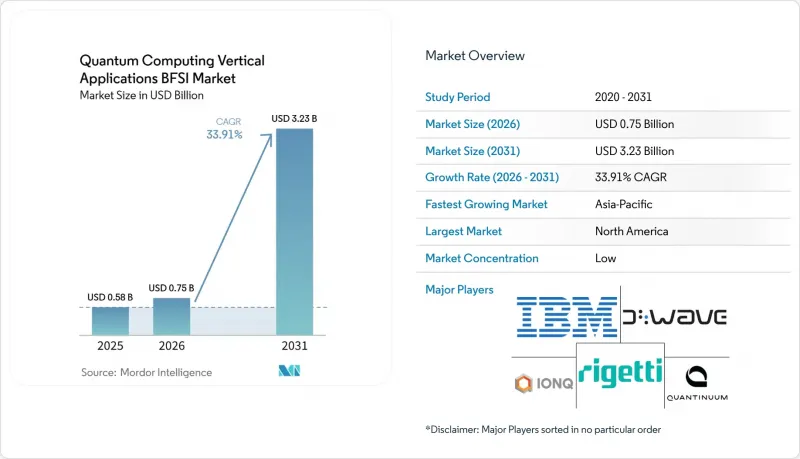
本報告按解決方案(軟體和服務)、部署模式(雲端、混合、本地部署)、量子運算範式(基於閘的量子運算、量子退火等)、應用程式(投資組合和資產管理等)、最終用戶(銀行、保險公司等)和地區進行細分。市場預測以美元計價。
全球趨勢及對銀行、金融服務和保險 (BFSI) 領域量子計算垂直應用市場的洞察。
對量子風險建模和投資組合最佳化的需求正在激增。
金融機構在對多因子投資組合進行大規模蒙特卡羅模擬時,仍面臨漫長的運算週期,因此風險分析仍是企業對量子運算需求最迫切的領域。 2026年5月,歐洲證券及市場管理局(ESMA)指出,量子蒙特卡羅技術的整合理論上可以為金融工作負載帶來比傳統方法更高的速度,即使在硬體完全成熟之前,這一應用場景也具有重要的商業性意義。 2026年6月,法國農業信貸銀行(Crédit Agricole CIB)與Pasqal公司加強了夥伴關係,制定了一份專注於資本市場應用和風險加權資產監控的實用化藍圖。這表明,銀行業、金融服務業和保險業(BFSI)在量子計算垂直應用領域的市場地位,正超越部分金融機構進行孤立的技術測試階段。銀行也逐漸意識到,在同一營運框架內,更優的最佳化和情境建模能夠提升定價品質、資本效率和反應速度。這極大地激勵了銀行現在就深入研究內部演算法。因為,儘早學習的金融機構將在營運層面系統可靠性提升時佔據更有利的地位。
金融網路中對後量子密碼學的準備工作日益迫切。
後量子密碼學已從研究主題轉變為基礎設施規劃的挑戰,因為金融機構現在擁有了正式的標準和更清晰的過渡指南。 2024年8月,美國國家標準與技術研究院 (NIST) 最終確定了 ML-KEM、ML-DSA 和 SLH-DSA 標準,為銀行和支付服務提供者提供了具體的過渡標準,而非模糊的技術目標。 2026年1月,七國集團網路安全專家小組進一步強化了這個方向,發布了一份協調藍圖,將2030-2032年定為高優先級系統的關鍵截止日期,並將2035年定為更廣泛的過渡最終截止日期。這種緊迫性比表面看起來更為嚴重,因為「先收集後解密」的風險意味著,今天獲取的高度敏感的金融數據在成熟的攻擊手段部署之前可能長期處於脆弱狀態。在代表量子運算垂直整合應用的 BFSI 市場中,這種壓力迫使許多金融機構比原計劃更早將安全預算、網路改造和採購計畫轉向「加密敏捷」架構。
目前還不存在能夠處理金融業務工作負載的容錯量子系統。
對於銀行、金融服務和保險(BFSI)市場而言,量子運算在垂直領域的應用面臨的最大短期瓶頸並非客戶認知度,而是硬體準備。歐洲證券及市場管理局(ESMA)在2026年5月指出,目前的量子硬體能力仍然有限,難以解決現實世界中規模龐大的金融問題。因此,大多數金融機構對在風險較高的生產環境中利用量子計算成果持謹慎態度。由此,銀行仍將許多量子計算結果視為諮詢、實驗或預生產數據,需要透過傳統方法進行檢驗。這些額外的檢驗步驟削弱了量子技術最初吸引人的速度和效率優勢。在糾錯系統能夠更有效地應用於金融工作負載之前,大部分需求仍將停留在先導計畫、沙箱和受控研究計畫中,而非大規模部署。
細分市場分析
預計到2025年,軟體收入將占到68.42%,成為銀行、金融和保險(BFSI)產業量子運算垂直領域中最大的解決方案細分市場。這一主導地位反映了這樣一個現實:大多數金融機構都在利用開發套件、模擬工具、雲端介面和應用程式程式設計層來發揮量子運算能力,而不是直接擁有硬體。這種支出模式也表明,買家在做出更專業的基礎設施決策之前,正在尋求可用於建模、測試和工作流程整合的可操作環境。預計到2031年,服務業將以36.84%的複合年成長率成長,顯示對託管試點、應用程式調優、遷移工作和部署支援的需求不斷成長。在BFSI產業量子運算垂直應用的現階段,軟體仍然是最容易進入的商業性切入點,因為它自然融入了現有的企業採購模式。
第二層需求圍繞實施支援。這是因為機構需要幫助將量子方法融入實際業務流程,而不僅僅是孤立的演示。擁有可重複使用程式庫(用於評估、最佳化、詐欺分析和加密遷移工作)的供應商,比那些僅依賴客製化諮詢服務的公司更能有效地擴展業務。這也是為什麼銀行、金融服務和保險 (BFSI) 產業在量子運算的垂直應用領域重視那些能夠將工具、領域知識和整合能力整合到單一解決方案中的供應商的原因之一。 Pasqal 與法國農業信貸銀行 (Crédit Agricole CIB) 的詳細合作案例表明,金融業的客戶為何重視那些能夠從技術探索到系統實施規劃全程參與的供應商。
到2025年,基於雲端的部署將佔收入的71.26%,這意味著在量子運算的垂直應用領域,銀行、金融服務和保險(BFSI)市場仍將高度依賴遠端存取模式。這種模式適合受監管的金融機構,因為它既能保證研發階段工作的柔軟性,也能限制初始資本投入。這也反映了現實情況:很少有公司準備好在本地擁有、營運和維護專門的量子基礎設施。隨著用戶開始將量子工具更直接地與傳統分析、數據管道和公司治理相結合,預計到2031年,混合部署將以35.19%的複合年成長率成長。最終,市場規模將以可訪問性為基礎,而整合深度將決定未來的差異化格局。
混合模式正日益受到青睞,因為它們比純量子環境更符合金融機構的營運邏輯。銀行和其他使用者可以利用量子元件處理特定的計算任務,同時在經典系統中保留敏感的管治程序、檢驗例程和容錯移轉邏輯。這降低了銀行、金融服務和保險(BFSI)市場在量子運算垂直應用上的組織摩擦,因為它無需在進行技術實驗時完全重寫現有架構。本地部署仍將僅限於那些控制權、主權或基礎設施策略優先於成本和柔軟性的情況。
區域分析
到2025年,北美將佔全球銷售額的36.41%,成為BFSI(銀行、金融服務和保險)市場在量子運算垂直應用領域最大的區域市場佔有率。該地區受益於一級銀行、支付服務商、資本市場公司以及與這些企業關係密切的量子供應商的高度集中。美國在密碼學準備方面也擁有明顯的優勢。美國國家標準與技術研究院(NIST)於2024年8月制定的首個後量子密碼學標準,為金融機構的轉型計畫提供了正式的技術基礎。這項標準制定作用正在推動BFSI市場在量子運算垂直應用領域進行安全、基礎設施改造和試點計畫等的早期採購活動。南美洲雖然規模仍較小,但仍具有重要意義。由於基於雲端的交付和服務主導的部署模式,該地區對於尋求有限採用量子技術的金融機構而言,准入門檻仍然較低。
歐洲已成為銀行、金融服務和保險(BFSI)市場中量子運算垂直應用領域第二大需求中心,其中英國、德國、法國和西班牙市場特別活躍。歐洲證券及市場管理局(ESMA)強調,DORA 和 NIS 2 框架使得歐洲金融機構在製定量子相關加密漏洞緩解計畫時面臨更系統化的合規挑戰。這一點意義重大,因為與那些僅依賴自願實驗的市場相比,更明確的監管時間表使供應商能夠更清晰地了解市場需求。奧地利第一儲蓄銀行集團(Erste Group)於 2026 年 2 月將量子金鑰傳輸(QKD)技術整合到維也納現有銀行光纖基礎設施的案例也表明,歐洲不僅在測試軟體主導的試點項目,也在測試實體網路安全用例。
預計到2031年,亞太地區將以36.92%的複合年成長率成長,成為銀行、金融服務和保險(BFSI)市場中量子運算垂直應用領域成長最快的區域市場。這一成長主要得益於公共資金投入、大規模國家技術項目、機構研究活動以及銀行和金融基礎設施運營商日益成長的興趣。富士通和SC Ventures於2026年1月發布的Qubitra Technologies藍圖表明,該地區正在建立一條應用主導的路徑,以應對詐欺偵測和交易用例,而不是僅僅等待硬體成熟。雖然中東和非洲的市場規模仍然較小,但該地區的政府主導計畫和金融機構已開始探索衍生性商品定價和結算安全等早期切入點。
其他好處:
- Excel格式的市場預測(ME)表
- 3個月的分析師支持
目錄
第1章:引言
- 研究假設和市場定義
- 調查範圍
第2章:調查方法
第3章執行摘要
第4章 市場狀況
- 市場概覽
- 市場促進因素
- 對量子風險建模和投資組合最佳化的需求激增
- 金融網路中對後量子密碼學準備工作的需求日益成長。
- 擴大銀行業混合量子-經典工作流程的應用
- 公私合營為金融級先導計畫提供聯合資金
- 量子即服務降低了中型銀行、金融服務和保險 (BFSI) 公司的進入門檻。
- 監管機構施壓要求加密基礎設施進行現代化改造
- 市場限制因素
- 生產金融工作負載的非容錯量子系統
- 基於量子技術的模型檢驗風險與財務結果相關
- 缺乏量子金融技術堆疊整合的專家
- 向 PQC 過渡週期過長可能會延誤採購決策。
- 宏觀經濟因素對市場的影響
- 產業價值鏈分析
- 科技趨勢
- 監理情勢
- 波特五力分析
第5章 市場規模與成長預測
- 透過解決方案
- 軟體
- 服務
- 不同的發展
- 基於雲端的
- 混合
- 現場
- 量子運算範式
- 基於閘的量子計算
- 量子退火
- 混合量子和經典計算
- 透過使用
- 投資組合和資產管理
- 風險管理和情境分析
- 詐欺偵測和金融犯罪預防
- 演算法交易和高頻交易
- 衍生性商品定價
- 信用評分和貸款申請審核
- 網路安全與後量子密碼學
- 客戶分析與個人化
- 其他用途
- 最終用戶
- 銀行
- 保險
- 資本市場和投資公司
- 金融科技
- 支付和數位金融服務
- 按地區
- 北美洲
- 美國
- 加拿大
- 墨西哥
- 南美洲
- 巴西
- 阿根廷
- 其他南美國家
- 歐洲
- 德國
- 英國
- 法國
- 俄羅斯
- 西班牙
- 其他歐洲國家
- 亞太地區
- 中國
- 日本
- 印度
- 韓國
- 東南亞
- 其他亞太國家
- 中東和非洲
- 中東
- 沙烏地阿拉伯
- 阿拉伯聯合大公國
- 土耳其
- 其他中東國家
- 非洲
- 南非
- 奈及利亞
- 埃及
- 其他非洲國家
- 中東
- 北美洲
第6章 競爭情勢
- 市場集中度
- 策略趨勢
- 市佔率分析
- 公司簡介
- International Business Machines Corporation
- D-Wave Quantum Inc.
- IonQ, Inc.
- Rigetti Computing, Inc.
- Quantinuum Ltd.
- Xanadu Quantum Technologies Inc.
- Pasqal SAS
- IQM Quantum Computers Oy
- Oxford Quantum Circuits Ltd.
- Alice and Bob SAS
- Alpine Quantum Technologies GmbH
- QuEra Computing Inc.
- Quantum Computing Inc.
- Infleqtion, Inc.
- SEEQC, Inc.
- Quix Quantum BV
- Origin Quantum Computing Technology Co., Ltd.
- Shenzhen SpinQ Technology Co., Ltd.
- Anyon Systems Inc.
- Riverlane Ltd.
- Google LLC
- Cambridge Quantum Computing Ltd.
- Intel Corporation
- Fujitsu Limited
- Honeywell International Inc.
第7章 市場機會與未來展望
According to Mordor Intelligence, the quantum computing vertical applications BFSI market size was USD 0.58 billion in 2025 and is forecast to reach USD 3.23 billion by 2031 at a CAGR of 33.91% from 2026 to 2031.
This report is Segmented by Solution (Software and Services), Deployment (Cloud-Based, Hybrid, and On-Premises), Quantum Computing Paradigm (Gate-Based Quantum Computing, Quantum Annealing, and More), Application (Portfolio and Wealth Management, and More), End-User (Banking, Insurance, and More), and Geography. The Market Forecasts are Provided in Terms of Value (USD).
Global Quantum Computing Vertical Applications BFSI Market Trends and Insights
Surging Demand for Quantum Risk Modeling and Portfolio Optimization
Financial institutions continue to face long compute cycles when running large Monte Carlo simulations across multi-factor portfolios, which keeps risk analytics at the forefront of enterprise quantum demand. ESMA stated in May 2026 that quantum Monte Carlo integration offers a theoretical quadratic speedup over classical approaches for financial workloads, which keeps the use case commercially relevant even before full hardware maturity arrives. Credit Agricole CIB and Pasqal advanced their partnership in June 2026 with a production roadmap focused on capital markets applications and risk-weighted asset monitoring, which shows that the quantum computing vertical applications BFSI market is moving beyond isolated technical tests in selected institutions. Banks also recognize that better optimization and scenario modeling can influence pricing quality, capital efficiency, and response times within the same operating framework. This creates a practical incentive to build internal algorithm knowledge now, because institutions that learn earlier will be better placed when production-grade systems become more dependable.
Rising Need for Post-Quantum Cryptography Readiness in Financial Networks
Post-quantum cryptography has moved from a research topic to an infrastructure planning issue, as financial institutions now have formal standards and clearer migration guidance. NIST finalized ML-KEM, ML-DSA, and SLH-DSA in August 2024, giving banks and payment operators a concrete baseline for transition work rather than a loose technical target. The G7 Cyber Expert Group reinforced this direction in January 2026 with a coordinated roadmap that pointed to 2030-2032 as a critical deadline window for high-priority systems and 2035 as the broader endpoint for migration. The urgency is stronger than it appears because harvest-now-decrypt-later exposure means sensitive financial data captured today can remain vulnerable long before a mature attack capability is deployed. In the quantum computing vertical applications BFSI market, that pressure is pushing security budgets, network reviews, and procurement calendars toward crypto-agile architectures earlier than many institutions had originally planned.
No Fault-Tolerant Quantum Systems for Production Finance Workloads
The biggest near-term brake on the quantum computing vertical applications BFSI market is hardware readiness, not customer awareness. ESMA noted in May 2026 that current quantum hardware capabilities are still limited for real-world, industry-scale financial problems, which keeps most institutions from using quantum outputs in high-stakes production environments. Banks, therefore, continue to treat many quantum results as advisory, experimental, or pre-production material that must be checked against classical methods. Those extra validation steps weaken the speed and efficiency gains that make quantum adoption attractive in the first place. Until error-corrected systems become more practical for financial workloads, a large part of demand will remain tied to pilots, sandboxes, and controlled research engagements rather than scaled deployment.
Other drivers and restraints analyzed in the detailed report include:
- Growing Bank Adoption of Hybrid Quantum-Classical Workflows
- Public-Private Funding for Financial-Grade Quantum Pilots
- Model Validation Risk for Quantum-Derived Financial Outputs
For complete list of drivers and restraints, kindly check the Table Of Contents.
Segment Analysis
Software accounted for 68.42% of revenue in 2025, making it the largest solution segment in the quantum computing vertical applications BFSI market. This lead reflects how most financial institutions access quantum capabilities through development kits, simulation tools, cloud interfaces, and application programming layers rather than through direct hardware ownership. The spending pattern also shows that buyers want usable environments for modeling, testing, and workflow integration before they commit to more specialized infrastructure decisions. Services are projected to expand at a 36.84% CAGR through 2031, indicating rising demand for managed pilots, application tuning, migration work, and implementation support. In the current phase of the quantum computing vertical applications BFSI market, software remains the easiest commercial entry point because it fits more naturally into established enterprise buying patterns.
The second layer of demand is forming around execution support, since institutions need help connecting quantum methods to real business processes rather than isolated demonstrations. Vendors with reusable libraries for valuation, optimization, fraud analytics, and cryptographic transition work can scale more effectively than firms that depend only on bespoke advisory assignments. This is one reason the quantum computing vertical applications BFSI industry is rewarding providers that combine tools, domain knowledge, and integration capabilities in a single offering. Pasqal's deeper work with Credit Agricole CIB shows why financial clients value suppliers that can stay engaged from technical exploration into structured delivery planning.
Cloud-based deployment captured 71.26% of revenue in 2025, which shows that the quantum computing vertical applications BFSI market still depends heavily on remote access models. This structure suits regulated institutions because it limits upfront capital commitments while preserving flexibility for research-stage work. It also reflects the reality that very few firms are prepared to own, operate, and maintain specialized quantum infrastructure on premises. Hybrid deployment is projected to expand at 35.19% CAGR through 2031 as users begin to connect quantum tools more directly with classical analytics, data pipelines, and enterprise controls. The result is a market where access convenience supports current scale, while integration depth shapes future differentiation.
The hybrid model is gaining ground because it better aligns with the operating logic of financial institutions than a pure quantum environment does. Banks and other users can keep sensitive governance steps, validation routines, and failover logic inside classical systems while allowing quantum components to handle selected compute tasks. This lowers organizational friction across the quantum computing vertical applications BFSI market because technical experimentation does not require a full rewrite of existing architecture. On-premises deployment will remain limited to cases where control, sovereignty, or infrastructure policy outweighs cost and flexibility.
Complete Report Scope:
- By Solution
- Software
- Services
- By Deployment
- Cloud-Based
- Hybrid
- On-Premises
- By Quantum Computing Paradigm
- Gate-Based Quantum Computing
- Quantum Annealing
- Hybrid Quantum-Classical Computing
- By Application
- Portfolio and Wealth Management
- Risk Management and Scenario Analysis
- Fraud Detection and Financial Crime Prevention
- Algorithmic and High-Frequency Trading
- Derivatives Pricing
- Credit Scoring and Loan Assessment
- Cybersecurity and Post-Quantum Cryptography
- Customer Analytics and Personalization
- Other Applications
- By End-User
- Banking
- Insurance
- Capital Markets and Investment Firms
- FinTech
- Payment and Digital Financial Services
- By Geography
- North America
- United States
- Canada
- Mexico
- South America
- Brazil
- Argentina
- Rest of South America
- Europe
- Germany
- United Kingdom
- France
- Russia
- Spain
- Rest of Europe
- Asia-Pacific
- China
- Japan
- India
- South Korea
- Southeast Asia
- Rest of Asia-Pacific
- Middle East and Africa
- Middle East
- Saudi Arabia
- United Arab Emirates
- Turkey
- Rest of Middle East
- Africa
- South Africa
- Nigeria
- Egypt
- Rest of Africa
- Middle East
- North America
Geography Analysis
North America accounted for 36.41% of revenue in 2025, giving it the largest regional position in the quantum computing vertical applications BFSI market. The region benefits from a dense concentration of Tier-1 banks, payment operators, capital markets firms, and quantum vendors with established enterprise relationships. The United States also has a clear advantage in cryptographic preparedness, as NIST finalized the first post-quantum cryptography standards in August 2024, providing financial institutions with a formal technical basis for migration planning. That standard-setting role supports earlier procurement activity across security, infrastructure review, and pilot work in the quantum computing vertical applications BFSI market. South America remains much smaller in scale, but the region is still relevant as cloud delivery and service-led adoption lower the barriers for financial firms seeking selective quantum exposure.
Europe forms a substantial secondary demand center in the quantum computing vertical applications BFSI market, with the United Kingdom, Germany, France, and Spain standing out as active markets. ESMA highlighted that DORA and the NIS 2 framework are turning quantum-related cryptographic vulnerability planning into a more structured compliance issue for European financial entities. That matters because regulatory timing gives vendors a clearer demand path than in markets where adoption depends only on voluntary experimentation. Erste Group's February 2026 integration of entangled quantum key distribution into existing banking fiber infrastructure in Vienna also shows that Europe is testing physical network security use cases, not only software-led pilots.
Asia-Pacific is projected to expand at 36.92% CAGR through 2031, making it the fastest-growing regional segment in the quantum computing vertical applications BFSI market. Public funding, large national technology programs, institutional research activity, and rising interest from banks and financial infrastructure players are supporting growth. The roadmap for Qubitra Technologies, announced by Fujitsu and SC Ventures in January 2026, shows how the region is building application-led pathways into fraud detection and trading use cases rather than waiting only for hardware maturity. The Middle East and Africa remain smaller in absolute terms, but sovereign programs and financial institutions in the region are beginning to explore derivatives pricing and payments security as early entry points.
- International Business Machines Corporation
- D-Wave Quantum Inc.
- IonQ, Inc.
- Rigetti Computing, Inc.
- Quantinuum Ltd.
- Xanadu Quantum Technologies Inc.
- Pasqal SAS
- IQM Quantum Computers Oy
- Oxford Quantum Circuits Ltd.
- Alice and Bob SAS
- Alpine Quantum Technologies GmbH
- QuEra Computing Inc.
- Quantum Computing Inc.
- Infleqtion, Inc.
- SEEQC, Inc.
- Quix Quantum B.V.
- Origin Quantum Computing Technology Co., Ltd.
- Shenzhen SpinQ Technology Co., Ltd.
- Anyon Systems Inc.
- Riverlane Ltd.
- Google LLC
- Cambridge Quantum Computing Ltd.
- Intel Corporation
- Fujitsu Limited
- Honeywell International Inc.
Additional Benefits:
- The market estimate (ME) sheet in Excel format
- 3 months of analyst support
TABLE OF CONTENTS
1 INTRODUCTION
- 1.1 Study Assumptions and Market Definition
- 1.2 Scope of the Study
2 RESEARCH METHODOLOGY
3 EXECUTIVE SUMMARY
4 MARKET LANDSCAPE
- 4.1 Market Overview
- 4.2 Market Drivers
- 4.2.1 Surging Demand for Quantum Risk Modeling and Portfolio Optimization
- 4.2.2 Rising Need for Post-Quantum Cryptography Readiness in Financial Networks
- 4.2.3 Growing Bank Adoption of Hybrid Quantum-Classical Workflows
- 4.2.4 Public-Private Funding for Financial-Grade Quantum Pilots
- 4.2.5 Quantum-As-A-Service Lowering Entry Barriers for Mid-Tier BFSI Firms
- 4.2.6 Regulatory Pressure to Modernize Cryptographic Infrastructure
- 4.3 Market Restraints
- 4.3.1 No Fault-Tolerant Quantum Systems for Production Finance Workloads
- 4.3.2 Model Validation Risk for Quantum-Derived Financial Outputs
- 4.3.3 Specialized Talent Shortage in Quantum Finance Stack Integration
- 4.3.4 Long PQC Migration Cycles can Delay Procurement Decisions
- 4.4 Impact of Macroeconomic Factors on the Market
- 4.5 Industry Value Chain Analysis
- 4.6 Technology Outlook
- 4.7 Regulatory Landscape
- 4.8 Porter's Five Forces Analysis
- 4.8.1 Threat of New Entrants
- 4.8.2 Bargaining Power of Suppliers
- 4.8.3 Bargaining Power of Buyers
- 4.8.4 Threat of Substitutes
- 4.8.5 Intensity of Competitive Rivalry
5 MARKET SIZE AND GROWTH FORECASTS (VALUE)
- 5.1 By Solution
- 5.1.1 Software
- 5.1.2 Services
- 5.2 By Deployment
- 5.2.1 Cloud-Based
- 5.2.2 Hybrid
- 5.2.3 On-Premises
- 5.3 By Quantum Computing Paradigm
- 5.3.1 Gate-Based Quantum Computing
- 5.3.2 Quantum Annealing
- 5.3.3 Hybrid Quantum-Classical Computing
- 5.4 By Application
- 5.4.1 Portfolio and Wealth Management
- 5.4.2 Risk Management and Scenario Analysis
- 5.4.3 Fraud Detection and Financial Crime Prevention
- 5.4.4 Algorithmic and High-Frequency Trading
- 5.4.5 Derivatives Pricing
- 5.4.6 Credit Scoring and Loan Assessment
- 5.4.7 Cybersecurity and Post-Quantum Cryptography
- 5.4.8 Customer Analytics and Personalization
- 5.4.9 Other Applications
- 5.5 By End-User
- 5.5.1 Banking
- 5.5.2 Insurance
- 5.5.3 Capital Markets and Investment Firms
- 5.5.4 FinTech
- 5.5.5 Payment and Digital Financial Services
- 5.6 By Geography
- 5.6.1 North America
- 5.6.1.1 United States
- 5.6.1.2 Canada
- 5.6.1.3 Mexico
- 5.6.2 South America
- 5.6.2.1 Brazil
- 5.6.2.2 Argentina
- 5.6.2.3 Rest of South America
- 5.6.3 Europe
- 5.6.3.1 Germany
- 5.6.3.2 United Kingdom
- 5.6.3.3 France
- 5.6.3.4 Russia
- 5.6.3.5 Spain
- 5.6.3.6 Rest of Europe
- 5.6.4 Asia-Pacific
- 5.6.4.1 China
- 5.6.4.2 Japan
- 5.6.4.3 India
- 5.6.4.4 South Korea
- 5.6.4.5 Southeast Asia
- 5.6.4.6 Rest of Asia-Pacific
- 5.6.5 Middle East and Africa
- 5.6.5.1 Middle East
- 5.6.5.1.1 Saudi Arabia
- 5.6.5.1.2 United Arab Emirates
- 5.6.5.1.3 Turkey
- 5.6.5.1.4 Rest of Middle East
- 5.6.5.2 Africa
- 5.6.5.2.1 South Africa
- 5.6.5.2.2 Nigeria
- 5.6.5.2.3 Egypt
- 5.6.5.2.4 Rest of Africa
- 5.6.5.1 Middle East
- 5.6.1 North America
6 COMPETITIVE LANDSCAPE
- 6.1 Market Concentration
- 6.2 Strategic Moves
- 6.3 Market Share Analysis
- 6.4 Company Profiles (includes Global Level Overview, Market Level Overview, Core Segments, Financials as available, Strategic Information, Market Rank/Share, Products and Services, Recent Developments)
- 6.4.1 International Business Machines Corporation
- 6.4.2 D-Wave Quantum Inc.
- 6.4.3 IonQ, Inc.
- 6.4.4 Rigetti Computing, Inc.
- 6.4.5 Quantinuum Ltd.
- 6.4.6 Xanadu Quantum Technologies Inc.
- 6.4.7 Pasqal SAS
- 6.4.8 IQM Quantum Computers Oy
- 6.4.9 Oxford Quantum Circuits Ltd.
- 6.4.10 Alice and Bob SAS
- 6.4.11 Alpine Quantum Technologies GmbH
- 6.4.12 QuEra Computing Inc.
- 6.4.13 Quantum Computing Inc.
- 6.4.14 Infleqtion, Inc.
- 6.4.15 SEEQC, Inc.
- 6.4.16 Quix Quantum B.V.
- 6.4.17 Origin Quantum Computing Technology Co., Ltd.
- 6.4.18 Shenzhen SpinQ Technology Co., Ltd.
- 6.4.19 Anyon Systems Inc.
- 6.4.20 Riverlane Ltd.
- 6.4.21 Google LLC
- 6.4.22 Cambridge Quantum Computing Ltd.
- 6.4.23 Intel Corporation
- 6.4.24 Fujitsu Limited
- 6.4.25 Honeywell International Inc.
7 MARKET OPPORTUNITIES AND FUTURE OUTLOOK
- 7.1 White-Space and Unmet-Need Assessment

 全球量子計算軟體市場規模、佔有率、趨勢和成長分析報告(2026-2034)全球量子計算市場規模、佔有率、趨勢和成長分析報告(2026-2034)
 抗量子安全技術的研究服務
 汽車市場量子計算:全球市場預測(2026-2032年)
 超導性量子位元市場:商業機會、成長要素、產業趨勢分析及2026-2035年預測量子運算市場報告:趨勢、預測與競爭分析(至2035年)中性原子量子計算市場機會、成長要素、產業趨勢分析及2026-2035年預測
 量子計算軟體平台:市場佔有率分析、產業趨勢與統計及成長預測(2026-2031)量子軟體工具鏈:市場佔有率分析、產業趨勢與統計、成長預測(2026-2031)量子軟體開發工具包:市場佔有率分析、產業趨勢與統計及成長預測(2026-2031 年)