


 |
市場調查報告書
商品編碼
2099965
量子機器學習(QML)軟體:市場佔有率分析、產業趨勢與統計及成長預測(2026-2031)Quantum Machine Learning (QML) Software - Market Share Analysis, Industry Trends & Statistics, Growth Forecasts (2026 - 2031) |
||||||

※ 本網頁內容可能與最新版本有所差異。詳細情況請與我們聯繫。
2025 年量子機器學習 (QML) 軟體市場價值為 4.8 億美元,預計到 2031 年將達到 24.9 億美元,而 2026 年為 6.2 億美元,在 2026 年至 2031 年的預測期內,複合年成長率為 32.06%。
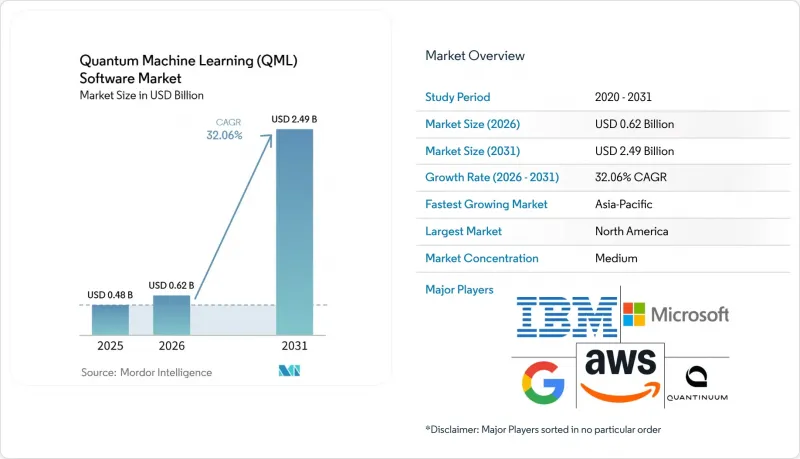
本報告按解決方案(軟體平台和服務)、部署類型(雲端、混合、本地部署)、組織規模(大型企業和中小企業)、應用程式(最佳化等)、最終用戶產業(銀行、金融服務和保險、教育和研究機構等)以及地區進行細分。市場預測以美元計價。
全球量子機器學習(QML)軟體市場趨勢與洞察
企業對混合量子-經典工作流程的需求
量子機器學習 (QML) 軟體市場正受益於企業對混合工作流程日益成長的需求,因為軟體編配決定著量子任務是否能在實際生產環境中有效利用。大多數短期機器學習和最佳化用例需要在量子處理前後進行迭代的經典處理,因此,在現階段,工作流程設計比單純的量子位元數量更為重要。 Quantinuum 公司於 2025 年 11 月發布的商業版「Helios」就清楚地證明了這一點。該系統與基於 Python 的程式語言「Guppy」和混合運算雲端平台「Nexus」協同部署,已在藥物發現、材料研究和金融分析等領域初步應用。這一趨勢正在擴大那些能夠將現有資料結構、模型邏輯和流程轉換為量子化格式,而無需對企業系統進行徹底重新設計的供應商的作用。因此,量子機器學習 (QML) 軟體市場正從將量子運算視為獨立環境轉向將量子實驗與標準人工智慧、分析和研究任務連接起來的產品。隨著買家越來越追求可複製的價值而不是一次性的演示,能夠促進此類合作的供應商將繼續保持有利地位。
在高度複雜的應用場景中,對量子安全最佳化的需求日益成長。
量子機器學習 (QML) 軟體市場的發展也受到各行業需求的推動,在這些行業中,僅靠傳統方法在實際的業務時間範圍內解決大規模最佳化問題變得越來越困難。物流規劃、財務投資組合設計、衍生性商品定價和藥物篩檢等都需要日益複雜的決策結構,因為變數、限制條件和可能結果的數量都在增加。 D-Wave 在 2026 年第一季公佈財報中透露,其混合求解器 Stride 現在支援代理機器學習整合,這表明客戶已經開始轉向更具適應性的工業最佳化工作流程。第二個因素是,與黑箱預測模型相比,數學結構的最佳化過程更容易檢驗和解釋。這在銀行業、醫療保健和其他高度監管的行業中具有重要意義。量子輔助最佳化不僅被視為一種效能增強工具,而且被視為一種提高決策可追溯性和課責的手段,這促進了量子機器學習 (QML) 軟體市場的成長。這種廣泛的價值提案使得軟體在那些必須平衡計算性能和監管要求的行業中變得更加重要。
容錯量子硬體的商業規模有限
量子機器學習 (QML) 軟體市場仍面臨許多限制因素。這是因為商業性可行且具備容錯能力的量子硬體尚未達到企業級廣泛應用所需的規模。因此,供應商只能開發雜訊較大的中型系統,產品設計也必須考慮誤差率、有限的相干視窗和狹窄的效能要求,而無法充分利用糾錯計算的理論優勢。 IBM 預計將在 2026 年底實現量子優勢,並在 2029 年實現容錯能力,而微軟則透過其「Majorana 2」項目,將 2029 年作為建構可擴展系統的路線圖。這種延遲正在改變量子機器學習 (QML) 軟體市場的競爭格局,那些專注於噪音管理、編譯和硬體感知執行的供應商,其重要性超過了那些僅僅關注演算法理論的供應商。此外,這種延遲也削弱了買家的信心,因為許多機構希望在配套硬體達到更成熟穩定的階段之前,就獲得軟體能夠創造價值的證據。在差距縮小之前,軟體層將繼續發展,但與完全成熟的硬體環境相比,它將進行更多的測試、基準測試和謹慎操作。
細分市場分析
2025年,軟體平台佔據了量子機器學習(QML)軟體市場72.41%的佔有率。這反映了一種趨勢:企業更傾向於整合開發工具包、模擬環境和演算法設計軟體,而非功能單一的單功能產品。買家之所以青睞這些平台,是因為它們允許企業在單一環境中管理程式碼開發、工作流程測試、基準測試和後端訪問,從而減少了從概念驗證(PoC)過渡到有限生產階段的阻力。 IBM在2026年7月發表了Qiskit v2.5,進一步強化了這個平台趨勢。 Qiskit v2.5配備了多表示編譯器框架和專用的容錯編譯管道,使開發人員能夠在同一程式碼庫中更輕鬆地處理短期和未來的架構。隨著企業團隊在擴展預算之前越來越傾向於並行比較量子和經典性能,模擬軟體也獲得了戰略價值。演算法設計環境允許使用者探索問題建模,而無需具備深厚的量子物理或底層電路設計專業知識,從而進一步刺激了市場需求。
服務是成長最快的解決方案細分市場,量子機器學習 (QML) 軟體服務市場預計將在 2026 年至 2031 年間以 35.82% 的複合年成長率 (CAGR) 成長。這一成長表明,許多採購公司仍然缺乏足夠的內部人才來支援模型設計、工作流程整合、基準測試和現場部署。隨著企業從早期實驗階段轉向與業務成果和科學目標相關的項目,諮詢、實施和配置服務的價值日益凸顯。製藥和金融服務業對服務的需求尤其強勁,這些行業的合約通常與提高分子模擬品質、建立投資組合、詐欺檢測或最佳化等目標相關,而非漫無目的的測試。與之相關的轉變是向基於結果的合約模式的轉變,因為買家越來越要求供應商保證在最佳化和建模方面取得可衡量的改進,而不僅僅是按時間收費。這種轉變使擁有更深厚專業知識的公司更具優勢。這是因為在量子機器學習 (QML) 軟體市場,能夠將技術能力與特定產業應用知識相結合的服務供應商備受青睞。
到2025年,基於雲端的部署將佔據68.24%的市場佔有率,這表明量子機器學習(QML)軟體市場仍然主要依賴遠端存取模式,用戶可以透過大規模雲端環境存取量子後端。這種模式之所以仍然具有吸引力,是因為它無需對專用系統進行資本投資,並為企業提供了一種在進行大規模投資之前輕鬆比較各種工具、供應商和硬體的方法。亞馬遜於2025年8月推出的Braket計畫進一步鞏固了這一地位,它縮短了相容工作負載的執行時間,並改善了訓練和最佳化工作流程中經常需要的迭代電路執行的處理。基於雲端的交付也成為供應商提供更新分發、基準測試功能以及對多個處理器進行管理存取的更實用方式。這種組合使得雲端交付能夠保持其主導地位,因為對於大多數買家而言,即時可用性和低進入門檻比直接的本地控制更為重要。
預計到2031年,混合部署將以34.19%的複合年成長率成長,成為量子機器學習(QML)軟體市場中成長最快的部署模式。這種轉變反映了一種更謹慎的架構,企業會根據延遲接受度、資料機密性和成本效益,在傳統CPU、GPU和量子處理器之間分配不同的工作流程步驟。 PASQAL於2026年3月宣布與CUDA-Q整合,這表明量子處理可以整合到標準的高效能運算調度模式中,而不是作為現有計算流程的外部組件。混合設計的重要性日益凸顯,因為許多實際應用案例仍然依賴於圍繞任務中量子處理部分的迭代式經典最佳化、參數更新和資料準備。本地部署的規模仍然較小,但在政府機構和受監管的金融業中仍然發揮著重要作用,因為在這些領域,雲端的使用受到安全法規、主權問題或網路限制的限制。未來,混合架構將不再被視為暫時的過渡階段,而是量子機器學習 (QML) 軟體市場中的一種標準操作模式。
區域分析
2025年,北美佔據了量子機器學習(QML)軟體市場38.62%的佔有率,成為該地區最大的軟體應用、平台開發和企業採購中心。這項優勢得益於超大規模資料中心業者基礎設施、專業供應商、創投活動以及已做好試點部署先進運算工具準備的企業用戶之間的緊密聯繫。 2026年,包括美國商務部獎勵計畫和白宮關於量子技術商業化和效能評估的行政命令在內的公共資金,進一步鞏固了這一優勢。這些措施至關重要,因為它們同時支援了硬體、軟體、基準測試和採購能力。雖然加拿大透過Xanadu Quantum Technologies和1QBit等公司進行了顯著的活動,但墨西哥的企業應用仍處於早期階段。這些因素共同造就了2025年至2026年間量子機器學習(QML)軟體市場最強勁的商業環境。
在德國、英國和法國的支持下,歐洲透過系統性的生態系統建設和公共合作項目,在量子機器學習(QML)軟體市場佔據第二大區域市場地位。該地區的優勢並非源自於單一主導的企業,而是來自標準化、互通性和研發商業化路徑的合作努力。歐盟的「量子旗艦計畫」(Quantum Flagship)框架和歐洲高效能營業單位(EuroHPC)的「QEC4QEA」舉措,為跨境量子增強應用建立了共用基礎設施,並建立了更清晰的軟體開發路徑。德國的「FullStaQD」舉措透過開發量子運算堆疊的參考軟體架構,進一步提升了整個國家生態系統的組件互通性。西班牙也憑藉著「Multiverse Computing」保持著重要的市場地位,該公司是該地區最活躍的專注於最佳化的軟體供應商之一。雖然歐洲的超大規模資料中心業者資料中心集中度不如北美,但這種結構使其在量子機器學習(QML)軟體市場中扮演穩定的區域角色。
預計到2031年,亞太地區將以35.28%的複合年成長率成長,成為量子機器學習(QML)軟體市場成長最快的區域板塊。這一成長反映了各國商業化項目的推進、雲端服務的普及以及生命科學和研究應用領域日益成長的興趣。 2026年5月,日本理研、克里夫蘭診所和IBM聯合開展的一項研究計畫因其模擬12,635個先導計畫的突破性成果而備受矚目,成為該地區最傑出的應用案例之一。儘管南美洲在2025年的銷售額佔比不高,但巴西仍是該地區早期研發和企業試點計畫最活躍的中心。同時,中東和非洲仍處於起步階段,其發展更依賴人才培育和雲端服務的普及,而非直接的硬體投資。這表明,在除最大市場之外的區域擴張,其驅動力更多地來自生態系統的構建,而非成熟的商業部署。
其他好處:
- Excel格式的市場預測(ME)表
- 3個月的分析師支持
目錄
第1章:引言
- 研究假設和市場定義
- 調查範圍
第2章:調查方法
第3章執行摘要
第4章 市場狀況
- 市場概覽
- 市場促進因素
- 企業對混合量子-經典工作流程的需求
- 在高度複雜的應用場景中,對量子穩定性最佳化的需求日益成長。
- 雲端存取正在迅速擴展。
- 對量子軟體生態系統的監管和公共資金支持
- 一個被忽略的促進因素:演算法在硬體和後端之間的可移植性。
- 一個被忽略的促進因素:對採購中量子技術準備程度進行基準測試。
- 市場限制因素
- 容錯量子硬體的商業規模有限
- 與傳統企業資料和 MLOps 技術堆疊整合的成本相對較高。
- 量子演算法和量子DevOps領域人才短缺
- 關於量子優勢檢驗中阻礙因素和差距,報告不足。
- 宏觀經濟因素對市場的影響
- 產業價值鏈分析
- 科技趨勢
- 監理情勢
- 波特五力分析
第5章 市場規模與成長預測
- 透過解決方案
- 軟體平台
- 開發工具和SDK
- 仿真和基準測試軟體
- 演算法設計與最佳化軟體
- 服務
- 軟體平台
- 不同的發展
- 基於雲端的
- 混合
- 現場
- 按組織規模
- 大公司
- 小型企業
- 透過使用
- 最佳化
- 藥物發現與生命科學
- 材料科學與量子化學
- 財務分析與風險建模
- 密碼技術和網路安全
- 其他用途
- 按最終用戶行業分類
- IT/通訊
- BFSI
- 醫療保健和生命科學
- 工業製造
- 教育和研究機構
- 政府/行政部門
- 能源公用事業
- 其他終端用戶產業
- 按地區
- 北美洲
- 美國
- 加拿大
- 墨西哥
- 南美洲
- 巴西
- 阿根廷
- 其他南美國家
- 歐洲
- 德國
- 英國
- 法國
- 俄羅斯
- 西班牙
- 其他歐洲國家
- 亞太地區
- 中國
- 日本
- 印度
- 韓國
- 東南亞
- 其他亞太國家
- 中東和非洲
- 中東
- 沙烏地阿拉伯
- 阿拉伯聯合大公國
- 土耳其
- 其他中東國家
- 非洲
- 南非
- 奈及利亞
- 埃及
- 其他非洲國家
- 中東
- 北美洲
第6章 競爭情勢
- 市場集中度
- 策略趨勢
- 市佔率分析
- 公司簡介
- Xanadu Quantum Technologies Inc.
- Zapata Computing Holdings Inc.
- Classiq Technologies Ltd.
- QC Ware Corp.
- 1QBit Canada Ltd.
- QunaSys Inc.
- Quantinuum Ltd.
- Riverlane Ltd.
- Terra Quantum AG
- Multiverse Computing SL
- PASQAL SAS
- SEEQC, Inc.
- Algorithmiq Oy
- ProteinQure Inc.
- Atos SE
- D-Wave Quantum Inc.
- Rigetti Computing, Inc.
- IBM Corporation
- Microsoft Corporation
- Amazon Web Services, Inc.
- Google LLC
- IonQ Inc.
- Intel Corporation
- Fujitsu Limited
- QuEra Computing Inc.
第7章 市場機會與未來展望
According to Mordor Intelligence, the quantum machine learning (QML) software market size was valued at USD 0.48 billion in 2025 and estimated to grow from USD 0.62 billion in 2026 to reach USD 2.49 billion by 2031, at a CAGR of 32.06% during the forecast period 2026-2031.
This report is Segmented by Solution (Software Platforms, and Services), Deployment (Cloud-Based, Hybrid, and On-Premises), Organization Size (Large Enterprises, and Small and Medium Enterprises), Application (Optimization, and More), End-User Industry (BFSI, Education and Research Institutions, and More), and Geography. The Market Forecasts are Provided in Terms of Value (USD).
Global Quantum Machine Learning (QML) Software Market Trends and Insights
Enterprise Demand for Hybrid Quantum-Classical Workflows
The Quantum Machine Learning (QML) Software Market is benefiting from stronger enterprise demand for hybrid workflows, as software orchestration determines whether a quantum task can be used in a real production environment. Most near-term machine learning and optimization use cases still need repeated classical processing before and after the quantum step, which makes workflow design more important than raw qubit counts at this stage. Quantinuum's commercial launch of Helios in November 2025 clearly demonstrated this, as the system was introduced alongside Guppy, a Python-based programming language, and the Nexus cloud platform for hybrid computing, with early customer use cases in drug discovery, materials research, and financial analytics. This pattern is creating a larger role for middleware vendors that can translate existing data structures, model logic, and process flows into quantum-compatible formats without forcing a full redesign of enterprise systems. As a result, the Quantum Machine Learning (QML) Software Market is moving toward products that connect quantum experimentation with standard artificial intelligence, analytics, and research operations, rather than treating quantum computing as a stand-alone environment. Vendors that make this connection easier are likely to stay better positioned as buyers look for repeatable value rather than isolated demonstrations.
Rising Need for Quantum-Safe Optimization in High-Complexity Use Cases
The Quantum Machine Learning (QML) Software Market is also supported by demand from sectors where large-scale optimization problems are becoming harder to solve within practical business time frames using only classical methods. Logistics planning, financial portfolio design, derivative pricing, and pharmaceutical screening all require decision structures that become more difficult as the number of variables, constraints, and possible outcomes increases. D-Wave stated in its first-quarter 2026 results that its Stride hybrid solver now supports surrogate machine learning integration, indicating that customers are already moving toward more adaptive industrial optimization workflows. A second factor is that mathematically structured optimization pathways are easier to review and explain than black-box prediction models, which matters in banking, healthcare, and other regulated settings. This is helping the Quantum Machine Learning (QML) Software Market because quantum-assisted optimization is being evaluated not only as a performance tool, but also as a way to improve traceability and decision accountability. That broader value proposition is making software adoption more relevant in sectors that must balance computational performance with oversight requirements.
Limited Commercial Scale of Fault-Tolerant Quantum Hardware
The Quantum Machine Learning (QML) Software Market still faces a major restraint because commercially meaningful fault-tolerant quantum hardware is not yet available at the scale needed for broad enterprise use. That keeps software vendors tied to noisy intermediate-scale systems, where products must be designed around error rates, limited coherence windows, and narrow performance conditions rather than around the full theoretical benefits of error-corrected computing. IBM stated that it expects quantum advantage by the end of 2026 and fault tolerance by 2029, while Microsoft has pointed to 2029 as a path toward scalable systems through its Majorana 2 work. This delay shifts competition in the Quantum Machine Learning (QML) Software Market, as vendors that manage noise, compilation, and hardware-aware execution gain greater relevance than those that focus solely on algorithmic theory. It also erodes buyer confidence because many organizations still want proof that software can generate value before the supporting hardware reaches a more mature, stable phase. Until that gap narrows, the software layer will continue growing, but it will do so with more testing, benchmarking, and caution than a fully mature hardware environment would allow.
Other drivers and restraints analyzed in the detailed report include:
- Rapid Expansion of Cloud Access to Quantum Development Environments
- Regulatory and Public Funding Support for Quantum Software Ecosystems
- High Integration Cost With Legacy Enterprise Data and MLOps Stacks
For complete list of drivers and restraints, kindly check the Table Of Contents.
Segment Analysis
Software platforms commanded 72.41% of the Quantum Machine Learning (QML) Software Market share in 2025, which reflected enterprise preference for integrated development toolkits, simulation environments, and algorithm design software over narrower point products. Buyers favored these platforms because they could manage code development, workflow testing, benchmarking, and backend access in a single environment, reducing friction during the early shift from proof-of-concept work to limited production use. IBM strengthened this platform pattern in July 2026 when it released Qiskit v2.5 with a multi-representation compiler framework and dedicated fault-tolerant compilation pipelines, which made it easier for developers to work across near-term and future architectures in the same codebase. Simulation software also gained strategic value as enterprise teams increasingly sought side-by-side comparisons of quantum and classical performance before expanding budgets. Algorithm design environments added another layer of demand by enabling users to explore problem formulation without requiring deep expertise in quantum physics or low-level circuit design.
Services is the fastest-growing solution segment, with the Quantum Machine Learning (QML) Software Market size for services projected to expand at a 35.82% CAGR between 2026 and 2031. This growth shows that many buyers still lack the internal talent to handle model design, workflow integration, benchmarking, and in-house deployment support. Advisory, implementation, and managed deployment work is becoming more valuable as organizations move from initial experimentation to projects tied to business outcomes or scientific targets. Service demand is especially strong in pharmaceuticals and financial services, where engagements are often linked to molecular simulation, portfolio construction, fraud detection, or optimization quality rather than open-ended testing. A related shift is the move toward outcome-based contracts, as buyers increasingly want providers to stand behind measurable improvements in optimization or modeling gains rather than billing only by time spent. That change gives an edge to firms with greater domain depth, because the Quantum Machine Learning (QML) Software Market rewards service providers that can combine technical delivery with industry-specific application knowledge.
Cloud-based deployment held a 68.24% share in 2025, indicating that the Quantum Machine Learning (QML) Software Market still relied mainly on remote access models that allow users to reach quantum backends via large cloud environments. This model stayed attractive because it removed the need for capital spending on specialized systems and gave enterprises an easier way to compare tools, providers, and hardware types before making larger commitments. Amazon Braket's August 2025 program, which supported this position by reducing execution time on compatible workloads, improved the handling of repeated circuit runs, often required in training and optimization workflows. Cloud-based delivery also gave vendors a more practical way to distribute updates, benchmarking features, and managed access to multiple processors. That combination kept cloud delivery ahead because immediate availability and lower entry barriers mattered more to most buyers than direct local control.
Hybrid deployment is projected to grow at a 34.19% CAGR through 2031, making it the fastest-growing deployment mode in the Quantum Machine Learning (QML) Software Market. This shift reflects a more deliberate architecture in which enterprises route different workflow steps across classical central processing units, graphics processing units, and quantum processors based on latency tolerance, data sensitivity, and cost efficiency. PASQAL's March 2026 CUDA-Q integration demonstrated that quantum processing can fit within standard high-performance computing scheduling patterns rather than sitting outside existing compute operations. Hybrid design is gaining relevance because most practical use cases still rely on repeated classical optimization, parameter updates, and data preparation around the quantum portion of the task. On-premises deployment remains smaller, but it still has a role in government and regulated financial settings where security rules, sovereignty concerns, or network restrictions limit cloud usage. Over time, the Quantum Machine Learning (QML) Software Market is likely to treat hybrid architecture as a standard operating model rather than as a temporary transition stage.
Complete Report Scope:
- By Solution
- Software Platforms
- Development Tools And SDKs
- Simulation And Benchmarking Software
- Algorithm Design And Optimization Software
- Services
- Software Platforms
- By Deployment
- Cloud-Based
- Hybrid
- On-Premises
- By Organization Size
- Large Enterprises
- Small and Medium Enterprises
- By Application
- Optimization
- Drug Discovery and Life Sciences
- Materials Science and Quantum Chemistry
- Financial Analytics and Risk Modeling
- Cryptography and Cybersecurity
- Other Applications
- By End-User Industry
- IT and Telecommunication
- BFSI
- Healthcare and Life Sciences
- Industrial Manufacturing
- Education and Research Institutions
- Government and administration
- Energy and Utilities
- Other End-User Industries
- By Geography
- North America
- United States
- Canada
- Mexico
- South America
- Brazil
- Argentina
- Rest of South America
- Europe
- Germany
- United Kingdom
- France
- Russia
- Spain
- Rest of Europe
- Asia-Pacific
- China
- Japan
- India
- South Korea
- Southeast Asia
- Rest of Asia-Pacific
- Middle East and Africa
- Middle East
- Saudi Arabia
- United Arab Emirates
- Turkey
- Rest of Middle East
- Africa
- South Africa
- Nigeria
- Egypt
- Rest of Africa
- Middle East
- North America
Geography Analysis
North America held 38.62% of the Quantum Machine Learning (QML) Software Market share in 2025, making it the largest regional center for software adoption, platform development, and enterprise procurement. The region benefited from a dense mix of hyperscaler cloud infrastructure, specialist vendors, venture activity, and enterprise users that were already prepared to test advanced computational tools. Public funding also reinforced that lead in 2026 through the U.S. Department of Commerce incentive package and the White House executive order on quantum commercialization and performance assessment. These actions matter because they support hardware, software, benchmarking, and procurement structures simultaneously. Canada added meaningful activity through companies such as Xanadu Quantum Technologies and 1QBit, while Mexico remained at an earlier stage of enterprise adoption. Taken together, these factors gave North America the most complete commercial environment in the Quantum Machine Learning (QML) Software Market during 2025 and 2026.
Europe held the second-largest regional position in the Quantum Machine Learning (QML) Software Market, supported by Germany, the United Kingdom, and France through structured ecosystem development and public collaboration programs. The region's strength came less from a single dominant company and more from coordinated work on standards, interoperability, and research-to-commercialization pathways. The EU Quantum Flagship framework and the EuroHPC Joint Undertaking's QEC4QEA initiative are helping create shared infrastructure and a clearer software pathway for quantum-enhanced applications across borders. Germany's FullStaQD initiative added another layer by developing a reference software architecture for quantum computing stacks, which supports component interoperability across the domestic ecosystem. Spain also remained relevant through Multiverse Computing, one of the region's more commercially active optimization-focused software vendors. This structure gave Europe a stable regional role in the Quantum Machine Learning (QML) Software Market, even without the same level of hyperscaler concentration seen in North America.
Asia-Pacific is projected to grow at a 35.28% CAGR through 2031, which makes it the fastest-growing regional block in the Quantum Machine Learning (QML) Software Market. Growth in the region reflects national commercialization programs, broader cloud access, and rising interest in life sciences and research applications. Japan stood out in May 2026 with the collaboration among RIKEN, the Cleveland Clinic, and IBM on the 12,635-atom protein simulation milestone, which represented one of the clearest applications in the region. South America accounted for a modest revenue share in 2025, with Brazil remaining the region's most active base for early research and enterprise pilots, while the Middle East and Africa remained at an emerging stage driven more by talent development and cloud access than by direct hardware investment. This means regional expansion outside the largest markets is still being shaped by ecosystem building rather than by mature commercial deployment.
- Xanadu Quantum Technologies Inc.
- Zapata Computing Holdings Inc.
- Classiq Technologies Ltd.
- QC Ware Corp.
- 1QBit Canada Ltd.
- QunaSys Inc.
- Quantinuum Ltd.
- Riverlane Ltd.
- Terra Quantum AG
- Multiverse Computing S.L.
- PASQAL SAS
- SEEQC, Inc.
- Algorithmiq Oy
- ProteinQure Inc.
- Atos SE
- D-Wave Quantum Inc.
- Rigetti Computing, Inc.
- IBM Corporation
- Microsoft Corporation
- Amazon Web Services, Inc.
- Google LLC
- IonQ Inc.
- Intel Corporation
- Fujitsu Limited
- QuEra Computing Inc.
Additional Benefits:
- The market estimate (ME) sheet in Excel format
- 3 months of analyst support
TABLE OF CONTENTS
1 INTRODUCTION
- 1.1 Study Assumptions and Market Definition
- 1.2 Scope of the Study
2 RESEARCH METHODOLOGY
3 EXECUTIVE SUMMARY
4 MARKET LANDSCAPE
- 4.1 Market Overview
- 4.2 Market Drivers
- 4.2.1 Enterprise Demand for Hybrid Quantum Classical Workflows
- 4.2.2 Rising Need for Quantum Safe Optimization In High Complexity Use Cases
- 4.2.3 Rapid Expansion of Cloud Access to Quantum Development Environments
- 4.2.4 Regulatory and Public Funding Support For Quantum Software Ecosystems
- 4.2.5 Under-Reported Driver, Algorithm Portability Across Hardware Backends
- 4.2.6 Under-Reported Driver, Quantum Readiness Benchmarking In Procurement
- 4.3 Market Restraints
- 4.3.1 Limited Commercial Scale of Fault Tolerant Quantum Hardware
- 4.3.2 High Integration Cost With Legacy Enterprise Data and MLOps Stacks
- 4.3.3 Talent Shortage in Quantum Algorithms And Quantum DevOps
- 4.3.4 Under-Reported Restraint, Validation Gaps for Quantum Advantage Claims
- 4.4 Impact of Macroeconomic Factors on the Market
- 4.5 Industry Value Chain Analysis
- 4.6 Technology Outlook
- 4.7 Regulatory Landscape
- 4.8 Porter's Five Forces Analysis
- 4.8.1 Threat of New Entrants
- 4.8.2 Bargaining Power of Suppliers
- 4.8.3 Bargaining Power of Buyers
- 4.8.4 Threat of Substitutes
- 4.8.5 Intensity of Competitive Rivalry
5 MARKET SIZE AND GROWTH FORECASTS (VALUE)
- 5.1 By Solution
- 5.1.1 Software Platforms
- 5.1.1.1 Development Tools And SDKs
- 5.1.1.2 Simulation And Benchmarking Software
- 5.1.1.3 Algorithm Design And Optimization Software
- 5.1.2 Services
- 5.1.1 Software Platforms
- 5.2 By Deployment
- 5.2.1 Cloud-Based
- 5.2.2 Hybrid
- 5.2.3 On-Premises
- 5.3 By Organization Size
- 5.3.1 Large Enterprises
- 5.3.2 Small and Medium Enterprises
- 5.4 By Application
- 5.4.1 Optimization
- 5.4.2 Drug Discovery and Life Sciences
- 5.4.3 Materials Science and Quantum Chemistry
- 5.4.4 Financial Analytics and Risk Modeling
- 5.4.5 Cryptography and Cybersecurity
- 5.4.6 Other Applications
- 5.5 By End-User Industry
- 5.5.1 IT and Telecommunication
- 5.5.2 BFSI
- 5.5.3 Healthcare and Life Sciences
- 5.5.4 Industrial Manufacturing
- 5.5.5 Education and Research Institutions
- 5.5.6 Government and administration
- 5.5.7 Energy and Utilities
- 5.5.8 Other End-User Industries
- 5.6 By Geography
- 5.6.1 North America
- 5.6.1.1 United States
- 5.6.1.2 Canada
- 5.6.1.3 Mexico
- 5.6.2 South America
- 5.6.2.1 Brazil
- 5.6.2.2 Argentina
- 5.6.2.3 Rest of South America
- 5.6.3 Europe
- 5.6.3.1 Germany
- 5.6.3.2 United Kingdom
- 5.6.3.3 France
- 5.6.3.4 Russia
- 5.6.3.5 Spain
- 5.6.3.6 Rest of Europe
- 5.6.4 Asia-Pacific
- 5.6.4.1 China
- 5.6.4.2 Japan
- 5.6.4.3 India
- 5.6.4.4 South Korea
- 5.6.4.5 Southeast Asia
- 5.6.4.6 Rest of Asia-Pacific
- 5.6.5 Middle East and Africa
- 5.6.5.1 Middle East
- 5.6.5.1.1 Saudi Arabia
- 5.6.5.1.2 United Arab Emirates
- 5.6.5.1.3 Turkey
- 5.6.5.1.4 Rest of Middle East
- 5.6.5.2 Africa
- 5.6.5.2.1 South Africa
- 5.6.5.2.2 Nigeria
- 5.6.5.2.3 Egypt
- 5.6.5.2.4 Rest of Africa
- 5.6.5.1 Middle East
- 5.6.1 North America
6 COMPETITIVE LANDSCAPE
- 6.1 Market Concentration
- 6.2 Strategic Moves
- 6.3 Market Share Analysis
- 6.4 Company Profiles (includes Global Level Overview, Market Level Overview, Core Segments, Financials as available, Strategic Information, Market Rank/Share, Products and Services, Recent Developments)
- 6.4.1 Xanadu Quantum Technologies Inc.
- 6.4.2 Zapata Computing Holdings Inc.
- 6.4.3 Classiq Technologies Ltd.
- 6.4.4 QC Ware Corp.
- 6.4.5 1QBit Canada Ltd.
- 6.4.6 QunaSys Inc.
- 6.4.7 Quantinuum Ltd.
- 6.4.8 Riverlane Ltd.
- 6.4.9 Terra Quantum AG
- 6.4.10 Multiverse Computing S.L.
- 6.4.11 PASQAL SAS
- 6.4.12 SEEQC, Inc.
- 6.4.13 Algorithmiq Oy
- 6.4.14 ProteinQure Inc.
- 6.4.15 Atos SE
- 6.4.16 D-Wave Quantum Inc.
- 6.4.17 Rigetti Computing, Inc.
- 6.4.18 IBM Corporation
- 6.4.19 Microsoft Corporation
- 6.4.20 Amazon Web Services, Inc.
- 6.4.21 Google LLC
- 6.4.22 IonQ Inc.
- 6.4.23 Intel Corporation
- 6.4.24 Fujitsu Limited
- 6.4.25 QuEra Computing Inc.
7 MARKET OPPORTUNITIES AND FUTURE OUTLOOK
- 7.1 White-Space and Unmet-Need Assessment

 機器學習維運市場:全球市場預測,2026-2032年自動化機器學習市場:全球市場預測,2026-2032年機器學習即服務 (MLaaS) 市場:2026-2032 年全球市場預測(按服務類型、部署模式、組織規模、定價模式、技術、應用程式和最終用戶產業分類)
 智慧學習路徑市場預測-全球分析(按組件、學習模型、部署模式、應用、最終用戶和地區分類)——2034年
 2026年全球對抗性學習市場報告
 全球醫療、法律和監管 (MLR) 審查軟體市場:按組件、部署模式、組織規模、功能和審查內容類型分類-市場規模、產業趨勢、機會分析及 2026 年至 2035 年預測
 2026-2030年全球機械客戶市場
 GPU加速卡:市佔率分析、產業趨勢與統計、成長預測(2026-2031年)基於代理的AI在向量資料庫中的應用:市場佔有率分析、產業趨勢和統計數據以及成長預測(2026-2031年)機器學習維運(MLops):市場佔有率分析、產業趨勢與統計、成長預測(2026-2031)