


 |
市場調查報告書
商品編碼
2065522
GPU加速卡:市佔率分析、產業趨勢與統計、成長預測(2026-2031年)GPU Accelerator Card - Market Share Analysis, Industry Trends & Statistics, Growth Forecasts (2026 - 2031) |
||||||

※ 本網頁內容可能與最新版本有所差異。詳細情況請與我們聯繫。
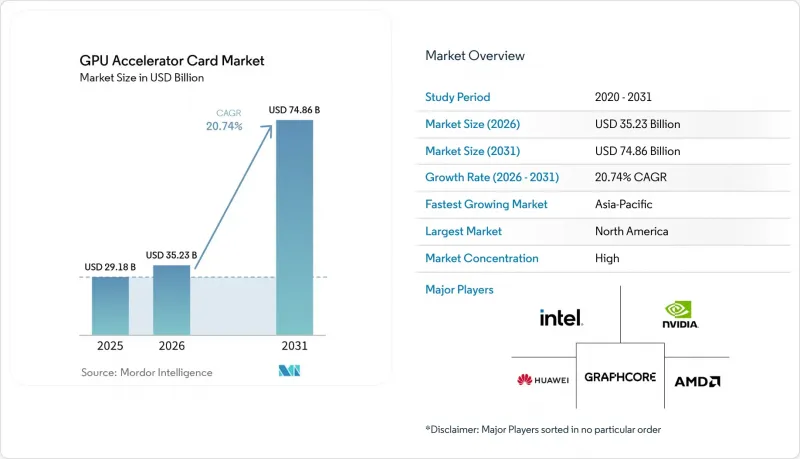
GPU加速卡市場預計將從2025年的291.8億美元成長到2026年的352.3億美元,到2031年達到748.6億美元,2026年至2031年的複合年成長率為20.74%。
本報告按外形尺寸(PCIe擴充卡、SXM/夾層卡、OAM)、記憶體類型(HBM、GDDR)、散熱方式(被動式、主動式)、部署模式(資料中心/伺服器、工作站、邊緣/嵌入式)、產業領域(雲端服務供應商、企業 IT、政府/研究機構、媒體/娛樂等)和地區進行細分。市場預測以美元計價。
全球GPU加速卡市場趨勢與洞察
人工智慧和機器學習訓練工作負載的爆炸性成長。
模型參數數量已從 1.8 兆激增至超過 10 兆,這需要配備超過 10 萬個加速器的集群,以及每個 GPU 超過 400 Gbps 的互連架構。美國國家實驗室的尖端系統目前整合了超過 28,000 個 NVIDIA H100 單元,超大規模資料中心業者已投資超過 700 億美元,計劃在 2025 年擴展 AI 容量。訓練任務需要接近 90% 的持續運轉率,這迫使人們重新評估總體擁有成本 (TCO) 假設,並制定跨越數年的長期硬體採購計畫。每次運行超過 1 億美元的預訓練成本限制了資本密集型公司的參與,從而導致整個 GPU 加速卡市場需求強勁。這種需求壓力導致高級產品供應受限,儘管出貨量增加,但平均售價仍居高不下。
雲端遊戲和串流平台的快速普及
預計到2025年,雲端遊戲收入將達到85億美元,目前領先的平台正致力於實現4K解析度、240幀/秒和低於40毫秒的延遲。服務供應商面臨夜間尖峰時段的嚴峻挑戰,正常運轉率波動幅度高達3倍,促使許多服務供應商將閒置的夜間資源轉移到生成式人工智慧推理處理,將資產利用率從35%提升至65%。為了滿足低於50毫秒的延遲要求,邊緣資料中心必須位於終端用戶20毫秒以內,這推動了對緊湊型、被動散熱且具備遠端控制功能的加速器的需求。隨著高水準競技遊戲轉向雲端交付,即使是1毫秒的延遲也可能導致客戶流失,從而加速GPU加速卡市場的更新換代。
先進基板永續供應鏈面臨的限制因素
味之素積層製造膜的基板訂單滿至2027年,前置作業時間長達52週。 NVIDIA、AMD和Intel已從台灣和韓國的同一批供應商處獲得了多年的配額,這阻礙了小規模參與企業進入該市場。 2024年台灣地震凸顯了該製程節點的脆弱性,導致生產中斷六週,使全球生產計畫進一步延後了一個季度。由於基板在基板材料清單(BOM)中佔比高達五分之一,價格上漲將直接影響最終產品-顯示卡-進而為GPU加速卡市場帶來不利影響。
細分市場分析
預計2026年至2031年間,OAM模組的複合年成長率將達到21.34%,而PCIe擴充卡GPU加速器市場在2025年佔總銷售額的52%。 OAM模組使超大規模資料中心業者能夠在42U機架中容納72個功耗為1.4MW的加速器,與同等功率的PCIe模組相比,面積減少了40%。 Meta及其同業正在推廣支援700W GPU的直冷式OAM設計,從而將能源效率提升了25%。相較之下,企業更重視PCIe熱插拔的柔軟性,仍是企業一次升級多台伺服器採購流程的基礎。
這種效率差異轉化為大規模環境下每次浮點運算成本的顯著降低。因此,超大規模資料中心部署的 OAM 數量將持續成長。然而,GPU 加速卡市場依然兩極化,因為規模較小的企業不願重新配置機架以容納 700W 的液冷迴路。 SXM 模組主要整合於 NVIDIA 的 DGX 系統中,佔據 28% 的市場佔有率,並將繼續在那些優先考慮專有 NVLink頻寬而非開放標準的用戶群中保持一定的市場需求。
到2025年,HBM將佔總銷售額的84%,並持續維持其競爭優勢,SK海力士、三星和美光等供應商將為GPU加速卡市佔率提供支撐。目前,每個HBM3e堆疊可提供1.15 TB/s的頻寬,而頂級設備則整合八個或更多堆棧,總合頻寬可達8 TB/s。由於型號尺寸的持續成長速度超過了莫耳定律規定的性能提升速度,因此消費者願意支付比GDDR6高出八倍的價格。
基於 GDDR 的顯示卡仍然廣泛應用於工作站和邊緣推理等應用場景,在這些場景中,每 GB 的成本比峰值頻寬更為重要,因此 GDDR 顯示卡仍保持著 16% 的市場佔有率。 HBM4 預計將於 2027 年問世,單堆疊頻寬可達 2 TB/s,預計將緩解效能瓶頸,但其初期價格可能更高。在韓國和美國的新產能於 2028 年達到量產水準之前,HBM 的供應可能會限制 GPU 加速卡片市場的整體成長。
區域分析
北美地區在超大規模資料中心業者資料中心投資超過3,000億美元的推動下,預計到2025年將佔全球營收的46%。然而,該地區的複合年成長率預計低於平均水平,僅為19.8%。這主要是由於電網互聯延遲和電力許可核准困難導致資料中心擴張速度放緩。在加拿大,嚴重依賴能源來源的省份正在吸引總計80億美元的投資用於建造新的資料中心。同時,美國對中國出口先進GPU的限制正將過剩需求轉向國內。這種需求轉移推高了該地區的GPU價格。
亞太地區預計將以21.82%的複合年成長率成長,成長速度在所有地區中最高。日本已撥款4兆日圓(約260億美元)用於人工智慧研究基礎建設;印度正透過一項耗資1,030.7億盧比(約12.4億美元)的項目新增1兆GPU;新加坡則投資5億美元以實現50 PFLOPS的運算能力。不受出口限制影響的中國國內廠商預計,2025年加速器出貨量將達80億美元。同時,韓國在HBM供應方面的主導地位鞏固了該地區在GPU加速卡市場的戰略重要性。
在德國、義大利和西班牙等百萬兆級的EuroHPC投資支持下,歐洲預計在2025年將佔18%的市場。新的指令要求在2028年將電源使用效率(PUE)控制在1.3以下,並將可再生能源佔比提高到80%以上,這正在推動對節能型GPU的需求。在法國,超過10個PF日的培訓工作必須進行碳排放核算,這使得擁有完善報告基礎設施的超大規模超大規模資料中心業者更具優勢。南美洲、中東和非洲合計佔8%的市場佔有率,這主要得益於主權財富基金在巴西、阿拉伯聯合大公國和沙烏地阿拉伯的投資。儘管電網容量限制和熟練人員短缺限制著短期成長,但長距離電纜升級和模組化核能發電試點計畫可能會刺激2028年以後的潛在需求。
其他好處:
- Excel格式的市場預測(ME)表
- 3個月的分析師支持
目錄
第1章:引言
- 研究假設和市場定義
- 調查範圍
第2章:調查方法
第3章執行摘要
第4章 市場狀況
- 市場概覽
- 市場促進因素
- 人工智慧和機器學習訓練工作負載的爆炸性成長。
- 雲端遊戲和串流平台的快速普及
- 加速企業採用生成式人工智慧應用
- 學術界和政府機構對高效能運算的需求日益成長。
- 歐盟永續發展法規正在加速採購節能型GPU。
- 開放加速器模組(OAM)標準實現了多個供應商之間的互通性。
- 市場限制因素
- 先進基板永續供應鏈面臨的限制因素
- 資料中心GPU基礎設施總體擁有成本(TCO)高
- HBM 的容量瓶頸限制了板級記憶體擴展。
- 出口限制旨在遏制GPU跨境運輸
- 宏觀經濟因素對市場的影響
- 產業價值鏈分析
- 監理情勢
- 技術展望
- 波特五力分析
第5章 市場規模與成長預測
- 按外形規格
- PCIe擴充卡
- SXM/夾層
- OAM
- 按記憶體類型
- HBM
- GDDR
- 透過冷卻法
- 被動的
- 積極的
- 不同的發展
- 資料中心/伺服器
- 工作站
- 邊緣/嵌入式
- 按行業分類
- 雲端服務供應商
- 企業IT
- 政府和研究機構
- 媒體與娛樂
- 汽車/邊緣人工智慧
- 按地區
- 北美洲
- 美國
- 加拿大
- 墨西哥
- 歐洲
- 英國
- 德國
- 法國
- 其他歐洲國家
- 亞太地區
- 中國
- 日本
- 印度
- 韓國
- 其他亞太國家
- 南美洲
- 中東和非洲
- 北美洲
第6章 競爭情勢
- 市場集中度
- 策略趨勢
- 市佔率分析
- 公司簡介
- NVIDIA Corporation
- Advanced Micro Devices, Inc.
- Intel Corporation
- Huawei Technologies Co., Ltd.(Ascend Series)
- Graphcore Ltd.
- Tenstorrent Inc.
- Qualcomm Technologies, Inc.
- Samsung Electronics Co., Ltd.
- Alibaba Group Holding Limited(T-Head)
- Baidu, Inc.(Kunlun)
- Cerebras Systems Inc.
- Advanced Micro Devices, Inc.(Xilinx VCK, Radeon Instinct)
- Giga Computing Technology Co., Ltd.
- Mellanox Technologies Ltd.(NVIDIA Networking)
- Broadcom Inc.
- ASUStek Computer Inc.
- Dell Technologies Inc.
- Hewlett Packard Enterprise Company
- Lenovo Group Limited
- Super Micro Computer, Inc.
- Inspur Group Co., Ltd.
第7章 市場機會與未來展望
According to Mordor Intelligence, the gPU accelerator card market size is expected to increase from USD 29.18 billion in 2025 to USD 35.23 billion in 2026 and reach USD 74.86 billion by 2031, growing at a CAGR of 20.74% over 2026-2031.
This report is Segmented by Form Factor (PCIe Add-In Cards, SXM/Mezzanine, and OAM), Memory Type (HBM, and GDDR), Cooling (Passive, Aand Active), Deployment (Data Center/Server, Workstation, and Edge/Embedded), Industry Vertical (Cloud Service Providers, Enterprise IT, Government and Research, Media and Entertainment, and More), and Geography. The Market Forecasts are Provided in Terms of Value (USD).
Global GPU Accelerator Card Market Trends and Insights
Explosive Growth in AI And Machine Learning Training Workloads
Model parameter counts have jumped from 1.8 trillion to over 10 trillion, requiring clusters with more than 100,000 accelerators and interconnect fabrics exceeding 400 Gbps per GPU. Frontier systems at U.S. national laboratories now integrate more than 28,000 NVIDIA H100 units, while hyperscalers each spent over USD 70 billion expanding AI capacity in 2025. Training jobs demand sustained utilization near 90%, reshaping total cost-of-ownership assumptions and locking in long multi-year hardware pipelines. Pre-training costs exceeding USD 100 million per run have narrowed participation to capital-intensive firms, thereby fortifying demand across the GPU accelerator card market. The resulting pressure keeps premium parts supply-constrained, sustaining high average selling prices even as volumes climb.
Surging Adoption of Cloud Gaming and Streaming Platforms
Cloud gaming revenues hit USD 8.5 billion in 2025, and leading platforms now target 4 K at 240 fps with sub-40 ms latency. Providers confront sharp evening peaks that create three-to-one utilization swings, so many routes idle overnight capacity toward generative AI inference to lift asset use from 35% to 65%. Latency budgets under 50 ms require edge data centers within 20 ms of end users, driving demand for compact, passively cooled accelerators that tolerate remote operation. As competitive esports titles migrate to cloud delivery, every millisecond of delay becomes a risk of customer churn, accelerating refresh cycles in the GPU accelerator card market.
Persistent Supply Chain Constraints in Advanced Substrates
Ajinomoto Build-up Film substrates remain fully booked through 2027, stretching lead times to 52 weeks. NVIDIA, AMD, and Intel hold multiyear allocations from the same pool of Taiwanese and Korean suppliers, crowding out smaller entrants. The 2024 Taiwan earthquake highlighted the fragility of this node, as it paused production for 6 weeks and lengthened global scheduling by another quarter. Because substrates form up to one-fifth of a board's bill of materials, price spikes ripple directly to end cards, creating a headwind for the GPU accelerator card market.
Other drivers and restraints analyzed in the detailed report include:
- Accelerated Enterprise Roll-Outs of Generative AI Applications
- Rising Demand for High-Performance Computing in Academia and Government
- High Total Cost of Ownership of Datacenter GPU Infrastructure
For complete list of drivers and restraints, kindly check the Table Of Contents.
Segment Analysis
OAM modules posted a 21.34% CAGR from 2026 to 2031, while the PCIe add-in card GPU accelerator market commanded 52% of revenue in 2025. OAM lets hyperscalers pack 72 accelerators drawing 1.4 MW into a 42U rack, shrinking floor space 40% compared with PCIe equivalents. Meta and its peers standardized on direct-liquid-cooled OAM designs that handle 700-W GPUs, enhancing power efficiency by 25%. In contrast, enterprises prize PCIe's hot-swappable flexibility, which still anchors procurement cycles for firms upgrading a few servers at a time.
The efficiency delta translates into materially lower cost per floating-point operation at massive scale, so OAM's installed base will keep climbing in hyperscale facilities. Yet the GPU accelerator card market remains bifurcated because smaller organizations hesitate to rebuild racks around 700-W liquid-cooling loops. SXM modules, embedded primarily in NVIDIA's DGX systems, hold a 28% share and will maintain niche demand among users who value proprietary NVLink bandwidth over open standards.
HBM attained 84% of 2025 revenue and remains the fulcrum of competitive positioning, with the GPU accelerator card market share segment anchored by supply from SK Hynix, Samsung, and Micron. Each HBM3e stack now delivers 1.15 TB/s, and top devices couple eight or more stacks for 8 TB/s aggregate bandwidth. Model sizes keep rising faster than Moore's law gains, so buyers willingly pay the 8x premium over GDDR6.
GDDR-backed cards continue to serve workstations and edge inference, where cost per GB trumps peak bandwidth, retaining a 16% share. HBM4 is scheduled for 2027 and promises 2 TB/s per stack, potentially easing the bottleneck but likely at even higher unit costs initially. Until fresh capacity in South Korea and the United States reaches volume scale in 2028, HBM supply will constrain overall growth in the GPU accelerator card market.
Geography Analysis
North America accounted for 46% of 2025 revenue, driven by hyperscaler outlays exceeding USD 300 billion. However, the regional compound annual growth rate (CAGR) is projected at a below-average 19.8%, primarily due to delays in grid interconnections and challenges in obtaining power permits, which are slowing further datacenter buildouts. In Canada, hydro-powered provinces have attracted investments totaling USD 8 billion for the construction of new data halls. Meanwhile, the U.S. export regime, which restricts the sale of advanced GPUs to China, has redirected excess demand domestically. This redirection has helped maintain elevated GPU prices in the region.
Asia-Pacific is set to grow at 21.82% CAGR, the fastest among regions. Japan allocated JPY 4 trillion (USD 26 billion) to AI research infrastructure, India's INR 103.07 billion (USD 1.24 billion) mission will add 10,000 GPUs, and Singapore targets 50 PFLOPS with a USD 500 million buildout. China's domestic vendors, shielded from export restrictions, shipped USD 8 billion worth of accelerators in 2025, while South Korea's dominance in HBM supply cements the area's strategic heft in the GPU accelerator card market.
Europe captured 18% share in 2025, helped by EuroHPC investments in exascale systems across Germany, Italy, and Spain. New directives requiring power-usage effectiveness below 1.3 and 80% renewable sourcing by 2028 drive demand for energy-efficient GPUs. France also requires carbon accounting for training jobs above 10 PF-days, which privileges hyperscalers with established reporting infrastructure. South America and the Middle East and Africa collectively held 8% share, backed by sovereign wealth fund commitments in Brazil, the United Arab Emirates, and Saudi Arabia. Limited grid capacity and specialist workforce shortages curb near-term acceleration, yet long-distance cable upgrades and modular nuclear pilots could unlock latent demand post-2028.
- NVIDIA Corporation
- Advanced Micro Devices, Inc.
- Intel Corporation
- Huawei Technologies Co., Ltd. (Ascend Series)
- Graphcore Ltd.
- Tenstorrent Inc.
- Qualcomm Technologies, Inc.
- Samsung Electronics Co., Ltd.
- Alibaba Group Holding Limited (T-Head)
- Baidu, Inc. (Kunlun)
- Cerebras Systems Inc.
- Advanced Micro Devices, Inc. (Xilinx VCK, Radeon Instinct)
- Giga Computing Technology Co., Ltd.
- Mellanox Technologies Ltd. (NVIDIA Networking)
- Broadcom Inc.
- ASUStek Computer Inc.
- Dell Technologies Inc.
- Hewlett Packard Enterprise Company
- Lenovo Group Limited
- Super Micro Computer, Inc.
- Inspur Group Co., Ltd.
Additional Benefits:
- The market estimate (ME) sheet in Excel format
- 3 months of analyst support
TABLE OF CONTENTS
1 INTRODUCTION
- 1.1 Study Assumptions and Market Definition
- 1.2 Scope of the Study
2 RESEARCH METHODOLOGY
3 EXECUTIVE SUMMARY
4 MARKET LANDSCAPE
- 4.1 Market Overview
- 4.2 Market Drivers
- 4.2.1 Explosive Growth in AI and Machine Learning Training Workloads
- 4.2.2 Surging Adoption of Cloud Gaming and Streaming Platforms
- 4.2.3 Accelerated Enterprise Roll-outs of Generative AI Applications
- 4.2.4 Rising Demand for High-Performance Computing in Academia and Government
- 4.2.5 EU Sustainability Rules Accelerating Procurement of Energy-Efficient GPUs
- 4.2.6 Open Accelerator Module (OAM) Standard Enabling Multi-Vendor Interoperability
- 4.3 Market Restraints
- 4.3.1 Persistent Supply Chain Constraints in Advanced Substrates
- 4.3.2 High Total Cost of Ownership of Datacenter GPU Infrastructure
- 4.3.3 HBM Capacity Bottlenecks Limiting Board-Level Memory Expansion
- 4.3.4 Export-Control Restrictions Curtailing Cross-Border GPU Shipments
- 4.4 Impact of Macroeconomic Factors on the Market
- 4.5 Industry Value Chain Analysis
- 4.6 Regulatory Landscape
- 4.7 Technological Outlook
- 4.8 Porter's Five Forces Analysis
- 4.8.1 Bargaining Power of Suppliers
- 4.8.2 Bargaining Power of Buyers
- 4.8.3 Threat of New Entrants
- 4.8.4 Threat of Substitutes
- 4.8.5 Intensity of Competitive Rivalry
5 MARKET SIZE AND GROWTH FORECASTS (VALUE)
- 5.1 By Form Factor
- 5.1.1 PCIe Add-In Cards
- 5.1.2 SXM / Mezzanine
- 5.1.3 OAM
- 5.2 By Memory Type
- 5.2.1 HBM
- 5.2.2 GDDR
- 5.3 By Cooling
- 5.3.1 Passive
- 5.3.2 Active
- 5.4 By Deployment
- 5.4.1 Data Center / Server
- 5.4.2 Workstation
- 5.4.3 Edge / Embedded
- 5.5 By Industry Vertical
- 5.5.1 Cloud Service Providers
- 5.5.2 Enterprise IT
- 5.5.3 Government and Research
- 5.5.4 Media and Entertainment
- 5.5.5 Automotive / Edge AI
- 5.6 By Geography
- 5.6.1 North America
- 5.6.1.1 United States
- 5.6.1.2 Canada
- 5.6.1.3 Mexico
- 5.6.2 Europe
- 5.6.2.1 United Kingdom
- 5.6.2.2 Germany
- 5.6.2.3 France
- 5.6.2.4 Rest of Europe
- 5.6.3 Asia-Pacific
- 5.6.3.1 China
- 5.6.3.2 Japan
- 5.6.3.3 India
- 5.6.3.4 South Korea
- 5.6.3.5 Rest of Asia Pacific
- 5.6.4 South America
- 5.6.5 Middle East and Africa
- 5.6.1 North America
6 COMPETITIVE LANDSCAPE
- 6.1 Market Concentration
- 6.2 Strategic Moves
- 6.3 Market Share Analysis
- 6.4 Company Profiles (includes Global Level Overview, Market Level Overview, Core Segments, Financials as available, Strategic Information, Market Rank/Share, Products and Services, Recent Developments)
- 6.4.1 NVIDIA Corporation
- 6.4.2 Advanced Micro Devices, Inc.
- 6.4.3 Intel Corporation
- 6.4.4 Huawei Technologies Co., Ltd. (Ascend Series)
- 6.4.5 Graphcore Ltd.
- 6.4.6 Tenstorrent Inc.
- 6.4.7 Qualcomm Technologies, Inc.
- 6.4.8 Samsung Electronics Co., Ltd.
- 6.4.9 Alibaba Group Holding Limited (T-Head)
- 6.4.10 Baidu, Inc. (Kunlun)
- 6.4.11 Cerebras Systems Inc.
- 6.4.12 Advanced Micro Devices, Inc. (Xilinx VCK, Radeon Instinct)
- 6.4.13 Giga Computing Technology Co., Ltd.
- 6.4.14 Mellanox Technologies Ltd. (NVIDIA Networking)
- 6.4.15 Broadcom Inc.
- 6.4.16 ASUStek Computer Inc.
- 6.4.17 Dell Technologies Inc.
- 6.4.18 Hewlett Packard Enterprise Company
- 6.4.19 Lenovo Group Limited
- 6.4.20 Super Micro Computer, Inc.
- 6.4.21 Inspur Group Co., Ltd.
7 MARKET OPPORTUNITIES AND FUTURE OUTLOOK
- 7.1 White-Space and Unmet-Need Assessment

 機器學習維運市場:全球市場預測,2026-2032年自動化機器學習市場:全球市場預測,2026-2032年
 量子機器學習(QML)軟體:市場佔有率分析、產業趨勢與統計及成長預測(2026-2031)機器學習即服務 (MLaaS) 市場:2026-2032 年全球市場預測(按服務類型、部署模式、組織規模、定價模式、技術、應用程式和最終用戶產業分類)
 智慧學習路徑市場預測-全球分析(按組件、學習模型、部署模式、應用、最終用戶和地區分類)——2034年
 2026年全球對抗性學習市場報告
 全球醫療、法律和監管 (MLR) 審查軟體市場:按組件、部署模式、組織規模、功能和審查內容類型分類-市場規模、產業趨勢、機會分析及 2026 年至 2035 年預測
 2026-2030年全球機械客戶市場基於代理的AI在向量資料庫中的應用:市場佔有率分析、產業趨勢和統計數據以及成長預測(2026-2031年)機器學習維運(MLops):市場佔有率分析、產業趨勢與統計、成長預測(2026-2031)