


 |
市場調查報告書
商品編碼
2099877
電工鋼:市場佔有率分析、產業趨勢與統計、成長預測(2026-2031)Electrical Steel - Market Share Analysis, Industry Trends & Statistics, Growth Forecasts (2026 - 2031) |
||||||

※ 本網頁內容可能與最新版本有所差異。詳細情況請與我們聯繫。
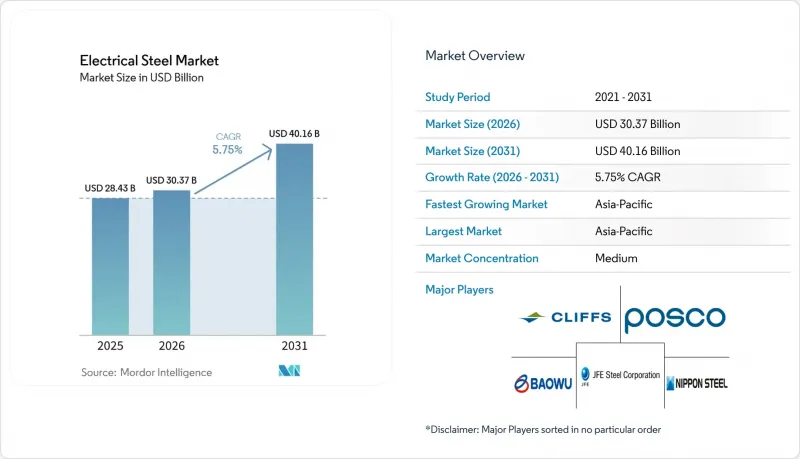
根據 Mordor Intelligence 預測,電工鋼板市場規模預計將從 2025 年的 284.3 億美元成長到 2026 年的 303.7 億美元,然後從 2026 年到 2031 年以 5.75% 的複合年成長率成長,到 2031 年達到 2031. 億美元。
本報告按產品類型(例如,取向電工鋼板)、應用領域(例如,變壓器、馬達)、塗層類型(例如,無機塗層、有機塗層)和地區(亞太地區、北美地區、歐洲地區、南美地區、中東和非洲地區)進行細分。市場預測以美元計價。
全球電工鋼板市場趨勢與洞察
交通運輸和工業系統的快速電氣化
電工鋼板市場的需求正在轉變。這是因為電動車驅動馬達需要比幾年前廣泛使用的傳統馬達平台更薄的矽鋼片和更嚴格的鐵損控制。生產商的趨勢也反映了這一轉變,浦項鋼鐵預計,在與全球汽車製造商簽訂的供應合約的支持下,2025年非晶態電工鋼板的出口將強勁成長。這一趨勢不僅限於汽車業;隨著能源效率法規日益嚴格,工業馬達升級也正從自願支出轉向規劃性的合規活動。隨著買家轉向更薄的鋼板厚度和更低的鐵損規格,電工鋼板市場對標準通用牌號的依賴性降低,而對製程能力、塗層性能和冶金均勻性的依賴性增強。浦項鋼鐵計畫於2026年6月與現代汽車及其合作夥伴組成一個聯盟,這表明,在開發用於下一代電動車驅動的高矽寬幅產品方面,電工鋼板市場正接近其目前的生產極限。大型製造商在追求提高產量的同時,也努力確保那些後進企業難以擴大規模的產品類別。
電網現代化與電力基礎設施擴建
電力系統投資正在支撐電工鋼板市場。這是因為隨著電網擴建、更新換代以及可靠性目標的提高,多個主要電力系統對變壓器的需求正在增加。在印度,儘管政府已通過核准的2032年前電網投資計畫包括延長輸電線路和大幅提升變壓器容量,但國內冷軋取向矽鋼(CRGO)的產量仍遠低於年消費量,導致持續的供不應求。為了解決這一供不應求,各方正在努力確保長期產能,例如JSW和JFE成立合資企業,以應對該國持續的供應緊張。電工鋼板市場也受惠於歐洲和北美重疊的更新換代需求。在這些地區,老舊的變壓器系統仍在運作,同時需要更嚴格的效率要求和彈性計劃。由於這些區域需求同時出現,即使整體鋼鐵市場疲軟,生產認證取向矽鋼(GOES)的製造商仍保持著有利地位。
電工鋼板生產過程中能耗高
電工鋼板市場面臨結構性成本挑戰。這是因為電工鋼板的生產需要比傳統鋼板多得多的能源。以非晶取向電工鋼板為例,每噸生產約需6500千瓦時的能源,而電價是影響各地區營運經濟效益的重要因素。這種壓力在歐洲尤為突出,高昂的電價正在擠壓利潤空間,並加劇了本已面臨進口壓力的工廠的停產。由於矽的添加和退火條件直接影響磁性能,生產商無法迅速解決這個問題。因此,在不影響冶金性能的前提下,改變能源投入或製造流程並非易事。在電工鋼板市場,電價低廉且政府支持力道大的地區更容易擴大產能。此外,即使終端需求保持強勁,市場仍可能繼續存在區域經濟狀況。
細分市場分析
預計到2025年,非對稱晶粒取向電工鋼板將佔據電工鋼板市場68.42%的佔有率,這主要得益於其在汽車、工業和消費性電子馬達及疊片領域的應用。該細分市場受益於廣泛的市場需求,因為它服務於多種馬達驅動系統,而非單一終端應用鏈。尤其是在電動車驅動系統中,高階產品的研發方向正轉向更薄的鋼板,因為降低鐵損有助於改善溫度控管並提升續航里程。安賽樂米塔爾的「iCARe 420Save」平台預計將於2026年實現0.2毫米厚度的部署,順應這一趨勢,滿足高速電動傳動系統中更為嚴格的疊片要求。根據中國標準YB/T 6421-2025,用於電動車驅動馬達的高性能非對稱晶粒取向電工鋼板(NGO)正朝著更規範的產品類別發展,對塗層和材料的要求也更加明確。
浦項製鐵(POSCO)非晶取向電工鋼板的出口動能表明,在2025年之前,海外對優質等級產品的需求將持續成長,這主要得益於全球汽車製造商對電動平台不斷擴大的採購需求。儘管取向電工鋼(GOES)的銷量落後於非晶取向電工鋼(NGOES),但預計到2031年,其年均成長率將達到6.24%,成為成長最快的產品類別。 GOES的成長與變壓器需求、電網升級和更換需求密切相關,這使其價值結構與大規模生產的NGOES有所不同。這一趨勢顯示電工鋼板產業的發展呈現兩極化:NGOES的成長主要得益於行動出行和工業應用領域銷售量的成長,而GOES的成長則主要來自高規格變壓器應用。這種結構支撐著電工鋼板市場兩條截然不同的成長路徑,而非單一的週期性波動。這也為同時生產這兩種產品的製造商提供了平衡銷售量、定價和技術差異化的基礎,以適應不斷變化的終端用戶需求。
區域分析
預計到2025年,亞太地區將佔據全球電工鋼板市場54.82%的佔有率,並預計在2031年之前以6.37%的複合年成長率成長。這將賦予該地區顯著的市場規模和成長動力。亞太地區電工鋼板市場受惠於許多因素,例如煉鋼能力、變壓器需求、電動車製造、消費性電子產品生產、工業馬達應用。中國繼續在這一市場中扮演核心角色,因為它支撐著該地區的生產基礎設施和貫穿整個供應鏈的全球出口活動。印度透過對電網的大規模投資和變壓器擴建來支持市場,這些投資推動了對取向電工鋼板(GOES)的需求,並凸顯了國內產能的不足。韓國和日本憑藉其在高檔產品方面的技術實力以及與汽車、工業設備和變壓器用戶相關的高性能供應鏈,在電工鋼板市場仍然佔據重要地位。
儘管北美和歐洲合計的市場佔有率不如亞太地區,但由於電網設備和先進電氣化系統的需求,它們在電工鋼板市場仍然佔據著重要地位。在北美,替換需求和持續投資推動了對變壓器等級材料以及經認證的國產和本地供應的需求。然而,在歐洲,進口市場佔有率正在擴大,而本地生產商正面臨供應壓力,因為他們正努力應對不斷上漲的能源成本和不斷下降的利潤率。蒂森克虜伯電工鋼公司位於伊斯貝格斯(Isberges)的工廠將於2026年部分時間停產,凸顯了該地區面臨的進口壓力和成本上升風險。另一方面,安賽樂米塔爾位於馬爾迪克(Mardic)的工廠投產,支撐了歐洲對用於汽車和工業電氣化的非晶態取向電工鋼(NGO)的需求,這向電工鋼板市場發出了不同的訊號。
儘管南美洲和中東及非洲的市場規模仍然相對較小,但它們各自對電工鋼板市場都有策略性的需求。在南美洲,變壓器的採購與提高電網密度和加強廣大地區的電力供應系統密切相關。在中東,基礎設施的擴建和產業多元化計畫正在推動取向電工鋼板(GOES)在變壓器領域的應用,以及取向電工鋼板(NGOES)在馬達驅動系統中的應用。南非仍然是電工鋼板市場的重要參與者,因為在長期供給能力短缺的情況下,電力基礎設施的維修支撐了對變壓器的需求。隨著高成長市場重新評估進口模式、對國內產業的影響以及向下游設備製造商的成本轉移,全部區域的貿易政策可能會變得更加重要。
其他好處:
- Excel格式的市場預測(ME)表
- 3個月的分析師支持
目錄
第1章:引言
- 研究假設和市場定義
- 調查範圍
第2章:調查方法
第3章執行摘要
第4章 市場狀況
- 市場概覽
- 市場促進因素
- 汽車動力傳動系統的快速電氣化
- 電網現代化和變壓器更換週期
- 工業自動化領域對高效率馬達的需求日益成長。
- 可再生能源併網需要低損耗的磁芯。
- 嚴格的能源效率法規正在推動高品質電工鋼板的採用。
- 市場限制因素
- 高能耗和不斷上漲的脫碳成本
- 複雜的製造程序和高准入門檻
- 來自非晶質和奈米晶態磁性材料的競爭日益激烈。
- 價值鏈分析
- 波特五力分析
第5章 市場規模與成長預測
- 依產品類型
- 取向電工鋼板
- 非晶取向電工鋼板
- 透過使用
- 變壓器
- 引擎
- 發電機
- 電感器
- 其他用途
- 按塗層類型
- 無機塗層
- 有機塗層
- 自沾塗層
- 其他塗層
- 按地區
- 亞太地區
- 中國
- 印度
- 日本
- 韓國
- 其他亞太國家
- 北美洲
- 美國
- 加拿大
- 墨西哥
- 歐洲
- 德國
- 英國
- 法國
- 義大利
- 俄羅斯
- 其他歐洲國家
- 南美洲
- 巴西
- 阿根廷
- 其他南美國家
- 中東和非洲
- 沙烏地阿拉伯
- 南非
- 其他中東和非洲國家
- 亞太地區
第6章 競爭情勢
- 市場集中度
- 策略趨勢
- 市佔率和排名分析
- 公司簡介
- Ansteel Group Corporation
- ArcelorMittal
- Baosteel Group Corporation
- China Baowu Steel Group
- China Steel Corporation
- Cleveland-Cliffs Inc.
- JFE Steel Corporation
- JSW Steel Limited
- NIPPON STEEL CORPORATION
- NLMK Group
- POSCO
- Shougang Group
- Taiyuan Iron & Steel(Group)Co. Ltd.,
- thyssenkrupp AG
- voestalpine AG
第7章 市場機會與未來展望
According to Mordor Intelligence, the electrical steel market size is expected to grow from USD 28.43 billion in 2025 to USD 30.37 billion in 2026 and is forecast to reach USD 40.16 billion by 2031 at 5.75% CAGR over 2026-2031.
This report is Segmented by Product Type (Grain Oriented Electrical Steel and More), Application (Transformers, Motors, and More), Coating Type (Inorganic Coatings, Organic Coatings, and More), and Geography (Asia-Pacific, North America, Europe, South America, and Middle-East and Africa). The Market Forecasts are Provided in Terms of Value (USD).
Global Electrical Steel Market Trends and Insights
Rapid Electrification of Transportation and Industrial Systems
The electrical steel market is experiencing a demand shift, as EV traction motors require thinner silicon steel and tighter loss control than legacy motor platforms used at scale only a few years ago. Producer activity reflects this shift, with POSCO expected to report strong growth in non-oriented electrical steel exports in 2025, supported by supply agreements with global vehicle manufacturers. This trend extends beyond vehicles, as industrial motor upgrades are moving from optional spending to scheduled compliance activity under tighter efficiency regulations. As buyers shift to thinner gauges and lower iron-loss specifications, the electrical steel market is becoming less dependent on standard commodity grades and more dependent on process capability, coating performance, and metallurgical consistency. POSCO's planned June 2026 consortium with Hyundai Motor and partner institutions indicates that the electrical steel market is approaching current manufacturing limits in developing high-silicon wide-sheet products for next-generation EV drives. Leading producers are pursuing higher volumes while working to secure product classes that remain difficult for followers to scale.
Grid Modernization and Power Infrastructure Expansion
Grid spending is supporting the electrical steel market, as transformer demand rises with transmission additions, replacement cycles, and higher reliability targets across several major power systems. India remains undersupplied because government-approved grid investment through 2032 includes large additions in transmission line length and transformer capacity, while domestic CRGO output still trails annual consumption by a wide margin. This gap has led to long-term capacity commitments, including the JSW JFE joint venture formed to address persistent supply tightness in the country. The electrical steel market also benefits from overlapping replacement needs in Europe and North America, where older transformer fleets now operate alongside stricter efficiency expectations and resilience planning. As these regional demand waves occur simultaneously, producers with qualified Grain Oriented Electrical Steel (GOES) output remain well-positioned, even as broader steel cycles soften.
High Energy Consumption in Electrical Steel Manufacturing
The electrical steel market faces a structural cost challenge because electrical steel requires significantly more energy to produce than conventional steel sheet. Non-grain-oriented electrical steel can require around 6,500 kWh per tonne, making power prices a key factor in operating economics across regions. This pressure is particularly evident in Europe, where higher electricity costs have reduced margins and contributed to plant shutdowns already facing import pressure. Producers cannot address this issue quickly because silicon alloying and annealing conditions directly affect magnetic performance. As a result, they cannot easily change energy inputs or process routes without affecting metallurgy. For the electrical steel market, capacity expansion remains more feasible in regions with lower power costs or stronger state support. The market may also continue to record uneven regional economics, even when end-use demand remains strong.
Other drivers and restraints analyzed in the detailed report include:
- Rising Demand for High-Efficiency Motors Driven by Regulatory Mandates
- Renewable Power Integration and Distributed Generation Growth
- Complex Manufacturing Processes and High Capital Intensity
For complete list of drivers and restraints, kindly check the Table Of Contents.
Segment Analysis
Non-grain-oriented electrical steel is expected to account for 68.42% of the electrical steel market share in 2025, supported by its use in automotive, industrial, and appliance motors and laminations. This segment benefits from broad volume demand, as it serves multiple motor-driven systems rather than a single end-use chain. Premium product development is shifting toward thinner gauges, especially in EV drive systems, where low iron loss supports heat control and range performance. ArcelorMittal's iCARe 420Save platform, which is expected to extend to a 0.2 mm gauge in 2026, aligns with this trend by targeting tighter lamination requirements in high-speed electrified drivetrains. The Chinese standard YB/T 6421-2025 indicates that higher-performance non-grain-oriented electrical steel (NGOES) for EV drive motors is moving into a more formal product class with defined coating and material expectations.
POSCO's non-grain-oriented export momentum indicates continued offshore demand for premium grades through 2025, as global automakers broaden sourcing requirements for electrified platforms. Grain-oriented electrical steel (GOES), while smaller in revenue terms, is forecast to grow at 6.24% through 2031, making it the fastest-growing product segment. Its expansion is linked to transformer demand, transmission upgrades, and replacement activity, creating a value profile that differs from the higher-volume NGOES segment. This trend indicates a split in the evolution of the electrical steel industry, with NGOES expanding through volume penetration in mobility and industrial applications, while GOES grows through high-specification transformer applications. This structure supports two separate growth paths within the electrical steel market rather than a single broad-based cycle. It also positions producers with both product families to balance volume, pricing, and technical differentiation across changing end-use patterns.
Complete Report Scope:
- By Product Type
- Grain Oriented Electrical Steel
- Non-Grain Oriented Electrical Steel
- By Application
- Transformers
- Motors
- Generators
- Inductors
- Other Applications
- By Coating Type
- Inorganic Coatings
- Organic Coatings
- Self-Bonding Coatings
- Other Coatings
- By Geography
- Asia-Pacific
- China
- India
- Japan
- South Korea
- Rest of Asia-Pacific
- North America
- United States
- Canada
- Mexico
- Europe
- Germany
- United Kingdom
- France
- Italy
- Russia
- Rest of Europe
- South America
- Brazil
- Argentina
- Rest of South America
- Middle-East and Africa
- Saudi Arabia
- South Africa
- Rest of Middle-East and Africa
- Asia-Pacific
Geography Analysis
Asia-Pacific is expected to hold 54.82% of the electrical steel market share in 2025 and is forecast to grow at a CAGR of 6.37% through 2031, giving the region significant scale and growth momentum. The electrical steel market in Asia-Pacific benefits from steelmaking capacity, transformer demand, EV manufacturing, appliance output, and industrial motor use. China remains central to this position, as the country supports regional production infrastructure and global export activity across the supply chain. India adds support through large grid investments and transformer additions, which drive demand for Grain-Oriented Electrical Steel (GOES) and highlight domestic capacity gaps. South Korea and Japan remain important in the electrical steel market, as they support technical capabilities in premium grades and high-performance supply chains linked to vehicles, industrial equipment, and transformer users.
North America and Europe together account for a smaller share than Asia-Pacific, but they remain important to the electrical steel market due to demand in grid equipment and advanced electrified systems. North America benefits from replacement needs and continued investment, which support demand for transformer-grade materials and qualified domestic or near-market supply. Europe faces supply pressure as imports gain share while local producers manage higher energy costs and weaker margin protection. The thyssenkrupp Electrical Steel shutdown at Isbergues through part of 2026 highlights the region's exposure to import pressure and cost inflation. ArcelorMittal's Mardyck startup presents a different signal in the electrical steel market, as it supports European demand for Non-Grain Oriented Electrical Steel (NGOES) tied to automotive and industrial electrification.
South America, the Middle East, and Africa remain smaller in absolute terms, yet each adds strategic demand to the electrical steel market. In South America, transformer procurement is linked to transmission densification and efforts to strengthen power delivery across large geographic areas. In the Middle East, infrastructure expansion and industrial diversification programs support the use of Grain-Oriented Electrical Steel (GOES) in transformers and NGOES in motor-driven systems. South Africa remains relevant in the electrical steel market, as power infrastructure rehabilitation supports transformer demand amid chronic capacity shortfalls. Trade policy could become more influential across these regions as high-growth markets review import patterns, domestic industry exposure, and cost pass-through into downstream equipment manufacturing.
- Ansteel Group Corporation
- ArcelorMittal
- Baosteel Group Corporation
- China Baowu Steel Group
- China Steel Corporation
- Cleveland-Cliffs Inc.
- JFE Steel Corporation
- JSW Steel Limited
- NIPPON STEEL CORPORATION
- NLMK Group
- POSCO
- Shougang Group
- Taiyuan Iron & Steel (Group) Co. Ltd.,
- thyssenkrupp AG
- voestalpine AG
Additional Benefits:
- The market estimate (ME) sheet in Excel format
- 3 months of analyst support
TABLE OF CONTENTS
1 Introduction
- 1.1 Study Assumptions and Market Definition
- 1.2 Scope of the Study
2 Research Methodology
3 Executive Summary
4 Market Landscape
- 4.1 Market Overview
- 4.2 Market Drivers
- 4.2.1 Rapid Electrification of Vehicle Powertrains
- 4.2.2 Grid Modernization and Transformer Replacement Cycles
- 4.2.3 Rising Demand for High Efficiency Motors in Industrial Automation
- 4.2.4 Renewable Power Integration Requiring Lower Loss Magnetic Cores
- 4.2.5 Stringent Energy Efficiency Regulations Driving Premium Electrical Steel Adoption
- 4.3 Market Restraints
- 4.3.1 High Energy Consumption and Rising Decarbonization Costs
- 4.3.2 Complex Manufacturing Process and High Entry Barriers
- 4.3.3 Increasing Competition from Amorphous and Nanocrystalline Magnetic Materials
- 4.4 Value Chain Analysis
- 4.5 Porter's Five Forces Analysis
- 4.5.1 Threat of New Entrants
- 4.5.2 Bargaining Power of Suppliers
- 4.5.3 Bargaining Power of Buyers
- 4.5.4 Threat of Substitutes
- 4.5.5 Competitive Rivalry
5 Market Size and Growth Forecasts (Value)
- 5.1 By Product Type
- 5.1.1 Grain Oriented Electrical Steel
- 5.1.2 Non-Grain Oriented Electrical Steel
- 5.2 By Application
- 5.2.1 Transformers
- 5.2.2 Motors
- 5.2.3 Generators
- 5.2.4 Inductors
- 5.2.5 Other Applications
- 5.3 By Coating Type
- 5.3.1 Inorganic Coatings
- 5.3.2 Organic Coatings
- 5.3.3 Self-Bonding Coatings
- 5.3.4 Other Coatings
- 5.4 By Geography
- 5.4.1 Asia-Pacific
- 5.4.1.1 China
- 5.4.1.2 India
- 5.4.1.3 Japan
- 5.4.1.4 South Korea
- 5.4.1.5 Rest of Asia-Pacific
- 5.4.2 North America
- 5.4.2.1 United States
- 5.4.2.2 Canada
- 5.4.2.3 Mexico
- 5.4.3 Europe
- 5.4.3.1 Germany
- 5.4.3.2 United Kingdom
- 5.4.3.3 France
- 5.4.3.4 Italy
- 5.4.3.5 Russia
- 5.4.3.6 Rest of Europe
- 5.4.4 South America
- 5.4.4.1 Brazil
- 5.4.4.2 Argentina
- 5.4.4.3 Rest of South America
- 5.4.5 Middle-East and Africa
- 5.4.5.1 Saudi Arabia
- 5.4.5.2 South Africa
- 5.4.5.3 Rest of Middle-East and Africa
- 5.4.1 Asia-Pacific
6 Competitive Landscape
- 6.1 Market Concentration
- 6.2 Strategic Moves
- 6.3 Market Share (%)/Ranking Analysis
- 6.4 Company Profiles (includes Global Overview, Market Overview, Core Segments, Financials as available, Strategic Information, Products and Services, and Recent Developments)
- 6.4.1 Ansteel Group Corporation
- 6.4.2 ArcelorMittal
- 6.4.3 Baosteel Group Corporation
- 6.4.4 China Baowu Steel Group
- 6.4.5 China Steel Corporation
- 6.4.6 Cleveland-Cliffs Inc.
- 6.4.7 JFE Steel Corporation
- 6.4.8 JSW Steel Limited
- 6.4.9 NIPPON STEEL CORPORATION
- 6.4.10 NLMK Group
- 6.4.11 POSCO
- 6.4.12 Shougang Group
- 6.4.13 Taiyuan Iron & Steel (Group) Co. Ltd.,
- 6.4.14 thyssenkrupp AG
- 6.4.15 voestalpine AG
7 Market Opportunities and Future Outlook
- 7.1 White-Space and Unmet-Need Assessment

 電工鋼板清漆市場報告:趨勢、預測及競爭分析(至2035年)
 電工鋼板市場:依材質、產品類型、厚度範圍、表面絕緣系統和應用分類-2026-2032年全球市場預測
 無取向電工鋼板:市場佔有率分析、產業趨勢與統計、成長預測(2026-2031年)
 全球電工鋼板市場規模、佔有率、趨勢及成長分析報告(2026-2034年)
 非光學電氣鋼板(NOES)市場預測至2034年-按類型、厚度、應用、最終用戶和地區分類的全球分析
 2026 年至 2035 年電工鋼板塗層市場的商業機會、成長要素、產業趨勢分析與預測。
 電工鋼板市場規模、佔有率、趨勢和預測:按類型、應用、最終用途行業和地區分類,2026-2034年2026-2034年全球取向矽鋼片市場規模、佔有率、趨勢與成長分析報告
 2026年全球無取向電工鋼市場報告2026年全球電工鋼市場報告