


 |
市場調查報告書
商品編碼
2099833
印度潤滑油物流:市場佔有率分析、產業趨勢與統計及成長預測(2026-2031)India Lubricants Logistics - Market Share Analysis, Industry Trends & Statistics, Growth Forecasts (2026 - 2031) |
||||||

※ 本網頁內容可能與最新版本有所差異。詳細情況請與我們聯繫。
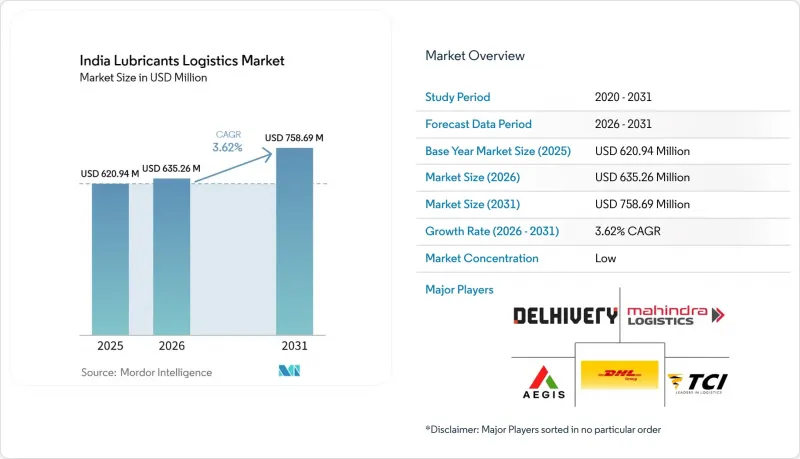
根據 Mordor Intelligence 預測,印度潤滑油物流市場預計將從 2025 年的 6.2094 億美元成長到 2026 年的 6.3526 億美元,到 2031 年達到 7.5869 億美元,2026 年至 2031 年的複合成長率為 3.62%。
商用車活動增加和工業生產強勁成長支撐了市場需求,從而維持了運輸和工廠相關分銷管道的活躍補貨週期。本報告按服務類型(運輸、倉儲物流及其他)、裝卸和運輸形式(散裝液體、IBC貨櫃、桶裝、零售和商業小批量)以及終端用戶行業(汽車、重型機械、鋼鐵和金屬加工、能源和發電、紡織、船舶、航太及其他)進行細分。市場預測以美元計價。
印度潤滑油物流市場趨勢與洞察
自有車輛數量和商用車輛車隊規模均增加。
印度商用車車隊正進入更新換代期,這推動了潤滑油的強勁需求,並提高了服務網路的配送頻率。 2026會計年度,商用車零售達1,060,906輛,首次突破10輛,較去年成長11.74%。營運車輛數量的增加意味著更頻繁的換油和到服務中心的次數,以及主要道路沿線服務區的補貨週期縮短。這導致印度潤滑油物流市場零擔貨運密度增加,尤其是在車輛服務中心和經銷商服務中心集中於貨運路線沿線的地區。隨著符合BS-VI排放標準的卡車逐步取代老舊車輛,潤滑油處理要求變得更加嚴格,對規格合規性的重視程度更高,對可控配送和精準庫存管理的需求也日益成長。
製造業、建設業和採礦業的蓬勃發展正在推動工業潤滑油的流通。
在工廠密集的走廊地帶,工業活動持續支撐著對液壓油、齒輪油和金屬加工液的強勁需求。根據印度統計和計畫實施部(MoSPI)的記錄,2025年12月製造業產出年增8.1%,更新後的數據顯示,2026年4月製造業產出年增6.2%,其中資本財產出成長16.0%,顯示產能持續擴張。印度政府發布的《2026會計年度經濟調查報告》也預測,該會計年度工業增加值(GVA)將成長6.2%,2026會計年度第二季將成長9.13%。儘管由於排放氣體法規的實施,設備銷售有所放緩,但現有運作設備仍需要預防性維護和持續潤滑。因此,印度潤滑油物流市場不僅受益於工業產出的成長,也受惠於高附加價值潤滑油的組成,這些潤滑油需要更乾淨的儲存、更完善的運輸管理和更嚴格的處理。
對基礎油進口的依賴以及原物料價格的波動
對基礎油的依賴仍然是印度潤滑油物流市場最明顯的供應側風險。到2025年,印度將嚴重依賴進口基礎油,使得調配商極易受到運費波動、地緣政治不穩定以及海外煉油廠運轉率等因素的影響。當進口供應趨緊時,調配廠的生產計畫能夠承受最初的衝擊,但隨後物流網路將面臨運輸模式不均衡、庫存快速消耗以及資產利用率下降等問題。雖然在港口和調配廠附近設立緩衝倉庫可以緩解部分風險,但這會增加資本密集度,並且在需求疲軟時期效率降低。因此,對於那些為了對沖價格波動而配置過多產能,卻無法透過穩定的合約獲得收入復甦的企業而言,盈利將持續受到擠壓。
細分市場分析
2025年,運輸業仍是印度潤滑油物流市場中最大的服務類別,佔71.09%的市佔率。這一主導地位源自於龐大的貨物運輸量,主要透過道路運輸,連接調配廠、倉庫、維修店和工業用戶。倉儲和配送業繼續發揮至關重要的輔助作用,緩解了進口延誤和季節性庫存積壓的影響。
預計到2031年,附加價值服務將以5.12%的複合年成長率成長,成為成長最快的服務領域。在印度潤滑油物流市場,加值服務受惠於庫存管理、重新包裝、重新貼標和套件組裝等外包業務的日益成長。其根本原因在於不同黏度等級、基礎油和應用場景的SKU日益複雜。產品種類的增加意味著更多的揀貨和包裝組合、更多的標籤查核點,以及對訂單客製化需求的不斷成長,無論買家是經銷商、維修店還是工業用戶。這使得擁有倉儲系統、規範處理區域和嚴格文件系統的物流合作夥伴更具優勢。印度標準局(BIS)的標籤檢視和品質要求進一步強化了擁有認證基礎設施的大型供應商的優勢。因此,增值服務的成長速度超過了單純的運輸服務,並正穩步成為印度潤滑油物流行業的重要收入來源。
其他好處:
- Excel格式的市場預測(ME)表
- 3個月的分析師支持
目錄
第1章:引言
- 研究假設和市場定義
- 調查範圍
第2章:調查方法
第3章執行摘要
第4章 市場狀況
- 市場概覽
- 市場促進因素
- 車輛擁有量增加和商用車輛車隊密度增加
- 製造業、建設業和採礦業活性化正在推動對工業潤滑油的需求。
- 消費稅實施後的倉庫整合與第三方物流實施
- 向優質合成潤滑油的轉變增加了操作的複雜性。
- 由於塔爾卡一級供不應求,地區層級對補給的需求日益成長。
- 廢油的指數級回收(EPR)正在擴大對逆向物流的需求。
- 市場限制因素
- 對基礎油進口的依賴以及原物料價格的波動
- 向電動車的轉變導致某些通路中引擎油的長期處理量放緩。
- 遵守危險物品管理法規,並投資興建用於處理潤滑油的倉庫設施。
- 分銷通路缺乏透明度,阻礙了我們掌握零售需求的真實狀況。
- 價值鏈分析
- 監理情勢
- 技術展望
- 波特五力分析
- 地緣政治事件對市場的影響
第5章 市場規模與成長預測
- 按服務類型
- 運輸
- 路
- 整車運輸 (FTL)
- 低於100%的運費(零擔運輸)
- 鐵路
- 多式聯運
- 路
- 倉儲/物流
- 附加價值服務(庫存管理、重新包裝、重新貼標、套件組裝等)
- 運輸
- 按處理方式/按運輸方式
- 散裝液體
- 中型散貨箱(IBC)
- 鼓
- 零售和商用(瓶子、果凍桶、立式袋、桶、酒桶等)
- 按最終用戶行業分類
- 車
- 重型機械
- 鋼鐵和金屬加工
- 能源/發電
- 工業製造
- 紡織品
- 海上
- 航太
- 其他終端用戶產業
第6章 競爭情勢
- 市場集中度
- 策略趨勢
- 市佔率分析
- 公司簡介
- 20Cube Logistics Pte. Ltd.
- Aegis Logistics Ltd.
- Allcargo Logistics Limited
- CJ Darcl Logistics Limited
- DHL Group
- DSV A/S
- Express Roadways Private Limited
- KD Supply Chain Solutions Pvt. Ltd.
- Kuehne+Nagel
- Mahindra Logistics, Ltd.
- MTI Logistics
- Nippon Express Holdings
- Om Logistics Limited
- Safexpress Private Limited
- Siddhartha Logistics Co. Pvt. Ltd.
- Toll Holdings Limited
- Transport Corporation of India Limited
- V Power Logistics
- Varuna Group
- VRL Logistics Limited
第7章 市場機會與未來展望
According to Mordor Intelligence, the India lubricants logistics market size is expected to increase from USD 620.94 million in 2025 to USD 635.26 million in 2026 and reach USD 758.69 million by 2031, growing at a CAGR of 3.62% over 2026-2031.
Demand is being supported by stronger commercial vehicle activity and firmer industrial output, which together are keeping refill cycles active across transport and factory-linked channels. This report is Segmented by Service Type (Transportation, Warehousing and Distribution, and More), by Handling/Shipment Format (Bulk Liquid, Ibcs, Drums, Small Retail & Commercial), and by End-User Industry (Automotive, Heavy Equipment, Steel and Metal Machining, Energy/Power Generation, Textile, Marine, Aerospace, and Others). The Market Forecasts are Provided in Terms of Value (USD).
India Lubricants Logistics Market Trends and Insights
Rising Vehicle Parc and Commercial Fleet Intensity
India's commercial vehicle base is moving through a renewal phase that keeps lubricant demand active and raises delivery frequency across service networks. Commercial vehicle retail sales reached 1,060,906 units in FY2026, which was the first time the segment crossed 10 lakh units, and sales rose 11.74% year over year. A larger operating fleet means more routine oil changes, more workshop visits, and tighter reorder cycles across highway-led service corridors. That pushes the India lubricants logistics market toward denser less-than-truckload runs, especially where fleet garages and dealer workshops cluster near freight routes. As BS-VI trucks replace older vehicles, lubricant handling requirements become more specification-sensitive, which increases the value of controlled delivery and accurate stock positioning.
Manufacturing, Construction, and Mining Activity Lifting Industrial Lubricant Flows
Industrial activity is sustaining a strong pull on hydraulic fluids, gear oils, and metalworking fluids across plant-heavy corridors. MoSPI recorded 8.1% manufacturing output growth in December 2025, and the updated series showed manufacturing growth at 6.2% year over year in April 2026, while capital goods rose 16.0%, signaling continued additions to productive capacity. The Government of India's Economic Survey FY2026 also placed industrial GVA growth at 6.2% for the year and manufacturing GVA growth at 9.13% in Q2 FY2026. Even as equipment sales softened during the transition to emission norms, the existing installed fleet still required preventive maintenance and steady lubricant replenishment. The India lubricants logistics market therefore benefits not only from more industrial output, but also from a higher-value lubricant mix that needs cleaner storage, better dispatch control, and more disciplined handling.
Base-Oil Import Dependence and Raw-Material Volatility
Base-oil dependence remains the clearest supply-side risk for the India lubricants logistics market. India relied heavily on imported base oil in 2025, and that leaves blenders exposed to freight cost changes, geopolitical disruptions, and overseas refinery run-rate decisions. When inbound supply tightens, production planning at blending sites absorbs the first shock and logistics networks then face uneven dispatch patterns, sudden stock draws, and weaker asset utilization. Buffer storage near ports and blending plants can reduce some of that risk, but it also raises capital intensity and works poorly in soft demand phases. This keeps returns under pressure for operators that commit too much capacity to volatility protection without stable contract recovery.
Other drivers and restraints analyzed in the detailed report include:
- Post-GST Warehouse Consolidation and 3PL Adoption
- Premium and Synthetic Lubricant Shift Increasing Handling Complexity
- EV Transition Moderating Long-Run Engine-Oil Throughput in Select Channels
For complete list of drivers and restraints, kindly check the Table Of Contents.
Segment Analysis
Transportation represented 71.09% of the India lubricants logistics market share in 2025, which kept it as the largest service category. That lead came from the heavy volume of road-led movement between blending plants, depots, workshops, and industrial users. Warehousing and distribution still played an important support role because they absorbed import timing mismatches and seasonal stock builds.
Value-added services are forecast to grow at a 5.12% CAGR through 2031, which makes them the fastest-growing service segment. This part of the India lubricants logistics market is benefiting from more outsourcing of inventory management, repacking, relabeling, and kitting. The deeper reason is the rising complexity of SKUs across viscosity grades, base stocks, and use cases. More product variants mean more pick-pack combinations, more labeling checkpoints, and more order customization across dealers, workshops, and industrial buyers. That favors logistics partners with warehouse systems, compliant handling areas, and disciplined documentation. BIS labeling and quality requirements further strengthen the case for larger providers with certified infrastructure. As a result, value-added work is growing faster than pure transport, and it is steadily becoming a more important revenue pool within the India lubricants logistics industry.
Complete Report Scope:
- By Service Type
- Transportation
- Road
- Full-Truck-Load (FTL)
- Less than-Truck-Load (LTL)
- Rail
- Multimodal Transport
- Road
- Warehousing and Distribution
- Value-added Services (Inventory management, Repacking, Relabeling, and Kitting etc.)
- Transportation
- By Handling / Shipment Format
- Bulk liquid
- Intermediate Bulk Containers (IBCs)
- Drums
- Small Retail and Commercial (Bottles and Jerry Cans, Stand-up Pouches, Pails, Kegs, etc.)
- By End-user Industry
- Automotive
- Heavy Equipment
- Steel and Metal Machining
- Energy/Power Generation
- Industrial Manufacturing
- Textile
- Marine
- Aerospace
- Other End-user Industries
List of Companies Covered in this Report:
- 20Cube Logistics Pte. Ltd.
- Aegis Logistics Ltd.
- Allcargo Logistics Limited
- CJ Darcl Logistics Limited
- DHL Group
- DSV A/S
- Express Roadways Private Limited
- K D Supply Chain Solutions Pvt. Ltd.
- Kuehne+Nagel
- Mahindra Logistics, Ltd.
- MTI Logistics
- Nippon Express Holdings
- Om Logistics Limited
- Safexpress Private Limited
- Siddhartha Logistics Co. Pvt. Ltd.
- Toll Holdings Limited
- Transport Corporation of India Limited
- V Power Logistics
- Varuna Group
- VRL Logistics Limited
Additional Benefits:
- The market estimate (ME) sheet in Excel format
- 3 months of analyst support
TABLE OF CONTENTS
1 Introduction
- 1.1 Study Assumptions and Market Definition
- 1.2 Scope of the Study
2 Research Methodology
3 Executive Summary
4 Market Landscape
- 4.1 Market Overview
- 4.2 Market Drivers
- 4.2.1 Rising Vehicle Parc and Commercial Fleet Intensity
- 4.2.2 Manufacturing, Construction, and Mining Activity Lifting Industrial Lubricant Flows
- 4.2.3 Post-GST Warehouse Consolidation and 3PL Adoption
- 4.2.4 Premium and Synthetic Lubricant Shift Increasing Handling Complexity
- 4.2.5 Taluka-Level Availability Gaps Increasing District-Deep Replenishment Demand
- 4.2.6 Used-Oil EPR Expanding Reverse-Logistics Requirements
- 4.3 Market Restraints
- 4.3.1 Base-Oil Import Dependence and Raw-Material Volatility
- 4.3.2 EV Transition Moderating Long-Run Engine-Oil Throughput in Select Channels
- 4.3.3 Hazardous-Goods Compliance and Lubricant-Compliant Warehousing Capex
- 4.3.4 Channel Opacity Reducing True Retail-Demand Visibility
- 4.4 Value Chain Analysis
- 4.5 Regulatory Landscape
- 4.6 Technological Outlook
- 4.7 Porter's Five Forces Analysis
- 4.7.1 Bargaining Power of Suppliers
- 4.7.2 Bargaining Power of Buyers
- 4.7.3 Threat of New Entrants
- 4.7.4 Threat of Substitutes
- 4.7.5 Intensity of Competitive Rivalry
- 4.8 Impact of Geopolitical Events on the Market
5 Market Size and Growth Forecasts (Value)
- 5.1 By Service Type
- 5.1.1 Transportation
- 5.1.1.1 Road
- 5.1.1.1.1 Full-Truck-Load (FTL)
- 5.1.1.1.2 Less than-Truck-Load (LTL)
- 5.1.1.2 Rail
- 5.1.1.3 Multimodal Transport
- 5.1.1.1 Road
- 5.1.2 Warehousing and Distribution
- 5.1.3 Value-added Services (Inventory management, Repacking, Relabeling, and Kitting etc.)
- 5.1.1 Transportation
- 5.2 By Handling / Shipment Format
- 5.2.1 Bulk liquid
- 5.2.2 Intermediate Bulk Containers (IBCs)
- 5.2.3 Drums
- 5.2.4 Small Retail and Commercial (Bottles and Jerry Cans, Stand-up Pouches, Pails, Kegs, etc.)
- 5.3 By End-user Industry
- 5.3.1 Automotive
- 5.3.2 Heavy Equipment
- 5.3.3 Steel and Metal Machining
- 5.3.4 Energy/Power Generation
- 5.3.5 Industrial Manufacturing
- 5.3.6 Textile
- 5.3.7 Marine
- 5.3.8 Aerospace
- 5.3.9 Other End-user Industries
6 Competitive Landscape
- 6.1 Market Concentration
- 6.2 Strategic Moves
- 6.3 Market Share Analysis
- 6.4 Company Profiles (Includes Global Level Overview, Market Level Overview, Core Segments, Financials as Available, Strategic Information, Market Rank/Share for Key Companies, Products and Services, and Recent Developments)
- 6.4.1 20Cube Logistics Pte. Ltd.
- 6.4.2 Aegis Logistics Ltd.
- 6.4.3 Allcargo Logistics Limited
- 6.4.4 CJ Darcl Logistics Limited
- 6.4.5 DHL Group
- 6.4.6 DSV A/S
- 6.4.7 Express Roadways Private Limited
- 6.4.8 K D Supply Chain Solutions Pvt. Ltd.
- 6.4.9 Kuehne+Nagel
- 6.4.10 Mahindra Logistics, Ltd.
- 6.4.11 MTI Logistics
- 6.4.12 Nippon Express Holdings
- 6.4.13 Om Logistics Limited
- 6.4.14 Safexpress Private Limited
- 6.4.15 Siddhartha Logistics Co. Pvt. Ltd.
- 6.4.16 Toll Holdings Limited
- 6.4.17 Transport Corporation of India Limited
- 6.4.18 V Power Logistics
- 6.4.19 Varuna Group
- 6.4.20 VRL Logistics Limited
7 Market Opportunities and Future Outlook
- 7.1 White-space and unmet-need assessment

 外科潤滑劑市場-全球市場預測(2026-2032年)潤滑油市場-2026-2032年全球市場預測大豆油基潤滑劑市場-2026-2032年全球市場預測
 亞太地區潤滑油市場:市場佔有率分析、產業趨勢與統計及成長預測(2026-2031年)拉絲潤滑劑市場:2026-2032年全球市場預測(依產品類型、添加劑類型、線材、基礎油、應用、終端用戶產業及銷售管道分類)開式齒輪潤滑劑:市場佔有率分析、產業趨勢與統計、成長預測(2026-2031)
 潤滑油和潤滑脂市場預測至2034年-按產品類型、基礎油、增稠劑類型、應用、最終用戶、分銷管道和地區分類的全球分析菲律賓潤滑油市場:市場佔有率分析、產業趨勢與統計及成長預測(2026-2031)
 特種潤滑油市場-全球產業規模、佔有率、趨勢、機會、預測:按類型、最終用戶、地區和競爭格局分類,2021-2031年
 鑽井潤滑劑市場規模、佔有率和成長分析:按產品類型、應用、功能和地區分類-2026-2033年產業預測