


 |
市場調查報告書
商品編碼
2099808
HBM3E:市場佔有率分析、產業趨勢與統計、成長預測(2026-2031)HBM3E - Market Share Analysis, Industry Trends & Statistics, Growth Forecasts (2026 - 2031) |
||||||

※ 本網頁內容可能與最新版本有所差異。詳細情況請與我們聯繫。
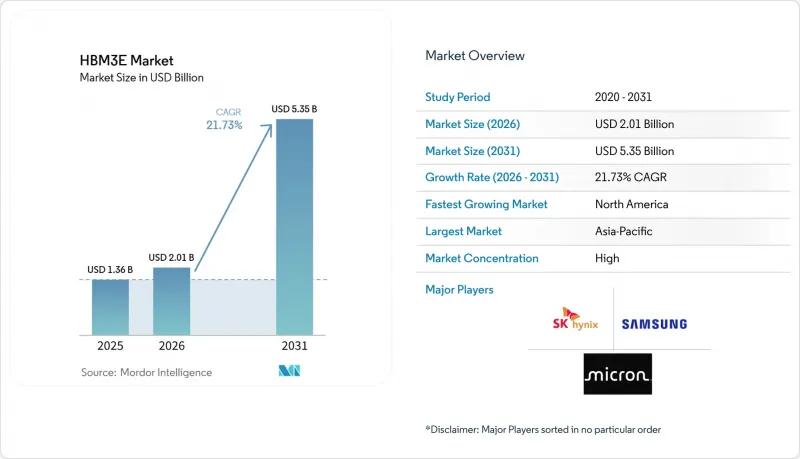
據 Mordor Intelligence 稱,HBM3E 市場預計將從 2025 年的 13.6 億美元成長到 2026 年的 20.1 億美元,到 2031 年達到 53.5 億美元,預計 2026 年至 2031 年的複合年成長率為 21.73%。
本報告按每堆疊記憶體容量(24 GB 或以下、24-36 GB、36 GB 或以上)、處理器介面(GPU、CPU、AI 加速器和 ASIC、FPGA 等)、應用領域(AI 訓練、高效能運算 (HPC) 伺服器、汽車和邊緣 AI 等)、用戶產業(雲端服務服務提供者、電信用戶產業(雲端服務供應商、電信用戶產業(雲端服務、電信)地區進行細分。市場預測以美元 (USD) 為單位。
全球 HBM3E 市場趨勢與洞察
人工智慧加速器頻寬的快速擴展
如今,人工智慧加速器所需的頻寬已遠超傳統商用運算系統。 HBM3E 標準本身旨在透過 1024 位元介面和 16 個獨立通道實現每引腳超過 9 Gbps 的資料傳輸速率,這充分說明了此類記憶體為何對當前人工智慧系統設計至關重要。隨著模型規模和上下文視窗的擴大,資料傳輸負載正以許多傳統記憶體子系統無法承受的速度成長,頻寬仍然是系統的核心瓶頸。這一趨勢正在為 HBM3E 市場創造結構性需求基礎,因為買家不僅要考慮短期預算週期,還要應對架構限制。這也解釋了為何儘管人工智慧基礎設施投資在訓練和推理階段有所波動,HBM3E 市場仍持續成長。因此,預計在整個預測期內,高階人工智慧平台對高頻寬記憶體的需求將持續存在。
HBM3E在高階GPU供應鏈中的認證優勢
HBM3E市場的格局由一套認證流程塑造而成,該流程對記憶體供應商構成了極高的進入門檻。 SK海力士於2024年9月開始量產全球首款12層HBM3E,在高階加速器計畫中確立了領先地位。 2025年6月,美光宣布其36GB 12層HBM3E已被AMD Instinct MI350系列解決方案採用,並通過了多個主流AI平台的認證。隨後,在2026年6月,NVIDIA和SK海力士宣布達成一項多年技術合作協議,其中包括共同開發用於Vera Rubin AI超級電腦、Vera CPU、RTX Spark PC以及Jetson Thor機器人平台的記憶體。這些措施表明,在HBM3E市場,那些能夠儘早獲得認證並持續融入後續平台發展藍圖的供應商將更受青睞。這也縮小了那些試圖在高階GPU供應鏈中取代現有供應商的後參與企業的機會窗口。
CoWoS 和類似中介器缺乏先進的封裝能力
HBM3E市場持續面臨先進封裝產能的限制,尤其是在CoWoS及相關2.5D整合流程方面。儘管台積電不斷擴大對前端和後端系統的支持以滿足AI需求,但在投資者簡報中多次強調,AI相關產能仍然極其緊張。台積電也指出,雖然CoWoS產能預計在2025年翻番,但目前仍處於高度預訂狀態,顯示封裝產能的成長不足以清理訂單訂單。這一點至關重要,因為HBM3E堆疊只有透過先進封裝生產線與運算晶片整合後才能獲利。此外,由於新型鍵合機和高精度貼片機需要時間才能達到量產水平,設備的前置作業時間也使得快速解決此產能限制更加困難。因此,HBM3E市場面臨記憶體需求與可交付加速器系統之間實際存在的過渡缺口。
細分市場分析
預計到 2025 年,24-36 GB 容量段將佔 HBM3E 市場 71.78% 的銷量,成為 HBM3E 市場中最大的記憶體容量等級。這個容量段的核心是 36 GB 12 引腳封裝的產品,這些產品支援 NVIDIA 和 AMD 的旗艦級 AI 加速器,這也解釋了為什麼它已成為 HBM3E 市場的商業性核心。 JEDEC HBM3E 標準憑藉其高頻寬介面和高單引腳資料傳輸速率,支援此配置,使此容量段非常適合高密度 AI 工作負載。 2025 年,24 GB 以下容量段仍將佔據重要地位,尤其是在傳統 AI 伺服器部署、網路應用場景以及對絕對頻寬要求不高的成本敏感型推理系統中。然而,隨著客戶轉向增加每個加速器的記憶體容量,HBM3E 市場的重心正從這些低容量產品轉移。
SK海力士於2024年9月推出全球首款12層HBM3E量產產品,顯示12層堆疊產品已從研發階段邁向大規模商業化生產。這項生產轉變意義重大,因為隨著供應商尋求提升利潤,HBM3E市場對堆疊高度的依賴程度正變得與晶圓產量不相上下。預計到2031年,容量超過36GB的產品將以22.38%的複合年成長率成長,這反映了下一代系統對16層堆疊和其他未來高密度規格的需求。三星於2026年5月宣布推出HBM4E樣品,顯示供應商已在為更高密度的記憶體封裝做準備,進一步強化了堆疊高度不斷提升的趨勢。在2025年的HBM3E市場中,24-36GB產品的市佔率反映了當前的市場接受度,而更大容量的產品將推動未來的成長。
2025年,GPU佔據了HBM3E市場76.93%的銷售額,持續維持圖形處理器在HBM3E市場中領先的介面類別地位。這一佔有率反映了目前HBM3E採購主要集中在NVIDIA的Blackwell系統和AMD的Instinct平台上,這兩個平台都是大規模訓練叢集和高級推理基礎設施的基礎。 HBM3E市場仍然高度依賴商用GPU的藍圖,因為這些平台是超大規模資料中心業者和高階AI系統買家最大採購量的主要驅動力。由於CPU和FPGA的應用場景較為狹窄和專業化,預計2025年它們的介面規模仍將較小。然而,隨著客製化晶片專案也開始涉足同一記憶體類別,HBM3E市場不再僅由GPU需求決定。
預計到2031年,AI加速器和ASIC將以22.73%的複合年成長率成長,成為HBM3E市場中成長最快的處理器介面。微軟於2026年1月發布的「Maia 200」是一款客製化推理加速器,整合了216GB的HBM3E和7.0TB/s的頻寬,清晰地展現了這一轉變。 SK海力士也宣布,Google選擇其作為TPU v7p和v7e的首個HBM3E供應商,這證實了超大規模資料中心業者ASIC專案正在成為重要的第二大需求管道。這種轉變將降低對單一供應商週期的依賴,使HBM3E市場能夠在通用和專用AI晶片領域獲得更廣泛的基本客群。這也意味著,即使GPU出貨量持續成長,GPU在未來介面配置中的比例也可能下降。
區域分析
到2025年,亞太地區將佔HBM3E市場61.36%的銷售額,成為該地區的主導市場。韓國仍將是生產中心,SK海力士和三星經營著目前週期內大部分的HBM晶圓和堆疊產能。海力士2026年的市場展望也提到,台灣將迎來強勁的HBM需求,其先進的封裝生產線將記憶體庫存和AI加速器邏輯晶片連接起來。隨後,台積電將在台灣增加封裝工藝,其CoWoS生產線仍將是系統輸出的關鍵查核點。韓國和台灣之間的這種生產合作解釋了為什麼亞太地區將在2025年佔據HBM3E市場最大的佔有率。
預計到2031年,北美地區的HBM3E市場將以22.64%的複合年成長率成長,成為該市場成長最快的地區。該地區受惠於超大規模資料中心業者集中投資人工智慧基礎設施,以及先進加速器應用帶來的強勁需求前景。微軟於2026年1月發布的「Maia 200」表明,北美市場的需求不僅限於購買商用GPU,客製化晶片專案也在推動HBM3E的消費。美光於2025年6月宣布與AMD平台整合,進一步鞏固了北美在HBM3E市場產品認證和客戶互動方面的重要地位。因此,該地區憑藉終端用戶需求、平台影響力以及策略性供應計劃,實現了高於市場平均的成長。
到2025年,HBM3E市場的剩餘佔有率將由歐洲、南美以及中東和非洲地區佔據,但各地區的貢獻仍將維持在個位數。在歐洲,需求的主要驅動力是支援科學計算、先進研究基礎設施和人工智慧工作負載的資料中心的擴張。南美仍處於起步階段,採用率集中在少數國家,這些國家對雲端運算和數位基礎設施的投資正在開始成長。中東和非洲地區正憑藉國家主導的人工智慧專案和GPU叢集的部署而崛起為需求區域,但出口管制合規性增加了與敏感目的地相關的採購的複雜性。
其他好處:
- Excel格式的市場預測(ME)表
- 3個月的分析師支持
目錄
第1章:引言
- 研究假設和市場定義
- 調查範圍
第2章:調查方法
第3章執行摘要
第4章 市場狀況
- 市場概覽
- 市場促進因素
- 人工智慧加速器頻寬的快速擴展
- HBM3E在高階GPU供應鏈中的認證優勢
- 12層以上堆疊密度的需求日益成長
- 在超大規模人工智慧伺服器的更新周期中採用HBM3E
- 人工智慧原始設備製造商面臨壓力,需對第二來源進行認證。
- 透過記憶體和運算單元的聯合設計,實現先進封裝良率最佳化。
- 市場限制因素
- CoWoS及類似中介層的先進封裝生產能力不足
- 高功率12 層 HBM3E 堆疊認證延遲
- 高密度人工智慧基板的熱相容性和功耗相容性限制
- 與中國相關的出口限制和客戶集中度風險。
- 產業供應鏈分析
- 監理情勢
- 技術展望
- 宏觀經濟因素對市場的影響
- 波特五力分析
第5章 市場規模與成長預測
- 每個堆疊的記憶體容量
- 最高可達 24 GB
- 24~36 GB
- 36 GB 或更多
- 透過處理器介面
- GPU
- CPU
- 人工智慧加速器和專用積體電路
- FPGA
- 其他介面
- 透過使用
- 人工智慧訓練
- 人工智慧推理
- 高效能運算 (HPC) 伺服器
- 網路與通訊
- 汽車和邊緣人工智慧
- 其他用途
- 產業最終用途
- 雲端服務供應商
- 企業IT
- 電訊
- 車
- 航太/國防
- 其他終端用戶產業
- 按地區
- 北美洲
- 美國
- 加拿大
- 墨西哥
- 歐洲
- 德國
- 英國
- 法國
- 義大利
- 其他歐洲國家
- 亞太地區
- 中國
- 日本
- 韓國
- 台灣
- 印度
- 其他亞太國家
- 南美洲
- 中東和非洲
- 北美洲
第6章 競爭情勢
- 市場集中度
- 策略趨勢
- 市佔率分析
- 公司簡介
- SK hynix Inc.
- Samsung Electronics Co., Ltd.
- Micron Technology, Inc.
- Other Ecosystem Players
- NVIDIA Corporation
- Advanced Micro Devices, Inc.
- Intel Corporation
- Marvell Technology, Inc.
- Rambus Inc.
- TSMC
- ASE Technology Holding Co., Ltd.
- Amkor Technology, Inc.
- Cadence Design Systems, Inc.
- Synopsys, Inc.
- Applied Materials, Inc.
- Lam Research Corporation
- Tokyo Electron Limited
- Kioxia Holdings Corporation
- Micron Taiwan Co., Ltd.
- Powerchip Semiconductor Manufacturing Corp.
- GlobalFoundries Inc.
第7章 市場機會與未來展望
According to Mordor Intelligence, the HBM3E market size is expected to increase from USD 1.36 billion in 2025 to USD 2.01 billion in 2026 and reach USD 5.35 billion by 2031, growing at a CAGR of 21.73% over 2026-2031.
This report is Segmented by Memory Capacity Per Stack (Up To 24 GB, 24 To 36 GB, and Above 36 GB), Processor Interface (GPU, CPU, AI Accelerator and ASIC, FPGA, and More), Application (AI Training, High-Performance Computing (HPC) Servers, Automotive and Edge AI, and More), End Use Industry (Cloud Service Providers, Telecommunications, and More), and Geography. The Market Forecasts are Provided in Terms of Value (USD).
Global HBM3E Market Trends and Insights
Rapid AI Accelerator Bandwidth Escalation
AI accelerators now require memory bandwidth levels not seen in earlier commercial computing systems. The HBM3E standard itself was designed for per-pin data rates beyond 9 Gbps across a 1,024-bit interface and 16 independent channels, which shows why this memory class sits at the center of current AI system design. As model sizes and context windows expand, data movement pressure rises faster than many conventional memory subsystems can handle, which keeps bandwidth at the center of system bottlenecks. That pattern gives the HBM3E market a structural demand base, as buyers respond to architectural constraints rather than only to short-term budget cycles. It also explains why the HBM3E market continues to advance even as AI infrastructure spending rotates between training and inference. The result is a durable pull for high-bandwidth memory in premium AI platforms over the forecast period.
HBM3E Qualification Advantage In Premium GPU Supply Chains
The HBM3E market has been shaped by a qualification process that functions as a high commercial barrier for memory suppliers. SK Hynix began the world's first mass production of 12-layer HBM3E in September 2024, giving it an early position in premium accelerator programs. Micron stated in June 2025 that its 36 GB 12-high HBM3E was designed into AMD Instinct MI350 Series solutions and was qualified on multiple leading AI platforms. NVIDIA and SK Hynix then announced a multiyear technology partnership in June 2026 that covered co-development of memory for Vera Rubin AI supercomputers, Vera CPUs, RTX Spark-powered PCs, and Jetson Thor robotic platforms. These moves show that the HBM3E market rewards suppliers that qualify early and stay inside customer roadmaps across successive platform generations. They also narrow the window for later entrants seeking to displace incumbent suppliers in premium GPU supply chains.
Limited Advanced Packaging Capacity For CoWoS And Similar Interposers
The HBM3E market remains constrained by advanced packaging capacity, especially in CoWoS and related 2.5D integration flows. TSMC repeatedly described AI-related capacity as very tight across its investor communications, even as the company expanded both front-end and back-end support for AI demand. TSMC also noted that CoWoS capacity doubled in 2025 but remained fully allocated, indicating that packaging additions have not been sufficient to clear the backlog. This matters because HBM3E stacks cannot become revenue until they are integrated with compute dies through advanced packaging lines. Equipment lead times then make the constraint harder to solve quickly, since new bonders and precision placement tools take time to reach volume use. The HBM3E market, therefore, faces a real conversion gap between memory demand and shippable accelerator systems.
Other drivers and restraints analyzed in the detailed report include:
- Intensifying Demand For 12-High And Higher Stack Density
- HBM3E Adoption In Hyperscale AI Server Refresh Cycles
- Export Controls And Customer Concentration Risk In China-Linked Demand
For complete list of drivers and restraints, kindly check the Table Of Contents.
Segment Analysis
The 24 to 36 GB segment held 71.78% of revenue in 2025, making it the largest memory capacity tier in the HBM3E market. This range is centered on 36 GB 12-high products that support flagship AI accelerators from NVIDIA and AMD, which explains why it became the commercial core of the HBM3E market. JEDEC's HBM3E standard supports this configuration with a wide interface and higher per-pin data rates, which makes the segment suitable for dense AI workloads. The up to 24 GB segment remained relevant in 2025 for legacy AI server deployments, networking use cases, and cost-sensitive inference systems where absolute bandwidth is less critical. Even so, the HBM3E market is shifting its center of gravity away from those lower-capacity products as customers move toward larger memory footprints per accelerator.
SK Hynix's world-first mass production of 12-layer HBM3E in September 2024 demonstrated that 12-high products had already moved from development into scaled commercial production. That production shift matters because the HBM3E market now depends on stack height as much as on wafer volume when suppliers try to expand revenue. Above 36 GB is projected to grow at a 22.38% CAGR through 2031, which reflects demand for 16-high and other future high-density formats in next-generation systems. Samsung's May 2026 announcement of a HBM4E sample shipment shows that suppliers are already preparing for even denser memory packages, reinforcing the direction of travel toward taller stacks. The HBM3E market share held by 24 to 36 GB in 2025 reflects the current deployment reality, while products above that range are driving future growth.
GPU accounted for 76.93% of revenue in 2025, which kept graphics processors as the main interface category in the HBM3E market. That share reflects the concentration of current HBM3E procurement in NVIDIA Blackwell systems and AMD Instinct platforms, both of which anchor large training clusters and advanced inference infrastructure. The HBM3E market still leans heavily on merchant GPU roadmaps because those platforms drive the largest volume commitments from hyperscalers and advanced AI system buyers. CPU and FPGA interfaces remained smaller in 2025 because their use cases were narrower and more specialized. Even so, the HBM3E market is no longer defined only by GPU demand, because custom silicon programs are now moving into the same memory class.
AI accelerators and ASICs are projected to expand at a 22.73% CAGR through 2031, making them the fastest-growing processor interfaces in the HBM3E market. Microsoft's Maia 200 launch in January 2026 clearly showed this shift, with a custom inference accelerator integrating 216 GB of HBM3E and 7.0 TB/s bandwidth. SK Hynix also said Google selected it as the first HBM3E supplier for TPU v7p and v7e, which confirms that hyperscaler ASIC programs are becoming a meaningful second channel for demand. This shift reduces dependence on one vendor cycle and gives the HBM3E market a broader customer base across both merchant and proprietary AI silicon. It also means future interface mix will likely become less GPU-heavy even if GPU unit volumes keep rising.
Complete Report Scope:
- By Memory Capacity Per Stack
- Up to 24 GB
- 24 to 36 GB
- Above 36 GB
- By Processor Interface
- GPU
- CPU
- AI Accelerator and ASIC
- FPGA
- Other Interfaces
- By Application
- AI Training
- AI Inference
- High-Performance Computing (HPC) Servers
- Networking and Telecommunications
- Automotive and Edge AI
- Other Applications
- By End Use Industry
- Cloud Service Providers
- Enterprise IT
- Telecommunications
- Automotive
- Aerospace and Defense
- Other End-user Industries
- By Geography
- North America
- United States
- Canada
- Mexico
- Europe
- Germany
- United Kingdom
- France
- Italy
- Rest of Europe
- Asia-Pacific
- China
- Japan
- South Korea
- Taiwan
- India
- Rest of Asia-Pacific
- South America
- Middle East and Africa
- North America
Geography Analysis
Asia-Pacific accounted for 61.36% of revenue in 2025, making it the leading regional bloc in the HBM3E market. South Korea remains the production hub because SK Hynix and Samsung operate the bulk of the HBM wafer and stacking capacity used in the current cycle. Hynix's 2026 market outlook also described the strong HBM pull into Taiwan, where advanced packaging lines connect memory stacks with AI accelerator logic dies. Taiwan then adds the packaging layer through TSMC, whose CoWoS lines remain a critical checkpoint for system output. This Korea-Taiwan production link explains why the Asia-Pacific held the largest share of the HBM3E market size in 2025.
North America is projected to grow at a 22.64% CAGR through 2031, making it the fastest-growing geography in the HBM3E market. The region benefits from concentrated AI infrastructure spending by hyperscalers and from strong demand visibility around advanced accelerator deployments. Microsoft's Maia 200 launch in January 2026 showed that North American demand is not limited to merchant GPU purchases, as custom silicon programs are also driving HBM3E consumption. Micron's June 2025 statement on AMD platform integration also reinforced North America's role in shaping product qualification and customer alignment for the HBM3E market. The region, therefore, combines end demand, platform influence, and strategic supply planning to support above-market growth.
Europe, South America, the Middle East, and Africa accounted for the remaining share of the HBM3E market in 2025, with each region still contributing at a single-digit level. In Europe, demand is mainly driven by scientific computing, advanced research infrastructure, and expanding data center footprints supporting AI workloads. South America remains at an earlier stage, with adoption concentrated in a small number of countries where cloud and digital infrastructure investment is beginning to scale. The Middle East and Africa are emerging as a demand region through sovereign AI programs and GPU cluster deployments, although export control compliance adds another layer of complexity for procurement tied to sensitive destinations.
- SK hynix Inc.
- Samsung Electronics Co., Ltd.
- Micron Technology, Inc.
Additional Benefits:
- The market estimate (ME) sheet in Excel format
- 3 months of analyst support
TABLE OF CONTENTS
1 INTRODUCTION
- 1.1 Study Assumptions and Market Definition
- 1.2 Scope of the Study
2 RESEARCH METHODOLOGY
3 EXECUTIVE SUMMARY
4 MARKET LANDSCAPE
- 4.1 Market Overview
- 4.2 Market Drivers
- 4.2.1 Rapid AI Accelerator Bandwidth Escalation
- 4.2.2 HBM3E Qualification Advantage In Premium GPU Supply Chains
- 4.2.3 Intensifying Demand For 12-High And Higher Stack Density
- 4.2.4 HBM3E Adoption In Hyperscale AI Server Refresh Cycles
- 4.2.5 Second-Source Qualification Pressure Across AI OEMs
- 4.2.6 Advanced Packaging Yield Optimization From Memory-Compute Co-Design
- 4.3 Market Restraints
- 4.3.1 Limited Advanced Packaging Capacity For CoWoS And Similar Interposers
- 4.3.2 Qualification Delays In High-Power 12-High HBM3E Stacks
- 4.3.3 Thermal And Power-Integrity Constraints In Dense AI Boards
- 4.3.4 Export Controls And Customer Concentration Risk In China-Linked Demand
- 4.4 Industry Supply Chain Analysis
- 4.5 Regulatory Landscape
- 4.6 Technological Outlook
- 4.7 Impact of Macroeconomic Factors on the Market
- 4.8 Porter's Five Forces Analysis
- 4.8.1 Bargaining Power of Suppliers
- 4.8.2 Bargaining Power of Buyers
- 4.8.3 Threat of New Entrants
- 4.8.4 Threat of Substitutes
- 4.8.5 Intensity of Competitive Rivalry
5 MARKET SIZE AND GROWTH FORECASTS (VALUE)
- 5.1 By Memory Capacity Per Stack
- 5.1.1 Up to 24 GB
- 5.1.2 24 to 36 GB
- 5.1.3 Above 36 GB
- 5.2 By Processor Interface
- 5.2.1 GPU
- 5.2.2 CPU
- 5.2.3 AI Accelerator and ASIC
- 5.2.4 FPGA
- 5.2.5 Other Interfaces
- 5.3 By Application
- 5.3.1 AI Training
- 5.3.2 AI Inference
- 5.3.3 High-Performance Computing (HPC) Servers
- 5.3.4 Networking and Telecommunications
- 5.3.5 Automotive and Edge AI
- 5.3.6 Other Applications
- 5.4 By End Use Industry
- 5.4.1 Cloud Service Providers
- 5.4.2 Enterprise IT
- 5.4.3 Telecommunications
- 5.4.4 Automotive
- 5.4.5 Aerospace and Defense
- 5.4.6 Other End-user Industries
- 5.5 By Geography
- 5.5.1 North America
- 5.5.1.1 United States
- 5.5.1.2 Canada
- 5.5.1.3 Mexico
- 5.5.2 Europe
- 5.5.2.1 Germany
- 5.5.2.2 United Kingdom
- 5.5.2.3 France
- 5.5.2.4 Italy
- 5.5.2.5 Rest of Europe
- 5.5.3 Asia-Pacific
- 5.5.3.1 China
- 5.5.3.2 Japan
- 5.5.3.3 South Korea
- 5.5.3.4 Taiwan
- 5.5.3.5 India
- 5.5.3.6 Rest of Asia-Pacific
- 5.5.4 South America
- 5.5.5 Middle East and Africa
- 5.5.1 North America
6 COMPETITIVE LANDSCAPE
- 6.1 Market Concentration
- 6.2 Strategic Moves
- 6.3 Market Share Analysis
- 6.4 Company Profiles (includes Global Level Overview, Market Level Overview, Core Segments, Financials as available, Strategic Information, Products and Services, Recent Developments)
- 6.4.1 SK hynix Inc.
- 6.4.2 Samsung Electronics Co., Ltd.
- 6.4.3 Micron Technology, Inc.
- 6.5 Other Ecosystem Players
- 6.5.1 NVIDIA Corporation
- 6.5.2 Advanced Micro Devices, Inc.
- 6.5.3 Intel Corporation
- 6.5.4 Marvell Technology, Inc.
- 6.5.5 Rambus Inc.
- 6.5.6 TSMC
- 6.5.7 ASE Technology Holding Co., Ltd.
- 6.5.8 Amkor Technology, Inc.
- 6.5.9 Cadence Design Systems, Inc.
- 6.5.10 Synopsys, Inc.
- 6.5.11 Applied Materials, Inc.
- 6.5.12 Lam Research Corporation
- 6.5.13 Tokyo Electron Limited
- 6.5.14 Kioxia Holdings Corporation
- 6.5.15 Micron Taiwan Co., Ltd.
- 6.5.16 Powerchip Semiconductor Manufacturing Corp.
- 6.5.17 GlobalFoundries Inc.
7 MARKET OPPORTUNITIES AND FUTURE OUTLOOK
- 7.1 White-Space and Unmet-Need Assessment

 ESG資料智慧平台市場預測至2034年-按智慧類型、資料來源、分析技術、部署模式、最終使用者和地區分類的全球分析語意層市場預測至 2034 年—按元件、部署模式、架構、資料來源、應用、最終使用者和區域分類的全球分析
 AI加速器DRAM市佔率分析、產業趨勢與統計及成長預測(2026-2031年)GDDR7 市佔率分析(適用於 AI 推理 GPU)、產業趨勢與統計及成長預測(2026-2031 年)
 克服記憶體瓶頸:CXL擴展和KV快取壓縮創新以人工智慧工作負載的 CXL 記憶體擴展:市場佔有率分析、行業趨勢與統計數據以及成長預測(2026-2031 年)衛星資料分析市場預測至2034年-按分析方法、資料類型、部署方式、應用、最終用戶和地區分類的全球分析HBM3:市場佔有率分析、產業趨勢與統計、成長預測(2026-2031)
 2026年全球合成電子健康紀錄(EHR)資料產生平台市場報告人工智慧開發工具市場預測——全球分析(按組件、工具類型、部署模式、組織規模、技術、應用、最終用戶和地區分類)——2034年