


 |
市場調查報告書
商品編碼
2099775
以人工智慧工作負載的 CXL 記憶體擴展:市場佔有率分析、行業趨勢與統計數據以及成長預測(2026-2031 年)CXL Memory Expansion For AI Workloads - Market Share Analysis, Industry Trends & Statistics, Growth Forecasts (2026 - 2031) |
||||||

※ 本網頁內容可能與最新版本有所差異。詳細情況請與我們聯繫。
根據 Mordor Intelligence 預測,用於 AI 工作負載的 CXL 記憶體擴展市場規模預計將在 2025 年達到 3.4 億美元,2026 年達到 7.4 億美元,到 2031 年達到 27.9 億美元,2026 年至 2031 年的複合年成長率為 30.16%。
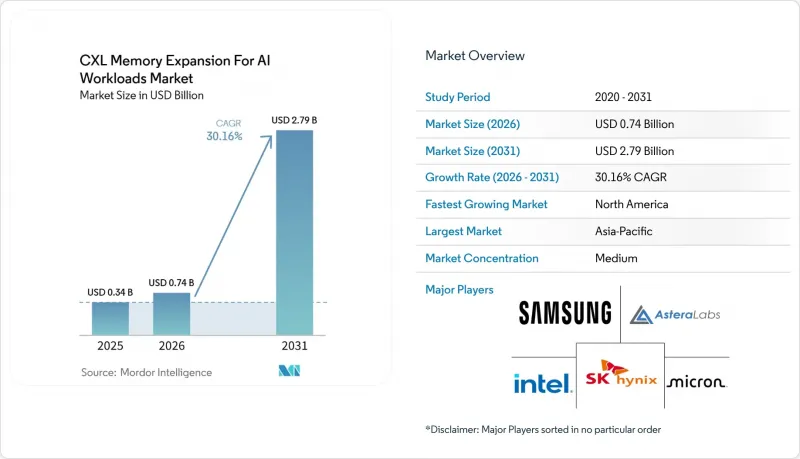
本報告按組件(例如,直連式 CXL Type 3 記憶體擴充設備)、實體外形尺寸(例如,EDSFF/E3.S CXL 記憶體模組)、應用程式(例如,AI 訓練和模型開發)、最終用戶(例如,超大規模資料中心業者)、CXL 規格(例如,CXL 1.1 及更早版本)和地區進行細分。市場預測以美元 (USD) 為單位。
全球CXL記憶體擴展市場趨勢及AI工作負載洞察
AI模型參數的成長超過了HBM和DIMM的容量。
人工智慧工作負載的 CXL 記憶體擴展市場需求並非僅源自於加速器吞吐量的提升。這是因為許多人工智慧工作負載在達到運算極限之前就已經面臨記憶體限制。一個使用 BF16 精度訓練的 700 億參數模型僅權重就需要近 140 GB 的內存,而當添加鍵值快取時,長文本上下文推理的實際內存需求還會進一步增加。同一項研究表明,一個包含 100 萬個詞元的上下文可能會使 700 億參數模型的鍵值快取需求增加到近 330 GB,這超過了目前任何 GPU 上可用的 HBM 容量。這使得人工智慧工作負載的 CXL 記憶體擴展市場與推理的經濟性密切相關,因為添加連貫外部記憶體可以在不重新設計加速器封裝或主機插槽的情況下擴展可用模型上下文。 Penguin Solutions 預測,到 2026 年,推理工作負載將更加依賴記憶體而非純粹的計算,這印證了 GPU 空閒時間是生產叢集集中直接成本問題的觀點。因此,以 AI 工作負載為導向的 CXL 記憶體擴展市場不僅作為一種硬體類別而獲得關注,而且還成為恢復已部署的昂貴加速器運轉率的一種手段。
推動超大規模資料中心業者中心向記憶體分散式架構轉型,以提高記憶體利用率。
面向人工智慧工作負載的 CXL 記憶體擴展市場正在蓬勃發展,部分原因是超大規模資料中心業者不再將記憶體解耦僅僅視為實驗性嘗試。微軟研究院發布了「Octopus」架構,展示了稀疏的 CXL pod 拓撲結構無需高成本的全網狀交換模型即可連接大規模記憶體域。這降低了可擴展池化的成本門檻。這一點至關重要,因為 CXL 記憶體擴展在人工智慧工作負載市場的商業化路徑取決於記憶體池化是否能在不增加每個擴展階段相應交換成本的情況下實現擴展。 2025 年 11 月,Astera Labs 宣布其「Leo」控制器已在 Microsoft Azure M 系列虛擬機器上可用。這是首個公開宣布的 CXL 附加記憶體商業雲端部署。此次公開部署為企業負責人和小規模雲端服務供應商提供了實務參考,他們先前一直在等待超大規模資料中心業者雲端服務商內部專案以外的概念驗證案例。從商業性角度來看,面向 AI 工作負載的 CXL 記憶體擴展市場的供應商需要同時支援通用部署和客製化雲端架構。
批量生產的認證 CXL 3 型板材的供應基礎有限。
由於獲得量產認證的3型記憶體供應商數量有限,面向人工智慧工作負載的CXL記憶體擴展市場面臨供應限制。雖然獲得認證的供應商主要集中在三星電子、SK海力士和美光科技,但經過測試的容量、外形尺寸和規格組合範圍仍然遠小於資料中心買家對廣泛部署的需求。 SK海力士已確認其96GB CMM-DDR5 CXL 2.0模組已於2025年完成客戶檢驗,且128GB版本也正在同步進行檢驗。雖然這代表著一種進步,但並未涵蓋所有部署選項。這一點至關重要,因為以人工智慧工作負載的CXL記憶體擴展市場與標準DDR5和HBM記憶體爭奪相同的底層記憶體製造產能。即使客戶興趣依然濃厚,HBM出貨量的增加也可能導致內部產能分配減少,進而影響新興的CXL產品。因此,面向 AI 工作負載的 CXL 記憶體擴展市場可能會出現需求迅速超過可用供應的情況,即使技術可行性已得到證實,也會導致實際部署的延遲。
細分市場分析
2025年,直連式CXL Type-3記憶體擴充設備在AI工作負載的CXL記憶體擴充市場中佔了47.32%的佔有率。這表明,在需求初期,使用者更傾向於選擇簡單的單主機部署方案,而不是更複雜的池化設計。這種情況反映了短期採購行為,因為最初的推理部署需要額外的記憶體容量,但又不想對機架架構進行徹底的重新設計。在AI工作負載的CXL記憶體擴充領域,直連式裝置在Intel Xeon 6和AMD EPYC Turin平台上的檢驗非常便捷,降低了首批使用者的採用門檻。記憶體池化設備和機箱等中階產品則滿足了那些需要單主機卡所不具備的柔軟性,但尚未準備好進行完整架構部署的客戶的需求。雖然記憶體管理和編配軟體的市場佔有率相對較小,但它在商業效用中仍然扮演著核心角色,因為除非能夠根據不斷變化的工作負載動態分配,否則池化記憶體的價值將受到限制。 MemVerge 將該層定位為專注於透明記憶體分層和最佳化 GPU 集群,這解釋了為什麼軟體堆疊具有重要的戰略意義,儘管它目前還不是其最大的收入來源。
預計到 2031 年,CXL 記憶體架構和機架級系統將以 30.96% 的複合年成長率成長,成為 AI 工作負載 CXL 記憶體擴展市場中成長最快的元件細分市場。這一成長勢頭源於多個計算主機能夠從共用內存池中獲取內存,這將徹底改變機架級 GPU 與內存的配置方式。 2025 年 10 月,XConn Technologies 和 MemVerge 展示了一個 100 TB 的商用 CXL 池,並報告稱其在 AI 推理工作負載方面比基於 SSD 的 KV 快取卸載方案效能提升超過 5 倍。隨後,在 2026 年 3 月,Marvell 宣布其 Structera S 30260 交換器將支援 16 至 32 個主機共用高達 48 TB 的內存,總頻寬為 4 TB/s,從而為機架級記憶體池化提供了更清晰的商業藍圖。從設備級擴展轉向共用架構至關重要,因為它能夠更緊密地追蹤整個叢集的工作負載需求。因此,在以人工智慧工作負載的 CXL 記憶體擴展市場中,我們預期在預測期內,價值重心將逐漸從簡單的連接產品轉向更高層級的池化系統。
預計到 2025 年,EDSFF/E3.S CXL 記憶體模組將佔據 49.84% 的市場佔有率,成為 AI 工作負載 CXL 記憶體擴展市場的主導物理形態。這一主導地位源於其與標準伺服器 NVMe 插槽的兼容性、低發熱量以及與主流伺服器整合路徑的緊密整合。英特爾展示了將 Xeon 6 6900P 處理器與多個 CXL E3.S 模組組合用於 AI 和 HPC 工作負載的應用案例,證實了該形態對 OEM 伺服器配置的實用性。這使得 EDSFF/E3.S 模組在企業和 OEM 認證流程中具有競爭優勢,因為在 AI 工作負載 CXL 記憶體擴展行業中,機械相容性和平台熟悉度至關重要。這種專有的整合格式仍然發揮作用,尤其是在客製化雲端系統中,它使供應商能夠比通用伺服器格式更嚴格地最佳化基板設計和延遲路徑。
預計從2026年到2031年,PCIe擴充卡的複合年成長率將達到30.92%,在面向人工智慧工作負載的CXL記憶體擴展市場中,其成長速度僅次於效能最佳的細分市場。 2026年3月,Penguin Solutions推出了MemoryAI KV快取伺服器,該伺服器在一個4U底盤內最多可配備八張1TB CXL擴充卡,總合11TB CXL記憶體。這使得AIC在推理基礎設施中的作用變得非常明確,也預示著部署路徑的分化。 AIC非常適合客製化設計的推理設備,而EDSFF/E3.S模組則更適合主流伺服器的升級週期。因此,面向人工智慧工作負載的CXL記憶體擴展市場並未朝著單一的通用實體格式發展,而是轉向雙軌模式,企業伺服器和自訂推理系統分別傾向於不同的封裝選項。這種外形尺寸上的差異可能會持續下去,因為標準資料中心伺服器叢集和 AI 專用機架在散熱設計、可維護性和部署模型需求方面存在顯著差異。
區域分析
北美將持續保持其在人工智慧工作負載CXL記憶體擴展市場中的最大區域貢獻地位,預計到2025年將佔61.44%的市場佔有率。這主要得益於該地區超大規模雲端服務供應商的存在、先進的檢驗能力以及早期的全面部署。 2025年11月,微軟Azure對Astera Labs Leo控制器在M系列虛擬機器上的支持,標誌著CXL附加記憶體首次在該地區實現商業雲端部署。美國是推動區域需求的主要力量,因為主要的雲端服務供應商和系統合作夥伴能夠證明客製化設計和長期檢驗週期的合理性。由英特爾2026年推出的Xeon 6+平台將進一步鞏固北美市場的地位,透過擴展對基於CXL的部署在人工智慧和橫向擴展基礎設施中的運作主機支援。
預計到2031年,亞太地區將以31.08%的複合年成長率成長,成為人工智慧工作負載CXL記憶體擴展市場成長最快的區域。韓國是該地區供應鏈的關鍵參與者,SK海力士和三星電子在認證記憶體供應方面發揮核心作用,而這一作用與當地日益成長的需求日益契合。 SK海力士已於2025年完成了其96GB CMM-DDR5 CXL 2.0模組的客戶檢驗,這將推動該地區將認證記憶體應用於實際配置。日本和印度正透過國家主導的人工智慧基礎設施項目以及本報告中概述的更廣泛的資料中心擴展計劃,推動該地區的發展勢頭。中國則為該地區增添了新的維度,其國內控制器研發正與國內人工智慧基礎設施需求同步發展。蒙太奇科技的CXL 3.1控制器將於2025年開始向客戶提供樣品,這表明亞太地區不僅正在發展成為記憶體製造地,而且正在發展成為控制器創新來源。
歐洲雖然是針對人工智慧工作負載的CXL記憶體擴展市場的成熟市場,但其態度更為謹慎。早期應用案例主要集中在企業資料中心,這些資料中心運行大規模記憶體內環境,而人工智慧推理尚未廣泛應用。這為CXL記憶體擴展提供了一個切實可行的切入點,因為買家可以先透過解決已經接近標準DRAM極限的資料庫和分析工作負載來證明其應用的合理性。此外,該地區也對提高記憶體利用率有著結構性的興趣,因為從能源效率法規和永續發展報告的角度來看,減少過度分配專用記憶體的架構是建議的。在歐洲,英國、德國和法國仍然是最重要的市場,而南美和中東及非洲地區的應用仍處於早期階段,預計將與更廣泛的人工智慧資料中心建設步伐保持一致。從整體區域趨勢來看,以人工智慧工作負載的CXL記憶體擴展市場正在從那些運算密度、檢驗能力和記憶體供應已經到位的地區擴展開來。
其他好處:
- Excel格式的市場預測(ME)表
- 3個月的分析師支持
目錄
第1章:引言
- 研究假設和市場定義
- 調查範圍
第2章:調查方法
第3章執行摘要
第4章 市場狀況
- 市場概覽
- 市場促進因素
- AI 模型參數的成長速度超過了 HBM 和 DIMM 容量的成長速度。
- 為了提高利用率,超大規模資料中心業者正在轉向記憶體去中心化。
- CXL 2.0 與 CXL 3.x 生態系成熟度
- PCIe Gen 5 和 Gen 6 平台的部署
- 動態記憶體分配的多租戶人工智慧基礎設施的需求
- 人工智慧推理成本的壓力正在推動記憶體池的採用,以降低總體擁有成本 (TCO)。
- 市場限制因素
- 批量生產的認證 CXL 3 型板材的供應基礎有限。
- 平台間互通性和檢驗的複雜性
- 記憶體編配軟體棧的不成熟
- 人工智慧資料中心平台重新認證的初始成本很高
- 供應鏈分析
- 技術展望
- 監理情勢
- 波特五力分析
第5章 市場規模與成長預測
- 按組件
- 直連式 CXL Type-3 記憶體擴充設備
- CXL 記憶體池設備
- CXL 儲存架構與機架級系統
- CXL 記憶體管理與編配軟體
- 按物理外形尺寸
- EDSFF/E3.S CXL 儲存模組
- PCIe擴充卡
- 專有或伺服器整合式外形規格
- 其他形式
- 透過使用
- 人工智慧訓練和模型開發
- 人工智慧推理和模型服務
- AI資料預處理、向量資料庫和RAG
- 人工智慧驅動的高效能運算和科學運算
- 大規模記憶體內和分析
- 最終用戶
- 超大規模資料中心業者
- AI雲端、GPU雲端和新型雲端供應商
- 二級雲端和託管服務供應商
- 企業資料中心
- 通訊業者、網路營運商、邊緣雲端供應商
- 研究機構、國家研究機構和學術高效能運算中心
- CXL規格
- CXL 1.1 及更早版本
- CXL 2.0
- CXL 3.x
- CXL 4.0
- 按地區
- 北美洲
- 美國
- 加拿大
- 墨西哥
- 歐洲
- 德國
- 英國
- 法國
- 義大利
- 其他歐洲國家
- 亞太地區
- 中國
- 日本
- 韓國
- 印度
- 東南亞
- 其他亞太國家
- 南美洲
- 中東和非洲
- 北美洲
第6章 競爭情勢
- 市場集中度
- 策略趨勢
- 供應商定位分析
- 公司簡介
- Samsung Electronics Co., Ltd.
- SK hynix Inc.
- Micron Technology, Inc.
- Intel Corporation
- Advanced Micro Devices, Inc.
- NVIDIA Corporation
- Marvell Technology, Inc.
- Astera Labs, Inc.
- Rambus Inc.
- Broadcom Inc.
- Microchip Technology Incorporated
- Renesas Electronics Corporation
- SMART Modular Technologies, Inc.
- Montage Technology Co., Ltd.
- MemVerge, Inc.
- GigaIO, Inc.
- Liqid, Inc.
- Dell Technologies Inc.
- Hewlett Packard Enterprise Company
- Super Micro Computer, Inc.
第7章 市場機會與未來展望
According to Mordor Intelligence, the CXL memory expansion for AI workloads market size is projected to be USD 0.34 billion in 2025, USD 0.74 billion in 2026, and reach USD 2.79 billion by 2031, growing at a CAGR of 30.16% from 2026 to 2031.
This report is Segmented by Component (Direct-Attached CXL Type-3 Memory Expansion Devices, and More), Physical Form Factor (EDSFF / E3. S CXL Memory Modules, and More), Application (AI Training and Model Development, and More), End User (Hyperscalers, and More), CXL Specification (CXL 1. 1 and Earlier, and More), and Geography. The Market Forecasts are Provided in Terms of Value (USD).
Global CXL Memory Expansion For AI Workloads Market Trends and Insights
AI Model Parameter Growth Outpacing HBM and DIMM Capacity
The CXL memory expansion for AI workloads market is being accelerated by a problem that lies above raw accelerator throughput, because many AI workloads run into memory limits before compute limits. A 70-billion-parameter model trained in BF16 precision requires close to 140 GB of memory for weights alone, and long-context inference pushes practical memory needs much higher once KV cache growth is added. The same research path also shows that 1-million-token contexts can drive KV cache needs to nearly 330 GB for a 70-billion-parameter model, which is beyond the HBM capacity available on any current GPU. This keeps the CXL memory expansion for AI workloads market closely tied to inference economics, because adding coherent external memory can extend usable model contexts without redesigning the accelerator package or the host socket. Penguin Solutions stated in 2026 that inference workloads are heavily shaped by memory pressure rather than pure compute pressure, which supports the view that idle GPU time has become a direct cost problem in production clusters. As a result, the CXL memory expansion for the AI workloads market is gaining support not only as a hardware category, but also as a way to recover utilization from expensive deployed accelerators.
Hyperscaler Shift Toward Memory Disaggregation to Improve Utilization
The CXL memory expansion for AI workloads market is also advancing because hyperscalers are no longer treating memory disaggregation as a lab exercise. Microsoft Research published its Octopus architecture to demonstrate that sparse CXL pod topologies can connect large memory domains without requiring an expensive full-mesh switching model, thereby lowering the cost barrier to scaled pooling. That matters because the commercial path for the CXL memory expansion for AI workloads market depends on whether memory pooling can grow without forcing proportional switch cost at every expansion step. Astera Labs announced in November 2025 that its Leo controllers were enabled on Microsoft Azure M-series virtual machines, which marked the first publicly announced commercial cloud deployment of CXL-attached memory. This public deployment created a usable reference point for enterprise buyers and smaller cloud operators that had been waiting for evidence beyond internal hyperscaler projects. The commercial implication is that vendors in the CXL memory expansion for AI workloads market now need to support both merchant deployments and custom cloud-architecture paths simultaneously.
Limited Production-Qualified CXL Type 3 Supply Base
The CXL memory expansion for AI workloads market still faces a supply ceiling because the pool of production-qualified Type-3 memory vendors remains narrow. The qualified supplier base is centered on Samsung Electronics, SK hynix, and Micron Technology, yet the range of tested densities, form factors, and specification combinations is still much smaller than data center buyers want for broad deployment. SK hynix confirmed customer validation of its 96 GB CMM-DDR5 CXL 2.0 module in 2025 and noted a 128 GB variant in parallel validation, which shows progress but not full breadth across deployment options. This matters because the CXL memory expansion for the AI workloads market competes for the same underlying memory manufacturing capacity that also serves standard DDR5 and HBM demand. When HBM volumes rise, internal allocation can shift away from emerging CXL products even if customer interest remains strong. The result is that the CXL memory expansion for AI workloads market can see demand faster than shippable volume, which slows real deployment even when the technology case is already accepted.
Other drivers and restraints analyzed in the detailed report include:
- CXL 2.0 and CXL 3.x Ecosystem Maturity
- PCIe Gen 5 and Gen 6 Platform Rollout
- Platform Interoperability and Validation Complexity
For complete list of drivers and restraints, kindly check the Table Of Contents.
Segment Analysis
Direct-attached CXL Type-3 memory expansion devices held a 47.32% share of the CXL memory expansion for AI workloads market in 2025, indicating that early demand favored simple single-host deployments over more complex pooled designs. This position reflected near-term buying behavior because initial inference deployments required additional memory capacity without forcing a full change in rack architecture. In the CXL memory expansion for AI workloads industry, direct-attached devices were easier to validate on Intel Xeon 6 and AMD EPYC Turin platforms, which reduced deployment friction for first-wave buyers. Mid-layer products, such as memory pooling appliances and enclosures, served customers who needed more flexibility than single-host cards could offer, but were not ready for full fabric implementations. Memory management and orchestration software held a smaller share, yet it remained central to commercial usefulness because pooled memory has limited value unless it can be assigned dynamically across changing workloads. MemVerge positions this layer around transparent memory tiering and GPU cluster efficiency, which helps explain why the software stack is strategically important even when it is not yet the largest revenue contributor.
CXL memory fabric and rack-scale systems are projected to grow at a 30.96% CAGR through 2031, which makes them the fastest-expanding component segment in the CXL memory expansion for AI workloads market. Their momentum comes from the ability to let multiple compute hosts draw from a shared memory pool, which changes how GPU-to-memory ratios can be set at the rack level. XConn Technologies and MemVerge demonstrated a 100 TB commercial CXL pool in October 2025 and reported more than 5x performance improvement over SSD-based KV cache offload for AI inference workloads. Marvell then announced in March 2026 that the Structera S 30260 switch would support up to 48 TB of shared memory across 16 to 32 hosts at 4 TB/s aggregate bandwidth, providing a clearer commercial roadmap for rack-scale pooling. The shift from device-level expansion to shared-fabric architectures matters because it allows capacity to more closely follow workload demand across the cluster. That is why the CXL memory expansion for the AI workloads market is likely to see value move gradually from simple attachment products toward higher-level pooling systems over the forecast period.
EDSFF/E3.S CXL memory modules held 49.84% share in 2025, which made them the leading physical form factor within the CXL memory expansion for AI workloads market. Their lead came from compatibility with standard server NVMe bays, a lower thermal footprint, and closer alignment with mainstream server integration paths. Intel demonstrated the use of Xeon 6 6900P processors with multiple CXL E3.S modules for AI and HPC workloads, which reinforced this form factor as a practical fit for OEM server configurations. In the CXL memory expansion for AI workloads industry, this gave EDSFF/E3.S modules an advantage in enterprise and OEM qualification pipelines where mechanical fit and platform familiarity matter. Proprietary integrated formats still have a role, especially in custom cloud systems where vendors can optimize board design and latency paths more tightly than commodity server formats allow.
PCIe add-in cards are projected to grow at a 30.92% CAGR from 2026 to 2031, which places them just behind the leading growth tiers in the overall CXL memory expansion for AI workloads market. Penguin Solutions launched its MemoryAI KV cache server in March 2026 with up to 8 x 1 TB CXL add-in cards and a total of 11 TB of CXL-based memory in a 4U chassis, which made the AIC role in inference infrastructure very clear. This points to a split in adoption paths, AICs fit purpose-built inference appliances, while EDSFF/E3.S modules fit mainstream server refresh cycles. The CXL memory expansion for AI workloads market, therefore, is not moving toward a single universal physical format. It is moving toward a dual-track model where enterprise servers and custom inference systems favor different packaging choices. That form factor split is likely to persist because thermal, serviceability, and deployment model needs differ sharply between standard data center fleets and AI-specialized racks.
Complete Report Scope:
- By Component
- Direct-Attached CXL Type-3 Memory Expansion Devices
- CXL Memory Pooling Appliances
- CXL Memory Fabric and Rack-Scale Systems
- CXL Memory Management and Orchestration Software
- By Physical Form Factor
- EDSFF / E3.S CXL Memory Modules
- PCIe Add-In Cards
- Proprietary or Server-Integrated Form Factors
- Other Form Factors
- By Application
- AI Training and Model Development
- AI Inference and Model Serving
- AI Data Preparation, Vector Databases, and RAG
- AI-Enabled HPC and Scientific Computing
- Large-Scale In-Memory Databases and Analytics
- By End User
- Hyperscalers
- AI Cloud, GPU Cloud, and Neo-Cloud Providers
- Tier-2 Cloud and Managed Service Providers
- Enterprise Data Centers
- Telecom, Network, and Edge Cloud Operators
- Research Institutions, National Laboratories, and Academic HPC Centers
- By CXL Specification
- CXL 1.1 and Earlier
- CXL 2.0
- CXL 3.x
- CXL 4.0
- By Geography
- North America
- United States
- Canada
- Mexico
- Europe
- Germany
- United Kingdom
- France
- Italy
- Rest of Europe
- Asia-Pacific
- China
- Japan
- South Korea
- India
- Southeast Asia
- Rest of Asia-Pacific
- South America
- Middle East and Africa
- North America
Geography Analysis
North America held a 61.44% share in 2025 and remained the largest regional contributor to the CXL memory expansion for AI workloads market, as the region hosts hyperscale cloud operators, advanced validation capacity, and early production deployments. Microsoft Azure's November 2025 enablement of Astera Labs' Leo controllers on M-series virtual machines marked the region's first publicly announced commercial cloud deployment of CXL-attached memory. The United States leads regional demand because major cloud operators and system partners can justify both bespoke designs and long validation cycles. Intel's 2026 Xeon 6+ platform rollout also reinforced North America's position by increasing live host support for CXL-based deployments across AI and scale-out infrastructure.
Asia-Pacific is projected to grow at a 31.08% CAGR through 2031, which makes it the fastest-growing regional block in the CXL memory expansion for AI workloads market. South Korea sits at the center of regional supply because SK hynix and Samsung Electronics are central to the availability of qualified memory, and that supply role increasingly overlaps with local demand growth. SK hynix completed customer validation of its 96 GB CMM-DDR5 CXL 2.0 module in 2025, which supports the region's efforts to move qualified memory into deployable configurations. Japan and India support regional momentum through sovereign AI infrastructure programs and broader data center expansion priorities described in the input. China adds a different layer to the regional picture because domestic controller activity is forming alongside demand for local AI infrastructure. Montage Technology's CXL 3.1 controller entered customer sampling in 2025, which shows that Asia-Pacific is not only a memory manufacturing base but also a growing source of controller innovation.
Europe remains an established but more cautious part of the CXL memory expansion for AI workloads market, with early use cases centered on enterprise data centers running large in-memory database environments before wider AI inference adoption. This creates a practical entry point for CXL memory expansion, as buyers can first justify adoption by addressing database and analytics workloads that already strain standard DRAM limits. The region also has a structural interest in improving memory utilization because energy-efficiency rules and sustainability reporting favor architectures that reduce overprovisioned dedicated memory. The United Kingdom, Germany, and France remain the most important country markets in Europe, while South America, the Middle East, and Africa are still earlier in adoption and are likely to follow the pace of broader AI data center build-out. The overall geographic picture shows that CXL memory expansion for AI workloads market is scaling first, where compute density, validation capacity, and memory supply access are already in place.
- Samsung Electronics Co., Ltd.
- SK hynix Inc.
- Micron Technology, Inc.
- Intel Corporation
- Advanced Micro Devices, Inc.
- NVIDIA Corporation
- Marvell Technology, Inc.
- Astera Labs, Inc.
- Rambus Inc.
- Broadcom Inc.
- Microchip Technology Incorporated
- Renesas Electronics Corporation
- SMART Modular Technologies, Inc.
- Montage Technology Co., Ltd.
- MemVerge, Inc.
- GigaIO, Inc.
- Liqid, Inc.
- Dell Technologies Inc.
- Hewlett Packard Enterprise Company
- Super Micro Computer, Inc.
Additional Benefits:
- The market estimate (ME) sheet in Excel format
- 3 months of analyst support
TABLE OF CONTENTS
1 INTRODUCTION
- 1.1 Study Assumptions and Market Definition
- 1.2 Scope of the Study
2 RESEARCH METHODOLOGY
3 EXECUTIVE SUMMARY
4 MARKET LANDSCAPE
- 4.1 Market Overview
- 4.2 Market Drivers
- 4.2.1 AI Model Parameter Growth Outpacing HBM and DIMM Capacity
- 4.2.2 Hyperscaler Shift Toward Memory Disaggregation to Improve Utilization
- 4.2.3 CXL 2.0 and CXL 3.x Ecosystem Maturity
- 4.2.4 PCIe Gen 5 and Gen 6 Platform Rollout
- 4.2.5 Multi-Tenant AI Infrastructure Needs for Dynamic Memory Allocation
- 4.2.6 AI Inference Cost Pressure Driving Lower TCO Memory Pooling
- 4.3 Market Restraints
- 4.3.1 Limited Production-Qualified CXL Type 3 Supply Base
- 4.3.2 Platform Interoperability and Validation Complexity
- 4.3.3 Software Stack Immaturity for Memory Orchestration
- 4.3.4 High Initial Platform Re-Qualification Cost for AI Data Centers
- 4.4 Supply Chain Analysis
- 4.5 Technological Outlook
- 4.6 Regulatory Landscape
- 4.7 Porter's Five Forces Analysis
- 4.7.1 Bargaining Power of Suppliers
- 4.7.2 Bargaining Power of Buyers
- 4.7.3 Threat of New Entrants
- 4.7.4 Threat of Substitutes
- 4.7.5 Intensity of Competitive Rivalry
5 MARKET SIZE AND GROWTH FORECASTS (VALUE)
- 5.1 By Component
- 5.1.1 Direct-Attached CXL Type-3 Memory Expansion Devices
- 5.1.2 CXL Memory Pooling Appliances
- 5.1.3 CXL Memory Fabric and Rack-Scale Systems
- 5.1.4 CXL Memory Management and Orchestration Software
- 5.2 By Physical Form Factor
- 5.2.1 EDSFF / E3.S CXL Memory Modules
- 5.2.2 PCIe Add-In Cards
- 5.2.3 Proprietary or Server-Integrated Form Factors
- 5.2.4 Other Form Factors
- 5.3 By Application
- 5.3.1 AI Training and Model Development
- 5.3.2 AI Inference and Model Serving
- 5.3.3 AI Data Preparation, Vector Databases, and RAG
- 5.3.4 AI-Enabled HPC and Scientific Computing
- 5.3.5 Large-Scale In-Memory Databases and Analytics
- 5.4 By End User
- 5.4.1 Hyperscalers
- 5.4.2 AI Cloud, GPU Cloud, and Neo-Cloud Providers
- 5.4.3 Tier-2 Cloud and Managed Service Providers
- 5.4.4 Enterprise Data Centers
- 5.4.5 Telecom, Network, and Edge Cloud Operators
- 5.4.6 Research Institutions, National Laboratories, and Academic HPC Centers
- 5.5 By CXL Specification
- 5.5.1 CXL 1.1 and Earlier
- 5.5.2 CXL 2.0
- 5.5.3 CXL 3.x
- 5.5.4 CXL 4.0
- 5.6 By Geography
- 5.6.1 North America
- 5.6.1.1 United States
- 5.6.1.2 Canada
- 5.6.1.3 Mexico
- 5.6.2 Europe
- 5.6.2.1 Germany
- 5.6.2.2 United Kingdom
- 5.6.2.3 France
- 5.6.2.4 Italy
- 5.6.2.5 Rest of Europe
- 5.6.3 Asia-Pacific
- 5.6.3.1 China
- 5.6.3.2 Japan
- 5.6.3.3 South Korea
- 5.6.3.4 India
- 5.6.3.5 Southeast Asia
- 5.6.3.6 Rest of Asia-Pacific
- 5.6.4 South America
- 5.6.5 Middle East and Africa
- 5.6.1 North America
6 COMPETITIVE LANDSCAPE
- 6.1 Market Concentration
- 6.2 Strategic Moves
- 6.3 Vendor Positioning Analysis
- 6.4 Company Profiles (includes Global Level Overview, Market Level Overview, Core Segments, Financials as available, Strategic Information, Market Rank/Share, Products and Services, Recent Developments)
- 6.4.1 Samsung Electronics Co., Ltd.
- 6.4.2 SK hynix Inc.
- 6.4.3 Micron Technology, Inc.
- 6.4.4 Intel Corporation
- 6.4.5 Advanced Micro Devices, Inc.
- 6.4.6 NVIDIA Corporation
- 6.4.7 Marvell Technology, Inc.
- 6.4.8 Astera Labs, Inc.
- 6.4.9 Rambus Inc.
- 6.4.10 Broadcom Inc.
- 6.4.11 Microchip Technology Incorporated
- 6.4.12 Renesas Electronics Corporation
- 6.4.13 SMART Modular Technologies, Inc.
- 6.4.14 Montage Technology Co., Ltd.
- 6.4.15 MemVerge, Inc.
- 6.4.16 GigaIO, Inc.
- 6.4.17 Liqid, Inc.
- 6.4.18 Dell Technologies Inc.
- 6.4.19 Hewlett Packard Enterprise Company
- 6.4.20 Super Micro Computer, Inc.
7 MARKET OPPORTUNITIES AND FUTURE OUTLOOK
- 7.1 White-Space and Unmet-Need Assessment

 ESG資料智慧平台市場預測至2034年-按智慧類型、資料來源、分析技術、部署模式、最終使用者和地區分類的全球分析語意層市場預測至 2034 年—按元件、部署模式、架構、資料來源、應用、最終使用者和區域分類的全球分析
 AI加速器DRAM市佔率分析、產業趨勢與統計及成長預測(2026-2031年)GDDR7 市佔率分析(適用於 AI 推理 GPU)、產業趨勢與統計及成長預測(2026-2031 年)
 克服記憶體瓶頸:CXL擴展和KV快取壓縮創新HBM3E:市場佔有率分析、產業趨勢與統計、成長預測(2026-2031)衛星資料分析市場預測至2034年-按分析方法、資料類型、部署方式、應用、最終用戶和地區分類的全球分析HBM3:市場佔有率分析、產業趨勢與統計、成長預測(2026-2031)
 2026年全球合成電子健康紀錄(EHR)資料產生平台市場報告人工智慧開發工具市場預測——全球分析(按組件、工具類型、部署模式、組織規模、技術、應用、最終用戶和地區分類)——2034年