


 |
市場調查報告書
商品編碼
2099772
機器人數控車削中心:市場佔有率分析、產業趨勢與統計、成長預測(2026-2031)Robotics CNC Turning Centers - Market Share Analysis, Industry Trends & Statistics, Growth Forecasts (2026 - 2031) |
||||||

※ 本網頁內容可能與最新版本有所差異。詳細情況請與我們聯繫。
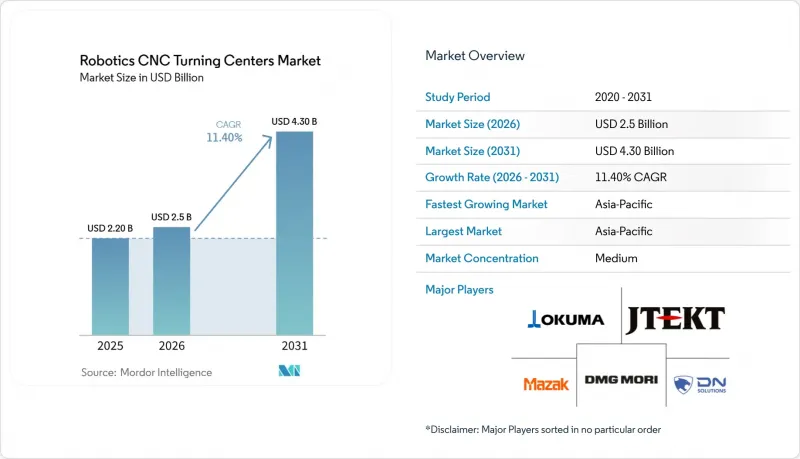
根據 Mordor Intelligence 預測,機器人數控車削中心市場規模將從 2025 年的 22 億美元成長到 2026 年的 25 億美元,然後在 2031 年達到 43 億美元,2026 年至 2031 年的複合年成長率為 11.40%。
本報告按機器類型(例如,水平機器人車削中心)、機器人類型(例如,關節型機器人)、機器人整合類型(例如,OEM整合機器人車削單元)、終端用戶產業(例如,石油、天然氣和能源)以及地區(例如,北美、南美)進行細分。市場預測以價值(美元)和數量(台)兩種形式呈現。
全球機器人數控車削中心市場趨勢與洞察
人事費用上升和熟練操作人員短缺正在加速機器人輔助加工的普及。
製造業人事費用上升的壓力是推動機器人數控車削中心市場發展的最顯著因素之一。根據美國勞工統計局的數據,預計到2025年,北美產業分類(NAICS)中所有20個三位數製造業產業的單位勞動成本平均將增加4.5%。這一成本趨勢對數控車削操作影響巨大,因為隨著生產計劃日益緊湊,擴大需要熟練操作人員的任務規模(例如設置、工件裝載和運行監控)仍然面臨挑戰。此外,隨著自動化將勞動力轉移到監督、程式設計和製程控制等工作,而剩餘的體力勞動崗位變得更加專業化且難以獲得,機器人數控車削中心市場正在加速發展。國際機器人聯合會已將緩解勞動力短缺列為2025年機器人技術的關鍵全球趨勢之一,這印證了機器人製程控制正在成為標準生產能力解決方案,而不僅僅是可選升級方案的觀點。
擴大無人值守和無人輪班生產
機器人數控車削中心市場的發展也得益於車床單元中「無人化生產」理念的日益普及。自動化曾經僅限於大型航太和汽車工廠,如今正擴展到中型合約製造工廠,這些工廠的目標是確保機器在二班、週末和節日也能持續運作。 2025年,美國國家標準與技術研究院(NIST)發布了關於改進型機器人工作單元以進行操作技術研究的成果,顯示無人離散製造已從有限的工廠級實驗階段發展到全面研究和標準化階段。真正的問題不再是無人車削加工是否可行,而是夾具、夾爪和可重複的工件夾持裝置能否在無需人工重置的情況下支援穩定的批次切換。在機器人數控車削中心市場,能夠解決這一問題的工廠可以將資金分配到更高的運作上,而那些未能解決這一問題的工廠將繼續承擔自動化成本,卻無法充分享受運轉率增加帶來的好處。
整合式機器人單元需要大量的初始投資。
高昂的初始成本仍是機器人數控車削中心市場廣泛應用的最大障礙。一套完整的機器人單元包括車床本身、機器人、末端執行器刀具、安全系統、軟體和安裝,這意味著投資的獲利能力取決於較高的機器運轉率和穩定的訂單量。小規模契約製造往往對採用這些系統猶豫不決,因為試運行可能比預期更長,或者零件系列的變化速度可能比預期更快,這可能會延長投資回收期。在混合生產環境中,由於產量不均衡,專用自動化系統的獲利能力必須針對每個批次進行驗證,因此挑戰更大。雖然租賃和基於服務的自動化等新型資金籌措模式未來可能有所裨益,但這些模式在佔全球車床用戶大多數的中小型企業中的應用仍然有限。
細分市場分析
到2025年,臥式機器人車削中心將佔據全球市場52.41%的佔有率,成為機器人數控車削中心市場中最大的工具機類型。這一主導地位源自於其諸多實用優勢:水平佈局非常適合棒料送料器、機器人上下料器、自動換刀裝置和模組化儲存系統,從而支援穩定、無人值守的循環加工。立式車床仍繼續用於加工大直徑、重型零件,因為重力有助於工件的固定、夾持一致性以及機器人上下料過程中夾具的穩定性。預計從2026年到2031年,多功能機器人市場將以17.1%的複合年成長率成長,成為機器人數控車削中心市場中成長最快的工具機類型。
這種成長反映了工廠對自動化價值評估方式的更廣泛轉變。買家現在會權衡多功能機器人單元的總合成本與多台機器、額外操作員、額外占地面積以及因零件在不同工序間移動而產生的在製品庫存等額外成本。在航太和醫療設備生產領域,單次裝夾加工通常具有優勢,因為它將零件保持在單一受控單元內,有助於維持幾何關係。 DMG MORI 於 2025 年 9 月發布的第三代 NTX 展示了工具機製造商如何從一開始就設計出相容自動化的車銑複合平台。這種產品策略透過減輕試運行負擔和緩解過去複雜多功能單元帶來的弊端,為機器人數控車削中心市場提供了支援。
2025年,關節型機器人繼續在機器人CNC車削中心市場中保持領先地位,市佔率高達54.62%。這一地位體現了其顯著的營運優勢,例如運動範圍、承重能力、循環速度以及在單一工作單元中處理多個主軸和加工點的能力。它們也非常適合大量生產環境,因為在同一工作範圍內可以添加去毛邊、標記或測量等功能。龍門機器人和笛卡爾機器人由於其結構剛性和操作簡便,在大型零件車削方面仍然具有價值,使其適用於高承重能力任務。
預計2026年至2031年間,協作機器人將以18%的複合年成長率成長,成為機器人數控車削中心市場中成長最快的細分領域。根據IFR的報告,2024年協作機器人的部署數量將增加12%,達到64,500台,佔全球工業機器人部署總量的12%,是2020年的兩倍多。這一成長對於從事多品種、小批量生產的按訂單訂單商尤為重要。在這些生產批量小、換型頻繁的環境中,簡單的編程和緊湊的安裝比最高的速度更為重要。此外,ISO 10218-2:2025標準鼓勵在進行適當風險評估的配置下擴展協作機器人的部署,這有助於首次採用自動化技術的公司以更低的准入門檻進入機器人數控車削中心市場。
區域分析
預計到2025年,亞太地區將佔據機器人數控車削中心市場45.21%的佔有率,並將繼續保持成長最快的區域市場地位,到2031年複合年成長率將達到14.9%。該地區受益於汽車、電子和精密工程等行業的製造群高度集中,這些集群遍布中國、日本、韓國和印度。中國在2024年新增工業機器人數量達29.5萬台,創下迄今單一國家年度新增機器人數量的最高紀錄。日本在2024年新增工業機器人數量達到4.45萬台,繼續保持其在機器人密度方面的領先地位,這為機器人車削單元在無人化生產中的廣泛應用提供了支持。印度在2024年新增機器人數量達到創紀錄的9,100台,而韓國、印尼、越南、泰國和馬來西亞等東南亞市場在電子和汽車零件製造方面的需求依然強勁。
在機器人數控車削中心市場,歐洲和北美仍是技術密集地區,需求集中在軟體豐富、高度柔軟性且通過安全認證的車削單元。 2024年,德國的機器人裝置量達26,982台,成為歐洲最大的工業機器人市場。這推動了機器人數控車削技術在模具製造、汽車一級供應商和精密加工領域的應用。德國工具機訂單在經歷了長期的國內需求低迷後,於2025年第四季出現首次以季度為基礎復甦跡象,年增4%。北美繼續受惠於「美國晶片計畫」(CHIPS for America)、先進製造業激勵措施以及國防工業擴張政策,這些都要求提高國內精密加工能力。根據「回流計劃」(Reshoring 舉措),預計到2024年,美國將透過製造業回流和外國直接投資創造24.4萬個製造業職位,凸顯了擴大車床產能和提高自動化程度的必要性。
南美洲在機器人數控車削中心市場仍蘊藏著巨大的發展機遇,這得益於汽車產業的近岸外包、與大宗商品價格相關的精密加工需求以及工業現代化進程。巴西作為該地區最大的製造地,處於需求的核心地位,汽車組裝是推動機器人車削單元近期需求的主要動力。中東和非洲市場雖然規模仍然較小,但由於沙烏地阿拉伯和阿拉伯聯合大公國的產業策略,人們對本土精密製造能力的興趣日益濃厚。南非憑藉其汽車組裝和採礦機械基地支撐著市場需求,預計國防和能源領域的投資計畫將在整個預測期內促進該地區對機器人數控車削中心的需求成長。
其他好處:
- Excel格式的市場預測(ME)表
- 3個月的分析師支持
目錄
第1章:引言
- 研究假設和市場定義
- 調查範圍
第2章:調查方法
第3章執行摘要
第4章 市場狀況
- 市場概覽
- 市場促進因素
- 人事費用上升和熟練操作人員短缺正在加速機器人輔助工作技術的應用。
- 擴大無人值守和無人輪班生產
- 精密零件日益複雜化,推動了機器人CNC車削中心單元的應用。
- 下一代航太生產計劃現已全面展開。
- 降低協作機器人的成本並提高其易用性
- 政府主導的鼓勵企業回流和工業現代化的激勵措施
- 市場限制因素
- 整合機器人單元需要大量的初始資本投入。
- 機器人與數控控制器之間缺乏標準化介面
- 網路化機器人和CNC系統中的網路安全漏洞
- 安全認證和監管合規的複雜性
- 價值供應鏈分析
- 零件和原料供應
- 製造和系統整合
- 分發和交付給最終用戶
- 售後服務和生命週期支持
- 監理情勢
- 技術展望
- 人工智慧驅動的視覺引導
- 預測性維護的整合
- 數位孿生與模擬技術
- 產業特定自動化成熟度評估
- 數控加工數位化發展趨勢
- 機器人CNC車削單元的投資與採購模式
- 價格分析
- 主要市場參與企業的平均售價 (ASP) 基準
- 以自動化程度分類的平均售價 (ASP) 基準
- 區域平均售價 (ASP) 基準
- 五力分析-產業吸引力評估
- 新進入者的威脅
- 供應商的議價能力
- 買方的議價能力
- 替代品的威脅
- 產業競爭
- 產業案例研究
- 地緣政治事件對市場的影響
第5章 市場規模與成長預測
- 按機器類型
- 水平機器人車削中心
- 垂直機器人車削中心
- 多功能機器人車削中心
- 其他
- 按機器人類型
- 關節機器人
- 協作機器人(cobots)
- 龍門/笛卡兒機器人
- 機器人整合方法
- OEM整合機器人車床單元
- 用於改裝/售後市場的機器人自動化應用
- 按最終用戶行業分類
- 汽車和商用車輛
- 航太/國防
- 醫療設備及手術器械
- 石油、天然氣和能源
- 電氣、電子和半導體製造設備
- 通用工業機械
- 其他
- 按地區
- 北美洲
- 美國
- 加拿大
- 墨西哥
- 南美洲
- 巴西
- 阿根廷
- 智利
- 秘魯
- 其他南美國家
- 歐洲
- 德國
- 英國
- 法國
- 義大利
- 西班牙
- 比荷盧經濟聯盟(比利時、荷蘭、盧森堡)
- 北歐國家(丹麥、芬蘭、冰島、挪威、瑞典)
- 其他歐洲國家
- 亞太地區
- 中國
- 印度
- 日本
- 韓國
- 澳洲
- 東南亞(印尼、越南、泰國、馬來西亞、菲律賓)
- 其他亞太國家
- 中東和非洲
- 阿拉伯聯合大公國
- 沙烏地阿拉伯
- 南非
- 奈及利亞
- 其他中東和非洲國家
- 北美洲
第6章 競爭情勢
- 市場集中度
- 策略趨勢
- 市佔率分析
- Competitive Benchmarking Analysis
- 公司簡介
- Yamazaki Mazak Corporation
- DMG MORI Co., Ltd.
- Okuma Corporation
- DN Solutions Co., Ltd.
- JTEKT Corporation
- Hyundai WIA Corporation
- Citizen Machinery Co., Ltd.
- INDEX-Werke GmbH & Co. KG
- EMAG GmbH & Co. KG
- Hwacheon Machinery Co., Ltd.
- Haas Automation, Inc.
- Hardinge Inc.
- Nakamura-Tome Precision Industry Co., Ltd.
- Tsugami Corporation
- SMEC Co., Ltd.
- Nidec Machine Tool Corporation
- Takisawa Machine Tool Co., Ltd.
- Goodway Machine Corporation
- Tongtai Machine & Tool Co., Ltd.
- KUKA Robotics
第7章 市場機會與未來展望
According to Mordor Intelligence, the robotics CNC turning centers market size is expected to grow from USD 2.20 billion in 2025 to USD 2.5 billion in 2026 and is forecast to reach USD 4.30 billion by 2031 at 11.40% CAGR over 2026-2031.
This report is Segmented by Machine Type (Horizontal Robotic Turning Centers, and More), by Robot Type (Articulated Robots, and More), by Robot Integration Type (OEM-Integrated Robotic Turning Cells, and More), by End-User Industry (Oil, Gas, and Energy, and More), and by Geography (North America, South America, and More). The Market Forecasts are Provided in Terms of Value (USD) and Volume (Units).
Global Robotics CNC Turning Centers Market Trends and Insights
Rising Labor Costs and Skilled-Operator Shortage Accelerating Robotic Tending Adoption
Manufacturing labor cost pressure has become one of the clearest supports for the robotics CNC turning centers market. United States Bureau of Labor Statistics data showed that manufacturing unit labor costs rose across all 20 covered three-digit NAICS manufacturing industries in 2025, with an average increase of 4.5%. In CNC turning environments, that cost trend matters because skilled setup, loading, and tending work remains hard to scale when output schedules tighten. The robotics CNC turning centers market also gains momentum as automation shifts labor toward supervision, programming, and process control, making the remaining manual roles more specialized and harder to fill. The International Federation of Robotics identified labor shortage mitigation as one of the top global robotics trends for 2025, which supports the view that robotic tending is becoming a standard capacity response rather than a discretionary upgrade
Growth of Lights-Out and Unmanned Shift Manufacturing
The robotics CNC turning centers market is also being driven by the wider use of lights-out production in turning cells. Automation, once limited to large aerospace and automotive plants, is now expanding into mid-sized job shops that aim to keep machines running through second shifts, weekends, and holiday periods. NIST published work in 2025 on an improved robotic workcell for operational technology research, demonstrating that unmanned discrete manufacturing has moved into active research and standards work rather than remaining a narrow plant-level experiment. The practical issue is no longer whether unattended turning is possible, but whether fixturing, grippers, and repeatable workholding can support stable batch changes without manual resets. In the robotics CNC turning centers market, plants that solve that problem can spread capital over more machine hours, while those that do not still bear the cost of automation without capturing full utilization gains.
High Upfront Capital Investment for Integrated Robotic Cells
High initial spending remains the clearest limit on wider adoption in the robotics CNC turning centers market. A full robotic cell includes the turning center, the robot, end-of-arm tooling, safety systems, software, and installation work, so the investment case depends on high machine utilization and stable order flow. Smaller contract manufacturers often hesitate because the payback can stretch when commissioning takes longer than expected or when part families shift faster than expected. This becomes even harder in mixed-production environments, where dedicated automation has to justify itself across batches with uneven volumes. New financing models such as leasing and service-based automation may help over time, but they still have limited reach among the smaller firms that make up much of the global turning base.
Other drivers and restraints analyzed in the detailed report include:
- Growing Complexity of Precision Components Driving Adoption of Robotic CNC Turning Cells
- Ramp-up of Next-Generation Aerospace Production Programs
- Lack of Standardized Robot-CNC Controller Interfaces
For complete list of drivers and restraints, kindly check the Table Of Contents.
Segment Analysis
Horizontal robotic turning centers held 52.41% of the global market in 2025, making them the largest machine format in the robotics CNC turning centers market. Their lead stems from a practical advantage: horizontal layouts work well with bar feeders, robot loaders, automatic tool changes, and modular storage systems that support steady, unattended cycles. Vertical turning centers continue to serve large-diameter and heavy-part work where gravity helps with seating, chucking consistency, and fixture stability during robotic loading. Multi-tasking robotic turning centers are projected to grow at a 17.1% CAGR from 2026 to 2031, making them the fastest-growing machine type in the robotics CNC turning centers market.
That growth reflects a broader change in how plants measure value from automation. Buyers are now comparing a multi-tasking robotic cell to the combined costs of several machines, more operators, extra floor space, and the work-in-progress inventory created by moving parts between steps. In aerospace and medical production, that comparison often favors single-setup machining because feature relationships are easier to protect when the part remains in a single controlled cell. DMG MORI's NTX 3rd Generation launch in September 2025 demonstrated how machine builders are designing mill-turn platforms with built-in automation compatibility from the start. That product direction supports the robotics CNC turning centers market by lowering commissioning effort and reducing the penalty that used to come with complex multi-function cells.
Articulated robots accounted for 54.62% of the robotics CNC turning centers market in 2025, which kept them in the lead among robot formats. Their position reflects clear operational strengths in reach, payload, cycle speed, and the ability to serve multiple spindles or process points from a single cell. They also fit high-volume environments where deburring, marking, or gauging can be added inside the same work envelope. Gantry and Cartesian robots still hold value in large-part turning because they offer structural stiffness and straightforward motion for heavy payload work.
Collaborative robots are forecast to grow at a 18% CAGR from 2026 to 2031, making them the fastest-growing segment of the robotics CNC turning centers market. IFR reported that cobot installations rose 12% in 2024 to 64,500 units, while their share of global industrial robot installations reached 12% and more than doubled from 2020. That increase matters most in high-mix job shops, where shorter runs and more frequent changeovers make simple programming and compact deployment more valuable than peak speed. ISO 10218-2:2025 also supports the wider use of collaborative setups under properly risk-assessed configurations, helping first-time automation buyers approach the robotics CNC turning centers market with a lower integration barrier.
Complete Report Scope:
- By Machine Type
- Horizontal Robotic Turning Centers
- Vertical Robotic Turning Centers
- Multi-Tasking Robotic Turning Centers
- Others
- By Robot Type
- Articulated Robots
- Collaborative Robots (Cobots)
- Gantry/Cartesian Robots
- By Robot Integration Type
- OEM-Integrated Robotic Turning Cells
- Retrofit/Aftermarket Robotic Automation
- By End-User Industry
- Automotive and Commercial Vehicles
- Aerospace & Defense
- Medical Devices and Surgical Instruments
- Oil, Gas, and Energy
- Electrical, Electronics and Semiconductor Equipment
- General Industrial Machinery
- Others
- By Geography
- North America
- United States
- Canada
- Mexico
- South America
- Brazil
- Argentina
- Chile
- Peru
- Rest of South America
- Europe
- Germany
- United Kingdom
- France
- Italy
- Spain
- Benelux (Belgium, Netherlands, and Luxembourg)
- NORDICS (Denmark, Finland, Iceland, Norway, and Sweden)
- Rest of Europe
- Asia-Pacific
- China
- India
- Japan
- South Korea
- Australia
- Southeast Asia (Indonesia, Vietnam, Thailand, Malaysia, Philippines)
- Rest of Asia-Pacific
- Middle East & Africa
- United Arab Emirates
- Saudi Arabia
- South Africa
- Nigeria
- Rest of Middle East & Africa
- North America
Geography Analysis
Asia Pacific held 45.21% of the robotics CNC turning centers market share in 2025 and is expected to remain the fastest-growing regional segment with a CAGR 14.9% through 2031. The region benefits from dense automotive, electronics, and precision engineering manufacturing clusters across China, Japan, South Korea, and India. China led global industrial robot installations in 2024 with 295,000 units, the highest annual total ever recorded for a single country. Japan recorded 44,500 industrial robot installations in 2024 and continued to lead in robot density, which supports wider use of robotic turning cells in lights-out production. India reached a record 9,100 robot installations in 2024, while South Korea and Southeast Asian markets such as Indonesia, Vietnam, Thailand, and Malaysia continue to see strong demand in electronics and automotive sub-assembly manufacturing.
Europe and North America remain technology-intensive regions in the robotics CNC turning centers market, with demand centered on software-rich, flexible, and safety-certified turning cells. Germany was the largest European market for industrial robots in 2024, with 26,982 installations, supporting robotic CNC turning adoption across toolmaking, automotive Tier 1 suppliers, and precision engineering applications. German machine tool order intake showed its first quarterly recovery signal in Q4 2025, rising 4% year over year after a prolonged period of weak domestic demand. North America continues to benefit from the CHIPS for America program, advanced manufacturing incentives, and defense industrial expansion policies that require greater domestic precision machining capacity. The Reshoring Initiative documented 244,000 United States manufacturing job announcements through reshoring and foreign direct investment in 2024, reinforcing the case for new turning capacity and higher automation intensity.
South America remains an emerging opportunity in the robotics CNC turning centers market, supported by automotive nearshoring, commodity-linked precision machining demand, and industrial modernization efforts. Brazil anchors regional demand as the largest manufacturing base, with automotive assembly driving much of the immediate need for robotic turning cells. The Middle East and Africa market remains smaller, but industrial strategies in Saudi Arabia and the United Arab Emirates are widening interest in domestic precision manufacturing capacity. South Africa adds support through its automotive assembly and mining equipment base, and planned investments in defense, and energy are expected to lift regional adoption through the forecast period.
- Yamazaki Mazak Corporation
- DMG MORI Co., Ltd.
- Okuma Corporation
- DN Solutions Co., Ltd.
- JTEKT Corporation
- Hyundai WIA Corporation
- Citizen Machinery Co., Ltd.
- INDEX-Werke GmbH & Co. KG
- EMAG GmbH & Co. KG
- Hwacheon Machinery Co., Ltd.
- Haas Automation, Inc.
- Hardinge Inc.
- Nakamura-Tome Precision Industry Co., Ltd.
- Tsugami Corporation
- SMEC Co., Ltd.
- Nidec Machine Tool Corporation
- Takisawa Machine Tool Co., Ltd.
- Goodway Machine Corporation
- Tongtai Machine & Tool Co., Ltd.
- KUKA Robotics
Additional Benefits:
- The market estimate (ME) sheet in Excel format
- 3 months of analyst support
TABLE OF CONTENTS
1 Introduction
- 1.1 Study Assumptions & Market Definition
- 1.2 Scope of the Study
2 Research Methodology
3 Executive Summary
4 Market Landscape
- 4.1 Market Overview
- 4.2 Market Drivers
- 4.2.1 Rising Labor Costs and Skilled-Operator Shortage Accelerating Robotic Tending Adoption
- 4.2.2 Growth of Lights-Out and Unmanned Shift Manufacturing
- 4.2.3 Growing Complexity of Precision Components Driving Adoption of Robotic CNC Turning Cells
- 4.2.4 Ramp-up of Next-Generation Aerospace Production Programs
- 4.2.5 Declining Cost and Improved Accessibility of Collaborative Robots
- 4.2.6 Government-backed Reshoring and Industrial Modernization Incentives
- 4.3 Market Restraints
- 4.3.1 High upfront capital investment for integrated robotic cells
- 4.3.2 Lack of standardized robot-CNC controller interfaces
- 4.3.3 Cybersecurity exposure of networked robotic-CNC systems
- 4.3.4 Safety certification and regulatory compliance complexity
- 4.4 Value / Supply-Chain Analysis
- 4.4.1 Component & Raw Material Supply
- 4.4.2 Manufacturing & System Integration
- 4.4.3 Distribution & End-User Delivery
- 4.4.4 Aftermarket Services & Lifecycle Support
- 4.5 Regulatory Landscape
- 4.6 Technological Outlook
- 4.6.1 AI-Enabled Vision Guidance
- 4.6.2 Predictive Maintenance Integration
- 4.6.3 Digital Twin and Simulation Technologies
- 4.7 Automation Maturity Assessment by Industry
- 4.8 Digitalization Trends in CNC Machining
- 4.9 Investment and Procurement Models for Robotic CNC Turning Cells
- 4.10 Pricing Analysis
- 4.10.1 Average Selling Price (ASP) Benchmarking of Key Market Participants
- 4.10.2 Average Selling Price (ASP) Benchmarking by Automation Level
- 4.10.3 Average Selling Price (ASP) Benchmarking by Geography
- 4.11 Porter's Five Forces - Industry Attractiveness Scoring
- 4.11.1 Threat of New Entrants
- 4.11.2 Bargaining Power of Suppliers
- 4.11.3 Bargaining Power of Buyers
- 4.11.4 Threat of Substitutes
- 4.11.5 Industry Rivalry
- 4.12 Industry Case Studies
- 4.13 Impact of Geopolitical events on the Market
5 Market Size & Growth Forecasts
- 5.1 By Machine Type
- 5.1.1 Horizontal Robotic Turning Centers
- 5.1.2 Vertical Robotic Turning Centers
- 5.1.3 Multi-Tasking Robotic Turning Centers
- 5.1.4 Others
- 5.2 By Robot Type
- 5.2.1 Articulated Robots
- 5.2.2 Collaborative Robots (Cobots)
- 5.2.3 Gantry/Cartesian Robots
- 5.3 By Robot Integration Type
- 5.3.1 OEM-Integrated Robotic Turning Cells
- 5.3.2 Retrofit/Aftermarket Robotic Automation
- 5.4 By End-User Industry
- 5.4.1 Automotive and Commercial Vehicles
- 5.4.2 Aerospace & Defense
- 5.4.3 Medical Devices and Surgical Instruments
- 5.4.4 Oil, Gas, and Energy
- 5.4.5 Electrical, Electronics and Semiconductor Equipment
- 5.4.6 General Industrial Machinery
- 5.4.7 Others
- 5.5 By Geography
- 5.5.1 North America
- 5.5.1.1 United States
- 5.5.1.2 Canada
- 5.5.1.3 Mexico
- 5.5.2 South America
- 5.5.2.1 Brazil
- 5.5.2.2 Argentina
- 5.5.2.3 Chile
- 5.5.2.4 Peru
- 5.5.2.5 Rest of South America
- 5.5.3 Europe
- 5.5.3.1 Germany
- 5.5.3.2 United Kingdom
- 5.5.3.3 France
- 5.5.3.4 Italy
- 5.5.3.5 Spain
- 5.5.3.6 Benelux (Belgium, Netherlands, and Luxembourg)
- 5.5.3.7 NORDICS (Denmark, Finland, Iceland, Norway, and Sweden)
- 5.5.3.8 Rest of Europe
- 5.5.4 Asia-Pacific
- 5.5.4.1 China
- 5.5.4.2 India
- 5.5.4.3 Japan
- 5.5.4.4 South Korea
- 5.5.4.5 Australia
- 5.5.4.6 Southeast Asia (Indonesia, Vietnam, Thailand, Malaysia, Philippines)
- 5.5.4.7 Rest of Asia-Pacific
- 5.5.5 Middle East & Africa
- 5.5.5.1 United Arab Emirates
- 5.5.5.2 Saudi Arabia
- 5.5.5.3 South Africa
- 5.5.5.4 Nigeria
- 5.5.5.5 Rest of Middle East & Africa
- 5.5.1 North America
6 Competitive Landscape
- 6.1 Market Concentration
- 6.2 Strategic Moves
- 6.3 Market Share Analysis
- 6.4 Competitive Benchmarking Analysis
- 6.5 Company Profiles (Includes Global Level Overview, Market Level Overview, Core Segments, Financials as Available, Strategic Information, Products & Services, and Recent Developments)
- 6.5.1 Yamazaki Mazak Corporation
- 6.5.2 DMG MORI Co., Ltd.
- 6.5.3 Okuma Corporation
- 6.5.4 DN Solutions Co., Ltd.
- 6.5.5 JTEKT Corporation
- 6.5.6 Hyundai WIA Corporation
- 6.5.7 Citizen Machinery Co., Ltd.
- 6.5.8 INDEX-Werke GmbH & Co. KG
- 6.5.9 EMAG GmbH & Co. KG
- 6.5.10 Hwacheon Machinery Co., Ltd.
- 6.5.11 Haas Automation, Inc.
- 6.5.12 Hardinge Inc.
- 6.5.13 Nakamura-Tome Precision Industry Co., Ltd.
- 6.5.14 Tsugami Corporation
- 6.5.15 SMEC Co., Ltd.
- 6.5.16 Nidec Machine Tool Corporation
- 6.5.17 Takisawa Machine Tool Co., Ltd.
- 6.5.18 Goodway Machine Corporation
- 6.5.19 Tongtai Machine & Tool Co., Ltd.
- 6.5.20 KUKA Robotics
7 Market Opportunities & Future Outlook
- 7.1 White-Space & Unmet-Need Assessment

 CNC控制器市場規模、佔有率和趨勢分析報告:按機器類型、安裝類型、最終用途、地區和細分市場預測(2026-2033年)
 CNC控制器市場-2026-2032年全球市場預測
 中國機器人數控車削中心:市佔率分析、產業趨勢與統計及成長預測(2026-2031年)日本機器人相容型數控車削中心市場:市佔率分析、產業趨勢與統計及成長預測(2026-2031年)
 CNC等電漿切割機市場機會、成長要素、產業趨勢分析及2026-2035年預測。
 機器人數控控制器市場分析及預測(至2035年):依類型、產品類型、服務、技術、組件、應用、製程、最終用戶、功能、安裝類型分類
 2026年全球CNC控制器市場報告
 全球 CNC 控制器市場規模:按 CNC 控制器類型、按軸類型、按應用、按地區、範圍和預測