

 |
市場調查報告書
商品編碼
2099417
日本機器人相容型數控車削中心市場:市佔率分析、產業趨勢與統計及成長預測(2026-2031年)Japan Robotics CNC Turning Centers - Market Share Analysis, Industry Trends & Statistics, Growth Forecasts (2026 - 2031) |
||||||

※ 本網頁內容可能與最新版本有所差異。詳細情況請與我們聯繫。
根據 Mordor Intelligence 預測,日本機器人數控車削中心市場規模預計在 2025 年達到 2 億美元,2026 年達到 2.1534 億美元,到 2031 年達到 3.2231 億美元,2026 年至 2031 年的複合年成長率為 8.40%。
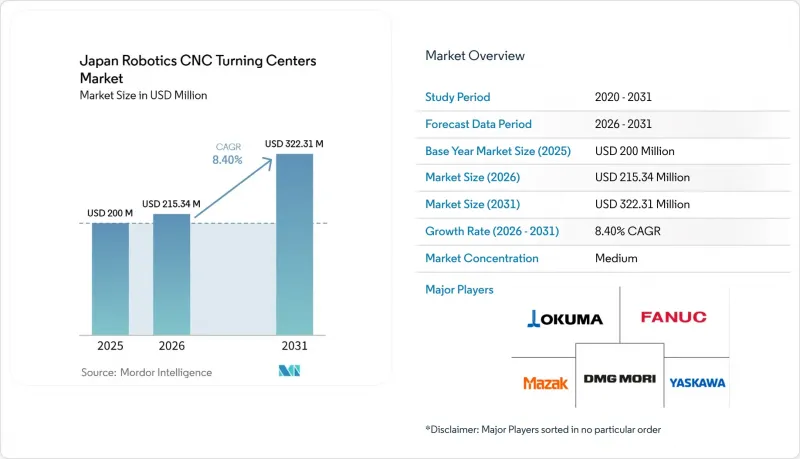
本報告按機器類型(水平機器人車削中心、立式機器人車削中心等)、機器人類型(關節型機器人等)、機器人整合類型(OEM、改裝/售後市場機器人自動化)以及終端用戶產業(石油、天然氣和能源、航太和國防等)進行細分。市場預測以價值(美元)和數量(台)兩種單位呈現。
日本機器人相容型數控車削中心市場趨勢及洞察
人口結構導致的勞動力短缺正在推動自動化進程。
2024年,日本製造業從業人員數量達到1,046萬人。然而,儘管生產活躍,但勞動年齡人口的持續下降仍然給勞動力供應帶來壓力。機械加工和工具製造領域的人手不足尤其嚴重,這直接提升了能夠穩定車間工件裝卸並提高重複加工精度的機器人車削單元的吸引力。根據國際貨幣基金組織的報告,2024年接受調查的企業中約有一半缺乏足夠的合格長期員工,顯示這場危機並非僅限於部分製造業。在日本機器人數控車削中心市場,這種情況正在改變採購決策的標準,使其從狹隘的投資報酬率計算轉向生產的連續性。這也意味著需求對短期訂單週期的敏感度降低,因為即使招聘情況沒有改善,工廠也需要維持生產水準。
向電動車的轉型正在推動使用機器人進行設備升級。
隨著汽車製造商不斷推動電池式電動車(BEV)的生產和平台轉型,日本汽車供應鏈目前正在重新審視其加工要求。鈴木計畫於2026會計年度在日本開始生產電動車,馬自達計畫於2027年推出BEV專用平台,刺激了零件供應商的資本投資計畫。截至2023年底,日本汽車產業已有132,766台機器人運作,現有的自動化基礎設施規模足以支援現有設備的升級,而無需完全依賴新的投資。日本的機器人數控車削中心市場正受益於此變化,因為電動車零件(例如馬達軸和變速箱殼體)需要更嚴格的製程控制、更短的設定週期和更一致的表面品質。這推動了對進程內測量功能、高重複性和出色多任務處理能力的機器人車削單元的持續需求。
高昂的初始投資成本
機器人數控車削單元仍需要大量的初始投資,因為購買價格包含了機器本身、機器人、視覺系統、安全裝置和軟體。這在日本尤其重要,因為日本集中了大量技術實力雄厚但自由現金流有限的小規模精密加工車間。經合組織一項針對中小企業自動化情況的調查也顯示,資金籌措仍然是採用自動化技術最常見的障礙之一。因此,在日本機器人數控車削中心市場,首次採用自動化技術的企業決策往往較為緩慢,並且越來越傾向於小規模升級而非徹底更換整個單元。這意味著,儘管潛在需求確實存在,但從興趣轉化為實際實施的過程卻十分緩慢。
細分市場分析
到了2025年,臥式機器人相容型數控車削中心佔45.21%的市場佔有率,成為日本機器人相容型數控車削中心市場中最大的機型。其主導地位源自於其高度適用於汽車零件的大規模生產。水平主軸配置實現了穩定的排屑、緊湊的機器人裝載佈局以及成熟的工藝流程。這種配置也符合許多一級供應商現有的生產邏輯,使得水平配置成為升級改造的首選。立式機器人車削在煞車盤、飛輪和工業法蘭等較重、較大直徑零件的領域中發揮較小但穩定的作用。其他類型的工具機,包括瑞士型和多刀系統,在微精密加工領域仍然佔據重要地位,其棒料送料的穩定性和小零件的公差控制為高價值的機器人投資提供了支援。
預計到2031年,多任務機器人車削將以10.21%的複合年成長率成長,成為日本機器人數控車削中心市場成長最快的機型。原因很簡單:電動車傳動系統零件通常需要在單次裝夾中完成多個製作流程,而減少加工步驟可以降低公差敏感零件的對準誤差風險。Yamazaki Mazak公司於2025年10月推出的用於電動車傳動系統零件量產的「QRX-50MSY」表明,原始設備製造商(OEM)的藍圖已經朝著這一需求發展。這種轉變正在向汽車行業以外的領域擴展,縮短裝夾週期和提高重複精度在航太、能源和其他精密領域的高階應用中至關重要。日本經濟產業省(METI)於2025年3月發布的產業願景也支持這一方向,引導日本零件和模具產業向高附加價值客戶領域發展,而這些領域自然更適合多任務平台。
預計到2025年,關節型機器人將佔據57.63%的市場主導,這反映了它們在重複性生產環境(包括汽車產業)中自動化數控工具工具機進行大規模生產所確立的地位。根據JARA的報告,2025年第四季用於機械加工的機器人出貨量達到6,332台,較去年同期成長47.9%,證實了該應用領域持續的需求。當承重能力範圍、靈活移動和可靠的循環性能比面積更小更為重要時,移動機器人仍然是標準選擇。龍門機器人和笛卡爾機器人仍然在傳送帶生產線作業中佔有一席之地,因為在這些作業中,線性精度和直接負載處理比多軸柔軟性更為重要。在日本的機器人數控車削中心市場,這一趨勢意味著移動系統在具有高頻重複操作、大規模零件流和系統化佈局管理的工廠中表現最佳。
預計從2026年到2031年,協作機器人將以11.26%的複合年成長率成長,成為日本機器人數控車削中心市場中成長最快的機器人類型。這一成長並非主要源於對關節機器人的取代,而是由於自動化技術擴展到那些以前無法負擔獨立機器人單元的工廠。許多日本小規模機械加工廠缺乏安裝空間、專業的機器人工程師以及實施完整整合方案所需的預算。 FANUC America於2026年4月推出的CRX-3iAFANUC,正是針對空間有限且快速部署而設計的,顯示該類別機器人能夠有效解決這些障礙。因此,協作機器人不僅易於安裝,而且對於開拓日本機器人數控車削中心市場的新用戶群也至關重要,該市場先前一直遊離於自動化主流之外。
其他好處:
- Excel格式的市場預測(ME)表
- 3個月的分析師支持
目錄
第1章:引言
- 研究假設和市場定義
- 調查範圍
第2章:調查方法
第3章執行摘要
第4章 市場狀況
- 市場概覽
- 市場促進因素
- 人口結構導致的勞動力短缺正在推動自動化進程。
- 向電動車的轉型正在推動機器人產業的重組。
- 支援「工業5.0」的工業自動化
- 工具機製造商對機器人的原生整合
- 智慧CNC工具機的普及正在推動向機器人的升級。
- 國內工具機和機器人領域強大的生態系統正在推動創新。
- 市場限制因素
- 高昂的資金成本
- 機器人整合和編程人員短缺
- 面臨勞動力老化的中小型機械加工製造商自動化程度較低。
- 來自中國和韓國的競爭日益加劇
- 價值供應鏈分析
- 零件和原料供應
- 製造和系統整合
- 分發和交付給最終用戶
- 售後服務和生命週期支持
- 監理情勢
- 技術展望
- 人工智慧驅動的視覺引導
- 預測性維護的整合
- 數位孿生與模擬技術
- 產業特定自動化成熟度評估
- 數控加工數位化發展趨勢
- 機器人輔助CNC車削中心單元的投資與採購模式
- 價格分析
- 主要市場參與企業的平均售價 (ASP) 基準
- 以自動化程度分類的平均售價 (ASP) 基準
- 區域平均售價 (ASP) 基準
- 五力分析-產業吸引力評估
- 新進入者的威脅
- 供應商的議價能力
- 買方的議價能力
- 替代品的威脅
- 產業競爭
- 產業案例研究
- 地緣政治事件對市場的影響
第5章 市場規模與成長預測
- 按機器類型
- 水平機器人車削中心
- 垂直機器人車削中心
- 多功能機器人車削中心
- 其他
- 按機器人類型
- 關節機器人
- 協作機器人(cobots)
- 龍門/笛卡兒機器人
- 按類型分類的機器人整合
- OEM整合機器人車床單元
- 用於改裝/售後市場的機器人自動化應用
- 按最終用戶行業分類
- 汽車和商用車輛
- 航太/國防
- 醫療設備及手術器械
- 電氣、電子和半導體製造設備
- 石油、天然氣和能源
- 通用工業機械
- 其他
第6章 競爭情勢
- 市場集中度
- 策略趨勢
- 市佔率分析
- Competitive Technology Benchmarking
- 公司簡介
- DMG MORI Co., Ltd.
- Yamazaki Mazak Corporation
- FANUC Corporation
- Okuma Corporation
- Yaskawa Electric Corporation
- Citizen Machinery Co., Ltd.
- Kawasaki Heavy Industries, Ltd.
- Star Micronics Co., Ltd.
- OM Manufacturing Co., Ltd.
- Mitsubishi Electric Corporation
- Howa Machinery, Ltd.
- Nakamura-Tome Precision Industry Co., Ltd.
- Tsugami Corporation
- FUJI CORPORATION
- Shibaura Machine Co., Ltd.
- Takisawa Machine Tool Co., Ltd.
- Murata Machinery, Ltd.
- Komatsu NTC Ltd.
- Nachi-Fujikoshi Corp.
- Mitsui Seiki Kogyo Co., Ltd.
第7章 市場機會與未來展望
According to Mordor Intelligence, the Japan robotics CNC turning centers market size is projected to be USD 200 million in 2025, USD 215.34 million in 2026, and reach USD 322.31 million by 2031, growing at a CAGR of 8.40% from 2026 to 2031.
This report is Segmented by Machine Type (Horizontal Robotic Turning Centers, Vertical Robotic Turning Centers, and More), by Robot Type (Articulated Robots, and More), by Robot Integration Type (OEM, Retrofit/Aftermarket Robotic Automation), by End-User Industry (Oil, Gas, and Energy, Aerospace & Defense, and More), The Market Forecasts are Provided in Terms of Value (USD) and Volume (Units).
Japan Robotics CNC Turning Centers Market Trends and Insights
Demographic Labor Shortages Driving Automation
Japan's manufacturing employment stood at 10.46 million in 2024, and the decline in the working-age population has kept the labor pool under steady pressure even as industrial output remains active. Shortages remain most severe in skilled machining and tooling roles, which directly increases the appeal of robotic turning cells that can stabilize loading and unloading and improve repeatability on the shop floor. The IMF also reported that around half of the surveyed firms in 2024 lacked sufficient qualified full-time employees, indicating that the strain is not limited to a small part of the manufacturing base. In the Japan robotics CNC turning centers market, this shifts purchase decisions away from a narrow payback calculation and toward production continuity. It also means that demand is less tied to short-term order cycles because factories still need to protect throughput even when hiring does not improve.
EV Transition Driving Robotic Retooling
Japan's automotive supply chain is now reworking machining requirements as automakers move further into battery electric production and platform changes. Suzuki began EV production in Japan in fiscal 2026, and Mazda plans to introduce its dedicated battery EV platform in 2027, which keeps capital planning active across component suppliers. Japan already had 132,766 robots operating in the automotive sector by the end of 2023, so the installed automation base is large enough to support upgrades rather than relying solely on greenfield investment. The Japan robotics CNC turning centers market gains from this change because EV parts, such as motor shafts and reducer housings, need tighter process control, fewer setups, and more stable surface quality. This keeps demand focused on robotic turning cells with in-process gauging, better repeatability, and stronger multi-tasking capability.
High Capital Costs
A robotic CNC turning cell still demands a high upfront investment because the machine, robot, vision system, safety equipment, and software all add to the purchase price. This matters most in Japan's dense base of small precision shops, many of which operate with limited free cash flow even when their technical capability is strong. OECD work on SME automation also shows that financing constraints remain one of the most common barriers to adoption. In the Japan robotics CNC turning centers market, the result is slower decision-making among first-time automation buyers and a greater preference for smaller upgrades over full-cell replacement. That keeps the addressable demand real, but it delays conversion from interest to installed capacity.
Other drivers and restraints analyzed in the detailed report include:
- Society 5.0 Supporting Industrial Automation
- Machine Tool OEMs Embedding Robotics Natively
- Shortage of Robotics Integration and Programming Talent
For complete list of drivers and restraints, kindly check the Table Of Contents.
Segment Analysis
Horizontal robotic turning centers held 45.21% of the market in 2025, which made them the largest machine type in the Japan robotics CNC turning centers market share mix. Their lead came from their strong fit with high-volume automotive component production, where horizontal spindle orientation supports stable chip evacuation, compact robotic loading layouts, and long-established process routines. This format also matched the installed production logic of many Tier 1 suppliers, so replacement and upgrade cycles continued to favor horizontal configurations. Vertical robotic turning centers played a narrower but stable role, handling heavier, larger-diameter parts such as brake discs, flywheels, and industrial flanges. The other category, including Swiss-type and gang-tool systems, remained important in micro-precision work, where bar-fed consistency and small-part tolerances support higher-value robotic investments.
Multi-tasking robotic turning centers are projected to grow at a 10.21% CAGR through 2031, which makes them the fastest-growing machine type in the Japan robotics CNC turning centers market. The reason is straightforward: EV drivetrain parts often require several operations in a single setup, and each avoided transfer reduces the risk of alignment errors on tolerance-sensitive components. Yamazaki Mazak's QRX-50MSY, introduced in October 2025 for high-volume EV drivetrain work, showed that OEM roadmaps are already aligning with this need. The same shift also extends to non-automotive sectors, as premium applications in aerospace, energy, and other precision fields value fewer setups and greater repeatability. METI's March 2025 sector vision supports this direction by pushing Japan's parts and tooling base toward higher-value-added customer sectors, which naturally favors multi-tasking platforms.
Articulated robots held 57.63% share in 2025, and that leadership reflected their established role in high-volume CNC machine tending across automotive and other repetitive production environments. JARA reported that machining-application robot shipments rose 47.9% year over year to 6,332 units in the fourth quarter of 2025, which confirmed sustained demand in this application class. Articulated robots remain the reference option when payload range, flexible movement, and reliable cycle performance matter more than a minimal footprint. Gantry and Cartesian robots still hold a niche in transfer-line work where linear precision and direct load handling carry more value than multi-axis flexibility. In the Japan robotics CNC turning centers market, this keeps articulated systems strongest where factories run higher repetition, larger part flow, and structured layout discipline.
Collaborative robots are forecast to grow at an 11.26% CAGR between 2026 and 2031, making them the fastest-growing robot type in the Japan robotics CNC turning centers market size outlook. Their growth comes less from replacing articulated robots and more from expanding automation into shops that could not previously justify a fenced robotic cell. Many smaller Japanese machine shops lack floor space, dedicated robot engineers, and the budget for full integration packages. FANUC America's CRX-3iA launch in April 2026 demonstrated how this category is designed for tight spaces and quick deployment, directly addressing those barriers. That makes cobots important not only because they are simpler to install, but because they open a new user base within the Japan robotics CNC turning centers market that had remained outside the core automation cycle.
Complete Report Scope:
- By Machine Type
- Horizontal Robotic Turning Centers
- Vertical Robotic Turning Centers
- Multi-Tasking Robotic Turning Centers
- Others
- By Robot Type
- Articulated Robots
- Collaborative Robots (Cobots)
- Gantry/Cartesian Robots
- By Robot Integration Type
- OEM-Integrated Robotic Turning Cells
- Retrofit/Aftermarket Robotic Automation
- By End-User Industry
- Automotive and Commercial Vehicles
- Aerospace & Defense
- Medical Devices and Surgical Instruments
- Electrical, Electronics and Semiconductor Equipment
- Oil, Gas, and Energy
- General Industrial Machinery
- Others
List of Companies Covered in this Report:
- DMG MORI Co., Ltd.
- Yamazaki Mazak Corporation
- FANUC Corporation
- Okuma Corporation
- Yaskawa Electric Corporation
- Citizen Machinery Co., Ltd.
- Kawasaki Heavy Industries, Ltd.
- Star Micronics Co., Ltd.
- OM Manufacturing Co., Ltd.
- Mitsubishi Electric Corporation
- Howa Machinery, Ltd.
- Nakamura-Tome Precision Industry Co., Ltd.
- Tsugami Corporation
- FUJI CORPORATION
- Shibaura Machine Co., Ltd.
- Takisawa Machine Tool Co., Ltd.
- Murata Machinery, Ltd.
- Komatsu NTC Ltd.
- Nachi-Fujikoshi Corp.
- Mitsui Seiki Kogyo Co., Ltd.
Additional Benefits:
- The market estimate (ME) sheet in Excel format
- 3 months of analyst support
TABLE OF CONTENTS
1 Introduction
- 1.1 Study Assumptions & Market Definition
- 1.2 Scope of the Study
2 Research Methodology
3 Executive Summary
4 Market Landscape
- 4.1 Market Overview
- 4.2 Market Drivers
- 4.2.1 Demographic Labor Shortages Driving Automation
- 4.2.2 EV Transition Driving Robotic Retooling
- 4.2.3 Society 5.0 Supporting Industrial Automation
- 4.2.4 Machine Tool OEMs Embedding Robotics Natively
- 4.2.5 Smart-CNC Penetration Supporting Robotic Upgrades
- 4.2.6 Strong Domestic Machine Tool and Robotics Ecosystem Driving Innovation
- 4.3 Market Restraints
- 4.3.1 High Capital Costs
- 4.3.2 Shortage of Robotics Integration and Programming Talent
- 4.3.3 Slow Automation Adoption by Aging SME Machine Shops
- 4.3.4 Rising Price Competition from China and South Korea
- 4.4 Value / Supply-Chain Analysis
- 4.4.1 Component & Raw Material Supply
- 4.4.2 Manufacturing & System Integration
- 4.4.3 Distribution & End-User Delivery
- 4.4.4 Aftermarket Services & Lifecycle Support
- 4.5 Regulatory Landscape
- 4.6 Technological Outlook
- 4.6.1 AI-Enabled Vision Guidance
- 4.6.2 Predictive Maintenance Integration
- 4.6.3 Digital Twin and Simulation Technologies
- 4.7 Automation Maturity Assessment by Industry
- 4.8 Digitalization Trends in CNC Machining
- 4.9 Investment and Procurement Models for Robotic CNC Turning Cells
- 4.10 Pricing Analysis
- 4.10.1 Average Selling Price (ASP) Benchmarking of Key Market Participants
- 4.10.2 Average Selling Price (ASP) Benchmarking by Automation Level
- 4.10.3 Average Selling Price (ASP) Benchmarking by Geography
- 4.11 Porter's Five Forces - Industry Attractiveness Scoring
- 4.11.1 Threat of New Entrants
- 4.11.2 Bargaining Power of Suppliers
- 4.11.3 Bargaining Power of Buyers
- 4.11.4 Threat of Substitutes
- 4.11.5 Industry Rivalry
- 4.12 Industry Case Studies
- 4.13 Impact of Geopolitical events on the Market
5 Market Size & Growth Forecasts
- 5.1 By Machine Type
- 5.1.1 Horizontal Robotic Turning Centers
- 5.1.2 Vertical Robotic Turning Centers
- 5.1.3 Multi-Tasking Robotic Turning Centers
- 5.1.4 Others
- 5.2 By Robot Type
- 5.2.1 Articulated Robots
- 5.2.2 Collaborative Robots (Cobots)
- 5.2.3 Gantry/Cartesian Robots
- 5.3 By Robot Integration Type
- 5.3.1 OEM-Integrated Robotic Turning Cells
- 5.3.2 Retrofit/Aftermarket Robotic Automation
- 5.4 By End-User Industry
- 5.4.1 Automotive and Commercial Vehicles
- 5.4.2 Aerospace & Defense
- 5.4.3 Medical Devices and Surgical Instruments
- 5.4.4 Electrical, Electronics and Semiconductor Equipment
- 5.4.5 Oil, Gas, and Energy
- 5.4.6 General Industrial Machinery
- 5.4.7 Others
6 Competitive Landscape
- 6.1 Market Concentration
- 6.2 Strategic Moves
- 6.3 Market Share Analysis
- 6.4 Competitive Technology Benchmarking
- 6.5 Company Profiles (Includes Global Level Overview, Market Level Overview, Core Segments, Financials as Available, Strategic Information, Products & Services, and Recent Developments)
- 6.5.1 DMG MORI Co., Ltd.
- 6.5.2 Yamazaki Mazak Corporation
- 6.5.3 FANUC Corporation
- 6.5.4 Okuma Corporation
- 6.5.5 Yaskawa Electric Corporation
- 6.5.6 Citizen Machinery Co., Ltd.
- 6.5.7 Kawasaki Heavy Industries, Ltd.
- 6.5.8 Star Micronics Co., Ltd.
- 6.5.9 OM Manufacturing Co., Ltd.
- 6.5.10 Mitsubishi Electric Corporation
- 6.5.11 Howa Machinery, Ltd.
- 6.5.12 Nakamura-Tome Precision Industry Co., Ltd.
- 6.5.13 Tsugami Corporation
- 6.5.14 FUJI CORPORATION
- 6.5.15 Shibaura Machine Co., Ltd.
- 6.5.16 Takisawa Machine Tool Co., Ltd.
- 6.5.17 Murata Machinery, Ltd.
- 6.5.18 Komatsu NTC Ltd.
- 6.5.19 Nachi-Fujikoshi Corp.
- 6.5.20 Mitsui Seiki Kogyo Co., Ltd.
7 Market Opportunities & Future Outlook
- 7.1 White-Space & Unmet-Need Assessment

 CNC控制器市場規模、佔有率和趨勢分析報告:按機器類型、安裝類型、最終用途、地區和細分市場預測(2026-2033年)
 CNC控制器市場-2026-2032年全球市場預測
 機器人數控車削中心:市場佔有率分析、產業趨勢與統計、成長預測(2026-2031)中國機器人數控車削中心:市佔率分析、產業趨勢與統計及成長預測(2026-2031年)
 CNC等電漿切割機市場機會、成長要素、產業趨勢分析及2026-2035年預測。
 機器人數控控制器市場分析及預測(至2035年):依類型、產品類型、服務、技術、組件、應用、製程、最終用戶、功能、安裝類型分類
 2026年全球CNC控制器市場報告
 全球 CNC 控制器市場規模:按 CNC 控制器類型、按軸類型、按應用、按地區、範圍和預測