


 |
市場調查報告書
商品編碼
2099472
中國機器人數控車削中心:市佔率分析、產業趨勢與統計及成長預測(2026-2031年)China Robotics CNC Turning Centers - Market Share Analysis, Industry Trends & Statistics, Growth Forecasts (2026 - 2031) |
||||||

※ 本網頁內容可能與最新版本有所差異。詳細情況請與我們聯繫。
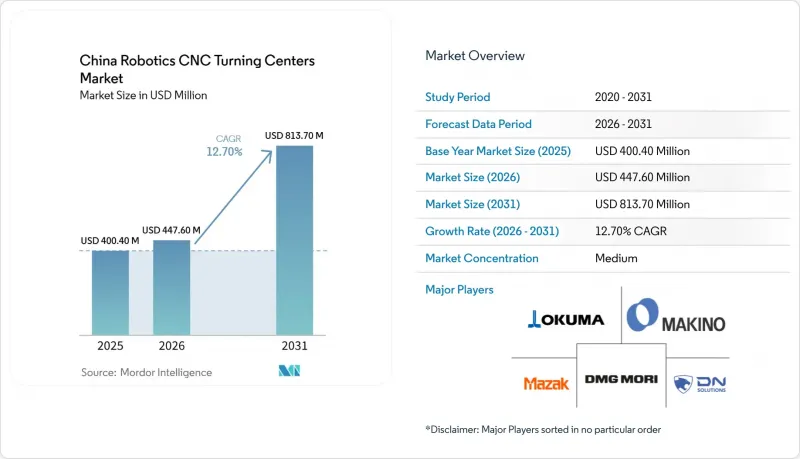
根據 Mordor Intelligence 預測,中國機器人數控車削中心的市場規模預計將從 2025 年的 4.004 億美元成長到 2026 年的 4.476 億美元,到 2031 年將達到 8.137 億美元,2026 年至 2031 年的複合年成長率為 12.70%。
本報告按機器類型(水平機器人車削中心、立式機器人車削中心等)、機器人類型(關節型機器人等)、機器人整合類型(OEM、改裝/售後市場機器人自動化)以及終端用戶產業(石油、天然氣和能源、航太和國防等)進行細分。市場預測以價值(美元)和數量(台)兩種單位呈現。
中國機器人數控車削中心市場趨勢與洞察
「中國製造2025」及後續產業政策正加速透過機器人實現製造業自動化。
產業政策仍是中國機器人數控車削中心市場最顯著的結構性支撐。 「中國製造2025」計畫將工業機器人定位為優先發展技術,並明確了零件本土化發展的方向,後續政策框架也大多沿用了其措辭和方向。在2026-2030年的「十五」規劃中,機器人技術被列為八大戰略性新興產業之一,具身智慧被列為未來產業,這向省級和行業規劃發出了明確的訊號,要求繼續加大對自動化領域的投入。此外,「人工智慧+製造(2025)」舉措要求將人工智慧智慧體引入數控工具工具機和工業機器人,從而拓展機器人車削單元的應用範圍,並促進更高附加價值的系統配置。這些政策的累積縮短了引進週期,加速了關鍵機器子系統的國產化,並為中國機器人數控車削中心市場創造了比純粹週期性資本投資市場更為強勁的需求下限。
工業機器人密度的不斷提高正在加速製造業的自動化進程。
機器人密度是目前中國機器人數控車削中心市場成長的直接驅動力。到2024年,中國每萬名製造業工人擁有567台機器人,位居全球第三。光是同年,中國就部署了29.5萬台機器人,使運作的機器人總數達到202.7萬台。在金屬和機械產業——機器人車削單元最直接的終端市場之一——2024年部署了5.46萬台機器人車削單元,其中90%由中國供應商提供,國內部署量年增31%。隨著機器人應用的不斷普及,客戶在評估系統時,不僅關注機械手臂硬體,還關注單元編配、預測性維護和流程軟體等要素。這種轉變使中國機器人數控車削中心市場的供應商獲得了競爭優勢,因為他們可以將機器人、數控控制器和軟體層作為一個整合解決方案提供。
依賴進口高階伺服系統、控制器和精密元件。
進口高階零件仍是中國機器人CNC車床市場的一大限制因素。伺服馬達、減速器和運動控制器佔工業機器人零件成本的近70%,這些領域已被明確列為「十五」規劃中的國產化重點。雖然該規劃指出,到2025年,中低價位伺服零件的國產化將取得進展,但高階編碼器、功率半導體和精密傳動零件等零件的進口依賴度仍然很高。因此,車床製造商面臨外匯波動、出口限制和零件供應中斷等風險。此外,在現有設計中更換伺服伺服時,往往會出現技術鎖定問題,通常需要修改控制架構,並由客戶重新檢驗和認證。
細分市場分析
到2025年,臥式機器人車床將佔據中國機器人CNC車削中心市場49.21%的佔有率。其優點——重力輔助排屑、旋轉工件夾持便利、龍門式裝載方式可適應各種佈局——使其成為大量生產的標準選擇。這些優勢在汽車軸、軸承環和電動汽車馬達殼體的生產中至關重要,因為運作和重複性是採購決策的關鍵因素。同時,立式機器人車床仍廣泛應用於加工煞車系統和重型機械製造中常見的短而重的圓盤和法蘭零件。
預計2026年至2031年間,多功能機器人車床細分市場將以13.52%的複合年成長率成長,成為中國機器人數控車削中心市場中成長最快的機型。其優點在於能夠在一次裝夾中完成車削、銑削、鑽孔和研磨等工序,從而減少工件轉移次數,縮短裝夾時間,並降低複雜零件公差的累積。這與新能源汽車動力系統和航太結構件日益成長的需求相契合,在這些領域,單一工具機難以滿足零件的幾何形狀和精度要求。因此,中國機器人數控車削中心市場正朝著能夠在單一加工範圍內執行更多任務的系統轉型,人工智慧數控技術的重要性日益凸顯,尤其是在多進程序列加工中。
預計到2025年,關節型機器人將佔據中國機器人CNC車床市場57.61%的佔有率。其主導地位歸功於關節型機器人廣泛的承重能力範圍,以及中國汽車和機械整合商在利用關節型機器人進行輔助作業、裝卸任務方面積累的豐富經驗。在專用輸送線上,龍門式和笛卡爾座標系統仍然十分有用,因為在這些應用中,線性運動、高承重能力處理和重複運動路徑比機械手臂的柔軟性更為重要。因此,儘管關節型機器人在規模上保持主導地位,但其他類型的機器人也在不斷發展,以滿足特定的佈局和成本需求。
預計2026年至2031年間,協作機器人將以14.78%的複合年成長率成長,成為中國機器人數控車削中心市場中成長最快的機器人類別。預計到2025年,中國協作機器人的銷售量將達到49,500台,其中國內製造商將佔據近90%的市場。在地化支援和低系統成本是推動這一成長的主要因素。由於協作機器人對安全防護欄的要求較低且編程週期較短,它們在車床應用中越來越受歡迎。這使得即使是以前無法負擔全自動化系統的中型代工製造商也能利用機器人輔助。這種轉變在中國機器人數控車削中心市場尤其明顯,小批量生產、勞動力短缺加劇以及資本投資預算減少等因素促使客戶尋求更簡單的實施成本結構。
其他好處:
- Excel格式的市場預測(ME)表
- 3個月的分析師支持
目錄
第1章:引言
- 研究假設和市場定義
- 調查範圍
第2章:調查方法
第3章執行摘要
第4章 市場狀況
- 市場概覽
- 市場促進因素
- 「中國製造2025」及後續產業政策正加速透過機器人實現製造業自動化。
- 工業機器人密度的不斷提高正在加速製造業的自動化進程。
- 政府直接補貼計畫正在減少製造商對自動化設備的投資。
- 新能源汽車和電動汽車零件的生產正在迅速擴張。
- 中國機器人製造商積極拓展出口業務,正在建立全球信任並實現規模經濟。
- 國內機器人製造商不斷擴大產能,為市場的長期成長提供了支撐。
- 市場限制因素
- 依賴進口高階伺服系統、控制器和精密元件。
- 日益激烈的競爭正在擠壓供應商的利潤空間,並威脅到長期的研發投資。
- 製造業資本投資對經濟狀況的敏感性
- 雖然機器人技術的普及率很高,但機器人整合和維護方面的熟練人員卻很短缺。
- 價值供應鏈分析
- 零件和原料供應
- 製造和系統整合
- 分發和交付給最終用戶
- 售後服務和生命週期支持
- 監理情勢
- 技術展望
- 人工智慧驅動的視覺引導
- 預測性維護的整合
- 數位孿生與模擬技術
- 產業特定自動化成熟度評估
- 數控加工數位化發展趨勢
- 機器人輔助CNC車削中心單元的投資與採購模式
- 價格分析
- 主要市場參與企業的平均售價 (ASP) 基準
- 以自動化程度分類的平均售價 (ASP) 基準
- 區域平均售價 (ASP) 基準
- 五力分析-產業吸引力評估
- 新進入者的威脅
- 供應商的議價能力
- 買方的議價能力
- 替代品的威脅
- 產業競爭
- 產業案例研究
- 地緣政治事件對市場的影響
第5章 市場規模與成長預測
- 按機器類型
- 水平機器人車削中心
- 垂直機器人車削中心
- 多功能機器人車削中心
- 其他
- 按機器人類型
- 關節機器人
- 協作機器人(cobots)
- 龍門/笛卡兒機器人
- 按類型分類的機器人整合
- OEM整合機器人車床單元
- 用於改裝/售後市場的機器人自動化應用
- 按最終用戶行業分類
- 汽車和商用車輛
- 航太/國防
- 醫療設備及手術器械
- 石油、天然氣和能源
- 電氣、電子和半導體製造設備
- 通用工業機械
- 其他
第6章 競爭情勢
- 市場集中度
- 策略趨勢
- 市佔率分析
- Competitive Technology Benchmarking
- 公司簡介
- DMG MORI Co., Ltd.
- Yamazaki Mazak Corporation
- Makino Milling Machine Co., Ltd.
- Okuma Corporation
- DN Solutions Co., Ltd.
- Hyundai WIA Corporation
- Tsugami Corporation
- Nakamura-Tome Precision Industry
- Shenyang Machine Tool Co., Ltd.(SMTCL)
- Dalian Machine Tool Group Co., Ltd.(DMTG)
- Qinchuan Machine Tool & Tool Group Co., Ltd.
- Haitian Precision Machinery Co., Ltd.
- FANUC Corporation
- ABB Ltd
- Yaskawa Electric Corporation
- KUKA AG
- Estun Automation Co., Ltd.
- Shenzhen Inovance Technology Co., Ltd.
- Siasun Robot & Automation Co., Ltd.
- Guangzhou CNC Equipment Co., Ltd.(GSK CNC)
第7章 市場機會與未來展望
According to Mordor Intelligence, the China robotics CNC turning centers market size is expected to increase from USD 400.40 million in 2025 to USD 447.60 million in 2026 and reach USD 813.70 million by 2031, growing at a CAGR of 12.70% over 2026-2031.
This report is Segmented by Machine Type (Horizontal Robotic Turning Centers, Vertical Robotic Turning Centers, and More), by Robot Type (Articulated Robots, and More), by Robot Integration Type (OEM, Retrofit/Aftermarket Robotic Automation), by End-User Industry (Oil, Gas, and Energy, Aerospace & Defense, and More), The Market Forecasts are Provided in Terms of Value (USD) and Volume (Units).
China Robotics CNC Turning Centers Market Trends and Insights
Made in China 2025 and Successive Industrial Policies Accelerating Robotic Manufacturing Automation
Industrial policy remains the clearest structural support for the China robotics CNC turning centers market. The Made in China 2025 program identified industrial robots as a priority technology area and set the tone for local component development, even though later policy frameworks largely absorbed its language and direction. The 15th Five-Year Plan for 2026 to 2030 now places robotics among eight strategic emerging industries and lists embodied intelligence among future industries, giving provincial and sector plans a clear signal to keep automation spending active. The 2025 AI plus manufacturing initiative also calls for AI agents in CNC machine tools and industrial robots, broadening the application range for robotic turning cells and supporting higher-value system configurations. This policy layering shortens adoption cycles, supports localization of key mechanical subsystems, and gives the China robotics CNC turning centers market a stronger demand floor than a purely cyclical capex market would normally have.
Rising Industrial Robot Density Accelerating Manufacturing Automation
Robot density is now a direct growth lever for the China robotics CNC turning centers market. China reached 567 robots per 10,000 manufacturing workers in 2024, ranked third globally, and built an operating stock of 2,027,000 units after installing 295,000 robots in that year alone. The metal and machinery sector, one of the closest end markets for robotic turning cells, recorded 54,600 installations in 2024, with Chinese suppliers accounting for 90% of those units and domestic installations rising 31% year over year. As robot adoption increases, customers increasingly judge systems by cell orchestration, predictive maintenance, and process software rather than arm hardware alone. That shift favors suppliers in the China robotics CNC turning centers market that can combine the robot, the CNC controller, and the software layer into a single integrated offering.
Dependence on Imported High-End Servo Systems, Controllers, and Precision Components
Imported high-end components remain a real constraint on the China robotics CNC turning centers market. The servo motors, gear reducers, and motion controllers account for close to 70% of an industrial robot's bill of materials, and the 15th Five-Year Plan directly identifies these areas as localization priorities. The same draft notes that localization improved in low to mid-range servo components by 2025, but high-end encoders, power semiconductors, and precision transmission parts still rely heavily on imports. That leaves turning-center builders exposed to exchange rate fluctuations, export controls, and component-level supply disruptions. It also creates technical lock-in because switching an installed design from one servo family to another often requires changes to the control architecture, revalidation, and customer requalification.
Other drivers and restraints analyzed in the detailed report include:
- Direct Government Subsidy Programs Lowering Automation Capex for Manufacturers
- New Energy Vehicle and EV Component Manufacturing Scaling Rapidly
- Intensifying Price Competition that Compresses Supplier Margins and Threatens Long-Term R&D Investment
For complete list of drivers and restraints, kindly check the Table Of Contents.
Segment Analysis
Horizontal robotic turning centers accounted for 49.21% of the China robotics CNC turning centers market in 2025. They remain the default choice for high-volume machining because gravity assists chip evacuation, workholding is straightforward for rotational parts, and gantry-style loading fits well with the layout. These strengths matter in automotive shafts, bearing rings, and EV motor housing programs where uptime and repeatability drive purchasing decisions. Vertical robotic turning centers still serve shorter, heavier disc or flange parts common in brake systems and in the production of heavy machinery.
The multi-tasking robotic turning centers segment is forecast to grow at a 13.52% CAGR from 2026 to 2031, which makes it the fastest-growing machine type in the China robotics CNC turning centers market. Its appeal lies in combining turning, milling, drilling, and grinding in a single setup, reducing transfers, cutting setup time, and lowering tolerance stacking in complex parts. That fits rising demand from NEV drivetrains and aerospace structural components, where part geometry and precision requirements are becoming harder to manage across separate machines. The China robotics CNC turning centers market is therefore moving toward systems that do more work within a single envelope, especially as AI-enabled CNC control becomes more relevant in multi-process sequences.
Articulated robots accounted for 57.61% of the China robotics CNC turning centers market share in 2025. They keep the largest position because they cover a broad payload range and because automotive and machinery integrators in China already have deep experience with their use in tending, loading, and transfer tasks. Gantry and Cartesian systems remain useful in dedicated transfer lines where linear motion, high payload handling, and repetitive travel paths matter more than arm flexibility. This keeps articulated robots in the leading role for scale, while other robot types grow around specific layout or cost needs.
Collaborative robots are projected to expand at a 14.78% CAGR from 2026 to 2031, making them the fastest-growing robot category in the China robotics CNC turning centers market. Cobot sales reached 49,500 units in China in 2025, and domestic manufacturers held close to 90% of the domestic cobot segment, indicating that local support and low system costs are widening adoption. Cobots matter in turning applications because they need less safety guarding and shorter programming cycles, which opens robotic tending to mid-tier job shops that could not justify full articulated automation before. The China robotics CNC turning centers market is seeing this shift most clearly, as smaller batch sizes, tighter labor availability, and lower capex budgets push customers toward simpler deployment economics.
Complete Report Scope:
- By Machine Type
- Horizontal Robotic Turning Centers
- Vertical Robotic Turning Centers
- Multi-Tasking Robotic Turning Centers
- Others
- By Robot Type
- Articulated Robots
- Collaborative Robots (Cobots)
- Gantry/Cartesian Robots
- By Robot Integration Type
- OEM-Integrated Robotic Turning Cells
- Retrofit/Aftermarket Robotic Automation
- By End-User Industry
- Automotive and Commercial Vehicles
- Aerospace & Defense
- Medical Devices and Surgical Instruments
- Oil, Gas, and Energy
- Electrical, Electronics and Semiconductor Equipment
- General Industrial Machinery
- Others
List of Companies Covered in this Report:
- DMG MORI Co., Ltd.
- Yamazaki Mazak Corporation
- Makino Milling Machine Co., Ltd.
- Okuma Corporation
- DN Solutions Co., Ltd.
- Hyundai WIA Corporation
- Tsugami Corporation
- Nakamura-Tome Precision Industry
- Shenyang Machine Tool Co., Ltd. (SMTCL)
- Dalian Machine Tool Group Co., Ltd. (DMTG)
- Qinchuan Machine Tool & Tool Group Co., Ltd.
- Haitian Precision Machinery Co., Ltd.
- FANUC Corporation
- ABB Ltd
- Yaskawa Electric Corporation
- KUKA AG
- Estun Automation Co., Ltd.
- Shenzhen Inovance Technology Co., Ltd.
- Siasun Robot & Automation Co., Ltd.
- Guangzhou CNC Equipment Co., Ltd. (GSK CNC)
Additional Benefits:
- The market estimate (ME) sheet in Excel format
- 3 months of analyst support
TABLE OF CONTENTS
1 Introduction
- 1.1 Study Assumptions & Market Definition
- 1.2 Scope of the Study
2 Research Methodology
3 Executive Summary
4 Market Landscape
- 4.1 Market Overview
- 4.2 Market Drivers
- 4.2.1 Made in China 2025 and Successive Industrial Policies Accelerating Robotic Manufacturing Automation
- 4.2.2 Rising Industrial Robot Density Accelerating Manufacturing Automation
- 4.2.3 Direct Government Subsidy Programs Lowering Automation Capex for Manufacturers
- 4.2.4 New Energy Vehicle and EV Component Manufacturing Scaling Rapidly
- 4.2.5 Aggressive Export Expansion by Chinese Robot Makers Building Global Credibility and Scale Economies
- 4.2.6 Ongoing Capacity Expansion by Domestic Robotics Manufacturers Supporting Long-Term Market Growth
- 4.3 Market Restraints
- 4.3.1 Dependence on Imported High-End Servo Systems, Controllers, and Precision Components
- 4.3.2 Intensifying Price Competition that Compresses Supplier Margins and Threatens Long-Term R&D Investment
- 4.3.3 Cyclical Sensitivity to Capital Expenditure in Manufacturing Sectors
- 4.3.4 Shortage of Skilled Robotics Integration and Maintenance Talent Despite High Adoption Rates
- 4.4 Value / Supply-Chain Analysis
- 4.4.1 Component & Raw Material Supply
- 4.4.2 Manufacturing & System Integration
- 4.4.3 Distribution & End-User Delivery
- 4.4.4 Aftermarket Services & Lifecycle Support
- 4.5 Regulatory Landscape
- 4.6 Technological Outlook
- 4.6.1 AI-Enabled Vision Guidance
- 4.6.2 Predictive Maintenance Integration
- 4.6.3 Digital Twin and Simulation Technologies
- 4.7 Automation Maturity Assessment by Industry
- 4.8 Digitalization Trends in CNC Machining
- 4.9 Investment and Procurement Models for Robotic CNC Turning Cells
- 4.10 Pricing Analysis
- 4.10.1 Average Selling Price (ASP) Benchmarking of Key Market Participants
- 4.10.2 Average Selling Price (ASP) Benchmarking by Automation Level
- 4.10.3 Average Selling Price (ASP) Benchmarking by Geography
- 4.11 Porter's Five Forces - Industry Attractiveness Scoring
- 4.11.1 Threat of New Entrants
- 4.11.2 Bargaining Power of Suppliers
- 4.11.3 Bargaining Power of Buyers
- 4.11.4 Threat of Substitutes
- 4.11.5 Industry Rivalry
- 4.12 Industry Case Studies
- 4.13 Impact of Geopolitical Events on the Market
5 Market Size & Growth Forecasts
- 5.1 By Machine Type
- 5.1.1 Horizontal Robotic Turning Centers
- 5.1.2 Vertical Robotic Turning Centers
- 5.1.3 Multi-Tasking Robotic Turning Centers
- 5.1.4 Others
- 5.2 By Robot Type
- 5.2.1 Articulated Robots
- 5.2.2 Collaborative Robots (Cobots)
- 5.2.3 Gantry/Cartesian Robots
- 5.3 By Robot Integration Type
- 5.3.1 OEM-Integrated Robotic Turning Cells
- 5.3.2 Retrofit/Aftermarket Robotic Automation
- 5.4 By End-User Industry
- 5.4.1 Automotive and Commercial Vehicles
- 5.4.2 Aerospace & Defense
- 5.4.3 Medical Devices and Surgical Instruments
- 5.4.4 Oil, Gas, and Energy
- 5.4.5 Electrical, Electronics and Semiconductor Equipment
- 5.4.6 General Industrial Machinery
- 5.4.7 Others
6 Competitive Landscape
- 6.1 Market Concentration
- 6.2 Strategic Moves
- 6.3 Market Share Analysis
- 6.4 Competitive Technology Benchmarking
- 6.5 Company Profiles (Includes Global Level Overview, Market Level Overview, Core Segments, Financials as Available, Strategic Information, Products & Services, and Recent Developments)
- 6.5.1 DMG MORI Co., Ltd.
- 6.5.2 Yamazaki Mazak Corporation
- 6.5.3 Makino Milling Machine Co., Ltd.
- 6.5.4 Okuma Corporation
- 6.5.5 DN Solutions Co., Ltd.
- 6.5.6 Hyundai WIA Corporation
- 6.5.7 Tsugami Corporation
- 6.5.8 Nakamura-Tome Precision Industry
- 6.5.9 Shenyang Machine Tool Co., Ltd. (SMTCL)
- 6.5.10 Dalian Machine Tool Group Co., Ltd. (DMTG)
- 6.5.11 Qinchuan Machine Tool & Tool Group Co., Ltd.
- 6.5.12 Haitian Precision Machinery Co., Ltd.
- 6.5.13 FANUC Corporation
- 6.5.14 ABB Ltd
- 6.5.15 Yaskawa Electric Corporation
- 6.5.16 KUKA AG
- 6.5.17 Estun Automation Co., Ltd.
- 6.5.18 Shenzhen Inovance Technology Co., Ltd.
- 6.5.19 Siasun Robot & Automation Co., Ltd.
- 6.5.20 Guangzhou CNC Equipment Co., Ltd. (GSK CNC)
7 Market Opportunities & Future Outlook
- 7.1 White-Space & Unmet-Need Assessment

 CNC控制器市場規模、佔有率和趨勢分析報告:按機器類型、安裝類型、最終用途、地區和細分市場預測(2026-2033年)
 CNC控制器市場-2026-2032年全球市場預測
 機器人數控車削中心:市場佔有率分析、產業趨勢與統計、成長預測(2026-2031)日本機器人相容型數控車削中心市場:市佔率分析、產業趨勢與統計及成長預測(2026-2031年)
 CNC等電漿切割機市場機會、成長要素、產業趨勢分析及2026-2035年預測。
 機器人數控控制器市場分析及預測(至2035年):依類型、產品類型、服務、技術、組件、應用、製程、最終用戶、功能、安裝類型分類
 2026年全球CNC控制器市場報告
 全球 CNC 控制器市場規模:按 CNC 控制器類型、按軸類型、按應用、按地區、範圍和預測