

 |
市場調查報告書
商品編碼
2099408
印度轉盤中心:市場佔有率分析、產業趨勢與統計及成長預測(2026-2031)India Turning Centers - Market Share Analysis, Industry Trends & Statistics, Growth Forecasts (2026 - 2031) |
||||||

※ 本網頁內容可能與最新版本有所差異。詳細情況請與我們聯繫。
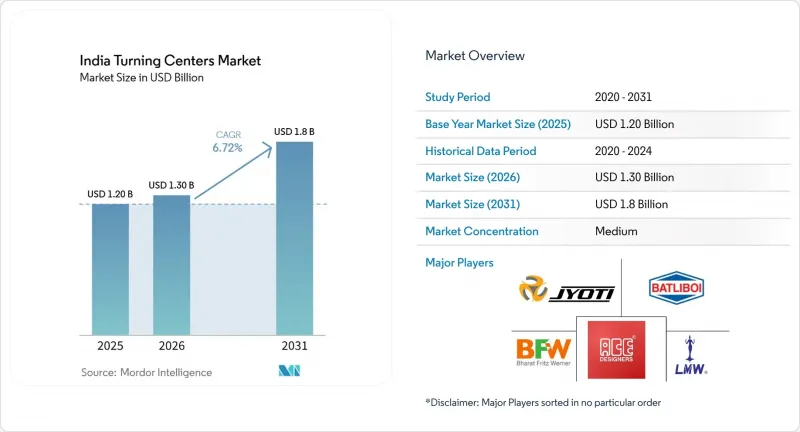
據 Mordor Intelligence 稱,2025 年印度轉盤市場價值 12 億美元,預計到 2031 年將達到 18 億美元,而 2026 年為 13 億美元,預測期(2026-2031 年)複合年成長率為 6.72%。
本報告依產品類型(水平車削中心、立式旋轉車削中心等)、軸配置(3軸、4軸、5軸或更多軸)、自動化類型(手動、半自動、全自動數控)以及最終用戶行業(汽車/商用車、航太/國防等)進行分類。市場預測以貨幣價值(美元)和銷售(台)兩種形式呈現。
印度車削中心市場的趨勢與洞察
關鍵產業的生產連結獎勵計畫(PLI)計劃
生產關聯激勵計劃(PLI)仍然是印度成為製造地最有力的政策支持,因為它將獎勵與製造業擴張掛鉤,而不僅僅是組裝量。截至2025年12月,該計畫已批准836項申請,累積投資達254億美元,相關生態系統創造了超過144萬個直接和間接就業機會。 2025-2026會計年度汽車業的PLI預算已從修訂後的4,080萬美元增至3.32億美元,而電子和IT硬體產業的撥款也增至10.6億美元,反映出這兩個產業設備需求的進一步成長。尋求這些激勵措施的公司必須滿足國內增值要求。這項要求正推動新的資本投資流向加工能力、零件生產線和工廠級自動化,而不是進口成品。因此,印度的車削中心市場與政策支持的廣泛且多元化的製造業週期緊密相連,並有望在未來幾年內維持設備需求。
印度的汽車產業正在推動對車輛週轉中心的需求。
印度汽車及零件產業仍是印度車削中心市場最大的需求來源,預計到2025年,乘用車和商用車的需求將佔總需求的38.5%。 2026會計年度上半年,印度汽車零件產業的銷售額達到419億美元,年增6.8%,證實了整個供應商網路的持續需求。超過70%的一級汽車零件供應商採用數控技術進行精密加工,這使得汽車供應鏈成為印度車削中心最穩定的市場之一。內燃機(ICE)和電動車(EV)生產的平行投資週期正在推動需求成長。這是因為製造商正在增加針對馬達殼體、電池結構件、輕量化連接器、曲軸和凸輪軸等部件的獨立加工能力,而不是簡單地用一個平台替換另一個平台。這使得印度車削中心市場對傳統和新興汽車零件類別的設備需求更加廣泛。
先進車削中心高度依賴進口
對進口的依賴仍然是限制印度車削中心市場成長的因素,尤其是在高階五軸加工中心和多功能加工系統領域,這些領域的國內產能仍然有限。預計到2025年,工具機進口額將達25億美元,年增23%,其中中國、日本和德國的進口額佔總數的62%。根據印度製造技術協會(AMT)預測,到2025年,車削中心將佔工具機進口總額的9%,凸顯了印度在某些高度專業化產品方面對海外供應的持續依賴。此外,進口設備必須符合《機械和電氣設備安全條例》規定的額外安全和認證要求,這給買家帶來了更大的合規負擔。這可能導致更嚴格的實質審查要求和更長的採購週期。在本地供應商在高階數控技術領域取得進一步進展之前,印度的車削中心市場將繼續面臨成本波動、前置作業時間風險以及進口系統中供應商集中度高等挑戰。
細分市場分析
到2025年,臥式車削中心將佔據印度車削中心市場52.5%的佔有率。這反映了臥式車削中心在汽車和工程等大批量生產應用領域的強勢地位,這些應用領域對主軸剛性、穩定的排屑和高度可重複的加工週期要求極高。由於曲軸、汽缸套和變速箱軸等零件的加工能力和尺寸一致性要求高於靈活的多進程佈局,臥式車削中心仍然是這些零件加工的標準選擇。這一優勢確保了臥式車削中心在大型汽車工廠以及服務動力傳動系統和傳動系統的供應商工廠中仍然是核心採購設備。此外,現有的臥式車削中心也為重複訂單提供了基礎,因為製造商通常會根據其現有刀具、操作人員的熟練程度和維護流程來擴建工廠,添置符合要求的工具機系列。在印度車削中心市場,這種更新換代和擴張的週期確保了水平車削中心能夠持續滿足當前最廣泛的市場需求。
預計到2031年,立式車削中心將以7.8%的複合年成長率成長,這主要得益於風力發電、重型工業設備以及大航太部件等應用領域的推動,在這些領域,重力夾持能夠增強工件的夾持穩定性。在那些優先考慮圓度控制、簡化夾具複雜性以及安全搬運大型工件而非生產線速度的領域,立式車削中心的吸引力日益增強。多功能車削中心在航太和國防領域的外包業務中也呈現成長趨勢,因為它們能夠將車削、銑削和鑽孔整合於一次裝夾中,從而減少多品種生產項目中的裝夾損失。 LMW在2025年IMTEX展會上發表的新產品包括LR30T L30、LR40TM L25、LTV 30 Plus和LTV 40 Plus等型號,顯示國內供應商正在擴展其產品線,以滿足直立和重型應用的需求。特殊用途和管道轉向中心系統仍然是小眾市場,但在鐵路、壓力容器和國防製造等優先考慮定製化而非標準批量生產的領域,它們仍然保持著強勁的需求。
預計到2025年,三軸車削中心將佔據印度車削中心市場65%的佔有率。這主要歸功於其低成本以及對標準公差環境下通用機械和汽車零件供應商的廣泛適用性。由於許多工廠仍然優先考慮可靠生產而非複雜零件的整合,因此憑藉其龐大的用戶基礎,該細分市場保持著核心地位。對於泵殼、軸、法蘭和傳統機械加工零件,三軸系統仍然能夠很好地滿足常見的生產量和預算限制。該類別的強勁表現也反映了印度微企業(MSME)製造業的結構,在這些企業中,較短的投資回收期和易於編程仍然是投資決策的重要因素。因此,即使印度車削中心市場的性能組合正向高階機型轉變,對三軸機床的需求仍保持穩定。
預計到2031年,四軸加工中心市場將以8.5%的複合年成長率成長,並有望成為成長最快的軸類,因為製造商正在採用Y軸功能來縮短變速箱殼體、泵體和航太支架的裝夾時間。五軸及以上軸類的需求仍集中在航太、國防和醫療設備加工領域,這些領域對單次裝夾的精度要求極高,且廢品成本也很高。根據Jyoti CNC發布的2026年第四季累積訂單,航太和國防領域佔其5.53億美元訂單儲備的38%,這表明即使在產量較低的情況下,對高階多軸加工中心的需求也對價值產生了顯著影響。此外,據報道,印度國產切割機中93%目前都採用數控系統,軸升級正與更廣泛的數位化趨勢保持一致,而不再局限於少數早期採用者。國產產品的推出,例如 Jyoti CNC 的「BTM 100」雙主軸車削中心和 ACE Designers 的四軸平台,顯示本地 OEM 製造商開始吸收曾經幾乎完全依賴進口的需求。
其他好處:
- Excel格式的市場預測(ME)表
- 3個月的分析師支持
目錄
第1章:引言
- 研究假設和市場定義
- 調查範圍
第2章:調查方法
第3章執行摘要
第4章 市場狀況
- 市場概覽
- 市場促進因素
- 關鍵產業的生產連結獎勵計畫(PLI)計劃
- 印度的汽車工業正在推動對車輛週轉中心的需求。
- 微企業現代化及「SAMARTH Udyog」計劃
- 擴大國內車削中心OEM能力
- 對半導體和電子製造業的投資
- 印度斯坦航空有限公司(HAL)以及「自力更生印度」(Athamanirba Bharat)政策下國防和航太領域的擴張
- 市場限制因素
- 先進車削中心高度依賴進口
- 主要城市以外地區的售後市場分散,以及原始設備製造商 (OEM) 的服務回應時間過長。
- 製造群中熟練的數控操作員和程式設計人員短缺
- 價格敏感度限制了印度高階維修中心的引入。
- 價值供應鏈分析
- 原料和關鍵部件的生態系統
- 製造和組裝價值鏈
- 分銷和市場進入通路
- 售後服務和生命週期支持
- 技術趨勢和當前創新投資狀況
- 人工智慧驅動的自適應控制和顫振抑制
- 高速主軸和HSK-T介面的發展
- 價格分析
- 主要市場參與企業的平均售價 (ASP) 基準
- 按產品類型分類的平均售價 (ASP) 分析
- 以軸配置分析平均售價 (ASP)
- 自動化系統對平均銷售價格 (ASP) 進行分析
- 採購標準與採購分析
- 五力分析-產業吸引力評估
- 新進入者的威脅
- 供應商的議價能力
- 買方的議價能力
- 替代品的威脅
- 產業競爭
- 地緣政治事件對市場的影響
第5章 市場規模與成長預測
- 依產品類型
- 水平轉彎中心
- 垂直轉彎中心
- 多工中心
- 其他
- 按軸配置
- 3軸
- 四軸
- 5個或更多軸
- 按自動化類型
- 手動的
- 半自動
- 全自動CNC工具機
- 按最終用戶行業分類
- 汽車和商用車輛
- 航太/國防
- 醫療設備及手術器械
- 石油、天然氣和能源
- 電氣、電子和半導體製造設備
- 通用工業機械
- 其他
第6章 競爭情勢
- 市場集中度
- 策略趨勢
- 市佔率分析
- Competitive Benchmarking Analysis
- 公司簡介
- Jyoti CNC Automation
- Bharat Fritz Werner(BFW)
- Lakshmi Machine Works(LMW)
- ACE Designers Ltd.
- Batliboi Ltd.
- Yamazaki Mazak
- DMG MORI
- DN Solutions
- Hyundai WIA
- Okuma Corporation
- Hwacheon Machinery
- Haas Automation
- INDEX-Werke
- EMAG GmbH
- Nakamura-Tome Precision Industry Co., Ltd.
- Goodway Machine Corporation
- Tongtai Machine Tool
- Tsugami Corporation
- Nidec Machine Tool
- Citizen Machinery Co., Ltd.
第7章 市場機會與未來展望
According to Mordor Intelligence, the India turning centers market size was valued at USD 1.20 billion in 2025 and is estimated to grow from USD 1.30 billion in 2026 to reach USD 1.8 billion by 2031, at a CAGR of 6.72% during the forecast period (2026-2031).
This report is Segmented by Product Type (Horizontal Turning Centers, Vertical Turning Centers, and More), by Axis Configuration (3-Axis, 4-Axis, 5-Axis & Above), by Automation Type (Manual, Semi-Automatic, Fully Automatic CNC), by End-User Industry (Automotive and Commercial Vehicles, Aerospace & Defense, and More). The Market Forecasts are Provided in Terms of Value (USD) and Volume (Units).
India Turning Centers Market Trends and Insights
Production Linked Incentive (PLI) Scheme Across Key Sectors
The PLI scheme remains the strongest policy support for India becoming a manufacturing hub because it ties incentives to manufacturing expansion rather than only to assembly output. As of December 2025, 836 applications had been approved under the scheme, cumulative investment had reached USD 25.4 billion, and the linked ecosystem had generated more than 1.44 million direct and indirect jobs. The automotive PLI budget for 2025-26 rose from USD 40.8 million in the revised estimate to USD 332 million, while electronics and IT hardware allocation increased to USD 1.06 billion, which is building deeper equipment demand across both sectors. Companies seeking these incentives must meet domestic value-addition conditions. That requirement is pushing fresh capital spending into machining capacity, component lines, and plant-level automation rather than into imported finished assemblies. This is keeping the India turning centers market tied to a policy-backed manufacturing cycle that is broad, multi-sector, and likely to sustain equipment demand over several years.
India's Automotive Sector Driving Turning Center Demand
India's automotive and auto components base remains the largest consumption engine for the India turning centers market, with automotive and commercial vehicles accounting for 38.5% of demand in 2025. The Indian auto component industry recorded turnover of USD 41.9 billion in H1 FY26, up 6.8% year on year, confirming continued demand across the supplier network. More than 70% of tier-1 auto component suppliers use CNC technology for precision machining, making the automotive supply chain one of the most stable markets for turning centers in the country. Demand is being reinforced by the parallel investment cycle in ICE and EV production, as manufacturers add separate machining capability for motor housings, battery structural parts, lightweight connectors, crankshafts, and camshafts rather than replacing one platform with another. This is giving the India turning centers market a wider equipment requirement across both traditional and new automotive component categories.
Heavy Import Dependency on Advanced Turning Centers
Import dependence continues to limit the upside of the India turning centers market, especially in premium 5-axis and multi-tasking systems, where domestic capability remains narrower. Machine tool imports rose 23% year on year to USD 2.5 billion in CY2025, and China, Japan, and Germany together accounted for 62% of those imports. Turning centers accounted for 9% of total machine tool imports by type in CY2025, according to the Association for Manufacturing Technology, underscoring the country's continued reliance on overseas supply for several advanced configurations. Buyers also face greater compliance efforts because imported equipment must navigate additional safety and certification requirements under the Machinery and Electrical Equipment Safety Order, which increases due diligence requirements and can lengthen procurement cycles. Until local suppliers move further into premium CNC capability, the India turning centers market will remain exposed to cost shifts, lead-time risk, and supplier concentration in imported systems.
Other drivers and restraints analyzed in the detailed report include:
- MSME (Micro, Small & Medium Enterprises) Modernization and SAMARTH Udyog Initiative
- Growing Domestic Turning Center OEM Capabilities
- Fragmented Aftermarket and Long OEM Service Response Times Outside Major Cities
For complete list of drivers and restraints, kindly check the Table Of Contents.
Segment Analysis
Horizontal turning centers commanded 52.5% of the India turning centers market share in 2025, which reflects their entrenched role in high-volume automotive and engineering applications that depend on spindle rigidity, stable chip evacuation, and repeatable cycle times. These machines remain the default choice for crankshafts, cylinder liners, and transmission shafts because those parts require throughput and dimensional consistency more than flexible multi-process layouts. This base keeps horizontal machines at the center of procurement in large automotive plants and in supplier facilities that serve powertrain and driveline programs. Their installed base also supports repeat orders because manufacturers often expand with machine families that match existing tooling, operator familiarity, and maintenance routines. In the India turning centers market, that replacement and expansion cycle keeps horizontals tied to the broadest part of current demand.
Vertical turning centers are projected to grow at 7.8% CAGR through 2031, driven by applications in wind energy, heavy industrial equipment, and large-diameter aerospace parts where gravity-assisted clamping improves workholding stability. Their appeal is increasing where out-of-roundness control, reduced fixturing complexity, and safer handling of larger workpieces matter more than line speed. Multi-tasking turning centers are also advancing in aerospace and defense subcontracting because they combine turning, milling, and drilling in a single setup, reducing setup losses on high-mix programs. LMW's IMTEX 2025 launches included LR30T L30, LR40TM L25, LTV 30 Plus, and LTV 40 Plus configurations, demonstrating that domestic suppliers are widening their portfolios to capture both vertical and heavy-duty demand. Special-purpose and pipe-turning systems remain niche but steady, serving railways, pressure vessels, and defense fabrication where customization matters more than standard volume.
3-axis turning centers held a 65% share of the India turning centers market in 2025, supported by their lower cost and wide fit with general engineering and automotive suppliers operating in standard-tolerance environments. This segment remains the baseline across a large installed base because many workshops still prioritize dependable production over complex part consolidation. For pump housings, shafts, flanges, and conventional machined parts, 3-axis systems remain aligned with prevailing volume and budget constraints. The strength of this category also reflects the structure of India's MSME manufacturing base, where investment decisions still favor faster payback and simpler programming. That keeps 3-axis machines relevant even as the performance mix in the India turning centers market shifts upward.
The 4-axis segment is forecast to expand at a 8.5% CAGR through 2031, making it the fastest-growing axis class as manufacturers adopt Y-axis capability to reduce setup time for transmission casings, pump bodies, and aerospace brackets. Demand for 5-axis and above remains concentrated in aerospace, defense, and medical device machining, where single-setup accuracy matters and scrap costs are high. Jyoti CNC's Q4 FY2026 order book showed aerospace and defense accounting for 38% of its USD 553 million pipeline, signaling how strongly premium multi-axis demand influences value even when unit volumes remain smaller. India also reported that 93% of cutting machines produced domestically are now CNC-operated, so axis upgrades are increasingly moving with the wider digitalization trend rather than remaining limited to a few early adopters. Domestic launches such as Jyoti CNC's BTM 100 twin-spindle turning center and ACE Designers' 4-axis platform indicate that local OEMs are starting to absorb demand that once moved almost entirely to imports.
Complete Report Scope:
- By Product Type
- Horizontal Turning Centers
- Vertical Turning Centers
- Multi-Tasking Turning Centers
- Others
- By Axis Configuration
- 3-Axis
- 4-Axis
- 5-Axis and Above
- By Automation Type
- Manual
- Semi-Automatic
- Fully Automatic CNC
- By End-User Industry
- Automotive and Commercial Vehicles
- Aerospace & Defense
- Medical Devices and Surgical Instruments
- Oil, Gas, and Energy
- Electrical, Electronics and Semiconductor Equipment
- General Industrial Machinery
- Others
List of Companies Covered in this Report:
- Jyoti CNC Automation
- Bharat Fritz Werner (BFW)
- Lakshmi Machine Works (LMW)
- ACE Designers Ltd.
- Batliboi Ltd.
- Yamazaki Mazak
- DMG MORI
- DN Solutions
- Hyundai WIA
- Okuma Corporation
- Hwacheon Machinery
- Haas Automation
- INDEX-Werke
- EMAG GmbH
- Nakamura-Tome Precision Industry Co., Ltd.
- Goodway Machine Corporation
- Tongtai Machine Tool
- Tsugami Corporation
- Nidec Machine Tool
- Citizen Machinery Co., Ltd.
Additional Benefits:
- The market estimate (ME) sheet in Excel format
- 3 months of analyst support
TABLE OF CONTENTS
1 Introduction
- 1.1 Study Assumptions & Market Definition
- 1.2 Scope of the Study
2 Research Methodology
3 Executive Summary
4 Market Landscape
- 4.1 Market Overview
- 4.2 Market Drivers
- 4.2.1 Production Linked Incentive (PLI) Scheme Across Key Sectors
- 4.2.2 India's Automotive Sector Driving Turning Center Demand
- 4.2.3 MSME Modernization and SAMARTH Udyog Initiative
- 4.2.4 Growing Domestic Turning Center OEM Capabilities
- 4.2.5 Semiconductor and Electronics Manufacturing Investments
- 4.2.6 HAL (Hindustan Aeronautics Limited) and Defense Aerospace Expansion Under Aatmanirbhar Bharat
- 4.3 Market Restraints
- 4.3.1 Heavy Import Dependency on Advanced Turning Centers
- 4.3.2 Fragmented Aftermarket and Long OEM Service Response Times Outside Major Cities
- 4.3.3 Shortage of Skilled CNC Operators and Programmers in Manufacturing Clusters
- 4.3.4 Price Sensitivity Limiting Premium Turning Center Adoption in India
- 4.4 Value / Supply-Chain Analysis
- 4.4.1 Raw Material & Critical Component Ecosystem
- 4.4.2 Manufacturing & Assembly Value Chain
- 4.4.3 Distribution & Go-to-Market Channels
- 4.4.4 Aftermarket Services & Lifecycle Support
- 4.5 Technological Outlook & Innovation Investment Landscape
- 4.5.1 AI-Driven Adaptive Control and Chatter Suppression
- 4.5.2 High-Speed Spindle And HSK-T Interface Evolution
- 4.6 Pricing Analysis
- 4.6.1 Average Selling Price (ASP) Benchmarking of Key Market Participants
- 4.6.2 Average Selling Price (ASP) Analysis, by Product Type
- 4.6.3 Average Selling Price (ASP) Analysis, by Axis Configuration
- 4.6.4 Average Selling Price (ASP) Analysis, by Automation
- 4.7 Buying Criteria & Procurement Analysis
- 4.8 Porter's Five Forces Analysis - Industry Attractiveness Scoring
- 4.8.1 Threat of New Entrants
- 4.8.2 Bargaining Power of Suppliers
- 4.8.3 Bargaining Power of Buyers
- 4.8.4 Threat of Substitutes
- 4.8.5 Industry Rivalry
- 4.9 Impact of Geopolitical Events on the Market
5 Market Size & Growth Forecasts
- 5.1 By Product Type
- 5.1.1 Horizontal Turning Centers
- 5.1.2 Vertical Turning Centers
- 5.1.3 Multi-Tasking Turning Centers
- 5.1.4 Others
- 5.2 By Axis Configuration
- 5.2.1 3-Axis
- 5.2.2 4-Axis
- 5.2.3 5-Axis and Above
- 5.3 By Automation Type
- 5.3.1 Manual
- 5.3.2 Semi-Automatic
- 5.3.3 Fully Automatic CNC
- 5.4 By End-User Industry
- 5.4.1 Automotive and Commercial Vehicles
- 5.4.2 Aerospace & Defense
- 5.4.3 Medical Devices and Surgical Instruments
- 5.4.4 Oil, Gas, and Energy
- 5.4.5 Electrical, Electronics and Semiconductor Equipment
- 5.4.6 General Industrial Machinery
- 5.4.7 Others
6 Competitive Landscape
- 6.1 Market Concentration
- 6.2 Strategic Moves
- 6.3 Market Share Analysis
- 6.4 Competitive Benchmarking Analysis
- 6.5 Company Profiles (Includes Global Level Overview, Market Level Overview, Core Segments, Financials as Available, Strategic Information, Products & Services, and Recent Developments)
- 6.5.1 Jyoti CNC Automation
- 6.5.2 Bharat Fritz Werner (BFW)
- 6.5.3 Lakshmi Machine Works (LMW)
- 6.5.4 ACE Designers Ltd.
- 6.5.5 Batliboi Ltd.
- 6.5.6 Yamazaki Mazak
- 6.5.7 DMG MORI
- 6.5.8 DN Solutions
- 6.5.9 Hyundai WIA
- 6.5.10 Okuma Corporation
- 6.5.11 Hwacheon Machinery
- 6.5.12 Haas Automation
- 6.5.13 INDEX-Werke
- 6.5.14 EMAG GmbH
- 6.5.15 Nakamura-Tome Precision Industry Co., Ltd.
- 6.5.16 Goodway Machine Corporation
- 6.5.17 Tongtai Machine Tool
- 6.5.18 Tsugami Corporation
- 6.5.19 Nidec Machine Tool
- 6.5.20 Citizen Machinery Co., Ltd.
7 Market Opportunities & Future Outlook
- 7.1 White-Space & Unmet-Need Assessment

 2026年全球岩心塞市場報告
 自行車零件售後市場規模、佔有率和成長分析:按產品類型、自行車類型、材料、銷售管道、最終用戶和地區分類 - 產業預測,2026-2033 年2026年全球燃油管路斷開工具市場報告
 全球鋁板市場:依產品形式、等級、最終用途產業和地區分類-預測至2035年
 德國車削中心:市場佔有率分析、產業趨勢與統計及成長預測(2026-2031 年)
 汽車原料市場:2026-2032年全球市場預測(依產品類型、材料形態、驅動系統、製造流程、車輛類型、應用、銷售管道及通路分類)美國車削中心:市場佔有率分析、行業趨勢和統計數據以及成長預測(2026-2031 年)中國車床中心:市場佔有率分析、產業趨勢與統計及成長預測(2026-2031年)轉向中心:市場佔有率分析、行業趨勢和統計數據、成長預測(2026-2031)
 汽車前風窗流水槽蓋板市場分析及預測(至2035年):類型、產品、技術、組件、應用、材質、最終用戶、功能、安裝類型