


 |
市場調查報告書
商品編碼
2099240
中國車床中心:市場佔有率分析、產業趨勢與統計及成長預測(2026-2031年)China Turning Centers - Market Share Analysis, Industry Trends & Statistics, Growth Forecasts (2026 - 2031) |
||||||

※ 本網頁內容可能與最新版本有所差異。詳細情況請與我們聯繫。
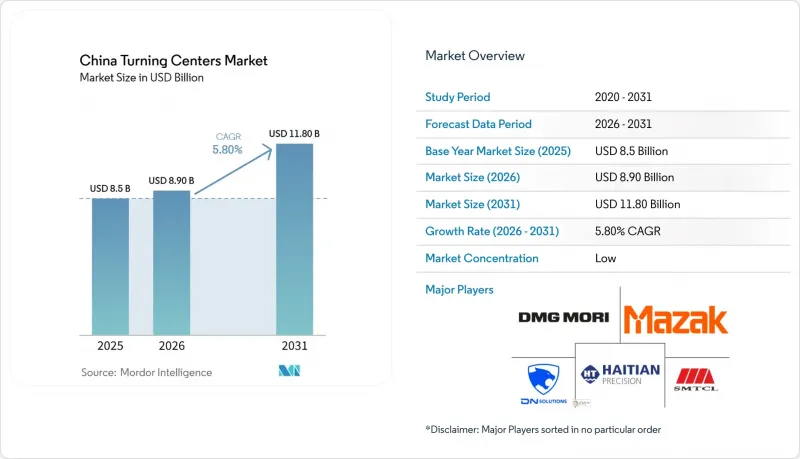
根據 Mordor Intelligence 預測,中國車床中心市場規模預計在 2025 年達到 85 億美元,2026 年達到 89 億美元,到 2031 年達到 118 億美元,2026 年至 2031 年的複合年成長率為 5.80%。
本報告按產品類型(臥式車床、立式車床等)、軸配置(三軸、四軸等)、自動化類型(手動、半自動等)以及最終用戶產業(汽車、航太與國防、醫療設備與手術器材等)進行細分。市場預測以貨幣價值(美元)和銷售(台)兩種形式呈現。
中國車床中心市場趨勢與洞察
電動車生產對精密車床中心的需求不斷成長
中國電動車產量的激增正在改變中國車床中心市場的整體加工需求。隨著傳動系統和結構件加工佔有率的擴大,標準公差設備已無法滿足需求。到2025年,中國電動車產量將達到1,663萬輛,較去年同期成長29%,佔新車總銷量的47.9%。這推動了本地製造商對精密車削軸、轉子殼體和變速箱部件的需求激增。這些零件通常需要極高的表面光潔度和重複精度,因此中國車床中心市場的買家偏好正轉向高速臥式平台和高性能數控系統。此外,一體化壓鑄電池機殼和一體化結構件的普及也增加了對大直徑車削能力的需求。這些薄壁車削應用不僅支撐了對傳統軸加工的需求,也推動了對立式車床中心的需求。簡而言之,電動車週期正在推動中國車床市場多個產品類型的需求,為能夠加工多種加工規格的供應商拓展了商機。這項長期投資前景因「十五五」規劃而進一步提振,該規劃將智慧互聯新能源汽車列為戰略性新興產業之一,並將持續獲得政策支持直至2030年。
「中國製造2025」及其後續政策的影響
「中國製造2025」的政策遺產仍在塑造中國車床中心市場,但其影響並非均勻分佈於整個價值鏈。外交貿易部的報告指出,中國在上游原料自主控制的領域取得了最大成功,尤其是在電動車、太陽能和工業機器人領域。另一方面,高階工具機市場的情況則是喜憂參半,外國製造商在頂級產品領域仍保持著技術優勢。這一趨勢對中國車床市場有重大影響,因為政策支援雖然促進了本土規模化和中端國產化,但卻未能立即彌合航太、半導體和醫療應用領域的精度差距。 「十五」規劃延續了類似的策略方向,大力推動人工智慧驅動的製造、綠色生產和技術本土化,並要求2030年國家研發投入每年至少成長7%。其次,隨著製造商升級到更智慧、更清潔、更數位化的生產線,他們也越來越傾向於用更能支援軟體整合、製程穩定性和無人化操作的新型設備來取代老舊機器。因此,中國車床市場不僅受益於產量的直接成長,也受益於政策主導對工廠設備品質要求的提升。
儘管國內已有多種選擇,但對進口控制器的依賴依然存在。
中國車床中心市場面臨的主要限制因素之一是控制器國產化進程未能與工具機組裝和中端機械性能的提升保持同步。儘管如此,高階控制器領域,例如五軸車床、航太航太單元和半導體設備,仍然高度依賴海外供應商。根據中國工業和資訊化部預測,到2025年,進口數控系統的市場規模將達到10.5億美元。這表明,儘管工具機行業一直在努力推進國產化,但先進的加工操作仍然推動著對外部技術的需求。 CAE研究指出,五軸連鎖功能的軟體限制是造成這一差距的原因之一,迫使國內開發商自行編寫程式碼,導致檢驗延遲,並在關鍵應用場景中實現可靠性能所需的時間更長。這為中國車床中心市場的部分買家設置了實際的瓶頸,因為工具機速度遠快於支援高要求操作的控制器和軟體堆疊。在國產控制系統在複雜的車削環境中展現出更強的長期可靠性之前,這種依賴將繼續限制其在高附加價值應用中的普及。
細分市場分析
到2025年,臥式車床中心仍將佔據50.2%的市場佔有率,繼續保持其在中國車床中心市場的主導地位。這是因為在量產車、通用工業應用和電動車的軸類生產中,擁有大規模刀俱生態系統的成熟平台仍然是首選。其主導地位反映了當前的製造結構,即仍然高度重視軸、襯套、轉子和其他能夠受益於高效線性工作流程、熟悉的設置和低資本密集度等優勢的零件。這也意味著,現有設備將繼續驅動未來的採購,因為許多買家更傾向於在現有刀具、操作人員技能和維護實踐的基礎上進行擴展,而不是重新設計整個生產單元。在中國車床中心產業,現有設備形成的慣性支撐著對臥式車床的需求,即使更先進的工具機形式在高附加價值加工領域日益普及。因此,儘管產品類型依然豐富,但臥式車床的主導地位不僅是由價格因素驅動的,也是由其實際的生產經濟效益所決定的。
立式車床在加工大直徑、重型工件方面仍然發揮著至關重要的作用。對於外殼、框架部件和大型結構件的製造商而言,重力輔助夾持、設置穩定性以及工件的易於接近仍然是關鍵因素。在加工大型電動車外殼、能源設備和航太框架等領域,立式車床的重要性日益凸顯,因為在這些領域,零件尺寸和尺寸控制與切割速度同樣重要。多功能車床是成長最快的產品細分市場,預計到2031年,中國車床市場多功能車床的年複合成長率將達到8.1%。這主要是因為買家越來越希望在一次裝夾中完成車削、銑削和鑽孔。這種需求的轉變在零件複雜性日益增加的領域尤其明顯,尤其是在航太、半導體設備和機器人結構件領域,在這些領域,縮短裝夾時間和保持一致的公差比標準批量生產加工更為重要。 「其他」部分,包括瑞士型車床和專用車床,規模仍然很小,但在醫療和微精密應用領域,其重要性日益成長,因為在這些領域,表面品質、污染控制和微零件的可重複性至關重要。
臥式車床也受惠於最完善的服務和支援體系,這在中國車床市場是關鍵因素。這是因為對於中小企業而言,運作和快速更換刀鏈通常比尖端先進功能更為重要。另一方面,立式車床雖然應用範圍有限,但已確立了穩固的地位,因為它們的價值在於加工某些臥式設備無法高效處理的零件形狀。多功能系統透過縮短設定週期、減少搬運損耗和改善複雜零件組的加工製程控制,推動了對高階配置的進一步投資。因此,產品類型的需求日益兩極化,臥式車床構成了大量生產的基礎,而多功能平台則在策略投資中佔據越來越大的佔有率。
預計到2025年,三軸工具機的市佔率將達到54.5%,顯示中國車床中心市場仍依賴大量部署在標準汽車、工業和中小企業生產線上的傳統數控設備。這些工具機對不需要高級表面路徑控制的製造商仍然具有吸引力,因為它們具有實用的生產效率、低部署成本、易於編程和維護等優點。其市場佔有率也反映出,中國車床中心市場的大部分仍然與中等複雜程度的日常生產需求相關,從週期成本的角度來看,更簡單的形式更具優勢。這使得三軸工具機在中國車床中心產業中佔據穩固地位,即使市場的高附加價值領域正在快速變化。四軸加工中心繼續填補注重成本的標準車削和高階多面加工之間的空白,對於那些需要在偏心加工中提高生產效率但又不想承擔五軸平台成本的用戶來說,四軸加工中心尤其有用。
五軸及以上配置的航太該細分市場的複合年成長率將達到9.2%。這主要得益於航空航太、醫療和半導體產業對更先進的幾何控制和更短的加工週期日益成長的需求。 CAE研究中對五軸軟體限制的深入分析進一步凸顯了該細分市場的戰略重要性,因為在買家評估複雜的車削加工時,控制器層級的性能與機械硬體同等重要。因此,預計中國車床中心市場的軸向配置將保持廣泛。然而,市場規模正穩步朝向能夠滿足終端用戶高階需求的高軸數機床傾斜。
向五軸設備的轉型也帶來了採購行為的改變。在採購過程中,不僅主軸和結構規格,軟體相容性、模擬精度和長期支援也變得越來越重要。四軸機床仍將發揮重要的過渡作用,尤其適用於中型汽車零件製造商以及一些零件種類不斷增加但預算有限的通用工業領域。因此,最大的機會存在於軸數頻譜的兩端:三軸機床保持著廣泛的需求,而五軸機床則推動了最強勁的升級投資。這種二元結構比簡單地用一種形式取代另一種形式更能準確地反映中國車床中心市場的現狀。
其他好處:
- Excel格式的市場預測(ME)表
- 3個月的分析師支持
目錄
第1章:引言
- 研究假設和市場定義
- 調查範圍
第2章:調查方法
第3章執行摘要
第4章 市場狀況
- 市場概覽
- 市場促進因素
- 電動車生產對精密車削中心的需求日益成長
- 「中國製造2025」及其後續政策的影響
- 高階車床中心與進口替代政策
- 機器人和自動化技術正在推動對結構件的需求成長。
- Delta和珠三角Delta中小企業現代化
- 受中國商飛C919和中航工業計畫推動,航太床中心訂單。
- 市場限制因素
- 儘管有國內的選擇,但仍依賴進口控制器。
- 國內價格競爭和供應過剩正在給利潤率帶來壓力。
- 高精度加工品質認知差距:日本和德國OEM製造商的比較。
- 熟練的數控操作員和CAM程式人員短缺正在影響運轉率。
- 價值供應鏈分析
- 原料和關鍵部件的生態系統
- 製造和組裝價值鏈
- 分銷和市場進入通路
- 售後服務和生命週期支持
- 監理情勢
- 技術趨勢和當前創新投資狀況
- 人工智慧驅動的自適應控制和顫振抑制
- 高速主軸和HSK-T介面的發展
- 價格分析
- 主要市場參與企業的平均售價 (ASP) 基準
- 按產品類型分類的平均售價 (ASP) 分析
- 以軸配置分析平均售價 (ASP)
- 自動化系統對平均銷售價格 (ASP) 進行分析
- 採購標準與採購分析
- 五力分析-產業吸引力評估
- 新進入者的威脅
- 供應商的議價能力
- 買方的議價能力
- 替代品的威脅
- 產業競爭
- 地緣政治事件對市場的影響
第5章 市場規模與成長預測
- 依產品類型
- 臥式車床
- 高架車床
- 多功能車床
- 其他
- 按軸配置
- 3軸
- 四軸
- 5個或更多軸
- 按自動化類型
- 手動的
- 半自動
- 全自動CNC工具機
- 按最終用戶行業分類
- 汽車和商用車輛
- 航太/國防
- 醫療設備及手術器械
- 石油、天然氣和能源
- 電氣、電子和半導體製造設備
- 通用工業機械
- 其他
第6章 競爭情勢
- 市場集中度
- 策略趨勢
- 市佔率分析
- Competitive Benchmarking Analysis
- 公司簡介
- Shenyang Machine Tool Co.(SMTCL)
- DMG MORI
- Mazak Corporation
- Ningbo Haitian Precision Machinery
- DN Solutions
- Okuma Corporation
- Genertec Dalian Machine Tool(DMTG)
- Qinchuan Machine Tool Group
- Zhejiang RIFA Precision Machinery
- JIER Machine-Tool Group
- Fanuc Corporation
- Hwacheon Machinery
- Hyundai WIA
- Nakamura-Tome Precision Industry Co., Ltd
- INDEX-Werke GmbH
- Wuhan Heavy Duty Machine Tool Group
- Baoji Machine Tool Group
- Ningjiang Machine Tool Group
- EMAG GmbH
- Tsugami Corporation
第7章 市場機會與未來展望
According to Mordor Intelligence, the China turning centers market size is projected to be USD 8.5 billion in 2025, USD 8.90 billion in 2026, and reach USD 11.80 billion by 2031, growing at a CAGR of 5.80% from 2026 to 2031.
This report is Segmented by Product Type (Horizontal Turning Centers, Vertical Turning Centers, and More), by Axis Configuration (3-Axis, 4-Axis, and More), by Automation Type (Manual, Semi-Automatic, and More), and by End-User Industry (Automotive, Aerospace & Defense, Medical Devices and Surgical Instruments, and More). The Market Forecasts are Provided in Terms of Value (USD) and Volume (Units).
China Turning Centers Market Trends and Insights
Rising Demand for Precision Turning Centers in EV Production
China's EV production surge is changing machining requirements across the China turning centers market, as standard-tolerance equipment is insufficient for a growing share of drivetrain and structural work. China produced 16.63 million EVs in 2025, up 29% year over year, and EVs accounted for 47.9% of total new vehicle sales, sharply boosting demand for precision-turned shafts, rotor housings, and gearbox components required by local manufacturers. These parts often require better surface finish and higher repeatability, which shifts buyer preference within the China turning centers market toward high-speed horizontal platforms and higher-performance CNC systems. The move toward integrated die-cast battery enclosures and unified structural castings is also widening demand for large-diameter turning capabilities. These thin-wall-turning applications support vertical turning center demand rather than just conventional shaft work. This means the EV cycle is raising demand across multiple product categories in the China turning centers market, broadening the addressable opportunity for suppliers that can cover multiple machining formats. The long investment horizon is further supported by the 15th Five-Year Plan, which lists intelligent connected new energy vehicles among the strategic emerging industries that will continue to receive policy backing through 2030.
Impact of Made in China 2025 and Successor Policies
The policy legacy of Made in China 2025 continues to shape the China turning centers market, though its effects are not evenly distributed across the value chain. The MFAT review noted that China achieved its strongest gains where upstream inputs were under domestic control, especially in EVs, solar, and industrial robotics. At the same time, high-end machine tools remained a mixed area with continued foreign capability advantages at the top tier. That pattern matters for the China turning centers market because it confirms that policy support can lift local scale and mid-range localization without immediately closing the precision gap in aerospace, semiconductor, and medical applications. The 15th Five-Year Plan kept the same direction by pushing AI-enabled manufacturing, green production, and deeper technological localization, while also calling for annual growth of at least 7% in nationwide R&D spending through 2030. A second effect is that manufacturers upgrading to smarter, cleaner, and more digitalized production lines are more likely to replace older machines with configurations that support better software integration, process stability, and unattended operation. As a result, the China turning centers market is being supported not only by direct output growth, but also by a policy-led rise in quality expectations for the equipment installed on factory floors.
Reliance on Imported Controllers Despite Domestic Options
A major constraint in the China turning centers market is that controller localization has not advanced at the same pace as machine assembly or mid-range mechanical capability. Yet, the high-end controller layer for five-axis turning, aerospace cells, and semiconductor equipment still relies heavily on foreign suppliers. Imported CNC control systems reached USD 1.05 billion in 2025, according to the Ministry of Industry and Information Technology (MIIT), indicating that advanced workloads are still driving demand for external technology even as localization efforts continue across the broader machine tool base. The CAE study explains part of the gap, noting that software restrictions on five-axis linkage functions forced domestic developers to build independent code paths, which slows validation and raises the time needed to reach trusted performance in critical use cases. This creates a practical ceiling for some buyers in the China turning centers market, because machine procurement can be localized more quickly than the controller and software stack that support the most demanding operations. Until domestic control systems prove stronger long-run reliability in complex turning environments, this dependency will continue to limit adoption in the highest-value end uses.
Other drivers and restraints analyzed in the detailed report include:
- High-End Turning Centers and Import Substitution Mandate
- Robotics and Automation Boosting Structural Component Demand
- Margin Compression Due to Domestic Price Wars and Overcapacity
For complete list of drivers and restraints, kindly check the Table Of Contents.
Segment Analysis
Horizontal turning centers held a 50.2% share in 2025, keeping them at the center of the China turning centers market, as high-volume automotive, general industrial, and EV shaft production still favors established platforms with large tooling ecosystems. Their leadership reflects a manufacturing structure that remains heavily weighted toward shafts, bushings, rotors, and other parts that benefit from efficient linear workflows, familiar setups, and lower capital intensity. This also means the installed base continues to reinforce future purchases, since many buyers prefer to expand around existing tooling, operator familiarity, and maintenance practices rather than redesign the entire cell. In the China turning centers industry, the installed base creates inertia that supports horizontal demand even as more advanced formats gain traction in higher-value work. The product type mix, therefore, remains broad, but the dominant role of horizontal machines is still tied to practical production economics rather than only price.
Vertical turning centers continue to serve large-diameter and heavy-workpiece applications, where gravity-assisted holding, setup stability, and workpiece access remain important for manufacturers handling housings, frame parts, and larger structural elements. Their relevance is increasing in areas such as large EV enclosures, energy equipment, and aerospace frame machining, where part size and dimensional control matter as much as cutting speed. Multi-tasking turning centers are the fastest-growing product segment, with the China turning centers market size for this segment projected to expand at an 8.1% CAGR through 2031, because buyers increasingly want turning, milling, and drilling completed in a single setup. That demand shift is strongest where part complexity is rising, especially in aerospace, semiconductor equipment, and robot structural components, making setup reduction and tolerance consistency more valuable than in standard-volume work. The others segment, which includes Swiss-type turning centers and specialized lathes, remains smaller but is gaining importance in medical and miniature precision applications where surface quality, contamination control, and micro-part repeatability carry outsized weight.
Horizontal machines also benefit from the broadest service support base, which matters in the China turning centers market because uptime and quick toolchain replacement are often more important to SMEs than top-tier sophistication. Vertical machines offer a narrower but durable role, since their value lies in specific part geometries that cannot be handled as efficiently on horizontal equipment. Multi-tasking systems are pulling more capital toward premium configurations because they reduce multiple setups, lower handling losses, and support better process control in complex part families. This leaves product-type demand more polarized, with horizontal machines anchoring volume while multitasking platforms capture a rising share of strategic investment.
3-axis configurations held a 54.5% share in 2025, indicating that the China turning centers market still relies on a large installed base of conventional CNC capacity used in standard automotive, industrial, and SME production lines. These machines remain attractive because they offer workable productivity, lower acquisition costs, easier programming, and a simpler maintenance profile for manufacturers that do not need advanced surface path control. Their share also reflects the fact that a large portion of the China turning centers market is still tied to everyday production needs where complexity remains moderate, and cycle economics favor simpler formats. In the China turning centers industry, this gives 3-axis machines a durable role even when the premium part of the market is moving much faster. Four-axis machines continue to fill the space between cost-sensitive standard turning and high-end multi-surface machining, especially for buyers who need better productivity for eccentric work but want to avoid the cost jump into a five-axis platform.
Five-axis and above configurations are the fastest-growing axis segment, and the China turning centers market for this segment is projected to expand at a 9.2% CAGR through 2031 as aerospace, medical, and semiconductor work demand greater geometric control and fewer setups. The CAE study's discussion of five-axis software constraints also shows why this tier remains strategically important, as controller-level capability becomes just as important as mechanical hardware when buyers evaluate complex turning operations. As a result, the axis mix in the China turning centers market is likely to remain broad. Still, the value pool is steadily moving upward toward higher-axis machines that can support premium end-user requirements.
The shift toward five-axis equipment also changes buying behavior, since procurement increasingly includes software compatibility, simulation accuracy, and long-run support rather than only spindle or structure specifications. Four-axis machines will retain a useful transitional role, especially in mid-tier automotive parts and selected general industrial programs where part families are expanding but budgets remain controlled. The largest opportunities, therefore, lie at both ends of the axis spectrum, with 3-axis machines sustaining broad demand and five-axis equipment driving the strongest upgrade spending. That split captures the current structure of the China turning centers market more accurately than a simple narrative of one format replacing another.
Complete Report Scope:
- By Product Type
- Horizontal Turning Centers
- Vertical Turning Centers
- Multi-Tasking Turning Centers
- Others
- By Axis Configuration
- 3-Axis
- 4-Axis
- 5-Axis and Above
- By Automation Type
- Manual
- Semi-Automatic
- Fully Automatic CNC
- By End-User Industry
- Automotive and Commercial Vehicles
- Aerospace & Defense
- Medical Devices and Surgical Instruments
- Oil, Gas, and Energy
- Electrical, Electronics and Semiconductor Equipment
- General Industrial Machinery
- Others
List of Companies Covered in this Report:
- Shenyang Machine Tool Co.(SMTCL)
- DMG MORI
- Mazak Corporation
- Ningbo Haitian Precision Machinery
- DN Solutions
- Okuma Corporation
- Genertec Dalian Machine Tool (DMTG)
- Qinchuan Machine Tool Group
- Zhejiang RIFA Precision Machinery
- JIER Machine-Tool Group
- Fanuc Corporation
- Hwacheon Machinery
- Hyundai WIA
- Nakamura-Tome Precision Industry Co., Ltd
- INDEX-Werke GmbH
- Wuhan Heavy Duty Machine Tool Group
- Baoji Machine Tool Group
- Ningjiang Machine Tool Group
- EMAG GmbH
- Tsugami Corporation
Additional Benefits:
- The market estimate (ME) sheet in Excel format
- 3 months of analyst support
TABLE OF CONTENTS
1 Introduction
- 1.1 Study Assumptions & Market Definition
- 1.2 Scope of the Study
2 Research Methodology
3 Executive Summary
4 Market Landscape
- 4.1 Market Overview
- 4.2 Market Drivers
- 4.2.1 Rising Demand for Precision Turning Centers in EV Production
- 4.2.2 Impact of Made in China 2025 and Successor Policies
- 4.2.3 High-End Turning Centers and Import Substitution Mandate
- 4.2.4 Robotics and Automation Boosting Structural Component Demand
- 4.2.5 SME Modernization in Yangtze and Pearl River Delta Clusters
- 4.2.6 Aerospace Turning Center Orders Driven by COMAC C919 and AVIC Programs
- 4.3 Market Restraints
- 4.3.1 Reliance on Imported Controllers Despite Domestic Options
- 4.3.2 Margin Compression Due to Domestic Price Wars and Overcapacity
- 4.3.3 Quality Perception Gap in High-Precision Work vs. Japanese and German OEMs
- 4.3.4 Skilled CNC Operator and CAM Programmer Shortage Impacting Utilization
- 4.4 Value / Supply-Chain Analysis
- 4.4.1 Raw Material & Critical Component Ecosystem
- 4.4.2 Manufacturing & Assembly Value Chain
- 4.4.3 Distribution & Go-to-Market Channels
- 4.4.4 Aftermarket Services & Lifecycle Support
- 4.5 Regulatory Landscape
- 4.6 Technological Outlook & Innovation Investment Landscape
- 4.6.1 AI-driven adaptive control and chatter suppression
- 4.6.2 High-speed spindle and HSK-T interface evolution
- 4.7 Pricing Analysis
- 4.7.1 Average Selling Price (ASP) Benchmarking of Key Market Participants
- 4.7.2 Average Selling Price (ASP) Analysis, by Product Type
- 4.7.3 Average Selling Price (ASP) Analysis, by Axis Configuration
- 4.7.4 Average Selling Price (ASP) Analysis, by Automation
- 4.8 Buying Criteria & Procurement Analysis
- 4.9 Porter's Five Forces Analysis - Industry Attractiveness Scoring
- 4.9.1 Threat of New Entrants
- 4.9.2 Bargaining Power of Suppliers
- 4.9.3 Bargaining Power of Buyers
- 4.9.4 Threat of Substitutes
- 4.9.5 Industry Rivalry
- 4.10 Impact of Geopolitical Events on the Market
5 Market Size & Growth Forecasts
- 5.1 By Product Type
- 5.1.1 Horizontal Turning Centers
- 5.1.2 Vertical Turning Centers
- 5.1.3 Multi-Tasking Turning Centers
- 5.1.4 Others
- 5.2 By Axis Configuration
- 5.2.1 3-Axis
- 5.2.2 4-Axis
- 5.2.3 5-Axis and Above
- 5.3 By Automation Type
- 5.3.1 Manual
- 5.3.2 Semi-Automatic
- 5.3.3 Fully Automatic CNC
- 5.4 By End-User Industry
- 5.4.1 Automotive and Commercial Vehicles
- 5.4.2 Aerospace & Defense
- 5.4.3 Medical Devices and Surgical Instruments
- 5.4.4 Oil, Gas, and Energy
- 5.4.5 Electrical, Electronics and Semiconductor Equipment
- 5.4.6 General Industrial Machinery
- 5.4.7 Others
6 Competitive Landscape
- 6.1 Market Concentration
- 6.2 Strategic Moves
- 6.3 Market Share Analysis
- 6.4 Competitive Benchmarking Analysis
- 6.5 Company Profiles (Includes Global Level Overview, Market Level Overview, Core Segments, Financials as Available, Strategic Information, Products & Services, and Recent Developments)
- 6.5.1 Shenyang Machine Tool Co.(SMTCL)
- 6.5.2 DMG MORI
- 6.5.3 Mazak Corporation
- 6.5.4 Ningbo Haitian Precision Machinery
- 6.5.5 DN Solutions
- 6.5.6 Okuma Corporation
- 6.5.7 Genertec Dalian Machine Tool (DMTG)
- 6.5.8 Qinchuan Machine Tool Group
- 6.5.9 Zhejiang RIFA Precision Machinery
- 6.5.10 JIER Machine-Tool Group
- 6.5.11 Fanuc Corporation
- 6.5.12 Hwacheon Machinery
- 6.5.13 Hyundai WIA
- 6.5.14 Nakamura-Tome Precision Industry Co., Ltd
- 6.5.15 INDEX-Werke GmbH
- 6.5.16 Wuhan Heavy Duty Machine Tool Group
- 6.5.17 Baoji Machine Tool Group
- 6.5.18 Ningjiang Machine Tool Group
- 6.5.19 EMAG GmbH
- 6.5.20 Tsugami Corporation
7 Market Opportunities & Future Outlook
- 7.1 White-Space & Unmet-Need Assessment

 2026年全球岩心塞市場報告
 自行車零件售後市場規模、佔有率和成長分析:按產品類型、自行車類型、材料、銷售管道、最終用戶和地區分類 - 產業預測,2026-2033 年2026年全球燃油管路斷開工具市場報告
 全球鋁板市場:依產品形式、等級、最終用途產業和地區分類-預測至2035年
 印度轉盤中心:市場佔有率分析、產業趨勢與統計及成長預測(2026-2031)德國車削中心:市場佔有率分析、產業趨勢與統計及成長預測(2026-2031 年)
 汽車原料市場:2026-2032年全球市場預測(依產品類型、材料形態、驅動系統、製造流程、車輛類型、應用、銷售管道及通路分類)美國車削中心:市場佔有率分析、行業趨勢和統計數據以及成長預測(2026-2031 年)轉向中心:市場佔有率分析、行業趨勢和統計數據、成長預測(2026-2031)
 汽車前風窗流水槽蓋板市場分析及預測(至2035年):類型、產品、技術、組件、應用、材質、最終用戶、功能、安裝類型